ESSAY · JOCHEN WERNE · 27 NOVEMBER 2026
From the Printing Press to AI: Who Holds the Power?
Every technological revolution redistributes power. Whether it advances civilisation depends on our judgment—and our capacity to cooperate across divides.
At the qSkills Security Summit, I explored the relationship between nuclear weapons, algorithms and independent thought. The question behind that comparison is simple: when technology changes what people can do, who gains the power to decide?
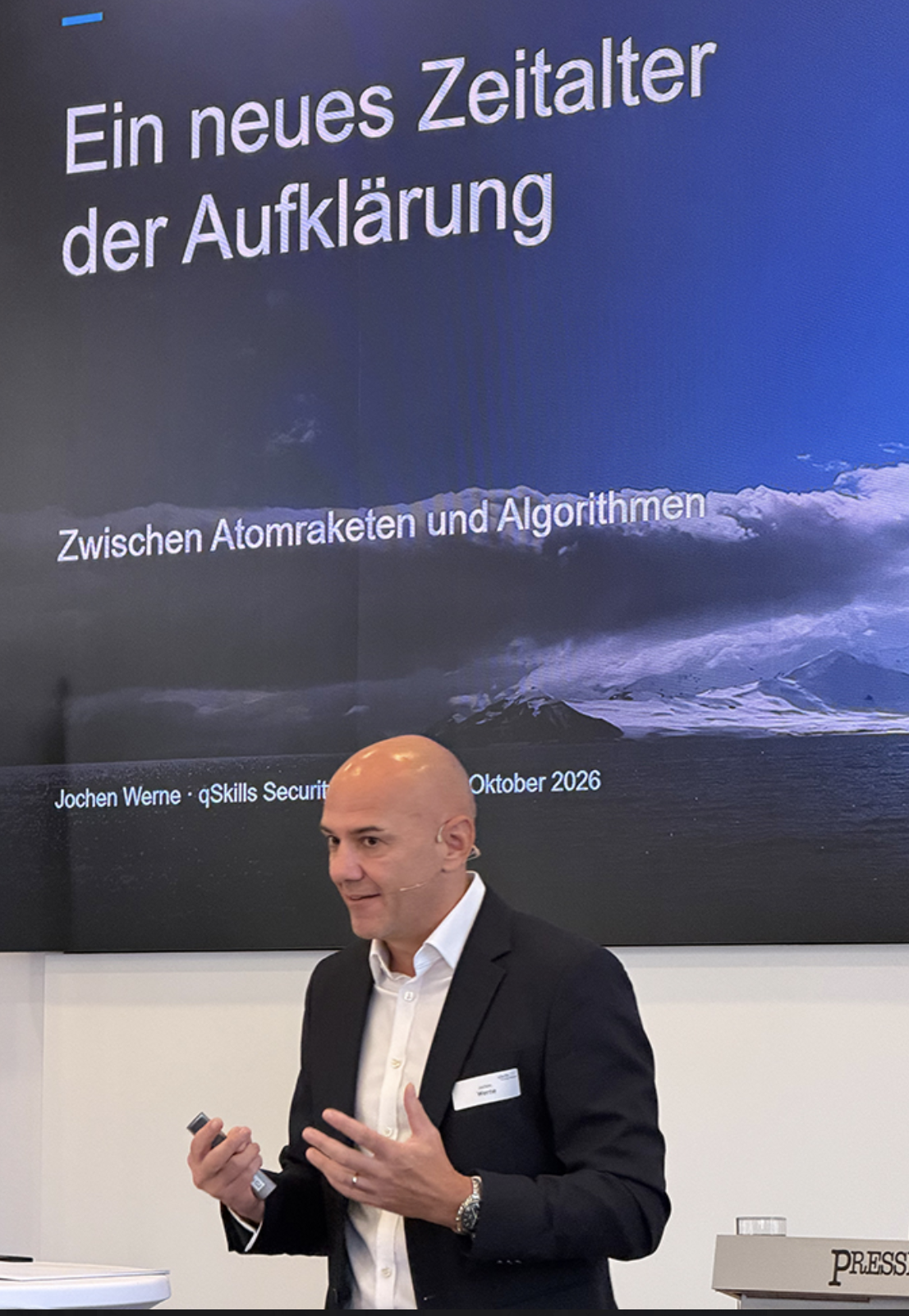 Jochen Werne · qSkills Security Summit · October 2026. “Ein neues Zeitalter der Aufklärung — Zwischen Atomraketen und Algorithmen.” Photograph supplied by Jochen Werne. Source: qSkills Security Summit 2026 gallery.
The answer is rarely settled by the invention alone. It emerges through institutions, markets, conflict and the choices people make about dependence and responsibility.
Knowledge travels. Authority moves.
Movable-type printing in Europe widened the circulation of arguments beyond the institutions that had traditionally mediated access to knowledge. The Reformation showed how print could carry challenges to established authority. It also showed that greater access to ideas did not mean agreement about truth.
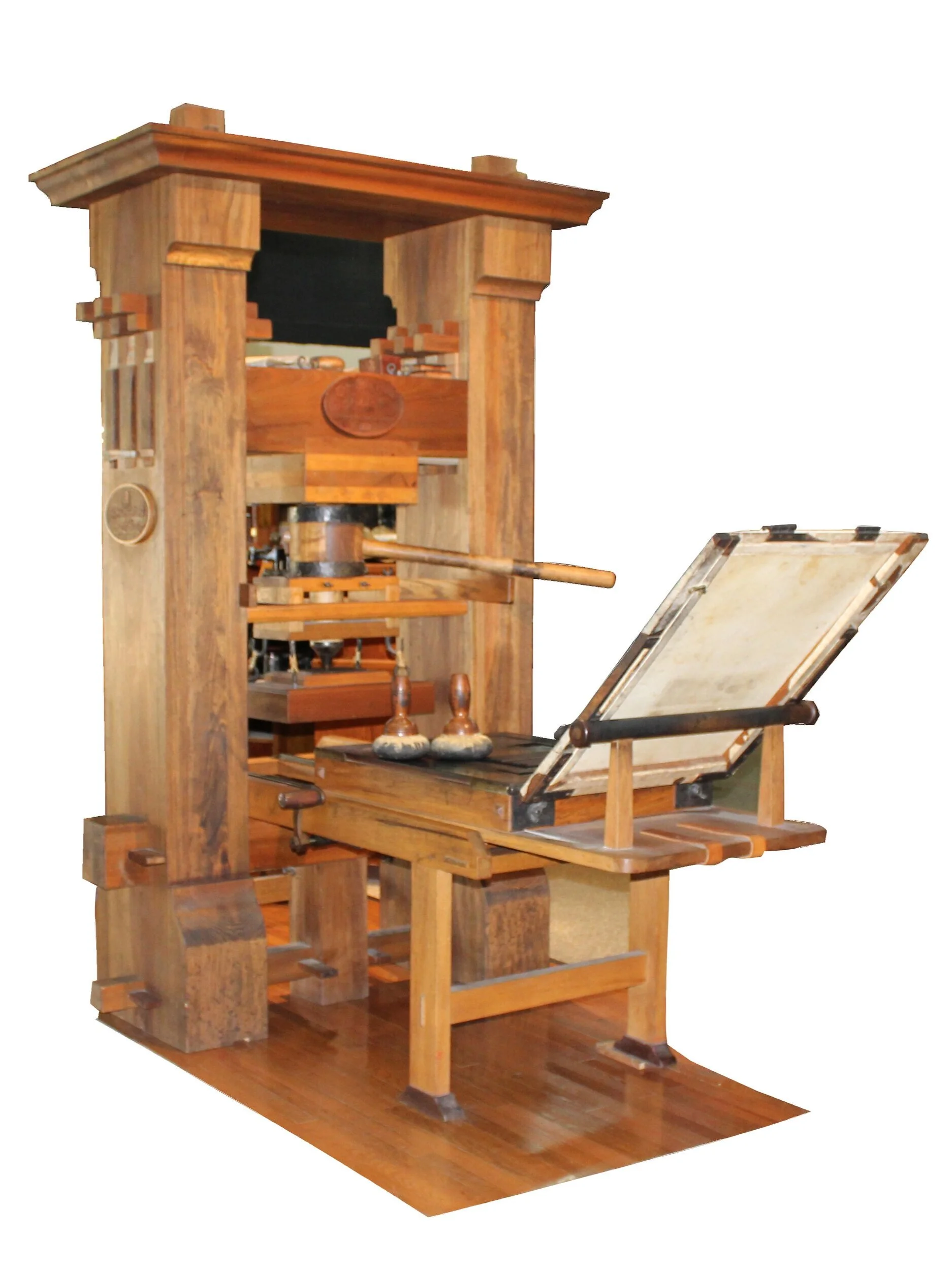 A replica of Gutenberg’s press: the physical machinery behind a transformation in the circulation of ideas. Source & rights
“There are two periods when technology shifted the advantage to distributed social networks.”— Niall Ferguson, Observer interview, 2018
Ferguson draws a parallel between the age of print and our networked world. I find that comparison useful because it directs attention to relationships: who can reach whom, whose authority can be challenged, and which new intermediaries take the place of the old.
It also raises a difficult question for AI. Capabilities may become widely accessible while control over their underlying infrastructure remains concentrated. Democratising use and distributing power are different achievements.
EXPLORE THE ARGUMENT
A conceptual comparison, not a quantitative model or a claim that these technologies are equivalent. Select a period to reveal its relationships.
Capability demands restraint
Nuclear weapons changed the stakes of conflict. Their destructive capacity forced states to consider how the pursuit of their own security could deepen the insecurity of others. Deterrence, diplomacy and verification became central responses to that dilemma. The Nuclear Non-Proliferation Treaty remains an expression of the attempt to combine security, peaceful cooperation and restraint.
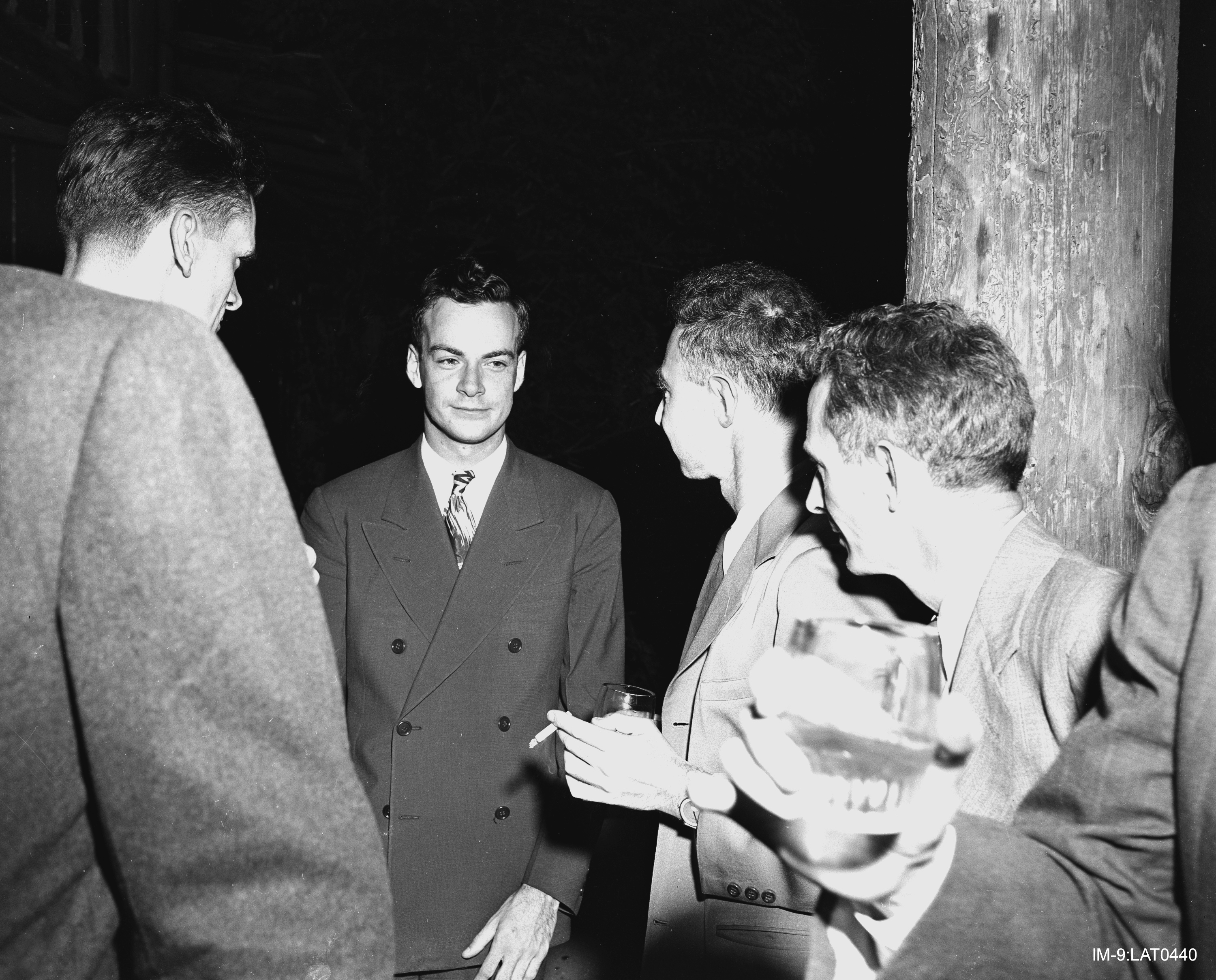 Feynman (centre) and Oppenheimer (to his right) at Los Alamos, 1943–1946. Scientific capability was being assembled inside a state-directed project. Source & rights
“public policy could itself become the captive of a scientific-technological elite.”— Dwight D. Eisenhower, Farewell Address, 1961 (excerpt)
Eisenhower’s warning concerned the relationship between expertise and public power. Applied to AI, it prompts a question: how can society benefit from specialised knowledge while retaining the capacity to scrutinise those who possess it?
The analogy has limits. AI is a general-purpose technology distributed through everyday products, not a weapon with a single defining destructive purpose. Historical comparison should clarify the choices before us, rather than imply that history will repeat itself.
The five layers behind artificial intelligence
Jensen Huang describes an industrial framework with five layers: energy, chips, infrastructure, models and applications. I use his framework here to examine dependence and choice. It is a useful industry perspective, rather than a universal technical standard. NVIDIA, 10 March 2026.
A seemingly weightless digital answer rests on a physical system. Affordable energy matters, alongside reliable electricity, grid connections and infrastructure that can actually be delivered. The International Energy Agency documents this interdependence between AI and energy.
Chips form the second layer: processors and the semiconductor supply chains behind them. NVIDIA is a prominent example. Infrastructure forms a separate third layer: data centres, cooling, networking and the systems that bring computing capacity into operation.
Models form the fourth layer. Frontier models—including those developed by OpenAI and Anthropic, the company behind Claude—make powerful capabilities available to organisations unable to build them independently.
Applications form the fifth layer: the services and workflows through which organisations put models to work. Each layer can widen opportunity and create dependence. Access to a model does not mean control over its price, availability or future development. Cheap electricity alone does not create an AI industry. The strategic question is how these capabilities work together, and where the ability to choose is constrained.
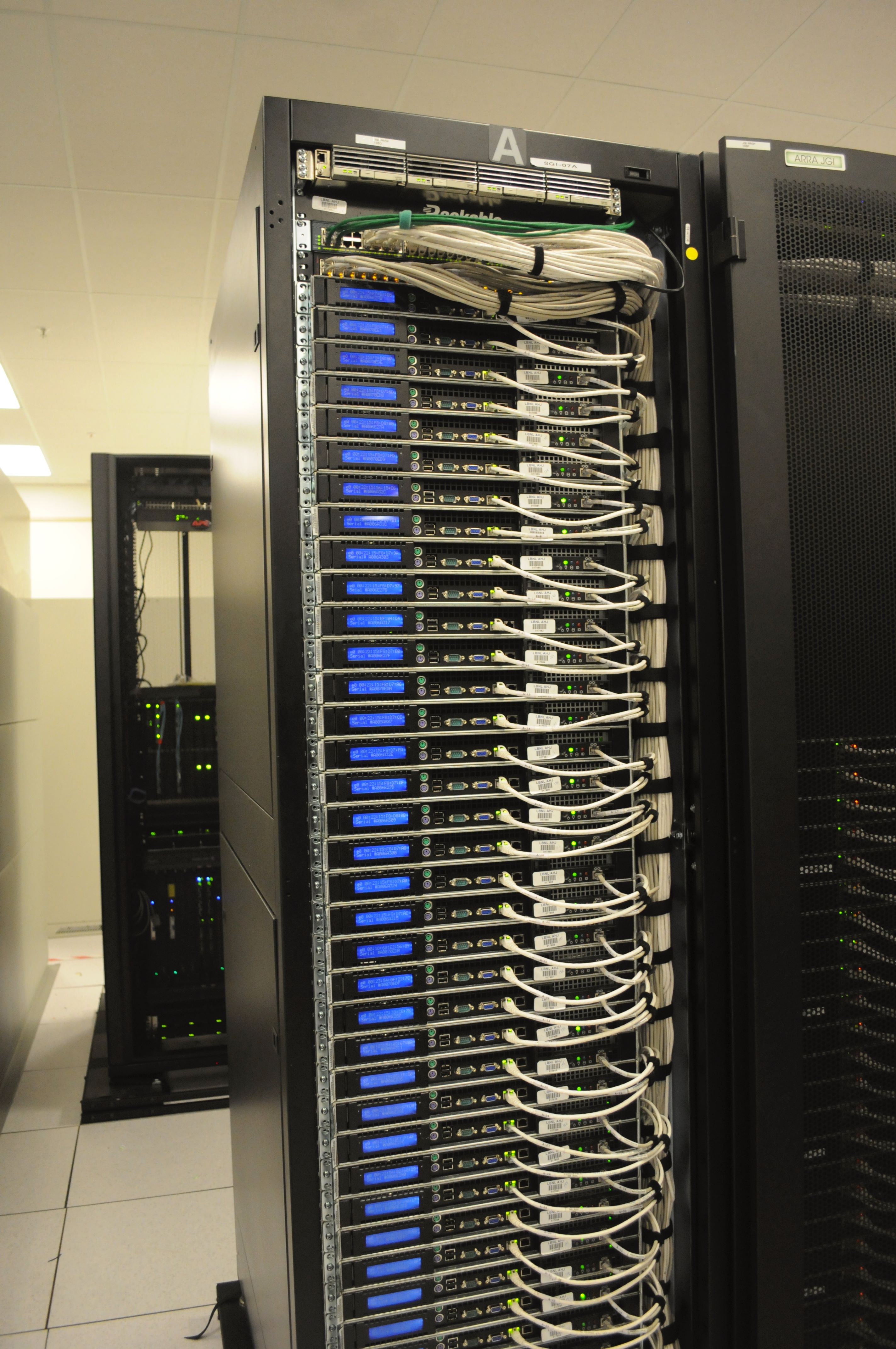 The physical foundations of digital capability: a research-computing rack at NERSC, 2011. Historical infrastructure, not a contemporary frontier-AI installation. Source & rights
WHERE DOES YOUR ORGANISATION DEPEND ON OTHERS?
Energy · reliable supply and grid access
Chips · processors and semiconductor supply chains
Infrastructure · data centres, cooling and networking
Models · capability, access and provider choices
Applications · services and organisational workflows
Five connected layers. Select the button to examine the leadership question at each.
Adapted from Jensen Huang’s five-layer framework (NVIDIA, March 2026). Leadership questions are Jochen Werne’s editorial interpretation. Data, governance and security cut across the layers.
Three numbers behind the redistribution of power
The tension between access and control becomes clearer when we put numbers beside it.
More than 280-fold: Stanford’s 2025 AI Index reports that the inference cost of a system performing at GPT-3.5 level fell by more than this factor between November 2022 and October 2024. This is a comparison at a specified performance level, not a claim that every AI task became equally cheap. It illustrates how quickly the price of access can fall. Source: Stanford HAI.
Nearly 90%: industry produced almost nine in ten notable AI models in 2024, according to the same report. This measures the origin of notable models, not market share. My reading is that wider access to AI can coexist with a concentration of the resources needed to develop it. Source: Stanford HAI.
415 to 945 terawatt-hours: the IEA’s 2025 base case projected global data-centre electricity demand rising from approximately 415 TWh in 2024 to around 945 TWh in 2030. These figures cover all data centres, not AI alone, and the 2030 figure is a scenario-based projection. The implication is physical: falling costs per answer do not remove the need for power systems capable of serving expanding demand. Source: IEA, Energy and AI (2025).
The decisions leaders cannot delegate
Inside a business, this becomes concrete. Which customer problem deserves investment? What level of error is acceptable? Can a supplier be replaced without disrupting operations? Who can challenge an automated recommendation?
“For a successful technology, reality must take precedence over public relations, for nature cannot be fooled.”— Richard Feynman, Challenger investigation, 1986; original report, Appendix F
For AI adoption, that principle demands evidence: measured outcomes, scrutiny of failures and a clear route for intervention. Fluent output and impressive demonstrations cannot substitute for knowing whether a system serves the people affected by it.
Competition can accelerate discovery. Cooperation enables shared research, infrastructure and safeguards. Leadership requires judgment about where rivalry produces value and where it creates risks no participant can manage alone.
For Europe, I believe the ambition should be the capacity to make meaningful choices: to build capabilities, contribute knowledge, select partners and retain the competence to question what we use.
Quantum: the next redistribution?
My hypothesis is that quantum computing could become another major source of strategic advantage. I would not claim that it must be the next technological revolution, or assign it a dependable arrival date. Its significance will depend on whether useful capabilities can be delivered reliably and at scale—and on who can access them.
The security implications already require decisions. NIST released its first three post-quantum cryptography standards in August 2024 and published transition guidance in October 2026. These preparations address the threat that sufficiently capable future quantum computers could defeat widely used public-key cryptography; they do not mean that today’s machines can already do so. NIST standards; transition guidance.
The potential redistribution of power runs in two directions: advantage for those who develop useful quantum capabilities, and resilience for those who protect their information and systems in time. For leaders, the immediate task is to understand where their organisations depend on vulnerable cryptography and how suppliers will support migration.
A technology can change strategic behaviour before it reaches maturity. The anticipation of quantum capability is already changing security standards. That is an early signal of how future power can influence present decisions.
The courage to think for ourselves becomes more demanding when answers arrive instantly. We must still examine evidence, tolerate disagreement and revise our conclusions.
The future will be shaped by the power we build—and by the judgment we exercise over it.
Watch the argument develop
Jochen Werne · Human. Digital. Culture.
KuppingerCole Analysts · European Identity & Cloud Conference, 2019 · 20:04. An earlier keynote on AI, business and society; not a recording of the 2026 qSkills presentation.
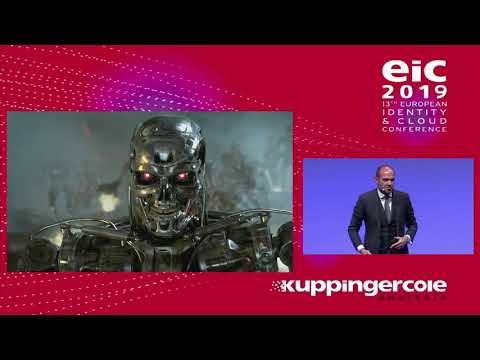
Loading connects to YouTube/Google and shares IP and device data. Cookies and processing outside the EU may occur. Privacy information. Watch directly on YouTube.
Supporting source video: Jensen Huang in conversation with Larry Fink, World Economic Forum, January 2026. Watch the discussion alongside NVIDIA’s account and embedded recording. His industry outlook is a source for the framework, not an endorsement of this article.
Source library
Primary accounts, historical evidence and further reading. Sources checked 27 November 2026.
- Jensen Huang — AI Is a 5-Layer CakeNVIDIA · 10 March 2026 · Primary source for the five-layer framework; a supplier’s perspective.
- Energy and AIInternational Energy Agency · 2025 · Independent analysis of AI’s energy requirements and electricity systems.
- Networks and Hierarchies: Interview with Niall FergusonObserver · 2018 · Source of the attributed quotation and historical comparison.
- Dwight D. Eisenhower — Farewell AddressUS National Archives · 17 January 1961 · Full transcript; source of the technological-elite quotation.
- Richard Feynman — Personal Observations on Reliability of ShuttleNASA · Rogers Commission report, Volume 2, Appendix F · 1986 · Primary source of the quotation.
- Treaty on the Non-Proliferation of Nuclear Weapons — BackgroundUnited Nations · Treaty objectives and historical context.
- qSkills Security Summit 2026Event organiser · Context for Jochen Werne’s keynote; not a transcript of the talk.
- Printing and the Growth of a Protestant Movement in Germany, 1517–1524Church History · Scholarly study supporting the discussion of print and the Reformation.
- Jensen Huang and Larry Fink at DavosNVIDIA · 21 January 2026 · Supporting video and company account of the discussion.
Additional evidence: Stanford HAI, AI Index 2025 (historical model-development and inference-cost measures); IEA, Energy and AI 2025, executive summary (2024 estimate and 2030 base case); NIST, first three PQC standards, August 2024; NIST, transition guidance, October 2026. The quantum outlook is the author’s hypothesis, not a forecast endorsed by these sources.
Image credits
Summit photograph supplied by Jochen Werne from the qSkills Security Summit 2026 gallery. Video preview: existing website asset; video hosted by YouTube. No external images or players load automatically.
By Jochen Werne · Published 27 November 2026. Quotations are attributed to their sources; they do not imply endorsement.
All Reflections · Impressum · Privacy