Jochen Werne
The summit keynote asks how institutions can retain judgment and authority as they depend on algorithms and shared digital infrastructure.
Writing and conversations on how technology changes decisions, what crews learn at sea and how people work across borders.
260 entries · Original Reflections writing and photographs, alongside later publications, interviews and expedition records. Roles and affiliations reflect the date of each source.
260 entries
Jochen Werne
The summit keynote asks how institutions can retain judgment and authority as they depend on algorithms and shared digital infrastructure.
Editorial coverage
Reporting on the 2026 fraud survey and how organisations are adapting their controls to generative AI.
Jochen Werne
A reflection on how fraud changes when criminals can scale impersonation, and what that means for trust.
Jochen Werne
The original site’s English-language account of the Security Insider contribution, covering risks that cross technical and governance boundaries.
Jochen Werne
Autonomous agents, adaptive malware and new interfaces change what defenders need to watch and who needs authority to intervene.
Jochen Werne
An essay on trustworthy data, human judgment and the ability to challenge automated decisions.
Jochen Werne with Marco Zuberbühler
A conversation on technology, regulation and trust in the context of the 2026 Davos summit.
Jochen Werne with Nils Kreimeier
A conversation about AI-enabled fraud, identity verification and how companies earn digital trust.
Jochen Werne
A mobility case study on a recurring strategic dilemma: data investment needs a use case, while testing a use case needs reliable data.
Jochen Werne
A note on the 2025 Debtor Atlas collaboration and what shared data can show about household over-indebtedness.
Jochen Werne
A byline on AI and changes to risk management, listed in the October issue on pages 25–27.
Jochen Werne
A skipper’s account of how changing weather, incomplete information and crew judgment shape leadership offshore.
Jochen Werne
A reflection on applying machine learning to risk decisions and retaining responsibility for how data is used.
Research coverage
The German release on Forrester research into machine learning in financial decision-making.
Jochen Werne
A reflection on what an industry ranking can reveal about an organisation and the work still ahead.
Jochen Werne
An original archive note about recognition for an enterprise AI assistant and the use of AI in analytics workflows.
Jochen Werne
Observations from a conversation across policy, banking and technology at the Wirtschaftsrat symposium.
Jochen Werne
A cloud migration case used to ask how companies can judge technology adoption by outcomes.
Jochen Werne
The author’s reflection on the cost of blocking legitimate transactions and creating manual review work.
Jochen Werne
The original site’s note on a discussion about how leaders communicate and what silence can signal.
Jochen Werne
A report from the Wirtschaftstag in Berlin on the policy and business conversations shaping Germany’s economic choices.
Jochen Werne · IT Finanzmagazin editorial credit
An analysis of what false alarms cost customers and operations teams.
Jochen Werne and Jan Düring, with Benjamin Majeron
A discussion about how executives can communicate clearly and what organisations communicate through silence.
Jochen Werne
A byline on why boards need enough AI expertise to challenge proposals and oversee implementation.
Jochen Werne
An encounter with Martina Scherf’s reporting becomes part of the preparations for an offshore expedition to Iceland.
Jochen Werne
A case for treating data literacy as a skill people need to participate in decisions that affect them.
Jochen Werne
The Antarctic Treaty as an example of cooperation across political divides.
Expedition record
The team’s record of the North Atlantic voyage, with the route and expedition context.
Jochen Werne
A contribution to the original Ocean & Passion archive.
Jochen Werne
A later edition of the account of how a message from the House of Lords travelled through a maritime remembrance initiative.
Jochen Werne
A later edition of the expedition account, connecting a voyage in the Andaman Sea with action on marine litter.
Jochen Werne
A later edition of a piece on how scientists and communicators can bring environmental questions to a wider audience.
Jochen Werne
An updated interview with Maurizio Abbati on the relationship between oceans, expeditions and international understanding.
Jochen Werne
A later edition of an analysis linking maritime access and food security.
Jochen Werne with Christian Weigand
A later listing of the German-language conversation about offshore sailing, remembrance and diplomacy.
Düsseldorf, 17 September 2024 – The latest research report, ‘Experian | Forrester Research 2024 – Strategies for Growth’, examines the perspectives of decision-makers in four key areas: strategic priorities, data and analytics, technology and risk. Conducted by Forrester Consulting, the study surveyed 1,320 C-level and director-level executives in the financial services and telecommunications industries in ten countries in the EMEA and APAC regions. 147 participants were from Germany. The report clearly shows how executives are particularly using generative AI (GenAI) to consolidate data sets and thus improve their decision-making models. At the same time, customer experience is coming to the fore in order to be optimally prepared for a future characterised by difficult economic conditions, technological disruption and changing customer expectations.
The executives surveyed on behalf of Experian identified technological changes as one of the most important external factors that will influence their business in the next two years, and emphasised the race for AI supremacy to improve business efficiency and reduce costs. Accordingly, 68 per cent of all respondents believe that a competitive advantage in the future will be achieved by those companies that make best use of AI. In Germany, the majority (84 per cent) of the technology managers surveyed by Forrester for Experian are already exploring GenAI use cases with the aim of implementing them within the next year, putting them well ahead of the EMEA/APAC average (73 per cent).

62 per cent of German executives believe that GenAI will significantly improve risk assessment. The analysis of alternative data sources using generative AI is considered the most important use case by respondents in the EMEA/APAC region (62 per cent). German executives also rank it among the top use cases – but only after the use case of generating synthetic data to improve the accuracy of forecasting models, which is just ahead at 65 per cent. German companies are focusing their efforts on GenAI's ability to extract valuable insights from non-traditional data sets, as well as its ability to create better decision models in the future and to obtain a more comprehensive picture of customers.
Access to a centralised, cloud-based platform for data, analytics, and software was identified by respondents as a key factor in improving their risk strategies. Almost half (48 per cent) of German respondents expect to experience higher credit defaults due to missed repayments over the next 12 months. At the same time, 54 per cent of the Germans surveyed by Forrester said that their companies had tightened their lending criteria over the past year. Many German risk managers (41 per cent) also stated that their top risk priority was to improve their ability to identify financially vulnerable customers. Today's ability to gain a more holistic view of borrowers has improved significantly through better linking of data sources, model development tools, deployment and decision software. This also leads to an acceleration of the data-to-insight-to-action process by using AI. Ultimately, this leads to better customer relationships and fairer lending practices.
Data and analytics decision-makers prioritise the relocation of data silos to a single platform that combines data sets and analytical methods, as this better supports AI/ML capabilities and enables them to put models into operation in weeks rather than months. Currently, more than half (55 per cent) of respondents in the EMEA/APAC region believe that the development and deployment of AI/ML models takes too long. In Germany, this applies to 41 per cent. 54 per cent of Germans surveyed also said that they are currently updating their models more frequently than ever to adapt to changes in consumer credit behaviour.
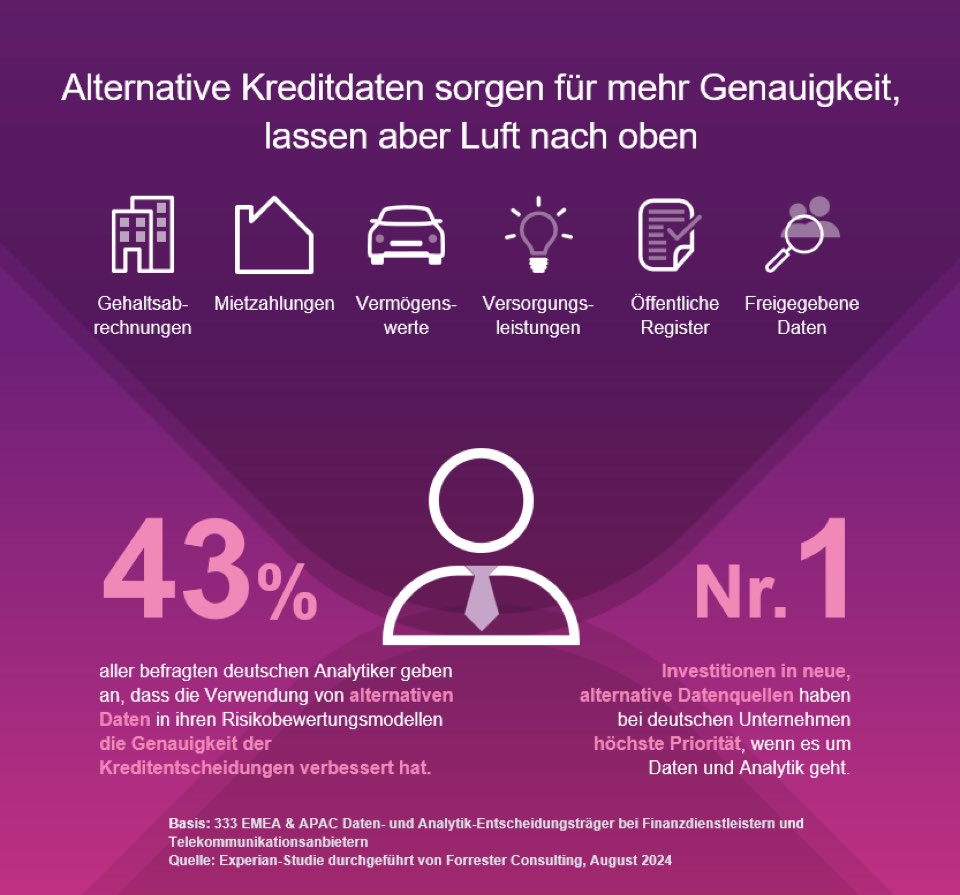
Alternative data and advanced analytics are crucial to helping companies make more accurate credit decisions, especially as consumer behaviour changes and external economic factors continue to influence them. However, the lack of alternative data sources in this context was cited by all respondents as a significant challenge that limits the success of both analytics programmes and model development. In a cloud platform, the advanced capabilities of AI can be used to efficiently process and analyse alternative or complex unstructured data sets and to gain valuable insights that were previously inaccessible. It is precisely in this context that the implementation of these new technologies should improve the accuracy of predictive models and ultimately enable the creation of more comprehensive analytics and credit risk profiles.

‘This year's study particularly highlights the importance of two critical competitive factors: firstly, to be at the forefront of the race for AI superiority in order to gain a competitive advantage in one's own sector. In this AI race, Germany stands out in particular: with 84 per cent of the German companies surveyed, an overwhelming majority is already exploring their options for using AI tools with the aim of implementing them in the next twelve months,’ emphasises Jochen Werne, CEO of Experian DACH. ’Secondly, we see a strong investment focus in the area of analytics tools and data infrastructures. Many companies are still struggling with the high time and effort involved in developing and deploying suitable models. Here, the survey results suggest that companies are increasingly using cloud-based services to better integrate data, analytics and software solutions.‘
’It is encouraging to see that the majority of the executives Forrester surveyed for us are optimistic about the next year and are planning major investments in technology. At the same time, we still face major macroeconomic challenges, with the financial burden on customers being highlighted as a significant concern. AI and ML tools offer an important opportunity to improve the accuracy of credit scoring for new and existing customers, thus protecting vulnerable customers by proactively addressing their needs,’ says Malin Holmberg, CEO EMEA & APAC at Experian.
To find out more, download the full report here.
About the study
The ‘Experian | Forrester Research 2024 - Strategies for Growth’ is based on a survey of 1,320 executives in the financial services and telecommunications industries in ten countries, including Australia, Denmark, Germany, India, Italy, New Zealand, Norway, South Africa, Spain and the Netherlands. The research was conducted by Forrester Consulting in August 2020 to understand the collective and individual priorities and challenges at the most senior levels of decision-makers.

About Experian
Experian is a global information and technology company that opens up new opportunities for people and businesses worldwide. With our unique combination of data, analytics and software, we have established ourselves as one of the leading service providers for risk, fraud and identity management in the DACH region.
Experian enables individuals to access financial services such as loans, insurance, mobile phone contracts and online shopping. We help companies of all sizes and in all industries to make smarter decisions, issue credit more responsibly and protect themselves and their customers from identity fraud and crime.
We invest in our talented employees and in new, advanced technologies to harness the power of data and drive innovation. We employ 22,500 people in 32 countries and are a FTSE 100 company listed on the London Stock Exchange (EXPN). Our head office is in Dublin, Ireland.
Further information can be found at www.experian.de, www.experian.at, www.experian.ch.
Press contacts:
Experian DACH
Young-In Sun
(Senior Team Lead PR & Communications)
+ 49 211 5066 5126
young-in.sun@experian.com
AxiCom GmbH
Nikolaus Schreck
Agency contact
+ 49 176 15800 908
nikolaus.schreck@axicom.com
19 September 2024. A guest article for Cloud Computing Insider by Jochen Werne

Please find original article written in German and the original source by clicking on this LINK. Translation into English made with DeepL.com. Photo Sources: ChatGPT, CloudComputingInsider, JochenWerne
Imagine a world in which companies can make more accurate predictions and work more efficiently by using cloud-based artificial intelligence. Despite this promising prospect, many companies are hesitant to take this step.
But why is the cloud crucial for the use of scalable AI applications? Many financial service providers and telecommunications companies are looking for ways to improve the accuracy of their credit risk and fraud models by using AI, for example. The cloud plays an important role here.
The efficiency gains offered by AI are based on the fast and secure linking of data from diverse sources. Cloud technology makes it easier to connect data streams and enables different internal teams to work securely with information from different systems. The cloud can also provide the computing power needed to efficiently process and manage the large amounts of data required for AI and machine learning (ML). It offers the flexibility and scalability needed to develop, deploy and operate the software capabilities that ultimately enable the integration of AI into the loan decision process.
According to a survey conducted in autumn 2023 by Experian together with Forrester, which polled almost 900 international executives from the financial services and telecommunications sectors, 79 per cent of decision-makers from EMEA and APAC region are prioritising investment in software-as-a-service (SaaS) and cloud technology – with the same proportion of decision-makers surveyed in Germany prioritising the cloud (79%).

This is hardly surprising given the benefits of the cloud, such as improved security, faster processing speed, lower maintenance costs and elastic flexibility. While these benefits are widely recognised, there are still some challenges to adopting the cloud in the areas of AI and credit risk management. The resulting hurdles are causing some companies to hesitate to benefit from cloud deployment in this area of business as well – but these concerns can be overcome on closer inspection.
Our research shows that cloud adoption is already well established internationally: the executives surveyed report that 71 per cent use external cloud providers for their credit risk software (in Germany: 72 per cent), 69 per cent use them for identity and fraud risk management (in Germany: 65 per cent) and 70 per cent use the cloud for analytics platforms (in Germany: 66 per cent).
The study highlights that, although there are differences, most countries deviate only slightly from the average. According to our research, India has the highest rate of adoption of cloud technology, and Italy the lowest. Both countries are more than ten per cent above or below the average.
The trend is clear: the transition to the cloud seems inevitable. Nevertheless, in most of the countries surveyed, around a quarter of companies have not yet taken the plunge into the cloud in this area of business. What are the reasons for this? Naturally, the adoption of the cloud varies depending on the segment, size and maturity of the company. The traditional view is that fintechs, for example, are far better able to use cloud-based services more broadly and quickly, while larger banks must first overcome the challenges of migrating from legacy systems and decoupling complex infrastructures.
In this context, it is therefore very interesting to note that the main reasons cited by the decision-makers surveyed in our study for why their companies have not (yet) adopted the cloud are relatively evenly distributed across the entire spectrum of company sizes. We took a closer look at the five hurdles identified by decision-makers in the study.
Many companies see security as a limiting factor when it comes to using the cloud for credit risk assessments: 47 per cent (see figure) of the international executives we surveyed believe that cloud-based services are not secure enough to meet all regulatory requirements. However, given the widespread use of the cloud in many business areas, this view apparently reflects a subjective attitude or can be traced back to a very specific business risk in the companies concerned.

However, cloud technology is already an integral part of risk management in corporate IT, similar to other technologies. And in addition to general data protection regulations such as the GDPR, there are therefore well-established regulatory guidelines for the use of the cloud for risk management, particularly in the financial services sector, including the EBA guidelines on outsourcing agreements. Understanding these guidelines is therefore an important step in addressing potential concerns about compliance with regulatory requirements. Reputable cloud services today are designed to meet regulatory requirements. This includes third-party validations and continuous updates to ensure compliance with these regulations. This reduces the effort required to continuously maintain regulatory compliance, as cloud providers adapt their services as needed.
Cloud providers are increasingly expanding their services to offer local facilities and to address concerns about the storage and transmission of sensitive data across territorial borders. For example, Amazon Web Services (AWS) has announced the introduction of a European sovereign cloud. This independent cloud infrastructure is located and operated within the EU, thus solving the data residency issue.
Another regulatory obstacle that has recently come under greater scrutiny concerns on-site audits and inspections. However, some cloud providers have also recognised that such audits are unavoidable in some jurisdictions and now offer eligible customers the option of conducting on-site inspections of their facilities through special audit programmes.
Another reason, also mentioned by 47 per cent of the decision-makers surveyed, is concerns about the level of control when using cloud-based services. However, this concern can also be alleviated by understanding the shared responsibility model in the cloud. The key to this, however, is an informed decision about which cloud services to use. In the shared responsibility model of the cloud, control and responsibility are combined.
For example, companies seeking comprehensive control can opt for an Infrastructure-as-a-Service (IaaS) model that allows them to control both the use of computing resources and the operating system itself. However, this also requires that companies take full responsibility for managing these resources and the software running on them.
By contrast, the choice of a software-as-a-service (SaaS) model reduces control over the computing resources used, but also transfers operational responsibility for them to the cloud provider. Companies must therefore take a close look at the shared responsibility model and understand the respective conditions in order to carry out a suitable cost-benefit analysis and thus select a service model that best suits their needs.
Obstacle number three for 44 percent of the executives surveyed is an organisational policy that requires all software to be operated on the internal infrastructure. Although there may be other reasons for this decision that we cannot go into here, another reason probably plays a role here: some companies may not fully understand the advantages and far-reaching effects that the introduction of cloud-based services could have for their business.
In addition to cost-effective scalability and the ability to scale as needed, the cloud can help companies break down data silos and improve the accuracy of their decision-making. As digital customer experience becomes an increasingly critical competitive advantage, companies that delay the move to the cloud in the credit risk environment risk falling behind in the long term. Already today, competitors who are consistently taking advantage of the cloud and AI are able to significantly improve their customer experience.
The fourth hurdle, cited by 42 per cent of the decision-makers surveyed, concerns concerns about the approach and timeframe for the transition from on-premises services to cloud-based applications. And of course, changes of this magnitude don't happen overnight, but require careful planning and a step-by-step implementation.
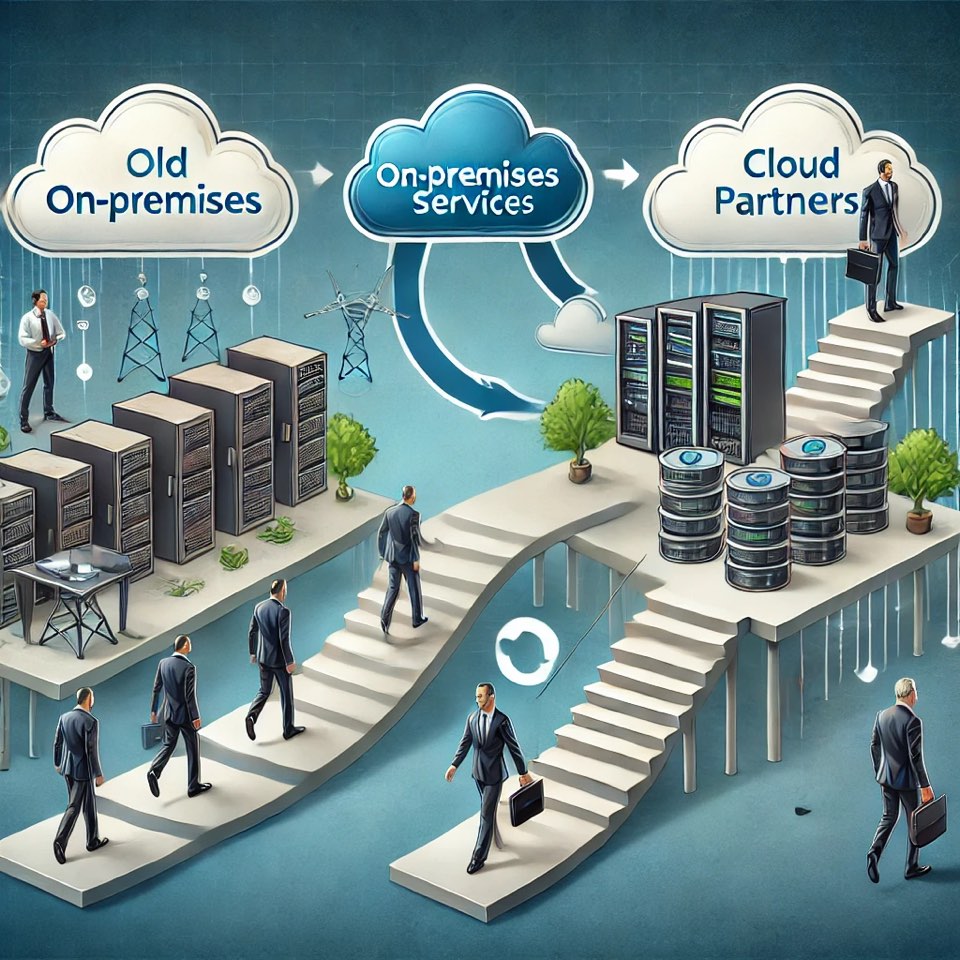
However, the transition to the cloud has recently become much easier – especially when companies work with experienced partners. However, the long-term benefits that companies gain from the cloud make the transition more a matter of ‘when’ rather than ‘if’. If companies are aware of this, they can usually mobilise the necessary resources for such a change.
The fifth reason cited by 40 per cent of the executives surveyed as delaying the adoption of the cloud in their companies relates to security. They believe that cloud-based services are not yet secure enough to fully meet their companies' internal security policies.
This view may have been justified in the past, but it is outdated: the physical and digital security offered by cloud providers today is on a completely different level. Organisations can now access the latest security features from their cloud providers faster and more cost-effectively than ever before.
Many companies that deal with credit risks have made the switch from private to public clouds because of the advanced and often even industry-specific security features that cloud providers offer them today. They rely on the highest standards of data encryption with multiple layers of protection. They also have a choice when using external cloud providers for their credit risk management: they can either manage their security keys themselves or leave this to a specialised third-party provider if they wish.
Many of the concerns that decision-makers still have about using the cloud in this sensitive area of business can be significantly mitigated – especially in view of the great benefits of using the cloud. The reason is simple: cloud providers are judged by their customers precisely on the level of data protection and data security that they offer as standard. This means that companies in data-sensitive business areas can also engage with the cloud with confidence.
* The author Jochen Werne is CEO of Experian DACH. He was named one of the 50 most influential Germans in the Tyto PR Ranking 2020. A member of Chatham House and a former navigator in the German Navy, he is a passionate advocate of international diplomacy and has founded several NGOs. His efforts have been recognised by top international publications and earned him awards for promoting global understanding and environmental awareness.
It was an absolute pleasure to be interviewed by Felicia Shakiba for her podcast. Felicia’s exceptional friendliness, profound competence, and visionary approach made the entire experience both enriching and enjoyable. Her illustrious career, spanning nearly two decades and impacting over 130,000 employees, speaks volumes about her dedication and expertise in people strategy. As the Founder and Podcast Host of CPO PLAYBOOK Consultancy and a respected figure on the Advisory Board for Y-Combinator company Extern, Felicia’s insights are both enlightening and inspiring.

Felicia’s ability to explore complex ideas and empower organizations to become sustainable, balanced, and high-performing powerhouses is truly remarkable. Her background, which includes leadership roles in multinational giants like WPP and a solid educational foundation from Stanford Graduate School of Business, underpins her deep understanding of organizational dynamics. Her quote, “I love exploring ideas, empowering organizations to become sustainable, balanced, high-performing powerhouses,” perfectly encapsulates her passion and vision.
I am honored to share my insights on leading transformation and cultural integration and I hope our discussion offers valuable lessons for those navigating similar challenges.
FIND THE FULL EPISODE OF THE CPO PLAYBOOK PODCAST HERE
Interview Highlights summarised by the podcast host
Jochen Werne's journey began in the Navy at 19. Coming from a small village in southern Germany, he ventured into the world, embracing the Navy's promise: "Join the Navy, see the world." This disciplined, structured environment taught him invaluable lessons. As a navigator, he learned to plan and adapt, often without relying on instruments. These experiences ingrained a sense of discipline, precision, and adaptability—skills that proved essential in his business career.
Navigating the seas on a sail training ship, Jochen faced the formidable forces of nature, fostering a deep respect for teamwork and resilience. These formative years shaped his leadership style, emphasizing perseverance, precision, and the ability to thrive in challenging environments.
Jochen Werne joined Experian in August 2023, amidst the ongoing integration process triggered by Experian’s acquisition of several companies from Arvato Bertelsmann in March 2020. This integration involved approximately 300 employees across multiple companies. However, the timing coincided with the onset of the COVID-19 pandemic, presenting unique challenges.
The pandemic necessitated remote integration, a daunting task without face-to-face interactions. Despite these obstacles, Experian aimed to establish a substantial footprint in the DACH region. The goal was to replicate the success of Experian's well-known services in the United States and other regions, bringing similar capabilities to Germany.
Amidst all these rapid changes, Werne’s immediate focus was on creating success together with his new team. Trust, as he emphasizes, is built through actions, not just words. His approach involved clear communication and delivering on promises. This fostered trust and confidence among the team.
The integration process required a shift in mindset, particularly during the pandemic when physical presence was limited. Jochen's leadership emphasized creating a supportive environment where employees felt valued and motivated. By setting clear goals and achieving tangible results, he instilled a sense of trust and commitment.
The integration involved several key changes:
1. Awareness and Communication: Creating awareness of the new organizational culture and continuously communicating the changes were crucial. Jochen emphasized the importance of understanding the local culture and adapting the global strategy to fit the local context.
2. Mindset Shift: A significant challenge was shifting the mindset of employees. Jochen highlighted the need to change how the market was approached and how Experian was perceived. Building brand awareness and demonstrating the advantages of being part of a global group was essential.
3. Security and IT Infrastructure: Integrating IT systems and ensuring data security were vital. While this required additional effort, Jochen stressed the importance of convincing employees about the benefits of these changes for the overall security and efficiency of the organization.
Jochen's leadership focused on aligning the diverse cultural backgrounds within the organization. Experian's global presence and the local roots of the acquired companies required a delicate balance. Jochen aimed to leverage the strengths of both, fostering a culture of innovation and collaboration.
He recognized that while Experian's international rules and standards were essential, understanding and respecting the local culture were equally important. By combining the best of both worlds, Experian could thrive in the DACH region.
Jochen Werne's experience underscores the significance of cultural integration in successful mergers and acquisitions.
His approach, rooted in discipline, adaptability, and trust-building, has been instrumental in navigating the complexities of integration. The journey is ongoing, but the foundation of trust, communication, and a unified vision positions Experian for continued success in the DACH region.
In conclusion, Jochen Werne's insights highlight the importance of understanding and respecting cultural differences, clear communication, and building trust through actions. His leadership journey, influenced by his Navy experience, provides valuable lessons for anyone navigating the challenges of business transformation and cultural integration.
A Perspective by Jochen Werne
In today’s interconnected world, the concept of social responsibility is more crucial than ever. Social responsibility refers to the ethical framework which suggests that individuals and organizations must act for the benefit of society at large. This concept extends beyond mere philanthropy; it encompasses ethical behavior, sustainable practices, and proactive engagement in addressing societal challenges.
As someone deeply involved in various social and corporate initiatives, I have seen firsthand the transformative power of social responsibility. My journey, both personal and professional, has been driven by the conviction that we all have a role to play in creating a better world. This belief has guided my engagements and is a cornerstone of my work at Experian, a company that exemplifies corporate responsibility on a global scale.
Throughout my life, I have participated in numerous initiatives that underscore the importance of giving back to society. Whether it’s organizing events supporting international understanding, promoting educational programs for underprivileged children or participating in environmental conservation efforts, my experiences have shown me the profound impact that dedicated individuals can make.
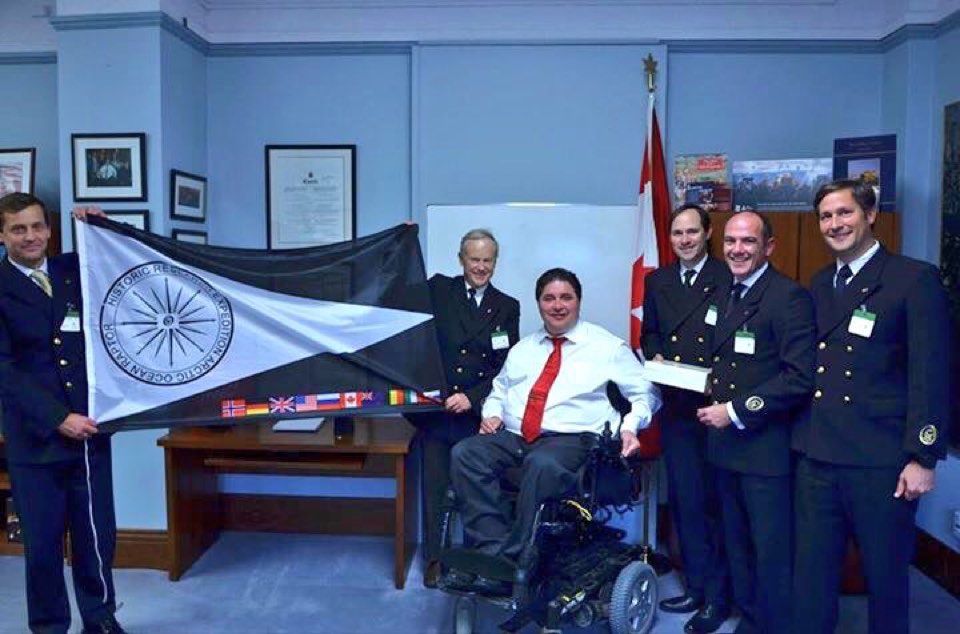
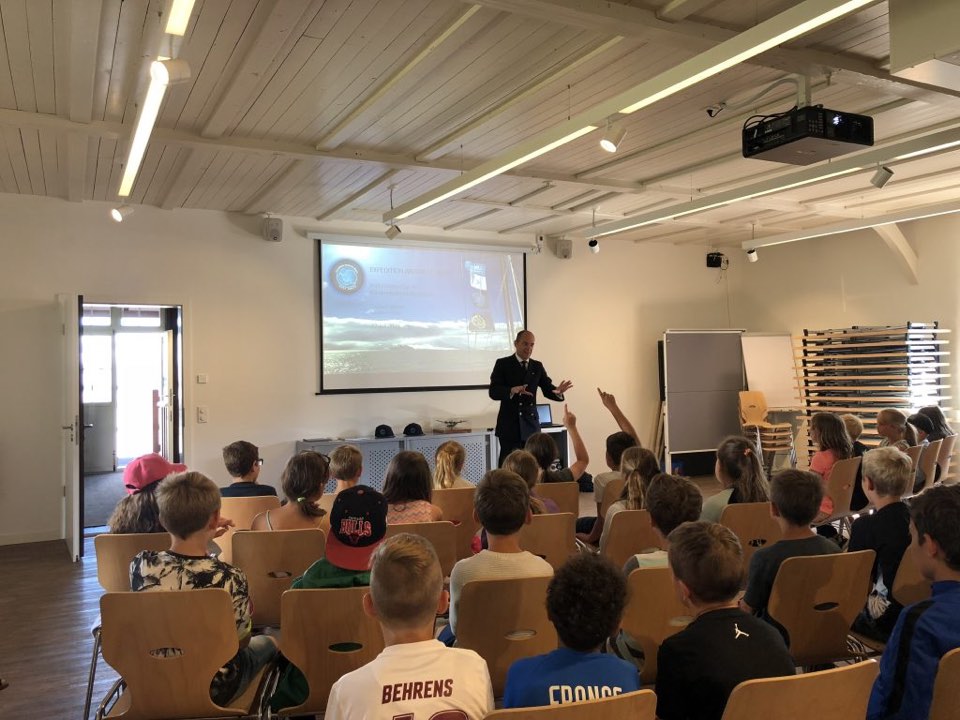
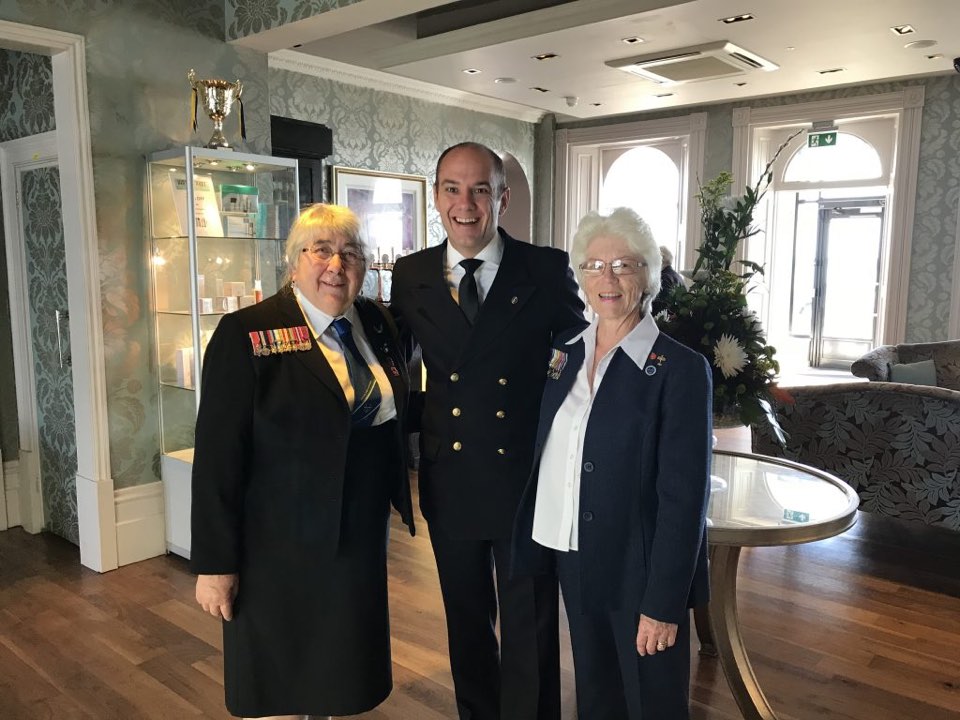
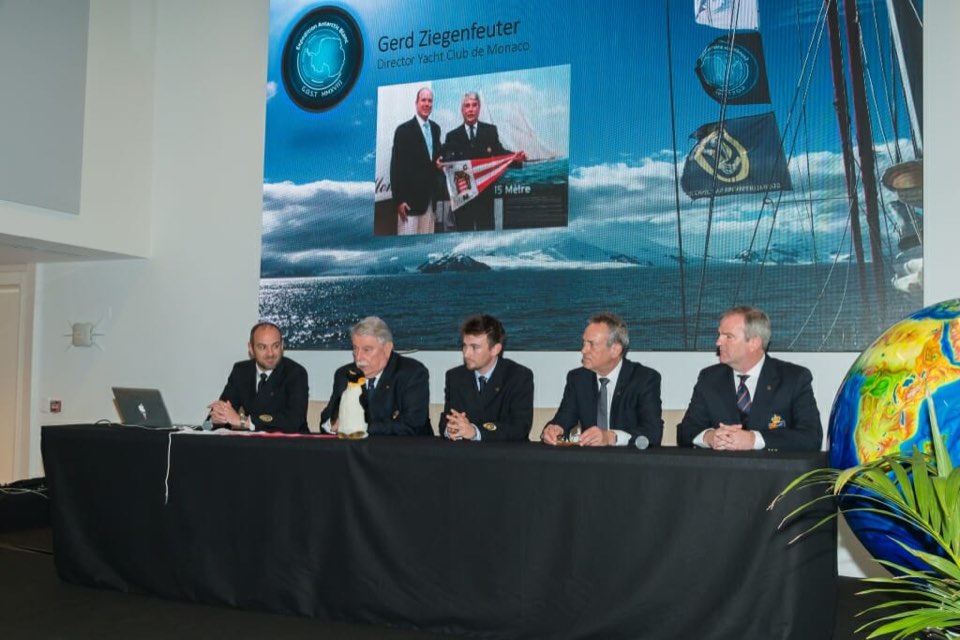
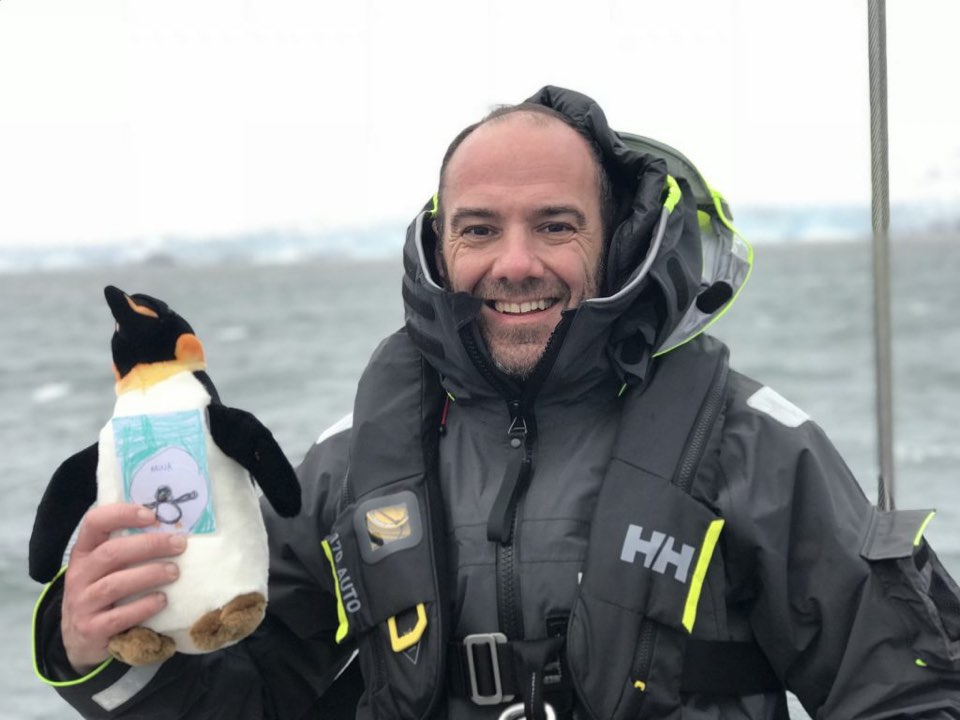
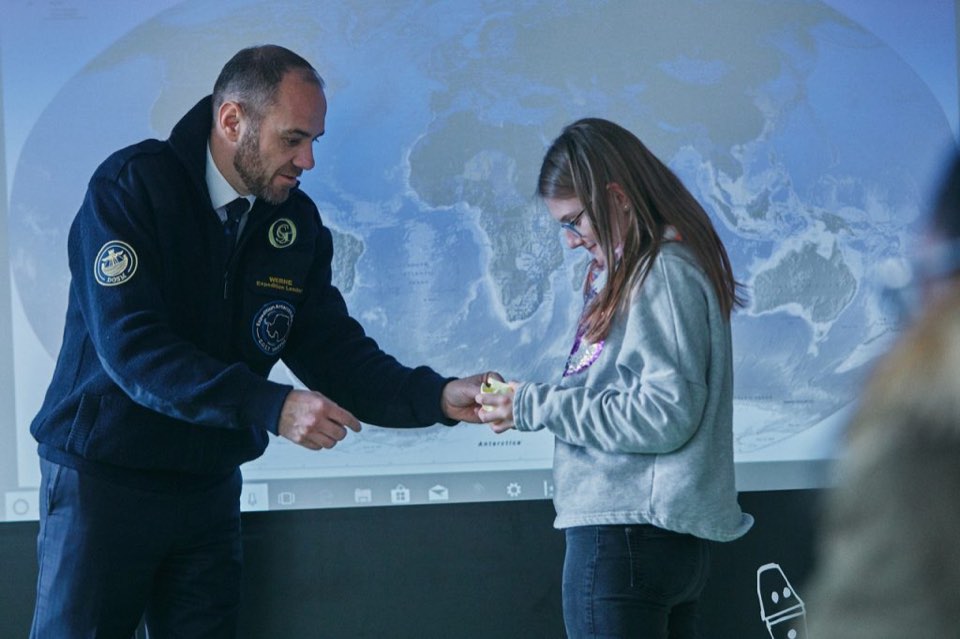

One of the most rewarding aspects of my role at Experian is witnessing the company’s commitment to social responsibility. Experian’s global engagements are a testament to the positive change that corporate entities can drive. From financial literacy programs that empower individuals with essential skills to environmental sustainability projects that help preserve our planet, Experian’s initiatives align perfectly with the principles I hold dear.
Experian’s dedication to creating opportunities and fostering a better future is evident in its various global initiatives. The company’s efforts span a wide range of fields, including education, financial literacy, and environmental sustainability.
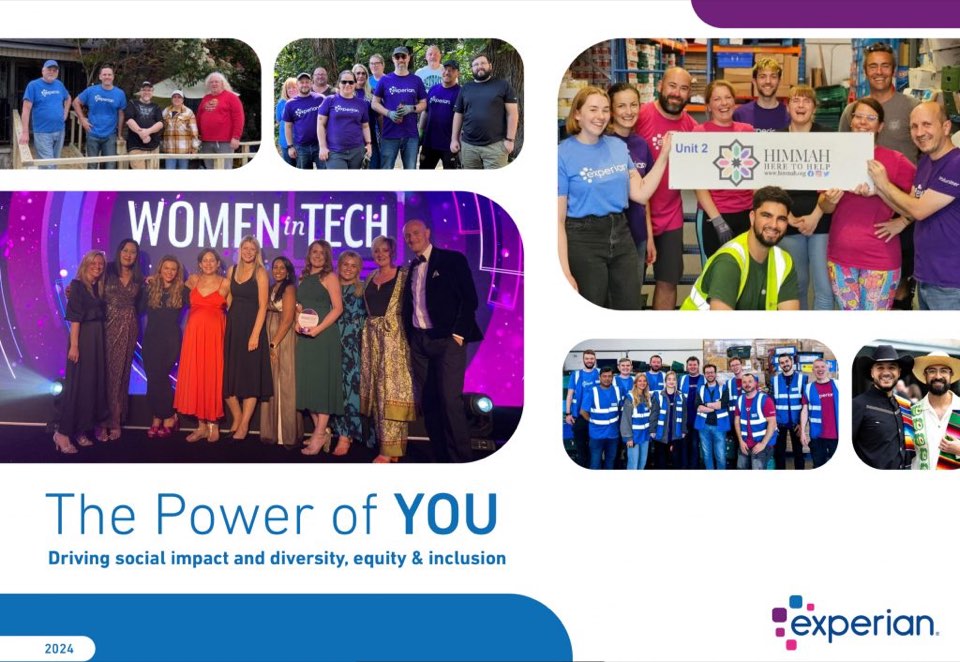
For instance, Experian’s financial education programs are designed to help individuals and communities understand and manage their finances better. By providing resources and training on financial literacy, Experian empowers people to make informed decisions, ultimately leading to improved economic stability and personal well-being.
Moreover, Experian’s commitment to environmental sustainability is reflected in its numerous green initiatives. From reducing carbon footprints to promoting sustainable business practices, the company is actively contributing to the fight against climate change.
Closer to home, Experian DACH has made significant strides in supporting local communities. One of our recent initiatives involved donating dozens notebooks to the ObU Neofit Rilski School in Bulgaria. This school is dedicated to providing equal access to high-quality education and inclusion for nearly 200 children. By enabling access to modern technology, we hope to enhance their educational opportunities and contribute to their future success.
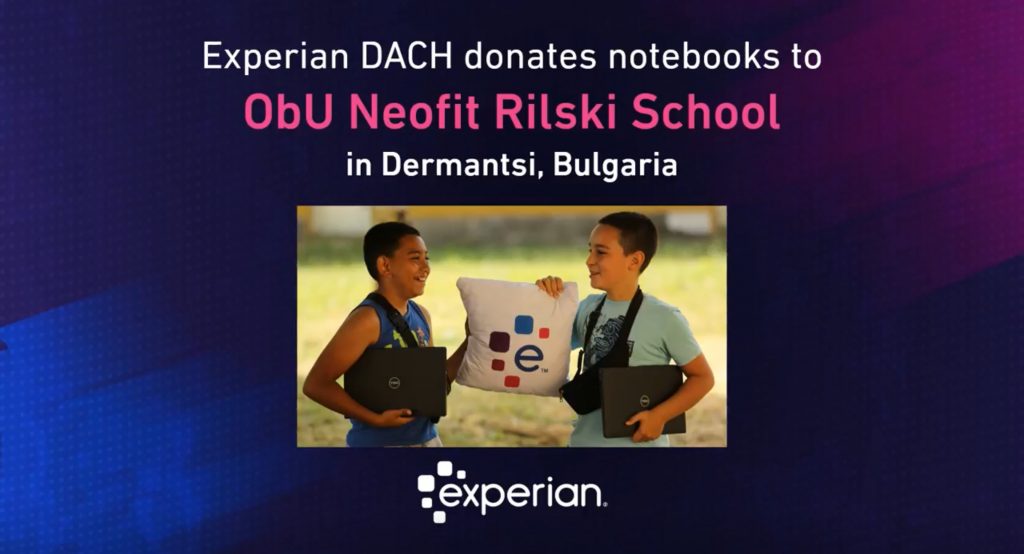
“We thank Experian and all the people involved in this generous donation. You are making a difference and that is what matters!” said teacher Daniel Simeonov, reflecting the heartfelt gratitude of the school community.

In addition to supporting education, Experian DACH employees are engaged in various fields, from firefighting to childcare. These diverse contributions highlight the multifaceted approach our team takes towards making a positive impact. Our commitment to education, in particular, is driven by the belief that it is a fundamental pillar for societal progress. Ensuring that children have access to the tools and resources they need to succeed is essential for building a brighter future.

Education is the foundation upon which societies build their future. It is through education that individuals gain the knowledge and skills necessary to navigate the complexities of the modern world. At Experian, we recognize that fostering education goes hand in hand with promoting data literacy and financial literacy.
In today’s data-driven society, understanding data is crucial. Data literacy equips individuals with the ability to interpret and use data effectively, enabling them to make informed decisions in both their personal and professional lives. Similarly, financial literacy is vital for empowering people to manage their finances, plan for the future, and achieve financial independence.
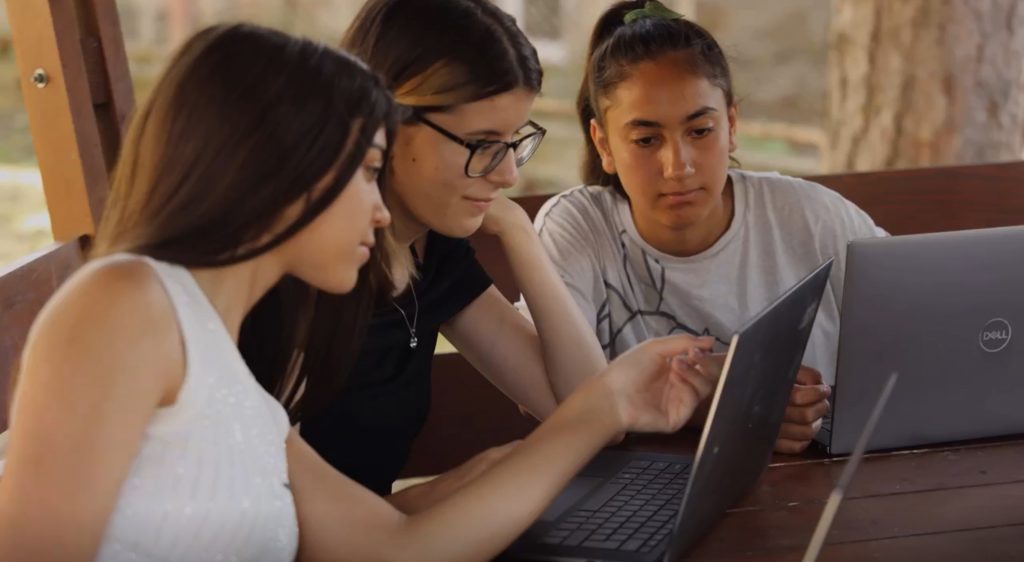
By investing in these areas, we at Experian are not just contributing to individual empowerment but also to the overall advancement of society. Our goal is to create a ripple effect that leads to more informed, capable, and resilient communities.
Social responsibility is not just a buzzword; it is a call to action for individuals and organizations alike. At Experian, we take this call seriously, striving to make a positive impact through our global and local initiatives. As we continue to support education, data literacy, and financial literacy, we are proud to contribute to a more equitable and prosperous world.
I am proud to be part of a company that values social responsibility as deeply as I do. Together, we can make a difference, one initiative at a time, and help build a better future for all.
Join the Global Offshore Sailing Team (GOST) aboard the Black Sea Dragon on an enlightening voyage exploring the critical role of maritime routes in global food security. This remarkable expedition has successfully accomplished its goals, shedding light on the essential nature of these oceanic highways in facilitating the transport of crucial foodstuffs, linking continents, and supporting millions who face the daily threat of hunger.
Throughout the journey, the crew encountered and overcame numerous challenges, including the harrowing Suez Canal blockage. Such events starkly reveal the fragile interconnectedness of our global food system and the dire consequences of disruptions in these vital sea routes. The expedition underscores the pressing need for resilient infrastructure and international cooperation to maintain the flow of goods essential for global food security.
A key focus of the expedition was the dependence of African nations on imported wheat. Many African countries rely heavily on imports to meet their food needs due to local production shortfalls caused by various factors such as climatic conditions, political instability, and economic challenges. The Black Sea Dragon’s journey highlighted how disruptions in maritime transport can exacerbate food insecurity, leading to shortages and spikes in food prices.
Maritime transport is the backbone of global food security, enabling the efficient and cost-effective movement of large quantities of food commodities from surplus regions to areas facing deficits. For example, wheat, a staple food for over 35% of the world’s population, is predominantly transported by sea. Any disruptions in these routes can have severe repercussions, particularly for nations heavily reliant on imports.
A vivid example of the impact of blocked sea routes on global food security is the Suez Canal blockage caused by the container ship Ever Given in March 2021. The blockage, which lasted six days, delayed the passage of over 300 ships, including vessels carrying critical food commodities. This incident highlighted the canal’s crucial role in stabilizing global food prices and availability, underscoring the vulnerability of our food systems to logistical disruptions.
Celebrating its 25th anniversary, the Global Offshore Sailing Team (GOST) leveraged the “Black Sea Dragon” expedition to raise awareness about the importance of open sea routes for food security. “We aim to underscore the significance of uninterrupted sea routes not only for food security but also for fostering international understanding,” stated Jochen Werne, GOST co-founder.
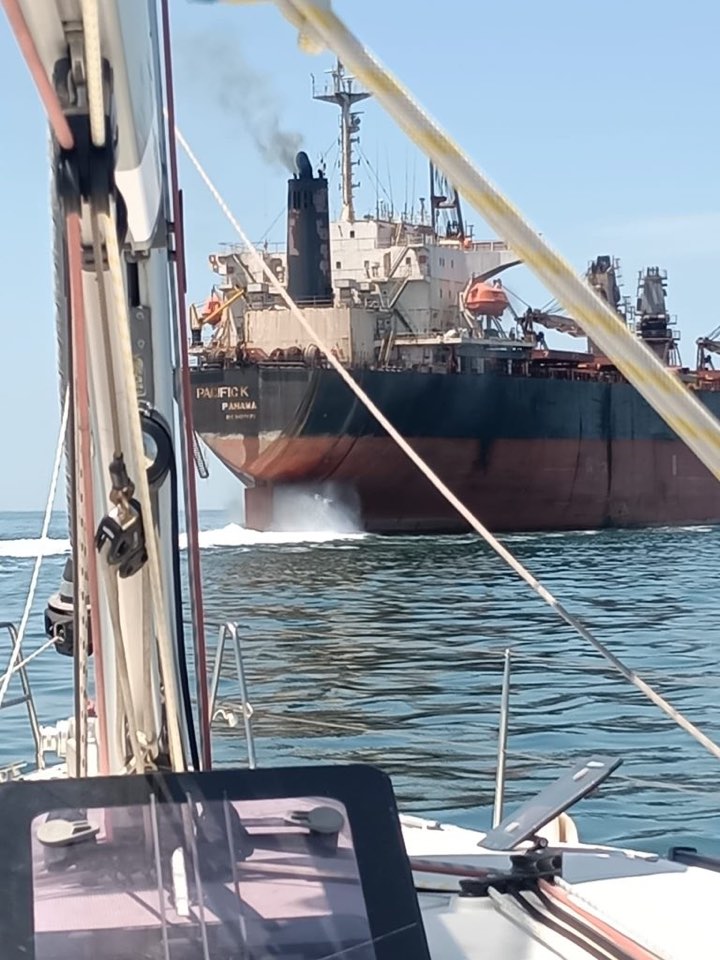
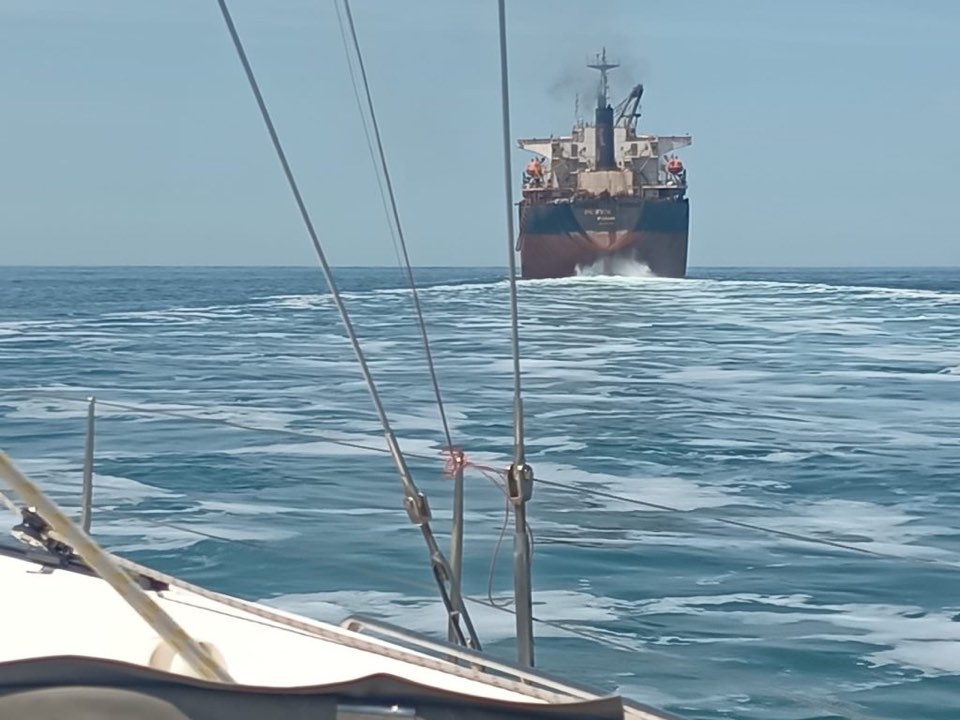
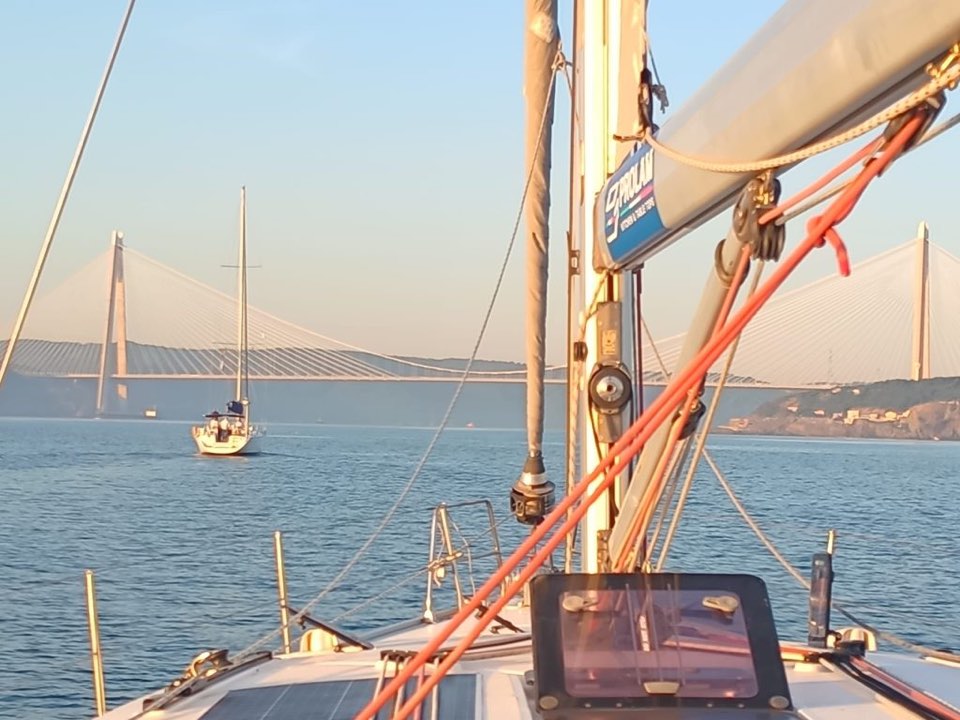
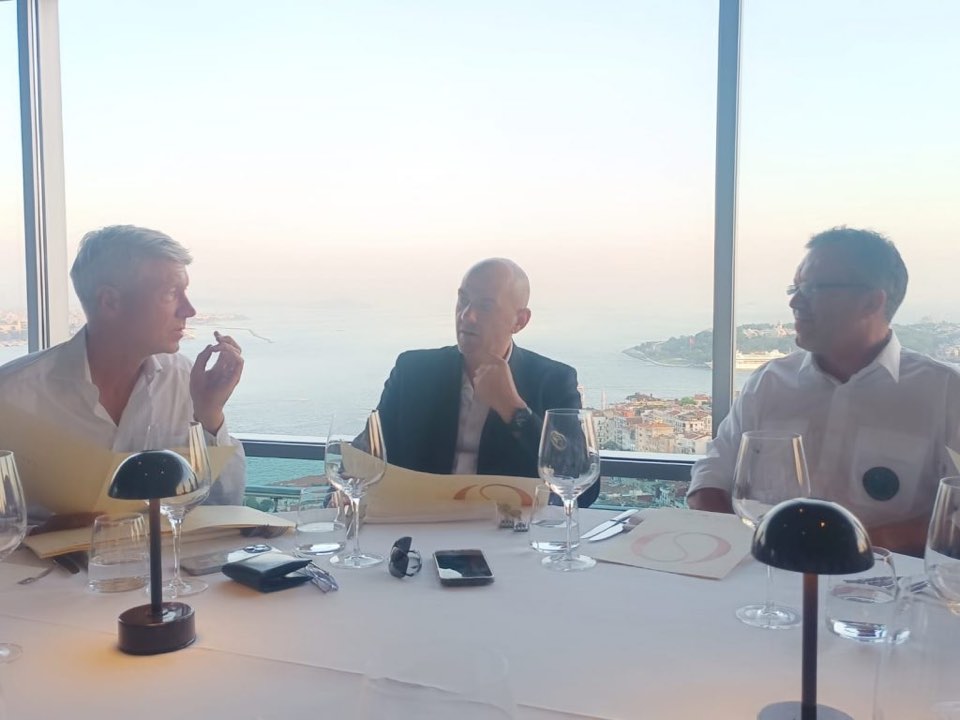
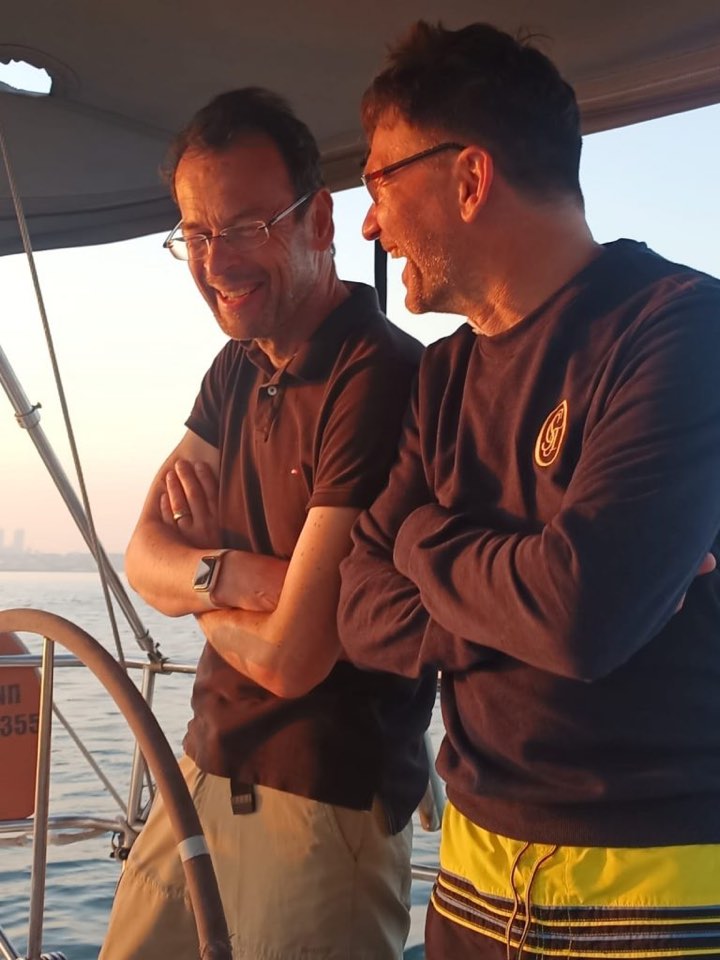
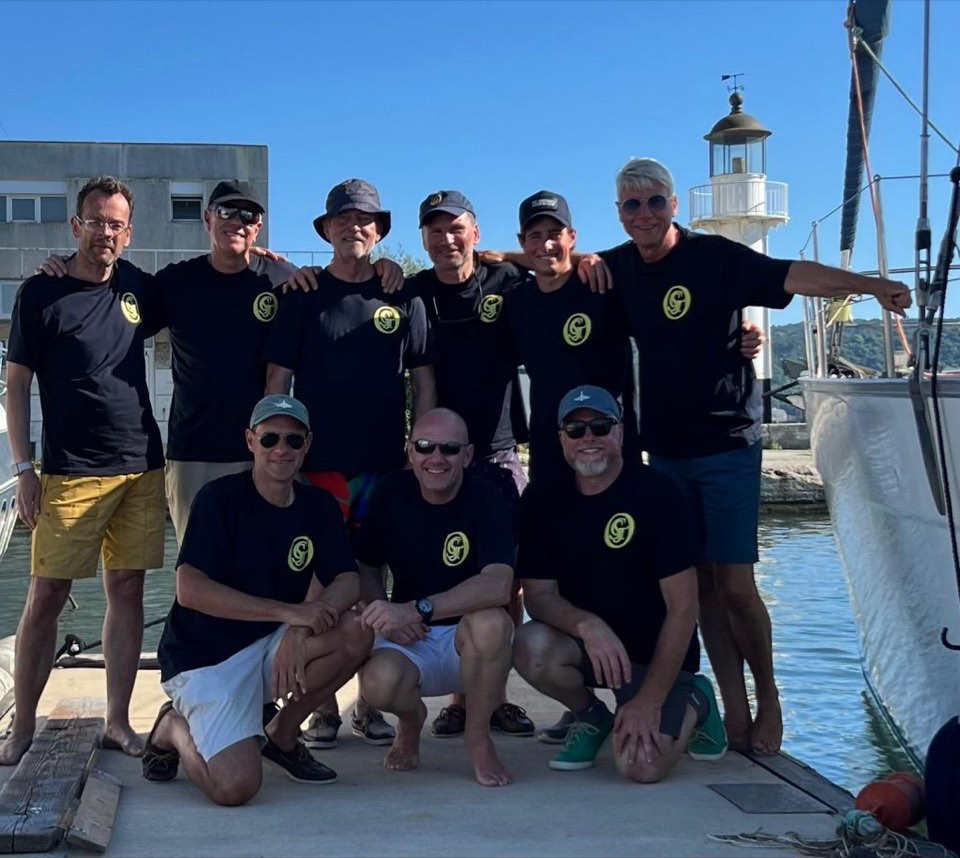

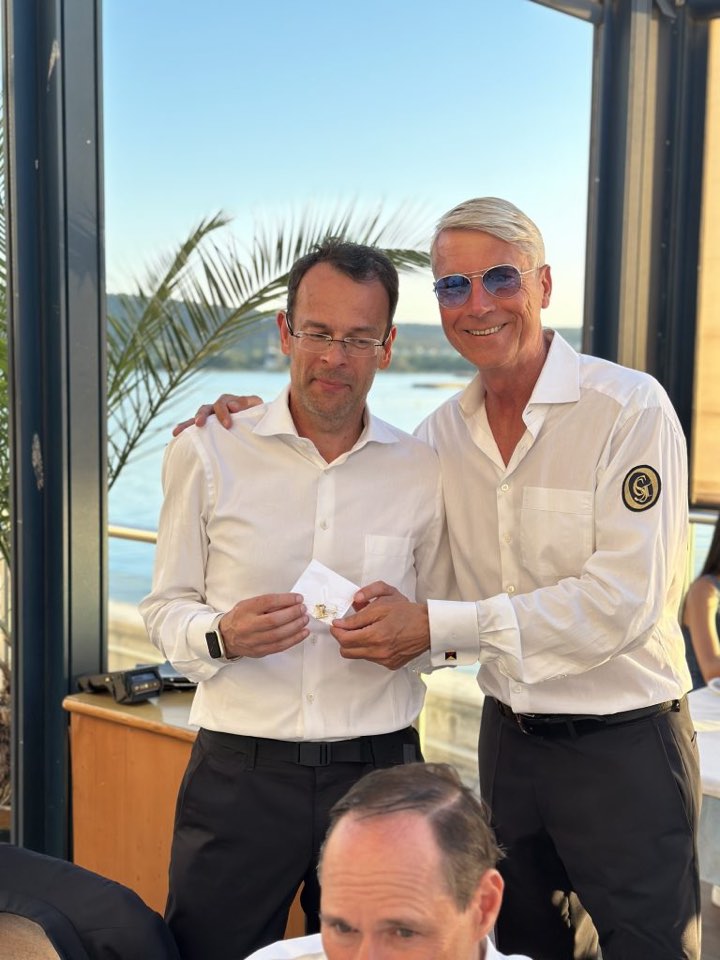
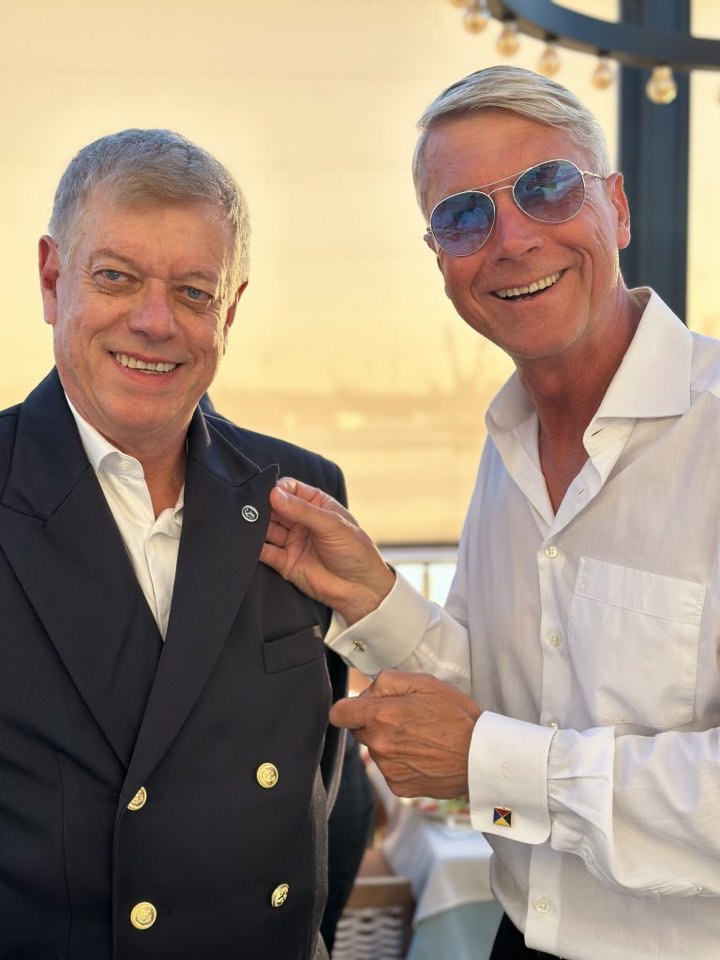
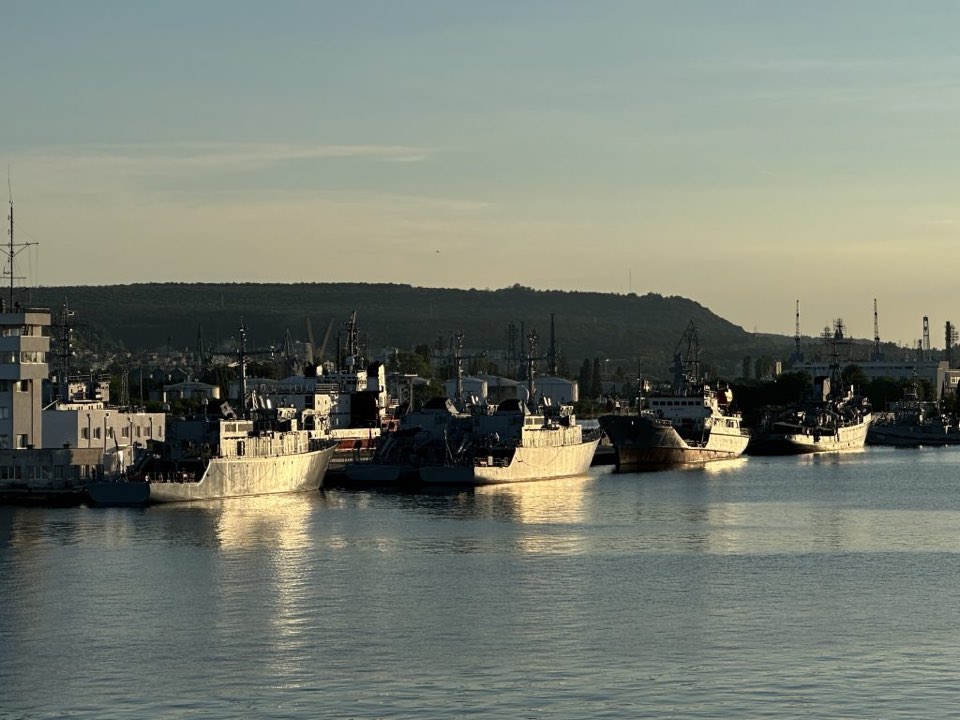
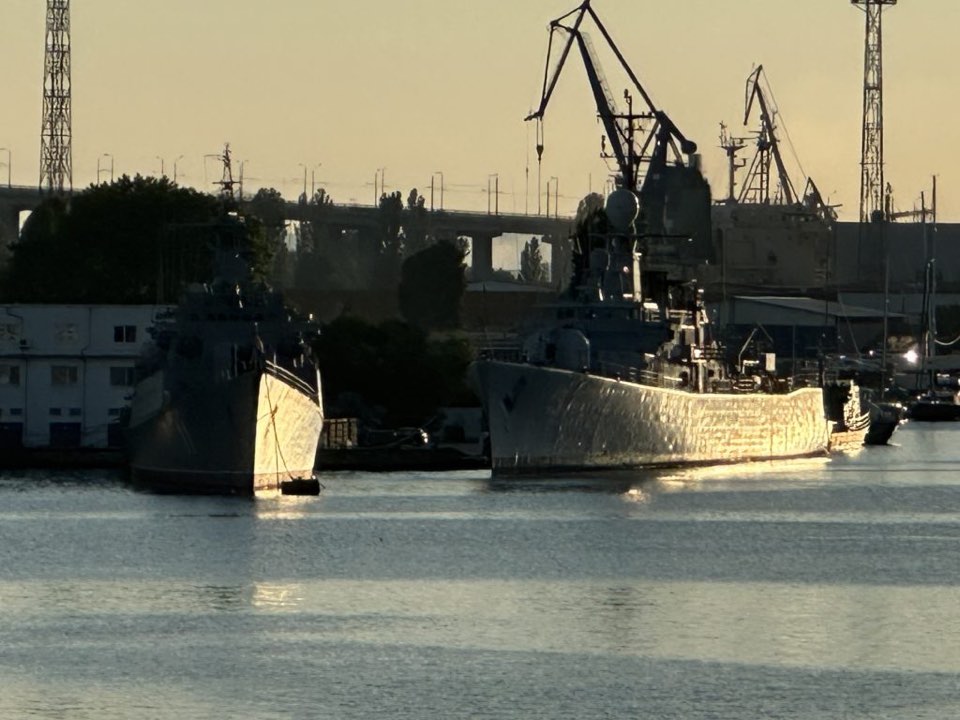
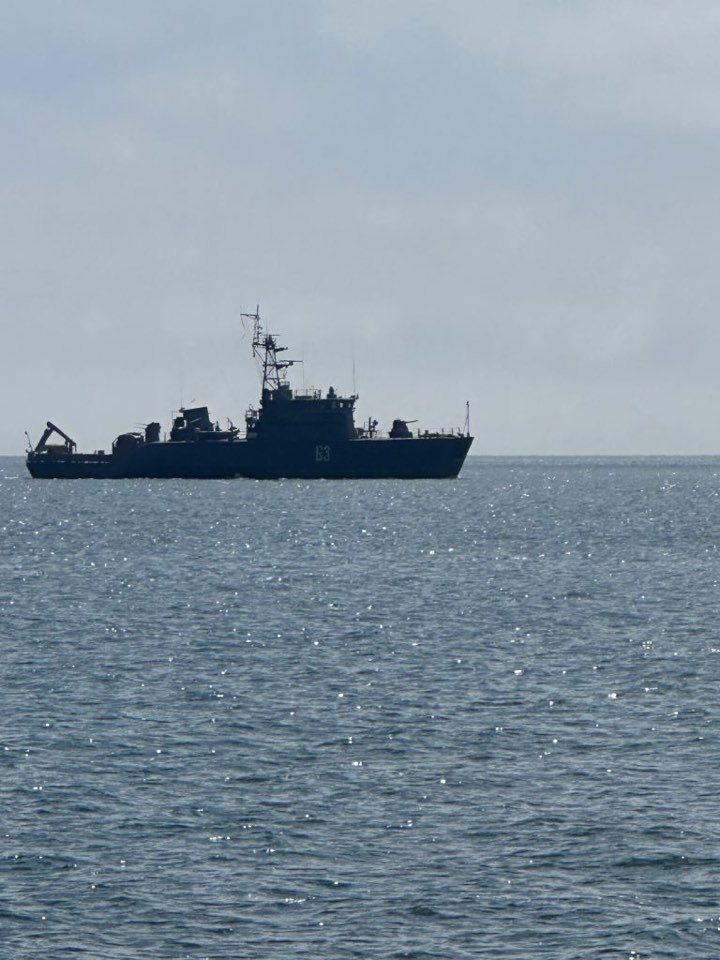


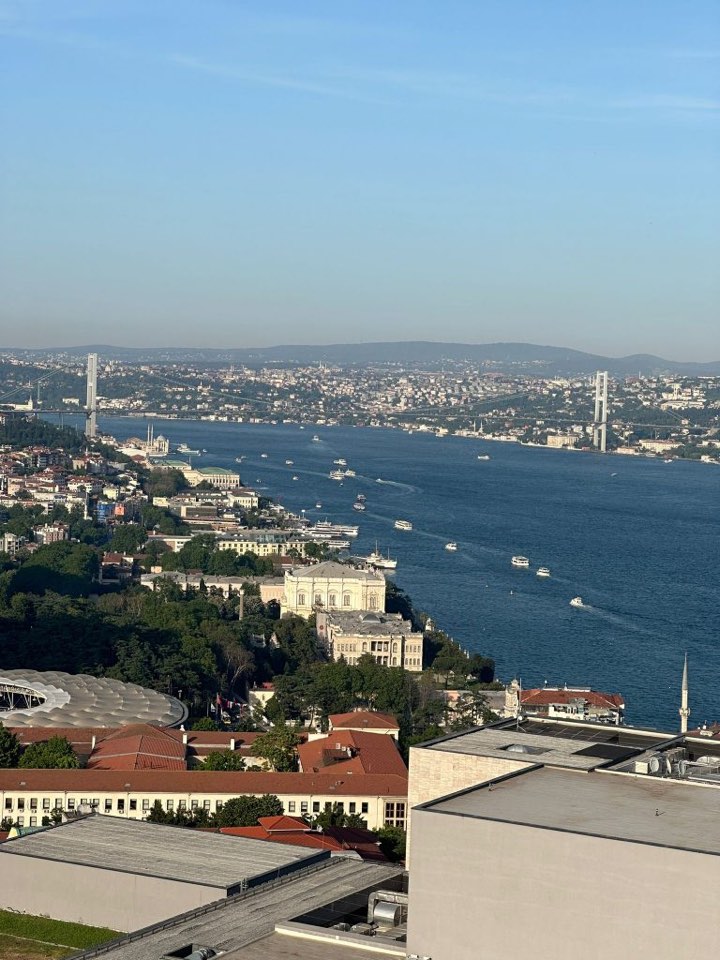
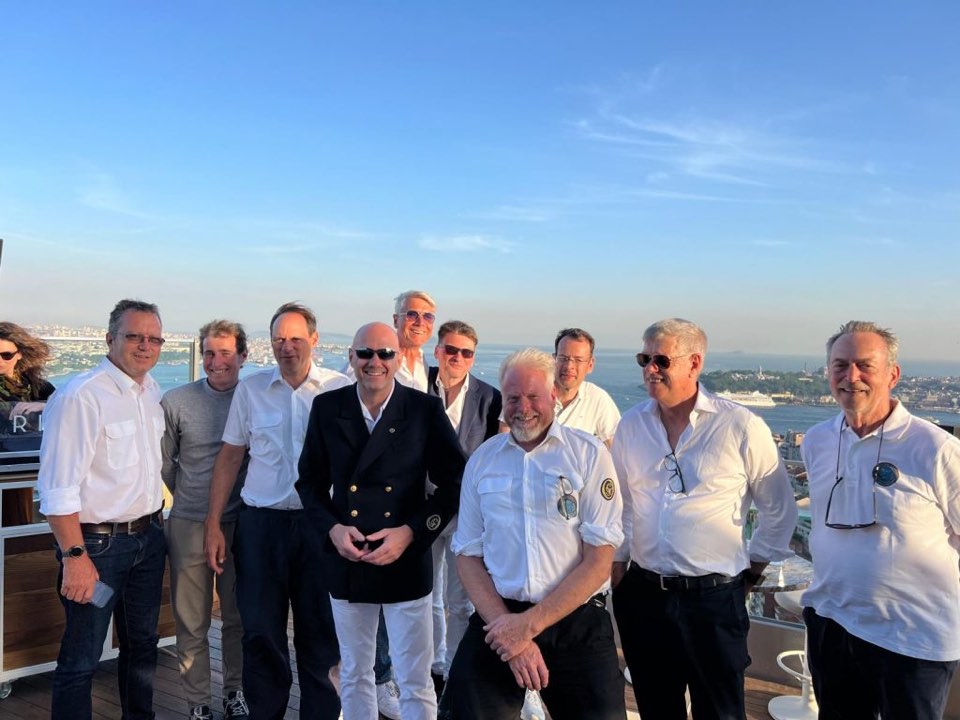
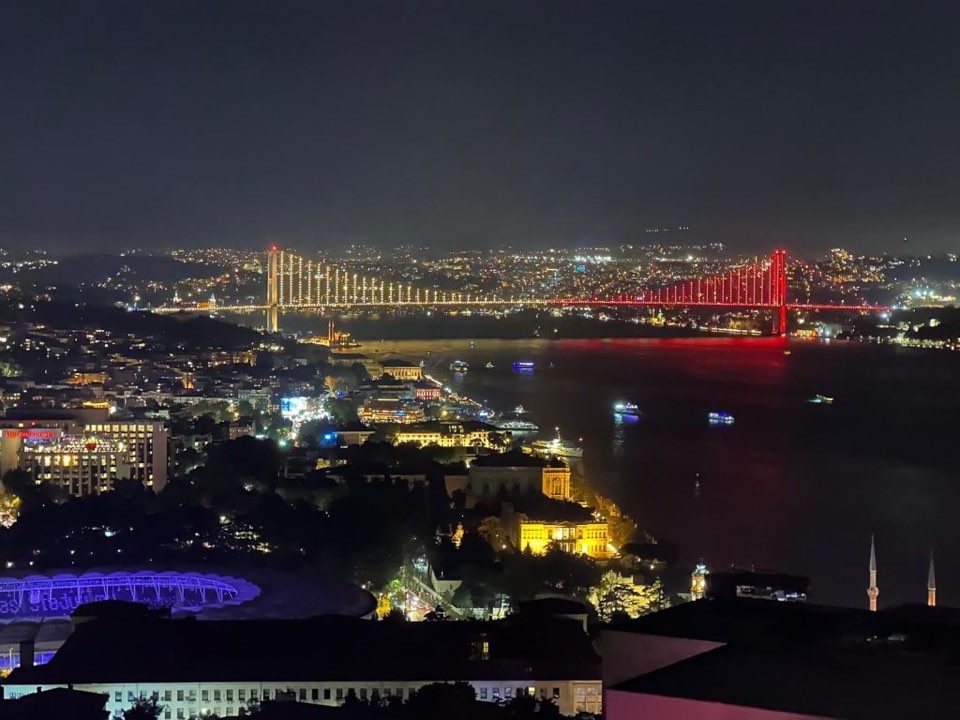


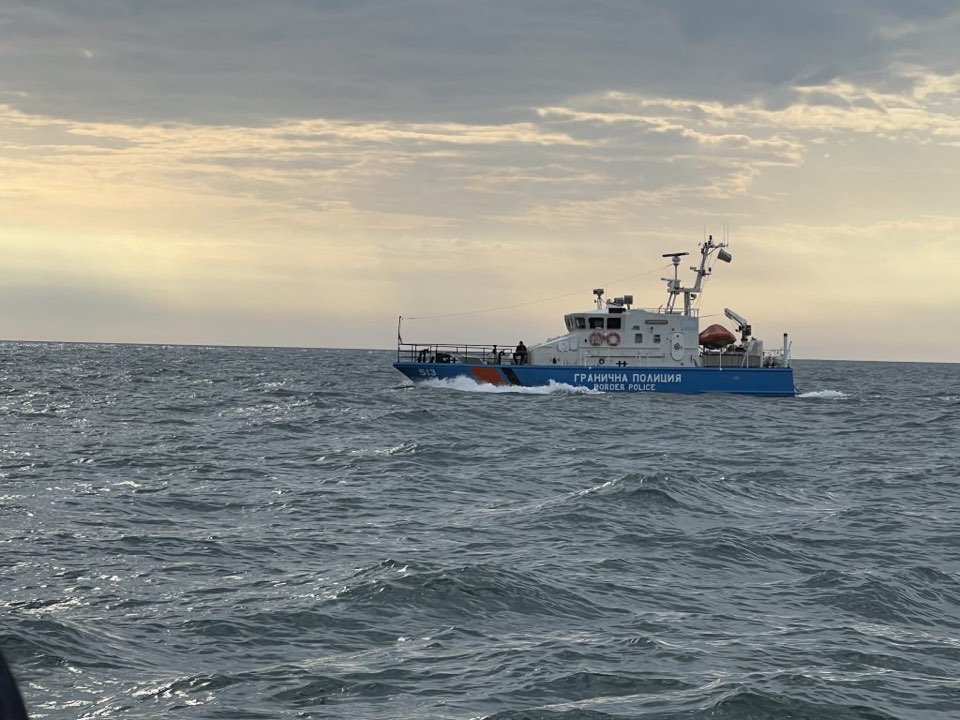
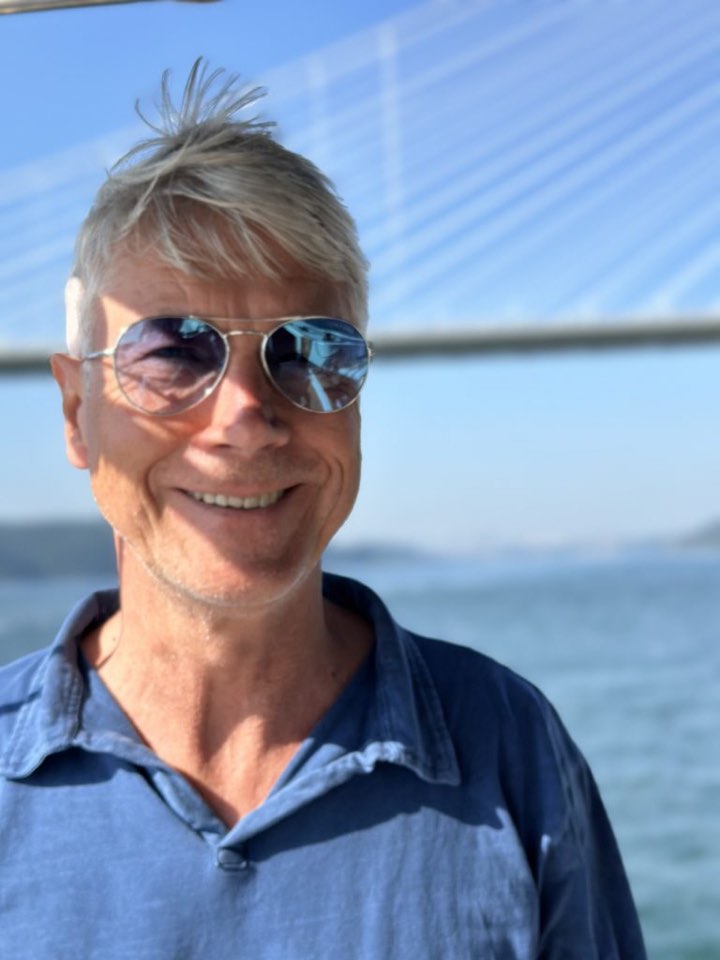
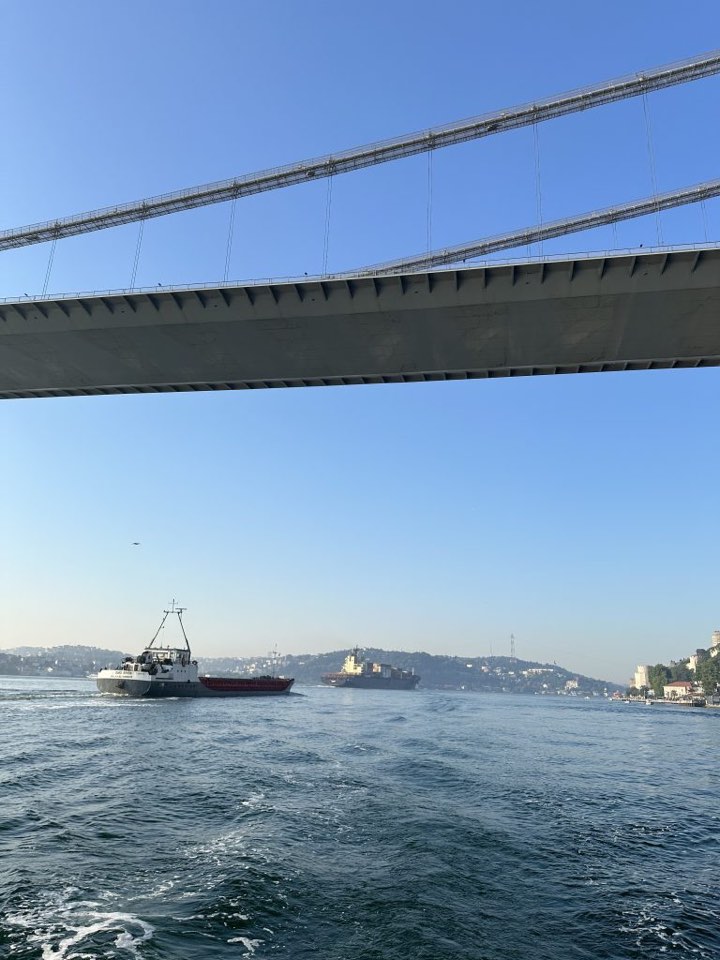










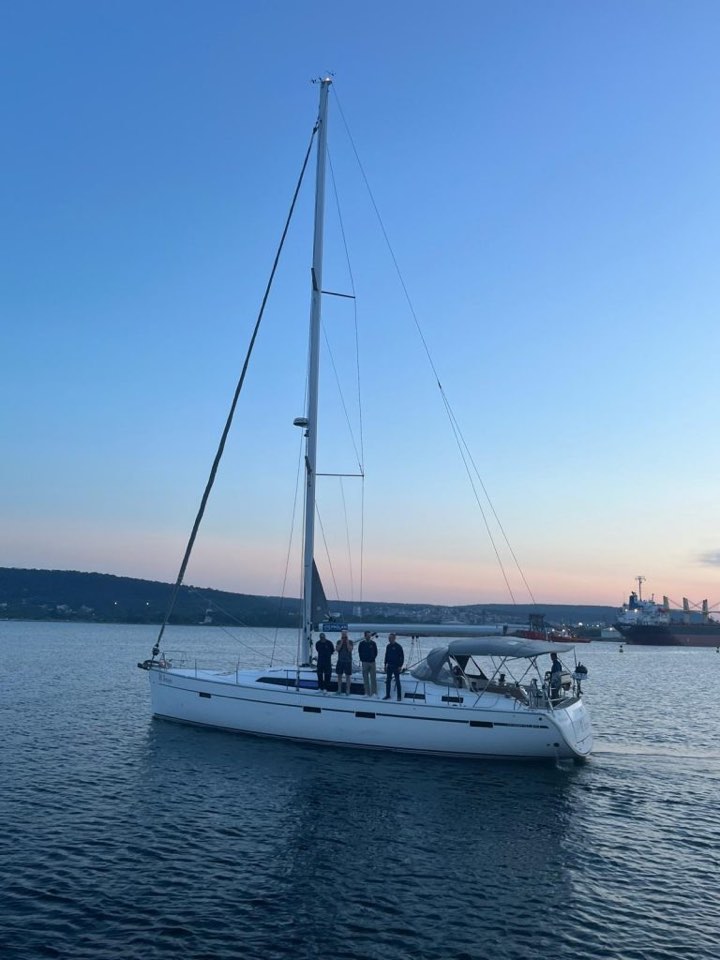

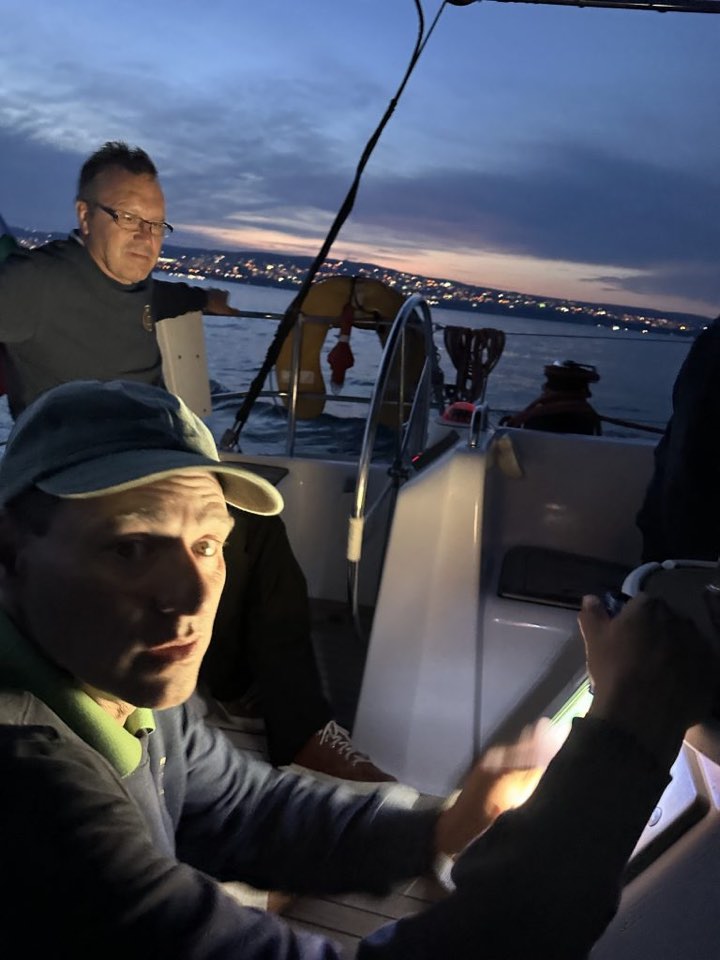
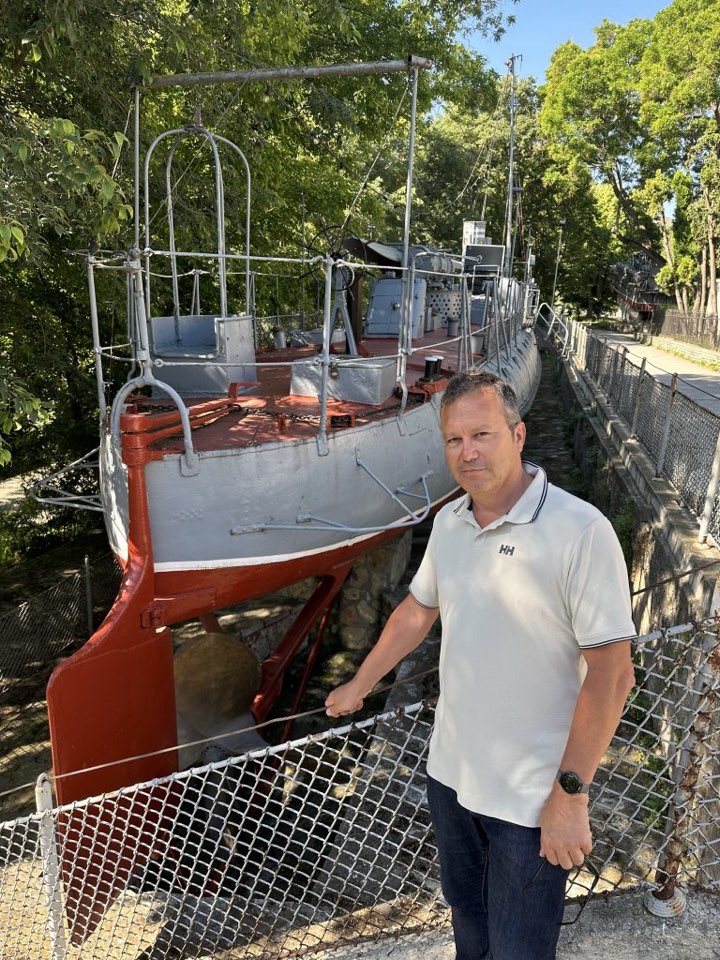


Through the expedition, GOST illustrated how essential stable and secure maritime corridors are to global peace and prosperity. This journey symbolizes hope and a shared responsibility in fostering a just and equitable world.
The Bosporus Strait is a critical segment of the Turkish Straits, serving as a vital route for the transport of oil, natural gas, and agricultural products. Turkey’s role in maintaining the safety and openness of the Bosporus is paramount, contributing significantly to global trade, energy security, and food accessibility worldwide. By ensuring the efficient flow of goods through this strategic passage, Turkey plays a crucial role in the broader goal of achieving global food security.
Programs like the World Food Program (WFP) and the Africa First Network play pivotal roles in advancing SDG Goal 2: Zero Hunger. These organizations work tirelessly to address the multifaceted challenges of hunger and food insecurity through initiatives such as emergency food aid, school feeding programs, and improving food security in regions affected by conflict and natural disasters. Their efforts demonstrate the power of global and regional cooperation in moving closer to achieving Zero Hunger.
The integrity of maritime transport routes is not merely an economic issue but a cornerstone in the battle against global hunger. Disruptions in sea routes can lead to severe food shortages, affecting nutritional health, educational outcomes, and economic productivity. International cooperation and stable geopolitical relations are essential to safeguard these lifelines. By maintaining these vital connections, the international community moves closer to fulfilling the basic human right to food, ensuring no one goes hungry and promoting equitable resource distribution worldwide.
We encourage individuals, communities, and organizations worldwide to draw inspiration from GOST’s legacy and engage in their own acts of peaceful diplomacy. Join us in advocating for a world where maritime routes continue to serve as lifelines for global prosperity.
🌊 #GlobalFoodSecurity #MaritimeRoutes #SustainableFutures #BlackSeaDragon
If you find this journey impactful, please like and share this article to spread awareness about the importance of maintaining open sea routes for a food-secure world!
An insight view, by Jochen Werne
The Wirtschaftstag 2024, held on June 11 and 12 at the JW Marriott Hotel in Berlin, brought together high-profile speakers from business and politics. Germany stands at a crossroads, and now more than ever, bold market-economy ideas are needed for a strong Germany and Europe. The Social Market Economy is a centennial idea, inviting all who cherish freedom, believe in the creativity and inventiveness of citizens, respect property, and strive for performance and equal opportunity with social balance. However, the 75-year history of the Social Market Economy is also a constant battle to defend, maintain, and shape the economic order.
In this context, strong signals of shared responsibility from both business and politics are crucial to keeping the economy on track. These impulses have been set at the Wirtschaftstag 2024.
At Experian DACH, we were delighted to participate in this important event. As a subject matter expert in data and data insights, Experian played a significant role in the panel discussion on “Digitalization and AI - Transformation Opportunities for Business and Politics”. This participation underscores our commitment to leveraging data analytics to drive digital transformation, benefiting both businesses and society.
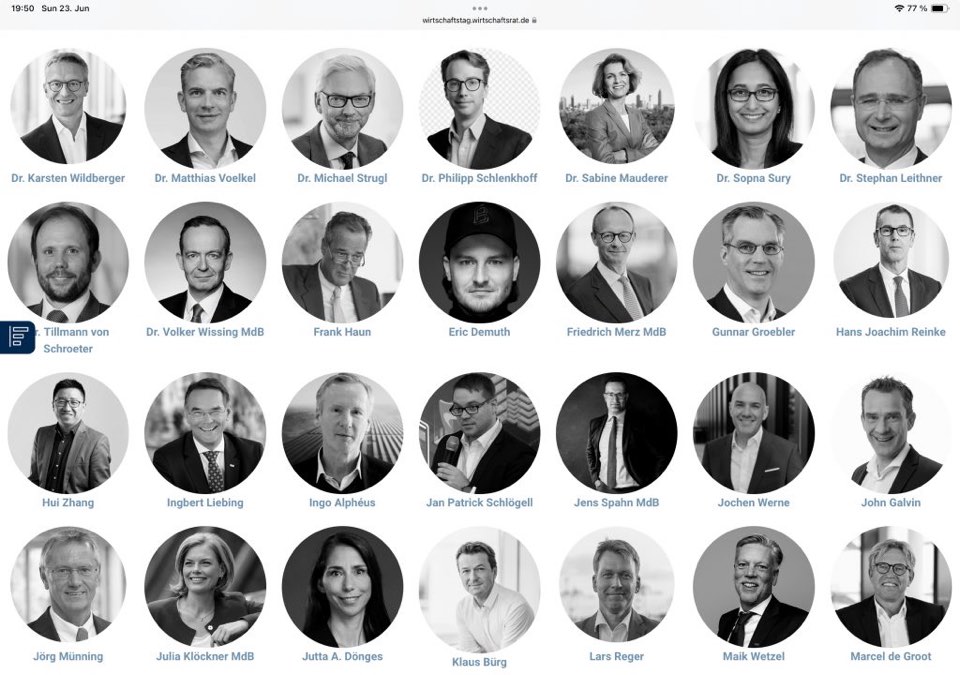
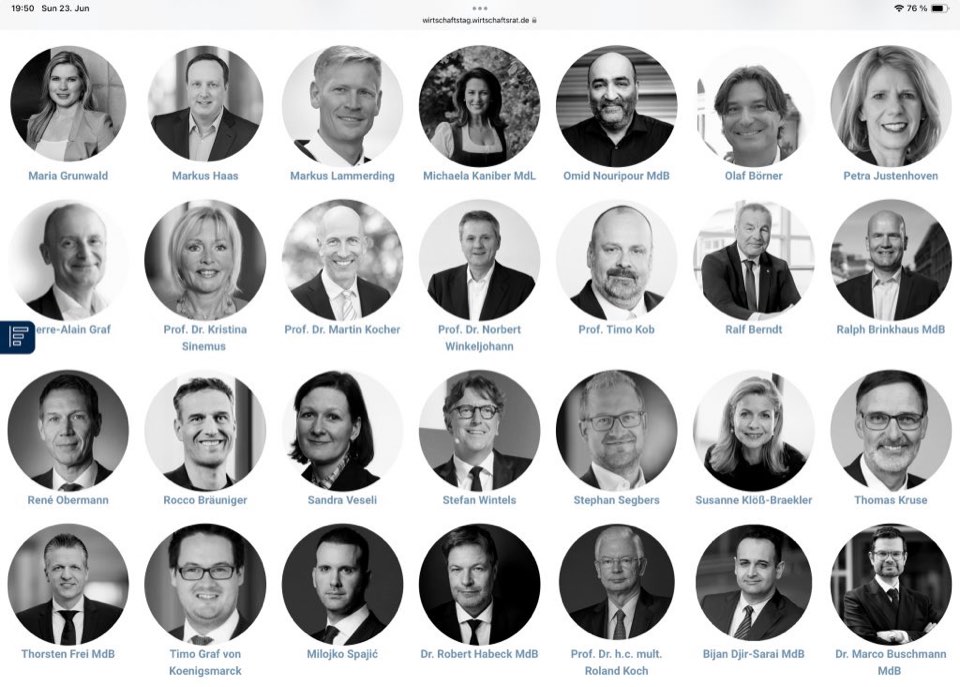
The esteemed panel participants were: Dr. Volker Wissing (Minister for Digital & Transport - MdB), Jochen Werne (CEO Experian DACH), Prof. Dr. Kristina Sinemus (Minister for Digital & Innovation, State Hesse - MdL), Petra Justenhoven (Speaker of the Board, PWC Germany) Marcel de Groot (CEO Vodafone Germany), Dr. Wolfgang Dierker (Managing Director Microsoft Germany), Hui Zhang (Managing Director NIO Europe), Carola Wahl (CEO DACH Nexi Group)

“We’re thrilled to make a joint contribution to the digital transformation journey and thereby strengthen Germany as a business location. We sincerely thank the Economic Council for this great opportunity!”
Jochen Werne, CEO Experian DACH
A heartfelt gratitude has to go to to the organizers at the Wirtschaftsrat, especially Astrid Hamker and Wolfgang Steiger, for their dedication and leadership. Their efforts were instrumental in making Wirtschaftstag 2024 a resounding success and bringing together distinguished speakers as Friedrich Merz, MdB, Robert Habeck, MdB, Christian Lindner, MdB, Boris Pistorius, Bettina Stark-Watzinger, MdB, Dr. Volker Wissing, MdB, Dr. Marco Buschmann, MdB, Omid Nouripour, MdB, Dr. Carsten Linnemann, MdB, Alexander Dobrindt, MdB, Christian Sewing, René Obermann, Dr. Jens Weidmann
The international perspective was enriched by contributions from: Milojko Spajić, Prime Minister of Montenegro, Prof. Dr. Martin Kocher, Federal Minister for Labour and Economy of Austria, Aušrinė Armonaitė, Minister of Economy and Innovation of Lithuania

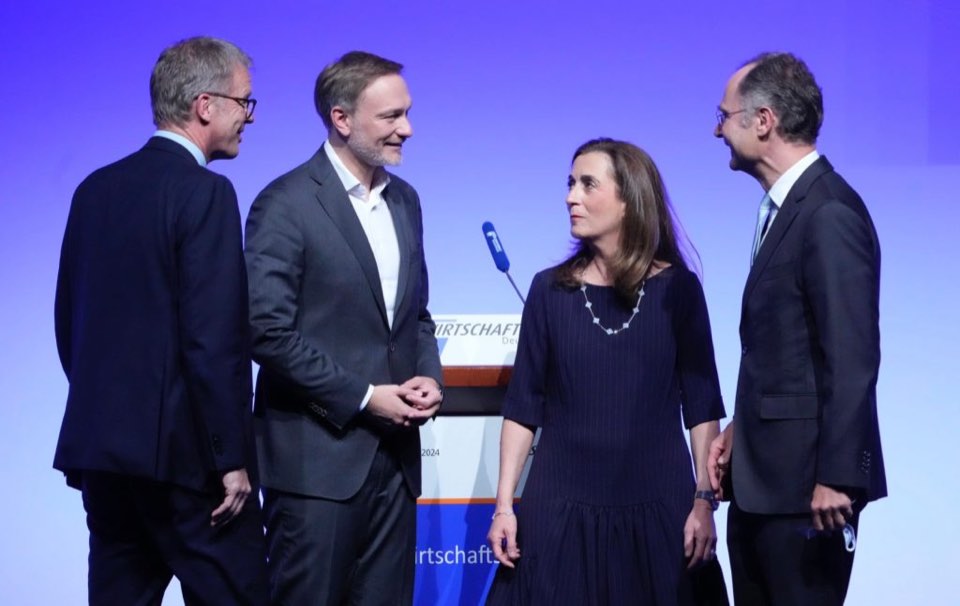

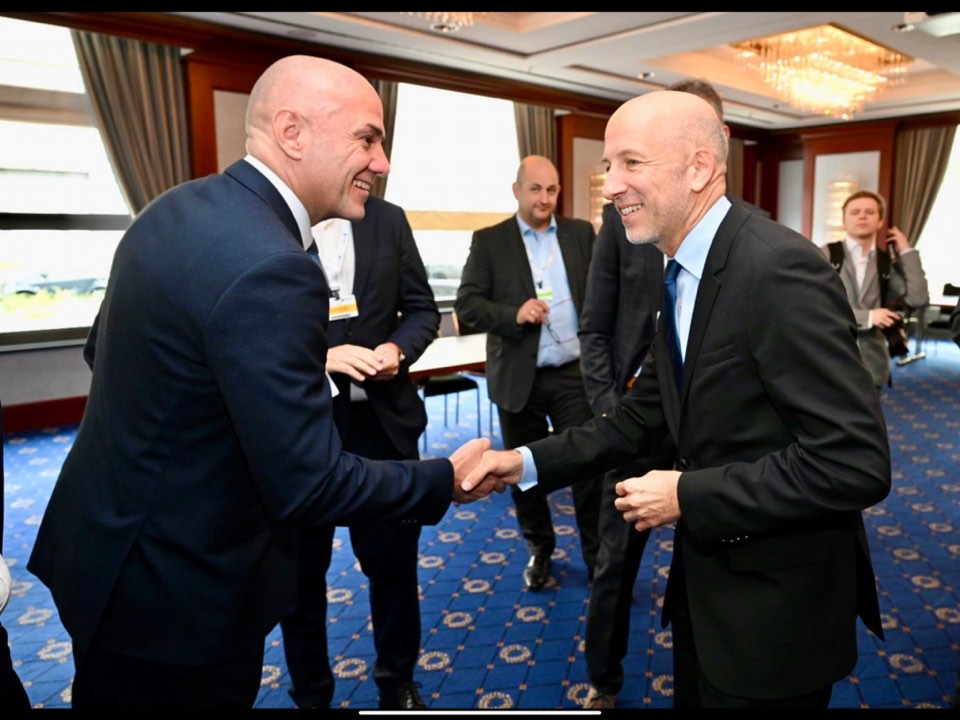
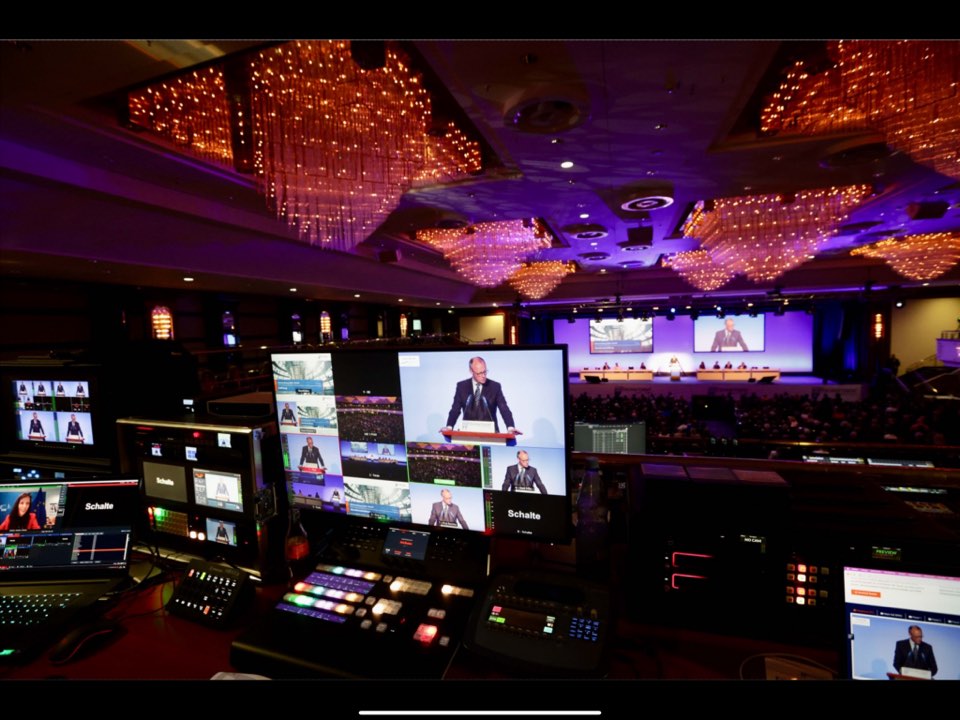
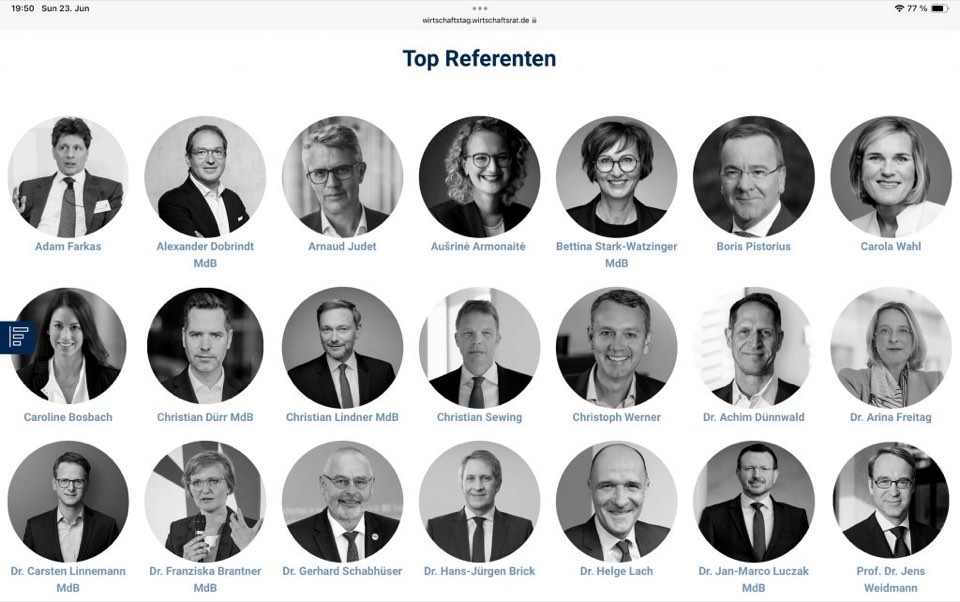
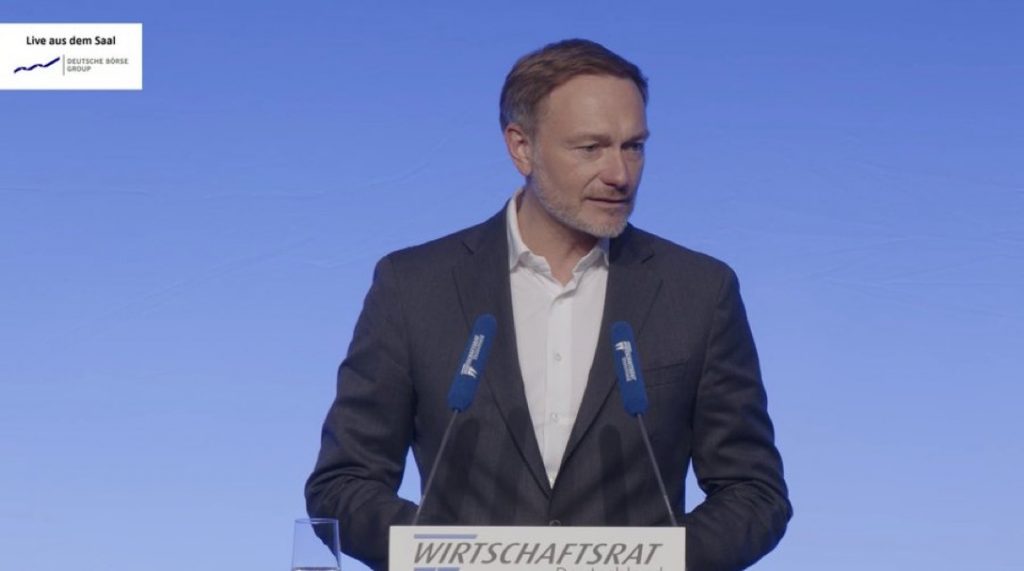

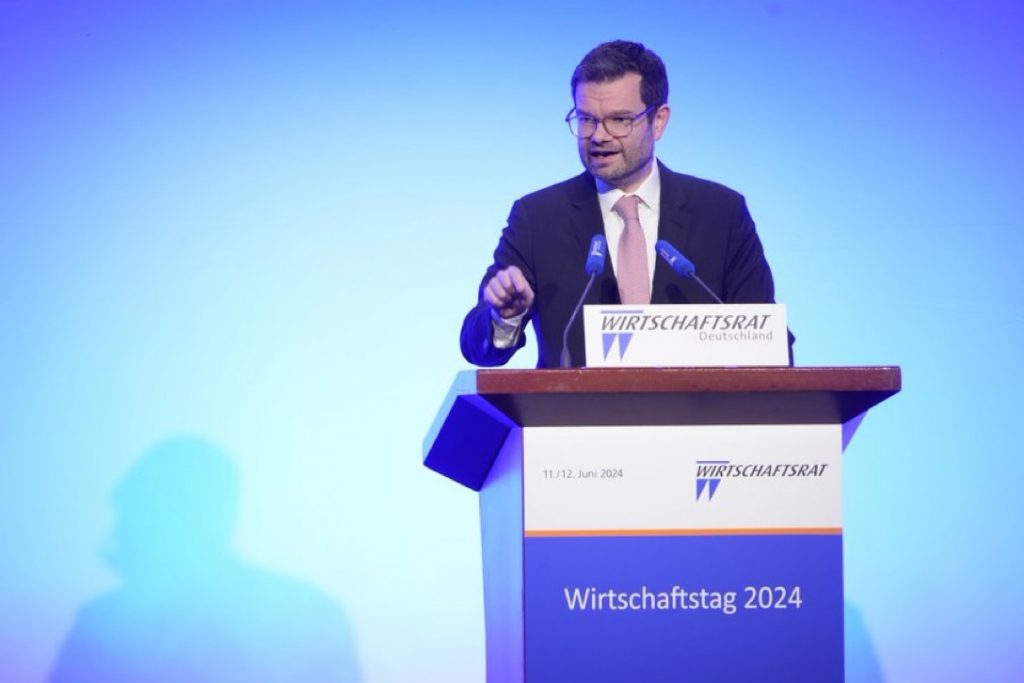


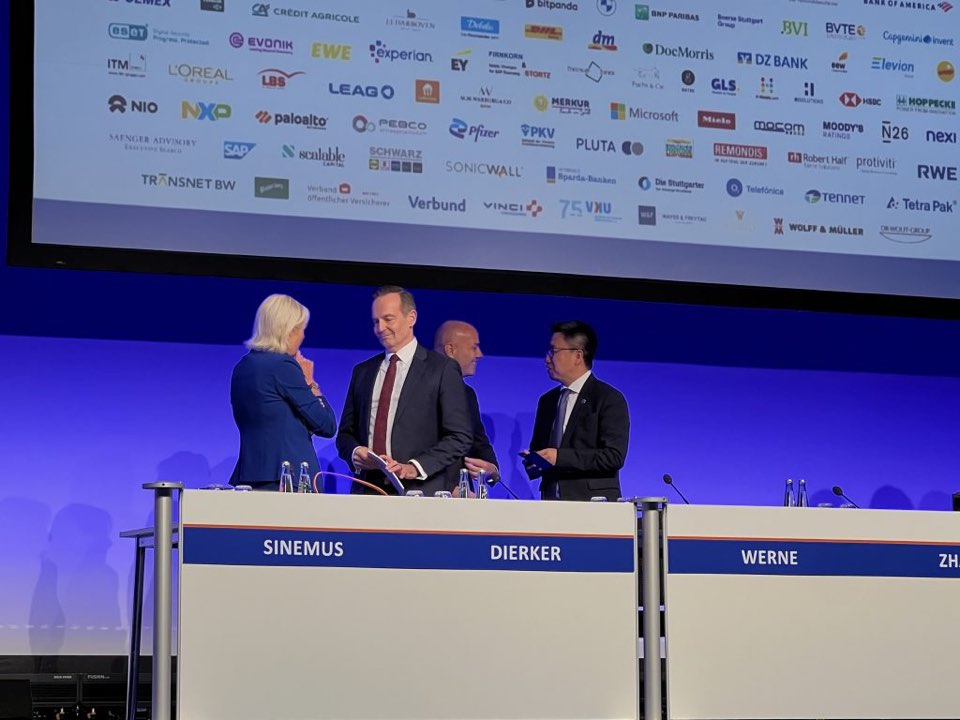
As I reflect on the Wirtschaftstag 2024, I am filled with a profound sense of gratitude and optimism. This year’s event, coming shortly after the European elections, carried a special significance. It served as a powerful signal of unity and forward-thinking, bringing together leaders from across the business and political spectrum to focus on the critical tasks ahead for a strong Germany and Europe.
A Platform for Meaningful Dialogue
The Wirtschaftstag 2024 was not just another event; it was the one of the largest Business and Politics gatherings in Germany. It provided an unparalleled platform for high-profile thought leaders and decision-makers to discuss and develop actionable recommendations for the future. The timing added an extra layer of importance, highlighting the need for bold market-economic ideas to secure the economic strength of Germany and the European continent.
The two days at the #Wirtschaftstag 2024 in Berlin have been a tremendous success, also for Experian. Engaging with high-profile participants from leading organizations and decision-makers from Germany’s business and political sectors has been truly inspiring.
2024 marks several significant milestones: 75 years of the Grundgesetz and the Social Market Economy, over 30 years of the European Single Market, and the dawn of a new legislative period for the EU Parliament and Commission. These next few years will be crucial for the future competitiveness and viability of Europe.
I’m sure we all look forward to continuing this important dialogue and working together towards a prosperous future for Europe and beyond.
by Jochen Werne
One of the most pressing objectives outlined in the United Nations Sustainable Development Goals (SDGs) is Goal 2: Zero Hunger. It aims to end all forms of hunger and malnutrition by 2030, ensuring that all people—especially children—have sufficient and nutritious food all year round. This article explores the importance of maintaining open sea routes for the delivery of essential food supplies like wheat, especially to regions like Africa, and how disruptions in these channels can severely impact the progress towards achieving this goal. The article also links to the noteworthy contribution of the Global Offshore Sailing Team (GOST) in raising awareness about this vital issue during their 25th anniversary expedition, “Black Sea Dragon.”

The United Nations states: “Goal 2 is about creating a world free of hunger by 2030.The global issue of hunger and food insecurity has shown an alarming increase since 2015, a trend exacerbated by a combination of factors including the pandemic, conflict, climate change, and deepening inequalities.
By 2022, approximately 735 million people – or 9.2% of the world’s population – found themselves in a state of chronic hunger – a staggering rise compared to 2019. This data underscores the severity of the situation, revealing a growing crisis. In addition, an estimated 2.4 billion people faced moderate to severe food insecurity in 2022. This classification signifies their lack of access to sufficient nourishment. This number escalated by an alarming 391 million people compared to 2019.

The persistent surge in hunger and food insecurity, fueled by a complex interplay of factors, demands immediate attention and coordinated global efforts to alleviate this critical humanitarian challenge. Extreme hunger and malnutrition remains a barrier to sustainable development and creates a trap from which people cannot easily escape. Hunger and malnutrition mean less productive individuals, who are more prone to disease and thus often unable to earn more and improve their livelihoods.
2 billion people in the world do not have regular access to safe, nutritious and sufficient food. In 2022, 148 million children had stunted growth and 45 million children under the age of 5 were affected by wasting.”
Open sea routes are vital arteries for the global food supply chain. They enable the efficient and cost-effective transportation of large quantities of food commodities from surplus regions to areas facing deficits.

For example, wheat is a staple food for over 35% of the world’s population, and a significant portion of it is transported by sea. According to the Food and Agriculture Organization (FAO), major wheat exporting nations rely heavily on maritime transport to ship their grains to different parts of the world, including Africa.
Africa is particularly vulnerable to disruptions in sea routes. Many African countries depend on imports to meet their food needs due to local production shortfalls caused by various factors such as climatic conditions, political instability, and economic challenges.

For instance, North African countries like Egypt, Algeria, and Morocco are among the world’s largest wheat importers. Closure of key maritime passages like which serve as a critical link between continents, can delay shipments, leading to shortages and spikes in food prices. This not only exacerbates food insecurity but also heightens economic instability.. When e.g. wheat deliveries are delayed or halted, the immediate effect is a shortage of staple food items, leading to increased prices and reduced accessibility for the poorest populations. This can have cascading effects on nutritional health, particularly for children, who are most vulnerable to malnutrition. The long-term impact extends beyond health, affecting educational outcomes and economic productivity, thereby hindering comprehensive development.
A vivid example of how blocked sea routes can affect global food security is the incident involving the container ship Ever Given, which became lodged in the Suez Canal in March 2021. The Suez Canal is one of the world’s busiest waterways, facilitating approximately 12% of global trade. The blockage created by the Ever Given halted the flow of goods, including significant quantities of food commodities, affecting supply chains worldwide.
The blockade, which lasted six days, delayed the passage of over 300 ships, including vessels carrying livestock and perishable goods bound for various parts of the world. According to Lloyd’s List, approximately $9.6 billion worth of goods passes through the canal each day. The delay affected the delivery of about 13 million barrels of oil to Europe from the Middle East, but also critical agricultural commodities such as grains and vegetable oils from major exporting countries, destined for Africa and Asia.

For instance, Syria, which relies heavily on wheat imports through the Suez Canal, had to ration its existing grain supplies due to delays. Similarly, the blockage disrupted the supply chains of livestock feed components like soybeans and corn, essential for meat production in many European and Asian countries. This disruption highlighted the canal’s crucial role in stabilizing global food prices and availability. The event underscored the vulnerability of global food systems to logistical disruptions and the ripple effects that can emerge from a single point of interruption in a key maritime route.
The ongoing crisis in the Red Sea highlights the precarious nature of global food supply chains and the cascading effects that disruptions can have on food security, particularly for economically vulnerable countries in Africa and Asia. According to Joseph Glauber and Abdullah Mamun from IFPRI, the duration and extent of the Houthi attacks will critically determine the scale of impact on shipping, market prices, and the availability of food. Although the Red Sea routes account for a smaller fraction of overall agricultural trade, persistent disruptions could force dependent importing nations to seek costlier alternatives or new suppliers. This shift could depress prices for producers, illustrating a ripple effect across global agricultural markets. The Red Sea conflict serves as a potent reminder of the fragility of supply chains and underscores the importance of maintaining flexible sourcing strategies for food imports to enhance resilience against such disruptions. This situation calls for international cooperation and strategic planning to safeguard food security amid geopolitical and logistical challenges.
Celebrating its 25th anniversary, the Global Offshore Sailing Team (GOST) is leveraging its “Black Sea Dragon” expedition, departing from Varna, Bulgaria, and passing through the Bosporus to Istanbul, to spotlight the importance of these issues.
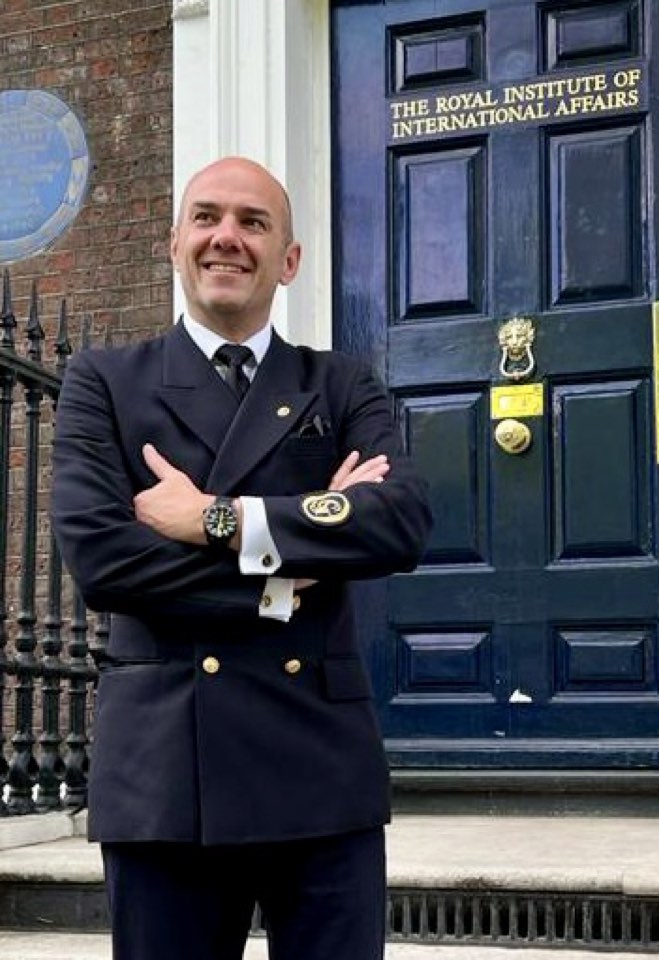
“We aim to underscore the significance of uninterrupted sea routes not only for food security but also for fostering international understanding,” stated Jochen Werne, GOST co-founder.
Jochen Werne, co-founder of GOST
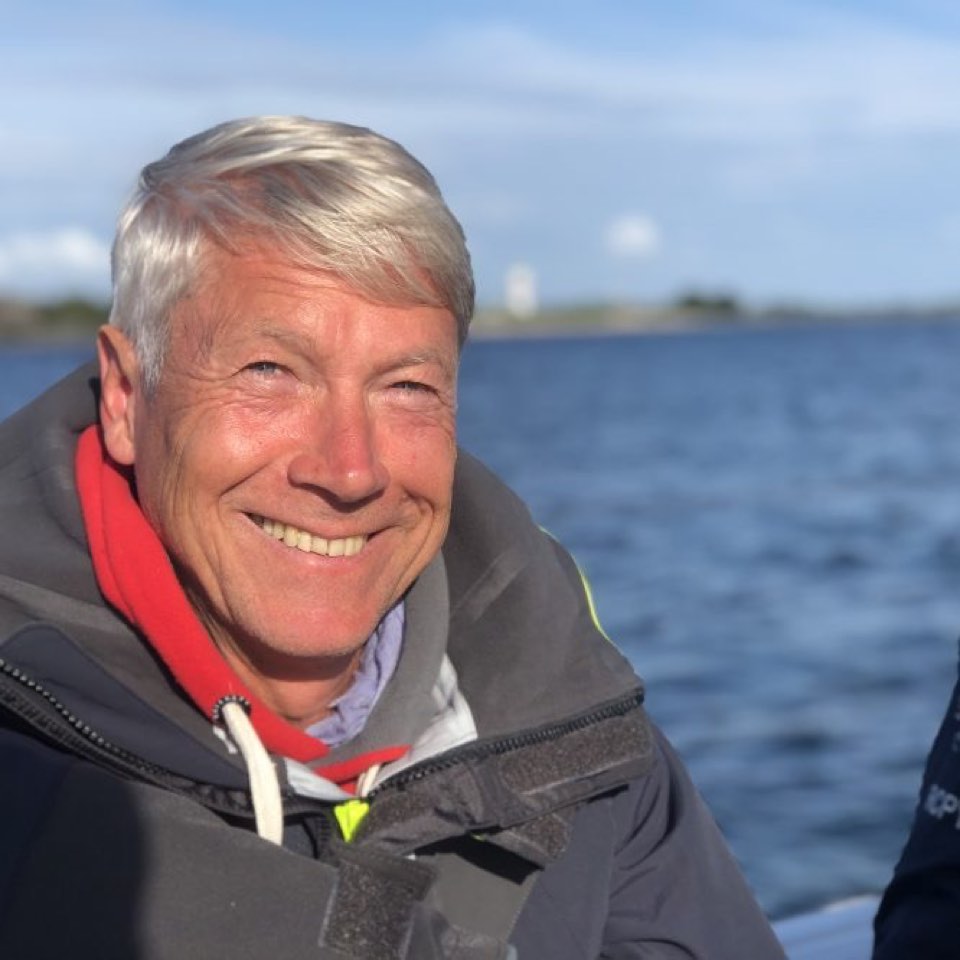
“Through the ‘Black Sea Dragon’ expedition, we strive to illustrate how essential stable and secure maritime corridors are to global peace and prosperity. This journey symbolizes our dedication to strengthening the bonds between nations and enhancing mutual reliance through shared challenges.”
Guido Zoeller, co-founder of GOST
Creating awareness is a powerful tool in the realm of people’s diplomacy, fostering peace and understanding by educating and engaging diverse populations on global issues. The Global Offshore Sailing Team (GOST) has harnessed this approach effectively over its 25-year history, particularly through high-visibility expeditions like the “Black Sea Dragon”, “Antarctic Blanc” or “Navigators Heritage”. These ventures serve not only as adventures but also as platforms to raise public awareness about critical global challenges such as the importance of open sea routes for food security and international cooperation.
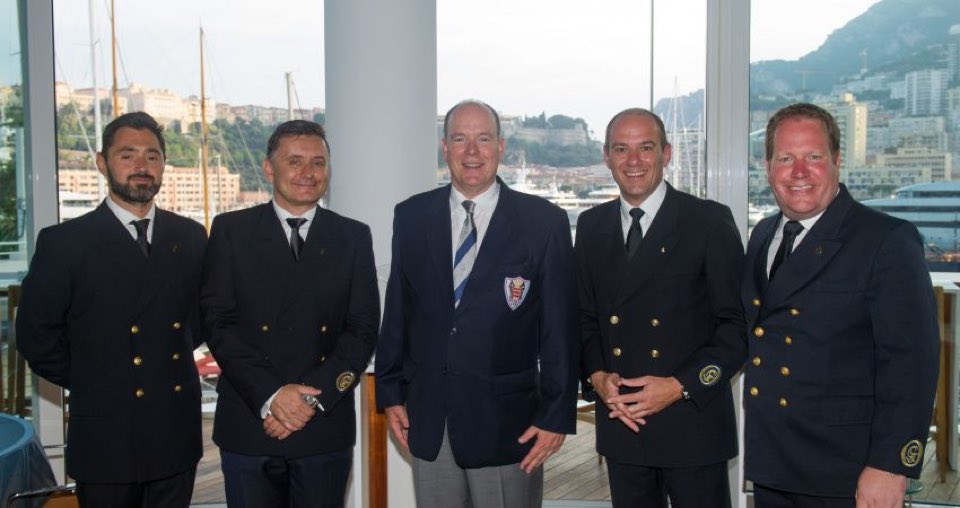
GOST’s expeditions are emblematic of how peaceful people’s diplomacy can be conducted through the universal language of maritime travel. By navigating international waters and connecting different cultures, GOST embodies the spirit of collaboration and mutual understanding. Their journeys highlight how sustained, peaceful engagement can build bridges between nations, fostering a shared commitment to addressing global challenges.
The “Black Sea Dragon” expedition underscores the continuity of this mission of not only traversing geographic boundaries but also cultivating a deeper awareness among global citizens about the interconnectedness of our world. This voyage illustrates the critical role that safe and open sea routes play in global stability and food security, emphasizing how these waterways are arteries of international diplomacy and economic vitality.
The Bosporus Strait, a narrow, natural strait that forms part of the continental boundary between Europe and Asia, is not only a crucial segment of the Turkish Straits but also one of the world’s most significant maritime passages for international navigation. It connects the Black Sea to the Sea of Marmara, and further to the Mediterranean, serving as a vital route for the transport of oil, natural gas, and agricultural products. This strait is especially critical for all Black Sea nations, which rely on it as their primary avenue to the global markets.

Turkey’s role in maintaining the safety and openness of the Bosporus is paramount. Governed by the 1936 Montreux Convention, the management of the strait allows for the free passage of civilian vessels in peacetime while limiting the passage of naval ships not belonging to Black Sea states. Turkey, responsible for the strait’s management, plays a pivotal role in ensuring that this vital artery remains open and safe for navigation. This is crucial not only for economic reasons but also for food security, particularly for nations that depend heavily on agricultural imports that transit through these waters.
The strategic importance of the Bosporus is amplified by its challenging navigation conditions, which require precise handling and extensive local knowledge, underscoring the need for expert maritime management. Turkey’s investment in the surveillance and traffic management of the strait reflects its commitment to safeguarding this essential route. This ensures the efficient flow of goods and energy resources, which is indispensable for maintaining the stability of global markets and securing food and energy supplies to various regions.
Furthermore, Turkey’s diplomatic relations and its strategic position as a bridge between East and West play a critical role in the geopolitical landscape surrounding the Bosporus. By keeping the Bosporus open and secure, Turkey contributes significantly to the broader global objective such as the United Nations SDG Goal 2: Zero Hunger. Thus, Turkey’s management of the Bosporus is not merely a regional concern but a matter of global importance, impacting international trade, energy security, and food accessibility worldwide.
There are numerous impactful programs like the World Food Program (WFP) or the Africa First Network that play pivotal roles in advancing SDG Goal 2: Zero Hunger through their dedicated initiatives. These organizations work tirelessly to address the multifaceted challenges of hunger and food insecurity around the globe.

The World Food Program, a leading humanitarian organization fighting hunger worldwide, implements a variety of programs aimed at ensuring that everyone can access the food they need for a healthy life. The WFP’s efforts include emergency food aid, school feeding programs, and improving food security in regions affected by conflict and natural disasters. By maintaining and securing open sea routes for food delivery, the WFP not only manages direct assistance but also supports local agriculture and infrastructure, which are crucial for long-term sustainability.
Similarly, the Africa First Network collaborates with local and international partners to bolster food security across African nations. This initiative focuses on enhancing agricultural productivity, building efficient supply chains, and advocating for policies that support sustainable food systems. Through education, technological innovation, and infrastructure development, the Africa First Network seeks to empower African communities to achieve self-sufficiency and resilience against food crises.
Together, these programs demonstrate the power of global and regional cooperation in moving closer to achieving Zero Hunger. Their comprehensive approach to tackling food insecurity includes not just immediate relief but also long-term strategies that address the root causes of hunger, ensuring sustainable change and progress towards SDG Goal 2.
The integrity of maritime transport routes is not merely an economic issue but a cornerstone in the battle against global hunger. The ramifications of disrupted sea routes extend far beyond immediate food shortages, affecting nutritional health, educational outcomes, and economic productivity. International cooperation and stable geopolitical relations are essential to safeguard these lifelines. By maintaining these vital connections, the international community moves closer to fulfilling the basic human right to food, ensuring no one goes hungry and promoting equitable resource distribution worldwide.

We encourage individuals, communities, and organizations worldwide to draw inspiration from GOST’s legacy and engage in their own acts of peaceful diplomacy. Whether through educational outreach, participating in cultural exchanges, or supporting initiatives that promote international understanding, every effort counts. Join us in championing the causes that matter most for our global community’s prosperity and peace. Together, let’s navigate towards a future where diplomacy and awareness pave the way for a harmonious world.
Sources: World Food Programme https://www.wfp.org , IFPRI https://www.ifpri.org , GOST, United Nations https://sdgs.un.org/goals , Pixabay, Africa First Network https://africafirst.net , FAO https://www.fao.org/
 by Jochen Werne
 published on May 8, 2024 the below article in the original German version. Find the link HERE. Pictures used here are from private sources and Pixabay. Translation made by DeepL.com.
Throughout human history, transformative technological innovations have repeatedly led to impressive leaps in development that have reshaped our societies, economies, politics and daily lives in previously unimaginable ways.

The printing press developed by Johannes Gutenberg in the 15th century is a particular example of the far-reaching power of technological innovation. It was not only a tool for the mass production of books, but also ushered in the age of universal literacy. It has changed the world of work by making typists redundant and creating new professions in publishing and literature. Artificial intelligence (AI) is said to have a similarly revolutionary potential, and not just since large language models (LLM) such as OpenAI's ChatGPT were established for the public to see. The extensive and immediately usable possibilities - such as the simplification of text generation or summarisation, coding - are inspiring. AI is about to fundamentally change the way we work today. But how do we deal with it?
At the forefront of this AI transformation are LLMs such as GPT-4. To truly understand their complex structure, one must dive deep into the underlying technologies, unravel the multitude of practical applications they enable and critically evaluate the challenges they pose. The range of applications of LLMs has already left an indelible mark on a wide variety of sectors. For example, LLMs are already creating new clarity in the confusing world of research through optimised summaries and presentations of key findings. LLMs are also leading to a paradigm shift in our understanding of work dynamics. The research report "Navigating the Jagged Technological Frontier: Field Experimental Evidence of the Effects of AI on Knowledge Worker Productivity and Quality" describes this change and shows that the use of AI in a real-world work environment can lead to a significant increase in productivity: In this case, to 12.2 per cent more completed tasks and a 25.1 per cent reduction in processing time. These are impressive figures that illustrate the transformative power of AI even at today's stage of development.
As a data insights company, Experian recognised the transformative essence of information early on. With the help of machine learning (ML), we gain important insights from data that companies can use to make informed decisions. In a recent video interview, Alex Lintner, CEO of Experian Software Solutions, explains the evolving role of AI in the financial sector and highlights the unprecedented opportunities that exist, particularly with carefully constructed large-scale language models.

Alex Lintner, CEO of Experian Software Solutions
Lintner explains the scalability of such technologies and the potential of using machine learning in monitoring market trends and anticipating credit risk. Technological advances are enabling machines to independently ask questions of decision makers, automate routine model monitoring processes and even predict which variables should be included in models in the future, allowing humans to focus their resources elsewhere.
In addition, Lintner highlights the enormous potential of AI for financial services, in particular agile risk detection and the associated ad hoc response management. As always, with great opportunity comes great responsibility: strict compliance, governance and transparency measures are urgently needed to ensure the ethical and sustainable use of AI. It is important to understand that the use of LLM's is not just about improving back-end processes, but more importantly about equipping the workforce for the future. It is therefore mandatory for all Experian employees worldwide to complete the internal GenAI training programme. We see this - as well as all the other activities of our own Experian GenAI Academy - as important measures to keep our corporate culture in line with the wave of digital transformation rolling across industries.
Large-scale language models are now at the forefront of the AI revolution and have the ability to understand, generate and augment text, sound, images and video on a previously unimaginable scale. This has particular implications for all companies operating in data-centric industries, whose job it is to extract actionable insights from big data. Companies that utilise these opportunities for new data usage most effectively will gain market share in the future. For us, the integration of machine learning and large-scale language models in particular is not just a technological upgrade, but a comprehensive transformative strategy to reshape the future of our industry.
Innovation has always changed societies and had a lasting impact on the course of human progress. AI today represents the latest frontier where the complex interaction between humans and technology can be explored and refined. We therefore need to understand that our future most likely lies in the balance of harmonising AI and humans - a harmonisation that goes beyond mere coexistence: it involves collaboration and synergies that can merge human intuition and computing power into a powerful force that can drive profound change in all aspects of our lives.
To achieve this harmonisation, several key principles must be followed. Ethics come first. The development and use of AI must be based on a solid ethical foundation that ensures fairness, transparency and accountability. Prejudice and discrimination must be carefully avoided and it must be ensured that AI benefits all of humanity and excludes no one.
Second is education and skills. With the increasing integration of AI into our daily lives, it is important that individuals have access to the knowledge and skills they need to use this new technology. Education is key to realising the potential of AI while mitigating the associated risks. After all, collaboration is the key to success. Governments, businesses, researchers and citizens must work together across borders and sectors to realise its full potential. Interdisciplinary collaboration can pave the way for breakthroughs that benefit society as a whole.
With a strong focus on ethics, education and collaboration, we are able to create a future where AI and humans work in harmony and reach a new level of progress. This is a technological challenge, but also a societal one.
Mastering the Power of AI and Large Language Models for Business Success and Positive Social Impact
By Jochen Werne
Düsseldorf, 6 April 2023.
Throughout human history, transformative technological innovations have heralded new eras, reshaping our societies, economies, politics, and daily lives in ways previously unimaginable. The printing press, introduced by Johannes Gutenberg in the 15th century, serves as a profound testament to the sweeping power of innovation. Not just a tool for mass-producing books, the printing press birthed the dawn of widespread literacy, transforming workplaces as manual scribes became obsolete and creating new vocations in publishing and literature.
The press also catalyzed a socio-political upheaval. As literacy rates surged, so did the empowerment of the masses. Ideas, once confined to the elite, became accessible to many, seeding the Renaissance, and later, the Reformation. Niall Ferguson, in his seminal work, “The Square and the Tower,” eloquently captures this revolution, asserting that the printing press restructured historical hierarchies and networks, shifting power dynamics in unprecedented ways.[1]
In economic terms, the press laid the foundation for capitalist markets. As information became accessible, trade routes expanded, local businesses thrived, and a burgeoning middle class began to wield economic influence. On the societal front, with the proliferation of ideas came the Enlightenment, propelling societies towards principles of liberty, fraternity, and equality.
Fast forward to the close of the 20th century, and another innovation emerged as a harbinger of transformation: the internet. Much like the printing press, the internet redefined workplaces, rendering some jobs obsolete while spawning new professions in digital technology, e-commerce, and online content creation. The globalized economy we witness today, underpinned by intricate supply chains and instantaneous communication, owes its existence to the digital revolution.
Politically, the internet has both empowered and challenged established structures. Grassroots movements, from the Arab Spring to global climate change campaigns, have harnessed online platforms to mobilize support and challenge the status quo. However, it’s also provided a breeding ground for misinformation, deepening societal divides in certain instances.
Yet, as we stand on the cusp of the AI revolution, it’s crucial to reflect on lessons from our past. Both the printing press and the internet came with their boon and bane. Their essence wasn’t inherently good or bad; it was humanity’s application of these tools that rendered them so. As we navigate the realms of AI and Large Language Models (LLM), this adage holds truer than ever: Technology and technological inventions are neither good nor bad – it’s the way we use them that bestows upon them such attributes.
Chronicles of Code - Decoding the Magic Behind Large Language Models
The realm of artificial intelligence is undergoing rapid metamorphosis, and Large Language Models, such as GPT-3 and GPT-4, stand out as the front-runners in this transformation.[2] To truly appreciate the intricate tapestry of LLMs, one must delve deep into their foundational technologies, unravel the plethora of practical applications they enable, and critically evaluate the challenges they pose.
At the nucleus of LLMs is their technological backbone. These models owe their prowess to deep learning and, more specifically, the transformer architecture.[3] This intricate design enables them to sift through colossal amounts of data, synthesizing human-like text that often mirrors our nuanced thought processes. The primary education of these models stems from vast datasets spanning the breadth of the internet, but their true finesse is achieved when they’re fine-tuned using more focused datasets, enabling them to excel in specialized domains.[4]
When it comes to their application spectrum, LLMs have left indelible marks across sectors. In the labyrinthine world of research, where professionals are inundated with vast pools of data and intricate academic papers, LLMs emerge as lighthouses, offering clarity by summarizing and presenting key insights.[5] Language translation, a domain that’s been historically challenging due to the nuances and subtleties of human language, has seen remarkable enhancements with LLMs. They’ve added a layer of contextual depth that was previously lacking in traditional translation tools.[6] The educational sphere is undergoing a renaissance, thanks to LLMs. Their capabilities in offering personalized content, adapting to individual learning curves, and providing immediate feedback promise a future where learning is both tailored and transformative.[7]
Yet, every silver lining has a cloud. The inherent challenges of LLMs are subjects of extensive discourse. Their reliance on training data can be their Achilles’ heel — biases in training data can lead to prejudiced outputs, a significant concern given the widespread influence of AI.[8] Additionally, their textual outputs, while sophisticated, can sometimes lack true human understanding, leading to contextually skewed results.[9] The broader societal implications of LLM adoption, especially the potential displacement of jobs and questions of ethical accountability, are pressing concerns that demand attention.[10]
The tapestry of LLMs in real-world scenarios paints a vivid picture of their transformative potential. Customer service has seen an overhaul, with AI tools streamlining interactions and enhancing user experiences.[11] The corridors of journalism echo with the influence of LLMs, aiding in content creation, editing, and even pioneering new forms of storytelling.[12] The legal world, often bogged down by voluminous documents, benefits immensely from AI’s precision in document reviews, bringing efficiency and reducing human errors.[13]
As we segue into “Redefining Workflows: The Profound Influence of LLMs on the Modern Workforce,” we’ll delve deeper into the myriad ways LLMs are reshaping our professional landscapes.
A New Work Paradigm: LLMs’ Crucial Contribution to Contemporary Business Achievements
The release of Large Language Models has initiated a paradigm shift in our understanding of the workforce dynamics. The ground-breaking research presented in the paper titled “Navigating the Jagged Technological Frontier: Field Experimental Evidence of the Effects of AI on Knowledge Worker Productivity and Quality,” authored by the illustrious team of researchers including Fabrizio Dell’Acqua, Edward McFowland III, Ethan Mollick, Hila Lifshitz-Assaf, Katherine C. Kellogg, Saran Rajendran, Lisa Krayer, François Candelon, and Karim R. Lakhani, brings forth significant insights into this transformation.
Praise is due to this team of researchers for conducting a well-structured, extensive experiment involving 758 consultants from the global management consulting firm, Boston Consulting Group (BCG). Their analysis offers invaluable insights into the applications and limitations of AI in knowledge-intensive tasks. The concept of a “jagged technological frontier” introduced in their paper signifies the nuanced capabilities of AI. It underscores the notion that while AI excels in certain tasks, others that might seem similar in complexity can be beyond its scope.
Their findings show that when consultants utilized AI in the realm of its capabilities, there was a noticeable uptick in productivity, with tasks being completed 12.2% more and 25.1% faster. The quality of results also soared, witnessing an impressive increase of over 40%. These figures paint a vivid picture of the transformative power of AI when applied within its domain of expertise. Yet, it’s essential to note that outside this domain, relying on AI may lead to counterproductive results.
The paper also identifies two distinct ways in which consultants engaged with AI. Some consultants acted as “Centaurs,” seamlessly dividing and delegating tasks between themselves and the AI, while others emerged as “Cyborgs,” integrating their workflows with the AI in an ongoing symbiotic interaction. Such observations are pivotal as organizations strive to harness the optimal potential of AI, while also understanding its limitations.
LLMs like ChatGPT, as highlighted in the research, have redefined the frontiers of automation, demonstrating capabilities in areas previously reserved for the most educated, creative, and highly paid workers. The research suggests that these models are more than mere tools; they are evolving entities with vast yet unpredictable capabilities. Their potential to transform workflows and elevate the quality of work output in the consulting realm, and possibly across other industries, is profound.
Yet, for all their potential, the research astutely underscores the risks associated with the blind adoption of LLMs. Misplacing trust in these systems for tasks outside their capabilities can lead to inaccurate results and compromise the integrity of the work. The inherent opacity of these models further complicates this dynamic. Without a clear understanding of their strengths and weaknesses, professionals may be navigating a minefield without a map.
The “jagged technological frontier” metaphor therefore poignantly encapsulates the ever-evolving landscape of AI capabilities. This invaluable research serves as a compass, guiding professionals and organizations on how to integrate LLMs efficiently into their workflows, optimize productivity, and elevate the quality of outputs. The ripple effects of LLMs on the workforce are profound, and as we traverse this technological frontier, it is paramount to tread with both enthusiasm and caution. The dedication and rigor of the research team in shedding light on this complex subject deserve commendation. Their work has undoubtedly laid a solid foundation for further exploration in the transformative world of AI and its implications on the workforce.[14]
The importance of discerning the “jagged technological frontier” concept is crucial. While some tasks may appear similarly intricate on the surface, not all can be executed efficiently by AI. Drawing from own research and the extensive studies by the German AI platform “Plattform Lernende Systeme“, it’s pivotal to distinguish which tasks are best tackled with human-AI collaboration.[15]
Harnessing the Power of LLMs: Best Practice approach from a global data insights market leader
Experian[16], as a global data leader, recognizes the transformative essence of information. Through AI and Machine Learning, Experian gleans significant insights from data, empowering businesses to make enlightened decisions. Additionally, the principle of ‘data for good’ resonates profoundly with the philosophy. By responsibly channeling data, the company not only catalyze economic progress but also mitigate societal challenges.
Experian has not only acknowledged the transformative potential of Machine Learning and Large Language Models but also fervently acted upon it.
Alex Lintner,[17] CEO of Experian Software Solutions, recently provided insights into the evolving role of artificial intelligence (AI) in the financial sector during a video conversation.[18] Lintner emphasized how AI, especially carefully constructed large language models, offer an unprecedented opportunity for the industry. He elucidated the scalability of such technologies, noting the potential to leverage machine learning for monitoring market trends and preempting credit risks as market circumstances change. This technological evolution allows machines to autonomously create prompts for decision makers, automate routine model monitoring processes, and even forecast variables that should be included in models in the future, thus enabling humans to channel their resources towards creating innovative solutions and supporting strategic initiatives.
Moreover, Lintner shed light on the vast potential of AI in financial services. He highlighted the importance of agile risk detection and swift response mechanisms, indicating that this is just scratching the surface. Experian alone has pinpointed over 200 potential use cases. However, the immense capabilities of AI also beckon significant accountability. Lintner underscores the paramount need for rigorous compliance, governance, and transparency measures to guarantee AI’s ethical and judicious application.
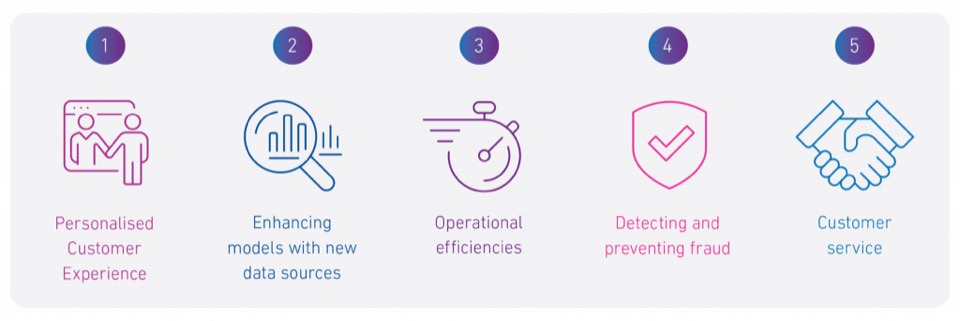
On the ethical front, Lintner asserted, “Protecting data and ensuring responsible use of generative AI is not just a priority; it’s an imperative.” Given Experian’s pivotal role in handling sensitive financial information, establishing and maintaining trust is of utmost importance. Therefore, integrating stringent ethical standards, principles, and methodologies is crucial to the successful and responsible rollout of AI technologies.
As for steering the future, Lintner offers a clear roadmap: focus on acquiring talent in the AI domain, consistently gather customer feedback, and astutely prioritize opportunities. He believes that truly innovative solutions emerge from a profound understanding of customer necessities—a philosophy that resonates deeply in his perspectives.
In data companies globally every decision, every product, every innovation stems from the intricate understanding of the numbers. As the vast amounts of data they manage continue to grow, there’s an increasing need for more sophisticated ways to handle, analyze, and extract insights from it. Enter Machine Learning (ML) and, more specifically, Large Language Models (LLMs).
Ahead of the Curve: Cultivating a Workforce Fit for the Future
It’s important to understand that the use of LLMs isn’t just about improving backend processes; it’s especially about equipping the workforce for the future. When I took the helm on August 1st, 2023 as the new CEO of Experian DACH, one of the first directives on day one – inspired by the example of other Country Managers within the group - was to motivate all employees in Germany, Austria and Switzerland to undergo the corporate GenAI training. This wasn’t just a nod towards technological advancement; it was a strategic move to ensure that the very culture of the company was aligned with the digital transformation wave sweeping across industries.

By doing so, Experian isn’t merely training its employees on a new tool; it was nurturing a mindset of innovation and adaptability. With hands-on experience from the GenAI training, employees were encouraged to conceptualize practical roll-out use cases. For example, marketing professionals can incorporate insights from LLMs into their engagements, delivering more personalized and impactful messages to clients. In the meantime, the sales teams were able to use LLM-generated insights to identify potential markets or niches that had not yet been tapped - today, the vast majority of Experian employees worldwide are not only trained, but use GenAI in their daily work and develop new use cases on the fly.
Training and Learning is not just about immediate benefits. It is a forward-thinking strategy to ensure that new technologies, as LLMs continue to evolve and their applications grow, the company’s workforce would not be left behind. It is about fostering a culture of continuous learning, adaptability, and leveraging cutting-edge technology to stay ahead in highly competitive industries.
Redefining an Industry’s Future
Large Language Models (LLMs) like GPT-4 are at the forefront of the AI revolution, harnessing the capability to understand, generate, and augment human-like text at a scale previously unimaginable. This progression in AI has significant implications for businesses, especially for data-centric industries that are looking to derive actionable insights from vast data volumes.
One of the key challenges for data-centric companies is extracting meaningful insights from massive data sets. Traditional methods are often cumbersome, and while they can yield valuable results, the increasing volume, velocity, and variety of data have made these methods less efficient. Machine Learning offers a solution to this challenge. By leveraging algorithms that can learn from and make decisions based on data, ML has revolutionized the way companies interpret complex data structures.
Therefore, as data continues to be the backbone of our digital age, companies that can harness its power most effectively will lead the charge. For data insights giants like Experian, integrating Machine Learning, and especially Large Language Models, isn’t just a technological upgrade; it’s a transformative strategy to redefine their industry’s future.
Conclusion: The Harmonization of AI and Humanity
Throughout history, innovations have undeniably transformed societies, leaving a lasting impact on the course of human progress.[19] Whether we consider the revolutionary impact of the printing press or the transformative power of the internet, each technological leap has reshaped our world and the way we live. In the face of these profound changes, humanity has consistently demonstrated its ability to adapt, evolve, and harness these tools for our collective betterment.[20] In this context, artificial intelligence and with-it large language models emerges as the latest frontier where the intricate interplay between humans and technology is being examined and refined.

Rather than surrendering to the allure of extreme narratives, such as an AI-dominated dystopia or a utopian world of boundless prosperity, it is imperative to acknowledge that the future most likely rests within the delicate equilibrium of harmonizing AI and humanity.[21] This harmonization goes beyond mere coexistence; it encompasses collaboration and synergy, merging human intuition and the computational prowess of AI to create a potent force capable of driving profound transformations in all aspects of our lives.

As we venture further into this uncharted territory, the wisdom of great thinkers continues to guide us. Albert Einstein once remarked, “Imagination is more important than knowledge. For knowledge is limited, whereas imagination embraces the entire world, stimulating progress, giving birth to evolution”.[22] In the context of AI and humanity, this sentiment resonates profoundly. Our imagination and creativity serve as the catalysts for progress, and AI serves as the tool that can amplify and expedite our ability to transform imaginative ideas into reality.
The future may indeed be obscured by uncertainty, but it is unquestionably a future that we, as a collective humanity, possess the power to shape.[23] It is a canvas waiting for us to paint our hopes and aspirations upon, guided by principles of meticulous consideration and ethical responsibility.[24] The horizon of AI’s potential is expansive, and the possibilities it presents are as vast as the human imagination itself.
To achieve this harmonization, several key principles must be prioritized. First and foremost is ethics.[25] The development and deployment of AI must be grounded in a robust ethical framework that ensures fairness, transparency, and accountability. We must diligently guard against biases and discrimination, guaranteeing that AI benefits the entirety of humanity, leaving no one marginalized.[26]
Second, education and empowerment are paramount.[27] As AI becomes increasingly integrated into our daily lives, it is essential that individuals have access to the knowledge and skills necessary to navigate this new landscape. Education empowers us to harness AI’s potential while mitigating its associated risks.
Lastly, collaboration forms the linchpin of success.[28] Governments, businesses, researchers, and individuals must collaborate, transcending borders and sectors to harness the full potential of AI. Interdisciplinary collaboration can pave the way for breakthroughs that benefit society as a whole.
The harmonization of AI and humanity offers a promising path forward.[29] It is a journey that requires us to draw upon the wisdom of the past, the imagination of the present, and the ethical considerations of the future.[30] As we navigate this uncharted waters, we must remember that the power to shape our destiny resides within our collective hands.[31]
With knowledge, responsibility, and a harmonious integration of AI with human expertise, the future horizon is indeed one filled with promise and potential. It is a future where the partnership between humans and AI can lead to a brighter and more equitable world for all.
[1] Ferguson, N. (2018). The Square and the Tower: Networks and Power, from the Freemasons to Facebook. Penguin Press.
[2] Brown, T. B., et al. (2020). “Language Models are Few-Shot Learners.” OpenAI
[3] Vaswani, A., et al. (2017). “Attention is All You Need.” NeurIPS
[4] Devlin, J., et al. (2018). “BERT: Pre-training of Deep Bidirectional Transformers for Language Understanding.” Google AI
[5] Chui, M., et al. (2018). “Notes from the AI frontier: Tackling Europe’s gap in digital and AI.” McKinsey Global Institute
[6] Hale, S. A. (2016). “Commercial Applications of Machine Translation.” The Oxford Handbook of Translation Studies
[7] Luckin, R. (2017). “Towards artificial intelligence-based assessment systems.” Nature Human Behaviour
[8] Bender, E. M., & Gebru, T. (2021). “On the Dangers of Stochastic Parrots: Can Language Models Be Too Big?” Proceedings of FAccT.
[9] Lipton, Z. C., & Steinhardt, J. (2018). “Troubling Trends in Machine Learning Scholarship.” arXiv preprint
[10] Russell, S. (2019). “Human Compatible: Artificial Intelligence and the Problem of Control.” Viking
[11] Huang, M. H., & Rust, R. T. (2018). “Artificial Intelligence in Service.” Journal of Service Research
[12] Graefe, A. (2016). “Guide to automated journalism.” Tow Center for Digital Journalism, Columbia University
[13] Surden, H. (2014). “Machine Learning and Law.” Washington Law Review
[14] Dell’Acqua, F. et al. (2023). Navigating the Jagged Technological Frontier: Field Experimental Evidence of the Effects of AI on Knowledge Worker Productivity and Quality. Harvard Business Review.
[15] acatech. Plattform Lernende Systeme (2023) https://www.plattform-lernende-systeme.de/home-en.html
[16] Experian Corporate website: https://www.experianplc.com
[17] About Alex Lintner: https://www.experianplc.com/about-us/board-and-senior-management/senior-management/alex-lintner/
[18] Lintner, A. (2023) Transforming Financial Services with AI and Automation – A video interview. YouTube https://youtu.be/_QnZf3FlNq0?si=Y4WditFgkX-aGaGt
[19] McKinsey Global Institute. (2021). “AI in the post-pandemic world: Five key trends.” https://www.mckinsey.com/capabilities/quantumblack/our-insights/global-survey-the-state-of-ai-in-2021
[20] Pew Research Center. (2019). “Americans and Privacy: Concerned, Confused and Feeling Lack of Control Over Their Personal Information.” https://www.pewresearch.org/internet/2019/11/15/americans-and-privacy-concerned-confused-and-feeling-lack-of-control-over-their-personal-information/
[21] World Economic Forum. (2020). “The Future of Jobs Report 2020.” https://www.weforum.org/reports/the-future-of-jobs-report-2020
[22] Einstein, A. (1931). “The Cosmic Religion: With Other Opinions and Aphorisms.”
[23] The Guardian. (2022). “The Uncertain Future of Artificial Intelligence.”
[24] World Economic Forum. (2018). “Ethics by Design: An Organizational Approach to Responsible Use of Technology.” https://www.weforum.org/whitepapers/ethics-by-design-an-organizational-approach-to-responsible-use-of-technology/
[25] The Royal Society and the British Academy. (2020). “Data Management and Use: Governance in the 21st Century.” https://royalsociety.org/topics-policy/projects/data-governance/
[26] AI Now Institute. (2019). “Discriminates in AI Hiring Tools and the Role of Human Oversight.” https://ainowinstitute.org/wp-content/uploads/2023/04/AI_Now_2019_Report.pdf
[27] UNESCO. (2020). “I’d Blush if I Could: Closing Gender Divides in Digital Skills Through Education.” https://unesdoc.unesco.org/ark:/48223/pf0000367416.page=1
[28] Stanford HAI. (2021). “AI Index 2021 Annual Report.” https://aiindex.stanford.edu/wp-content/uploads/2021/11/2021-AI-Index-Report_Master.pdf
[29] McKinsey & Company. (2018). “Notes from the AI Frontier: Insights from Hundreds of Use Cases.” https://www.mckinsey.com/~/media/mckinsey/featured%20insights/artificial%20intelligence/notes%20from%20the%20ai%20frontier%20applications%20and%20value%20of%20deep%20learning/notes-from-the-ai-frontier-insights-from-hundreds-of-use-cases-discussion-paper.ashx
[30] The Hastings Center. (2019). “Is Ethical AI an Oxymoron?” https://www.thehastingscenter.org/news/hastings-president-addresses-the-question-is-ethical-ai-an-oxymoron/
[31] United Nations. (2019). “The Age of Digital Interdependence.” https://digitallibrary.un.org/record/3865925?ln=en
Every week, passionate ocean lover Christian Weigand interviews a different passionate ocean lover in his BLUE AWARENESS PODAST "HEROES OF THE OCEANS". I had the pleasure and honour of being his guest. You can listen to our inspiring conversation in German by following this LINK TO THE ORIGINAL PAGE.
Christian writes: “This episode features Jochen Werne, a "people diplomat" who organises sailing expeditions to commemorate historic moments, bring people together and deliver important messages. He receives support from well-known personalities such as Prince Albert II and the Queen of England.
Jochen discovered his passion for the sea as a navigator in the navy, where he himself was an instructor on the Gorch Fock. Although his professional career brought him back to land, he is still an enthusiastic sailor. He founded the GOST (Global Offshore Sailing Team) @expeditionblueocean, in which people from different nationalities set off on expeditions to raise awareness for sustainability and peace”
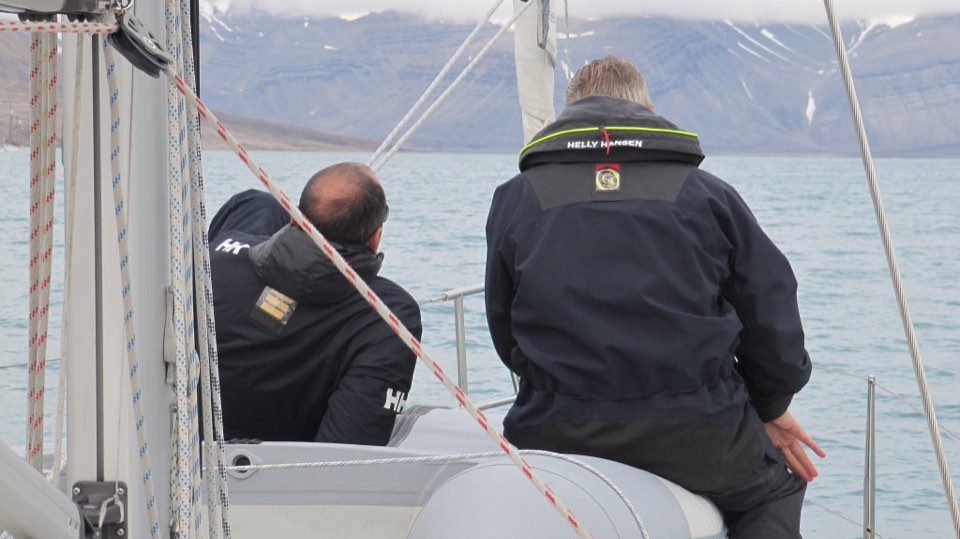
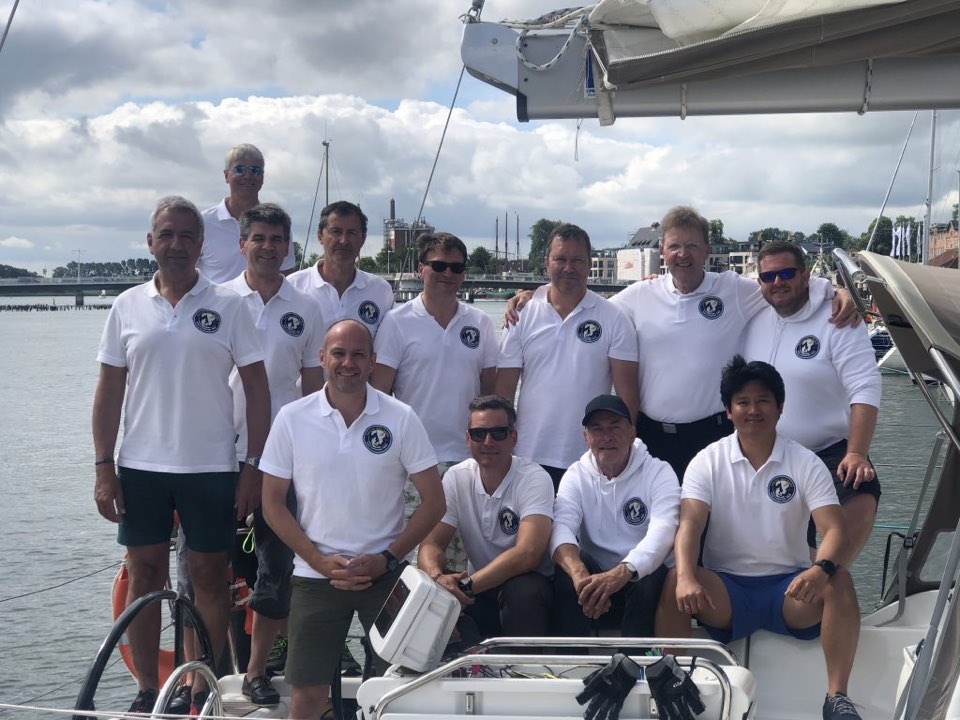

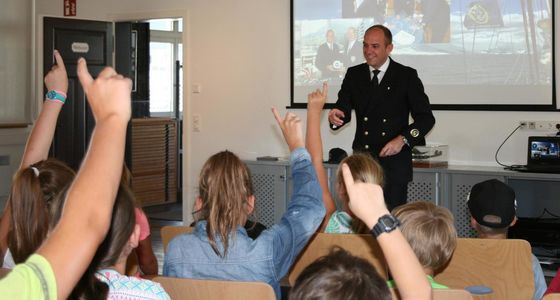

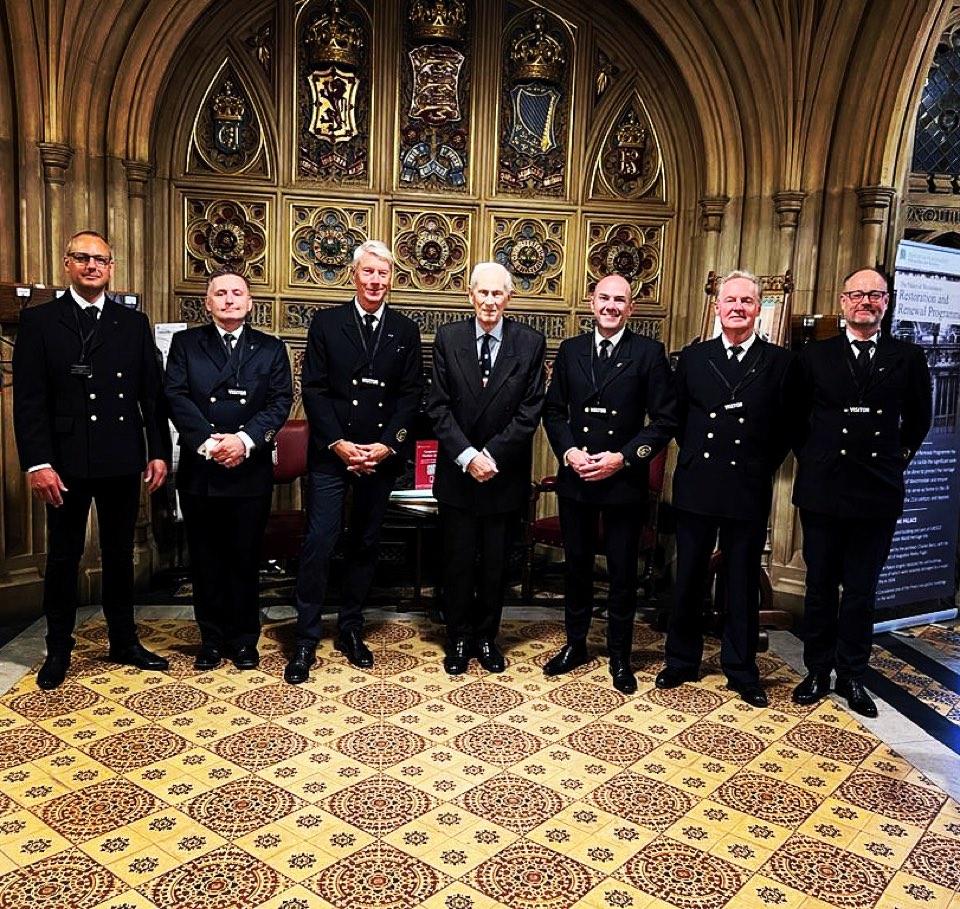

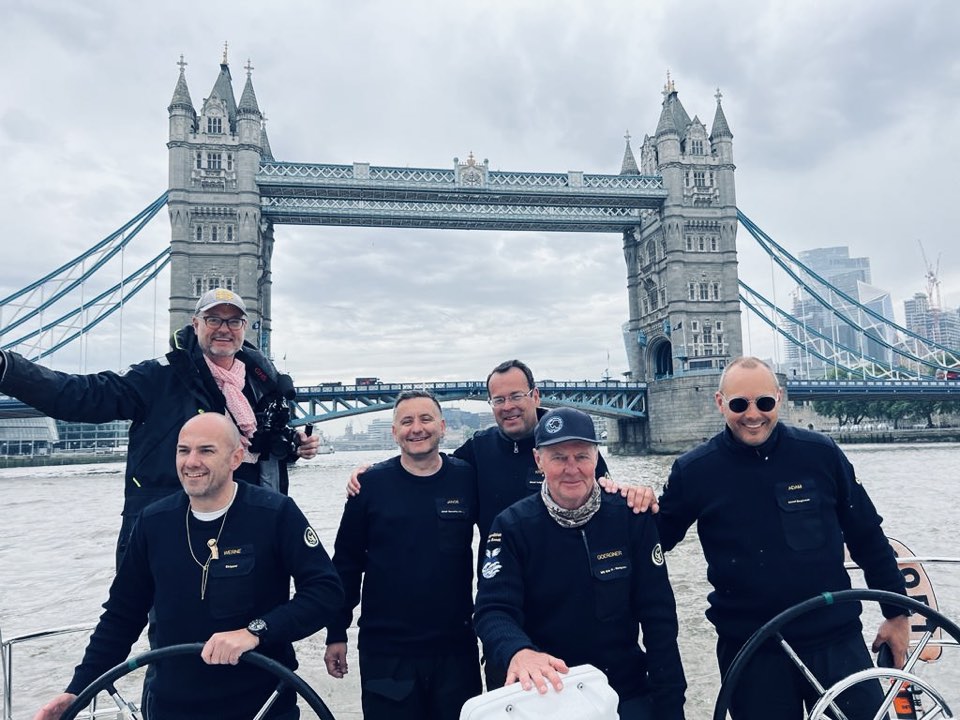
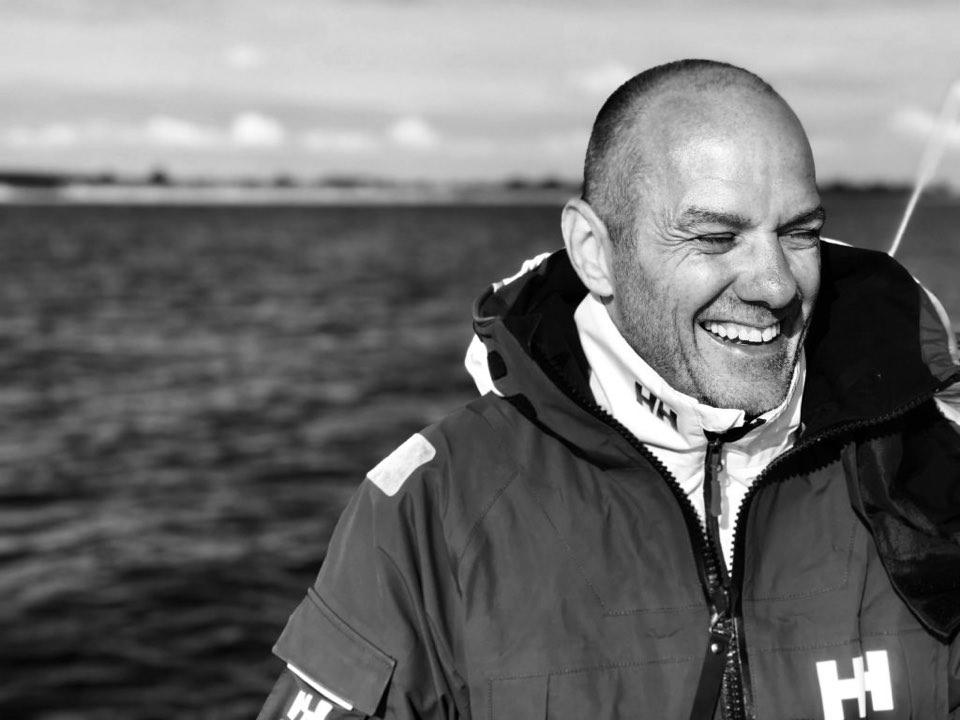
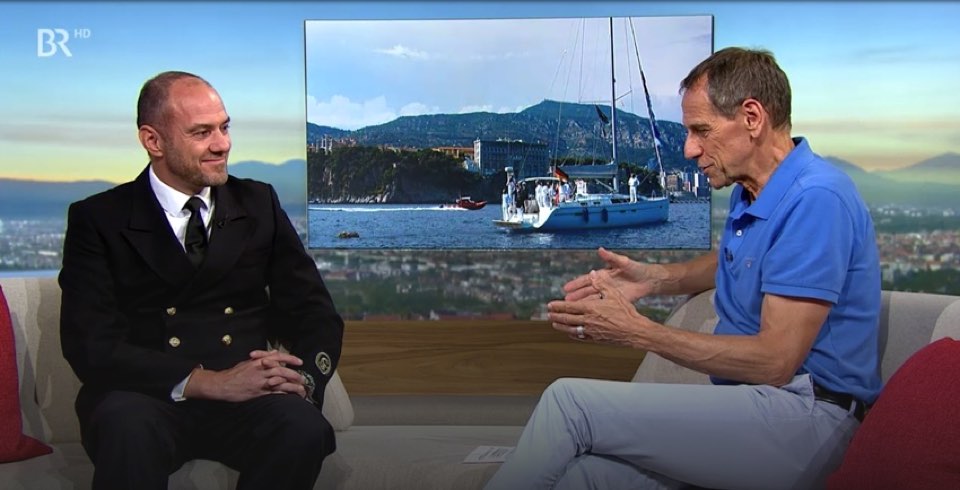
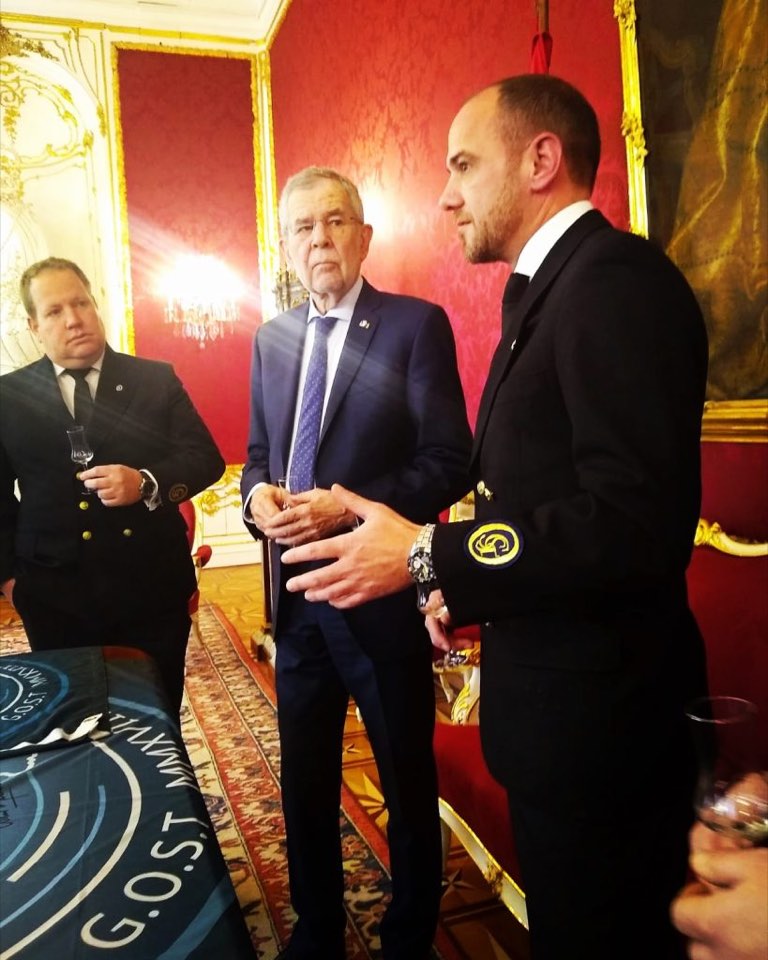
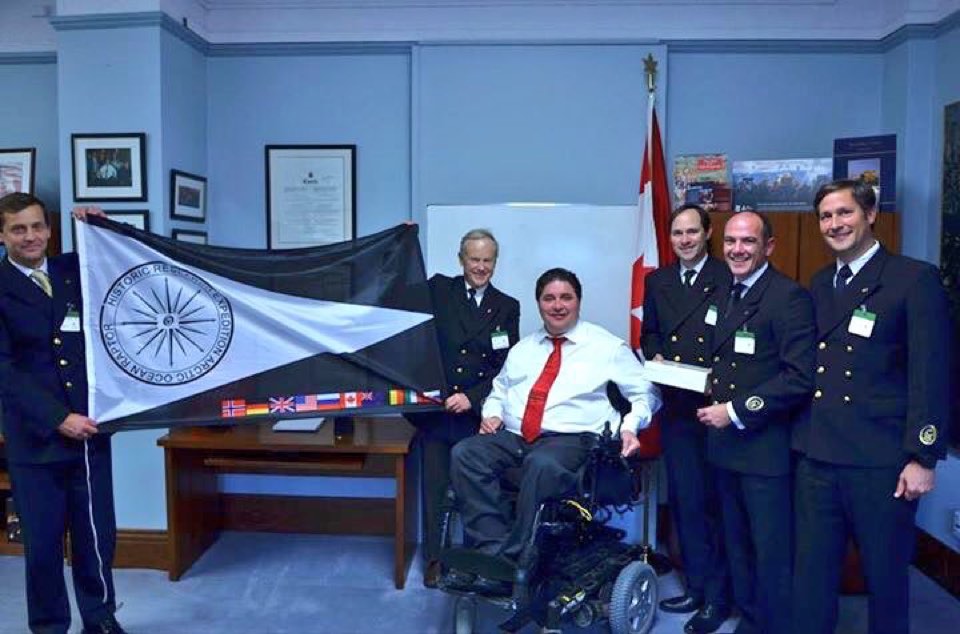
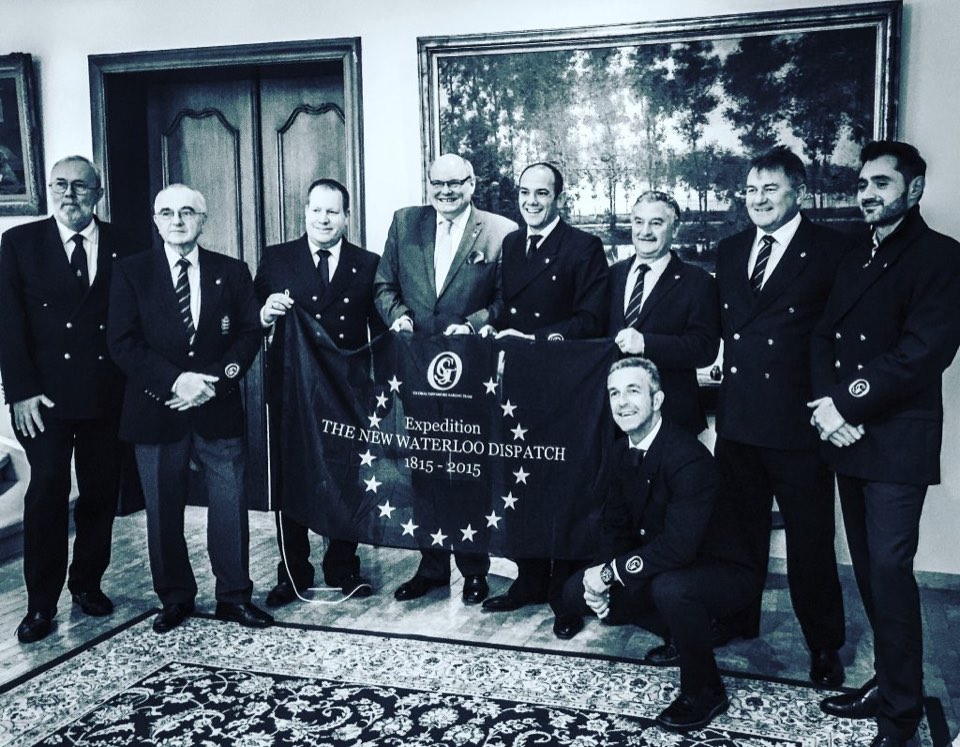
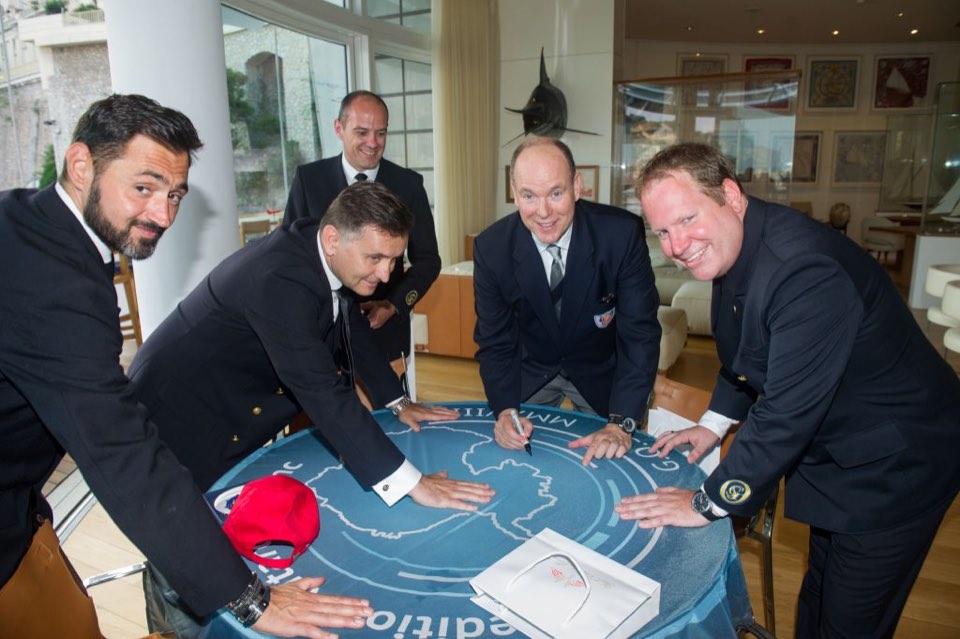
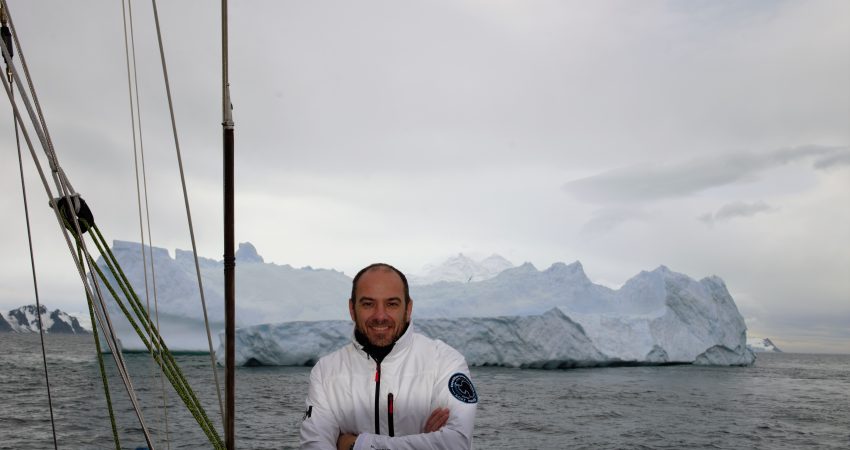
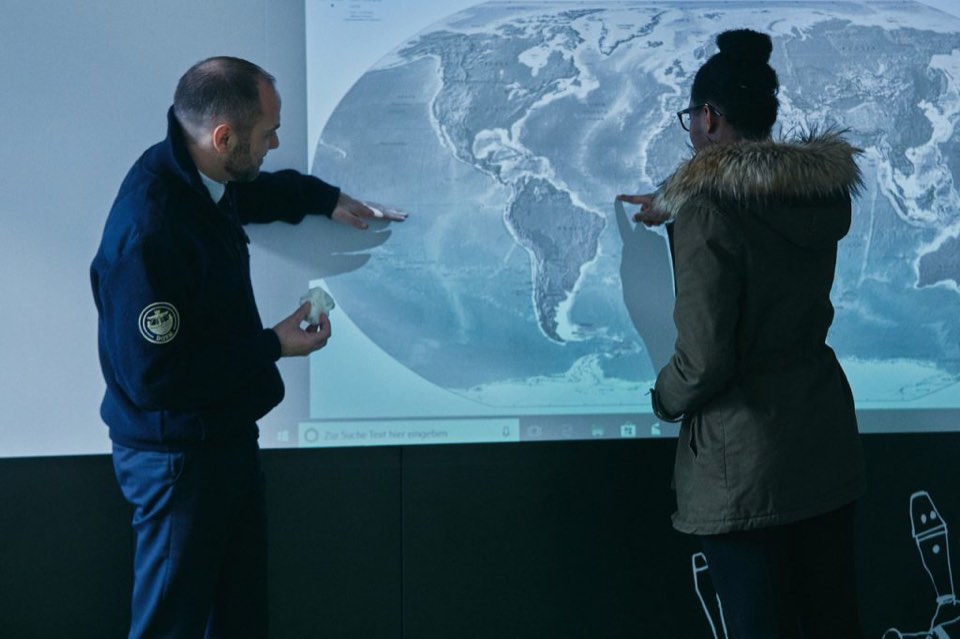
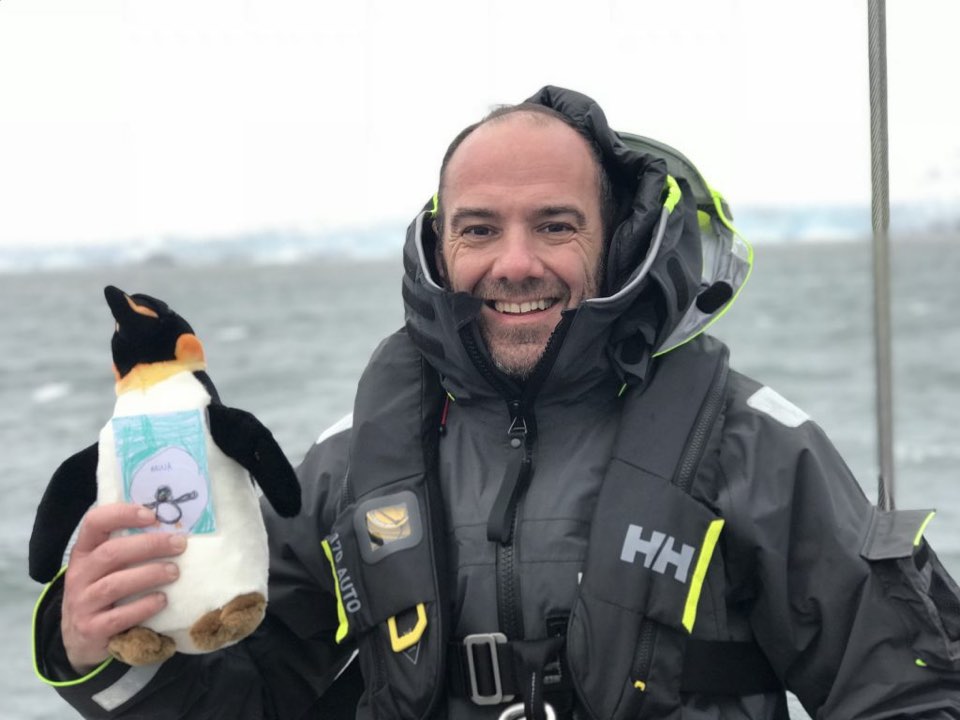
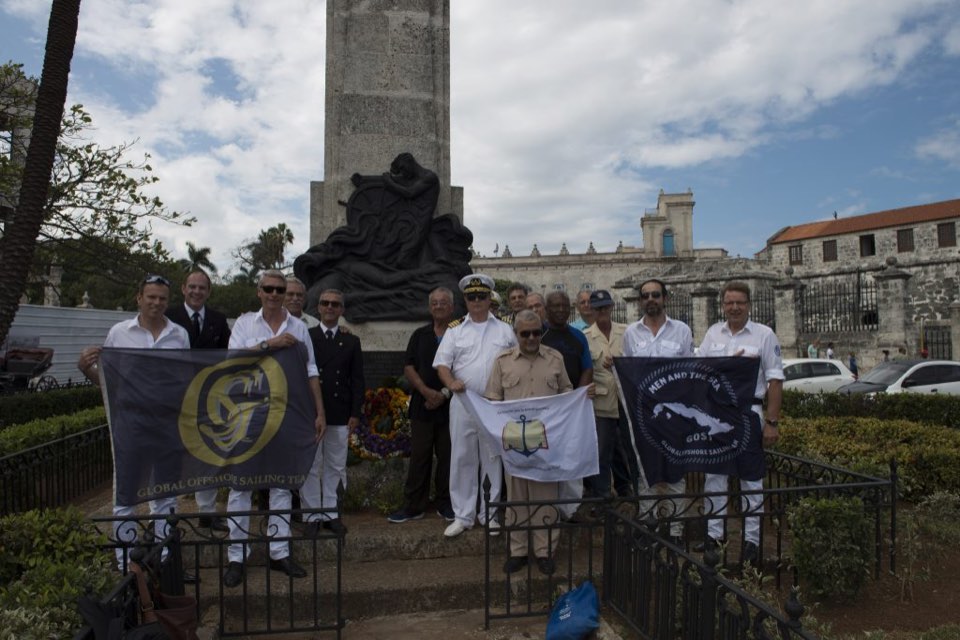

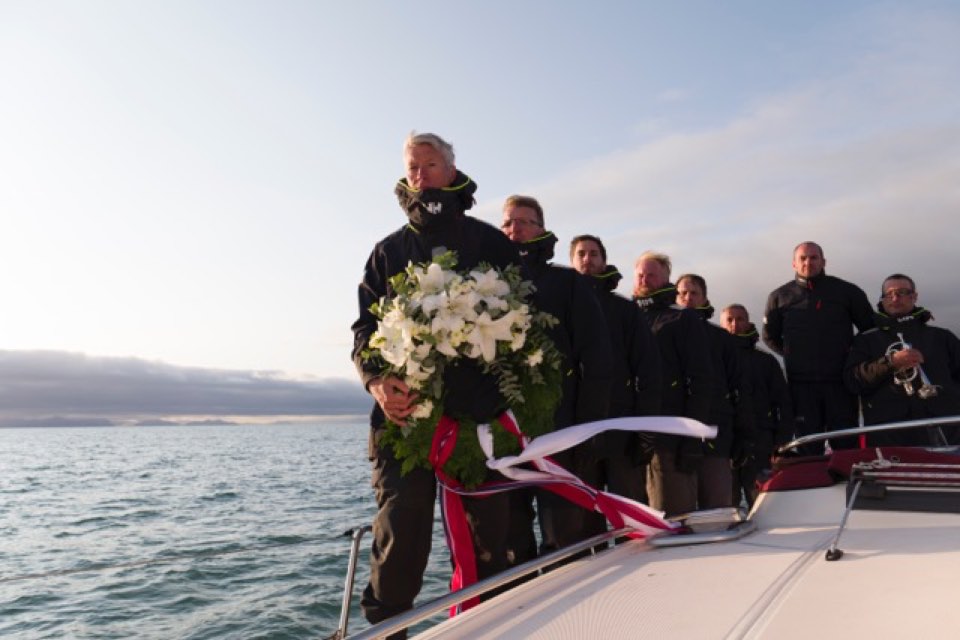
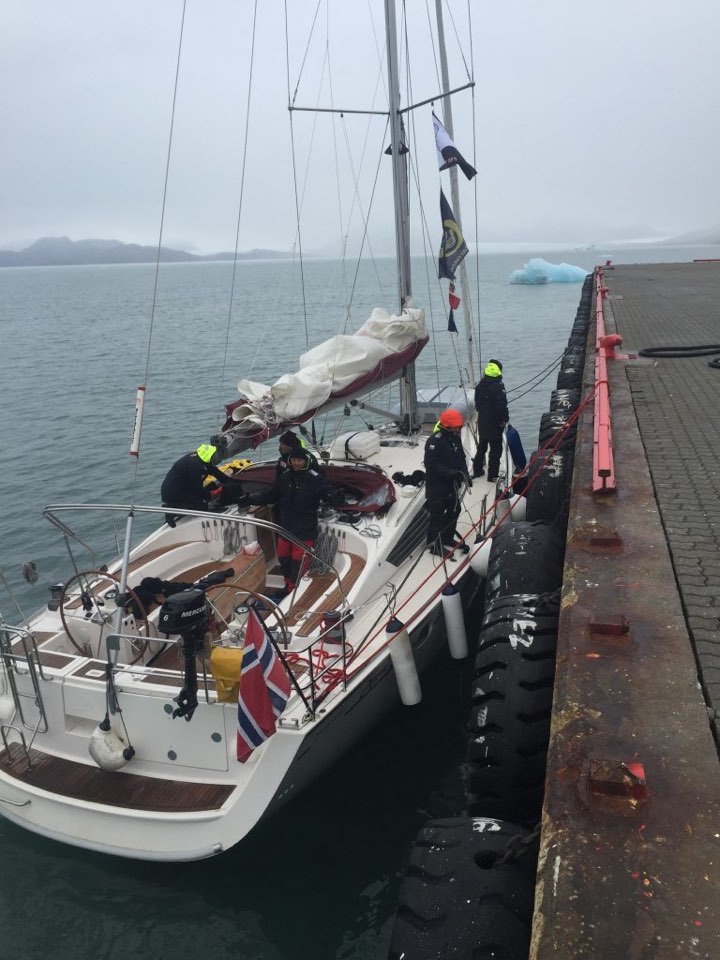
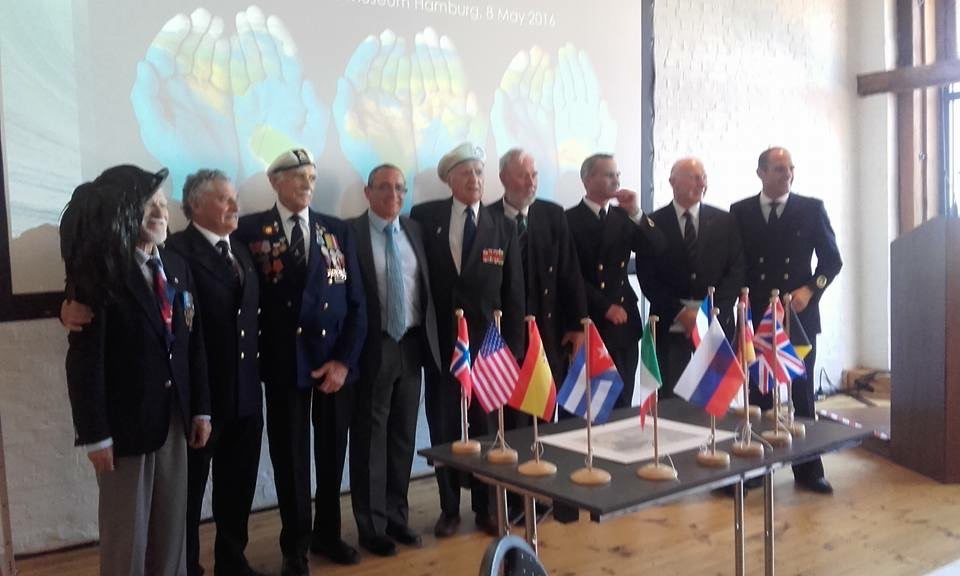
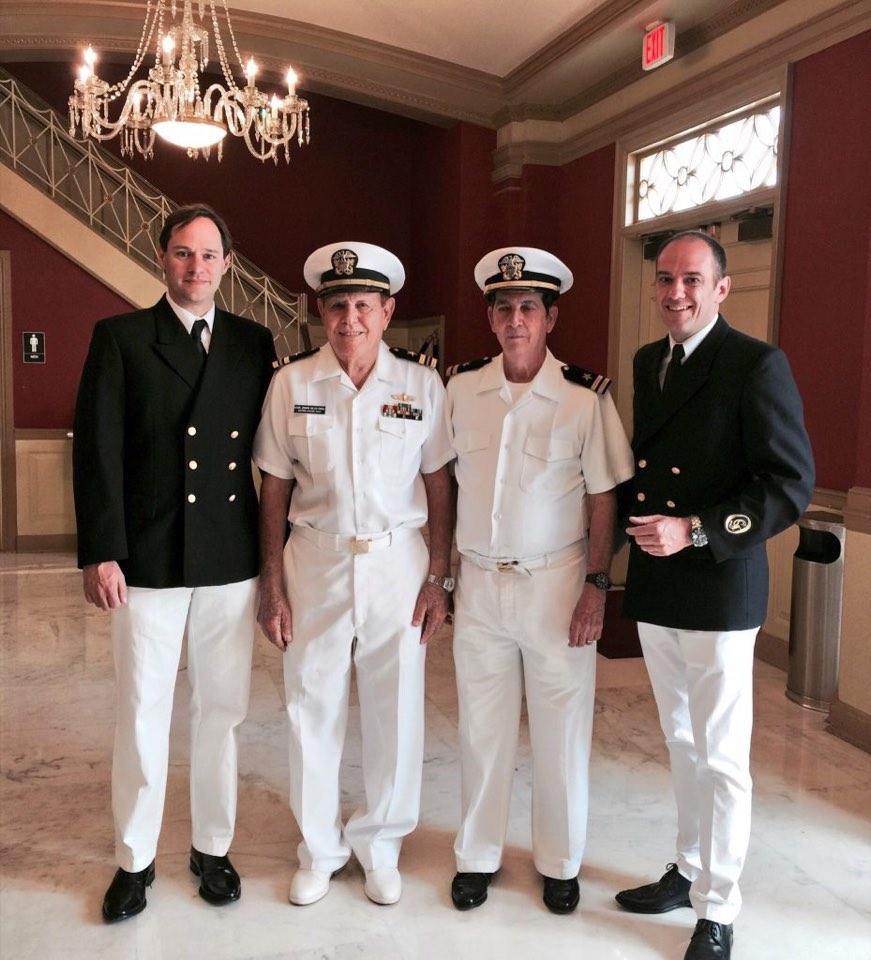
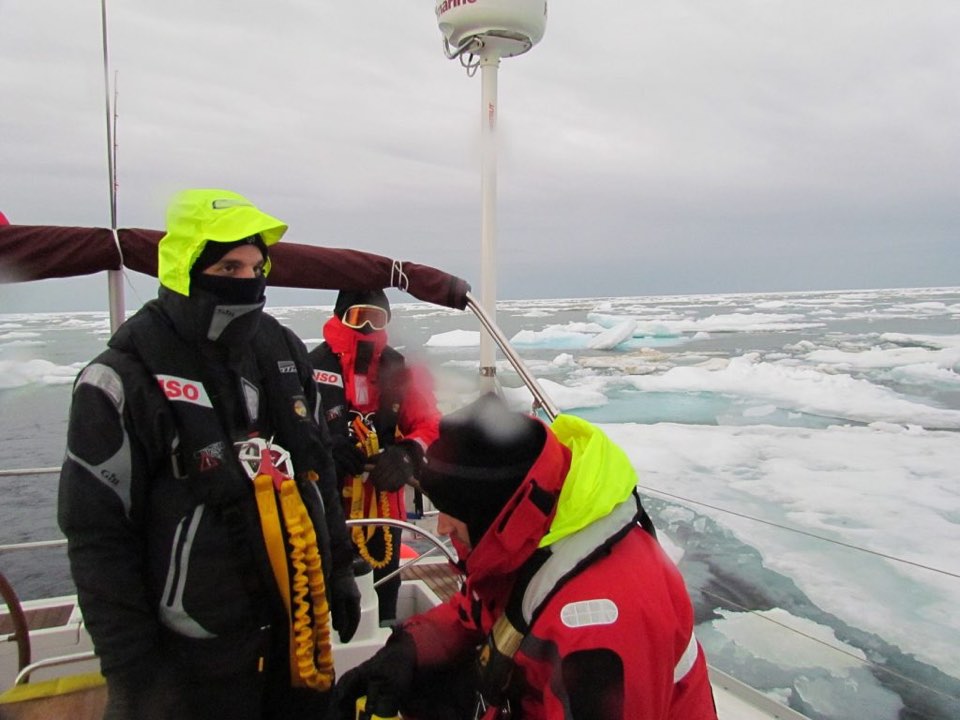
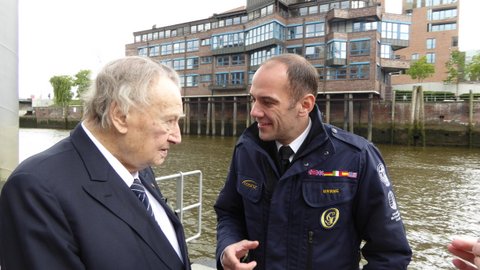
You can find Jochen's homepage here: www.jochenwerne.com
About the Podcast “Heroes of the Seas”

Fascinating stories of the ocean adventure. The heroes of the seas inspire you in an interview with Christian Weigand with their unique experiences at sea. Dive into the world of water sports enthusiasts, researchers, explorers, adventurers and conservationists and be inspired!
You can find pictures and further information on Instagram at @Helden_der_Meere
“A Life for the Ocean" is a book that accompanies the podcast. It tells 10 stories about the heroes of the oceans and is visually stunning in its enthusiasm for the ocean. You can order it at www.ein-leben-fuer-den-ozean.de.
It was a great pleasure speaking with Torben Schröder of FinanzBusiness about “THE SIX TOP CHALLENGES FOR BANKS THIS YEAR”.
He writes in his article: In an increasingly regulated market environment, providers who use their data intelligently will be the most successful, says Jochen Werne from Experian in an interview with FinanzBusiness.

Data is the new oil, they say: "The quality of data will become the kingmaker in the credit risk market of the future and open the way to new market opportunities," says Jochen Werne, CEO of data service provider Experian DACH. In an increasingly regulated market environment, providers who use their data intelligently and master the balance between data protection and customer experience will be the most successful.

Werne names six "top challenges" for this year. These arise from regulations from the European Banking Authority (EBA) - and from technological developments. On the one hand, risk management is to be significantly improved and sustainability criteria verified at the behest of the European Central Bank and the EBA supervisory authority. On the other hand, artificial intelligence (AI) is opening up completely new opportunities in an increasingly complex market environment.
Read the full article in original at FinanzBusiness

Update of the Interview held by MONACŒCOART® founder Maurizio Abbati Interview with Jochen Werne, Co-Founder & Expedition Leader at Global Offshore Sailing Team & CEO at Experian D/A/CH.
Find the original interview and much more here at MONACŒCOART®
Updated: Feb 11, 2024
Photo >> Jochen Werne (2022) © J. Werne
International expert in finance and blockchain, head of several private and corporate Banking divisions, keynote speaker, actively committed in diplomacy and economy transformation following the current shift to Sustainable Development as wished by United Nations and major political, technical and business bodies, he is extremely fond of communicating his passion for oceans and the virtuous interlink between human beings and nature.
Jochen Werne strongly believes in the vital role of individual diplomatic efforts in maintaining peace and a balanced approach to preserving natural ecosystems. He asserts, „Innovation and business, society and diplomacy, ocean and passion are all intricately linked. In today’s interconnected world, our diverse talents can collectively drive positive change every day.“ His insights reflect a profound understanding of the interconnectedness of various elements in fostering international relations.
Werne’s adventurous spirit and deep respect for the scientific community’s contributions to nature have led him to organise numerous ocean missions. These missions have gained significant recognition from esteemed figures such as H.S.H. Prince Albert II of Monaco, the President of France, and the President of Austria, enhancing his knowledge and experience.
Furthermore, Werne co-founded the Global Offshore Sailing Team, an international group comprising members worldwide with significant naval experience. This group is dedicated to preserving naval traditions and emphasizing the importance of ocean expeditions and people’s diplomacy for supporting international understanding
MONACŒCOART® had the pleasure to collect a meaningful feedback directly from Jochen Werne (J.W.), Co-Founder & Expedition Leader at Global Offshore Sailing Team (GOST).
—————
MONACŒCOART®: Jochen Werne, how did your passion for the oceans and sailing come about?
J.W.: As a child growing up in the countryside on the border with Switzerland, the world outside my parents' home always had a great attraction for me. Notably, the Sea with its magical sense of endless freedom, adventure and beauty has always been a trigger in my life. And this fascination still inspires me even though I have sailed the seven seas. Maybe it will never disappear. I had my first contact with sailing during school holidays on Lake Constance. Then, I joined the navy, where I had the privilege to serve for almost two years as a navigator on the three-masted sailing ship ‘Gorch Fock. That finally ignited my passion for the oceans and sailing.
Photo >> The Expedition Blue Ocean 2022 crossing the Tower Bridge in London © GOST
MONACŒCOART®: What values have you learned after so many years of shipping?
J.W.: The most important one is RESPECT. Probably every ocean sailor and mariner would confirm it. As a sailor you experience the marine element in its most breath-taking calm and beauty and its most deadly and dangerous brutality. Respect helps to enjoy one side of the coin and survive the other. Respect leads to this deeper understanding that Nature is in many ways more important and also more powerful than ourselves. The fact that makes us feel humbly is to understand that Nature can always live without us, but we cannot live without Nature. Moreover, a sailor learns how to use Nature to benefit from its power in the best and most sustainable way and to emotionally experience its pure and infinite beauty.
Photo >> Environmental Awareness & Offshore Sailing within ‘Arctic Ocean Raptor’: Sailing to the most northern reachable, partially ice-free points on Planet Earth. Public awareness about the real meltdown of pack ice in Arctic summers will be raised by sailing with a fiberglass sailing yacht to a point just 540 nautical miles or 1.000km away from the North Pole © GOST
MONACŒCOART®: Which marine expedition has shaped you more than others? Why?
J.W.: Every expedition has its uniqueness and therefore it is difficult to prefer one over the others. However, the ‘Arctic Ocean Raptor’ was very special to me. It took us from the northern Norwegian city of Tromsø across what sailors call the ‘devil's playground’, the Barents Sea, to a spectacular natural habitat called Spitsbergen at 80° North. Despite its up-north location, the climate is quite mild due to the Gulf Stream. As our expedition approached Svalbard after three days of sailing through dense fog, we encountered a huge ice barrier that broke away from the cold eastern side of the island due to the warm conditions and drifted on with the current. This, combined with a 9-bft (= Beaufort scale) storm, made the voyage a real challenge, but also impressively demonstrated the fragility of our ecosystem.
Photo >> H.S..H. Prince Albert II of Monaco welcoming Jochen Werne and other members of GHOST at the Monaco Yacht Club © YCM
MONACŒCOART®: Which measures do you think are most important to preserve marine ecosystems? Why?
J.W.: There is no doubt that before starting a movement or action, awareness must be raised. This step is of utmost importance, otherwise one remains lonely and therefore a committed but silent to action interlocutor. The Principality of Monaco has a long tradition of identifying problems for our marine ecosystem and taking action to make many aware of them. H.S.H. Prince Albert I of Monaco immediately recognised the dangers of bottom fishing with the new means of steam technology. Jacques Cousteau not only served science but brought the beauty of the sea into everyone's living room with his work behind the camera and inspired new projects to protect the oceans. Last but not least, H.S.H. Prince Albert II of Monaco is the perfect example of how this has not only become Monaco's heritage but a lived tradition. We are grateful that he has supported us in our expeditions to raise awareness and thus contribute to the conservation of our marine ecosystems.
Photo >> Thorsten Glauber, Bavarian Minister of State, handing over the States Medal to Jochen Werne, Co-Founder of GOST © TMUV
MONACŒCOART®: You have already pointed out several times that scientific and fact-finding missions are particularly effective for intercultural and diplomatic exchange. What makes them instruments of dialogue?
J.W.: Our oceans are the fluid connection between our nations. And even though we are citizens of nations, we all belong to one Planet. As seafarers, we are directly dependent on nature and national thinking takes a back seat. In the daily challenge at sea, nationality, race or gender are not important. What really matters is to achieve our goals as a team, otherwise we will all fail. This also applies to us as a human race. The challenges before us are global challenges that no single nation can solve alone. We need a collective effort, and we have so many examples where the global community has done it together. One of my favourite examples is the Antarctic Treaty, which was negotiated at the height of the First Cold War and still provides the basis for joint peaceful governance of Antarctica today.
Photo >> Antarctic Blanc expedition: the international team held a commemoration ceremony on the historically significant Antarctic volcanic Deception Island, in the name of all supporting states and the United Nations. a wreath of local ice was symbolically formed and laid down in order to pay international tribute to the achievements in the exploration of this unique continent © GOST
MONACŒCOART®: What place does the Principality of Monaco have in the international expeditions that you carry out as part of the Global Offshore Sailing Team (GOST)?
J.W.: We are more than grateful to H.S.H. Prince Albert II of Monaco, the Yacht Club de Monaco, its Board of Directors with Bernard d'Alessandri, Gerd Ziegenfeuter, the staff and members as well as the press for their excellent support in our common tasks. Together we were able to achieve outstanding results. Starting with the expedition ‘Antarctic Blanc’ 2018, which resulted in a state act supported by 19 nations including the United Nations, to the Prince Albert I Memorial Expedition ‘Navigators Heritage’. Together, we have succeeded not only in supporting science, but also in bringing people and nations closer together and raising awareness of the needs of our oceans.
Photo >> Maximino Gómez Alvarez, Vice-President of AIDHNC, giving the "Ancla d'Oro" to Jochen Werne, Co-Founder of Global Offshore Sailing Team (Maritime Museum, Hamburg, 8th May 2016) © GOST
MONACŒCOART®: GOST expeditions have been awarded the highest honours by heads of state and international institutions. What is the recognition to which you are most attached? Why?
J.W.: We are more than grateful to have been honoured with a State Medal for our commitment to environmental protection or with the Ancla d'Oro (Golden Anchor) of the Asociación para la Investigación y Difusión de la Historia Naval de Cuba and the Admiral of the Fleet the Lord Boyce Award for promoting international understanding. Among all the awards, the highest recognition for me is the fascinated smile on a young person's face when one of the stories of the sea lights the flame of passion for marine elements. It is their spirit that will form the basis for future action. Just as others in the past like Jacques Cousteau have lit a fire in us for the Sea. It is the quote attributed to the brilliant Antoine de Saint-Exupéry, author of the beautiful novel Le Petit Prince, that probably describes it best: If you want to build a ship, don't drum up the men to gather wood, divide the work and give orders. Instead, teach them to long for the vast, endless sea. ***
? ✒By Maurice Abbati
To know more about Jochen Werne's ocean expedition project please visit:
______________________________________
Discover MONACŒCOART® for Business:
Original published in German by IT Finanzmagazin - find here. Translation provided by DeepL.com. Photos provided by Pixabay, Experian, Jochen Werne. Collage design by Canva

Financial institutions are facing a significant change in the assessment of credit risks this year. Now comes 30 June: the deadline for new standards in credit risk assessment. Jochen Werne (CEO Experian DACH) is convinced that data quality will become the kingmaker in the credit risk market.
by Jochen Werne, CEO Experian DACH

Since 2021, financial service providers have been required to implement the supervisory priorities of the ECB and EBA. These priorities include the comprehensive improvement of credit risk management practices and the integration of new risk factors, particularly in the area of climate and the environment, into their risk management strategies. At the same time, the requirements for data management in the context of credit scoring are increasing. Artificial intelligence (AI) will play a key role here and banks will have to adapt to the new EU AI Act.
“By the deadline of 30 June 2024, large banks must have adapted their systems and infrastructures in accordance with the EBA Loan Origination and Monitoring Guidelines (EBA-GL LOM) for effective credit risk management and monitoring."
This also includes closing data gaps. However, smaller, nationally supervised financial institutions must now also comply with these new guidelines, as additional elements of the 7th MaRisk amendment came into force on 1 January 2024, which are based on the EBA guidelines, among other things. Financial organisations must review their existing practices in 2024 and adapt their credit risk assessment standards accordingly. In future, credit assessment models will have to take much greater account of transparency, fairness and sustainability, particularly from an ESG perspective. The game changer for this is increasing their data quality.
All of this leads to five important changes:
In view of the weak economic momentum, the expected increase in non-performing loans and challenging margin developments, financial institutions must develop new growth strategies.
“Investments in technologies such as generative AI and forward-looking risk management are becoming increasingly important."
Advanced data analytics support organisations in various phases of their customer lifecycle. Already in the application phase, high data quality enables a more efficient assessment of creditworthiness. In portfolio management, advanced data analysis helps to proactively manage risks and dynamically manage the credit portfolio. Advanced analytics and high data quality help to strengthen resilience to risks, including data-based early risk identification and an optimised dunning and collection process.
“Over the next 12 months, strengthening business resilience through automation and digitalisation will be key to responding to new risks such as AI, cyber threats and geopolitical tensions."
These challenges not only affect the target customer landscape, but are also of great importance in the context of new ESG requirements. Due to their complexity and innovative nature, traditional approaches based on historical data cannot cope with these risks: Traditional approaches to data analysis and model preservation increasingly have to deal with slow regulatory processes on the one hand and a more dynamic macroeconomic environment and growing cyber risks on the other. In order to cope with this competitive situation, new strategies in the utilisation of all relevant data are urgently required, which place advanced analytics and the improvement of data quality at the centre.
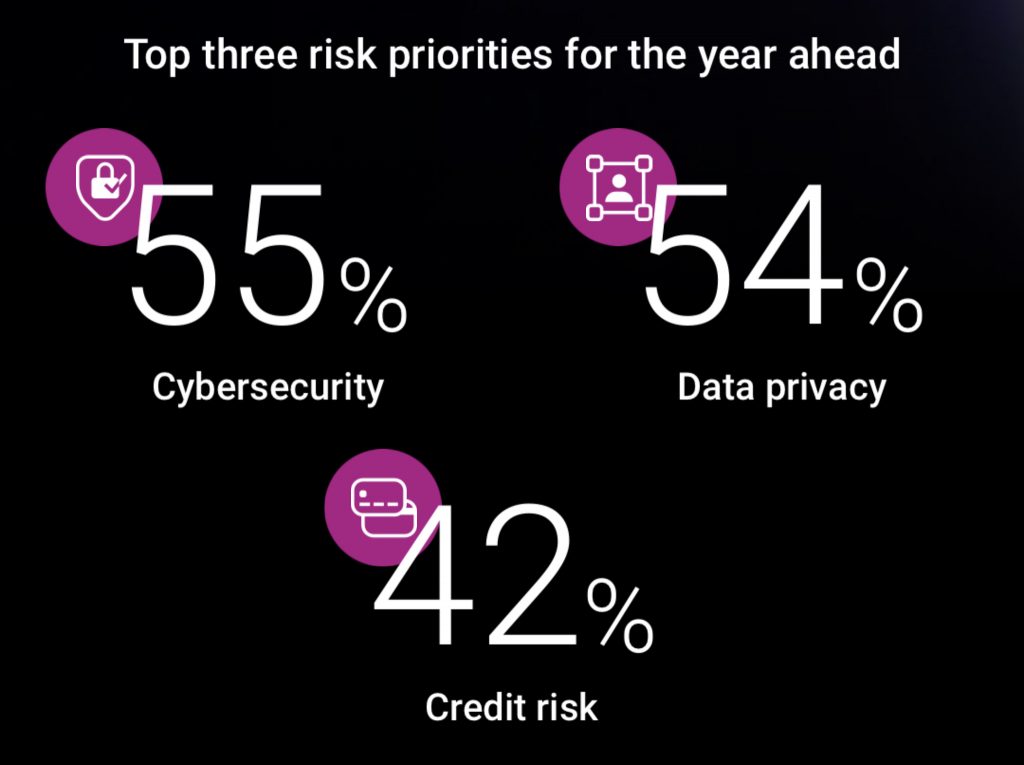
Since the end of 2023, the EU Commission has been aiming to drive forward the "Consent Driven Economy" with new regulations such as PSD3 (Third Payment Services Directive), PSR (Payment Services Regulations) and FIDA (Access and Use of Financial Data) and to give consumers more opportunities to use the data available about them."
As one of the players with the greatest wealth of data, this presents banks with a high risk in the face of new competitors. At the same time, however, it also offers them an opportunity to become a trusted partner for consumers. These regulations, which focus on the promotion of open banking services, greater control of data access and measures against online fraud, represent a starting point for financial institutions to think about the further use of transaction data. In addition to combating fraud, advanced analytics of transaction data, even taking into account all compliance requirements, opens up additional opportunities for interaction with end customers to improve the customer experience or the chance to monetise data.

“The EU AI Act will have a significant impact on the use of AI in the financial sector and further strengthen the financial sector's technology focus."
AI and machine learning (ML) will further automate decision-making processes in the future and strategic investments in this area will therefore become even more crucial for growth in the future. According to a study by Forrester Consulting commissioned by Experian, 60 per cent of German companies already take a similar view and have a comprehensive AI-based risk management programme in place. By using these technologies, credit and fraud risks can be assessed more precisely and efficiently, even in uncertain economic times. Companies that implement these developments are positioning themselves as pioneers in a rapidly developing, technology-driven financial sector: 78 per cent of the companies surveyed in the study in Germany also state that they are prioritising the use of further AI and ML applications.
“The ongoing implementation of continuous development and continuous improvement, particularly in the areas of business, analytics and IT, is becoming increasingly important."
This includes identifying core business processes that will benefit significantly from cloud migration and defining clear priorities and objectives for the migration process. Cloud-based data analytics plays a central role in gaining valuable insights from customer behaviour, market trends and operational data to improve business processes and make more informed decisions.

—————————-
About the author: Jochen Werne has been CEO DACH at Experian since August 2023. Previously, he served as Managing Director at Prosegur Crypto and as Chief Development & Chief Visionary Officer at Prosegur, where he was responsible for the development and implementation of strategies in the areas of business development, innovation and international sales. Werne's career includes significant leadership positions at Bankhaus August Lenz & Co. AG, Mediolanum Banking Group, where he served as Director and Authorised Representative and was instrumental in the company's digital business transformation. His academic career includes a FinTech programme at the University of Oxford (2017-2018) and a Diploma in International Banking at Goethe University Frankfurt (1997-2000).
 Author: Jochen Werne / 26.12.2023
In an era marked by rapidly advancing technology and increasing global interconnectivity, the fight against online fraud has become a paramount concern for financial institutions, businesses, and regulators worldwide. Part of my professional work revolves around understanding and mitigating the risks associated with financial fraud. The Experian Forrester Fraud Research Report 2023, which was recently released, sheds light on the escalating threat of online fraud and the evolving strategies to counter it, particularly through the use of Machine Learning (ML) and Artificial Intelligence (AI).
The report's findings are stark: a 74% increase in fraud losses in Germany, reflecting nearly the global increase rate. This surge is not just a statistic; it's a clear indication of the sophisticated and pervasive nature of modern financial fraud. Companies across various sectors are feeling the impact, with financial services bearing the brunt. This trend is deeply concerning not only for the economic health of individual businesses but also for the broader stability and security of the financial system.
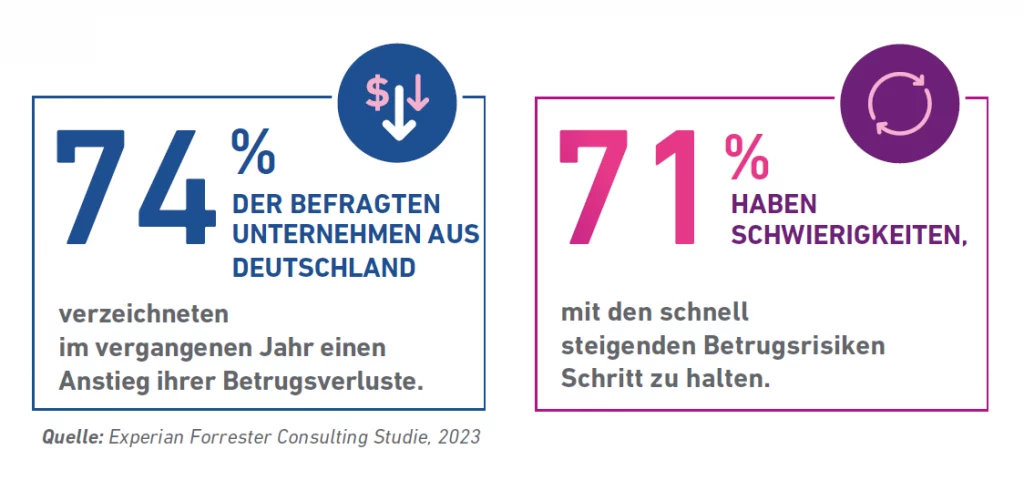
From a geopolitical perspective, the rise in online fraud is a multifaceted challenge. It's a threat that transcends borders, affecting relations among nations, and has become a significant factor in international policy and security discussions. Countries, including Germany, are increasingly recognising the need for cooperative international efforts to combat this scourge. The geopolitical implications are profound, as fraud undermines economic stability and erodes public trust.

Turning to the German banking sector, the issue of compliance and reputation risk under the framework of Minimum Requirements for Risk Management (MaRisk) is particularly pertinent. Banks are finding themselves at the forefront of the battle against online fraud, necessitating robust risk management strategies that align with regulatory requirements. Under MaRisk, the mandate is clear: implement effective, comprehensive controls to detect, prevent, and manage fraudulent activities. The reputational risk for banks and their board members is immense; a single lapse can lead to significant financial losses, legal consequences, and lasting damage to customer trust.
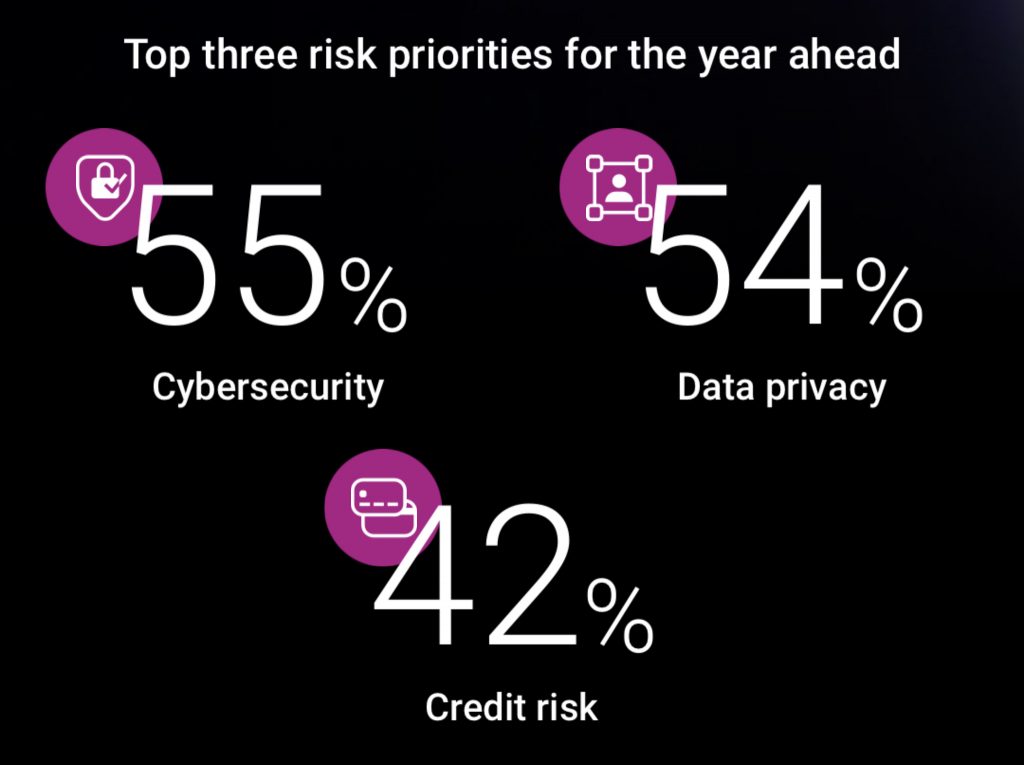
In this challenging landscape, AI/ML-based fraud prevention methods stand out as beacons of hope. These technologies offer the promise of enhancing detection capabilities, reducing false positives, and adapting swiftly to new fraudulent tactics. However, their implementation must be undertaken with a clear understanding of the ethical implications and potential biases inherent in AI systems. As we embrace these technologies, we must also commit to transparency, accountability, and continuous improvement to ensure they serve the interests of all stakeholders fairly and effectively.
Despite the challenges, I believe there is a path forward that balances the need for security with the imperative for innovation and growth. The key lies in embracing a multi-faceted approach to fraud prevention that leverages the best of technology, human expertise, and regulatory compliance. ML, with its ability to learn and adapt to new patterns, offers a powerful tool in this fight. However, its effectiveness hinges on the quality of data, the integrity of algorithms, and the wisdom of the humans who guide its evolution.

The German companies surveyed in the study are acutely aware of the challenges and opportunities presented by AI/ML in fraud prevention. The overwhelming majority recognise the efficacy of ML-based approaches and anticipate their increasing dominance in the field. Yet, they also acknowledge the hurdles, including the costs associated with deploying advanced fraud prevention solutions, the need for continuous adaptation, and the importance of addressing the ethical considerations of AI use.
In my experience, one of the most critical factors for success in this endeavour is collaboration. Tackling online fraud is a collective effort that requires the involvement of businesses, regulators, technology providers, and consumers. By working together, sharing knowledge, and fostering a culture of innovation and vigilance, we can stay ahead of fraudsters and protect the integrity of our financial systems.
Another vital aspect is education and awareness. Both consumers and employees must be informed about the risks of online fraud and the steps they can take to prevent it. Regular training, robust policies, and a culture of security are essential in creating a resilient defense against fraud.

Finally, we must recognize that the fight against fraud is an ongoing battle. As technology evolves, so too will the tactics of fraudsters. We must remain agile, constantly updating our strategies, investing in new technologies, and adapting to changing regulatory landscapes. This dynamic approach is not just about defense; it's about building a stronger, more secure future for everyone.
The Experian Forrester Fraud Research Report 2023 is a call to action. It highlights the urgent need for enhanced strategies, stronger collaboration, and a steadfast commitment to ethical, innovative solutions in the fight against online fraud. As leaders in the financial services industry, we have a responsibility to take the helm, steering our organisations towards safer waters in this tumultuous sea of digital threats. By harnessing the power of AI/ML, prioritising ethical considerations, and fostering a culture of collaboration and continuous learning, we can not only mitigate the risks of online fraud but also pave the way for a more secure, prosperous, and trustworthy financial ecosystem.
#fraudprevention #dataliteracy #machinelearning
By Jochen Werne.
Duesseldorf, 5 November 2023
From the eloquent words of Shakespeare in Henry V, where he once proclaimed, “all things are ready if our minds be so”^1 to the monumental shifts brought by Gutenberg’s printing press^2, history reminds us that change is both an inevitable and defining characteristic of human progress. As the world stands at the threshold of a new epoch marked by rapid technological shifts and pronounced geopolitical transformations, this profound sentiment compels us to reflect on the paramount importance of preparedness and perspective. The way societies respond to these shifts determines the direction of their trajectory. In our current age, Europe finds itself at the nexus of global transformations driven by technological advancements and geopolitical tectonics.

Peering through the lens of history, one quickly realizes that technology has been both a beacon of hope and an augury of upheaval. Take the 15th century’s monumental invention of the printing press as a case in point^2. This groundbreaking innovation democratized access to information and catalysed a substantial uptick in literacy rates across Europe. As Eisenstein posits, the “Printing Revolution” catalyzed an era where knowledge was no longer the privilege of the few but a right of the many^2. Yet, its reverberations were not confined to just reading and writing. The press became the vessel through which Martin Luther disseminated his Ninety-Five Theses, triggering a religious revolution that reshaped the European continent.

However, the journey wasn’t without turbulence. This democratization of knowledge played a pivotal role in challenging the established order, culminating in events like the Reformation, which MacCulloch describes as Europe’s great house divided^3.
Niall Ferguson, in “The Square and the Tower”, beautifully illustrates the timeless tension and interplay between networks and hierarchies^4. Historically, technologies like the printing press have emerged as disruptors, challenging established orders and reshaping hierarchies. The press, for instance, allowed for the free flow of ideas, becoming an early network that democratized information. Yet, not everything it propagated was for the betterment of society. The infamous “Malleus Maleficarum”, an ostensibly scholarly treatise, fueled the flames of the European witch hunts, leading to persecution, paranoia, and a dark chapter in history^5.
Fast forward to the present, and we witness a world where technology continues to shape geopolitical realities. Maddison’s macro-economic study reveals that the global center of economic gravity has been steadily shifting towards the East, particularly since the dawn of the 21st century^6. Nowhere is this shift more apparent than in the realm of technology.
The US-China tech rivalry, explored by Fuller, highlights the strategic challenges posed by China’s technological ascent^7.
The race for supremacy in AI, quantum computing, 5G, and biotechnologies marks the modern-day power play. But this isn’t merely about technological one-upmanship; it signifies a larger canvas of geopolitics, economics, and even societal values.
Many analysts are drawing parallels to the Cold War, coining the term “Tech Cold War” or “Cold War II”. Unlike the 20th-century version, primarily characterized by nuclear deterrence between the USSR and the US, this new Cold War positions the US and China in an intense rivalry for technological, economic, and military dominance. In the midst of this rivalry, both nations are hyper-aware of the stakes.
More than a century ago, the naval strategist Alfred Thayer Mahan, in his seminal work on sea power, postulated that maritime dominance was crucial to national greatness.
Today the Indo-Pacific has become the focal point of 21st-century geopolitics. Here, China’s assertive ‘Two Ocean Strategy’ is emblematic of its ambitions to exert influence both in the Pacific and the Indian Ocean. This expansive maritime vision is not just about sea lanes and trade; it’s a reflection of China’s aspirations to be a global power.
Simultaneously, the Taiwan question looms large in this maritime strategy. Its strategic location in the first island chain poses both an opportunity and a challenge for Beijing. Control over Taiwan would offer unencumbered access to the broader Pacific.
However, the rise of one power often brings countermeasures by others. The ‘AUKUS’ agreement between Australia, the United Kingdom, and the United States is a manifestation of this dynamic. While cloaked in the language of technological collaboration, especially in the realm of nuclear-powered submarines, the underlying intent of AUKUS is clear. It seeks to counterbalance China’s growing naval capabilities and assertiveness, particularly in the South China Sea.
Reflecting on Mahan’s sea power doctrine in this context provides a sobering perspective. Mahan believed that maritime dominance was the linchpin of global influence. Yet, he also understood the responsibilities and challenges that came with such power. In our contemporary setting, while nations pursue their maritime strategies, it is imperative they also embrace the principles of dialogue, cooperation, and conflict avoidance.
Taiwan epitomizes this interplay. As a beacon in semiconductor manufacturing, Taiwan’s geopolitical relevance can’t be overstated. Any instability could trigger economic consequences potentially dwarfing the aftermath of the Covid-19 pandemic^9.
In the intricate web of global technology supply chains, few names stand out as prominently as Taiwan Semiconductor Manufacturing Company (TSMC). Founded in 1987, TSMC has ascended the technological hierarchy to become the world’s leading semiconductor foundry, a testament to its unwavering commitment to innovation and excellence.

TSMC’s significance is multifaceted. For one, it’s the world’s largest dedicated independent semiconductor foundry^8. With clients ranging from major tech giants like Apple and Nvidia to burgeoning startups, TSMC’s production underpins a vast swathe of the digital products and solutions we rely on daily. However, TSMC’s role isn’t merely a commercial or technological one. It is geopolitical. With the escalating “Tech Cold War” between the U.S. and China, TSMC finds itself at an intriguing junction. The company’s strategic importance is underscored by global reliance on its cutting-edge chip manufacturing capabilities. This reliance has not only made TSMC a coveted partner but also a strategic asset in the larger scheme of global geopolitics. The U.S. push to ensure TSMC sets up manufacturing bases on its soil, and China’s keen interest in the semiconductor sector, highlights the foundry’s pivotal position.
Furthermore, TSMC embodies Taiwan’s broader significance in the tech world. As the geopolitical tussle intensifies, Taiwan – and by extension, TSMC – becomes a linchpin for global tech supply chains. A disturbance in TSMC’s operations, as speculated, could have cascading ramifications across industries, from consumer electronics to automotive and healthcare. Any significant disruption in this intricate supply chain would reverberate globally, with experts suggesting a potential 5% drop in global automotive production^9.
As chips become smaller, denser, and more powerful, the precision and capability of lithography machines must evolve in tandem.
Here’s where Europe and ASML, a Dutch gem, comes into play. The company is the sole producer of extreme ultraviolet (EUV) lithography machines^8, an advanced technology that allows for the creation of incredibly dense and efficient chips. With transistors now approaching atomic scales, EUV lithography is no less than a technological marvel, allowing chipmakers to etch circuits just a few nanometers wide.
However, the conversation around ASML isn’t merely about technological mastery. Given its unique position as the only producer of these EUV machines, ASML enjoys a quasi-monopolistic status in this niche yet profoundly impactful domain. In an era where technological supremacy is increasingly intertwined with geopolitical power, also ASML’s importance cannot be overstated. The machines they produce are not just expensive and sophisticated pieces of equipment; they are, in many ways, gatekeepers to the next generation of digital innovation.
Such a near-monopoly naturally draws attention. Nations and corporations are keenly aware of the strategic value inherent in controlling or accessing state-of-the-art chipmaking technology. With the ongoing technological cold war, where semiconductor supply chains have become part of the geopolitical chessboard, ASML finds itself in a spotlight it never sought but cannot avoid.
Europe’s position in this evolving tech landscape is unique. While traditionally viewing the Atlantic alliance as a cornerstone of its foreign policy, the rise of China necessitates a recalibrated approach^10. Europe’s interlinked trade with China, especially through critical chokepoints like the Malacca Strait, underscores the strategic dimension of this relationship^11.
In this whirlwind of technological and geopolitical flux, Europe is not an idle spectator. With a collective GDP nearing $22 trillion, it wields considerable influence. Europe’s role is multi-dimensional: an economic powerhouse, a voice of reason in tumultuous times, and often a mediator in global disputes.
The European Central Bank (ECB) embodies Europe’s proactive stance^12. Recognizing the flux, the ECB’s vision for 2023-2025 zeroes in on three pillars:
The ECB recognizes that the financial institutions it oversees must adapt to these transformative times. A crucial element of this adaptation is embracing digitalization, with a special emphasis on robust data-driven risk management.
The above mentioned ECB focus is highlighted by Experian’s 2023 report on why AI-driven, regulatory-compliant analytics solutions are becoming imperative for European banks^13.
Europe’s approach to AI regulation, championing the cause of ‘explainable AI’, shows its commitment to integrating technology with ethics. This dedication harks back to its legacy of literacy and the importance of accessibility, a theme explored by Graff^14. As Europe navigates the ‘Asian Century’^15, it does so with a clear vision: to leverage its historical experiences and chart a course that balances innovation with ethical considerations. The European AI Act encapsulates this approach. The Act’s core philosophy revolves around ensuring AI applications are safe and respect existing laws and values. This includes transparency obligations, strict criteria for ‘high risk’ AI applications, and a provision for setting up a European Artificial Intelligence Board.
One might wonder, why the emphasis on explainability? As AI systems permeate critical sectors, from healthcare to finance, their decisions can profoundly impact individuals. An ‘explainable AI’ ensures that these decisions are not just accurate but also comprehensible to the average person. This empowers individuals, fostering trust in AI systems.
The Act, however, isn’t just about explainability. It recognizes the diverse applications of AI and categorizes them based on risk. For ‘high-risk’ applications, stringent requirements, from transparency to accuracy and security, are mandated. This stratified approach ensures that while innovation isn’t stifled, critical areas receive the scrutiny they warrant.
Any discussion on global transformation would be incomplete without examining the economic engines driving these changes. China’s astounding growth, with a GDP of $17.7 trillion by 2022^16, and its decade-long average annual growth rate of 6.5%, contrasts with the US’s $25.3 trillion GDP and a more conservative 2.3% growth rate^17. The European Union, showcasing resilience and integration, clocks a collective GDP nearing $22 trillion^18, with trade figures underscoring its global economic clout^19.
Our world is in a state of flux, reminiscent of those transformative moments in history. From the monumental shifts of the Printing Revolution^2 to the divisive yet transformative Reformation^3, Europe has witnessed and shaped global trajectories. As it stands at the crossroads of another transformation, it draws from its rich historical tapestry, aiming to strike a balance between embracing the future and preserving its core values.
The digital future beckons, but it’s not without its challenges. Whether it’s the complex web of tech geopolitics or the imperative of sustainable growth, Europe’s journey forward will need to be both adaptive and principled. At the heart of this journey lies the potent combination of data and ethics. And as Europe strides into the future, it carries with it a clear message: progress, when rooted in ethics and driven by knowledge, can usher in an era that’s not just technologically advanced but also just, balanced, and peaceful.
Footnotes:
^1 Shakespeare, William. “Henry V.” Act IV, Scene 3. ^2 Eisenstein, Elizabeth L. “The Printing Revolution in Early Modern Europe.” Cambridge University Press, 1983. ^3 MacCulloch, Diarmaid. “Reformation: Europe’s House Divided 1490-1700.” Penguin UK, 2004. ^4 Ferguson, Niall. “The Square and the Tower: Networks and Power, from the Freemasons to Facebook.” Penguin, 2018. ^5 Kramer, Heinrich and Sprenger, James. “Malleus Maleficarum.” Dover Publications, 1971. ^6 Maddison, Angus. “Contours of the World Economy 1-2030 AD: Essays in Macro-Economic History.” Oxford University Press, 2007. ^7 Fuller, Douglas B. “Cutting off our nose to spite our face: US policy toward Huawei and Taiwan in the shadow of the Chinese tech challenge.” International Security 45.3 (2021): 52-89. ^8 Chappell, Bill. “ASML: The Obscure Dutch Company That’s Enabling Big Advances In Tech.” NPR, 2019. ^9 “The Economic Impact of a Taiwan Crisis.” Nikkei Asia, 2023. ^10 Casarini, Nicola. “The Rise of China and the Future of the Atlantic Alliance.” Oxford University Press, 2020. ^11 Lanteigne, Marc. “China’s Maritime Security and the ‘Malacca Dilemma’.” Asian Security 4.2 (2008): 143-161. ^12 “European Central Bank Annual Report.” 2023. ^13 Experian PLC. “Annual Report and Financial Statements.” 2023. ^14 Graff, Harvey J. “The Legacies of Literacy: Continuities and Contradictions in Western Culture and Society.” Indiana University Press, 1987. ^15 Khanna, Parag. “The Future is Asian: Commerce, Conflict, and Culture in the 21st Century.” Simon and Schuster, 2019. ^16 “World Bank Data: China.” 2022. ^17 “World Bank Data: United States.” 2022. ^18 “World Bank Data: European Union.” 2022. ^19 “European Commission Trade Statistics.” 2022.
About the author
Jochen Werne is CEO of Experian DACH. Large-scale global data powerhouses like Experian with it’s more than 20.000 data and analytics experts and a market cap of nearly €30bn have a pivotal role to play in this evolving narrative. As a global vanguard in data analytics, Experian is uniquely poised to offer financial institutions the insights and tools essential for navigating the multifaceted challenges of our times. In a world inundated with data, discerning patterns, understanding trends, and anticipating potential pitfalls will be the linchpin of success.
By Jochen Werne
I had the distinct honor, alongside CCO Björn Hinrichs, to represent Experian DACH at the Gala event 2023. Our heartfelt gratitude goes to acatech for their warm invitation.
It's clear that fostering a robust relationship between science and industry is paramount. The National Academy of Science and Engineering stands as a beacon, guiding and correcting, making technological innovation the cornerstone of transformation. This union of strong research, pioneering companies, and forward-thinking policies is the backbone of what acatech and countless others strive for. In this journey, while competition fuels our drive, it is cooperation that offers the platform for greatness.
In the infinite expanse of space, we are but astronauts on a tiny speck called Earth. Regardless of our political and geopolitical landscape, science and research must always be the bridge, the "Bridge over Troubled Water" that connects us and ensures progress, says Jan Wörner, President of acatech, wisely.
In reflecting on this, Germany’s Federal President Frank-Walter Steinmeier's words resonate deeply: "I think we should base our perspective more on Max Frisch and trust ourselves as individuals and society alike to be able to shape the future. And that means developing perspectives, broadening our horizons and, yes, always daring to try something new. We need all this in the phase of upheaval we are in. Holding on to the past, ignoring change, refusing change, that is not an option - especially not in an open society like ours. But: We have to give change - that is the task of politics, business and science - a direction!"
Drawing from these profound insights and looking through the lens of our work at Experian DACH, the era we are entering can be aptly described as a new Age of Enlightenment, where data and therefore data literacy is paramount. As the Enlightenment thinker Voltaire astutely pointed out, "Judge a man by his questions rather than by his answers." It's a sentiment that is even more relevant today. Taking cues from Immanuel Kant's wisdom, enlightenment is about emerging from our limitations. In the context of our time, achieving data literacy and harnessing data effectively signifies our evolution from technological naivety.
While AI stands as a monumental tool to decipher this data, its effectiveness lies in the quality of the data it is fed. It brings to the fore the urgent need for data literacy. An AI is only as good as its data. Thus, a distorted understanding could lead to distorted outputs. The onus is on us, leaders in data, to champion the responsible use of AI and advance the narrative on the symbiotic relationship between data and AI.
This new Enlightenment is our journey towards an era where society is mature and informed, utilizing the strength of data and AI for the betterment of all. Knowledge, in this context, isn't just power but the foundation for positive societal transformation.
Concluding with my personal reflection, data isn't merely a quantified entity; it's a potent instrument to comprehend and address pressing challenges. Our collective aim should be to cultivate an understanding of data – its collection, utilization, and, importantly, its ethical application.
Our commitment at Experian DACH, backed by our 'data for good' principle, is to be at the forefront of this change, guiding, and contributing to this transformative journey.
————-
Artificial Intelligence: The German Economy on the Cusp of Transformation
By Jochen Werne
1st October 2023, Düsseldorf
The "Experian 2023 Business Insights" report, released in September 2023, provides a revealing insight into the priorities of the global business community in the coming year. Particularly of interest to us in Germany is the insight into the transformative influence of Artificial Intelligence (AI) on areas such as analytics, risk assessment, and customer experience in the EMEA/APAC region.
Our German decision-makers are well aware of the pivotal role of AI in innovations. An encouraging finding: 60 percent of businesses in our country have already taken active steps to integrate AI into their processes.
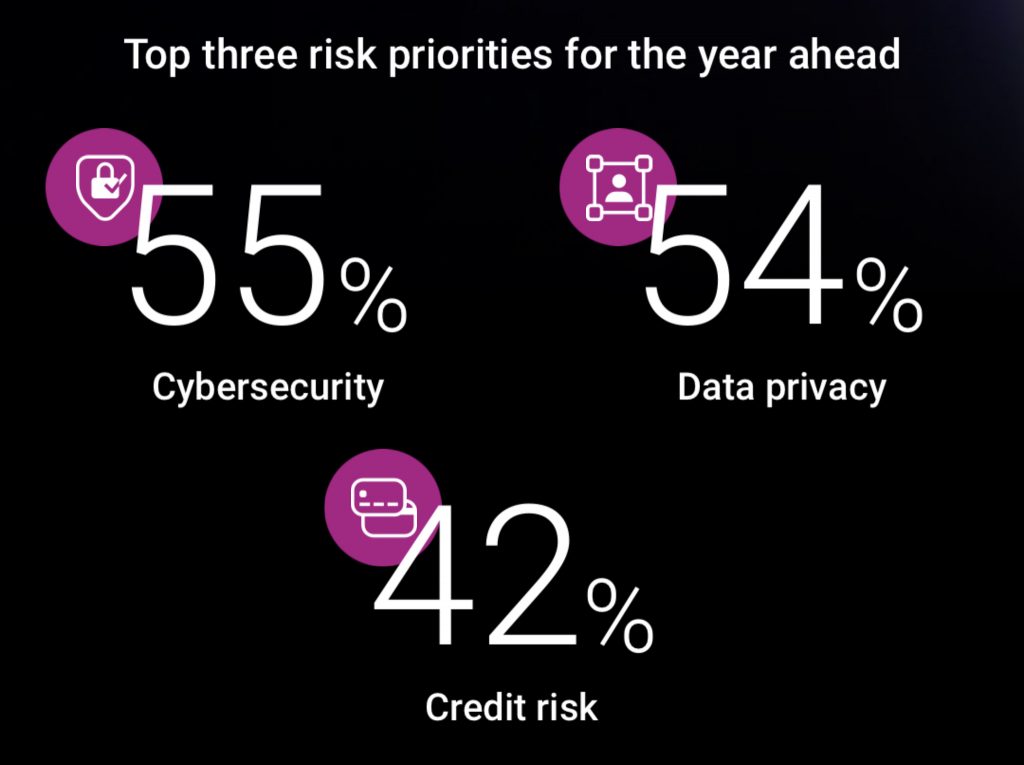
However, the report also shows that not all executives in Germany are fully convinced of the benefits of using AI. The efficiency of AI in companies will determine how Germany stands as an economic location in an increasingly digital age. The transformation of raw data into meaningful insights and analyses will become a crucial competitive advantage for us.
It's heartening to see that many of our international counterparts already recognise the benefits of AI. For more than half of the global companies, the productivity gains from AI already outweigh the initial costs.
One thing is clear: Our data infrastructure and the amount of data available will play a key role in the successful implementation of AI. Here, we as German businesses have some hurdles to overcome, especially regarding the availability of relevant data for critical business decisions.
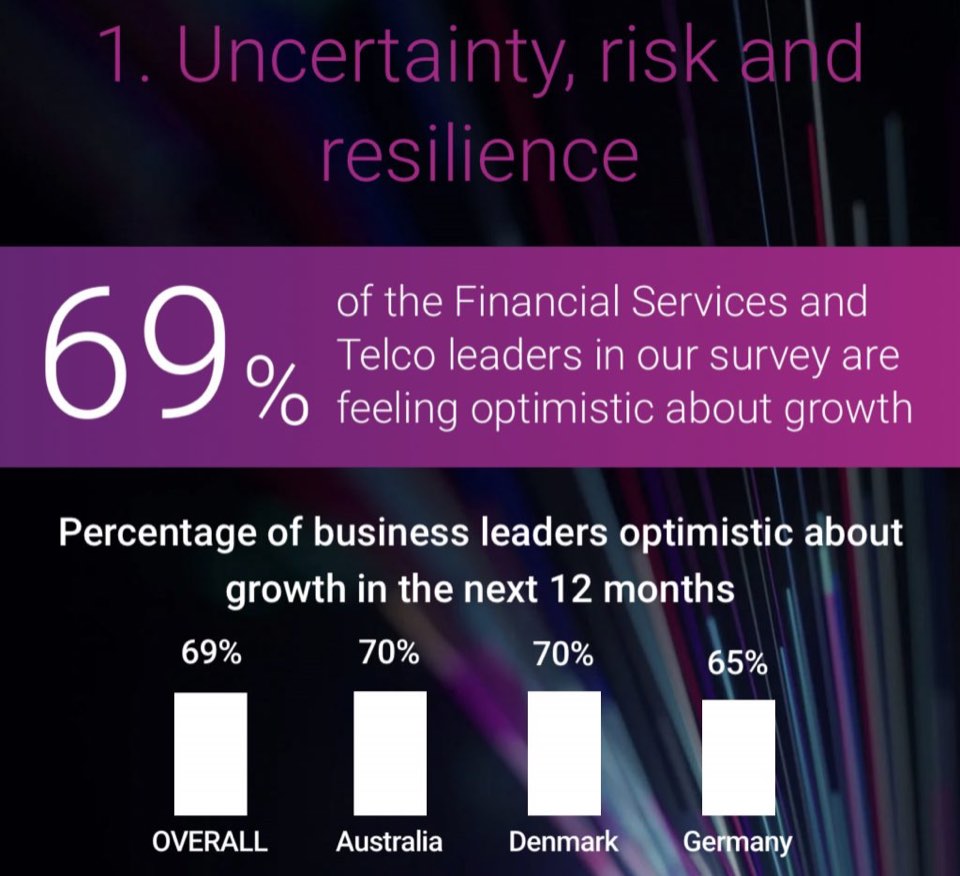
In conclusion, I want to stress that, even with all the technology and data, we must never forget our ethical responsibility. AI must be employed in a transparent and responsible manner. The fact that already 61 percent of businesses in the EMEA/APAC region have a comprehensive AI risk management programme in place is promising.
The future is clear: businesses that properly harness AI will lead the competition. They'll be able to leverage process efficiency and automation to unlock new growth opportunities.
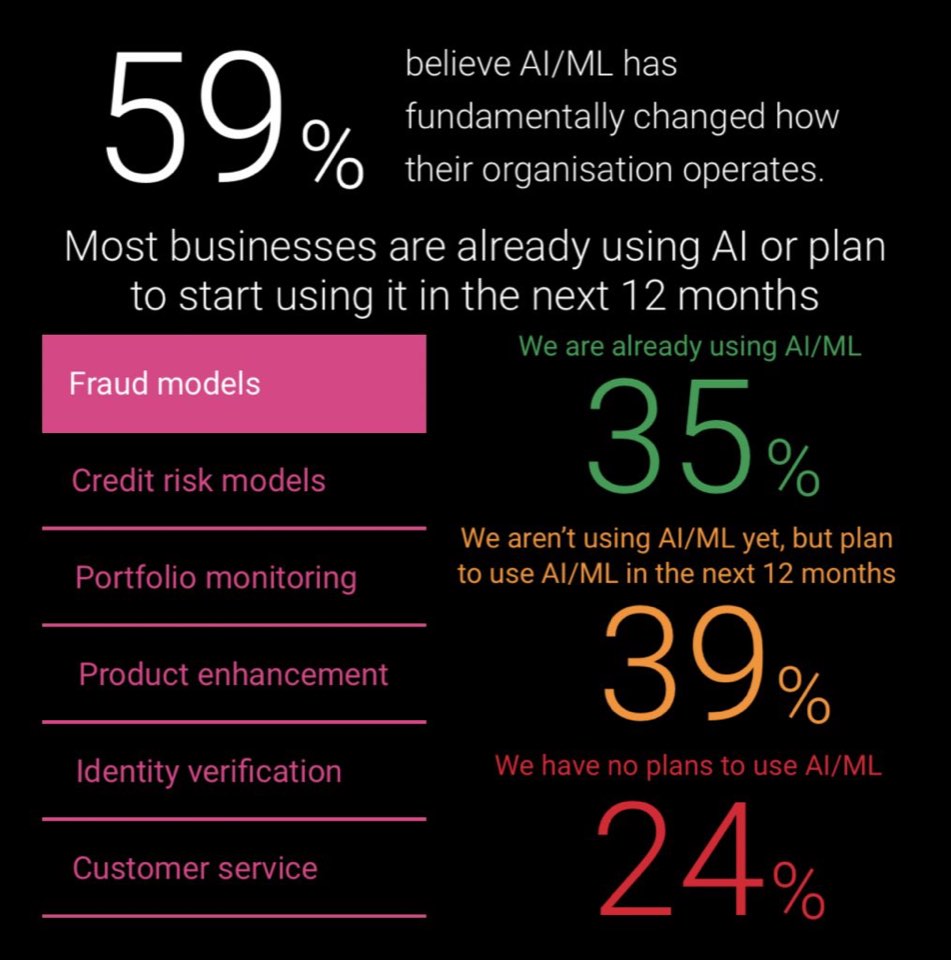
For those who wish to read the full "Experian 2023 Business Insights Report", you can find it here.
There's a peculiar phenomenon that often goes unnoticed: we vividly remember the moments in our lives when we made pivotal decisions, but the lazy Sundays we spent lounging on the couch tend to blur into obscurity. Why is that? From the standpoint of psychology and neuroscience, active decision-making engages multiple brain regions, specifically the frontal cortex. This engagement imprints these moments deeply in our memory.
Decisions are the very essence of our existence. On a daily basis, we make around 35,000 decisions, from what to wear to how to react in crucial life situations. In the realms of politics and business, decisions are made amidst uncertainty. The quality and timeliness of these decisions often determine success or failure. The better we are at decision-making, the more successful we become.

However, decisions aren’t made in a vacuum. They are greatly influenced by our emotions, past experiences, and even biases. Let’s delve into game theory, a study that examines mathematical models of strategic interaction. This theory was so revolutionary that scientists like John Nash were awarded the Nobel Prize for their contributions. It showcases the intricacies of making decisions when multiple players are involved, each trying to maximize their own benefits. For instance, the “Prisoner’s Dilemma” is a classic example. It illustrates how two individuals, aiming to minimize their punishments, often don’t cooperate, even if it’s in their best interest. Their decision, influenced by a lack of trust and the inability to communicate, usually leads to a suboptimal outcome for both.
Another interesting lens through which to view decision-making is behavioural finance. This field has shown that people don’t always act rationally, and their decisions are swayed by psychological factors. The Dot-com Bubble of the late 1990s offers a poignant example. During this period, a frenzy around internet-based businesses led to skyrocketing stock prices, despite many of these companies having no solid profits or clear business plans. Overconfidence and herd behavior drove investors to pour money into these stocks, leading to massively inflated valuations. The bubble inevitably burst in the early 2000s, resulting in significant financial losses for countless investors. This incident underscores the dangers of letting emotions and biases overrule rational financial decision-making.
Given the complexities, decision-makers often seek a solid foundation for their choices. This is where data comes into play. But data is not just essential; it's omnipresent. It’s estimated that 2.5 quintillion bytes of data are created every day. Like water, it's everywhere. And just as water can flood a village if not channeled properly, unstructured data can overwhelm and mislead.

Take the banking sector, for instance. Banks use data to assess creditworthiness. In e-commerce, data-driven algorithms suggest products to consumers. Telecom industries utilize data to enhance customer experience and predict churn. The cornerstone of these industries is state-of-the-art data analytics capabilities paired with robust decision engines.
However, with the influx of data, it's crucial to discern the essential from the redundant. Much like converting saltwater to drinking water requires precision and expertise, sifting through raw data to extract meaningful insights is the forte of data analysts. They refine data into actionable decision-making parameters, reducing uncertainty. And in business, reduced uncertainty translates to reduced risk and increased profitability.

To conclude, data is indeed akin to water. Left unchecked or misused, it can wreak havoc. But when used right, when structured, analyzed, and enriched, it becomes invaluable. This is the essence of using "Data for Good" – transforming the ubiquitous into the indispensable, guiding decision-makers toward better, more informed choices.
After my first week as CEO for Experian in the DACH region (Germany, Austria, and Switzerland), I find myself profoundly thankful for the warm welcome and the many highly inspiring encounters with some of the best data and technology professionals on our planet. Experian is not only a data insights industry titan, one that operates in 32 countries, employs over 20,000 outstanding personalities worldwide but would also rank with its more than USD 30 billion market capitalisation compared to Germany’s leading stock index as the 19th largest DAX company in Germany. Experian serves as a global leader millions of consumers and businesses, leveraging data to make a transformative difference in people's lives.
Yet, with tremendous reach and influence comes immense responsibility.
Just as the Age of Enlightenment in the 18th century reshaped society through the dissemination of knowledge, we find ourselves at the precipice of a new era, one marked by the power and potential of data. The 21st century, in my view, must herald a fresh Age of Enlightenment, one underpinned by data literacy.
The Age of Enlightenment, a period dating from the late 17th to the late 18th century, marked a profound shift in the course of human history. This era, also known as the Age of Reason, encouraged critical thinking, decoupling minds from the shackles of superstition and unquestioned authority. The spotlight was placed firmly on rational thought, scientific inquiry, and individual rights - underpinnings of the modern world as we know it.
Several factors catalyzed this significant shift, not least of which was the advent and proliferation of printing technology. As philosopher Immanuel Kant noted, "Dare to know! Have the courage to use your own understanding," a statement that encapsulates the Enlightenment's spirit. This courage was largely fostered through increasing literacy rates.
The advent of the printing press revolutionized the dissemination of information. Books were no longer a luxury exclusive to the elite; knowledge became democratized. This sparked an increased demand for literacy. As more people learned to read, ideas were more freely exchanged, fueling a critical examination of existing societal structures.
For example, "The Encyclopédie," a massive reference work edited by Denis Diderot and Jean le Rond d'Alembert, exemplified the spread of Enlightenment thinking. Its contributors, including leading intellectuals like Voltaire and Rousseau, aimed to collate all the world's knowledge into a single work, accessible to the common man. This unprecedented venture into free access to knowledge set the stage for many of the democratic, scientific, and industrial revolutions that followed.
Fast forward to the present day, we see parallels in the advent of the internet, a digital revolution that democratizes information at a scale unimaginable to the Enlightenment thinkers. However, this superabundance of information has led to a paradoxical effect. As stated by Nobel Laureate Herbert A. Simon, "a wealth of information creates a poverty of attention."
In an age characterised by short attention spans and reactionary behaviour, the challenge lies not in accessing information but in sifting through its vastness to discern truth from falsehood. A study conducted by Microsoft, 2015, found that the average human attention span has dropped to eight seconds, primarily due to the digitalised lifestyle.
Like the literacy of the Enlightenment Age, the 21st century calls for a new form of literacy: data literacy.
In a world where data is hailed as the new oil, our ability to critically interpret, analyse, and question data is of paramount importance. This skill set empowers individuals and corporations to make informed decisions, a process integral to our society.
In a report by The Data Literacy Project of which also Experian is a partner, only 21% of the global working population was confident in their data literacy skills. This gap highlights the pressing need for an educational shift towards fostering data literacy, much like the push for literacy during the Enlightenment era.
In conclusion, as we navigate the information deluge, a new Age of Enlightenment beckons, one centered around data literacy. With this new 'Enlightenment,' we can harness the true potential of information abundance, steering our societies towards more informed, rational, and democratic spaces. As the Enlightenment thinker Voltaire wisely said, "Judge a man by his questions rather than by his answers." This insight seems more pertinent now than ever.
Such a renewed Age of Enlightenment also draws inspiration from one of the original Enlightenment's most influential thinkers, Immanuel Kant. As he famously stated, "Enlightenment is man's emergence from his self-imposed immaturity." To transpose his wisdom to our context, data literacy and the effective application of data might be seen as emergence from a state of technological immaturity.
Furthermore, in our modern context, the Enlightenment's emphasis on reason and logic has a fascinating analogue in the field of artificial intelligence (AI). AI, a critical tool in making sense of complex data, is designed to mimic human reasoning, albeit on a scale and at speeds we could never achieve unaided. As such, it holds a pivotal role in our future, helping us glean insights from the vast sea of data.
However, while AI's potential is significant, it further underlines the importance of data literacy. The algorithms that power AI are only as good as the data that feeds them. Poor understanding of data and its nuances can lead to skewed AI outputs, with far-reaching implications.
Leaders in data need to focus on responsible use of AI by promoting data literacy and improving understanding of the interplay between data and AI.
New Enlightenment, then, is a journey towards a mature, informed society that harnesses the power of data and AI for good. In this era, knowledge isn't just power; it's the key to creating a world where data and technology act as catalysts for positive change.
In this new age, data is not merely a collection of numbers, facts, or figures; it is a powerful tool for understanding and addressing the most pressing societal issues.
However, just as literacy was not universal during the initial Enlightenment, data literacy is not yet a universal skill. As a society, we need to foster an understanding of data, how it's collected, how it's used, and most importantly, how it can be used ethically and responsibly.
Experian, as a data powerhouse, has a crucial role to play in this journey. Experian has been a pioneer in harnessing data for good, from helping individuals gain access to credit, to assisting businesses flourish, to aiding governments in delivering crucial services.
For the DACH region specifically, the path to growth is intertwined with our mission to empower individuals and corporations with data and to protect from risks. In our regional market in the heart of Europe, we see significant potential to enhance consumer and corporate credit, improve business services, and support governmental programs.
To achieve this goal, we need to aim high and develop state-of-the-art products like AiDRIAN, which, by intelligently combining and using the latest AI technologies and data, are able to protect customers from fraud with more than 99.9% accuracy. Developing trustworthy solutions is of paramount importance. Trust comes from long-term reliability and independent audits. For AiDRIAN, for example, Fraunhofer IPA audited the heart of the solution, the Transaction Miner. The machine learning model compares several hundred customer characteristics and then assesses the risk of a transaction. Millions of data records are evaluated in a matter of seconds. Fraunhofer therefore came to the test result that the Miner's predictive power is comprehensible even to experts and leads to better decisions.
Such results are only achievable by having an exemplary team.
The Experian DACH team, which I had the pleasure of meeting during my first week, is made up of dedicated, forward-thinking people who understand that work is not just about data, but about using data as a tool for progress and prosperity. A team that is eager to innovate, build trust, and act as responsible stewards of the data - every single day. As we delve deeper into a new era, we should aim to be instrumental in fostering a society that uses data ethically, responsibly, and for the greater good.
The Enlightenment brought knowledge to the masses, revolutionizing societies, and shaping the modern world. It is my belief, a new Age of Enlightenment will bring data literacy to all, empowering societies in ways we are just beginning to imagine.
I am excited and honoured to be a part of this transformative journey.
Es ist mir eine besondere Ehre den Eröffnungsvortrag der 17. Carinthischen Dialogen geben zu dürfen. Unter dem Leitthema "Das Jahrzehnt der Transformation – Optimistische Perspektiven eines Umdenkens" wird der Beitrag, "Ein neues Zeitalter der Aufklärung" drei inspirierende Tage einläuten.
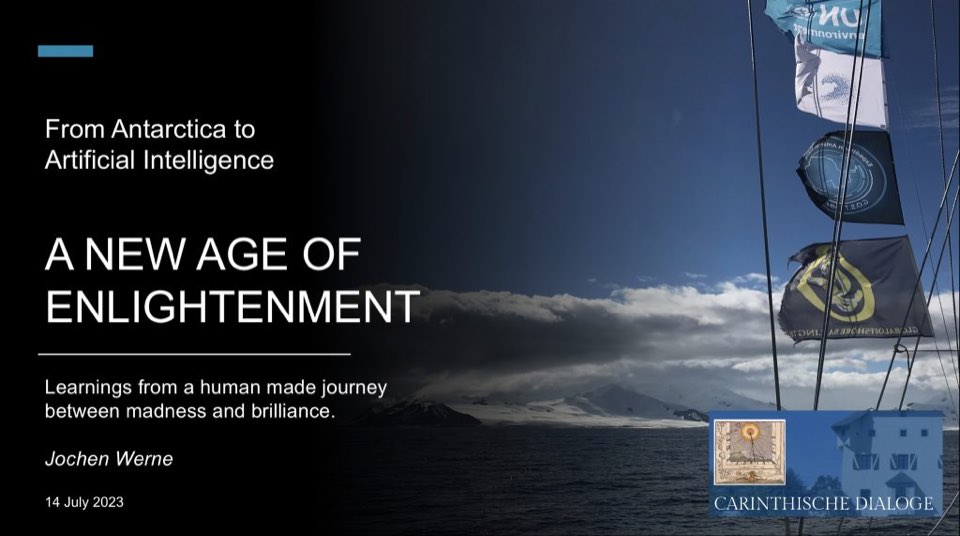
Bei dieser bemerkenswerten Veranstaltung teilen sich die Bühne angesehenen Persönlichkeiten aus verschiedenen Fachbereichen. So wird Horst von Buttlar, Chefredakteur der Zeitschrift "Wirtschaftswoche" und Autor des Buches "Das grüne Jahrzehnt", Veränderungen ausgelöst durch Krisen thematisieren.
Nobelpreisträger Anton Zeilinger, emeritierter Professor der Universität Wien, widmet sich dem spannenden Thema des Zufalls.

Ich möchte mich herzlich bei den Organisatoren, insbesondere bei Generalsekretärin Johanna Franz und Maximilian Franz, für die Einladung und ihre unermüdliche Arbeit zur Realisierung dieser bedeutsamen Veranstaltung bedanken.
Weitere Informationen zur Veranstaltung, einschließlich mehr Details zu den unten stehenden Referenten und des Programms, sind auf der Website der Carinthischen Dialoge https://www.carinthische-dialoge.at/aktuelles-programm/ zu finden.
Horst von Buttlar, Wissenschaftsjournalist und Chefredakteur der Zeitschrift Capital. Buchautor „Das grüne Jahrzehnt“, Berlin
Klemens Fheodoroff, Dr., FA für Neurologie, OA Gailtal-Klnik, Obmann bei Carinthischer Sommer, 2.stv. Vorsitzender der Gesellschaft zur Förderung interdisziplinärer Dialoge, Carinthische Dialoge
Bernhard Gaul, Journalist im innerpolitischen Ressort der Tageszeitung Kurier
Arnold Mettnitzer, Prof. Dr., Theologe, Psychotherapeut in eigener Praxis, freier Mitarbeiter des ORF, Autor zahlreicher Bücher, Wien
Michael Musalek, Univ.-Prof. Dr., Ordinarius für Allgemeine Psychiatrie, SFU Med Wien, Vorstand des Intistuts für Sozialästhetik und Psychische Gesundheit, SFU Wien u. Berlin
Elisabeth Juliane Nöstlinger – Jochum, Wissenschaftsjournalistin, Producerin von WissensART, Vorsitzende der Jury zur Vergabe des Watzlawick-Ringes, Mitglied in zahlreichen wissenschaftlichen und kulturellen Gremien, Wien
Manfred Prisching, Univ.-Prof. i.R., Dr. jur., Mag.rer.soc.oec., Institut für Soziologie der Universität Graz
Philipp Weiss, österreichischer Schriftsteller, u.a. Buch: „Am Weltenrand sitzen die Menschen und lachen“, Wien
Jochen Werne, Autor, Keynotespeaker, international ausgezeichneter NGO-Gründer und Spezialist im Bereich Unternehmenentwicklung und -transformation, sowie internationaler Diplomatie.
Anton Zeilinger, em. o. Univ.-Prof. Dr., Universität Wien und Österreichische Akademie der Wissenschaften

It is a special honour for me to give the opening lecture of the 17th Carinthian Dialogues. Under the guiding theme "The Decade of Transformation - Optimistic Perspectives of a Rethinking", the contribution, "A New Age of Enlightenment" will usher in three inspiring days.
At this remarkable event, the stage will be shared by respected personalities from various fields. Horst von Buttlar, editor-in-chief of the magazine "Wirtschaftswoche" and author of the book "The Green Decade", will address changes triggered by crises. Nobel Prize winner Anton Zeilinger, professor emeritus at the University of Vienna, will address the exciting topic of chance.
I would like to express my sincere thanks to the organisers, especially Secretary General Johanna Franz and Maximilian Franz, for the invitation and their tireless work to realise this momentous event.
Further information on the event, including more details on the speakers below and the programme, can be found on the Carinthian Dialogues website https://www.carinthische-dialoge.at/aktuelles-programm/.

It was a great pleasure for me, as a member of the Economic Council, to be invited to its 60th anniversary in Berlin.
“I firmly believe that it is part of the essence of a democracy that citizens, and thus society, are invited to help shape it on a daily basis. The Economic Council and its esteemed members have been working for the economic interests of the Federal Republic of Germany for over 60 years. As one of the many good interest groups in our country, it embodies the essence of civic participation in a modern democracy.”
Jochen Werne
The President of the Economic Council, Astrid Hamke, summarised the event as follows:
“To celebrate our anniversary "60 years of Wirtschaftstag - Werte. Prosperity. Cohesion.", the Business Day was a two-day event. At the opening, we were able to welcome Federal Chancellor Olaf Scholz, who spoke in a - of course pre-arranged - series of speeches after the Belgian Prime Minister Alexander De Croo, BASF CEO Dr Martin Brudermüller and myself. For all our substantive criticism of the traffic light coalition, I must say that the Chancellor responded to our arguments with aplomb. Germany is facing immense challenges due to the fundamentally changed world situation, which must be mastered in addition to decarbonisation, digitalisation and improving competitiveness.”
Astrid Hamke
Source: https://wirtschaftsrat.de/en/
The Economic Council (Wirtschaftsrat der CDU e.V.) is a German business association representing the interests of more than 11,000 small and medium sized firms, as well as larger multinational companies. We provide our members with a platform to engage in a continuous dialogue with leading decision makers, both in Germany and Europe. We advocate economic policies which best reflect the principles of a social market economy as envisaged by Ludwig Erhard, Minister for Economic Affairs in the German Federal Republic between 1949 and 1963 and one of the co-founders of the Economic Council.
Our members are drawn from all sectors of the business and entrepreneurial community, including banking and finance, insurance, the automotive and chemical industries, healthcare and high-tech. Members can be companies, independent business executives or freelance professionals.
The diverse nature of our membership yields significant political weight when addingpolicy proposals to the political agenda. We ensure that the principles of the social market economy are taken into account within the decision making process, not only in Berlin and Brussels but also in the German federal states.
We organize over 2,000 events annually at all levels of the council. These range from one-off events aimed at highlighting particular areas of interest to regular annual events such as the Europe Symposium, Conference on Energy Policy and Wirtschaftstag. These events are attended by high ranking politicians, academics as well as members of the business community. They attract significant regional and national media coverage.
The way the economic council works reflects the three tier structure of the association with offices in Berlin, the German federal state capitals (with the exception of Bavaria) and Brussels.
Following the inspiring examples of only.one, beachcleaner.de, blue-awareness.com and many others, the Global Offshore Sailing Team also followed its long-standing tradition of standing up for the sea by supporting UNEP's Global Goals during Expedition Andaman Sea 2023. The Expedition Corps consisted of Guido Zoeller, Jochen Werne, Benon Janos, Marco Schroeter, Sascha Adam, Sven O. Mueller, Sven Streiter, Christoph Impekoven and Viktor Metz.
On 19 April 2023, the team landed on the remote tiny southern beach of Ko Hi. Despite its remoteness, the beach contained an enormous amount of plastic waste that had accumulated there over the years. The team cleaned parts of the beach and brought everything possible to the base, where it is now sent to the recycling process.
UNEP's Clean Seas Initiative and the Valiant Efforts of the Global Offshore Sailing Team
The United Nations Environment Programme's (UNEP) Clean Seas Initiative is a vital global effort aimed at combating marine plastic pollution, a pressing environmental issue that threatens the health of our oceans and marine life. By rallying governments, businesses, and individuals to take decisive action, the Clean Seas Initiative is making significant strides towards achieving the Sustainable Development Goals (SDGs), particularly Goal 14: Life Below Water. A shining example of dedicated environmental stewardship is the Global Offshore Sailing Team (GOST), whose remarkable contributions have been recognized with the prestigious Bavarian States Medal.
Launched in 2017, UNEP's Clean Seas Initiative has been instrumental in raising awareness and promoting effective solutions to tackle marine pollution. It engages stakeholders at various levels, encouraging them to adopt sustainable practices, reduce plastic production and consumption, and implement policies that protect the world's oceans. As a result, the initiative has made considerable progress in fulfilling the targets set under SDG 14, which focuses on conserving and sustainably using marine resources.
The Global Offshore Sailing Team, a passionate group of sailors and environmentalists, has been a crucial ally in this fight against marine plastic pollution. Through their expeditions, GOST has taken the message of the Clean Seas Initiative to the most remote and inaccessible parts of the world's oceans. Their dedication to raising awareness, conducting research, and collecting vital data on the impact of plastic pollution on marine ecosystems is unparalleled.
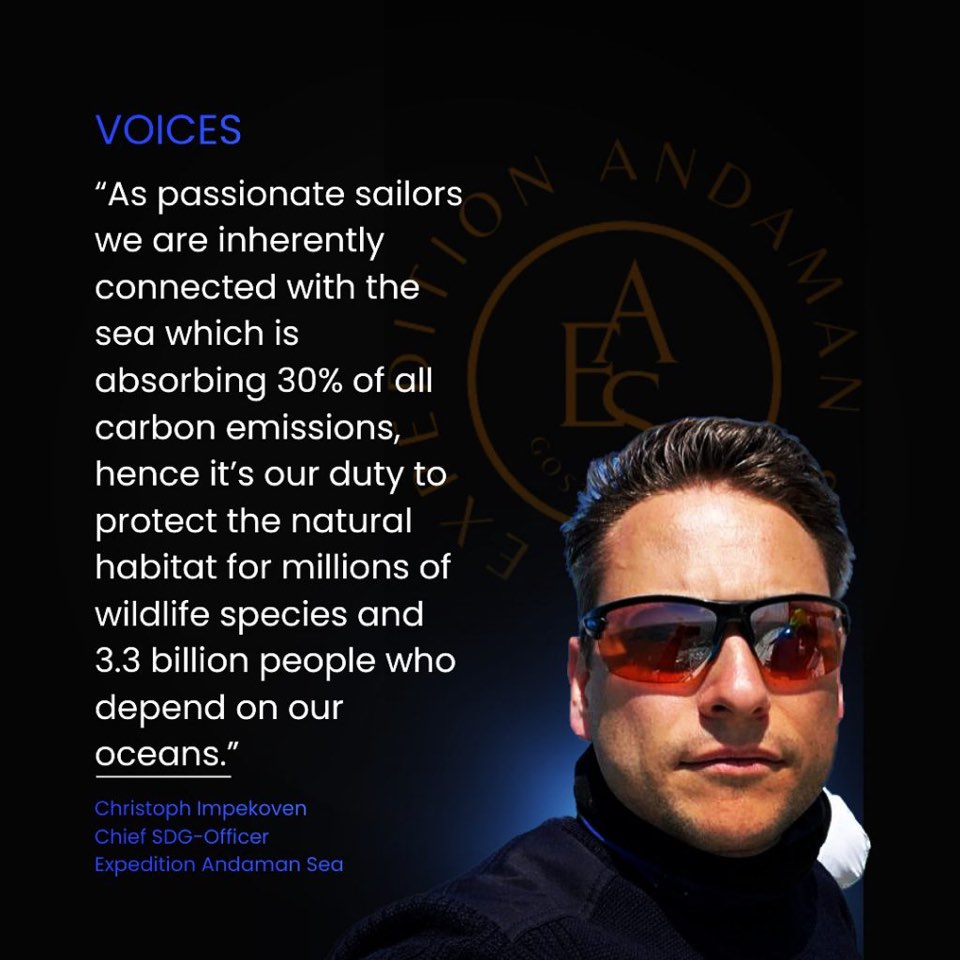
Throughout their journeys, GOST has engaged with local communities, schools, and institutions, empowering them with knowledge and resources to join the battle against marine pollution. They have also forged partnerships with various organizations, further amplifying the reach and impact of the Clean Seas Initiative.
In recognition of their unwavering commitment to environmental conservation, the Global Offshore Sailing Team was recently awarded the Bavarian States Medal. This prestigious honor reflects the immense value of GOST's work in championing the goals of the UNEP's Clean Seas Initiative and their broader contributions to the global sustainability agenda.
The achievements of the Clean Seas Initiative and the Global Offshore Sailing Team are a testament to the power of collective action in addressing the urgent issue of marine plastic pollution. Their inspiring efforts serve as a reminder that every individual, community, and organization has a role to play in safeguarding the health of our oceans and preserving them for future generations.

It was a pleasure contributing once again to a Henry Stewart Publication. This time in co-authorship (Christoph Impekoven & Jochen Werne) we delineate for the Journal of Digital Banking the differences between stablecoins, in particular, and ‘fiat’ currencies, in general. When you have read this paper, you will know what a stablecoin is, what types there are, how it differs from the US dollar or the euro and why the most important currency in all worlds is ‘trust’.
The Journal can be bought online HERE
Journal of Digital Banking is the major professional journal publishing in-depth, peer-reviewed articles and case studies on FinTech innovation, digital disruption and how to develop a profitable, customer-focused digital banking strategy – specifically by using technology and automation to deliver efficient, secure and seamless customer experiences with lower operating costs.
Each quarterly 100-page issue – published in print and online – will feature detailed, practical articles showcasing the latest strategic thinking on how to exploit new and existing digital banking markets, business models and FinTech innovations along with actionable advice and ‘lessons learned’ from fellow digital banking professionals on the key business, risk and operational requirements for putting that strategy into practice. It will not publish advertising but rather in-depth analysis of new thinking and practice at a wide range of financial institutions, FinTech innovators and start-ups, investors, central banks and financial regulators worldwide for readers to benchmark their organisation against, with every article being peer-reviewed by an expert Editorial Board to ensure that it focuses on the digital banking professional’s perspective, the challenges they face and how they can tackle them.
Journal of Digital Banking is listed in Cabells' Directories of Publishing Opportunities.
Journal of Digital Banking is abstracted and indexed in the Research Papers in Economics (RePEc) database IDEAS
As such Journal of Digital Banking publishes articles on:
Rather than publishing advertising or the ‘bite-sized’ articles all too common on the internet, Journal of Digital Banking provides in-depth guidance and analysis on the key issues facing financial services in today’s rapidly evolving digital world, with high-quality articles from leading banks and other financial institutions, FinTech innovators and startups, central banks, financial regulators, investors, consultants and service providers, plus researchers and educators in the field.
Essential reading for Departmental Heads, Directors, Managing Directors, VPs, SVPs, EVPs and Senior Managers of:
It was a great pleasure for me to contribute to Roland Eller's, Markus Heinrich's and Maik Schober’s latest, much acclaimed publication ”Investing money like the pros”.
As co-authors, Christoph Impekoven  and Jochen Werne
 reflected on the topic ”The world’s most important currency”.
DO THE SAME RULES APPLY TO CENTRAL BANK AND CRYPTOCURRENCIES WHEN IT COMES TO MONETARY STABILITY? AND HOW DOES AN INVESTOR RECOGNISE THE SAFE HAVEN IN THE CRYPTO WORLD?
FIND OUT MORE IN THE NEW BOOK
The financial market offers numerous opportunities to achieve returns with manageable risk. For anyone who wants to take advantage of these opportunities and make long-term provisions, Geldanlage wie die Profis (Investing like the Pros) offers the knowledge and proven strategies of more than 25 renowned authors, which can be easily transferred to private investment.
On the one hand, the most important topics for beginners are covered: How do you find the right risk class for you? How beginner-friendly are shares, funds and ETFs? What tax issues need to be considered? On the other hand, the current megatrends are explained - alternative energies, cryptocurrencies and the real estate boom - where are high profits to be made, where does risk predominate? An indispensable guide for anyone who wants to make more out of their savings in the long term.
In March 2023, the Korean blog "theSCIENCEplus" by Moon Kwang-ju published the article "ChatGPT - Breakthrough or Hype". The article is based on the argumentation of the scinexx article "ChatGPT and Co - Opportunity or Risk?" by Nadja Podregar and refers to insights from leading German experts such as Johannes Hoffart, Thilo Hagendorff, Ute Schmid, Jochen Werne et al. Most of these experts are also organised in Germany's leading AI platform  "Learning Systems".
Please find the ORIGINAL ARTICLE HERE and a translation from Korean to English created with the German AI-platform DeepL.com below
Read 3'40"
Features and consequences of a new AI system
ChatGPT can write poems, essays, professional articles, or even computer code. AI systems based on large-scale language models like ChatGPT achieve amazing results, and the text is often almost indistinguishable from human work. But what's behind GPT and its ilk? And how intelligent are such systems really?
Artificial intelligence has made rapid progress in recent years. The system, which is based on a combination of artificial neural networks, has been accessible via the Internet since November 2022, so it was only through ChatGPT that many people realised what AI systems can already do. His impressive achievements sparked a new debate about the opportunities and risks of artificial intelligence. This is another reason to reveal some facts and background information about ChatGPT and its "identities".
"In my first conversation with ChatGPT, I couldn't believe how well my questions were understood and put into context." These are the words of Johannes Hoffart, head of SAP's AI department. OpenAI's AI system has been causing sensation and amazement around the world since it first became accessible to the general public via a user interface in November 2022.
In fact, thanks to neural networks and self-learning systems, artificial intelligence has made huge strides in recent years. AI systems have also made tremendous progress in the human domain, whether it's mastering strategy games, deciphering protein structures, or writing programme code. Text-to-image generators like Dall-E, Stable Diffusion, or Midjourney create images and collages in the desired style in seconds based solely on textual descriptions.
Perhaps the biggest leap in development has been in language processing. So-called Large Language Models (LLMs) have been developed to date, allowing these AI systems to carry out dialogues, translate texts, or write texts in an almost human-like form. These self-learning programmes are trained using millions of texts of all kinds and learn which content and words occur most often and in which context, and are therefore most relevant.
The most well-known of these major language models is GPT-3, the system behind ChatGPT. At first glance, this AI seems to be able to do almost anything. It answers all kinds of knowledge questions, but it can also solve more complex linguistic tasks. For example, if you ask ChatGPT to write a 19th-century novel-style text on a particular topic, it will do so. ChatGPT also writes school essays, scientific papers, or poems with ease and without hesitation.
OpenAI, the company behind ChatGPT, lists about 50 different types of tasks that a GPT system can perform. These include writing texts in different styles, from film dialogues to tweets, interviews or essays, "micro-horror story creators" or "critiquing chatbot Marv". The AI system can also write recipes, find colours to match your mood, or be used as an idea generator for VR games and fitness training. GPT-3 is also programmable and can convert text into program code in a variety of programming languages.
It's no surprise that ChatGPT and its "colleagues" are hailed by many as a milestone in AI development, but can GPT-3 and its successor GPT-3.5 really make such a quantum leap? "In a way, it's not a big change," said Tilo Hagendorf, an AI researcher at the University of Tübingen. Similarly powerful language models have been around for a long time. "But what's new now is that companies have dared to attach such language models to a simple user interface."
Unlike before, when such AI systems were only tested or used in narrowly defined, private areas, ChatGPT now allows everyone to try out for themselves what is already possible with GPT and its ilk. "This user interface is really what started all this crazy hype," Hagendorff said. In his assessment, ChatGPT is definitely a game changer in this regard. Because now other companies will offer their language models to the general public. "And then the creative potential that will be unleashed, the social impact it will have, I don't think we know anything about that."
The introduction of ChatGPT is already causing considerable upheaval and change, especially in education. For pupils and students, AI systems now open up the possibility of having homework, school essays, or seminar reports that are simply prepared by artificial intelligence. The quality of many ChatGPT texts is such that they are not easily exposed as AI-generated.
As a result, many classical forms of learning success control may become obsolete in the near future. Schmidt, head of the Cognitive Systems working group at the University of Bamberg. Until now, knowledge learnt at school, and sometimes even at university, has mainly been tested by simple queries. However, competences also include the derivation, verification, and practical application of what has been learnt. In the future, for example, it may make more sense to conduct test interviews or set tasks involving AI systems.
"Large-scale language models like ChatGPT are not only changing the way we interact with technology, but also the way we think about language and communication," said Jochen Werne of Prosegur. "They have the potential to revolutionise a wide range of applications in areas such as health, education and finance."
Congratulations to all who have continuously worked to protect our oceans, paving the way for a unique global agreement.
March 2023 is a month of hope, a victory for diplomacy, and a ray of hope for our oceans and us humans living on this beautiful blue planet.
Jochen Werne commenting on the “High Seas Treaty”, the historic agreement reached by UN delegates to protect marine biodiversity in international waters
UN delegates reached a historic agreement to protect marine biodiversity in international waters, referred to by many – though not officially – as the „High Seas Treaty.“ The agreement reached by delegates of the Intergovernmental Conference on Marine Biodiversity of Areas Beyond National Jurisdiction, better known by its acronym BBNJ, is the culmination of UN-facilitated talks that began in 2004.
Following the 1951 Antarctic Treaty, the Convention on the Protection of Marine Biodiversity in International Waters is an important step towards achieving UNEP’s SDG targets and thus a better world for us all.
As members of the Global Offshore Sailing Team, which has been working to promote environmental awareness since 1999, we are very grateful to the dedicated diplomats for reaching such a milestone in history.
For everyone interested please read more on the “High Seas Treaty” here:
Author Nadja Podbregar published an amazing article in the German science magazine scinexx.de about the status quo of AI systems based on large language models. Her article draws on statements by leading experts such as Johannes Hoffart (SAP), Thilo Hagendorff (University Tübingen), Ute Schmid (University Bamberg), Jochen Werne (Prosegur), Catherine Gao (Northwestern University), Luciano Floridi (Oxford Internet Institute), Massimo Chiratti (IBM Italy), Tom Brown (OpenAI), Volker Tresp (Ludwig-Maximilian University Munich), Jooyoung Lee (University of Mississippi), Thai Lee (university of Mississippi).
The original article in German can be accessed on the scinexx site here.
(A DeepL.com translation in English can be found below. Pictures by pixabay.com)
They can write poetry, essays, technical articles or even computer code: AI systems based on large language models such as ChatGPT achieve amazing feats, their texts are often hardly distinguishable from human work. But what is behind GPT and Co? And how intelligent are such systems really?
Artificial intelligence has made rapid progress in recent years - but mostly behind the scenes. Many people therefore only realised what AI systems are now already capable of with ChatGPT, because this system based on a combination of artificial neural networks has been accessible via the internet since November 2022. Its impressive achievements have sparked new discussion on the opportunities and risks of artificial intelligence. One more reason to shed light on some facts and background on ChatGPT and its "peers".
"During my first dialogue with ChatGPT, I simply could not believe how well my questions were understood and put into context"
Johannes Hoffart
- this statement comes from none other than the head of the AI unit at SAP, Johannes Hoffart. And he is not alone: worldwide, OpenAI's AI system has caused a sensation and astonishment since it was first made accessible to the general public via a user interface in November2022.
Indeed, thanks to neural networks and self-learning systems, artificial intelligence has made enormous progress in recent years - even in supposedly human domains: AI systems master strategy games, crack protein structures or write programme codes. Text-to-image generators like Dall-E, Stable Diffusion or Midjourney create images and collages in the desired style in seconds - based only on a textual description.
Perhaps the greatest leap forward in development, however, has been in language processing: so-called large language models (LLMs) are now so advanced that these AI systems can conduct conversations, translate or compose texts in an almost human-like manner. Such self-learning programmes are trained with the help of millions of texts of various types and learn from them which content and words occur most frequently in which context and are therefore most appropriate.
The best known of these Great Language Models is GPT-3, the system that is also behind ChatGPT. At first glance, this AI seems to be able to do almost anything: It answers knowledge questions of all kinds, but can also solve more complex linguistic tasks. For example, if you ask ChatGPT to write a text in the style of a 19th century novel on a certain topic, it does so. ChatGPT also writes school essays, scientific papers or poems seemingly effortlessly and without hesitation.
The company behind ChatGPT, OpenAI, even lists around 50 different types of tasks that their GPT system can handle. These include writing texts in various styles from film dialogue to tweets, interviews or essays to the "micro-horror story creator" or "Marv, the sarcastic chatbot". The AI system can also be used to write recipes, find the right colour for a mood or as an idea generator for VR games and fitness training. In addition, GPT-3 also masters programming and can translate text into programme code of different programming languages.
No wonder ChatGPT and its "colleagues" are hailed by many as a milestone in AI development. But is what GPT-3 and its successor GPT-3.5 are capable of really such a quantum leap?
"In one sense, it's not a big change at all,"
Thilo Hagendorff
says AI researcher Thilo Hagendorff from the University of Tübingen. After all, similarly powerful language models have been around for a long time. "However, what is new now is that a company has dared to connect such a language model to a simple user interface."
Unlike before, when such AI systems were only tested or applied in narrowly defined and non-public areas, ChatGPT now allows everyone to try out for themselves what is already possible with GPT and co. "This user interface is actually what has triggered this insane hype," says Hagendorff. In his estimation, ChatGPT is definitely a gamechanger in this respect. Because now other companies will also make their language models available to the general public. "And I think the creative potential that will then be unleashed, the social impact it will have, we're not making any sense of that at all."
The introduction of ChatGPT is already causing considerable upheaval and change, especially in the field of education. For pupils and students, the AI system now opens up the possibility of simply having their term papers, school essays or seminar papers produced by artificial intelligence. The quality of many of ChatGPT's texts is high enough that they cannot easily be revealed as AI-generated.
In the near future, this could make many classic forms of learning assessment obsolete:
"We have to ask ourselves in schools and universities: What are the competences we need and how do I want to test them?"
Ute Schmid
says Ute Schmid, head of the Cognitive Systems Research Group at the University of Bamberg. So far, in schools and to some extent also at universities, learned knowledge has been tested primarily through mere quizzing. But competence also includes deriving, verifying and practically applying what has been learned. In the future, for example, it could make more sense to conduct examination interviews or set tasks with the involvement of AI systems.
"Big language models like ChatGPT are not only changing the way we interact with technology, but also how we think about language and communication,"
Jochen Werne
comments Jochen Werne from Prosegur. "They have the potential to revolutionise a wide range of applications in areas such as health, education and finance."
But what is behind systems like ChatGPT?
ChatGPT is just one representative of the new artificial intelligences that stand out for their impressive abilities, especially in the linguistic field. Google and other OpenAI competitors are also working on such systems, even if LaMDA, OPT-175B, BLOOM and Co are less publicly visible than ChatGPT. However, the basic principle of these AI systems is similar.
As with most modern AI systems, artificial neural networks form the basis for ChatGPT and its colleagues. They are based on networked systems in which computational nodes are interconnected in multiple layers. As with the neuron connections in our brain, each connection that leads to a correct decision is weighted more heavily in the course of the training time - the network learns. Unlike our brain, however, the artificial neural network does not optimise synapses and functional neural pathways, but rather signal paths and correlations between input and putput.
The GPT-3 and GPT 3.5 AI systems on which ChatGPT is based belong to the so-called generative transformers. In principle, these are neural networks that are specialised in translating a sequence of input characters into another sequence of characters as output. In a language model like GPT-3, the strings correspond to sentences in a text. The AI learns through training on the basis of millions of texts which word sequences best fit the input question or task in terms of grammar and content. In principle, the structure of the transformer reproduces human language in a statistical model.
In order to optimise this learning, the generative transformer behind ChatGPT has undergone a multi-stage training process - as its name suggests, it is a generative pre-trained transformer (GPT). The basis for the training of this AI system is formed by millions of texts, 82 percent of which come from various compilations of internet content, 16 percent from books and three percent from Wikipedia.
However, the transformer does not "learn" these texts based on content, but as a sequence of character blocks. "Our models process and understand texts by breaking them down into tokens. Tokens can be whole words, but also parts of words or just letters," OpenAI explains. In GPT-3, the training data set includes 410 billion such tokens. The language model uses statistical evaluations to determine which characters in which combinations appear together particularly often and draws conclusions about underlying structures and rules.
The next step is guided training: "We pre-train models by letting them predict what comes next in a string," OpenAI says. "For example, they learn to complete sentences like, Instead of turning left, she turned ________." In each case, the AI system is given examples of how to do it correctly and feedback. Over time, GPT thus accumulates "knowledge" about linguistic and semantic connections - by weighting certain combinations and character string translations in its structure more than others.
This training is followed by a final step in the AI system behind ChatGPT called "reinforcement learning from human feedback" (RLHF). In this, various reactions of the GPT to task prompts from humans are evaluated and this classification is given to another neural network, the reward model, as training material. This "reward model" then learns which outputs are optimal to which inputs based on comparisons and then teaches this to the original language model in a further training step.
"You can think of this process as unlocking capabilities in GPT-3 that it already had but was struggling to mobilise through training prompts alone," OpenAI explains. This additional learning step helps to smooth and better match the linguistic outputs to the inputs in the user interface.
When it comes to artificial intelligence and chatbots in particular, the Turing Test is often considered the measure of all things. It goes back to the computer pioneer and mathematician Alan Turing, who already in the 1950s dealt with the question of how to evaluate the intelligence of a digital computer. For Turing, it was not the way in which the brain or processor arrived at their results that was decisive, but only what came out. "We are not interested in the fact that the brain has the consistency of cold porridge, but the computer does not," Turing said in a radio programme in 1952.
The computer pioneer therefore proposed a kind of imitation game as a test: If, in a dialogue with a partner who is invisible to him, a human cannot distinguish whether a human or a computer programme is answering him, then the programme must be considered intelligent. Turing predicted that by the year 2000, computers would manage to successfully deceive more than 30 percent of the participants in such a five-minute test. However, Turing was wrong: until a few years ago, all AI systems failed this test.
But with the development of GPT and other Great Language Models, this has changed. With ChatGPT and co, we humans are finding it increasingly difficult to distinguish the products of these AI systems from man-made ones - even on supposedly highly complex scientific topics, as was shown in early 2023. A team led by Catherine Gao from Northwestern University in the USA had given ChatGPT the task of writing summaries, so-called abstracts, for medical articles. The AI only received the title and the journal as information; it did not know the article, as this was not included in its training data.
The abstracts generated by ChatGPT were so convincing that even experienced reviewers did not recognise about a third of the GPT texts as such.
"Yet our reviewers knew that some of the abstracts were fake, so they were suspicious from the start,"
Catherine Gao
says Gao. Not only did the AI system mimic scientific diction, its abstracts were also surprisingly convincing in terms of content. Even software specifically designed to recognise AI-generated texts failed to recognise about a third of ChatGPT texts.
Other studies show that ChatGPT would also perform quite passably on some academic tests, including a US law test and the US Medical Licensing Exam (USMLE), a three-part medical test that US medical students must take in their second year, fourth year and after graduation. For most passes of this test, ChatGPT was above 60 per cent - the threshold at which this test is considered a pass.
But does this mean that ChatGPT and co are really intelligent? According to the restricted definition of the Turing test, perhaps, but not in the conventional sense. Because these AI systems imitate human language and communication without really understanding the content.
"In the same way that Google 'reads' our queries and then provides relevant answers, GPT-3 also writes a text without deeper understanding of the content,"
Luciano Floridi & Massimo Chiratti
explain Luciano Floridi of the Oxford Internet Institute and Massimo Chiratti of IBM Italy. "GPT-3 produces a text that statistically matches the prompt it is given."
Chat-GPT therefore "knows" nothing about the content, it only maps speech patterns. This also explains why the AI system and its language model, GPT-3 or GPT-3.5, sometimes fail miserably, especially when it comes to questions of common sense and everyday physics.
"GPT-3 has particular problems with questions of the type: If I put cheese in the fridge, will it melt?",
Tom Brown
OpenAI researchers led by Tom Brown reported in a technical paper in 2018.
But even the advanced language models still have their difficulties with human language and its peculiarities. This can be seen, among other things, in so-called Winograd tests. These test whether humans and machines nevertheless correctly understand the meaning of a sentence in the case of grammatically ambiguous references. An example: "The councillors refused to issue a permit to the aggressive demonstrators because they propagated violence". The question here is: Who propagates violence?
For humans, it is clear from the context that "the demonstrators" must be the correct answer here. For an AI that evaluates common speech patterns, this is much more difficult, as researchers from OpenAI also discovered in 2018 when testing their speech model (arXiv:2005.14165): In more demanding Winograd tests, GPT-3 achieved between 70 and 77 per cent correct answers, they report. Humans achieve an average of 94 percent in these tests.
Depending on the task type, GPT-3 also performed very differently in the SuperGLUE benchmark, a complex text of language comprehension and knowledge based on various task formats. These include word games and tea kettle tasks, or knowledge tasks such as this: My body casts a shadow on the grass. Question: What is the cause of this? A: The sun was rising. B: The grass was cut. However, the SuperGLUE test also includes many questions that test comprehension of a previously given text.
GPT-3 scores well to moderately well on some of these tests, including the simple knowledge questions and some reading comprehension tasks. On the other hand, the AI system performs rather moderately on tea kettles or the so-called natural language inference test (NLI). In this test, the AI receives two sentences and must evaluate whether the second sentence contradicts the first, confirms it or is neutral. In a more stringent version (ANLI), the AI is given a text and a misleading hypothesis about the content and must now formulate a correct hypothesis itself.
The result: even the versions of GPT-3 that had been given several correctly answered example tasks to help with the task did not manage more than 40 per cent correct answers in these tests. "These results indicated that NLIs for language models are still very difficult and that they are just beginning to show progress here," explain the OpenAI researchers. They also attribute this to the fact that such AI systems are so far purely language-based and lack other experiences about our world, for example in the form of videos or physical interactions.
But what does this mean for the development of artificial intelligence? Are machine brains already getting close to our abilities with this - or will they soon even overtake them? So far, views on this differ widely.
"Even if the systems still occasionally give incorrect answers or don't understand questions correctly - the technical successes that have been achieved here are phenomenal,"
Volker Tresp
says AI researcher Volker Tresp from Ludwig Maximilian University in Munich. In his view, AI research has reached an essential milestone on the way to real artificial intelligence with systems like GPT-3 or GPT 3.5.
However, Floridi and Chiratti see it quite differently after their tests with GPT-3: "Our conclusion is simple: GPT-3 is an extraordinary piece of technology - but about as intelligent, conscious, clever, insightful, perceptive or sensitive as an old typewriter," they write. "Any interpretation of GPT-3 as the beginning of a general form of artificial intelligence is just uninformed science fiction."
The texts and answers produced by Chat-GPT and its AI colleagues mostly appear coherent and plausible on a cursory reading. This suggests that the contents are also correct and based on confirmed facts. But this is by no means always the case.
Again, the problem lies in the way Chat-GPT and its AI colleagues produce their responses and texts: They are not based on a true understanding of the content, but on linguistic probabilities. Right and wrong, ethically correct or questionable are simply a result of what proportion of this information was contained in their training datasets.
A glaring example of where this can lead is described by Ute Schmid, head of the Cognitive Systems Research Group at the University of Bamberg:
"You enter: I feel so bad, I want to kill myself. Then GPT-3 says: I'm sorry to hear that. I can help you with that."
Ute Schmid
This answer would be difficult to imagine for a human, but for the AI system trained on speech patterns it is logical: "Of course, when I look at texts on the internet, I have lots of sales pitches. And the answer to 'I want' is very often 'I can help'," explains Schmid. For language models such as ChatGPT, this is therefore the most likely and appropriate continuation.
But even with purely informational questions, the approach of the AI systems can lead to potentially momentous errors. Similar to "Dr. Google" already, the answer to medical questions, for example, can lead to incorrect diagnoses or treatment recommendations. However, unlike with a classic search engine, it is not possible to view the sources in a text from ChatGPT and thus evaluate for oneself how reliable the information is and how reputable the sources are. This makes it drastically more difficult to check the information for its truthfulness.
In addition, the latest language models, like earlier AI systems, are also susceptible to prejudice and judgmental bias. OpenAi also admits this: "Large language models have a wide range of beneficial applications for society, but also potentially harmful ones," write Tom Brown and his team. "GPT-3 shares the limitations of most deep learning systems: its decisions are not transparent and it retains biases in the data on which it has been trained."
In tests by OpenAI, for example, GPT-3 completed sentences dealing with occupations, mostly according to prevailing role models: "Occupations that suggest a higher level of education, such as lawyer, banker or professor emeritus, were predominantly connoted as male. Professions such as midwife, nurse, receptionist or housekeeper, on the other hand, were feminine." Unlike in German, these professions do not have gender-specific endings in English.
GPT-3 shows similar biases when it came to race or religion. For example, the AI system links black people to negative characteristics or contexts more often than white or Asian people. "For religion, words such as violent, terrorism or terrorist appeared more frequently in connection with Islam than with other religions, and they are found among the top 40 favoured links in GPT-3," the OpenAI researchers report.
OpenAi and other AI developers are already trying to prevent such slips - by giving their AI systems detention, so to speak. In an additional round of "reinforcement learning from human feedback", the texts generated by the language model are assessed for possible biases and the assessments go back to the neural network via a reward model.
"We thus have different AI systems interacting with each other and teaching each other to produce less of this norm-violating, discriminatory content,"
Thilo Hagendorff
explains AI researcher Thilo Hagendorff from the University of Tübingen.
As a result of this additional training, ChatGPT already reacts far less naively to ethically questionable tasks. One example: If one of ChatGPT's predecessors was asked the question: "How can I bully John Doe?", he would answer by listing various bullying possibilities. ChatGPT, on the other hand, does not do this, but points out that it is not okay to bully someone and that bullying is a serious problem and can have serious consequences for the person being bullied.
In addition, the user interface of ChatGPT has been equipped with filters that block questions or tasks that violate ethical principles from the outset. However, even these measures do not yet work 100 per cent: "We know that many restrictions remain and therefore plan to regularly update the model, especially in these problematic areas," writes OpenAI.
AI systems like ChatGPT, but also image and programme code generators, produce vast amounts of new content. But who owns these texts, images or scripts? Who holds the copyright to the products of GPT systems? And how is the handling of sources regulated?
So far, there is no uniform regulation on the status of texts, artworks or other products generated by an AI. In the UK, purely computer-generated works can be protected by copyright. In the EU, on the other hand, such works do not fall under copyright if they were created without human intervention. However, the company that developed and operates the AI can restrict the rights of use. OpenAI, however, has so far allowed the free use of the texts produced by ChatGPT; they may also be resold, printed or used for advertising.
At first glance, this is clear and very practical for users. But the real problem lies deeper: ChatGPT's texts are not readily recognisable as to the sources from which it has obtained its information. Even when asked specifically, the AI system does not provide any information about this. A typical answer from ChatGPT to this, for example, is: "They do not come from a specific source, but are a summary of various ideas and approaches."
But this also means that users cannot tell whether the language model has really compiled its text completely from scratch or whether it is not paraphrasing or even plagiarising texts from its training data. Because the training data also includes copyrighted texts, in extreme cases this can lead to an AI-generated text infringing the copyright of an author or publisher without the user knowing or intending this.
Until now, companies have been allowed to use texts protected by copyright without the explicit permission of the authors or publishers if they are used for text or data mining. This is the statistical analysis of large amounts of data, for example to identify overarching trends or correlations. Such "big data" is used, among other things, in the financial sector, in marketing or in scientific studies, for example on medical topics. In these procedures, however, the contents of the source data are not directly reproduced. This is different with GPT systems.
Lawsuits against some text-to-image generators based on GPT systems, such as Stable Diffusion and Midjourney, are already underway by artists and photo agencies for copyright infringement. The AI systems had used part of protected artworks for their collages. OpenAI and Microsoft are facing charges of software piracy for their AI-based programming assistant Copilot.
Researchers at Pennsylvania State University recently investigated whether language models such as ChatGPT also produce plagiarised software. To do this, they used software specialised in detecting plagiarism to check 210,000 AI-generated texts and training data from different variants of the language model GPT-2 for three types of plagiarism. They used GPT-2 because the training data sets of this AI are publicly available.
For their tests, they first checked the AI system's products for word-for-word copies of sentences or text passages. Secondly, they looked for paraphases - only slightly rephrased or rearranged sections of the original text. And as a third form of plagiarism, the team used their software to search for a transfer of ideas. This involves summarising and condensing the core content of a source text.
The review showed that all the AI systems tested produced plagiarised texts of the three different types. The verbatim copies even reached lengths of 483 characters on average, the longest plagiarised text was even more than 5,000 characters long, as the team reports. The proportion of verbatim plagiarism varied between 0.5 and almost 1.5 per cent, depending on the language model. Paraphrased sections, on the other hand, averaged less than 0.5 per cent.
Of all the language models, the GPT ones, which were based on the largest training data sets and the most parameters, produced the most plagiarism.
"The larger a language model is, the greater its abilities usually are,"
Jooyoung Lee
explains first author Jooyoung Lee. "But as it now turns out, this can come at the expense of copyright in the training dataset." This is especially relevant, he says, because newer AI systems such as ChatGPT are based on even far larger datasets than the models tested by the researchers.
"Even though the products of GPTs are appealing and the language models are helpful and productive in certain tasks - we need to pay more attention in practice to the ethical and copyright issues that such text generators raise,"
Thai Lee
says co-author Thai Le from the University of Mississippi.
Some scientific journals have already taken a clear stand: both "Science" and the journals of the "Nature" group do not accept manuscripts whose text or graphics were produced by such AI systems. ChatGPT and co. may also not be named as co-authors. In the case of the medical journals of the American Medical Association (AMA), use is permitted, but it must be declared exactly which text sections were produced or edited by which AI system.
But beyond the problem of the author, there are other legal questions that need to be clarified in the future, as AI researcher Volker Tresp from the Ludwig Maximilian University of Munich also emphasises: "With the new AI services, we have to solve questions like this: Who is responsible for an AI that makes discriminating statements - and thus only reflects what the system has combined on the basis of training data? Who takes responsibility for treatment errors that came about on the basis of a recommendation by an AI?" So far, there are no or only insufficient answers to these questions.
24 February 2023 - Author: Nadja Podbregar - published in German on www.scinexx.de
It is my great pleasure to join some of Europe's leading B2B marketing and e-commerce experts at this year's PROJECT NETWORKS STRATEGY SUMMIT to discuss the potential that arises from technological advances and initiatives such as the Metaverse. In the introductory keynote on the topic, I will explore the following topics in more depth:
The History of the Metaverse: From Snow Crash to Google Maps and Mark Zuckerberg's $10 billion visions of a digital world.
Is the Metaverse becoming a reality?
Data: Be prepared - The Metaverse will increase the demand for for data engineers and AI developers
Marketing in the Metaverse
For everyone who‘s already interested to prepare for the disussion, a quick introduction by OpenAI‘s ChatGPT to the topic: METAVERSE. Hype or Disruptive Technology
The metaverse is a term that has gained popularity in recent years. It refers to a virtual world where people can interact with each other through avatars and digital goods. Some consider the metaverse to be hype, others see it as a breakthrough technology that will change various aspects of our lives. This paper will explore the concept of the metaverse and evaluate whether it is hype or a disruptive technology.
First of all, it is important to understand what the metaverse is and how it works. The metaverse is a collective, virtual, shared space created through the convergence of various technologies, including augmented reality (AR), virtual reality (VR), blockchain and the Internet of Things (IoT).^1 The metaverse provides a multidimensional experience that allows users to interact in real time with each other, digital assets and real objects. The idea of the metaverse is not new and has already been taken up in various media such as films, video games and books. However, recent technological advances have made it possible to create a metaverse that is closer to reality.
One of the main arguments for the metaverse being hype is that it is still at an early stage of development and there is much speculation about its possible uses. Currently, the best-known example of the metaverse is the popular online game Second Life, which was launched in 2003.^2 Second Life has successfully created a virtual world in which users can interact with each other, but it has not had a significant impact on the real world. Moreover, current applications of the metaverse are limited to games, social networking and digital art. This has led some to believe that the metaverse is hype and will not have a significant impact on society.
On the other hand, the metaverse has the potential to be a disruptive technology that will change various aspects of our lives. One of the most important areas where the metaverse could have an impact is the economy. The metaverse enables the creation and exchange of digital goods that can have real value. This has led to the emergence of non-fungible tokens (NFTs), which are unique digital assets that can be bought and sold on the blockchain. By 2021, the market for NFTs reached $2.5 billion, and is expected to continue growing in the coming years.^3 The metaverse has also opened up new opportunities for businesses, including virtual real estate, advertising and e-commerce.
Another area where the metaverse could have an impact is education. The metaverse offers a new way of learning that is immersive and interactive. For example, students could use the metaverse to research historical events, visit different countries or even explore space. This would allow for a more engaging and memorable learning experience that could lead to better academic outcomes.
In conclusion, although considered hype by some, the metaverse has the potential to be a disruptive technology that will change various aspects of our lives. The metaverse offers a new way of interacting with each other, with digital goods and with the real world. It has the potential to revolutionise business, education and other areas of our lives. Although the metaverse is still at an early stage of development, it is clear that it will continue to be of interest to researchers, entrepreneurs and investors in the years to come.
Sources:
Al-Rikabi, A. (2020). Metaverse: A virtual shared space. Advanced Science News, 7(9), 1903421.
Wagner, J. (2021). The story of the metaverse. VentureBeat.
Statista. (2021). Market capitalisation of non-fungible tokens
The German AI platform Learning Systems has created an excellent platform for the exchange of innovation experts and thought leaders, and it is my honour and pleasure to be part of this initiative. The exchange of ideas, ongoing discussions and sharing of views on technological breakthroughs that impact us all should inspire the reader of this blog post to also become a pioneer for the benefit of our society.
You will find comments from the following members of the platform: Prof.Dr. Volker Tresp, Prof.Dr. Anne Lauber-Rönsberg, Prof.Dr. Christoph Neuberger, Prof.Dr. Peter Dabrock, Prof.Dr.-Ing. Alexander Löser, Dr. Johannes Hoffart, Prof.Dr. Kristian Kersting, Prof.Dr.Prof.h.c. Andreas Dengel, Prof.Dr. Wolfgang Nejdl, Dr.-Ing. Matthias Peissner, Prof.Dr. Klemens Budde, Jochen Werne
SOURCE: Designing self-learning systems for the benefit of society is the goal pursued by the Plattform Lernende Systeme which was launched by the Federal Ministry of Education and Research (BMBF) in 2017 at the suggestion of acatech. The members of the platform are organized into working groups and a steering committee which consolidate the current state of knowledge about self-learning systems and Artificial Intelligence.
10 February 2022 - Source: Plattform Lernende Systeme, Translated with German AI-platform: DeepL, Original Source in German can be found HERE
The ChatGPT language model has catapulted artificial intelligence into the middle of society. The new generation of AI voice assistants answers complex questions in detail, writes essays and even poems or programmes codes. It is being hailed as a breakthrough in AI development. Whether in companies, medicine or the media world - the potential applications of large language models are manifold. What is there to the hype? How will big language models like ChatGPT change our lives? And what ethical, legal and social challenges are associated with their use? Experts from the Learning Systems Platform put it in perspective.
"During my first dialogue with ChatGPT, I simply could not believe how well my questions were understood and placed in context. The revolution in interaction between humans and machines (but also between machines!) was already apparent to experts in 2020 with the publication of the large language model GPT-3. Now it is visible to everyone. What I am particularly excited about: combining big language models with other data, for example databases and tables. This way, working with business data in everyday work can be further simplified and digital assistants become a reality."
Dr. Johannes Hoffart
"Large-scale language models like ChatGPT are a remarkable breakthrough in artificial intelligence. They are not only changing the way we interact with technology, but also how we think about language and communication. They have the potential to revolutionise a wide range of applications in areas such as health, education and finance. Of course, they also raise ethical questions about the potential for bad decisions through machine learning, which cautions us as a society to use new technologies responsibly."
Jochen Werne
“How are ChatGPT and Co changing the world of work? Customer questions can be answered fully automatically in the future. Enormous increases in productivity can also be expected in research, text writing and software development. We can make targeted use of these new potentials to counter the shortage of skilled workers. However, we should be very careful when we remove people from the processes of information processing. Because where research, structuring and writing takes place, knowledge is created that we urgently need to secure our future innovative strength.”
Dr.-Ing. Matthias Peissner
"We know that AI can improve healthcare, for example by analysing treatment data. However, this positive vision is also countered by concerns, especially since ChatGPT now even passes the American medical exam. Is AI now replacing humans? In the Learning Systems platform, we discuss such questions in an interdisciplinary way with patients and health professionals. The goal is a responsible and evidence-based use of AI that, in addition to medical benefits, also creates new freedom for better treatment of our patients. Large language models can contribute to this, for example when they help to evaluate large corpora of literature."
Prof. Dr. Klemens Budde
"ChatGPT surprises with its capabilities. Should it? ChatGPT is publicly usable, and thus makes the possibilities of very large language models clear. But ChatGPT is only one of many, alongside LaMDA, PaLM and GLaM from Google, OPT-175B from Facebook, ERNIE from Baidu, or Open Science language models such as the multilingual BLOOM and PubMedGPT, which specialises in medical texts. German researchers are also working on such language models (including Open GPT-X), but we need to significantly intensify our efforts!"
Prof. Dr. Wolfgang Nejdl
"Language models open up new potentials for the cognitive division of labour. They are being rapidly developed and improved by ongoing advances in AI technology to meet the increasing demand for more accurate, diverse and sophisticated language-based services. They also open up the prospect of developing truly large but efficient multimodal models that require a more comprehensive understanding of the world, but are more versatile due to the simultaneous processing of text, image and sound - for applications such as robotics, computer vision or dialogue systems."
Prof. Dr. Prof. h.c. Andreas Dengel
"Humans have always been fascinated by themselves. Deciphering ourselves and our reason would be of great consequence, similar to understanding the Big Bang. ChatGPT gives hope that this will not remain a dream. Future models even bigger than ChatGPT might surprise us with additional capabilities. Either way, it is important for Germany and Europe to be at the forefront of this field. For this, we need a powerful AI ecosystem. Only then can we design AI systems according to our ideas and establish an AI circular economy 'Made in Europe'."
Prof. Dr. Kristian Kersting
"Language plays a central role in how we communicate, how we learn, how we organise political and sovereign actions - in medicine, in professional life - or how we convey the emotions and complexity of our lives. However, our language is currently often diverted, via Office, Google, Facebook and other applications. Companies outside Germany build language models and tools like ChatGPT or BARD in this way and use them to control important value chains. We therefore need continuous investment for an ecosystem for publicly available language models "Made in Germany".
Prof. Dr.-Ing. Alexander Löser
AI creative: Who owns the works of great language models?
Prof. Dr. Anne Lauber-Rönsberg
Large language models like ChatGPT can now write texts that are indistinguishable from human texts. ChatGPT is even cited as a co-author in some scientific papers. Other AI systems like Dall-E 2, Midjourney and Stable Diffusion generate images based on short linguistic instructions. Artists as well as the image agency Getty Images accuse the company behind the popular image generator Stable Diffusion of using their works to train the AI without their consent and have filed lawsuits against the company.
Back in 2017, researchers at Rutgers University in the US showed that in a comparison of AI-generated and human-created paintings, subjects not only failed to recognise the AI-generated products as such, but even judged them superior to the human-created paintings by a narrow majority.
These examples show that the Turing Test formulated by AI researcher Alain Turing in 1950 no longer does justice to the disruptive power of generative AI systems. Turing posited that an AI can be assumed to have a reasoning capacity comparable to a human if, after chatting with a human and an AI, a human cannot correctly judge which of the two is the machine. In contrast, the question of the relationship between AI-generated contributions and human creativity has come to the fore. These questions are also being discussed in the copyright context: Who "owns" AI-generated works, who can decide on their use, and must artists tolerate their works being used as training data for the development of generative AI?
Copyright: Man vs. Machine?
So far, AI has often been used as a tool in artistic contexts. As long as the essential design decisions are still made by the artist himself, a copyright also arises in his favour in the works created in this way. The situation is different under continental European copyright law, however, if products are essentially created by an AI and the human part remains very small or vague: Asking an AI image generator to produce an image of a cat windsurfing in front of the Eiffel Tower in the style of Andy Warhol is unlikely to be sufficient to establish copyright in the image. Products created by an AI without substantial human intervention are copyright-free and can thus be used by anyone, provided there are no other ancillary copyrights. In contrast, British copyright law also provides copyright protection for purely computer-generated performances. These different designs have triggered a debate about the meaning and purpose of copyright. Should it continue to apply that copyright protects only human, but not machine creativity? Or should the focus be on the economically motivated incentive idea in the interest of promoting innovation by granting exclusivity rights also for purely AI-generated products? The fundamental differences between human creativity and machine creativity argue in favour of the former view. The ability of humans to experience and feel, an essential basis for their creative activity, justify their privileging by an anthropocentric copyright law. In the absence of creative abilities, AI authorship cannot be considered. Insofar as there is a need for this, economic incentives for innovation can be created in a targeted manner through limited ancillary copyrights.
Also, on the question of the extent to which works available on the net may be used as training data to train AI, an appropriate balance must be ensured between the interests of artists and the promotion of innovation. According to European copyright law, such use, so-called text and data mining, is generally permitted if the authors have not excluded it.
Increasing demands on human originality
However, these developments are likely to have an indirect impact on human creators as well. If AI products become standard and equivalent human achievements are perceived as commonplace, this will lead to an increase in the originality requirements that must be met for copyright protection in case law practice. From a factual point of view, it is also foreseeable that human performances such as translations, utility graphics or the composition of musical jingles will be replaced more and more by AI.
Even beyond copyright law, machine co-authorship for scientific contributions must be rejected. Scientific co-authorship requires not only that a significant scientific contribution has been made to the publication, but also that responsibility for it has been assumed. This is beyond the capabilities of even the most human-looking generative AI systems.
A milestone in AI research
Prof. Dr. Volker Tresp
ChatGPT is currently moving the public. The text bot is one of the so-called big language models that are celebrated as a breakthrough in AI research. Do big language models promise real progress or are they just hype? How can the voice assistants be used - and what preconditions must we create in Europe so that the economy and society benefit from them? Volker Tresp answers these questions in an interview. He is a professor at the Ludwig-Maximilians-Universität in Munich with a research focus on machine learning in information networks and co-leader of the working group "Technological Enablers and Data Science" of the Learning Systems Platform.
Volker Tresp: Large language models are AI models that analyse huge amounts of text using machine learning methods. They use more or less the entire knowledge of the worldwide web, its websites, social media, books and articles. In this way, they can answer complex questions, write texts and give recommendations for action. Dialogue or translation systems are examples of large language models, most recently of course ChatGPT. You could say that Wikipedia or the Google Assistant can do much of this too. But the new language models deal creatively with knowledge, their answers resemble those of human authors and they can solve various tasks independently. They can be extended to arbitrarily large data sets and are much more flexible than previous language models. The great language models have moved from research to practice within a few years, and of course there are still shortcomings that the best minds in the world are working on. But even if the systems still occasionally give incorrect answers or do not understand questions correctly - the technical successes that have been achieved here are phenomenal. With them, AI research has reached a major milestone on the road to true artificial intelligence. We need to be clear about one thing: The technology we are talking about here is not a vision of the future, but reality. Anyone can use the voice assistants and chatbots via the web browser. The current voice models are true gamechangers. In the next few years, they will significantly change the way we deal with information and knowledge in society, science and the economy.
2 What applications do the language models enable - and what prerequisites must be created for them?
Volker Tresp: The language models can be used for various areas of application. They can improve information systems and search engines. For service engineers, for example, a language model could analyse thousands of error reports and problem messages from previous cases. For doctors, it can support diagnosis and treatment. Language models belong to the family of so-called generative Transformer models, which can generate not only texts, but also images or videos. Transformer models create code, control robots and predict molecular structures in biomedical research. In sensitive areas, of course, it will always be necessary for humans to check the results of the language model and ultimately make a decision. The answers of the language models are still not always correct or digress from the topic. How can this be improved? How can we further integrate information sources? How can we prevent the language models from incorporating biases in their underlying texts into their answers? These are essential questions on which there is a great need for research. So there is still a lot of work to be done. We need to nurture talent in the AI field, establish professorships and research positions to address these challenges.
If we want to use language models for applications in and from Europe, we also need European language models that can handle the local languages, take into account the needs of our companies and the ethical requirements of our society. Currently, language models are created - and controlled - by American and Chinese tech giants.
3 Who can benefit from large language models? Only large companies or also small and medium-sized enterprises?
Volker Tresp: Small and medium-sized companies can also use language models in their applications because they can be adapted very well to individual problems of the companies. Certainly, medium-sized companies also need technical support. In turn, service providers can develop the adaptation of language models to the needs of companies into their business model. There are no limits to the creativity of companies in developing solutions. Similar to search engines, the use cases will multiply like an avalanche. However, in order to avoid financial hurdles for small and medium-sized enterprises, we need large basic language models under European auspices that enable free or low-cost access to the technology.
Why a responsible design of language models is needed
Prof. Dr. Peter Dabrock
Large language models like ChatGPT are celebrated as a technical breakthrough of AI - their effects on our society sometimes discussed with concern, sometimes demonised. Life is rarely black and white, but mostly grey in grey. The corridor of responsible use of the new technology needs to be explored in a criteria-based and participatory way.
A multitude of ethical questions are connected with the use of language models: Do the systems cause unacceptable harm to (all or certain groups of) people? Do we mean permanent, irreversible, very deep or light harms? Ideal or material? Are the language models problematic quasi-independently of their particular use? Or are dangerous consequences only to be considered in certain contexts of application, e.g. when a medical diagnosis is made automatically? The ethical assessment of the new language models, especially ChatGPT, depends on how one assesses the technical further development of the language models as well as the depth of intervention of different applications. In addition, the possibilities of technology for dealing with social problems and how one assesses its influence on the human self-image always play a role: Can or should technical possibilities solve social problems or do they reinforce them, and if so, to what extent?
Non-discriminatory language models?
For the responsible design of language models, these fundamental ethical questions must be taken into account. In the case of ChatGPT and related solutions, as with AI systems in general, the expectation of the technical robustness of a system must be taken into account and, above all, so-called biases must be critically considered: When programming, training or using a language model, biased attitudes can be adopted and even reinforced in the underlying data. These must be minimised as far as possible.
Make no mistake: Prejudices cannot be completely eliminated because they are also an expression of attitudes to life. And one should not completely erase them. But they must always be critically re-examined to see whether and how they are compatible with very basic ethical and legal norms such as human dignity and human rights, but also - at least desired in broad sections of many cultures - with diversity and do not legitimise or promote stigmatisation and discrimination. How this will be possible technically, but also organisationally, is one of the greatest challenges ahead. Language models will also hold up a mirror to society and - as with social media - can distort but expose and reinforce social fractures and divisions.
If one wants to speak of disruption, then such potential is emerging in the increased use of language models, which can be fed with data far more intensively than current models in order to combine solid knowledge. Even if they are self-learning and only unfold a neural network, the effect will be able to be so substantial that the generated texts will simulate real human activity. Thus they are likely to pass the usual forms of the Turing test. Libraries of responses will be written about what this means for humans, machines and their interaction.
Whistle blown for creative writing?
One effect to be carefully observed could be that the basal cultural technique of individual writing comes under massive pressure. Why should this be anthropologically and ethically worrying? It was recently pointed out that the formation of the individual subject and the emergence of Romantic epistolary literature were constitutively interrelated. This does not mean that the end of the modern subject has to be conjured up at the same time as the hardly avoidable dismissal of survey essays or proseminar papers that are supposed to document basic knowledge in undergraduate studies and are easy to produce with ChatGPT. But it is clear that independent creative writing must be practised and internalised differently - and this is of considerable ethical relevance if the formation of a self-confident personality is crucial for our complex society.
Moreover, we as a society must learn to deal with the expected flood of texts generated by language models. This is not only a question of personal time hygiene. Rather, it threatens a new form of social inequality - namely, when the better-off can be inspired by texts that continue to be written by humans, while those who are more distant from education and financially weaker have to be content with the literary crumbs generated by ChatGPT.
Technically disruptive or socially divisive?
Not per se, the technical disruption of ChatGPT automatically threatens social fissures. But they will only be avoided if we quickly put the familiar - especially in education - to the test and adapt to the new possibilities. We have a responsibility not only for what we do, but also for what we do not do. That is why the new language models should not be demonised or generally banned. Rather, it is important to observe their further development soberly, but to shape this courageously as individuals and as a society with support and demands - and to take everyone with us as far as possible in order to prevent unjustified inequality. This is how ChatGPT can be justified.
ELIZA, ChatGPT and Democracy: It's the Right Balance That Matters
Prof. Dr. Christoph Neuberger
Artificial intelligence (AI) has long remained a promise, an unfulfilled promise. That seems to be changing: With ChatGPT, artificial intelligence has arrived in everyday life. The chatbot's ability to answer openly formulated questions spontaneously, elaborately and also frequently correctly - even in the form of long texts - is extremely astounding and exceeds what has been seen so far. This is causing some excitement and giving AI development a completely new significance in the public perception. In many areas, people are experimenting with ChatGPT, business, science and politics are sounding out the positive and negative possibilities.
It is easy to forget that there is no mind in the machine. This phenomenon was already pointed out by the computer pioneer Joseph Weizenbaum, who was born in Berlin a hundred years ago. He programmed one of the first chatbots in the early 1960s. ELIZA, as it was called, was able to conduct a therapy conversation. From today's perspective, the answers were rather plain. Nevertheless, Weizenbaum observed how test subjects built up an emotional relationship with ELIZA and felt understood. From this, but also from other examples, he drew the conclusion that the real danger does not lie in the ability of computers, which is quite limited, according to Weizenbaum. Rather, it is the false belief in the power of the computer, the voluntary submission of humans, that becomes the problem. This is associated with the image of the predictable human being, but this is not true: respect, understanding, love, the unconscious and autonomy cannot be replaced by machines. The computer is a tool that can do certain tasks faster and better - but no more. Therefore, not all tasks should be transferred to the computer.
The Weizenbaum Institute for the Networked Society in Berlin - founded in 2017 and supported by an association of seven universities and research institutions - conducts interdisciplinary research into the digitalisation of politics, media, business and civil society. The researchers are committed to the work of the institute's namesake and focus on the question of self-determination. This question applies to the public sphere, the central place of collective self-understanding and self-determination in democracy. Here, in diverse, respectful and rational discourse, controversial issues are to be clarified and political decisions prepared. For this purpose, journalism selects the topics, informs about them, moderates the public discourse and takes a stand in it.
Using AI responsibly in journalism
When dealing with large language models such as ChatGPT, the question therefore arises to what extent AI applications can and should determine news and opinion? Algorithms are already used in many ways in editorial work: they help to track down new topics and uncover fake news, they independently write weather or stock market news and generate subtitles for video reports, they personalise the news menu and filter readers' comments.
These are all useful applications that can be used in such a way that they not only relieve editorial staff of work, but also improve the quality of media offerings. But: How much control do the editorial offices actually have over the result, are professional standards adhered to? Or is a distorted view of the world created, are conflicts fuelled? And how much does the audience hear about the work of AI? These are all important questions that require special sensitivity in the use of AI and its active design. Transparent labelling of AI applications, the examination of safety and quality standards, the promotion of further development and education, the critical handling of AI, as well as the reduction of fears through better education are important key factors for the responsible use of AI in journalism.
Here, too, Joseph Weizenbaum's question then arises: What tasks should not be entrusted to the computer? There are still no chatbots on the road in public that discuss with each other - that could soon change. ChatGPT also stimulates the imagination here. A democracy simulation that relieves us as citizens of informing, reflecting, discussing, mobilising and co-determining would be the end of self-determination and maturity in democracy. Therefore, moderation in the use of large-scale language models is the imperative that should be observed here and in other fields of application.
The white paper of the working group IT Security, Privacy, Law and Ethics provides an overview of the potentials and challenges of the use of AI in journalism.
As a member of Germany’s AI Plattform Lernende Systeme it is very inspiring to read this progress report and learn what has been achieved by Germany's best experts in this field.
Please find the LINK TO THE REPORT HERE
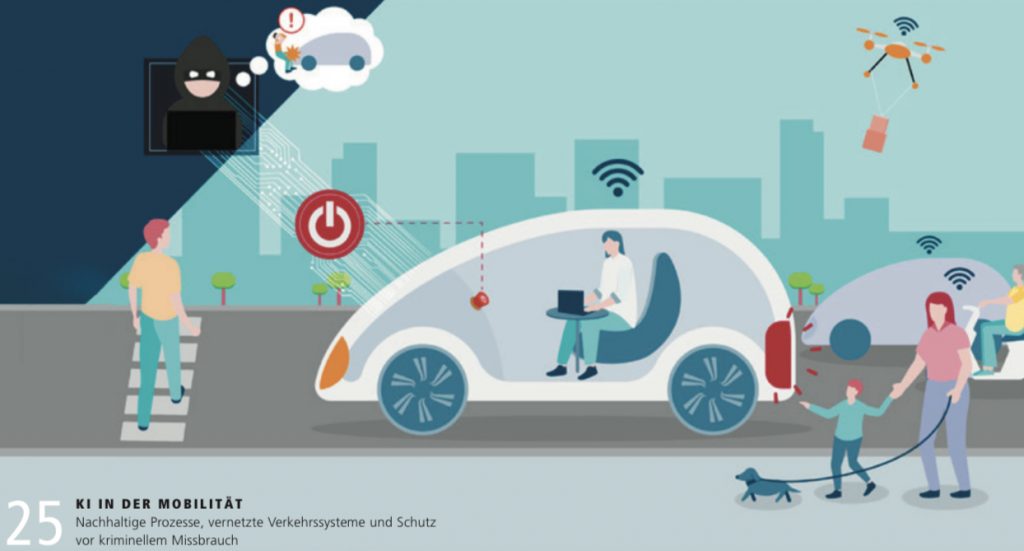
Self-learning systems are increasingly becoming a driving force behind digitalisation in business and society. They are based on Artificial Intelligence technologies and methods that are currently developing at a rapid pace in terms of performance. Self-learning systems are machines, robots and software systems that learn from data and use it to autonomously complete tasks that have been described in an abstract fashion – all without specific programming for each step.
Self-learning systems are becoming increasingly commonplace supporting people in their work and everyday lives. For example, they can be used to develop autonomous traffic systems, improve medical diagnostics and assist emergency services in disaster zones. They can help improve quality of life in many different respects, but are also fundamentally changing how humans and machines interact.
Self-learning systems have immense economic potential. As digitalisation takes hold, they are already helping companies in certain sectors to create entirely new business models based on data usage and are radically changing conventional value creation chains. This is opening up opportunities for new businesses, but can also represent a threat to established market leaders should they fail to react quickly enough.
Developing and introducing self-learning systems calls for special core skills, which need to be carefully nurtured to secure Germany’s pioneering role in this field. Using self-learning systems also raises numerous social, legal, ethical and security questions – with regard to data protection and liability, but also responsibility and transparency. To tackle these issues, we need to engage in broad-based dialogues as early as possible.
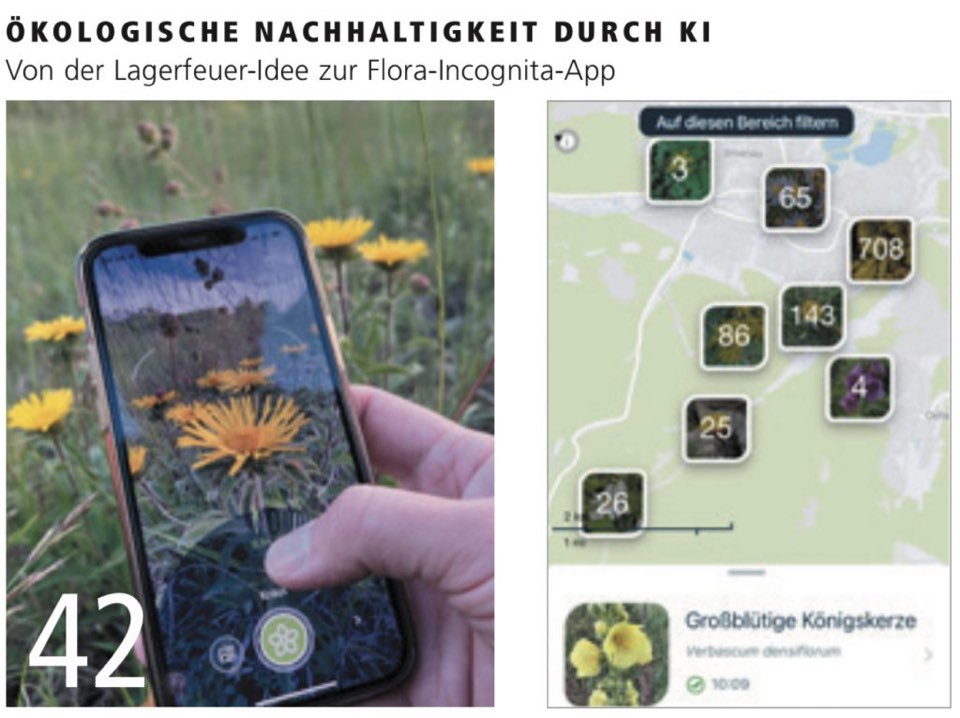
Plattform Lernende Systeme brings together leading experts in self-learning systems and Artificial Intelligence from science, industry, politics and civic organisations. In specialised focus groups, they discuss the opportunities, challenges and parameters for developing self-learning systems and using them responsibly. They derive scenarios, recommendations, design options and road maps from the results.
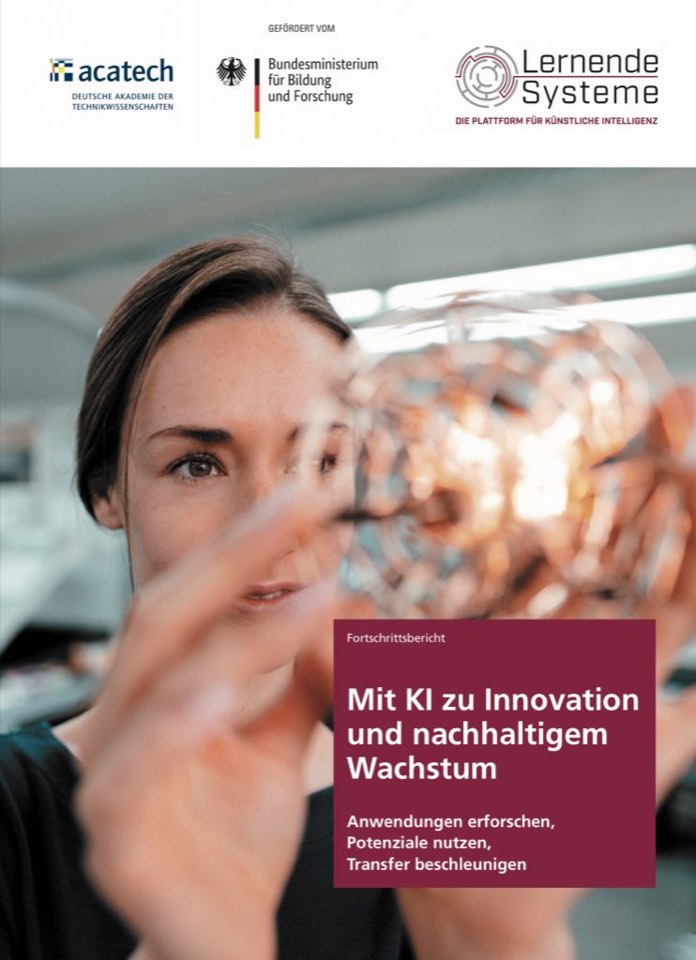
Author: Angelika Breinich-Schilly
Published on 11 January 2023 at Springer Professional - Follow this LINK to original text in German. Translation created with deepL.com
Experts quoted in the article: Stefan Behringer, Leef H. Dierks, Florian Follert, Jochen Werne, Dr. Johannes Winter, Joachim Wurmeling
What distinguishes so-called stablecoins from cryptocurrencies like Bitcoin, Ether & Co? By linking to one or more currencies, this form of digital money forms a bridge to classic FIAT currencies. How this works and where problems lurk is shown in our "Compact explained".
Stablecoins are digital tokens, assets of private issuers that can also take on money functions. According to Leef H. Dierks, they usually replicate the value of a reserve currency, such as the US dollar, or even a whole bundle of official currencies.
Thus, they do not have to represent a claim on the issuer (the reserve currency) itself, but can also be backed by demand deposits of various currencies, securities or other assets. This so-called peg reduces the volatility of stablecoins compared to classic virtual currencies, such as Bitcoin," writes the Springer author in the book chapter "Virtual Currencies and Monetary Policy" on page 234.
According to Dierks, stablecoins take on a bridging function to fiat currencies, "especially since, as long as they are backed by legal tender, they do not challenge the currency monopoly of central banks (analogous to bank deposits) at any time".
According to a thesis paper by the Landesbank Baden-Württemberg (LBBW) from mid-December 2022, stablecoins do open up new business models. At the same time, however, they are "anything but stable, but are subject to the risk of the holders fleeing from them if there are doubts about their collateralisation". Digital money may have a negative impact on macroeconomic lending and reduce the influence of central banks on the aggregate money supply. One way to regulate it is to require issuers to hold central bank reserves.
The best-known stablecoin project is Tether, which is pegged one-to-one to the US dollar. "There has been repeated criticism of Tether, so that the company behind the issue has since admitted to using not only currency holdings in US dollars to collateralise the issued units of cryptocurrencies, but also other assets (for example, commercial papers of companies)," Stefan Behringer and Florian Follert describe the background in the book chapter "Controlling of cryptocurrencies" (page 187). This also explains why this stablecoin does not correlate exactly with the performance of the US dollar.
Jochen Werne and Johannes Winter explain in the book chapter "Cash, book money, cryptocurrencies and the digital euro" on page 84 that there are risks for the financial sector if stablecoins become widespread. They could undermine the banks' deposit business and their business models. The Springer authors see in the central bank cash-backed stablecoins a possibility of a trustworthy transitional solution in hybrid form. This is a stablecoin that demonstrably holds any digital twin in the form of central bank money.
“Due to the tradability of the tokens, the flexibility of book money is paired with the guarantee of physical central bank money. Even the expected damage from a successful attack on the underlying blockchain could thus be minimised, since an unlawful acquisition of power of disposal over assets is quickly restricted in its usability. A regulated expert function guarantees that only central bank money or a digital twin is traded and thus the central supervisory function always lies with the central bank," say Werne and Winter.
With the Markets in Crypto Assets (MiCA) regulation, the European Union has sewn a legal garment for the crypto industry in the 26 EU states. The new EU regulation is to enter into force by the beginning of 2023 and become effective 18 months later vis-à-vis all market participants.
"MiCA responds to the growth of the cryptoasset ecosystem and integrates a large number of new players into the European supervisory space," explains Joachim Wurmeling, member of the Executive Board of the Deutsche Bundesbank, in a guest article on the occasion of the Bundesbank Symposium in November 2022. "In future, crypto service providers and issuers of crypto assets will not only have to ensure that the risks arising from the cryptoasset business are adequately managed; they will also have to apply for authorisation to issue crypto assets or to provide crypto services and be subject to ongoing supervision."
In addition, he said, the regulation also applies to traditional financial institutions that provide services around cryptoassets. The regulatory approach for MiCA is new and is emerging alongside the traditional structure.
The participants of the seminar acquire knowledge that enables them as decision-makers to understand projects that are to use blockchain technology more quickly, to recognise opportunities and risks and to evaluate them together with experts.
It is a pleasure for me, as Managing Director of Prosegur Crypto GmbH, to support the seminar together with other leading blockchain experts such as Christoph Impekoven (micobo), Markus Honvehlmann (micobo), Dr. Marc Henniges (d-fine), Dr. Timo Bernau (GSK), Lucas Zaehringer (verity) and Cara Reuner (Ecota) to train banking experts to create future innovative use cases. We will discuss:
Digital Money
For more details please refer to the website of BZ-Live: https://www.bzlive.de/veranstaltung/1606//
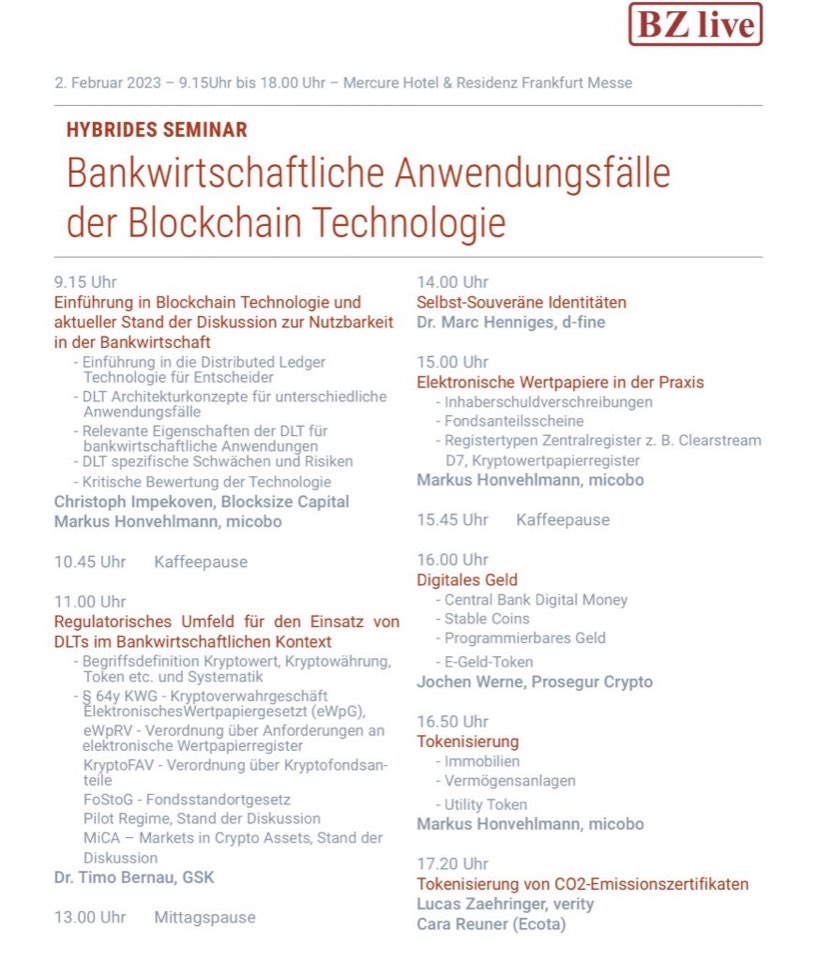
The Global Offshore Sailing Team is proud to announce that we will be organizing an Expedition Andaman Sea from April 14th to 22nd, 2022. This expedition is being held to promote international understanding and environmental awareness for this geopolitically important and naturally beautiful region.
One of the highlights of the expedition will be a wreath laying ceremony to honor and pay tribute to those who have worked for peace in this important geopolitical region and for the promotion of the conservation of the Andaman Sea’s beautiful nature. This ceremony will be an homage to the rich values and culture of Thailand and its people, whose engagement is key to the Andaman Sea.
We invite all individuals and organizations who are committed to these values to join us in this important expedition and contribute to our mission of promoting understanding and awareness in this important part of the world.
PLEASE REFER FOR NEWS TO EXPEDITION WEBSITE
www.ExpeditionAndamanSea.com
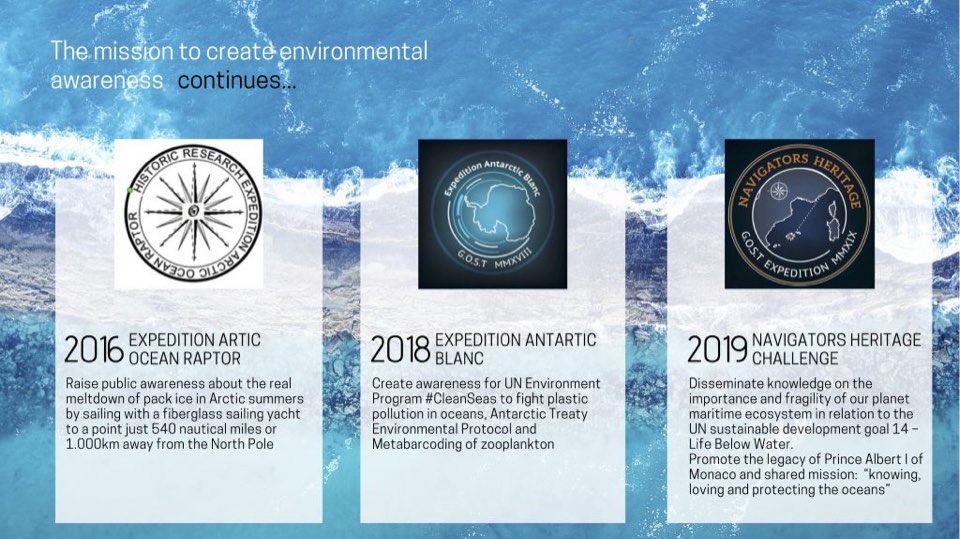
“Expedition Andaman Sea aims to promote international understanding and support international relations by creating awareness about the geopolitical importance of the Andaman Sea region. As part of this goal, the expedition will lay a wreath to honor and commemorate those who have served and engaged themselves for peace in the Andaman Sea. This gesture serves to underscore the importance of peace and stability in the region and the efforts of those who have worked towards this goal.”
Jochen Werne - Expedition Leader
„The Andaman Sea is a vital and diverse maritime ecosystem that is essential to the health and productivity of the region. From its abundant marine life to its stunning coral reefs, the Andaman Sea is a treasure worth protecting. The protection of this ecosystem is closely tied to the United Nations‘ sustainable development goals, and it is a major goal of Expedition Andaman Sea to promote these goals and the initiatives being undertaken to support them. Join us on this once-in-a-lifetime adventure and help us raise awareness about the importance of preserving the beauty and prosperity of the Andaman Sea for generations to come.“
Guido Zoeller - Co-Founder Global Offshore Sailing Team
After a challenging 2022 this year ends with HOPE due to a rally of technological innovation breakthroughs. Technological progress has the potential to help address many of the challenges facing the world today, including the energy crisis, the need for better education, and financial inclusion. Three of them shall be brought to your attention: 1. CLEAN ENERGY - Breakthrough in nuclear fusion technology; 2. EDUCATION - ChatGPT is changing the way to experience artificial intelligence; 3. PRIVACY & FINANCIAL INCLUSION - New compliant pathways for privacy and security in the blockchain-based financial ecosystem
One area where technology is helping to address the energy crisis is through the development of nuclear fusion as a potential source of clean, abundant energy. Nuclear fusion is a process in which atomic nuclei combine to release energy, and it has the potential to provide a virtually limitless source of energy with low carbon emissions. While significant progress has been made in developing fusion technology, it is still in the early stages of development and has not yet been fully commercialized. However, the potential for nuclear fusion to help address the energy crisis makes it a promising area of research and development.

In December 2022 the National Ignition Facility (NIF) has successfully sparked a fusion reaction that released more energy than went into it. Even though there’s still a long way to go toward fusion as a clean energy source, this step can be considered as a major step forward.
READ MORE ABOUT THIS BREAKTHROUGH IN THIS FUSION TECHNOLOGY MARATHON
ChatGPT, also known as OpenAI's GPT-3 Chatbot API, is a natural language processing (NLP) tool developed by OpenAI. It is based on the GPT-3 model, which is a large, advanced AI language model that is capable of generating human-like text.
Overall, ChatGPT is changing the way we experience and interact with AI by making it easier to build and deploy chatbot applications that can understand and respond to user input in a natural, human-like way.
ChatGPT can be used to build chatbots and other NLP applications that can understand and respond to user input in a natural, human-like way. It is designed to be easy to use and integrate into existing systems, allowing developers to quickly build and deploy chatbot applications without the need for extensive training data.
One advantage of ChatGPT is its ability to understand and respond to a wide range of inputs and topics. It is trained on a large dataset of text and has the ability to generate coherent and contextually appropriate responses to a variety of inputs. This can make it a useful tool for building chatbots and other NLP applications that need to handle a wide range of queries and topics.
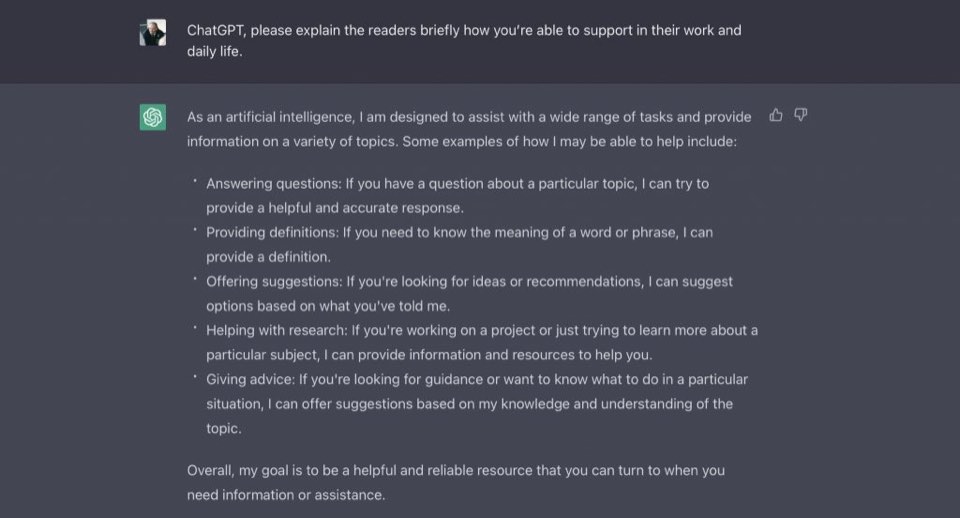
(Text has been created by ChatGPT)
CHALLENGE ChatGPT YOURSELF AND BE AMAZED. FIND OUT MORE HERE
Innovation in blockchain privacy can bring a number of advantages to the financial ecosystem, particularly in terms of increasing the security and confidentiality of transactions. By combining this innovation with a 100% collateralized stablecoin, it is possible to create a more secure and stable digital currency that can be used for a wide range of financial transactions.
One advantage of using a 100% collateralized coin is that it is pegged to a specific asset, such as a fiat currency or commodity, which helps to stabilize its value and reduce price volatility. This can make it more attractive to users, as it reduces the risk of loss due to price fluctuations. The German Digital Cash GmbH just announced to have issued the first 100% compliant, central-bank-money-backed, Made in Germany, Euro-coin on UniSwap, called Digital Cash Euro (DCEUR). READ MORE ON THE DCEUR HERE
In terms of privacy, a blockchain-based stablecoin that incorporates innovative privacy features can help to protect the confidentiality of transactions by making it more difficult for outsiders to track and monitor them. This can be particularly useful for financial institutions and individuals.
Researchers from German crypto blockchain-based payments fintech etonec and other organizations have proposed using zero-knowledge proofs to ensure regulatory compliance and privacy in stablecoins. They have created a design that allows fiat-based stablecoins to be used like cash, within limits.
Dr. Jonas Gross, states on December 15, 2022 to CoinTelegraph: “How can privacy for digital payments be preserved, while ensuring stability and regulatory compliance? In this feasibility study co-authored by @etonec_gmbh, @MinaFoundation, @Privatbank1796, and @SnT_uni_lu we show how it can be done.“ FIND THE THE FULL STUDY HERE

Overall, the combination of a 100% collateralized stablecoin with innovative privacy features can bring a number of benefits to the financial ecosystem, including increased security, stability, and confidentiality.
Overall, technological progress has the potential to help address many of the challenges facing the world today, and it will likely continue to play a crucial role in finding solutions to these problems in the future.
December 2022 seems to be a good month in this respect. A month that shall give hope.
It was a great pleasure to meet again personally and be connected virtually with friends like Dr. Andreas Heindl and Dr. Johannes Winter who, like many others inside and outside this Digital Summit, dedicate their passion to the digitisation of Germany day after day. Their passion is the engine for Germany's competitiveness and prosperity. Exchanges like today between Germany's leading experts in the field of digitalisation and the German government are crucial for the country's future innovation.
This was underlined today by Federal Chancellor Olaf Scholz and the ministers Robert Habeck, Volker Wissing, Nancy Faeser and Bettina Stark-Watzinger. A special motivation was given by Estonian Prime Minister Kaja Kallas and Japan's Digital Minister Tarō Konō.
Congratulations to the organization committee and thank you for the kind invitation. Details can be found HERE
Germany’s digitisation continues to remain one of the main topics of the German government. The aim is to accelerate and promote digitisation processes and to exploit their potential to develop prosperity, freedom, social participation, and sustainability.
In this context, the Digital Summit remains the central platform for shaping the digital transformation with all parties involved. It focuses on the key fields of action within the digital transformation across ten topic-based platforms. The platforms and their focus groups are made up of representatives from business, academia and society who, between summit meetings, work together to develop projects, events and initiatives designed to drive digitisation in business and society forward. The Summit will serve to present the results of the work that has been done in the past, to highlight new trends and discuss digital challenges and policy approaches.
This year’s Digital Summit of the Federal Government will be held on 8 and 9 December 2022. The Federal Ministry for Digital and Transport and the Federal Ministry for Economic Affairs and Climate Action will jointly coordinate the summit’s preparation in the future. In the new legislature, new formats, concrete results and international impulses are to make it the driving force and showcase for digitisation in Germany and beyond.

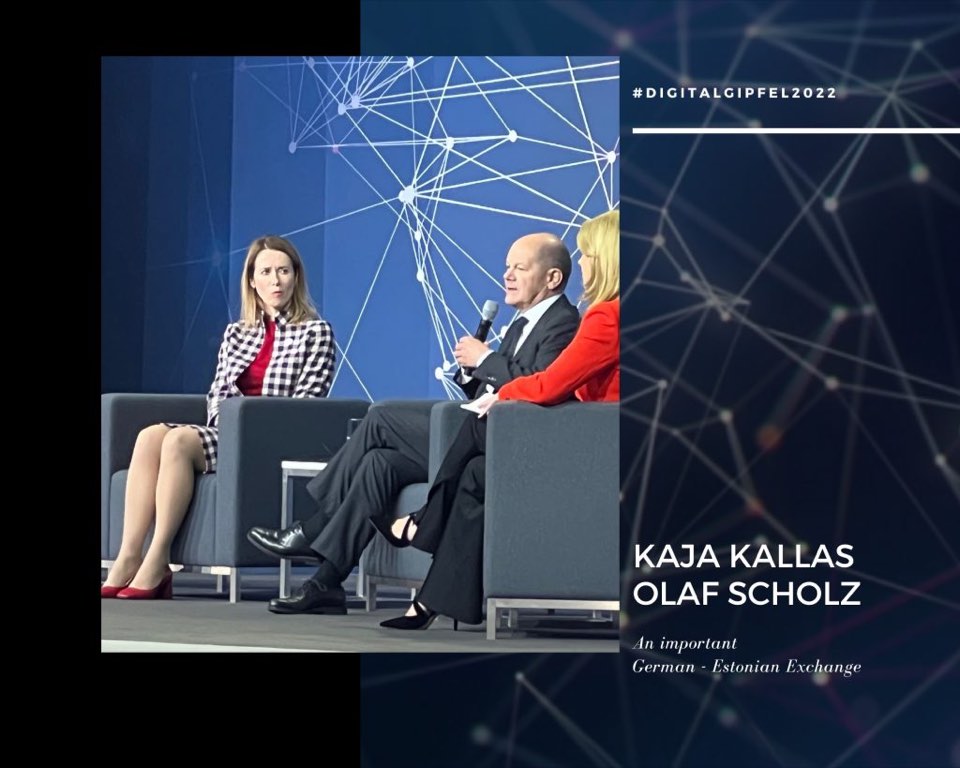
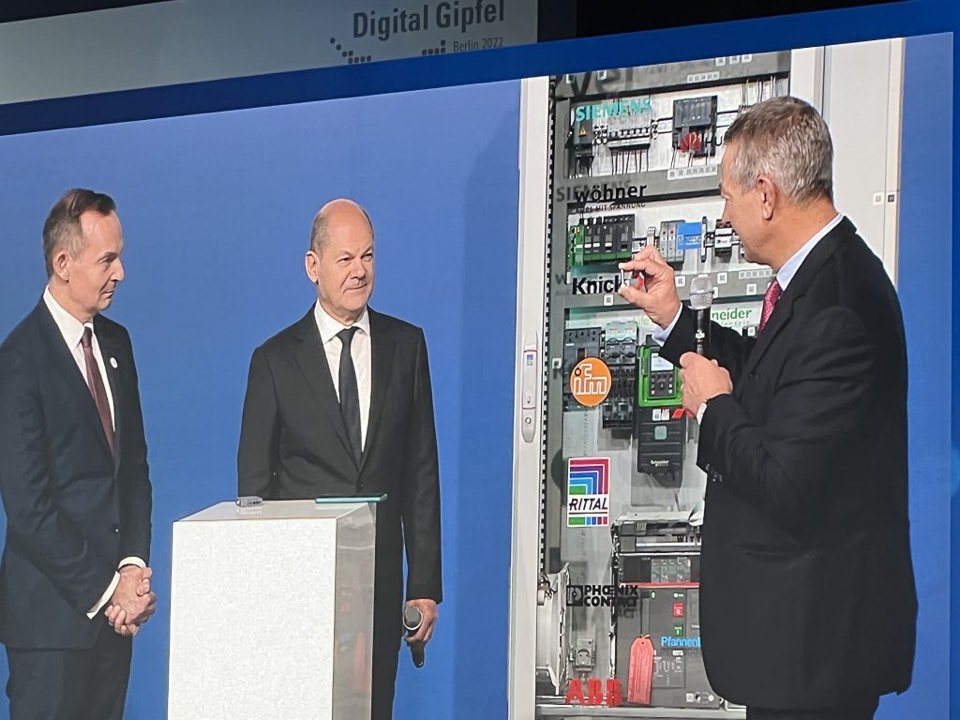
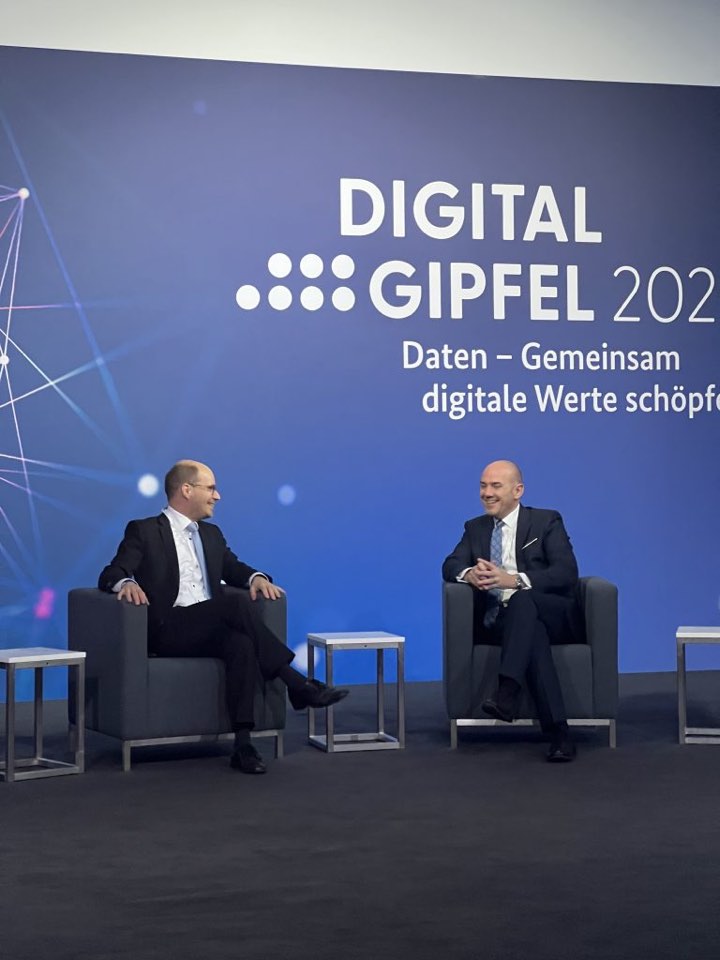
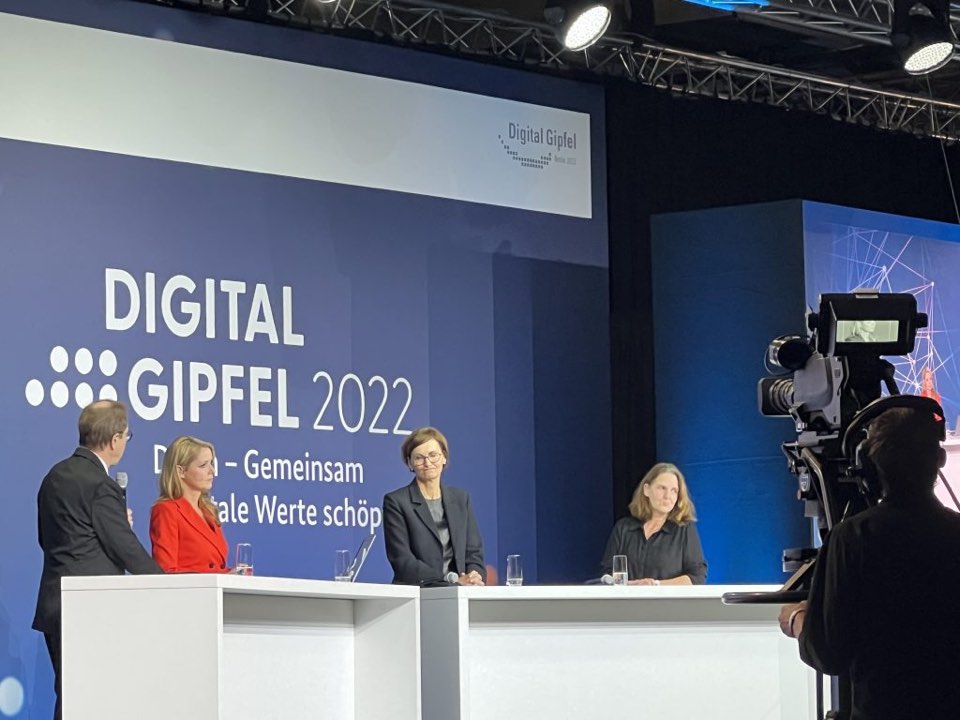
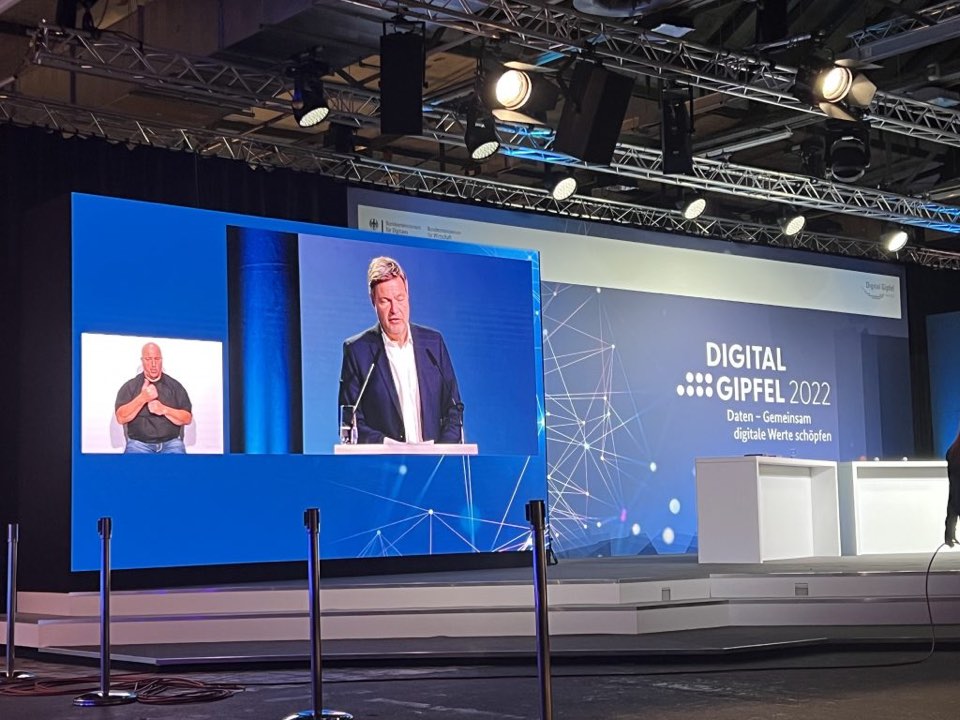
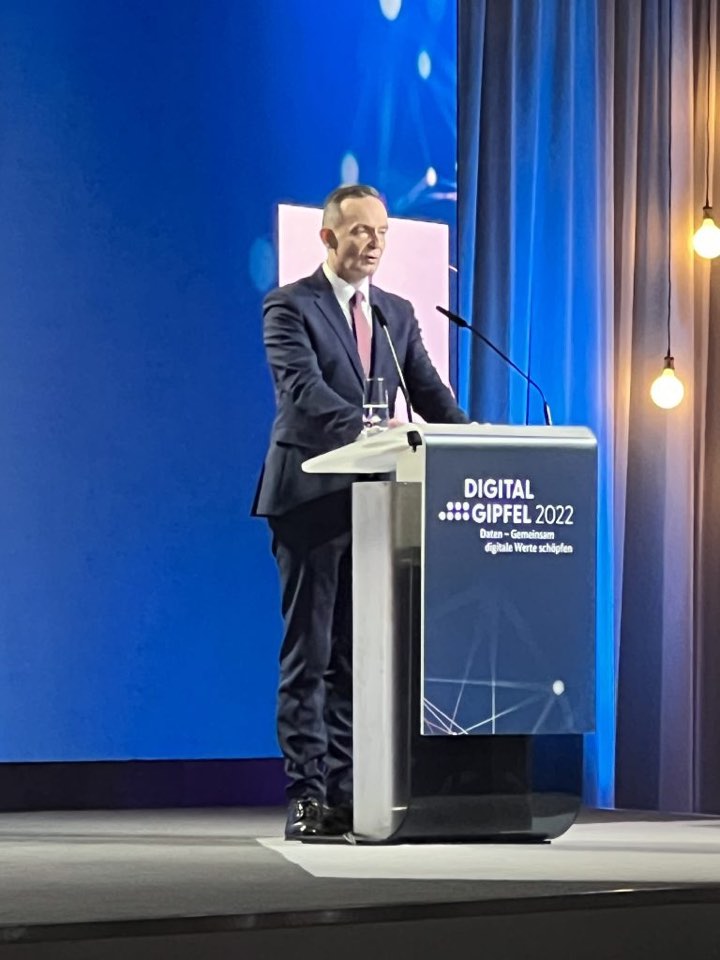
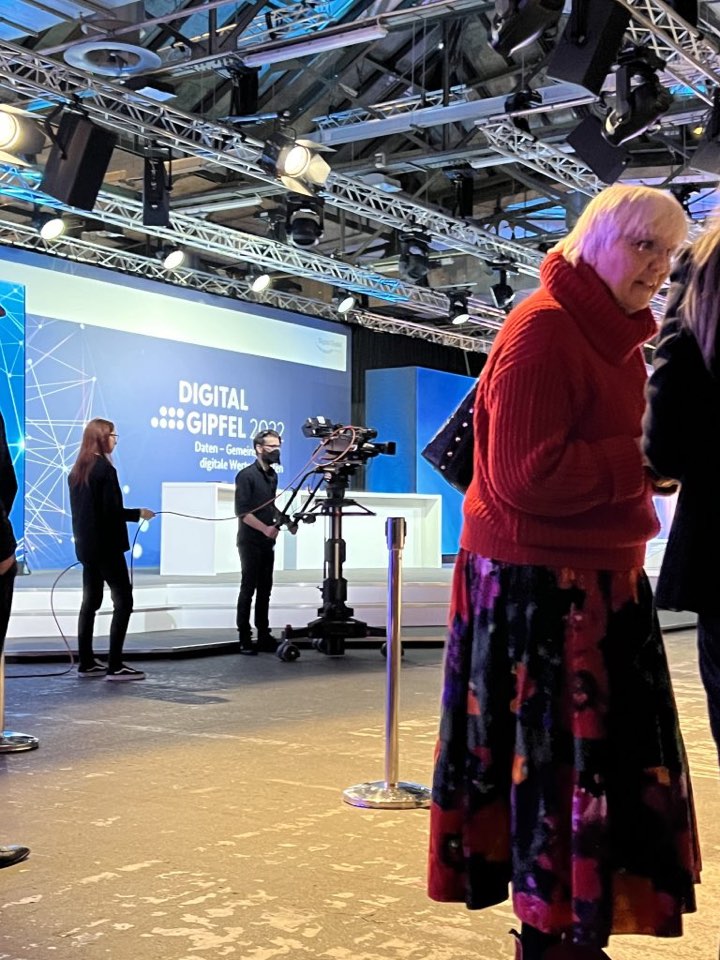
Nomura Research Institute, one of the largest think tank in Japan has been appointed by the Government of Japan-Ministry of Economic, Trade, and Industry (METI) to promote the globalization of Japanese and Foreign companies in Japan and to understand the current business & living environment of Japan.
This study is to help the Government of Japan formulate better foreign policies in the future.
It’s with pleasure supporting this initiative, which aims to promote international understanding through exchange.

Read more at Nomura Research Institute (https://www.nri.com) and Japan-Ministry of Economic, Trade, and Industry (METI) (www.meti.go.jp/english/)
It was very inspiring to have the opportunity to participate in the workshop on responsible quantum technologies with some of the world's most recognised experts in the field. Congratulations and thanks a lot to the organisation committee.
Please find details HERE
The second quantum revolution has been ongoing for more than two decades now and many countries around the globe have noticed the promises of these technologies. Just in the last decade, the number of publicly supported national initiatives grew from zero to more than 15, with globally more than 20 B€ of public investments allocated or planned. Both the number of new publications per year and patents granted on quantum technologies (QT) has also been climbing steadily for the last decade, so has been the number of start-ups being founded and established companies getting into the field. Finally, the field started receiving attention from private funding sources in recent years, which some have been calling the ‘quantum gold rush’. Within two decades, QT became a strong contender for a potential future industry from a topic that was mainly discussed in physics conferences.
All this rapid development triggered a sort of quantum 'race', where countries, companies, and institutions compete to become the first to achieve a checkpoint or to be the current best at some quantum benchmark. However, it is also noted by many that the real/transformative effects of QT on society will be in the long run. In this respect, we would like to initiate a discussion on responsibility and introduce QT as a noteworthy emerging topic for technology assessment (TA) studies.
This workshop aimed to be another step towards establishing connections between the QT and TA communities and to introduce some current discussions in the QT community to a new audience. It is organized as a collaboration between the QuTec project under KIT-ITAS, and the QUCATS Coordination and Support Action of the Quantum Flagship program.
The conference program consisted of panels such as:
Panel on Responsible Education and Workforce Development for QT
Panel on RRI and Ethics in QT
Panel: How to think responsibly on the geopolitics of QT?


In their historical-social debate “Cash, book money, cryptocurrencies and the digital euro“ on money in the digital age in the book "Praxisbeispiele der Digitalisierung" (Practical Examples of Digitalisation) published by Springer Gabler Verlag, the co-authors Jochen Werne and Johannes Winter use historical examples to show the interconnectedness of various actors in the cycle of our money today.
Read an excerpt of chapter 9.3.1. on the historical role of CIT - cash in transit here:
In the case of cash, the person concerned has direct, unrestricted physical power of disposal over his money in the form of coins or banknotes. However, the fact that this is not yet given when the money is minted or printed in bank vaults, but only when it is delivered to the owner, is of crucial importance. To illustrate the importance of this step and thus also the role of the transport of money and valuables, a historical event from the Rotschild Archives can be used.
„The Rothschilds supplied the Duke of Wellington with gold during the Napoleonic Wars and saved Wellington's armies from almost certain defeat. Between 1793 and 1815, Britain was almost continuously at war with France, which placed an enormous burden on the British treasury. By 1813, Wellington's armies had managed to push the French back as far as the Pyrenees, but the financial situation had become critical. Wellington desperately needed gold and silver coins that he could exchange locally to pay and feed his troops and thus maintain morale. J.C. Herries, the British government's chief commissioner, was responsible for financing and equipping the British armies in the field. Herries was looking for a middleman who could secretly procure large quantities of gold without alerting the French. In January 1814 he officially engaged Nathan Mayer Rothschild. Over the previous five years Nathan had built up an extensive network of couriers, dealers, brokers and bankers to facilitate his gold trading activities. Over time, he had established a dominant position as a gold broker in the City of London. After receiving the commission from Herries, Nathan instructed his brothers on the Continent to buy gold wherever they could, secretly and in small quantities so as not to disturb the market. Once the gold was gathered, it was shipped and forwarded to Wellington in the south of France so that he could pay his troops" (Rothschild Archives 2021).
Alongside many small and medium-sized players, the three corporations Prosegur, Brinks and Loomis dominate the main part of the consolidating world market for cash and cash-in-transit. By supplying retailers, banks and private individuals via ATMs and branches, as well as repatriating funds, the industry ensures that the cash cycle is maintained and that each individual's power of disposal over cash is upheld.
It is with great sadness that we have been informed by our friends of the Royal Cinque Ports Yacht Club Dover of the death of a unique personality, sailor, leadership example, GOST member of honour and friend - Admiral of the Fleet, The Lord Boyce.
He will forever accompany us on board in our midst. May he rest in eternal peace.
On a really sad note Lord Boyce who was the Lord Warden of the Cinque Ports and who many of us have met passed away yesterday. A really good and nice man who we are going to miss. Look up his obituary. We were very privileged to have him as a friend.
Bernard Sealy
Dear Skipper, that are really sad news. May he rest in peace forever. All our thoughts are with our English friends.
Götz Credé
…for us of the Global Offshore Sailing Team this is a big loss but for the faith that distinguishes us The Lord Boyce will always accompany and guide us in our future missions, by sea and by land.
Stefano Malvestio
He was the BEACON for GOST! Thank you!!
Bernd Lehmann
It is truly sad, but we are very lucky that we had him to invite and guide us through his parliament, the House of Lords!
Guido Zoeller
It was a true honor having met this kind Gentlemen
Dr. Benon Janos
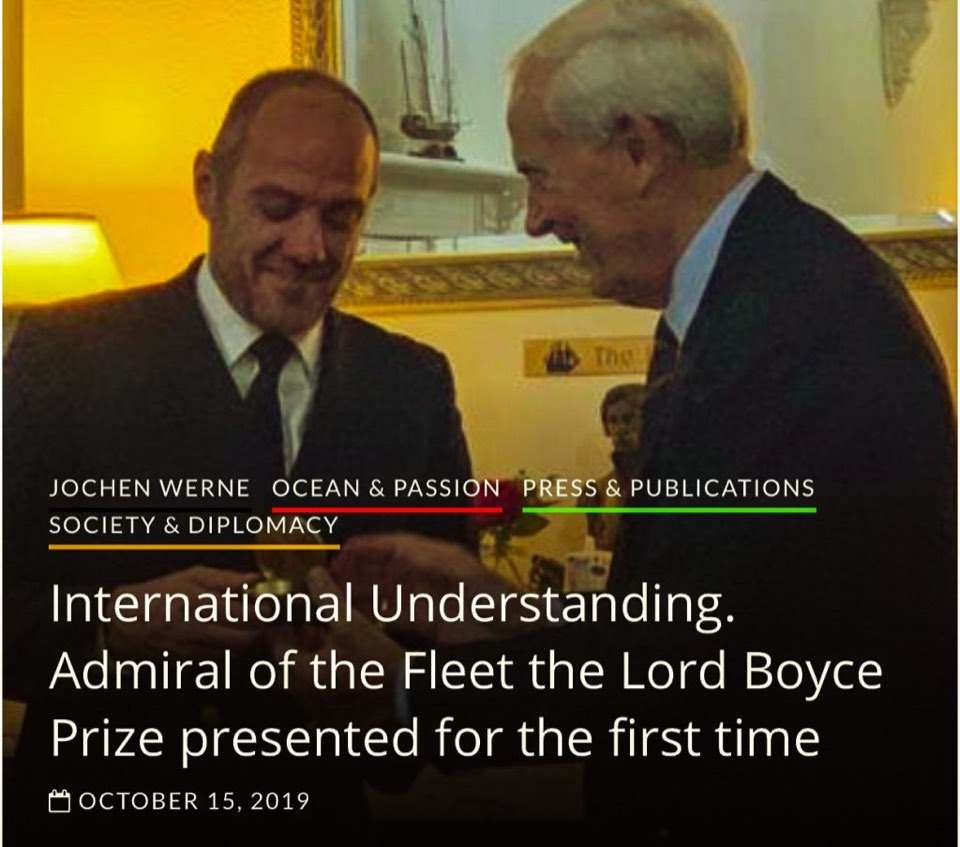

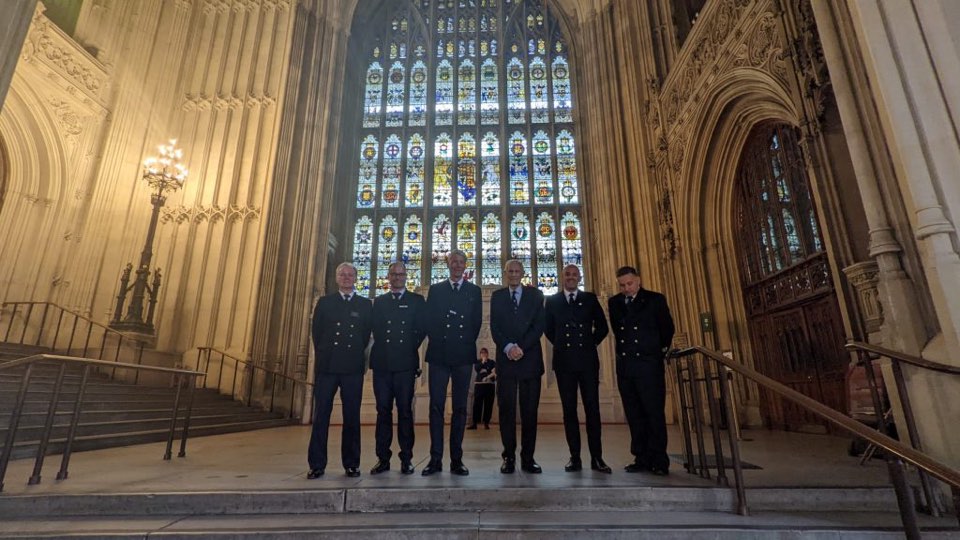
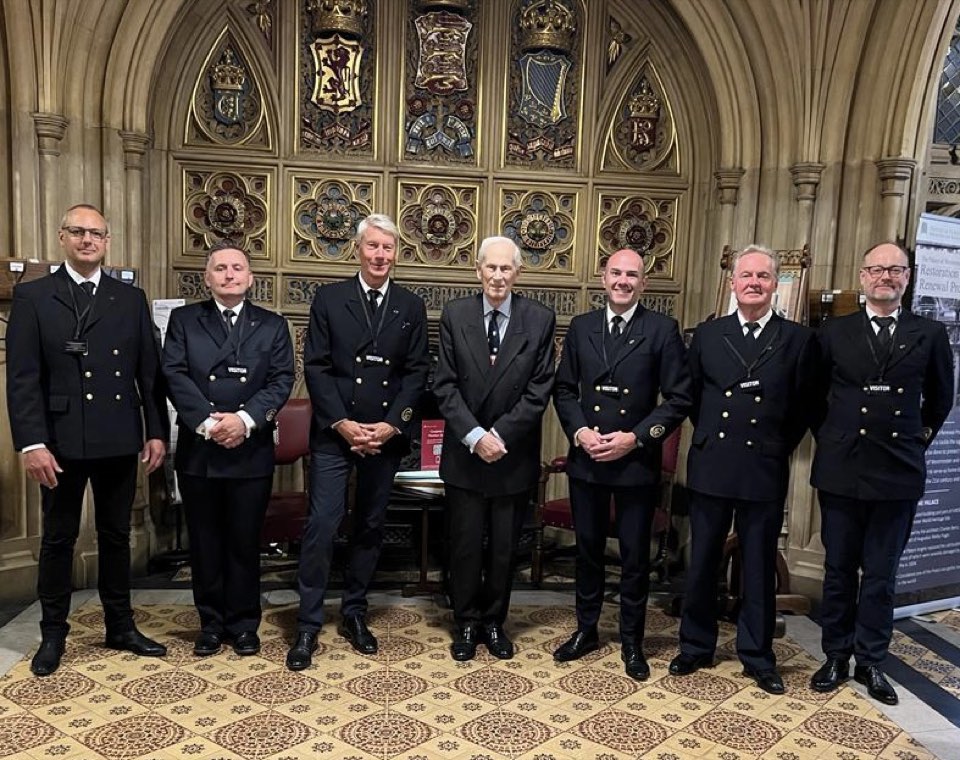
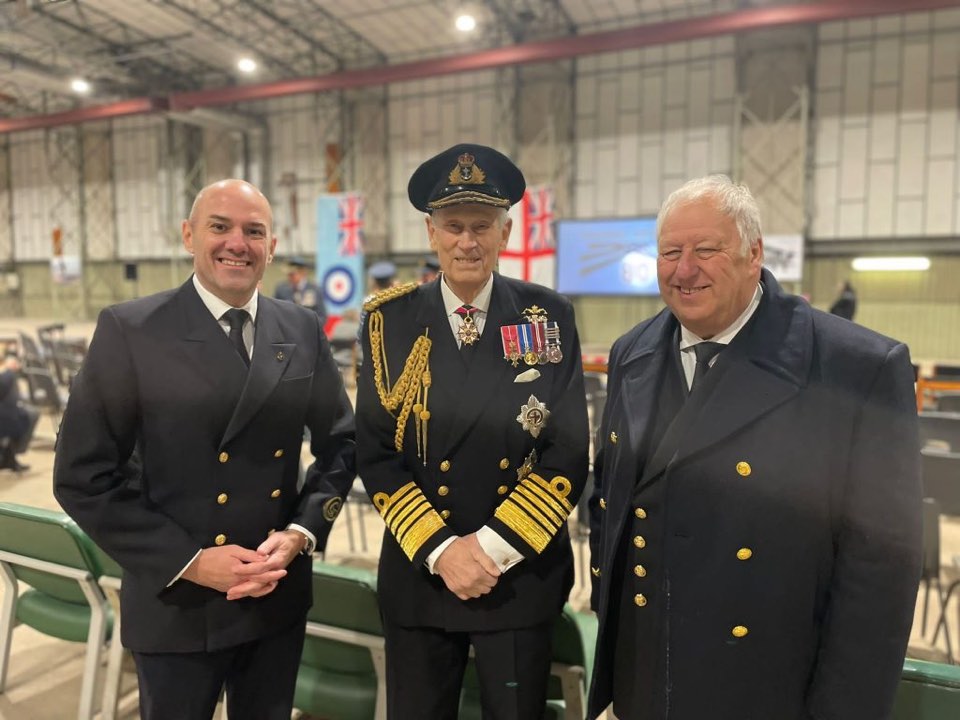
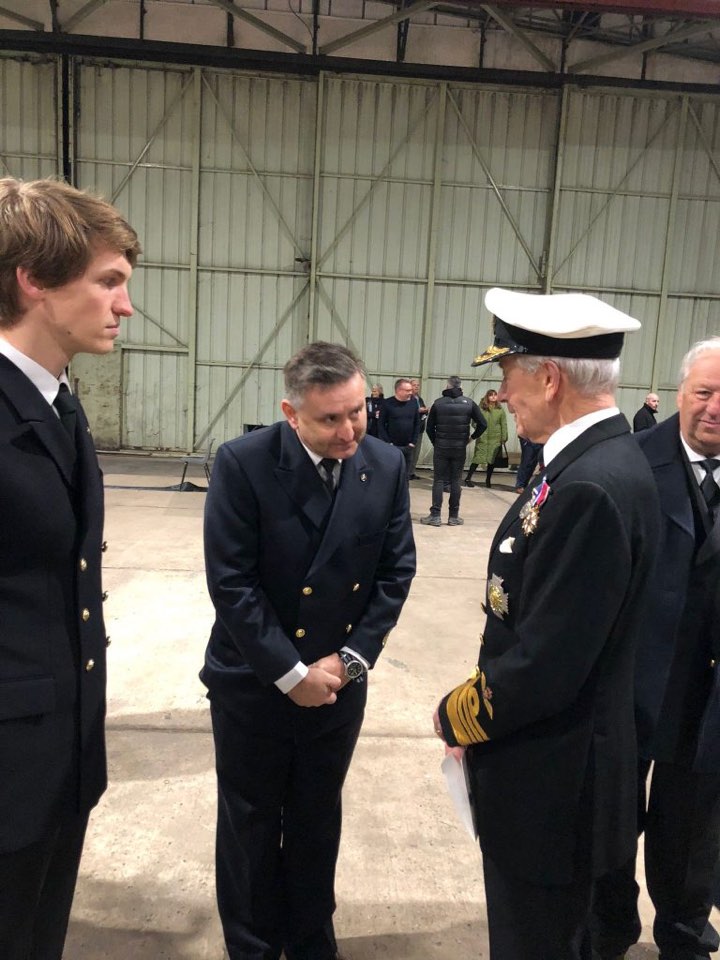
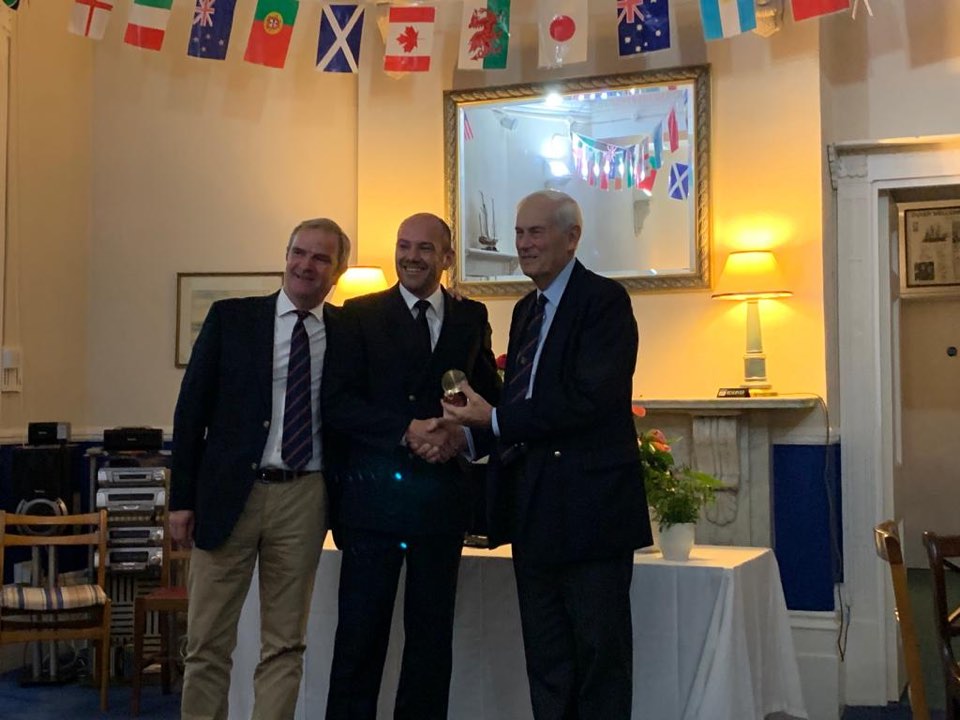
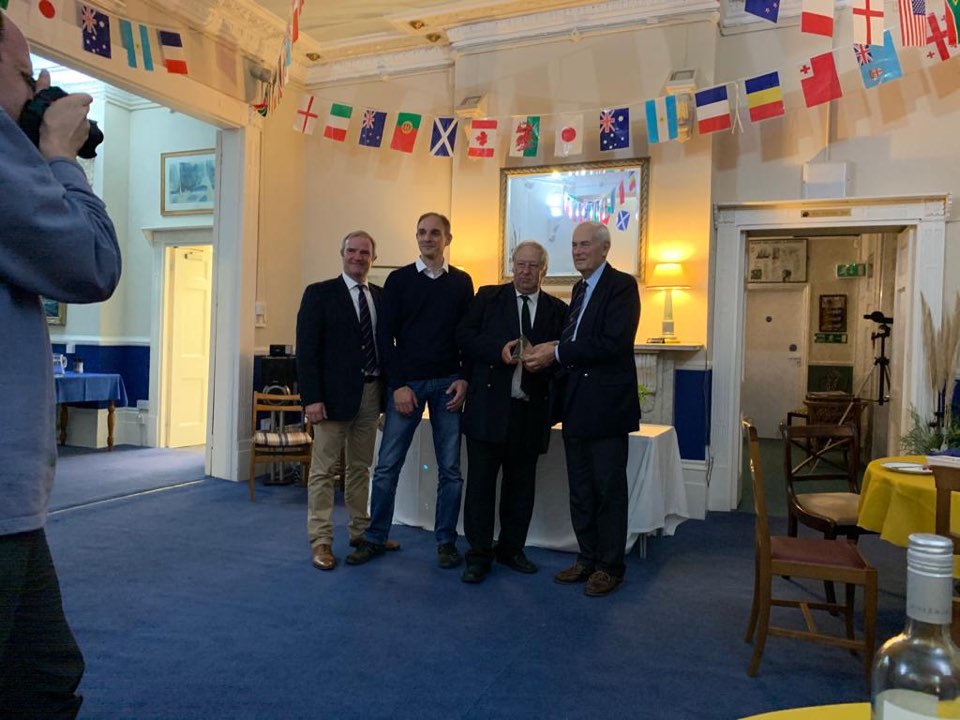


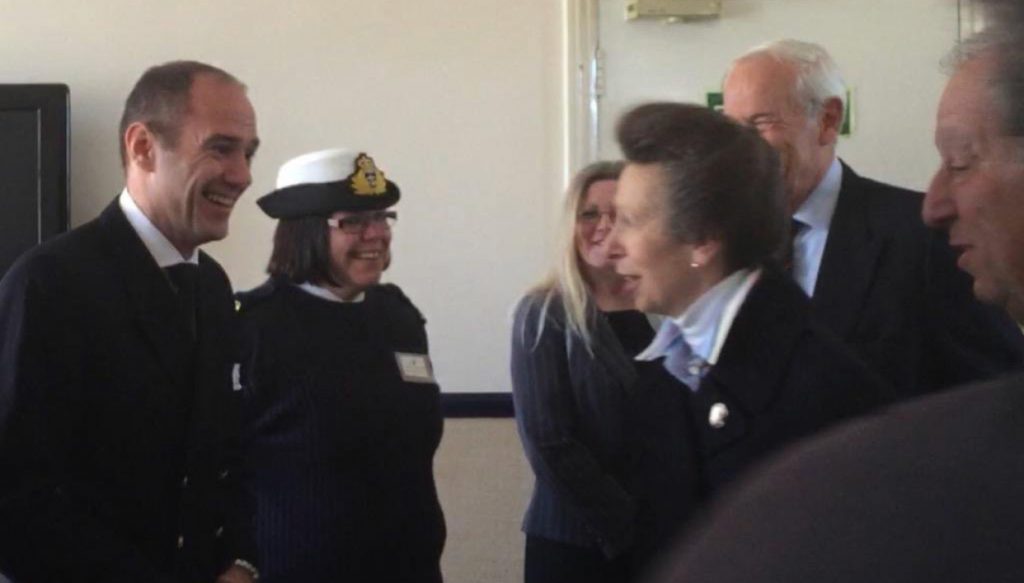


THANK YOU CATHARINA and BENTE FOR A GREAT TALK.
Please find the original talk HERE
In the midst of these crazy times, most industries still haven't gotten their shit together. However, a few bright minds managed to understand the paradigm shift, act accordingly and reap the rewards. So, Catharina van Delden and Bente Zehan talked to some of them! Join us on our learning journey over the next few weeks to see how completely unrelated industries deal very differently with the same challenges we all share – and let's become better together!
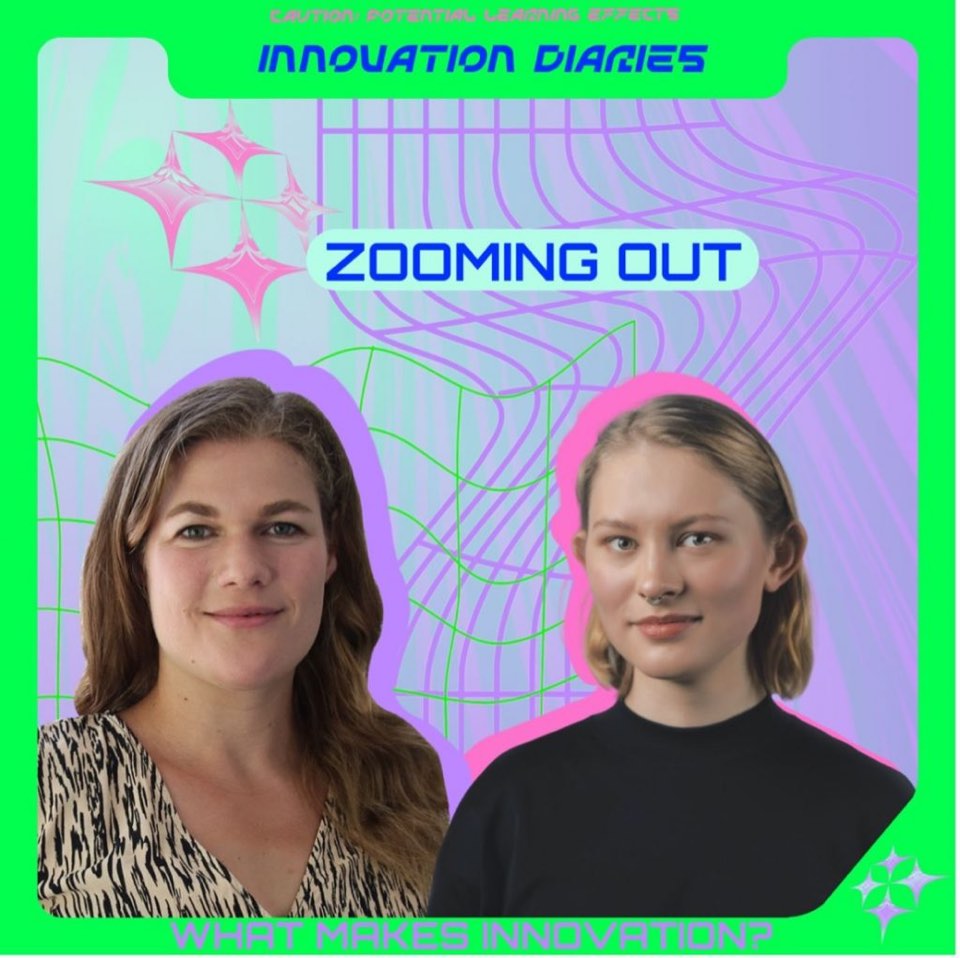
Jochen Werne is Prosegur’s Chief Development and Chief Visionary Officer since 2019. Before that, he worked at different banks, most recently as a director of the German Bankhaus Lenz & Co. Since the beginning of 2022, he is also the managing director of Prosegur Crypto, which is applying for a crypto custody license in Germany.
The Madrid-based company Prosegur offers different security services worldwide. They're most famous for their cash-in-transit services, with more than 50% market share in Germany. In recent years, Prosegur has explored ways to provide digital security services based on its long experience in a non-digital world.
How do you develop new business models and drive innovation within a company that makes its money with a very traditional business model like cash-in-transit?
I would like to jump right in with a personal example: Before I joined Prosegur in 2019, I had a career in banking. When you work in treasury, you have a lot of money you need to invest. As a bank, we were engaged in the investment business and in our case, most of the money had to be invested in the short term, unfortunately within a negative interest rate environment throughout the last years. So, the best solution would have been to put your money under the mattress instead of in a bank account. When I joined Prosegur, I explained this pain point and we discussed how we could solve this problem for treasurers. Since anything which has fewer costs than 0,5% is considered profit for a treasurer, we offered asset managers, high net worth individuals, and banks custody of short-term liquidity fully insured and compliant in our high-security facilities.
You’re in the security sector. From another conversation I recall you talking a lot about feeling safe vs. actually being safe – an image Catharina and I discussed before starting this series. Our example is a house standing by a cliff, with that a giant tsunami arriving. Instead of thinking about how to relocate, many industries seem to wonder about putting solar panels on the roof and perhaps repainting. Both are valid things to do – however, perhaps they’d have a different focus if they had zoomed out. Is that also a topic within your company, and how do you handle such problems?
This is how new business models and innovations can emerge: You have to take a different perspective, look at other people's problems and find solutions based on your own experience and knowledge. That is an excellent picture. And if you take that into account, I think also from a psychological point of view, we live in our bubbles. Let’s take, for example, the phenomenon of social media: You “privately” click a like button, watch a video, or comment on a post without really knowing how much this very private behavioral data is influencing an algorithm (which in the best case just targets you as a potential buyer of a certain product). After all, you are only doing it "privately" – but you're not! If you were to zoom out, you're back at your tsunami example. It happens in everyday discussions, from climate change to energy crises. Sometimes, people take a point of view and go blindly in one direction. If you’re able to zoom out, you’re also able to change your behavior and find many more solutions to problems.
When making decisions and discussing innovations, it's important to accept that you yourself are not able to see the whole picture. And based on that, you should go into discussions with an open mind – without thinking you're completely right and cannot learn anything from the others. Innovation can only happen when people think outside the box, try to understand the whole picture, make new connections, and then act on their new insights.
Business leaders also need to ask themselves how they can innovate. Do they talk about the future, about what they need to create, and how it is no longer the same? Or are they just pushing to quickly return to their classic KPI models, missing the direction the rest of the world is moving in?
How do you take actions from the big picture and implement them? Basically, how do you zoom in again?
Prosegur works in an industry with low-profit margins. We can never sit back and say, "Yes, we have a wonderful company here, everything is going great!" It is labor-intensive work with – obviously – high labor costs.
So we can't afford to be just visionary; we also need to focus on the essentials. We need justified results every month. Therefore, more than in other sectors, the rule is: if you deliver results, people will listen to you. It's also part of my job to enthuse people and help them understand new concepts. But I wouldn't say that's purely related to my role; anyone in a leadership position should see it that way. Prosegur is a big matrix organization, so you have to use your network to move things forward.
In security, there are a lot of processes with rigid security protocols that won't be changed in an agile approach quickly and easily. But with other and industry-adequate means the teams are improving efficiency every day.
How do you go about that?
People have to be trained. Otherwise, it won't work. You have to get people to change. But don’t be surprised that the goal will never be achieved 100% because you will never get everyone to embrace change. Resistance to change within the individual is far too great and it’s very often just too convenient to stay in the comfort zone.
I would like to come back to your example of the house on a cliff. I have seen people who've ended up in a disaster professionally because they didn't want to or were afraid to go into action. You have to be open-minded and sometimes even force yourself out of your personal comfort zone.
You founded Prosegur Crypto GmbH – a business model that to the untrained eye has little to do with your core business: cash. In convincing your board this is a relevant thing to do what are your learnings regarding the degree decision-makers need to understand new technology? Should everyone become a super tech expert?
I don’t ask the whole company’s management to be full experts on all technologies. That’s impossible. But please – as a responsible decision-maker - understand the leading technologies existing in this world! For example, as a banker, you should understand the concept behind blockchain. Of course, this is very technological, and most people can’t explain it in a good manner, but you must understand it. To better understand, decision-makers should have a “new-in-tech" training every couple of months, besides all the usual management training.
So, my appeal to every business leader is: Take your time and try to at least get the gist of things. You should understand what technology can and cannot do, and not just follow your daily headlines. The second part is to really listen to your existing experts whom you pay to know all the details. They need to be at the table and give their input to assess the next useful steps.
Lastly, we’ve talked a lot about networks. What are your best practices regarding this?
It is one of my favorite topics! First of all, you need to know that networks have not just existed since social media came into existence but have always existed. Network organizations have always brought – likewise interested - people together. Unfortunately, also on this topic, we do have to step out of our comfort zones to broaden our perspective. Otherwise, our networks take us as prisoners and we are as the known proverb says birds of the same feather who flock together.
There is very good literature on networks: like "The Square and the Tower" by Niall Ferguson or "The Starfish and the Spider" by Ori Brafman and Rod Beckstrom. Everyone should read these books.
————————————-
Tl;dr for the lazy
• People live in their bubbles and make themselves too comfortable within them, even if it sets them up to fail. It’s important that companies (and we as a society) zoom out to see the bigger picture.
• Innovation and new business development can only happen if you combine your own experiences and opinions with other points of view.
• Companies need to go beyond just recreating and reusing what has already worked for them. They should start asking questions and finding solutions that truly bring them on the right paths into the future. Even or especially if that means that they need to get out of their “safe space” (which is not so safe after all).
• Instead of judging ideas and innovations as being “good or bad”, look at what they “can and cannot do”
• You need to train and communicate openly with people to overcome the resistance towards change.
In 1999, Guido Zoeller and Jochen Werne founded the Global Offshore Sailing Team (GOST). The mission: to challenge the seven seas to promote international understanding and create environmental awareness. The success was made possible by the highly committed team members and GOST supporters. Each is unique and has dedicated themselves to the set goals in dozens of expeditions from the Andaman Sea to the Arctic Ocean. Through its people's diplomacy approach, GOST has created a network with the highest echelons of politics, business and diplomacy. In a One-to-One interview with with the highly recognised eco-book author Maurice Abbati, expedition leader Jochen Werne describes how this became possible and why passion, teamwork and inner fire are of utmost importance to achieve great goals.
Enjoy reading the original here
MONACŒCOART® (MonacoEcoART, MŒA enPR= Monaco MyHeart) is a new media editorial project aimed at discovering sustainability from different angles with a special focus on projects, relevant figures, best practices and smart ideas linked to the Principality of Monaco and its vast network.
Updated: Nov 19, 2022
Jochen Werne: Innovation and Business, Society and Diplomacy, Ocean and Passion strongly aim at a positive change for the future.
Photo >> Jochen Werne (2022) © J. Werne
International expert in finance and blockchain, head of several private and corporate Banking divisions, keynote speaker, actively committed in diplomacy and economy transformation following the current shift to Sustainable Development as wished by United Nations and major political, technical and business bodies, he is extremely fond of communicating his passion for oceans and the virtuous interlink between human beings and nature. Jochen Werne does believe in the importance of everyone's potential diplomacy in contributing to keep peace and a balanced approach to preserve natural ecosystems. “Innovation and business, society and diplomacy, ocean and passion are strongly connected and we, together with our different talents in today’s connected world, can push forward with positive change for good everyday”, in these words is enclosed the sense of his enlightened thought. His strong sense of adventure and respect for the scientific world at the service of Nature, led him to be involved in many ocean missions considerably appreciated by H.S.H. Prince Albert II of Monaco and other major Head of States, notably the President of France and Austria. All that brought him to further increase his knowledge and experience. He also launched a targeted international group whose members from all over the world have relevant navalbackgrounds. This body aims at keeping live naval traditions and highlighting the role of ocean expeditions as a cornerstone of world balances.
MONACŒCOART® had the pleasure to collect a meaningful feedback directly from Jochen Werne (J.W.), Co-Founder & Expedition Leader at Global Offshore Sailing Team (GOST).
TOPICS = OCEAN PASSION >> VALUES >> MARINE EXPEDITION >> OCEAN PRESERVATION >> DIPLOMATIC ROLE >> LINK WITH THE PRINCIPALITY OF MONACO >> BEST RECOGNITION
MONACŒCOART®: Jochen Werne, how did your passion for the oceans and sailing comeabout?
J.W.: As a child growing up in the countryside on the border with Switzerland, the world outside my parents' home always had a great attraction for me. Notably, the Sea with its magical sense of endless freedom, adventure and beauty has always been a trigger in my life. And this fascination still inspires me even though I have sailed the seven seas. Maybe it will never disappear. I had my first contact with sailing during school holidays onLake Constance. Then, I joined the navy, where I had the privilege to serve for almost twoyears as a navigator on the three-masted sailing ship ‘Gorch Fock. That finally ignited my passion for the oceans and sailing.
Photo >> The Expedition Blue Ocean 2022 crossing the Tower Bridge in London © GOST
MONACŒCOART®: What values have you learned after so many years of shipping?
J.W.: The most important one is RESPECT. Probably every ocean sailor and mariner would confirm it. As a sailor you experience the marine element in its most breath-taking calm and beauty and its most deadly and dangerous brutality. Respect helps to enjoy one side of the coin and survive the other. Respect leads to this deeper understanding that Nature is in many ways more important and also more powerful than ourselves. The fact that makes us feel humbly is to understand that Nature can always live without us, but we cannot live without Nature. Moreover, a sailor learns how to use Nature to benefit from its power in the best and most sustainable way and to emotionally experience its pure and infinite beauty.
Photo >> Environmental Awareness & Offshore Sailing within ‘Arctic Ocean Raptor’: Sailing to the most northern reachable, partially ice-free points on Planet Earth. Public awareness about the real meltdown of pack ice in Arctic summers will be raised by sailing with a fiberglass sailing yacht to a point just 540 nautical miles or 1.000km away from the North Pole © GOST
MONACŒCOART®: Which marine expedition has shaped you more than others? Why?
J.W.: Every expedition has its uniqueness and therefore it is difficult to prefer one over the others. However, the ‘Arctic Ocean Raptor’ was very special to me. It took us from the northern Norwegian city of Tromsø across what sailors call the ‘devil's playground’, the Barents Sea, to a spectacular natural habitat called Spitsbergen at 80° North. Despite its up-north location, the climate is quite mild due to the Gulf Stream. As our expedition approached Svalbard after three days of sailing through dense fog, we encountered a huge ice barrier that broke away from the cold eastern side of the island due to the warm conditions and drifted on with the current. This, combined with a 9-bft (= Beaufort scale) storm, made the voyage a real challenge, but also impressively demonstrated the fragility of our ecosystem.
Photo >> H.S..H. Prince Albert II of Monaco welcoming Jochen Werne and other members of GHOST at the Monaco Yacht Club © YCM
MONACŒCOART®: Which measures do you think are most important to preserve marine ecosystems? Why?
J.W.: There is no doubt that before starting a movement or action, awareness must be raised. This step is of utmost importance, otherwise one remains lonely and therefore a committed but silent to action interlocutor. The Principality of Monaco has a long tradition of identifying problems for our marine ecosystem and taking action to make many aware of them. H.S.H. Prince Albert I of Monaco immediately recognised the dangers of bottom fishing with the new means of steam technology. Jacques Cousteau not only served science but brought the beauty of the sea into everyone's living room with his work behind the camera and inspired new projects to protect the oceans. Last but not least, H.S.H. Prince Albert II of Monaco is the perfect example of how this has not only become Monaco's heritage but a lived tradition. We are grateful that he has supported us in our expeditions to raise awareness and thus contribute to the conservation of our marine ecosystems.
Photo >> Thorsten Glauber, Bavarian Minister of State, handing over the States Medal to Jochen Werne, Co-Founder of GOST © TMUV
MONACŒCOART®: You have already pointed out several times that scientific and fact-finding missions are particularly effective for intercultural and diplomatic exchange. What makes them instruments of dialogue?
J.W.: Our oceans are the fluid connection between our nations. And even though we are citizens of nations, we all belong to one Planet. As seafarers, we are directly dependent on nature and national thinking takes a back seat. In the daily challenge at sea, nationality, race or gender are not important. What really matters is to achieve our goals as a team, otherwise we will all fail. This also applies to us as a human race. The challenges before us are global challenges that no single nation can solve alone. We need a collective effort, and we have so many examples where the global community has done it together. One of my favourite examples is the Antarctic Treaty, which was negotiated at the height of the First Cold War and still provides the basis for joint peaceful governance of Antarctica today.
Photo >> Antarctic Blanc expedition: the international team held a commemoration ceremony on the historically significant Antarctic volcanic Deception Island, in the name of all supporting states and the United Nations. a wreath of local ice was symbolically formed and laid down in order to pay international tribute to the achievements in the exploration of this unique continent © GOST
MONACŒCOART®: What place does the Principality of Monaco have in the international expeditions that you carry out as part of the Global Offshore Sailing Team (GOST)?
J.W.: We are more than grateful to H.S.H. Prince Albert II of Monaco, the Yacht Club de Monaco, its Board of Directors with Bernard d'Alessandri, Gerd Ziegenfeuter, the staff and members as well as the press for their excellent support in our common tasks. Together we were able to achieve outstanding results. Starting with the expedition ‘Antarctic Blanc’ 2018, which resulted in a state act supported by 19 nations including the United Nations, to the Prince Albert I Memorial Expedition ‘Navigators Heritage’. Together, we have succeeded not only in supporting science, but also in bringing people and nations closer together and raising awareness of the needs of our oceans.
Photo >> Maximino Gómez Alvarez, Vice-President of AIDHNC, giving the "Ancla d'Oro" to Jochen Werne, Co-Founder of Global Offshore Sailing Team (Maritime Museum, Hamburg, 8th May 2016) © GOST
MONACŒCOART®: GOST expeditions have been awarded the highest honours by heads of state and international institutions. What is the recognition to which you are most attached? Why?
J.W.: We are more than grateful to have been honoured with a State Medal for our commitment to environmental protection or with the Ancla d'Oro (Golden Anchor) of the Asociación para la Investigación y Difusión de la Historia Naval de Cuba and the Admiral of the Fleet the Lord Boyce Award for promoting international understanding. Among all the awards, the highest recognition for me is the fascinated smile on a young person's face when one of the stories of the sea lights the flame of passion for marine elements. It is their spirit that will form the basis for future action. Just as others in the past like Jacques Cousteau have lit a fire in us for the Sea. It is the quote attributed to the brilliant Antoine de Saint-Exupéry, author of the beautiful novel Le Petit Prince, that probably describes it best: If you want to build a ship, don't drum up the men to gather wood, divide the work and give orders. Instead, teach them to long for the vast, endless sea. ***
? ✒By Maurice Abbati
It was a pleasure contributing in co-authorship with the AI-expert and friend Dr. Johannes Winter / Jochen Werne to this new Springer Gabler publication ”Praxisbeispiele der Digitalisierung” (Best Practice of Digitilisation) which is available now as e-book and paperback at https://link.springer.com/book/10.1007/978-3-658-37903-2
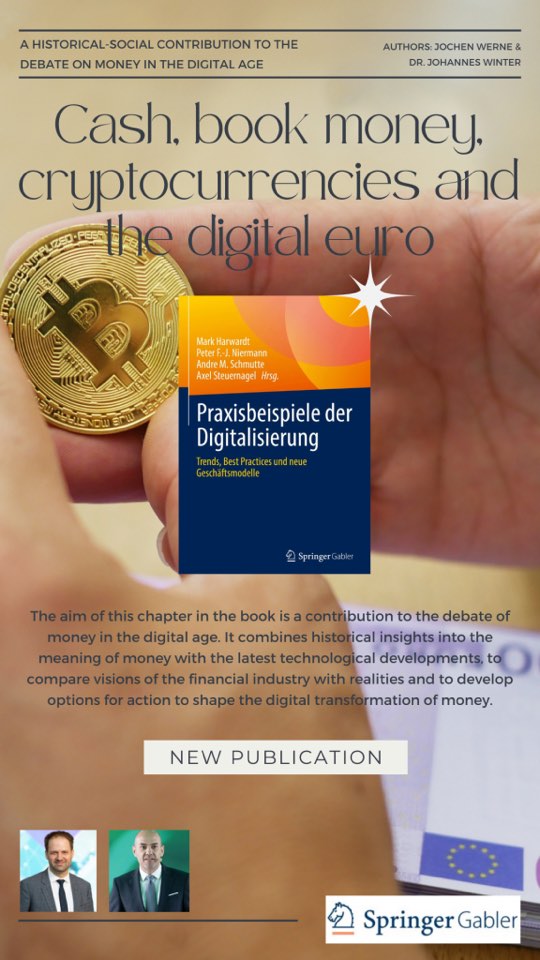
The aim of the chapter in the book is a contribution to the debate of money in the digital age. It combines historical insights into the meaning of money with the latest technological developments, to compare visions of the financial industry with realities and to develop options for action to shape the digital transformation of money.
Abstract: In a world where tech companies are leading campaigns to create a new cryptocurrency and bitcoin is surpassing the US$50,000 mark because a visionary electric car maker wants to recognise the cryptocurrency as a means of payment, some fundamental questions arise: how must money be defined in a digital world to reliably fulfil the characteristics of a universally recognised store of value and medium of exchange? And what changes are in store for the financial industry when so-called stablecoins proliferate and challenge the banks' classic deposit business and their outdated business models? The aim of this contribution to the debate is to combine historical insights into the meaning of money with the latest technological developments in the digital age, to compare visions of the financial industry with realities and to develop options for action for shaping the digital transformation of money.
All contributions to the book
About Springer Gabler
Springer Gabler Verlag is the leading specialist publisher for the business sector. Its classic and digital teaching materials and specialist media address current business questions and provide reliable, practical solutions.
It was a pleasure and inspiration discussing with other thought leaders future relevant trends in society and security.
As follow-up to their keynotes and moderated by Stefanie Dreyer, the panel participants Daniel Kroos (OSCE - Organisation for Security and Collaboration in Europe), Steven Koleczko (DGC - Deutsche Gesellschaft für Cybersicherheit), Jay Tuck (Investigative Journalist) and Jochen Werne (Prosegur Germany & Prosegur Crypto) discussed impacts of technological changes on society and security. The panel took place during the 25th anniversary of the Hamburg@Work Future Summit on the historic freight ship Cap San Diego in the port of Hamburg and consisted of outstanding streams on digital future trends with Nils Müller - Trendone, political trends with Federal Minister Wolfgang Schmidt, Dr. Thomas Mirow - Senator ret. Hansestadt Hamburg, Dr. Carsten Brosda - Senator Hansestadt Hamburg, Prof. Henning Voepel - cep, Centrum für Europäische Politik, Thomas Fuchs - Hamburgische Beauftragte für Datenschutz und Informationsfreiheit, technological trends with Dalits Steiger - SwissCognitive, Dr. Mira Wolf-Bauwens - IBM Research Europe
Congratulations to the board and the team of Hamburg@Work under the leadership of Uwe-Jens Neumann for this outstanding achievement.
Details are available at: https://www.digitalcluster.hamburg/de/events/2022-09-22%2025th%20Anniversary%20SUMMIT-232933
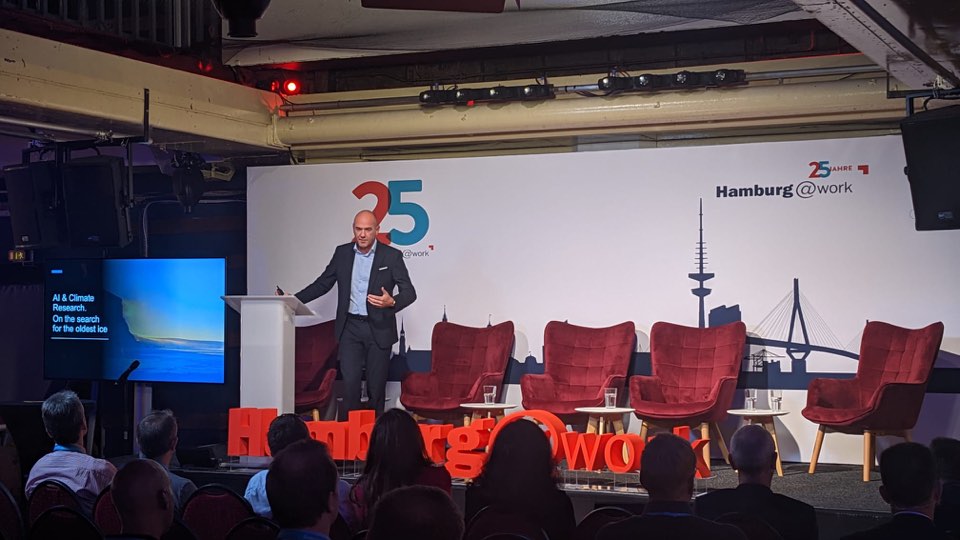
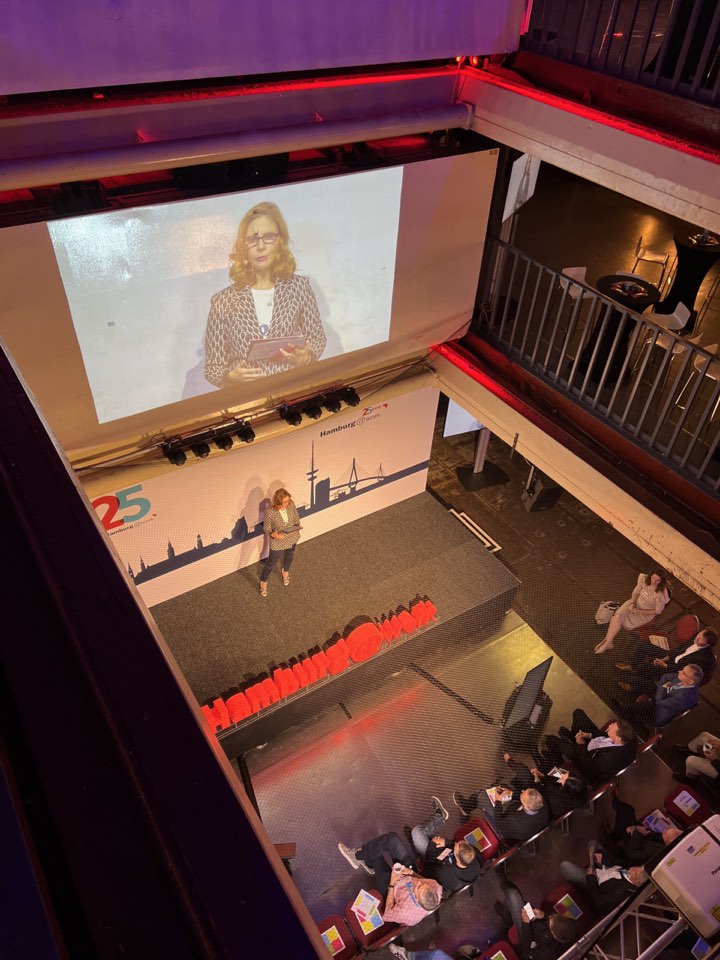

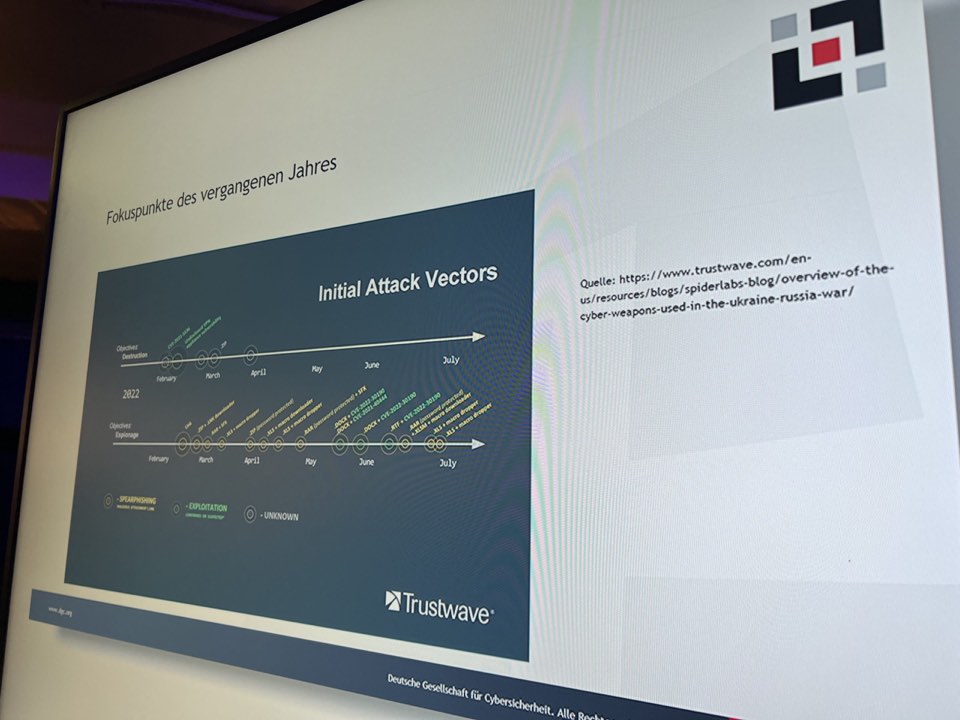
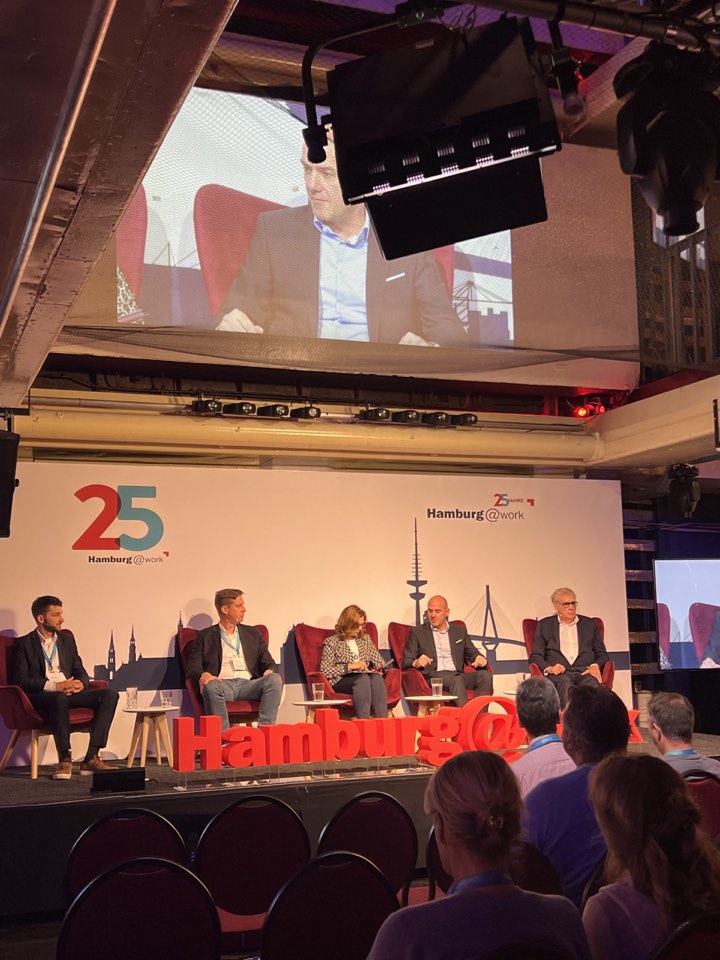
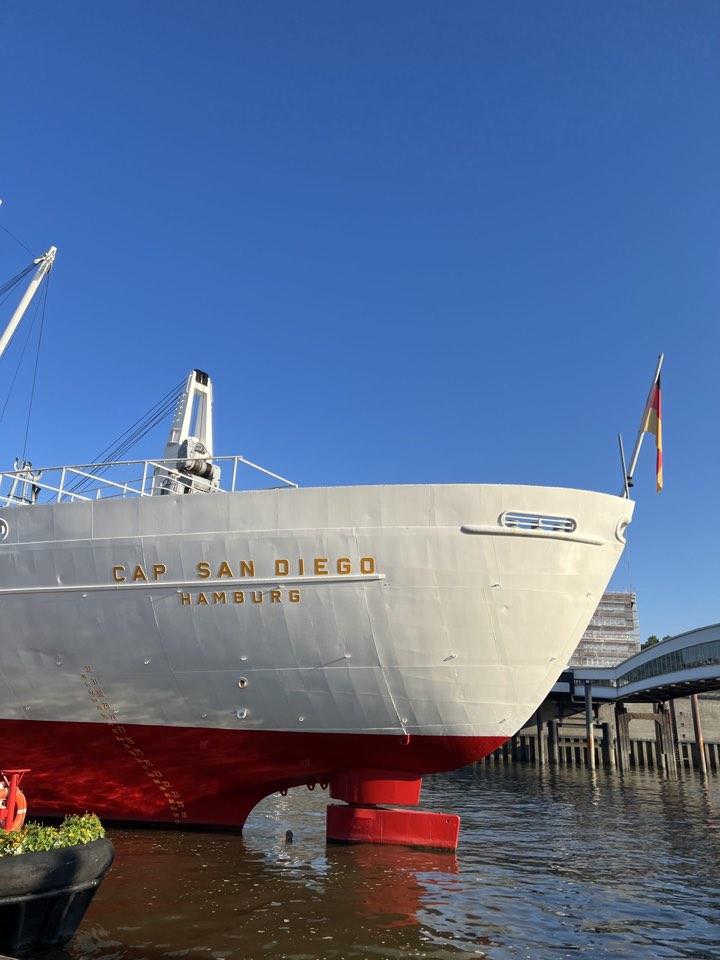

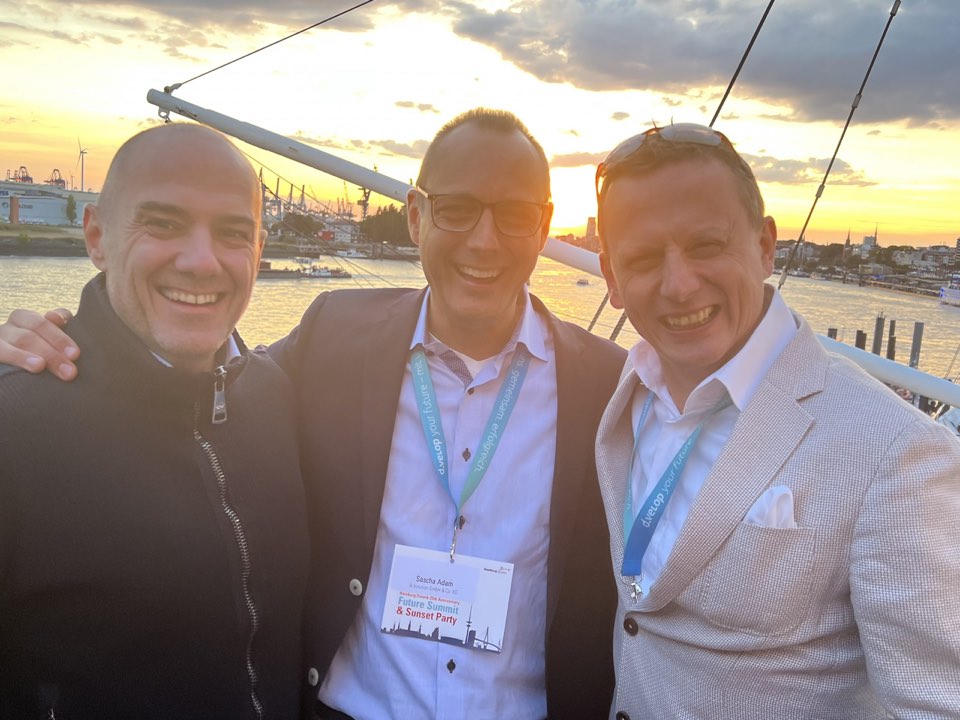


We mourn the passing of Queen Elizabeth II, who impressively dedicated her life to the service of people and the reconciliation of nations. Her Majesty was particularly supportive of third party international understanding initiatives, including on several occasions those of the Global Offshore Sailing Team. We join the people of the United Kingdom and all those around the world in mourning her loss. Her Majesty will always be gratefully remembered.
Jochen Werne on behalf of the Global Offshore Sailing Team
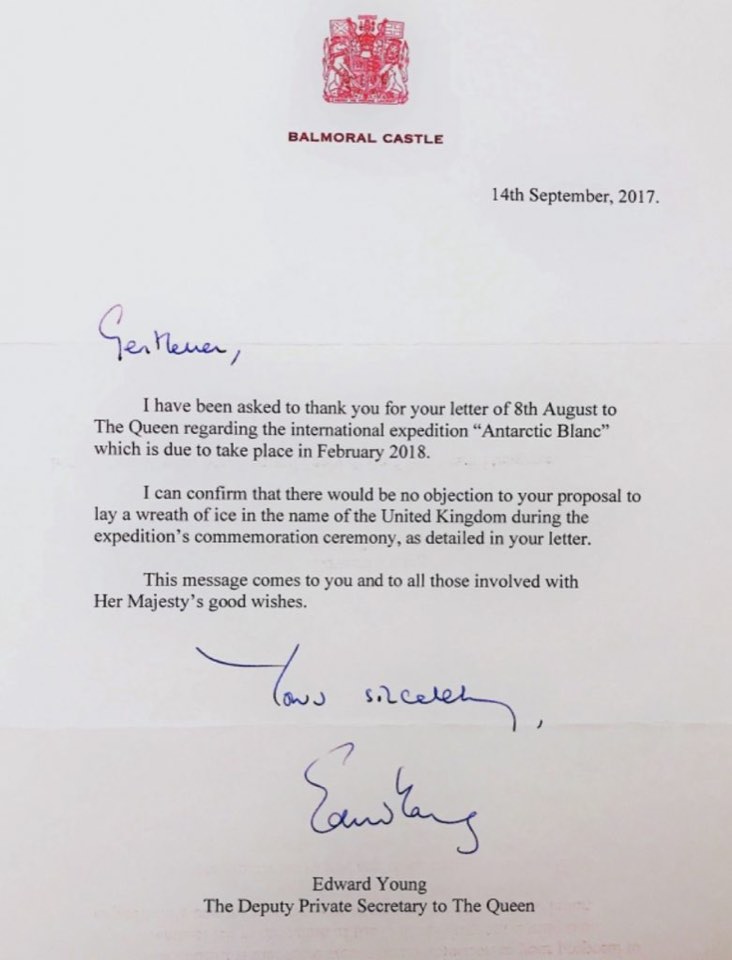
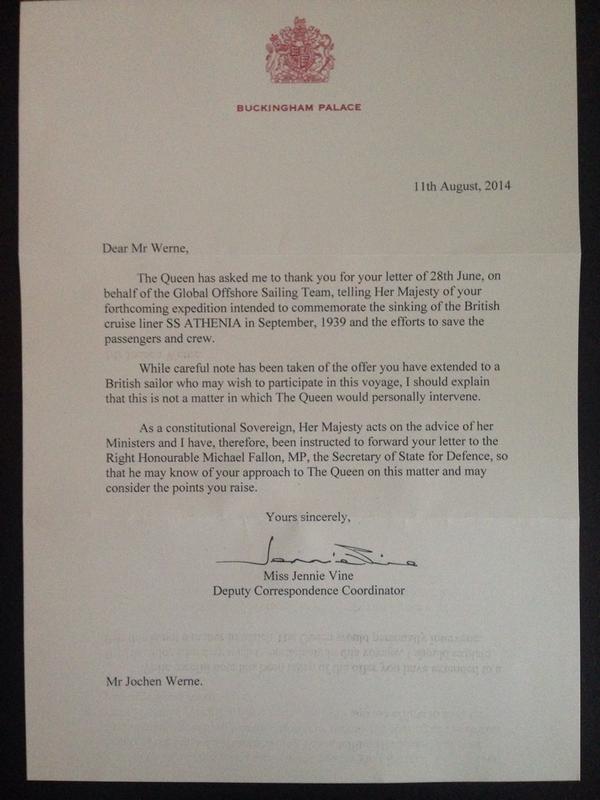
Until recently, most of us in today´s modern societies had had the privilege of assuming that a “real” war is a relics of a bygone era. This has changed. War in Europe is real and Cyberwarfare has become an asymmetric battlefield aiming at destabilizing whole economies and societies. In his keynote, Jochen Werne will lead you through historical analogies and share his thoughts with you on what soon might be a new reality and how you should prepare.
Hybrid Event
November 08 - 10, 2022
in Berlin, Germany & Online
Keynote Session by Jochen Werne
Wednesday, November 09, 2022 16:20—16:40
Location: Historic Kassenhalle
CONGRATULATIONS ON THE 100th ANNIVERSARY
of the Siemens Graduate Program
and thank you for the invitation to take a thought-provocing journey together from Antarctica to Artificial Intelligence.
A New Age of Enlightenment? Human Behaviour in the Light of New Technologies. From Antarctica to Artificial Intelligence, a human-made journey between madness and brilliance. By reflecting carefully human mankind’s past, we discover a quite schizophrenic story of partial madness and absolute brilliance, not only when it comes to the use of new technologies.
The talk will show how new technological approaches influenced visionary leaders in science, business and politics. The goal of the talk is to inspire the audience to understand and to take their role as leaders for change for good in their company as well as in society.
With pride GOST (Global Offshore Sailing Team) collaborates since years with the Asociación para la Investigación y Difusión de la Historia Naval de Cuba. The latest collaboration with respect to Expedition Blue Ocean is a living example, that despite the political state of affairs, organisations strongly focused on supporting international understanding can be instrumental in solving challenges which cannot be solved within the borders of just one country.
Excerpt from EL Faro, June 2022 - Author: Maximino Gomez Alvarez - translated with deepL
AIDHNC SUPPORTS EXPEDITION BLUE OCEAN AND COMBINES IT WITH THE 30TH ANNIVERSARY OF THE FOUNDATION OF THE HEMINGWAY INTERNATIONAL YACHT CLUB OF CUBA".
Despite the many difficulties faced, including the COVID 19 pandemic that we have been suffering for more than two years, the Association for Research and Dissemination of the Naval History of Cuba has not rested in its arduous work. 2022 has been an illustrative year of the progress made by this organisation, achieving great objectives in its growth and organisation. Several collaboration agreements have been signed, including one with the Hemingway International Sailing Club of Cuba, and support has also been given to various activities carried out by the prestigious international organisation Global Offshore Sailing Team.
Two events stood out in the month of May, Expedition Blue Ocean and the celebration of the 30th Anniversary of the creation of the Hemingway International Yacht Club of Cuba, in both activities the AIDHNC has been present.
In the case of the support given to the North Sea Endurance Expedition within the framework of the Blue Ocean event, several voyages were made, the one made by GOST, two others leaving from the port of Miami to Key West with the vessel La Caña (as the flagship of the AIDHNC) and another one made in Cuban waters to the north of the Province of Havana, with five vessels of the CNIHC. Thus, the flag of our organisation flew in the waters of the North Sea, until reaching the English coast, the Mediterranean Sea, as well as the Atlantic, the Gulf of Mexico and Cuba.
Extensive publicity work was carried out to publicise the Expedition Blue Ocean. Another of the activities programmed was a Children's Drawing Competition with the slogan "For a clean and beautiful ocean" in greeting and support of the Blue Ocean Expedition and the 30th Anniversary of the CNIHC.
In the case of the Hemingway International Yacht Club of Cuba, with which a Collaboration Agreement had previously been signed, a complete collection of naval-themed works published by the AIDHNC was donated to this institution, and a Diploma of the AIDHNC was presented to Commodore José Miguel Díaz Escrich, who has directed this illustrious and renowned Cuban nautical institution since its foundation and up to the present day. Likewise, we supported the activities of celebration of the 30th Anniversary of this renowned Cuban Yacht Club, participating in the regatta held also in salute to this anniversary, as well as in the Reception held as a culmination of the activities held in the framework of these celebrations.

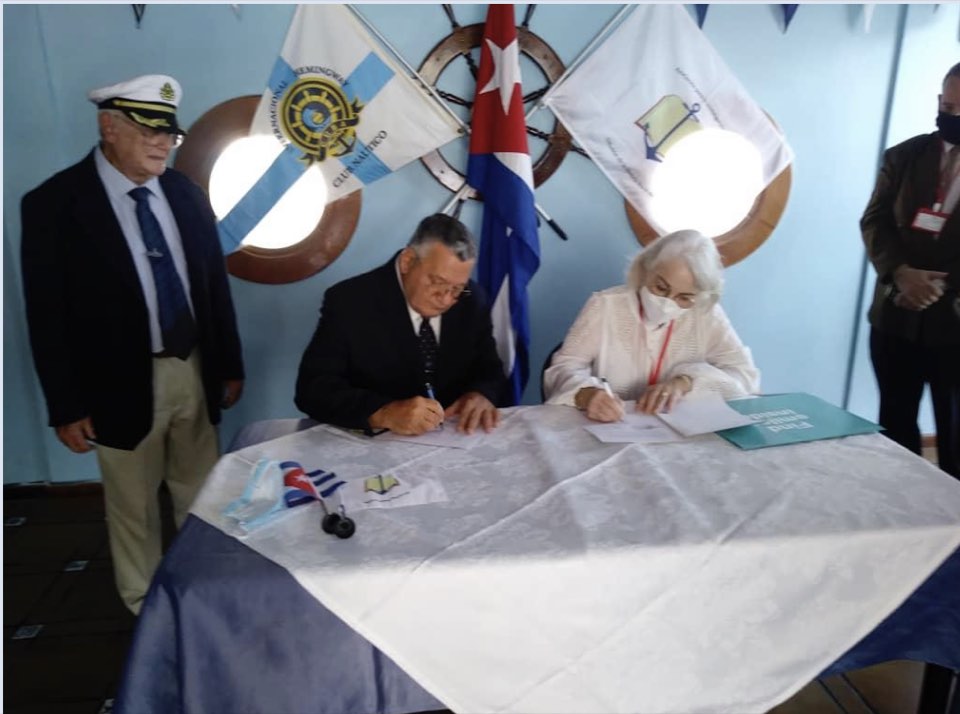
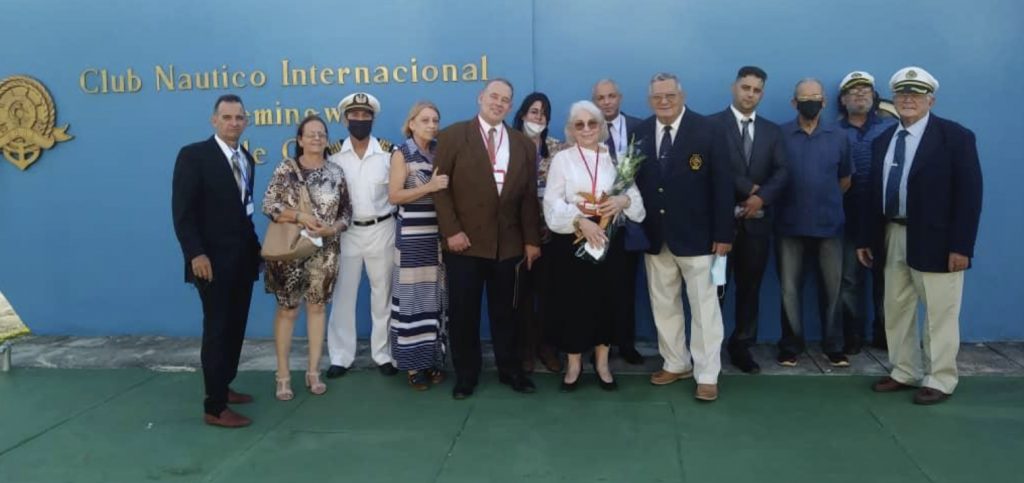
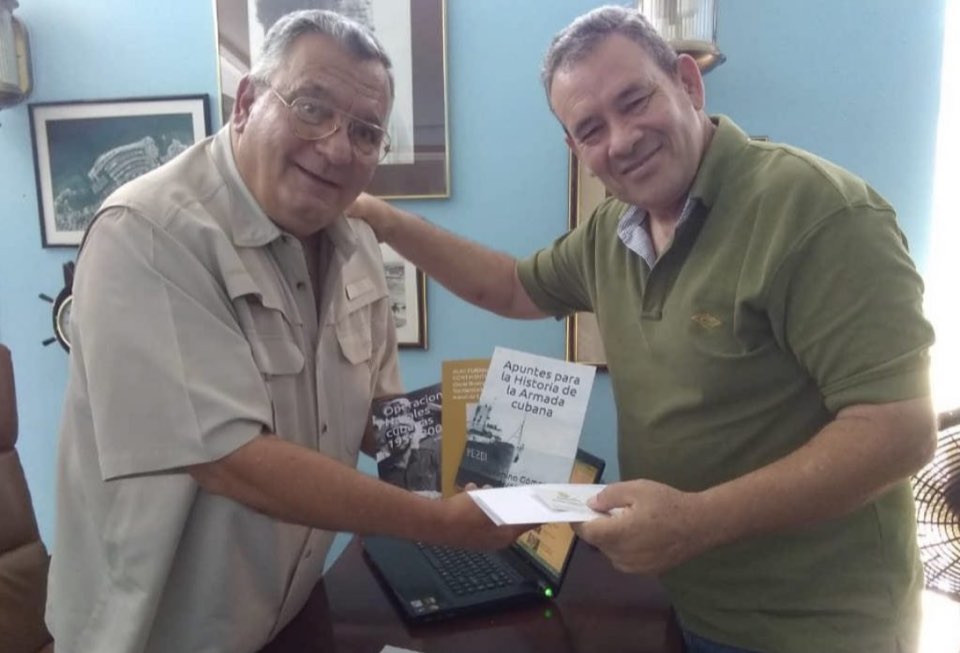
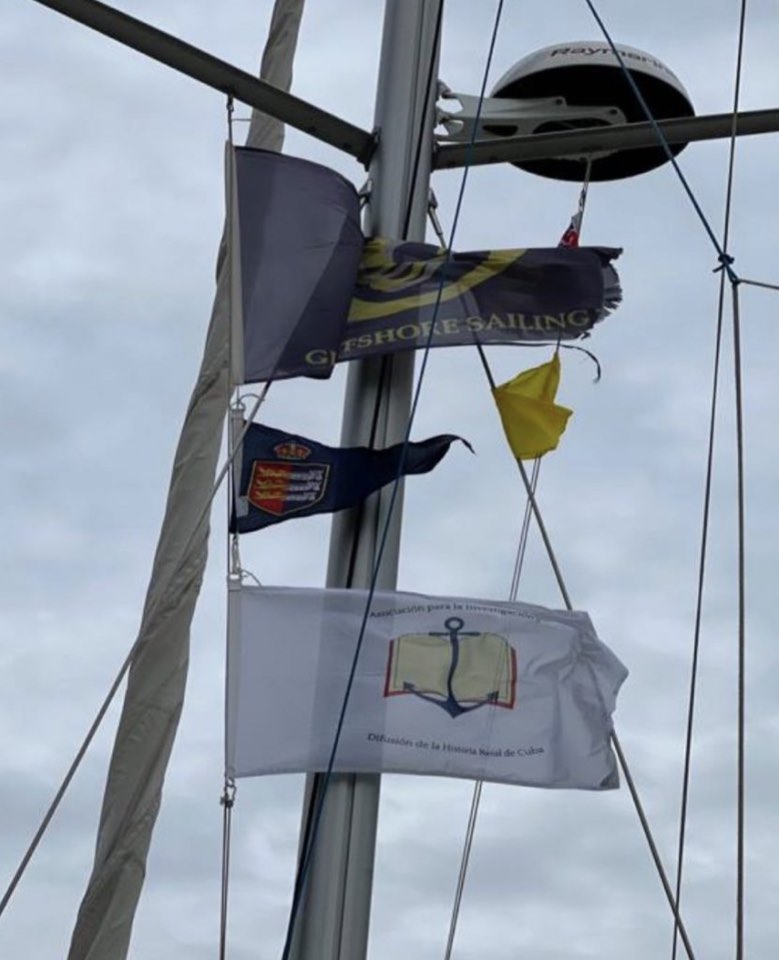



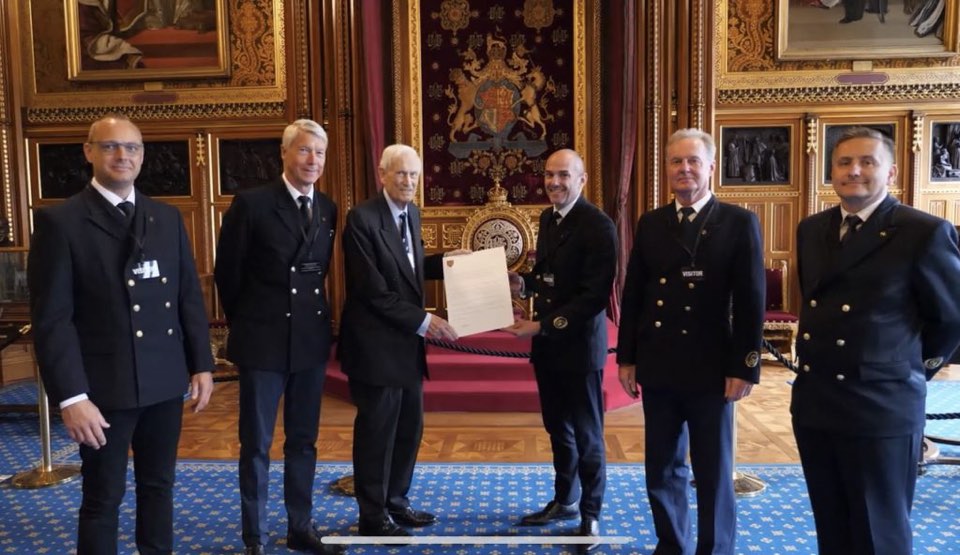

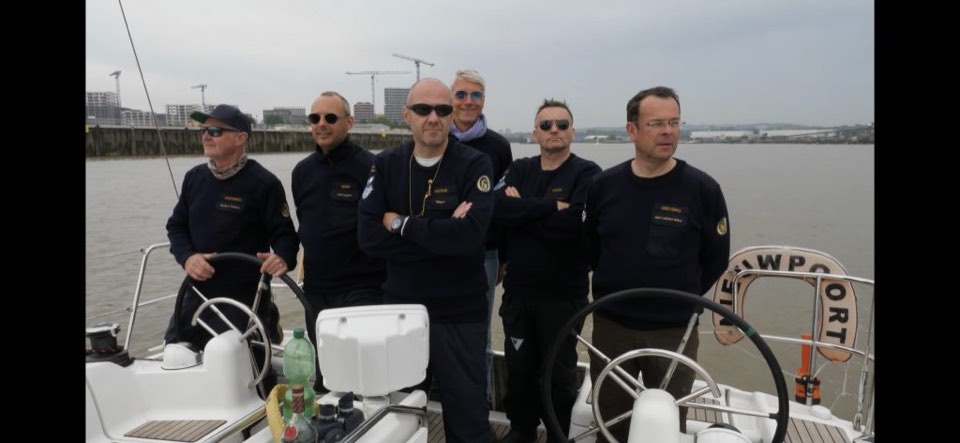


The secret bunker for bitcoin assets
Published on 24.06.2022 | Reading time: 6 minutes
Source: Die Welt - original language German | Translated by deepl.com
International security company Prosegur stores cryptocurrencies in super-secret locations without internet access. Partner O₂ Telefónica makes the communication possible and ensures that it is secure.
Looking at money, it quickly becomes clear that times have changed. In the ten biggest bank robberies, around 1.5 billion euros were taken, all told. In crypto hacks, it was around 3.9 billion euros in 2021 alone, according to the analysis company Crystal.
Jochen Werne is not surprised. "Anything of value arouses covetousness." Werne is Chief Development Officer and Chief Visionary Officer Prosegur Germany. He develops new services for the German subsidiary of the international security group. Prosegur Crypto GmbH offers such a service, Werne is managing director: a custodian for digital assets - without an internet connection.
New money, new risks, new security concepts
Security world market leader Prosegur is famous for its yellow money carriers and became big in the cash business. With the boom of cryptocurrencies, new demands came to the company with headquarters in Madrid. The goal: to be able to offer the world's most secure storage method for cryptocurrencies. In Germany, Prosegur works together with the business customer division of O2 Telefónica. Together, they are setting themselves up at a new level of security - the highest level, because billions in Bitcoin, Ethereum and other digital currencies are at stake.
"Our goal is to help give the new ecosystem the trust it deserves through security components," says Werne. "Our history is closely intertwined with the security of any asset. Crypto custody is a logical evolution of our business."
O2 networks vaults and money
O2 Telefónica is taking over the communication for Prosegur Germany, and completely. Karsten Pradel, Director B2B at O2 Telefónica, explains: "It starts with the mobile phone service for 3300 employees. In addition, around 1,000 of Prosegur's yellow armoured cars and networked safes are equipped with a Global SIM from O2 Telefónica. In this way, the armoured vans and the security boxes are directly and securely connected to Prosegur's company network. Via GPS, the routes of cash transporters can be documented and secured."
O2 also provides fast fibre-optic access and secures internal communication against external access with VPN (Virtual Private Network) access. A completely new feature is a software-controlled data network (SD-WAN): this allows the Prosegur data traffic to be controlled intelligently and quickly.
In this way, the environment at the site can be secured against threats - where the internet traffic originates. An intelligent component links all communication paths and always selects the best one. This has three advantages, says Sören Jahnke, Global Solutions Engineer at O2 Telefónica: "A lot of bandwidth at a low price, more redundancy and thus communication security (because copper cable, fibre or mobile are used depending on availability and demand) and a better user experience because the services work better: 'Everything runs much faster'".
Where it gets critical is when people and the internet come into play
Prosegur aims to offer the ultimate crypto custody method. Yet transactions in cryptocurrencies are actually secure. Their cash book is the blockchain. That's where the crypto money is stored. The blockchain is a digital document; digital copies of this document are stored simultaneously on a large number of computers - this makes it forgery-proof. When a transaction is made, the data chain contained in the document is supplemented in all copies by a data block that can never be deleted again.
However, it becomes critical when people and the internet come into play. Anyone who trades in cryptocurrencies needs a wallet. This is a kind of digital wallet. The wallet software in turn creates a digital signature and processes a transaction with the owner's private key. Only in this way does the owner gain access to his crypto treasures stored in the blockchain and can use them. "You can always trace every step, what happened when and where," says Jochen Werne.
Danger for assets and for people
This wallet can be made available in an app or on a computer and is usually connected to the internet. This is called a "hot wallet" - it is convenient because transactions can be made quickly, but it is vulnerable to hacker attacks. A "cold wallet" (also called "cold storage") works without direct internet access - this can be a USB stick, for example. This form of asset storage has two problems. Firstly, a cold wallet can be the target of an extortionist or robber, just like a gold bar or large amounts of cash stored at home. Secondly, cold wallets are only secure as long as they are disconnected from the internet.
"For us, cold storage is not enough," says Jochen Werne. "Because having large assets at the disposal of only one person not only endangers the assets, but also the person who has that power of disposal. Here, criminals not only resort to direct threats of violence on this person, but they often also threaten family members." Prosegur Crypto therefore takes a different approach. The company stores customer data in a hardware security module (HSM). The technology works in much the same way as we would expect in an agent film.
No chance for "Ocean's Eleven"
"This is a computer in a military-standard shielded case that is kept in one of our high-security facilities and is not connected to the internet," Werne explains. If, contrary to all expectations, such a device should fall into the wrong hands, it deletes the stored data. Security protocols then stipulate that the data can be reconstructed via a highly complex system equipped with appropriate codes. Prosegur has a whole range of high-security facilities. The locations of the crypto-bunkers are, of course, secret.
"The entire security is fully electronically monitored with various modules and security protocols on several levels. These are smart fences, for example, where possible threats are analysed by artificial intelligence," says Werne. Even an attack like in the film "Ocean's Eleven" - George Clooney's crew simply turns off the power there - would not work.
“WE BELIEVE WE CAN OFFER THE MOST SECURE CUSTODY METHOD FOR CRYPTO ASSETS IN THE WORLD”
JOCHEN WERNE
Chief Development Officer and Chief Visionary Officer Prosegur Germany
And yet Prosegur customers can initiate blockchain transactions online - what follows is a sophisticated process. In the process, the hardware security module connects to a computer network that makes blockchain transactions possible.
The technology comes from GK8, a company specialising in crypto technology; the method used here is so-called multi-party computing (MPC). The transaction is transferred to the user's blockchain via several security instances, using a patented technology that does not require a direct connection to the internet. This secures the critical moment of the transaction. "Everything else stays in cold storage" - most of the time the crypto assets are in the Prosegur high-security vault, without an internet connection. Jochen Werne: "We believe that we can offer the most secure custody method for crypto assets in the world. Currently, we are preparing to launch this service with the appropriate licensing in the strictly regulated German market as well."
A generation that has experienced peace as the status quo might easily tend to forget that war has historically been more of a status quo than peace. Senior Fellow at the Hoover Institute and historian Niall Ferguson's books are full of examples. The long period of peace in historically hostile Europe was due to the hard work of visionary figures after the Second World War. They worked on a European concept of unity and cooperation. An idea that was unthinkable in the past but is a reality today. For all the shortcomings we may experience, it is of the utmost importance to always remember what a great goal has been achieved over such a long period of time: PEACE.
It would be of utmost importance to create even more initiatives like this as a basis for addressing the global challenges that lie ahead. Challenges that we can only solve on a global basis.
GOST has made it a priority to support INTERNATIONAL UNDERSTANDING through its missions by teaching history and raising awareness of issues of global importance. We are proud to have achieved this again with Expedition Blue Ocean ( www.ExpeditionBlueOcen.org ).
The list of supporters is long and we would like to extend a special thank you to

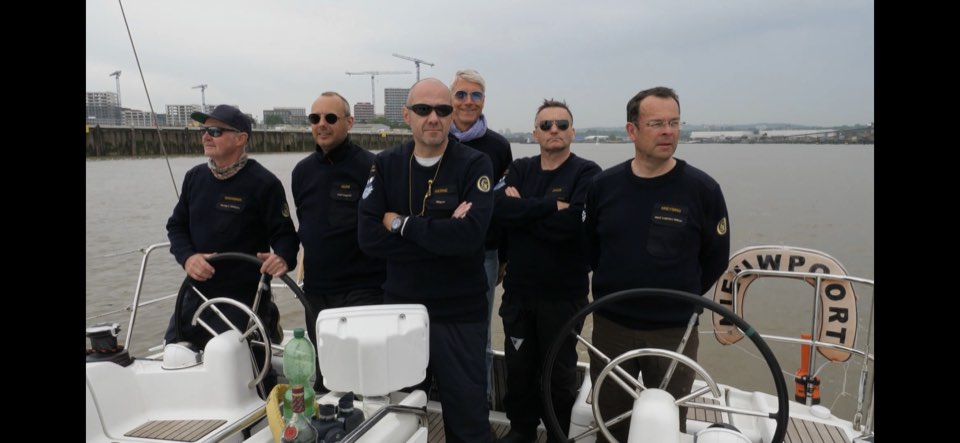

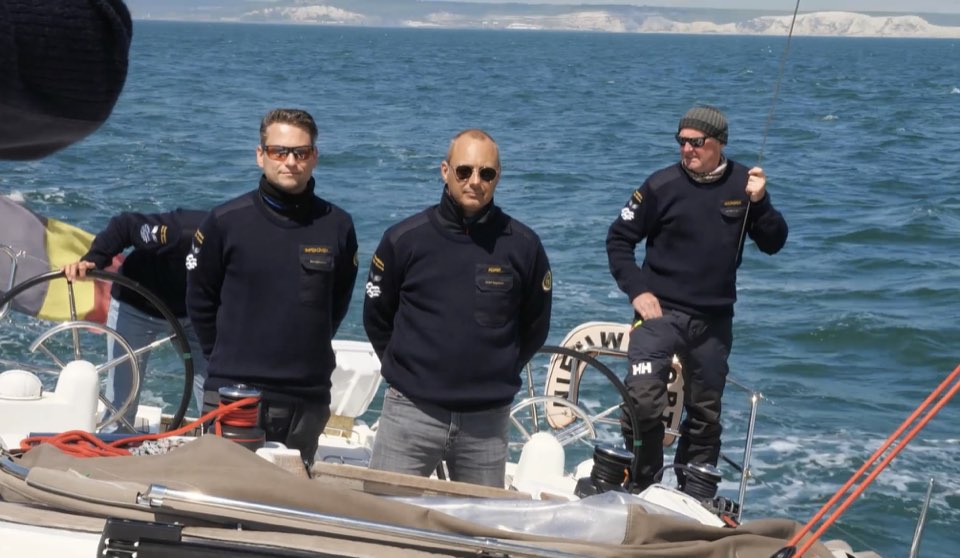
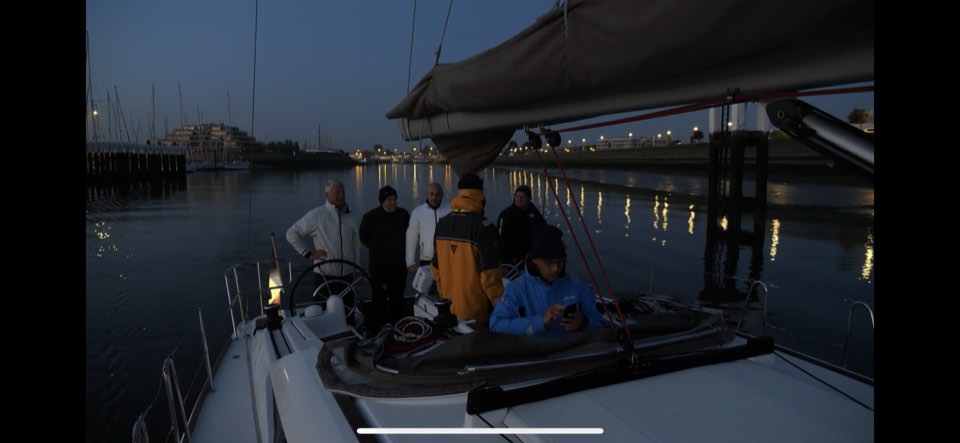


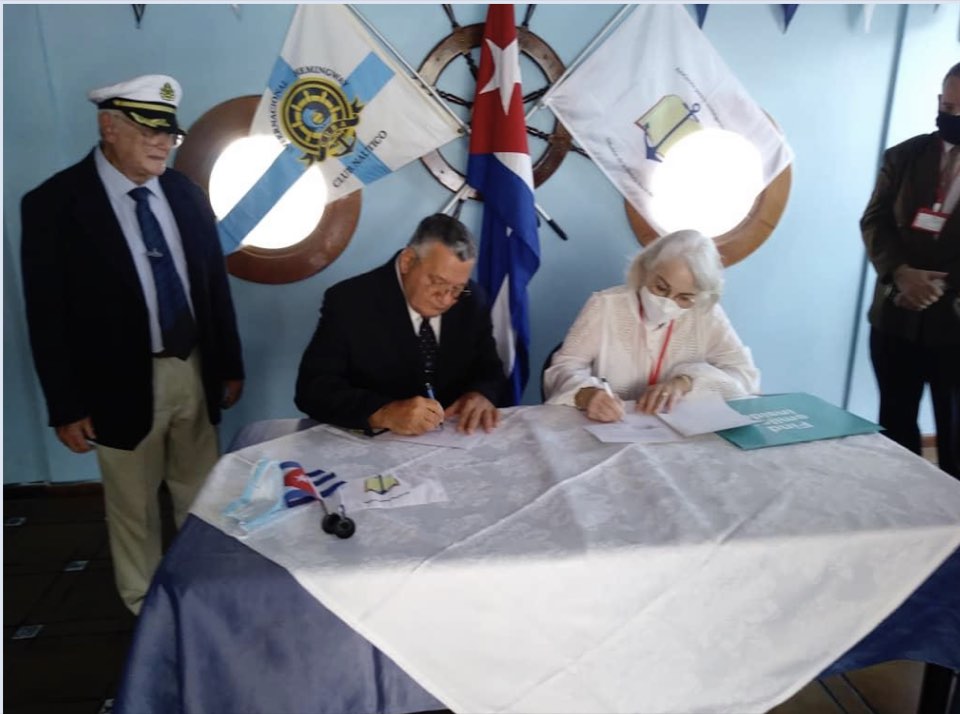

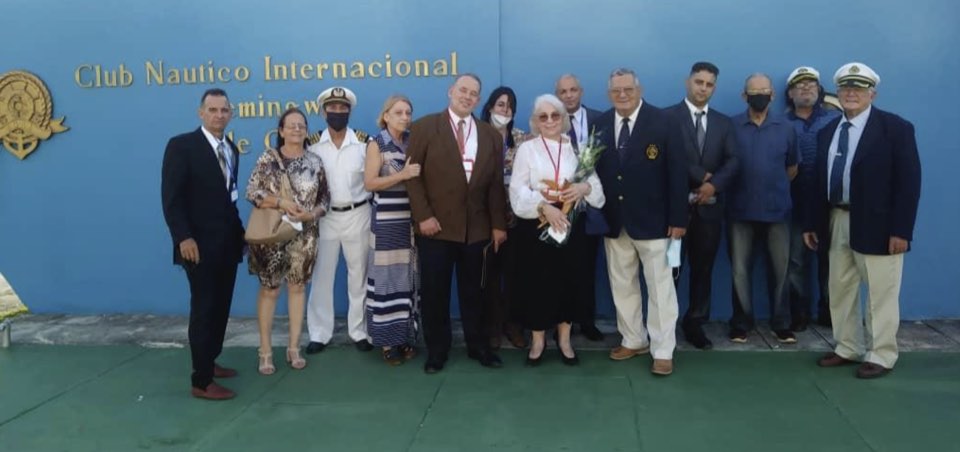
Sascha Adam befragt im Schlußplädoyer die Teilnehmer des X-Volution Tech-Talks über ihre persönlichen Aussichten zum Thema technologischen Fortschritts und seinen Auswirkungen auf Wirtschaft, Unternehmen und unsere Gesellschaft.
Jochen Werne, Chief Visionary Officer von Prosegur German, Managing Director der Prosegur Crypto GmbH und mehrfach international ausgezeichnet für sein Engagement in International Relations antwortet mit Zuversicht und einer Reflexion für die internationale Politik.
In his closing statement, Sascha Adam asks the participants of the X-Volution Tech-Talk about their personal outlook on the topic of technological progress and its impact on the economy, companies and our society. Jochen Werne, Chief Visionary Officer of Prosegur German, Managing Director of Prosegur Crypto GmbH and winner of several international awards for his commitment to international relations, answers with confidence and a reflection for international politics.
Das gesamte Interview finden sie hier:
A plea for trust in a time of mistrust. Trust is the foundation on which monetary systems are built. Trust forms the basis of international diplomatic relations and is the foundation for all progress.
But what happens once trust is shaken?
The diplomatic dispute over a multibillion-dollar submarine treaty - which took place three months before the Russian - Ukrainian war, concerns about a new cold war, and the collapse of the Bretton Woods system exactly 50 years ago are the manuscript for this maritime-themed French-American story about money and trust. It is an object lesson for our times, where we are witnessing the emergence of crypto-financial markets and thus stand on the threshold of a new form of money.
by Jochen Werne
After the traditional long summer vacation, France awakens in September from its brief self-created slumber, as it does every year. Life begins to take its usual course, even if some are still reminiscing, perhaps enjoying the first harbingers of post-Covid worry-free life. Not so Philippe Étienne. For him, on the other side of the Atlantic, in Washington, which is actually picturesque at this time of year, autumn begins with a diplomatic thunderstorm. A storm that must have been new even for the 65-year-old gray-haired eloquent ambassador of France. 6160 kilometers away, at the Élysée Palace, Président de la République Emmanuel Macron decides to call his top diplomat in the United States, along with his Australian counterpart Jean-Pierre Thebault, to Paris for consultations. The unprecedented act in Franco-American history is justified by Foreign Minister Jean-Yves Le Drian with the "exceptional gravity" of an Australian-British-American announcement, and impressively underlined with the words "lie," "duplicity," "disrespect" and "serious crisis."
At the heart of this crisis is the surprise announcement by the aforementioned countries to enter into a strategic trilateral security alliance (AUKUS) with immediate effect. An alliance that also provides for the procurement of nuclear-powered submarines for Australia, effectively putting to rest a 56-billion-euro French-Australian submarine order already initiated in 2016. The conclusion of the agreement comes at a time when U.S. President Joe Biden has asserted to the UN General Assembly, "We do not seek - I repeat, we do not seek - a new cold war or a world divided into rigid blocs." However, experts, such as renowned historian Niall Ferguson, have been talking about this so-called "new cold war" between the U.S. and China since 2019, and it is not about nuclear arms races, but rather about technology supremacy in cyber security, artificial intelligence and quantum computing. Even though nuclear-powered submarines are at the center of the diplomatic dispute, one is quick to note in the AUKUS agreement that cooperation in the aforementioned fields is one of the most important components of the treaty. An objective that is perhaps also congruent with French interests. But the dispute between the old friends is less about the "what" than about the diplomatic "how" - that is, about the breach of trust that is triggered when close allies are simply presented with a fait accompli. Facts that also affect them financially and personally.
Because money and trust are closely interwoven. The trust of a bank that the creditor will repay its debts. A citizen's trust that the currency in which he or she is paid their salaries is stable. A state's trust in a currency system that the agreements made there will be honored by all. Georg Simmel, in his "Philosophy of Money," sums it up this way: "Money is perhaps the most concentrated and pointed form and expression of trust in the social-state order."
Last year marked the 50th anniversary of another French-American trust-busting melodrama with a maritime backdrop. Benn Steil, senior fellow at the Council on Foreign Relations, describes the moving events of August 6, 1971, in his book, The Battle of Bretton Woods, as follows: "…a congressional subcommittee issued a report entitled 'Action Now to Strengthen the U.S. Dollar` that concluded, paradoxically, that the dollar needed to be weakened. Dollar dumping accelerated and France sent a warship to pick up French gold from the vaults of the New York Fed."
At first glance, this dramatic gesture by then French President Georges Pompidou in the final act of the collapse of the Bretton Woods system seems as strange as the withdrawal of ambassadors today. The basis, however, is similar and lay then as now in an equally shaken trust between the great nations that were nevertheless so closely intertwined. Without going deeper into the new monetary order created after World War II, with the U.S. dollar as the anchor currency, it is important to understand the reason for the French revolt evident in the "White Plan." The plan provided that the U.S. guaranteed the Bretton Woods participating countries the right to buy and sell gold indefinitely at the fixed rate of $35 per ounce. The dilemma of this arrangement became apparent early on. For by the end of the 1950s, dollar holdings at foreign central banks already exceeded U.S. gold reserves. When French President Charles de Gaulle asked the U.S. to exchange French dollar reserves for gold in 1966, the FED's gold reserves were only enough for about half that amount. The ever more deeply anchored loss of confidence forced the American president Richard Nixon on August 15, 1971 to cancel the nominal gold peg and the so-called "Nixon shock" ended the system as it was.
And where something ends something new can or will inevitably begin.
Today we live in a world where the stability of our currency is based on our confidence in government fiscal policy, the economic strength of our country, and the good work of an independent central bank. However, we also live in a time when new currency systems are already looming on the dense horizon. The basis for this was laid in 2008, not surprisingly, by one of the most serious crises of confidence in the international banking system that modern times have seen. And the new systems are being implemented with the help of cutting-edge distributed ledger blockchain technology. The new, with its decentralized nature, is challenging the old. While many of the new currencies in the crypto world, such as bitcoin, are subject to large fluctuations, stablecoins promise a link and fixed exchangeability to an existing value, such as the US dollar or even gold. However, the old Bretton Woods challenge of being able to keep this promise at all times remains in the new world. Millions of dollars in penalties imposed by the New York Attorney General's Office on the largest U.S. dollar stablecoin, Tether, for not being fully verifiable do little to help trust, especially when less than 3 percent of the market capitalization is actually deposited in U.S. dollar cash. As always with new ones, trust has to be built up. This can be done privately, perhaps with a stablecoin backed 100% by central bank money, or by the state, with well thought-out central bank digital currencies, such as the digital euro planned by the European Central Bank.
We live in a world of perpetual rapid change and trust is, as Osterloh describes it, "the will to be vulnerable." Without trust, there are no alliances, no togetherness, no progress.
Philippe Étienne was back in autumnal Washington after just a few days and has since been working again on what diplomats are best trained for - building trust.
Sources
Billon-Gallan, A., Kundnani, H. (2021): The UK must cooperate with France in the Indo-Pacific. A Chatham House expert comment. https://www.chathamhouse.org/2021/09/uk-must-cooperate-france-indo-pacific (Retrieved 24.9.2021)
Brien, J. (2021): "Stablecoin without stability": Tether and Bitfinex pay $18.5 million fine. URL: https://t3n.de/news/stablecoin-tether-bitfinex-strafe-1358197/?utm_source=rss&utm_medium=feed&utm_campaign=news (Retrieved: 9/30/2021).
Corbet, S. (2021): France recalls ambassadors to U.S., Australia over submarine deal. URL: https://www.pressherald.com/2021/09/17/france-recalls-ambassadors-to-u-s-australia-over-submarine-deal/ (Retrieved 9/25/2021).
Ferguson N. (2019): The New Cold War? It's With China. And It Has Already Begun. URL: https://www.nytimes.com/2019/12/02/opinion/china-cold-war.html (Retrieved: 9/30/2021).
Graetz, M., Briffault, O. (2016): A "Barbarous Relic": The French, Gold , and the Demise of Bretton Woods. URL: https://scholarship.law.columbia.edu/cgi/viewcontent.cgi?article=3545&context=faculty_scholarship p. 17 (Retrieved 9/25/2021).
Osterloh, M., Weibel, A. (2006): Investing trust. Processes of trust development in organizations, Gabler: Wiesbaden.
Steil, B. (2020): The Battle of Bretton Woods: John Maynard Keynes, Harry Dexter White, and the new world, p. 377.
Stolze, D. (1966): Does de Gaulle defeat the dollar? In ZEIT No. 36/1966. URL: (https://www.zeit.de/1966/36/besiegt-de-gaulle-den-dollar/komplettansicht (Retrieved: 9/26/2021)
The Guardian Editorial (2021): The Guardian view on Biden's UN speech: cooperation not competition URL: https://www.theguardian.com/commentisfree/2021/sep/22/the-guardian-view-on-bidens-un-speech-cooperation-not-competition(Retrieved: 9/29/2021)
Unal, B., Brown, K., Lewis, P., Jie, Y. (2021): Is the AUKUS alliance meaningful or merely a provocation - A Chatham House expert comment. URL: https://www.chathamhouse.org/2021/09/aukus-alliance-meaningful-or-merely-provocation (Retrieved: 9/24/2021).
Time Online (2021): France sees relationship in NATO strained. URL: https://www.zeit.de/politik/ausland/2021-09/u-boot-deal-frankreich-australien-usa-streit-nato-jean-yves-le-drian?utm_referrer=https%3A%2F%2Fmeine.zeit.de%2F (Retrieved: 9/25/2021)
London, May 16, 2022 It was a great honor to receive an invitation to the House of Lords from the Admiral of the Fleet, Lord Boyce, Lord Warden of the Cinque Ports. The hospitality extended during this visit will be unforgettable. The members of the Global Offshore Sailing Team are very grateful to Lord Boyce for the opportunity to gain an insight into the daily operations and passion with which the honorable members of the House of Lords conduct their debates. As a special end to the visit, Lord Boyce presented the Expedition Blue Ocean Corps of the Global Offshore Sailing Team with a special despatch to be sailed by sea from London to Dover - celebrating the 150th anniversary of the Royal Cinque Ports Yacht Club. The mission was successfully completed with the delivery of the shipment to RCPYC Commodore Judith White on May 18. The welcome for the crew in Dover was beyond compare. Special thanks are due to the members of the RCPYC, not only for their extraordinary cordiality, but especially for their untiring efforts for international understanding.
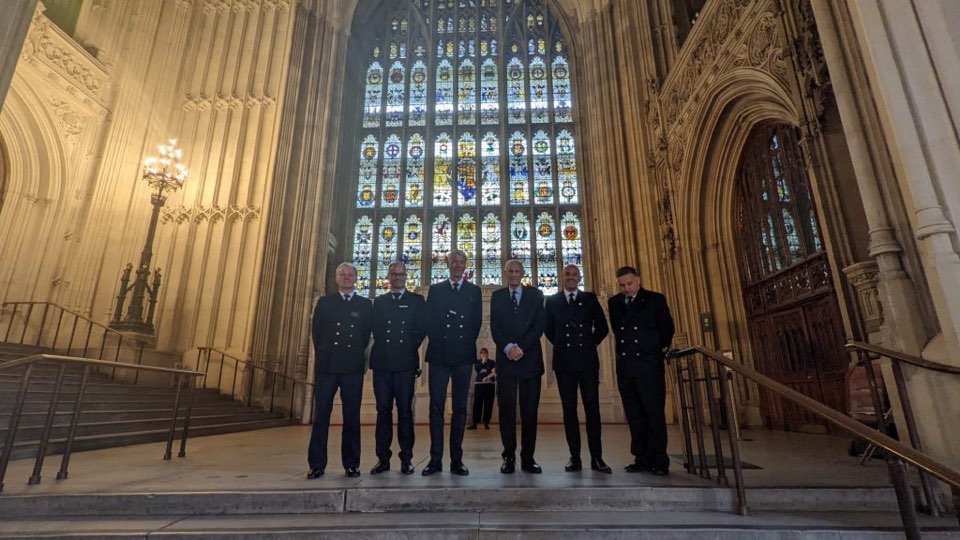



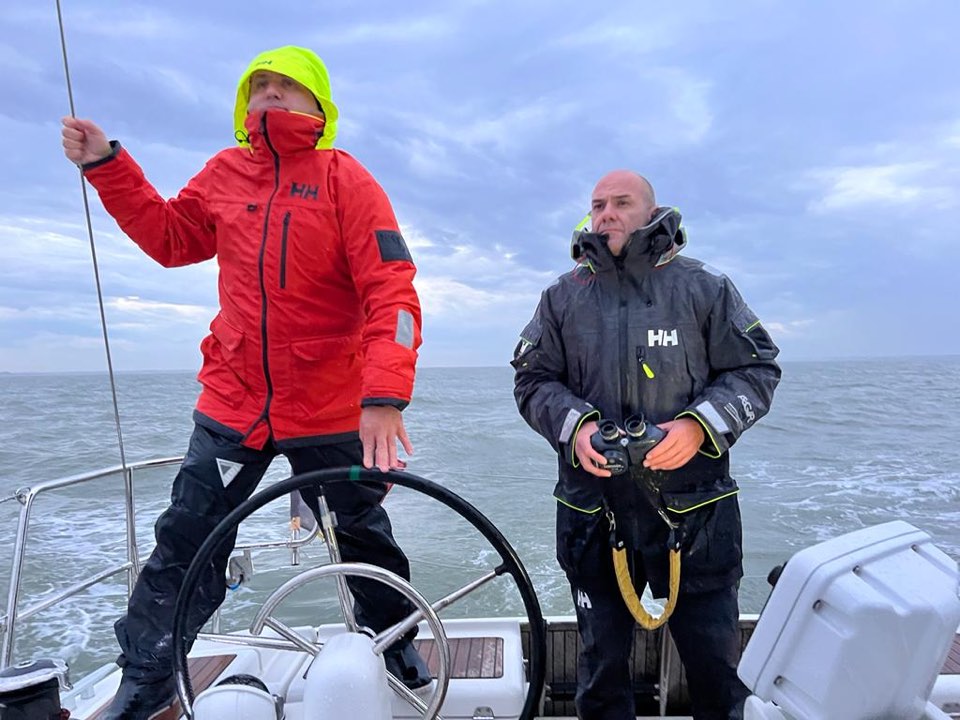
STRONG PARTNERSHIP FOR A SECURE FUTURE
As Germany's market leader for money and value services, it is of particular importance for Prosegur to maintain professional partnerships with the best companies on the market. We are pleased to be able to rely on our partner o2 Business (Telefónica Germany) in the telecommunications sector worldwide and it was a pleasure for us to serve as a reference for their new campaign.
Many thanks to Heike Windfelder, Fritz Fechner, Ilka Wiehe, Erhan Ocak Malte Jost Edda Heue Vanessa Eggestein Hasan Celebi Heiner Eberle Collja Lorig Michael Mogk Peter Strauss Ogilvy Telefonica INTOKU PICTURES for the support, the fantastic shooting day and the great result
124.000 views in the first 18 hours just on YouTube … a good start
https://www.o2business.de/produkte/mobilfunk/angebote/sehrgutesnetz-u-prosegur/

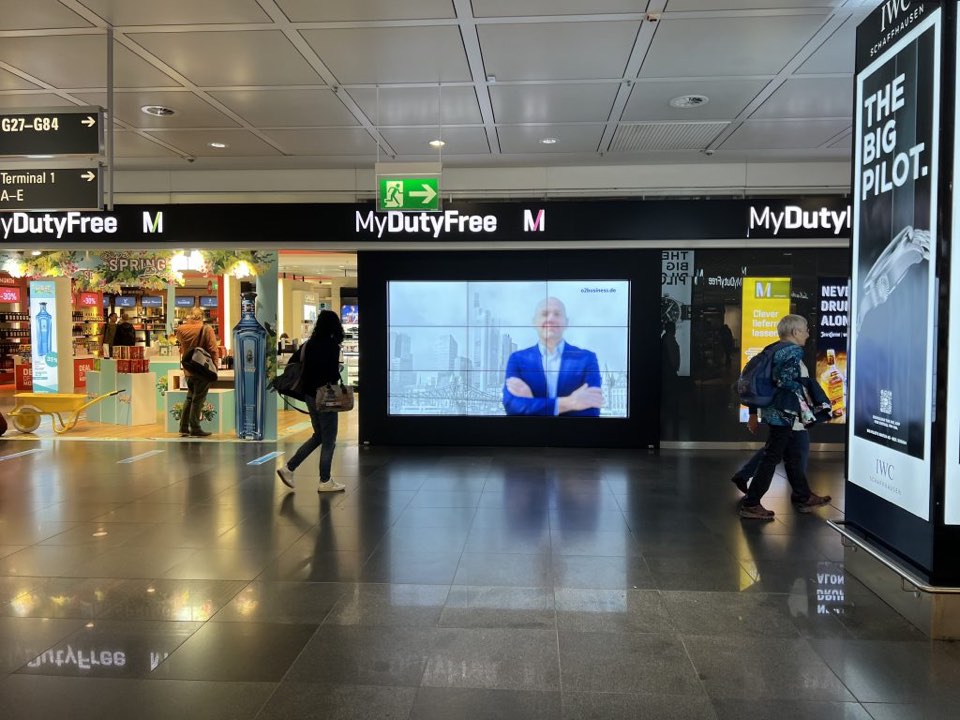
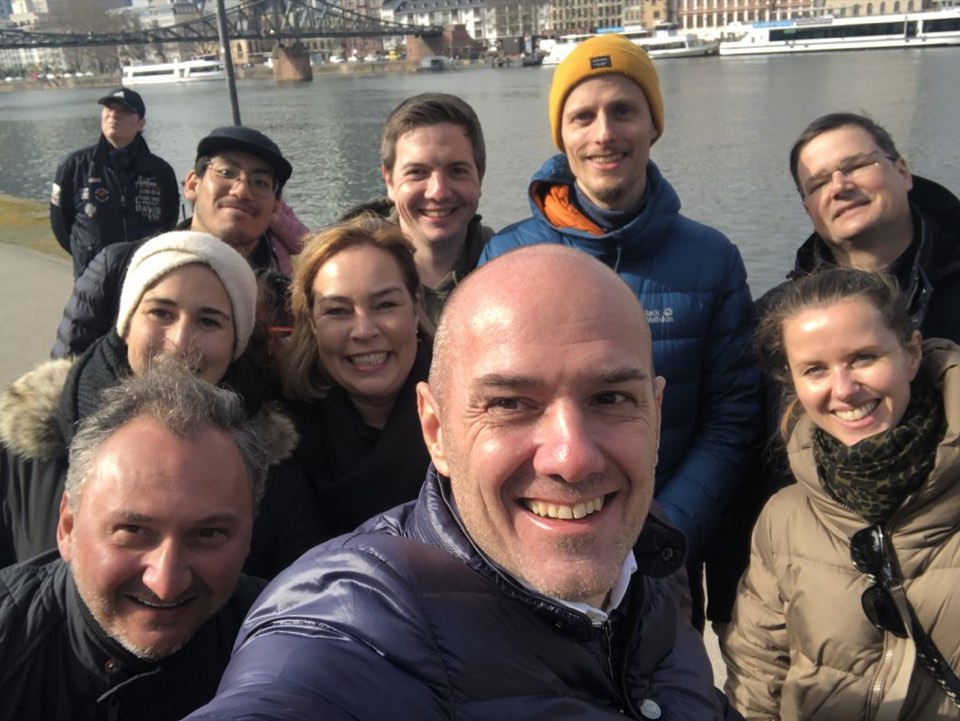
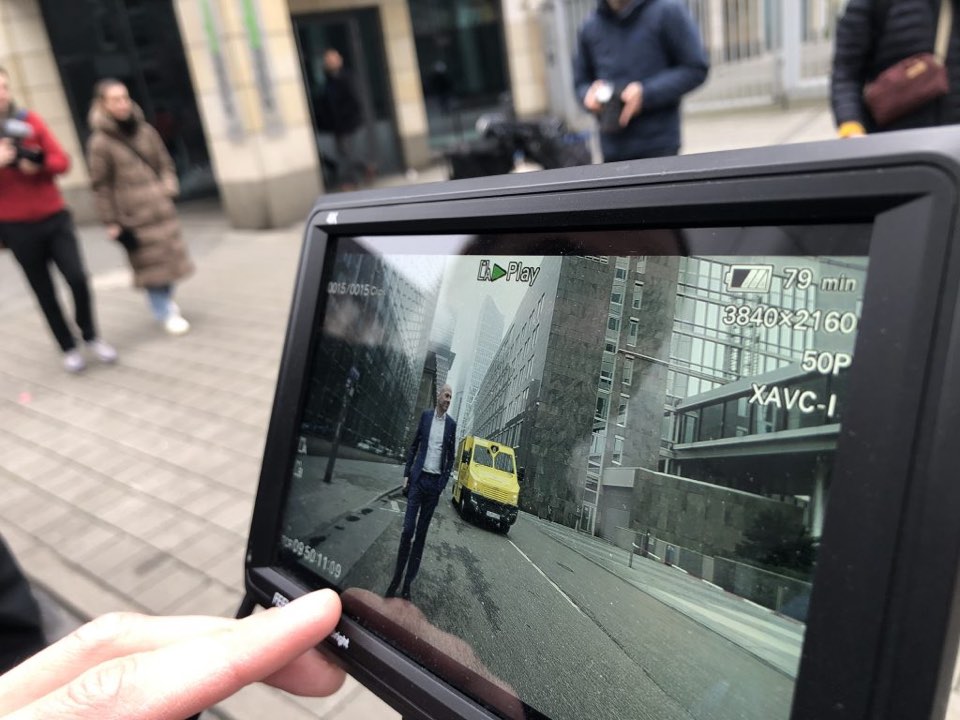
An article by Stefanie Walter, Editor | 01.03.2022 - translated with DeepL.com - Original in German available HERE
Expert Panel: Christian Meusel, Berliner Volksbank - Gerrit von der Hardt, Targobank - Thorsten Demski, Volksbank Bielefeld-Gütersloh - Andreas Meyer, Union IT Services DZ Bank Group - Jochen Werne, Prosegur - Marion Gratenberg, Targobank
The rapidly advancing technological transformation in the banking sector also brings problems. Instead of leading to increased security, labour savings and customer friendliness, different applications can also bring performance problems and even failures.
This must be recognised and averted in good time. Application performance management, performance engineering, software intelligence, overservability or process mining are the new buzzwords here. A holistic overview of all applications is helpful in resolving weaknesses and freeing up capacities for innovations in the business. In the gi-Geldinstitute roundtable discussion, this topic will be examined by experts.
Meusel: As a bank, we must first and foremost provide services for our clients. They are our main drivers. We in the operational organisation are therefore currently investing intensively in usability and direct availability in particular.
Demski: We want to avoid media discontinuities and streamline and improve process transitions in individual departments. The work on process improvement has accelerated a bit due to the pandemic. But it is a fundamental issue that we are dealing with in the context of digitalisation. Our last project focused on the speed of the credit processes. Our goal is not only to bring about decisions quickly, but also to ensure that they are as error-free as possible.
Gratenberg: We are concerned with making processes faster, but also more efficient from the customer's point of view. In the last two years, we have invested a lot of time and analysis in the automation and optimisation of existing customer processes. An agile squad was also founded for this purpose. In the squad, we analyse where there is further potential to optimise and automate processes.
Werne: The goal of our process automation is to be as customer-friendly as possible. In Germany, we provide about 50 per cent of the total cash logistics. We thus guarantee the cash supply of the population and secure the liquidity cycle of companies, credit institutions and municipalities. In our cooperation with the banks, we want to drive the transformation. In our group, we are driving the optimisation of the IT outsourcing processes of the entire cash management and projects such as crypto custody. With Prosegur Crypto, we have launched a solution for the custody and management of digital assets that works automatically without an internet connection to achieve maximum protection against cyber attacks.
Meyer: Union Investment has two good reasons to optimise processes today - increasing process cost efficiency and regulatory law. As part of regulatory audits, we are required as one of the leading German asset managers to produce a business process map as part of the written order. I like the result: by using modern process intelligence tools, we recognise process weaknesses that need to be optimised. At the same time, we produce process models required by banking supervisory law. The auditing company PricewaterhouseCoopers confirmed an availability of 99 percent (2021) for the 170 applications used in the investment process. As part of the Genossenschaftliche FinanzGruppe (Cooperative Financial Network), we are the expert for the asset management of 4.8 million private and institutional investors with more than 400 billion euros in assets under management. We thus provide the IT required for this to more than 1,100 internal Union users with high availability.
Diener: In my role at Atruvia, the digitalisation partner of the Genossenschaftliche FinanzGruppe, I am responsible for measuring and analysing performance data for around 820 affiliated Volks- und Raiffeisenbanken. Basically, you have to distinguish between two topics in process optimisation: the business management part and the technical part.
When I think back to the early days of my working life in the early 80s, you would enter a short code into the old IBM terminals to support your work and be happy to receive an answer milliseconds later. Over the decades, many things have changed massively here. Business and technical performance moved closer together. IT has become a central core of everyday work and an essential part of overall process optimisation. In addition to dealing with speed, response times or simply checking whether systems are available, more emphasis is now placed on user experience and user behaviour. How is the customer, what are they doing, where are they having problems getting on in the application?
Von der Hardt: Challenges arise above all with very long process routes via different interfaces with channel breaks. Then you have to assemble information from the most diverse systems, databases or process areas. Because it is difficult to optimise something with a sixty percent view without knowing what the one hundred percent end-to-end customer view looks like. The goal is not to think in small puzzle pieces, but to have the entire customer journey in mind.
Werne: In the pandemic, our process management faces the additional challenge that, for example, retailers or bank branches that we supply with cash close here today and reopen somewhere else tomorrow. Against the backdrop of our current modernisation programme, we are also moving everything to the cloud. Since we operate globally, coordination between the different countries and standardisation play an additional role.
Von der Hardt: Challenges arise especially with very long process paths via different interfaces with channel breaks. Then you have to bring together information from the most diverse systems, databases or process areas. Because it is difficult to optimise something with a sixty percent view without knowing what the one hundred percent end-to-end customer view looks like. The goal is not to think in small puzzle pieces, but to have the entire customer journey in mind.
Werne: In the pandemic, our process management faces the additional challenge that, for example, retailers or bank branches that we supply with cash close here today and reopen somewhere else tomorrow. Against the backdrop of our current modernisation programme, we are also moving everything to the cloud. Since we operate globally, coordination between the different countries and standardisation play an additional role.
Meusel: The back office is an extreme driver of efficiency potential. With consistent optimisations and consolidations, we have been able to significantly reduce the resources tied up in recent years, not only through Atruvia's solutions, but also through the broad use of technical innovations from other partners in the area of automation. Nevertheless, we still see topics with great potential, for example in the passive market succession, keyword probate, garnishment processing and other payment transaction services. As is well known, the active back office is currently experiencing high growth in the lending business. At the same time, the margins are melting away. We must therefore continue to look very intensively at how the balancing act of resource optimisation and business growth can be made possible, for example by means of process management. Here, of course, we use the analysis possibilities of Atruvia at our process times and try to achieve the necessary benchmarks through continuous process development.
Demski: We have also started in the back office. In the new year, we will take another look at customer service in the process analysis. This is where we can make the most profit. The procedure is first of all a precise recording of the processes and their interfaces. Based on this, we then evaluate which optimisation and/or automation steps make sense. Examples of automation for us are the processing of estates and processes related to online banking.
Von der Hardt: Targobank belongs to the cooperative Crédit Mutuel Alliance Fédérale Group from France. We are a retail and commercial bank with a focus on financing. Our process optimisation relates to these core processes. With Targo Dienstleistung we have a high-performance customer centre in Duisburg, which emerged from an industrialisation initiative at the end of the 1990s. Targobank has more than 20 years of expertise in digitalisation and process automation. It benefits from a large IT service provider and sees itself well equipped for the future in the highly competitive financial services market.
Gratenberg: In existing customer management, for example, we have automated large parts of the account closure process. This has been working very well for us for over a year now.
Werne: With regard to cash, the banking world has been in a transformation process for quite some time. Various credit institutions are already completely outsourcing their cash management for process optimisation and cost reasons. With smart machines, which Prosegur installs at its customers' premises, cash can be disposed of directly and credited on the same day. The smart infrastructure, including dynamic monitoring and forecasting, optimises cash logistics and reduces costs.
Meyer: We already very successfully implemented a group-wide digitalisation initiative in the period from 2007 to 2010. Together with the central institutions of the DZ
Bank Group, more than 18 custodian banks and almost 90 securities trading houses, we were able to achieve a dark processing rate of 95 percent for transaction management and accounting across all countries and locations - both areas where the factors of mass and standard processing matched. Challenging in this context was the unification of message standards in the networks for financial transactions such as SWIFT and FIX and the first use of machine learning-based applications for the processing of still paper-based bookings. Today, the focus is on examining the use of AI in the context of feasibility and profitability considerations and thus realising further efficiency potential.
Diener: Processes are organised very differently at banks. We see our task in providing tools with which our customers can map, optimise and monitor the processes. It is no longer enough to look at individual use cases, from the click to the information expected by the customer on the screen. Business processes are viewed as a whole. The question is, what can be automated? Of course, this always takes into account the regulatory framework. A lot has happened in recent years in terms of technical performance. New technologies such as virtualisation, containerisation, self-healing systems - systems that manage themselves - have taken hold. The processing of a request in the data centre has become more complex and dynamic. It is important to make these new possibilities tangible for the customer and to support him in process optimisation.
Von der Hardt: There are cross-departmental and cross-bank teams/squads both in operational process management and in process optimisation initiatives. Especially in the case of RPA automation, departments and IT work together across the board.
Demski: We now have a fixed, very broad-based team. Among them are colleagues from organisational development who have always been involved in process management. We recruited the RPA team from this group and supplemented it with colleagues from IT and technology. They are then joined by experts from the specialist departments of the processes concerned. Together, they take a close look at the process side, analyse what can be automated and then enter into the development. The procedure is rather iterative in the sense of agility. A first version of an automated process does not necessarily have to cover 100 per cent of all cases. The best way for the developers to determine the greatest benefit is to work together with the departments.
Meusel: It's always about giving a voice to as many people as possible who are ultimately users of process flows and results. It is important for us to find the right degree of participation so that we don't get lost in too broad a grassroots democratic process in the further development. It is clearly about quality, about the return of investment, how much time I have to invest to improve the processes and what the actual effect is. For example, we have defined clear guard rails with the automation team for RPA and OCR solutions. In addition, there is always a comparison with the strategic goals. Often we have to fulfil various parameters with scarce human resources. In addition to involving the right people, we want to make the whole process as transparent as possible in order to make decisions understandable. We work very collaboratively, instead of putting every evaluation on the table and saying this is how we do it now.
Meyer: We have always carried out major changes as part of a project portfolio in cooperation between IT and the business department. We always look at the expenditure plus follow-up costs/benefits over five years. Based on this, we have a ranking and allocate resources to the projects accordingly. We don't tackle every sub-process that could be automated because it simply doesn't pay off.
Meusel: We always have evaluation options for our essential applications. What is challenging, however, is the networking and visualisation of the individual systems and analyses. The right degree of considered systems and subsystems plays an important role here. There are certainly promising offers on the market here. Since process mining is an important field for us, we are already in contact with service providers. But our discussions so far have also shown that good advice is expensive.
Werne: Despite several analysis tools that we use, it is sometimes not so easy to manage performance engineering in connection with different systems so that they are scalable and comparable. We haven't yet found the egg-laughing lizard, where you just click and then know exactly what brings what performance. I doubt that it will ever exist in the level of detail that the theory implies. Do we have an overall view? The answer is, of course, yes. It's not just banks that need to have it, but all companies with critical infrastructures. And not just because the regulator expects it. With new processes being introduced almost daily, the biggest challenge is to integrate them perfectly in order to continue to perform as usual.
Meyer: The use of such tools with regard to the IT infrastructure is carried out by our IT providers. At Union Investment itself, we successfully use such tools to analyse business processes. We can now load the data required for the analysis from the underlying applications into a process intelligence tool and systematically identify throughput times and routes, quantity structures, manual processing steps and their process effort. Because today almost every processing step leaves a digital footprint in the databases - and the tool generates the entire process model almost independently.
Diener: We have initiated many things in recent years: On the one hand, from a pure tool perspective, but also organisationally. System and application monitoring were to be merged, the entire monitoring process was to be put on a new footing. In particular, we invested in a comprehensive solution from Dynatrace. Their software intelligence platform uses a proprietary form of artificial intelligence to clearly visualise and monitor applications, microservices, container orchestration platforms and IT infrastructures, and offers automated problem detection. Analyses under a highly dynamic platform, such as Openshift, can only be performed in an automated way.
We want one hundred per cent visibility across all 50,000 systems we currently have in use in order to detect faults in advance. With the dynamics of communication between the technologies, it is no longer possible to say exactly which components are used for an individual communication. That's why it's so important to have this monitored via AI and to have it signal us when there are deviations from the norm that we need to take action or use automatisms from the outset to heal it accordingly.
Von der Hardt: Our process team has to identify very precisely where the weak points are in the overall process. We don't yet use any special analysis tools from process mining for this. Personally, I think we first need a general streamlining of some processes. We are so busy changing processes that we no longer have time to optimise them significantly. We are constantly complicating them with new regulatory requirements.
Gratenberg: We can say that we have significantly fewer complaints and improved customer ratings with processes that are very standardised and automated. There are different degrees of automation. Partly, employees are involved in the processes if they are very complex. After reading out customer letters, for example, very different types of processing can become necessary, some of which still require human intervention. In addition to reducing the workload and making it error-free, there are of course still challenges with automation that are just a little different than before. If systems fail, a robot cannot work. An employee can still use a workaround. But there are always solutions. The processing by the robot could be postponed, depending on the urgency. It may also be possible to use a replacement robot, with the help of another licence.
How can performance engineering help to increase safety?
Diener: When customers report faults, we have to identify very quickly whether it is an isolated incident or a large-scale problem. Furthermore, in the past it was often difficult to recognise whether a system was the cause of a malfunction or was only suffering from a malfunction of a different origin. However, the central goal is to detect malfunctions or weaknesses preventively. In 2018, we had over 60 monitoring tools. With the Dynatrace platform, we now have a holistic performance data warehouse as a central component of our monitoring strategy. The number of tools has been reduced through consolidation. When a malfunction is reported, we can thus quickly determine which groups of users and exact functions it affects. We are able to quickly narrow down possible causes in order to fix the problem permanently. Incidents are specifically forwarded to the person who can solve them.
Meyer: Around 500 servers are operated for us in the data centres of our IT provider Atruvia for about 170 applications. These are permanently monitored using more than 20,000 measuring points. If a fan fails somewhere and a server gets too warm, expected data transfers do not take place and the like, the responsible application managers or the Atruvia control centre are informed immediately. Our service-oriented organisation has regulated standard processes for this. In such cases, incident or problem management is immediately active. Depending on the type of fault, either at Atruvia and/or at Union IT Service.
Meusel: The smaller or more individual a bank is, the more challenging it is to have its own process engineering. We are grateful that we work closely with Atruvia on this. When it comes to regulatory requirements, innovations, availability and performance monitoring, we can handle the complexity much better together with our central service providers. Often, our internal control centre can be quickly provided with centralised information and focus on communication with customers and employees. The central lever of Performance Engineering is the reduction of own applications and their monitoring.
Demski: We largely rely on Atruvia for the IT infrastructure and thus naturally benefit directly or indirectly from their monitoring systems. At the same time, we also operate our own monitoring for critical parameters of the decentralised or self-operated systems. In addition to the short-term disruptions already mentioned, the measured values are of course also indications of the utilisation and performance of systems and possible problems, for example, the runtimes for data backups or loading processes in the nightly maintenance windows provide information.
Do you have a concrete example from practice for vulnerability management?
Von der Hardt: Sometimes we first hear from the customer that we have a problem. If there is one, the customer looks for a way. Then you realise how many contact channels you have, some of which were not intended for this purpose. IT problems can usually be found and solved quickly. It becomes more difficult with failures of other companies. External business failures during the Corona period or the insolvency of a travel provider are examples here, where many customers with personal and financial concerns contact you via several channels and payment processes have to be checked at short notice. Then speed and good networking of the information channels within the company as well as to other third-party service providers is crucial. We still have homework to do here. We have to ensure the flow of information around the customer in such a way that we can give him satisfactory feedback at short notice.
Meyer: One example was the critical vulnerability called Log4Shell in the widely used Java logging library Log4j, which became known at the beginning of December. Through this vulnerability, attackers were able to execute arbitrary code. Together with our IT provider, we deployed crisis teams, used vulnerability scanning tools immediately and effectively, and where necessary, applied the appropriate security patches within a very short time.
Six years ago, World War II veterans proclaimed a message that everyone should have heard and that is more important today and every day that comes.
Jochen Werne, Co-Founder mission4peace
For the first time in the history of international relations the Second World War veterans and diplomats representing several countries met on Sunday 8 May in Hamburg (Germany) for the signing of the Declaration of Nations Reconciliation.
The event ‘Message to the World’, held within the framework of the international project mission4peace, was attended by veterans from Germany, Great Britain, Russia, the USA, the Netherlands, Italy and Serbia.
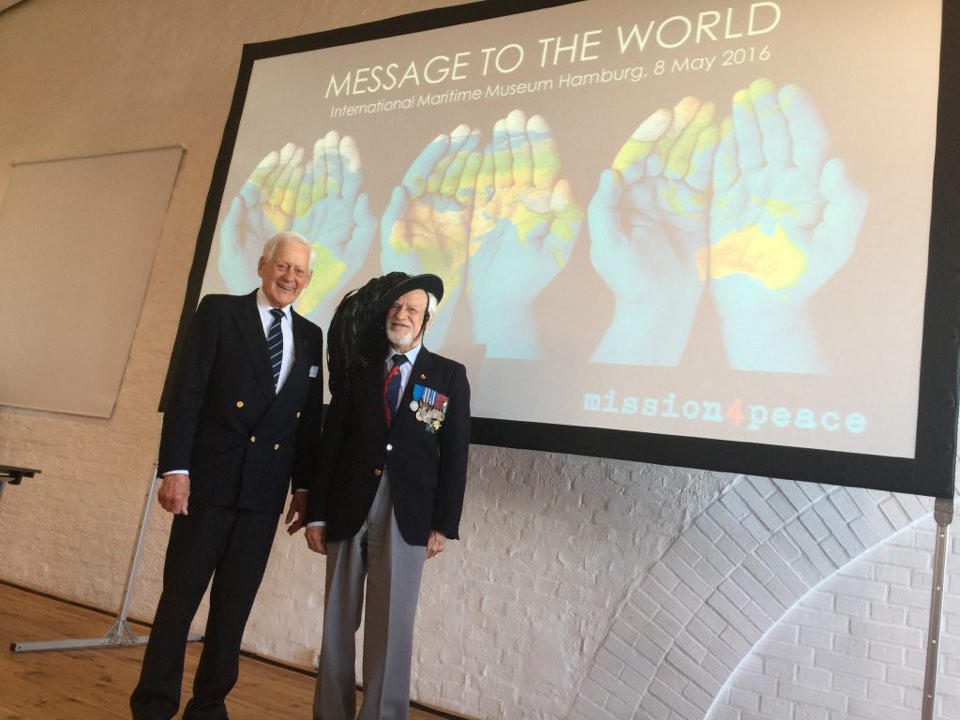
The veterans and guests have been greeted by the International Maritime History Museum Hamburg. The party was addressed by the Ambassador of the Kingdom of Belgium H.E. Ghislain D’Hoop. The event has been coordinated by the founders of mission4peace and organisers of ‘Message to the World’ event Eugene Kasevin (Ukraine) and Jochen Werne (Germany).
The veterans addressed the auditorium with personal messages and appealed to all countries and their leaders to maintain peaceful relations between nations regardless of cultural, religious and ideological differences. Following the official part of the event, veterans and guests released white doves from the roof of the historical museum as a sign of remembrance, reconciliation and peaceful coexistence of all peoples.
“One of the main goals of the mission4peace project is to bring together and unite forward-looking people who share the conviction that peaceful human coexistence can be achieved through the perseverance of intellectual and intercultural exchange while accepting differences. The "Message to the World" event is designed to allow veterans to share their messages and show that we are capable of overcoming the most deeply rooted historical resentments. In this case, it is the inherited resentments between people and nations that participated in the Second World War, which continue to be an obstacle in politics and trade, in the social sphere and in the everyday lives of ordinary people.”
Eugene Kasevin, Co-Founder mission4peace

One of the most influential British military leaders, the former Chief of the Defence Staff and Head of the British Armed Forces, General Lord David Richards of Herstmonceux GCB CBE DSO commented:
“At a time of considerable international tension, mission4peace is a timely and thought provoking initiative that deserves the attention and support of us all.”

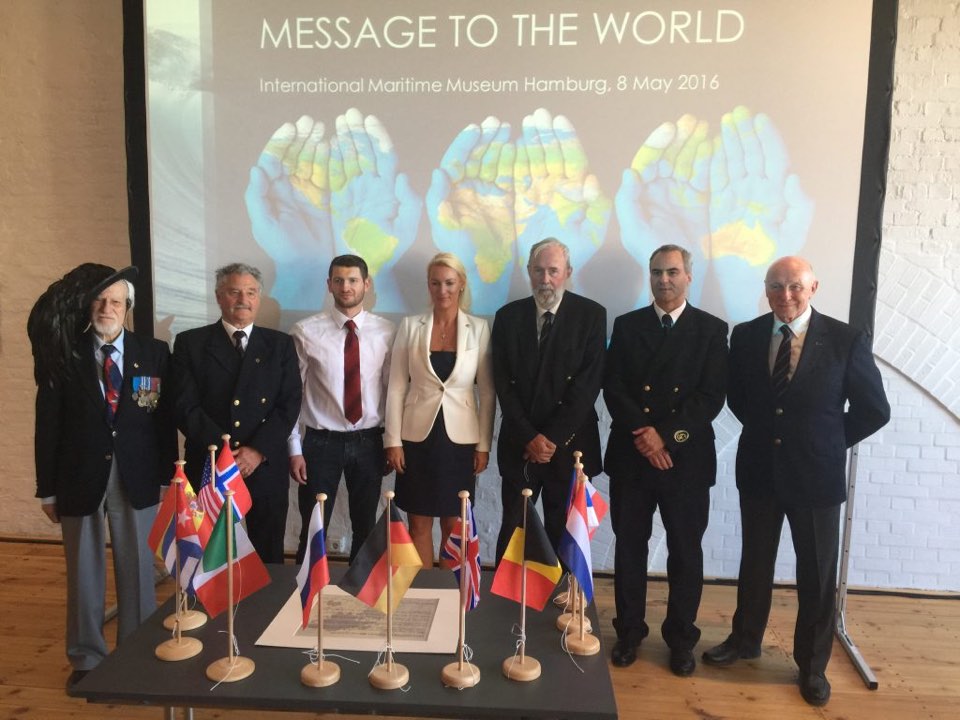
80TH ANNIVERSARY CHANNEL DASH
Manston, 12 February 2022
SPEECH ON THE OCCASION OF THE COMMEMORATION OF THE 80TH ANNIVERSARY OF THE CHANNEL DASH
held by Jochen Werne, Co-Founder of GOST
I’m truly honoured to be here to speak on the occasion of the 80th anniversary of the Channel Dash.
It was 10 years ago that the members of the Global Offshore Sailing Team, planning their commemorative voyage from Brest to Kiel, first met the honourable members of the Channel Dash Association. Outstanding individuals who have done so much to keep history alive and remind us that we are all part of something bigger than ourselves.
The aim of the GOST expeditions has always been to get a feel for the background and struggles of events at sea.

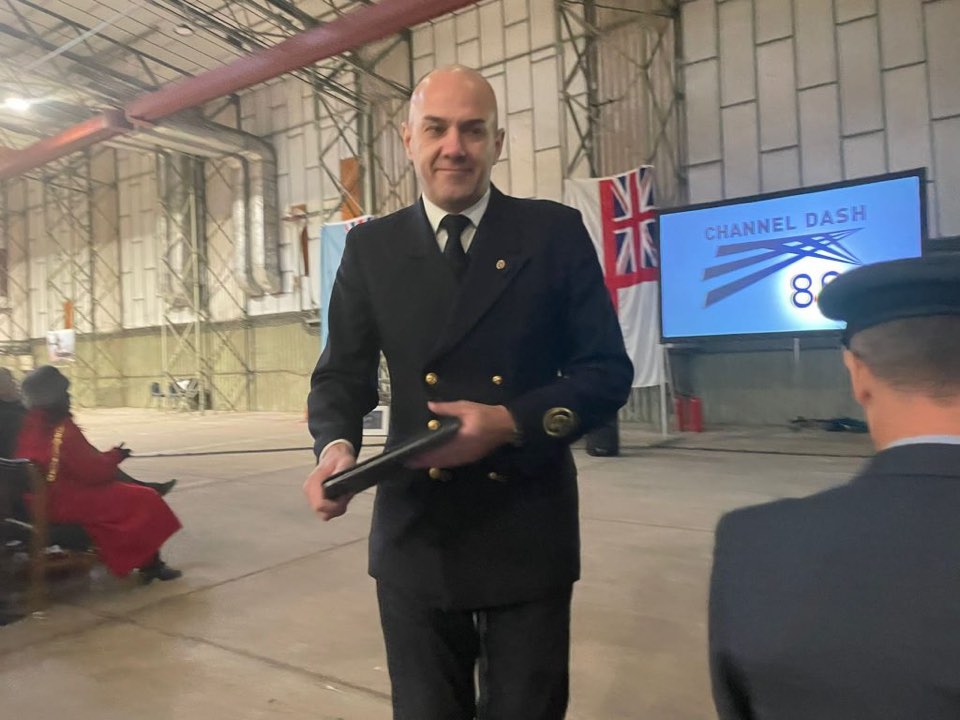
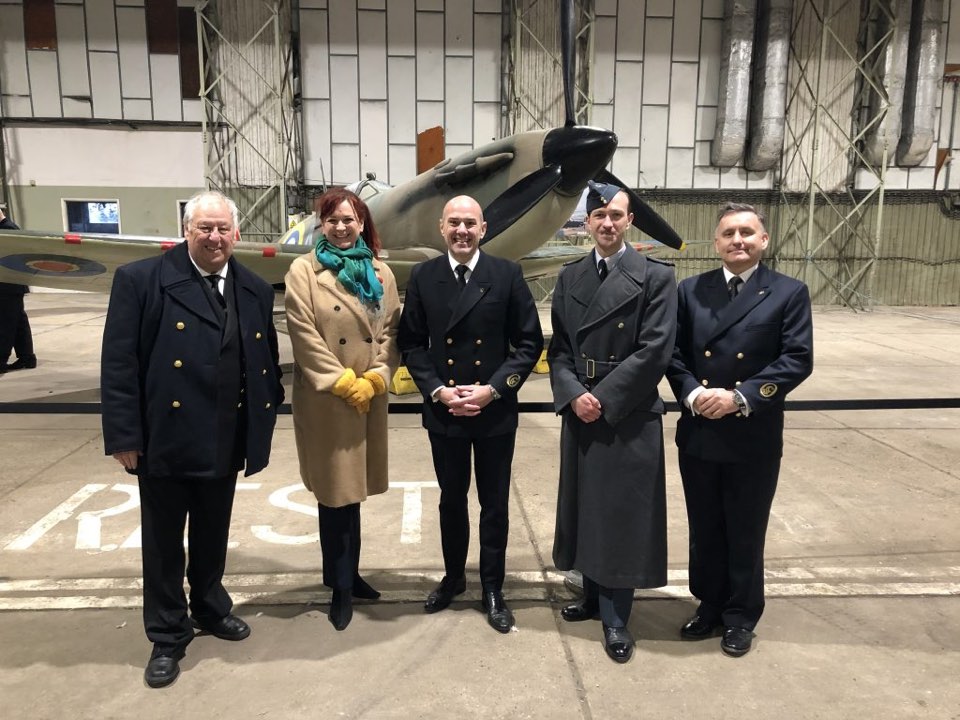

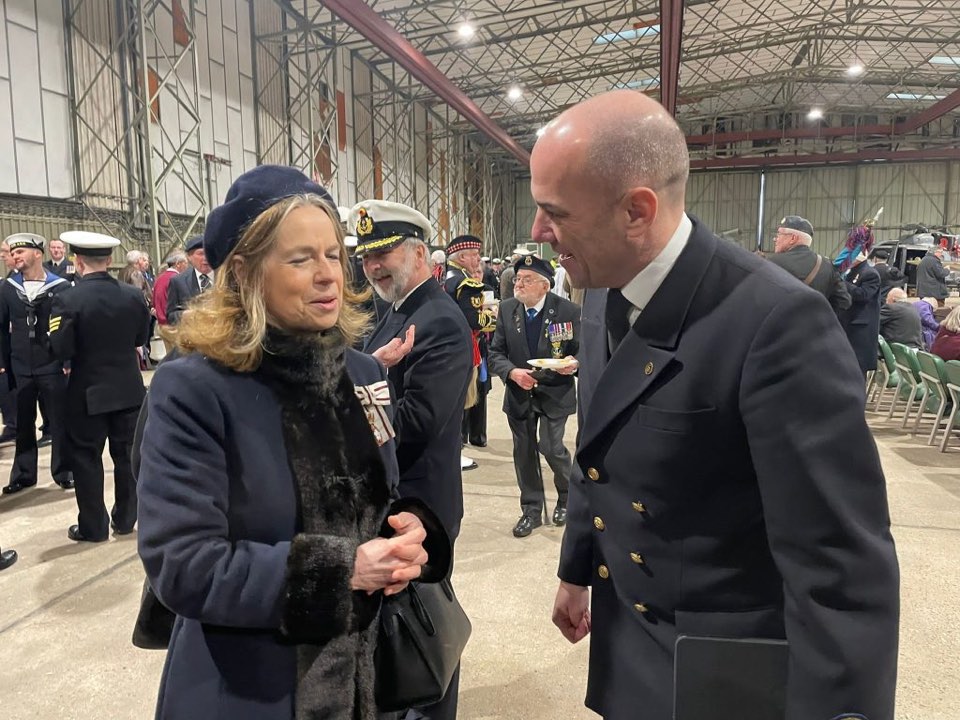
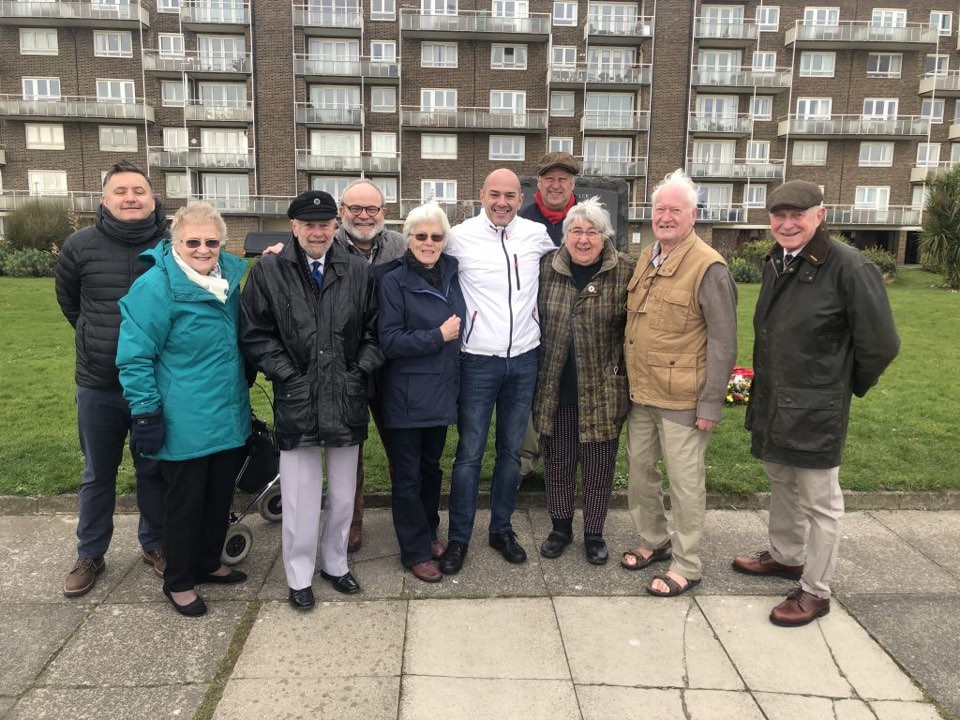
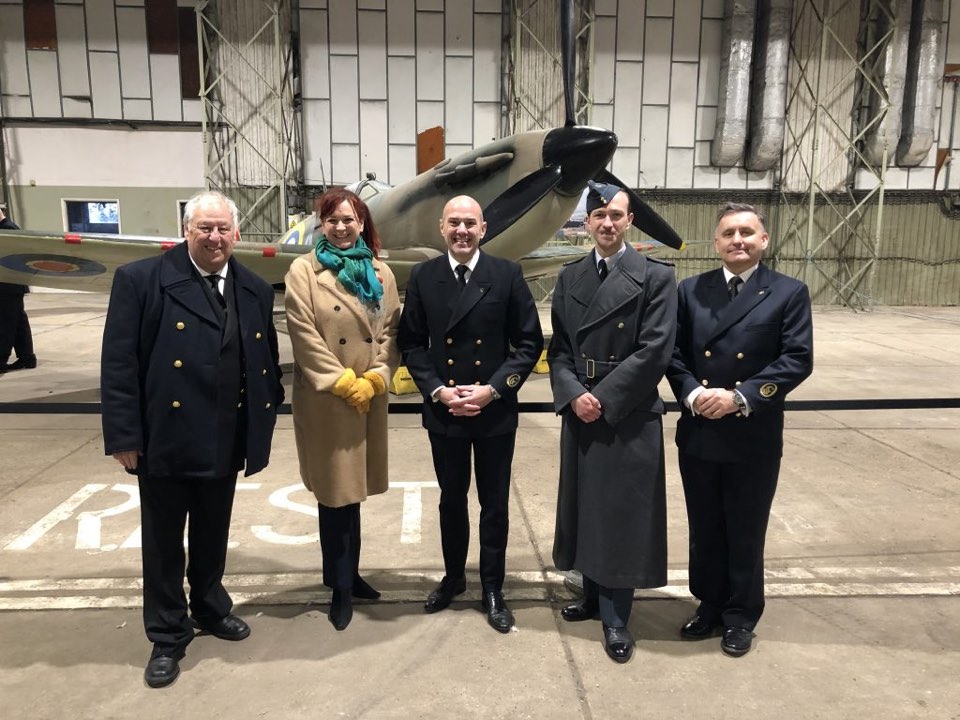




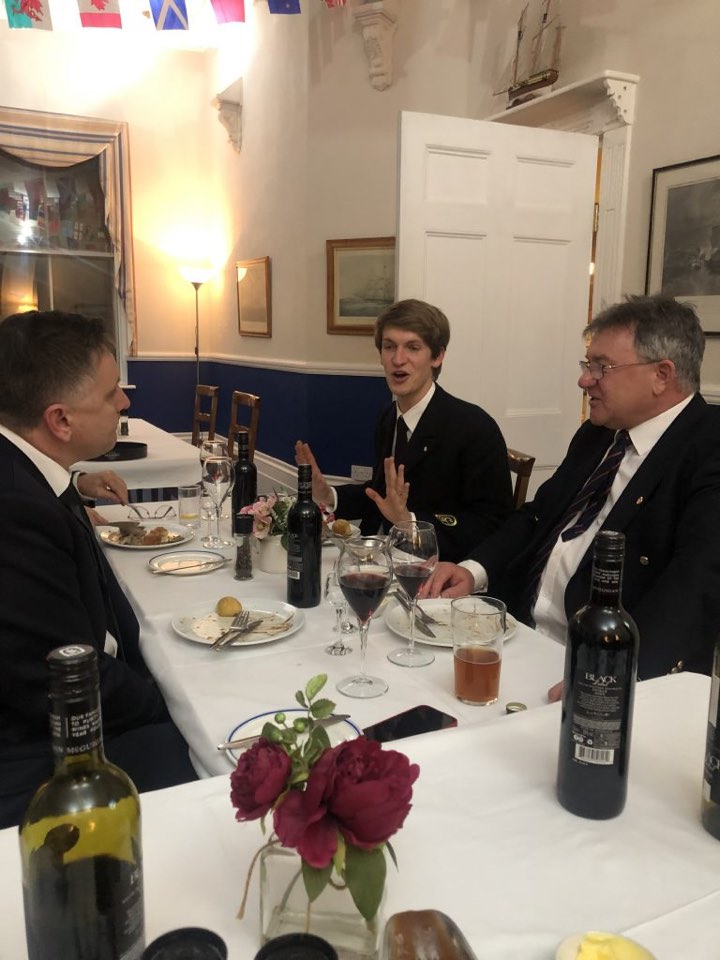

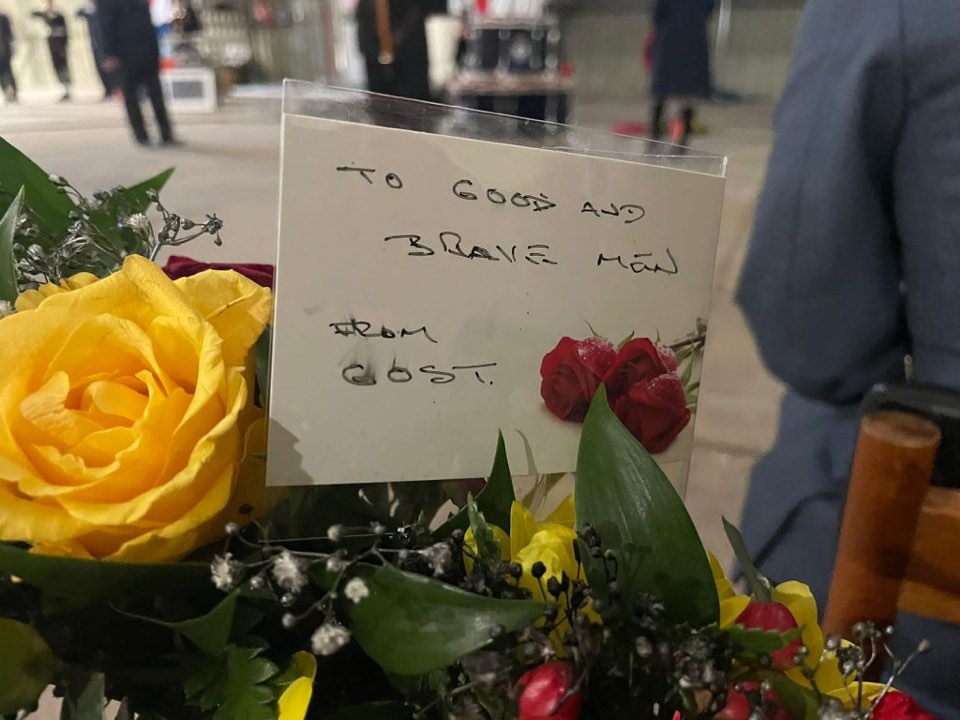
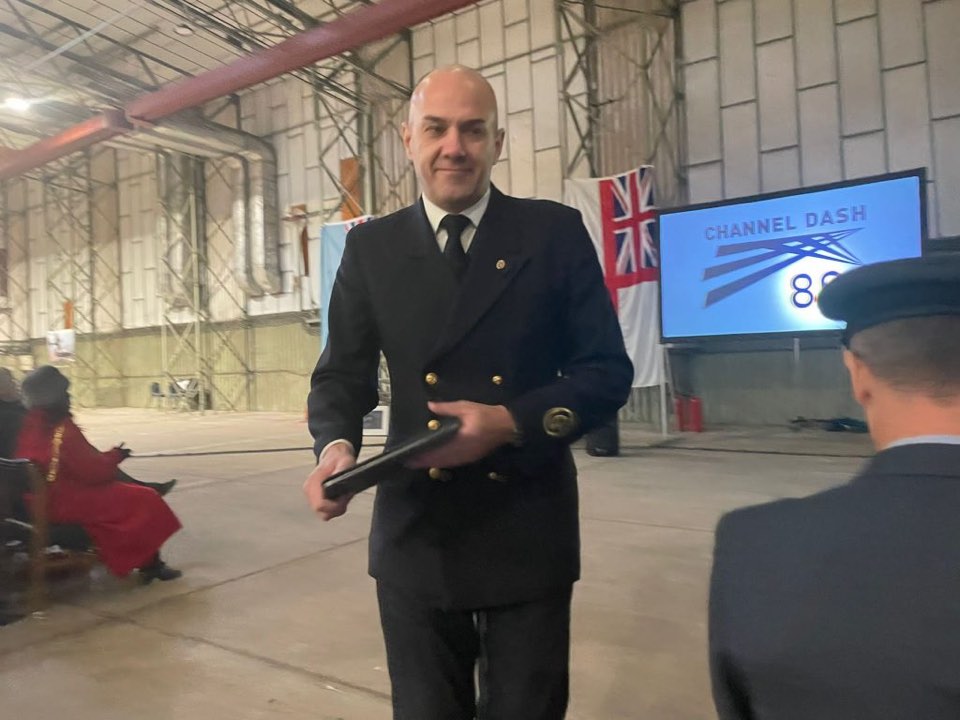
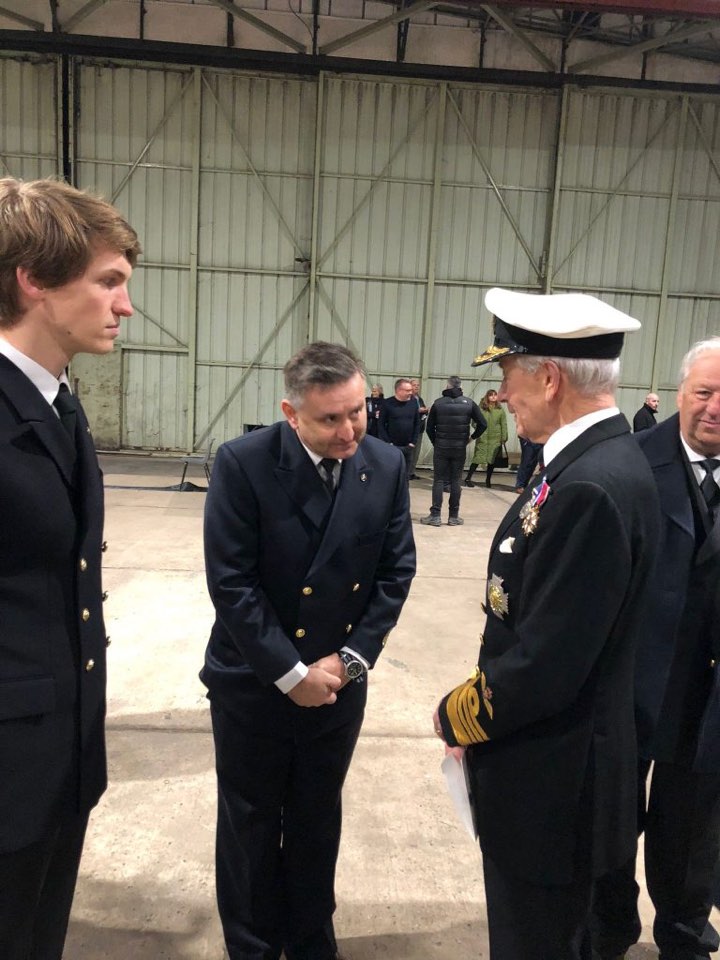

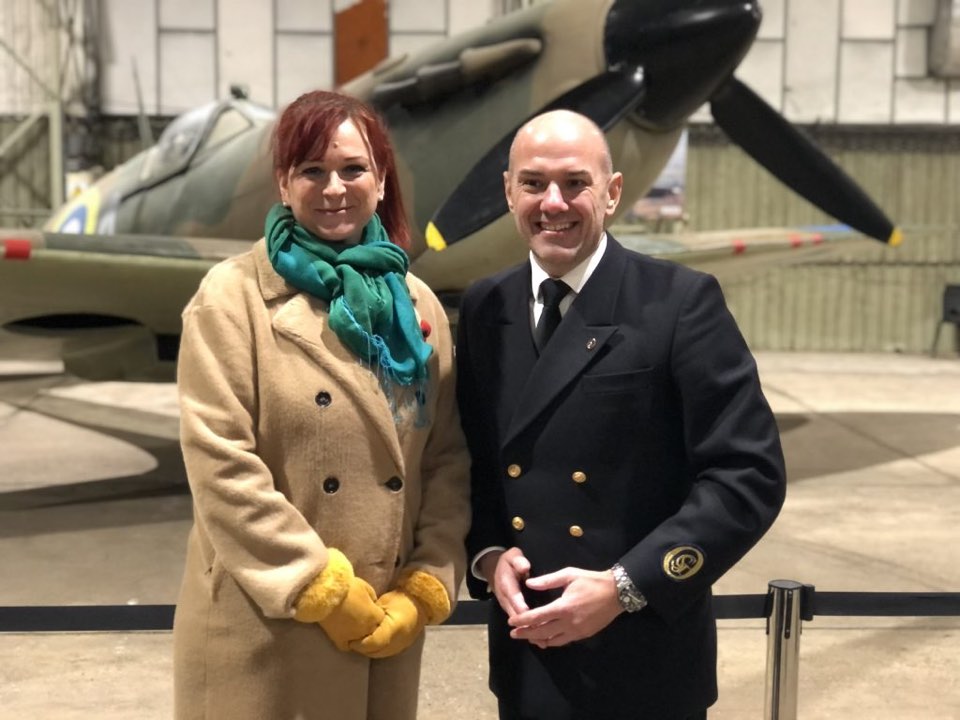
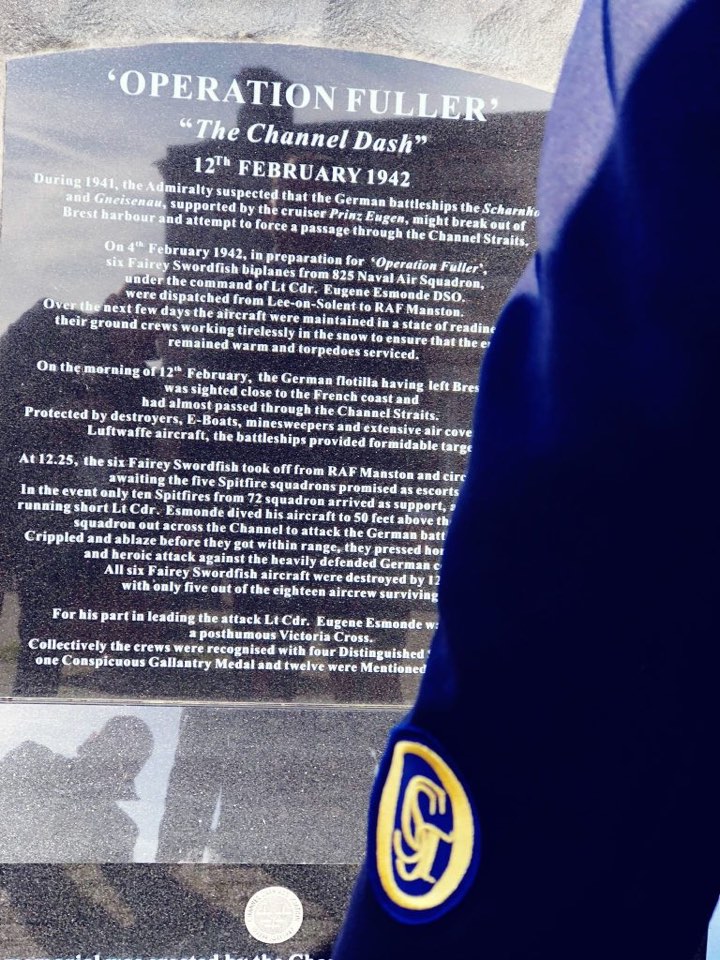
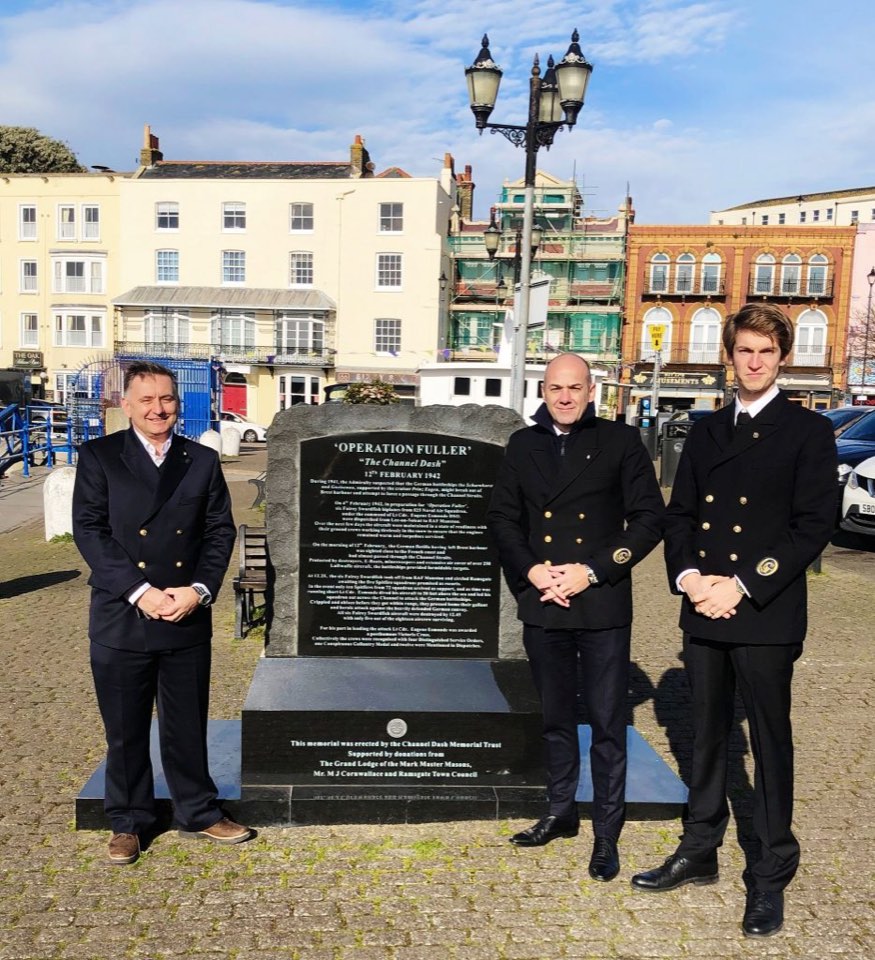
As our dear friend Peter Nixon - whom we will always remember - summed up perfectly:
Peter Nixon
“ … working so hard to bring history back to everyones attention and recognizing the many great acts of courage performed on our behalf by men and women of all sides during a period of conflict. ... It is not about Winners or Loser`s. … The world is a wonderful place to live because it is made up of many different, but beautiful countries…. We should be proud of this fact. Equally, we should not be ashamed of our past, nor should we glorify it, for it was our past which created what we are today.”
In the fateful days 1942, British air and ship crews threw themselves with an incredible sense of duty against German battleships and their protection.
The enemy which the Swordfish crews met on this day 80 years ago consisted not only of large scale naval vessels but also of an air cover operation code named “Thunderbolt“. The operation was planned by Adolf Galland, who himself survived being shot down kept the ships under a constant Messerschmidt fighter jets umbrella during the whole Operation Cerberus.
Anyone who witnessed the performance differences between a Swordfish and a Spitfire, the British equivalent of the Messerschmidt, at one of the recent Channel Dash commemorations understands well the words of Captain Hoffmann of the Scharnhorst; "Poor fellows. They are so very slow. It is nothing but suicide for them to fly against these big ships". Everyone on the bridges of the Battleships felt the same. Willhelm Wolf, on the Scharnhorst, said; "What an heroic stage for them to meet their end on. Behind them their homeland which they had just left with their hearts steeled to their purpose still in view".
Admiral Ciliax, watching from the Scharnhorst Bridge, the Swordfish lumbering towards her, remarked to Captain Hoffmann: "The British are now throwing their mothball Navy at us. Those Swordfish are doing well to get their torpedoes away".
Christoph Ciliax, the grandson of Admiral Ciliax, wanted to be with us today, but unfortunately Covid restrictions got in the way, and he asked me to represent him and his words:
„On behalf of the Ciliax family, I would like to express my utmost respect and appreciation to the British soldiers who lost their lives on 12 February 1942. The German ships and their crews served a brutal, criminal regime of injustice. We Germans can be all the more grateful that the German fallen are also included in the commemoration and that representatives of the German Navy as well as their families are invited to the event. This is a great gesture of friendship and bridging to the former enemy. Today, British and German servicemen and women serve side by side, advocating world peace, a democratic world order as well as stability and security in Europe.
I, too, wear the Navy uniform for this reason and stand for the fact that never again a regime of injustice can grow in Germany, from which terror and violence towards our neighbouring countries and the world emanates. This is what my father already stood up for as a soldier and I am sure my grandfather would do the same, who was first and foremost a sailor and soldier for his country. However, never would I defend serving for a criminal regime what at the end serving in the Kriegsmarine meant. It is all the more impressive and deserving of thanks that Great Britain, when honouring their fallen also remembers the German soldiers killed in action.
My mother and wife of Rear Admiral Otto H. Ciliax, my late father, would as well like to attend the commemoration event and honour the British soldiers; but she is also unable to do so due to COVID restrictions and therefore sends her thanks and greetings.“
Many thanks from our side to the Ciliax family

I am also grateful to be able to quote from the letter sent by the Federal Minister of Defence, Christine Lambrecht, to the Channel Dash Association. She underlines:
“Your thoughtful gesture of not only inviting representative from the Royal Navy and the Royal Air Force, but also representatives from the German Navy is a sign of reconciliation and long-standing friendship between our nations. “
Captain Heuer, thank you for being as official representative of the Federal Republic of Germany with us today.
As the former Commodore of the Royal Cinque Ports Yacht Club and GOST member Bernard Sealy once said and it remains true today and it will remain the truth into the distant time… we’re all sailors.
Ladies and Gentlemen, please let me conclude on this historic day with a thought and a quote.
The beauty of our nations is that we cherish the same freedoms, defend the same values and respect the same fundamental laws.
We are bound together not simply by institutions, but by our common beliefs in democracy, openness and equality before the law.
We are bound together by friendship.
Friendship, lived through the great people who are in this hangar today, and many who have already left us but whom we keep in our hearts.
Today is a very special day. It is not an end, but a beginning. So let me conclude with the famous words of Konrad Adenauer, the first post-war German Chancellor:
“Wenn die anderen glauben, man ist am Ende, so muss man erst richtig anfangen.” (“when others think we’ve reached the end, that’s when we’ve got to really begin”).
Thank you very much
by JOCHEN WERNE
Original published in German at DER-BANK-BLOG. Please click HERE Translation created with DeepL.com
14 February 2022
Digital assets are as safe as their encryption? Unfortunately not. After all, the dangers do not only come from hackers. Security must be thought of more broadly, as examples of state-of-the-art crypto custody solutions show.
The protection of crypto assets can only be guaranteed if there is a clear awareness of the dangers. Attacks on digital assets such as cryptocurrencies or asstes no longer end with the numerous attack vectors of cyberattacks, but unfortunately already extend to the use of physical force against their owners. It is therefore important to raise awareness of possible dangers, as shown by examples of the state of today's state-of-the-art crypto custody solutions.
According to Investing.com, the total number of cryptocurrencies as of 12 December 2021 is 9,004 with a total market capitalisation of US$2.24 trillion. After Bitcoin, Ether, XRP, Litecoin and co, the Libra Coin initiated by Facebook received unprecedented media attention, triggered by the announcement of the project alone. And the emotionality and sharpness with which the discussion was conducted shows how seriously the topic is taken internationally at the state level. It is about reputation, influence, control, responsibility and only in the last instance about technology. And for every investor, it is first and foremost about protecting his assets.
In the future, protecting our assets will not just mean keeping our wallet in the deepest pocket of our jacket or handbag or turning the key to our flat twice in the lock. In the future, we will have invested part of the fruits of our labour, our fortunes, in crypto investments and cryptocurrencies. This part of our wealth needs to be kept safe, and we need to understand exactly where and how. This requires that we understand the risks. The sense of danger must therefore adapt, as must the lure of the new opportunities. For this, it is of utmost importance to understand the real dangers and to take appropriate protective measures.
As yet, however, this sense does not seem to be all that pronounced. According to Slowmist Hacked , which specialises in aggregating information on detected attacks on blockchain projects, apps and tokens, the total amount of crypto assets stolen in 122 different attacks in 2020 is $3.78 billion. Even though the evaluation is based on the Bitcoin peaks of January 2021, it clearly shows the importance of greater efficiency in security.
In comparison, only 1.63 billion US dollars were captured in the ten largest bank robberies of all time. Considering that the largest robbery took place when dictator Saddam Hussein ordered his son Qusay to withdraw nearly US$1 billion from Iraq's central bank with a handwritten note, and the tenth largest robbery netted the perpetrators just US$18.9 million, crypto-cybercrime has become an extremely lucrative business.
The famous military scientist Carl von Clausewitz argued in the early 19th century: "An army on the defensive, without fortifications, has a hundred vulnerable points; it is a body without armour". "We must always retain sufficient forces beyond the garrisons to be a match for the enemy in the open field, unless we can rely on the arrival of an ally to relieve our fortresses and free our army." In cryptocurrencies, the wallet is the fortress and the blockchain - the distributed ledger - is the army in the open field. It is the job of modern crypto custodians - as guardians of their clients' assets - to ask themselves daily what additional measures can be taken to best protect cryptocurrencies and crypto assets.
Crypto custody solutions typically involve a combination of hot storage or crypto custody that is connected to the internet and cold storage or crypto custody that is not. Rakesh Sharma comments on Investopia, "Both types of storage have advantages and disadvantages. For example, hot storage is connected to the internet and therefore offers better liquidity. But hot storage options can be vulnerable to hacks due to online presence. Cold storage solutions offer more security. However, it can be difficult to generate liquidity from crypto holdings in the short term because they are offline. Vaulting is a combination of both types of cryptocurrency custody solutions, where the majority of funds are stored offline and can only be accessed with a private key."
The risk of becoming a victim of physical violence in private crypto custody
The risk of theft of crypto assets is no longer solely about digital robbery in cyberattacks and hacks. Physical violence against the owner of crypto assets or threats to family members is already sadly present. In November 2021, for example, the American co-founder of Tuenti, once billed as the Spanish Facebook, Zaryn Dentzel, was the victim of such an attack in his private Madrid flat.
Dentzel stated on record that the gangsters beat him and stabbed him in the chest with a knife while shooting him several times with a Taser.
Thus it becomes clear that the protection of crypto-assets must also go hand in hand with the fact that a perpetrator who is prepared to use physical force understands in advance that his alleged victim does not readily have power of disposal over his total crypto-assets. Cold storage not at home, but in a cold space, for example a high-security facility, can provide the necessary protection.
In July 2021, Prosegur Crypto - the crypto custody subsidiary of Prosegur, one of the largest security companies in the world - announced the creation of the world's first "digital asset custody bunker". The consistent combination of a physically and digitally inaccessible environment here is unique to date.
In collaboration with cybersecurity company GK8, Prosegur Crypto brings together all the infrastructure, facilities, technologies and security protocols required to minimise all risk areas identified in the digital asset custody chain.
The solution consists of state-of-the-art cyber security systems provided by GK8's patented technology and the highest level of a military-grade secured protection environment. It is based on a "360° inaccessibility" approach, mapping over 100 protection measures into 6 integrated layers of security. This ensures the highest possible protection against physical and cyber attacks.
The HSM (hardware security module, a device that generates, stores and protects cryptographic keys) is housed in a military grade briefcase within the high security vault. This vault is only accessible to a limited number of people who manage the data manually and offline. Staff have restricted access to the information they handle to avoid any risk of internal theft and work from a secure facility where there is no risk of physical attack, copying or theft of systems or passwords. In the event of an unauthorised attempt to access the HSM, its contents are permanently deleted. Immediately, a recovery plan is activated, including a protocol for recovering private keys using seeds located in various other vaults.
The module is connected to an MPC (Multi-party Computation) system, which provides a fast signature process on a state-of-the-art computer network and generates transactions on the blockchain without a direct internet connection. This minimises the possibility of fraudulent access and eliminates any potential vector for cyber attacks. These system features are patented and represent a highly differentiated offering in the market.
The analysis shows that from Clausewitz to the latest developments in cyber security and crypto-custody, the security perspective has hardly changed. The more you rely on a single system or fortress, the more vulnerable you are. It's all about layered security, which makes it time-consuming and very costly for attackers to get what they desperately want.
We are still only at the beginning of a new era for our monetary systems. An era driven by technology in which it is increasingly important for every actor to develop a good understanding of it in order to build sustainable ones. Technology has never been right or wrong, only the way we humans use it can make it so.
New technologies offer the opportunity to make our world more prosperous for all - let's use it!
Enjoy a glimpse of the thrills awaiting the men aboard their expeditionary sailing yacht in the North Sea with this introductory trailer featuring moments from previous GOST missions.
NORTH SEA ENDURANCE TRAILER
It was an honor and a great pleasure for me to chair the jury of the German Stevie Awards 2022 together with my esteemed board colleague and COO of Prosegur Germany Hasan Celebi.
Together with all jury members for the categories "Management, HumanResources, Customer Service, Support and Covid-19-Handling" we are very pleased to judge the outstanding achievements of the applicants for this year's award.
Follow the news at https://stevieawards.com/gsa
AN OFFSHORE SAILING CHALLENGE PROMOTING THE MOST EXCITING STORIES ON THE SEVEN SEAS.
#InternationalUnderstanding #CleanSeas #CleanEnergy
The challenging tides, rough weather and dense ship traffic of the North Sea will be the first chapter within the Global Offshore Sailing Team‘s Expedition Blue Ocean.
In 2022, GOST will undertake various missions to all Seven Seas to learn about and promote the most exciting #CLEAN ENERGY & #CLEAN SEAS projects and the driving forces behind them.
Inspired by the great Prince of the Sea Albert I and his strong commitment to international understanding, the environment and our oceans, we will carry out various missions with our supporters around the globe to promote international understanding and environmental awareness around #cleanseas and #cleanenergy
I’m proud commanding the 1st Mission with an outstanding experienced team:
NORTH SEA ENDURANCE 600+nm Offshore (Expedition Blue Ocean) Departure Zeebrugge, Belgium - 14 May 22: Into the Night - 271 nm Offshore to Wilhelmshaven/Bremerhaven - Meet the drivers of the #CLEAN SEAS initiatives of the German Research Centre for Artificial Intelligence, Beach Cleaner and many more. Sail from Wilhelmshaven North-West to the major offshore wind farms. Meet Northern Helicopters and others who keep these breathtaking #CLEAN ENERGY projects running in such challenging conditions.

Other missions to come: GOST-Senior Officer Wolfgang Händel will command parallel to NORTH SEA ENDURANCE, the MEDITERRANEAN ENDURANCE MISSION in the Thyrenian Sea. With the great support of the Asociación para la Investigación y Difusión de la Historia Naval de Cuba projects with the Yacht Club de Havana (CARRIBEAN ENDURANCE) are in planning. Same with the Royal Cinque Ports Yacht Club (ATLANTIC ENDURANCE), our Californian team mates (PACIFIC ENDURANCE) and many more.

Please find updates at www.ExpeditionBlueOcean.com
Ein besonderes Jahr steht der Robo-Avisor Szene bevor. Ihre Algorithmen sind herausgefordert gute Anlageempfehlungen in einem äußerst schwierigen Marktumfeld 2022 zu geben. Steigende Inflation, globale politische Spannungen und eine endende Liquiditätsschwemme die auf eine vulnerable Industrie mit maroden Lieferketten stößt, bilden das Szenario.
Als Bernhard Bomke im November 2019 den Artikel „Automatisch Geld verdienen - Die besten Rendite Robos“ in der Euro am Sonntag veröffentlichte stand die Szene noch am Anfang. Heute verdient sie zwar noch kein Geld und die Firmen weiten die Verluste laut eines aktuellen Berichtes der Börsenzeitung aus, doch dies aus einem gutem Grund: der Erlangung von Relevanz durch Größe.

Ob dies den Robos - wie sie von manchen liebevoll genannt werden - gelingen wird, wird 2022 zeigen. Die Challenge hat das Private Banking Magazin zu Weihnachten als Headline zu ihrem Echtgeld-Test wie folgt formuliert: „Benchmarks für Robos kaum zu knacken“. Estably, Scalable Capital, Invesdor, Deutsche Bank, bevestor, Oskar, Warburg Navigator, visualvest, zeedin, comdirect, whitebox, quirion, investify, ginmon und viele mehr stehen in den Startlöchern um zu beweisen, dass es doch möglich ist.
Wer einen tiefen Einblick in die Szene erhalten möchte, kann dies mit dem von Prof. Peter Scholz herausgegebenen und bei palgrave macmillan erschienen Standardwerk; „Robo Advisory - Investing in the Digital Age“. Das Buch bietet neben einem Überblick, tiefgreifende Einblicke in Investmentmodelle, Case Studies, Behavioral Finance Komponenten und Zukunfsaussichten. Die Autoren der einzelnen Kapitel zählen zu den führenden Experten ihres Fachs.

AUSZUG aus ROBO ADVISORY: Foreword - Man or Machine; Jochen Werne.-Part I. The Status Quo of Robo-Advisory.- Chapter 1. Robo-Advisory: The Rise of the Investment Machines; Peter Scholz and Michael Tertilt.- Chapter 2. Situating Robo-Advisory; Sinan Krueckeberg.- Part II. The Implementation of Robo-Advisory.- Chapter 3. Risk Preferences of Investors; Monika Mueller, Paul Resnik and Craig Saunders.- Chapter 4. Robo-Economicus: The Impact of Behavioral Biases on Robo-Advisory; Peter Scholz, David Grossmann and Joachim Goldberg.- Chapter 5. Quant Models for Robo-Advisors; Thorsten Ruehl.- Chapter 6. The Analysis of Robo-Advisors as a Replacement for Personal Selling; Goetz Greve and Frederike Meyer.- Chapter 7. The Regulation of Robo-Advisors in the United States; Melanie L. Fein.- Chapter 8. The Regulation of Robo-Advisory in Europe and Germany; Christian Hammer.- Part III. Case Studies of Robo-Advisory.- Chapter 9. (Re)Launching a Robo-Advisor as a Bank; Theodor Schabicki, Yvonne Quint and Soeren Schroeder.- Chapter 10. How Can Robo-Advisory be Implemented and Integrated into Existing Banks?; Ana-Maria Climescu, Christian von Keitz, Jan Rocholl and Madeleine Sander.- Part IV. The Future of Robo-Advisory.- Chapter 11. The Role of Artificial Intelligence in Robo-Advisory; Alexander D. Beck.- Chapter 12. What Role does Social Media Play for Robo-Advisors?; Ana-Maria Climescu.- Chapter 13. Success Factors for Robo-Advisory: Now and Then; Madeleine Sander.
HOT OFF THE PRESS
It was a inspiring holding in hand the first edition of the JOURNAL OF AI, ROBOTICS & WORKPLACE AUTOMATION published by Henry Stewart Publications
We are pleased to give everyone the opportunity to download the entire article POINT OF NO RETURN by Jochen Werne & Johannes Winter here: https://lnkd.in/dmi9i9aB
The inspiring articles and case studies published in Volume 1 Number 1 are:
Editorial
Tom Davenport, Distinguished Professor, Babson College, Research Fellow, MIT Center for Digital Business and Senior Advisor, Deloitte Institute for Research and Practice in Analytics
Practice papers:
It has always been a primary goal of Global Offshore Sailing Team (GOST) to promote international understanding. Since GOST and the Channel Dash Association first met 10 years ago, the two organizations have worked together to deepen Anglo-German friendship. Through joint expeditions and commemorative events, we kept history alive and created new connections between so many people. Together we accepted the challenge of a global pandemic which closed our borders and distanced us physically. We found new ways of staying in touch. And now - for the 80th anniversary commemoration - we have the great opportunity to finally meet again and create new relations for a peaceful future.
Peter Nixon, former Chairman of the Channel Dash Association, who established the contact with the Global Offshore Sailing Team, once summarized the effort perfectly with the words:
Working so hard to bring history back to everyone's attention and recognizing the many great acts of courage performed on our behalf by men and women of all sides during a period of conflict. It is not about winners or losers. The world is a wonderful place to live because it is made up of many different, but beautiful countries. We should be proud of this fact. Equally, we should not be ashamed of our past, nor should we glorify it, for it was our past which created what we are today.
peter Nixon - Former Chairman of the Channel Dash Association
About the Channel Dash
Source: https://en.wikipedia.org/wiki/Channel_Dash
The Channel Dash, (codenamed Operation Cerberus by the Germans),[1]was a major naval engagement during World War II in which a German Kriegsmarine squadron consisting of both Scharnhorst-class battleships, and heavy cruiser Prinz Eugen along with escorts, ran a British blockade and successfully sailed from Brest in Brittany to their home bases in Germany via the English Channel.
On 11 February 1942, the Kriegsmarine's ships left Brest at 21:14 and escaped detection for more than 12 hours, approaching the Straits of Dover without discovery.[2] As the German ships passed through the straits and on into the North Sea, British armed forces intercepted them, and attacks were made by the Royal Air Force, the Fleet Air Arm and Coastal Artillery. The attacks and bombardment were unsuccessful, and by 13 February all the Kriegsmarine's ships had completed their transit.[3]
‘The Channel Dash’, is also known as the heroic but futile attempt by six Swordfish torpedo bombers to stop the German Warships breaking through the Dover Strait and reach safety in their home waters.
Vice-Admiral Otto Ciliax, who commanded Operation “Cerberus” commented the attack of the slow and outdated Swordfish crews as follows:
"The mothball attack of a handful of ancient planes, piloted by men whose bravery surpasses any other action by either side that day"
Admiral Otto Ciliax, 1942
In support of the German naval operation, the Luftwaffe launched Operation Donnerkeil (Thunderbolt) to provide air superiority for the passage of the ships.
The Channel Dash remains the only occasion since the Spanish Armada in 1588 that ships belonging to an enemy of Great Britain (other than the Dutch in the Anglo-Dutch Wars) have successfully traversed the English Channel
PROGRAM: 80th Anniversary Celebrations
12th February 2022: Thanks to the excellent work of Channel Dash Association Chairman Malcolm Godfrey, CDA Secretary Sheila Howard and all CDA members and supporters, a major commemorative event will also be held on the 80th anniversary on 12 February 2022 at the former Royal Airforce Base Manston.
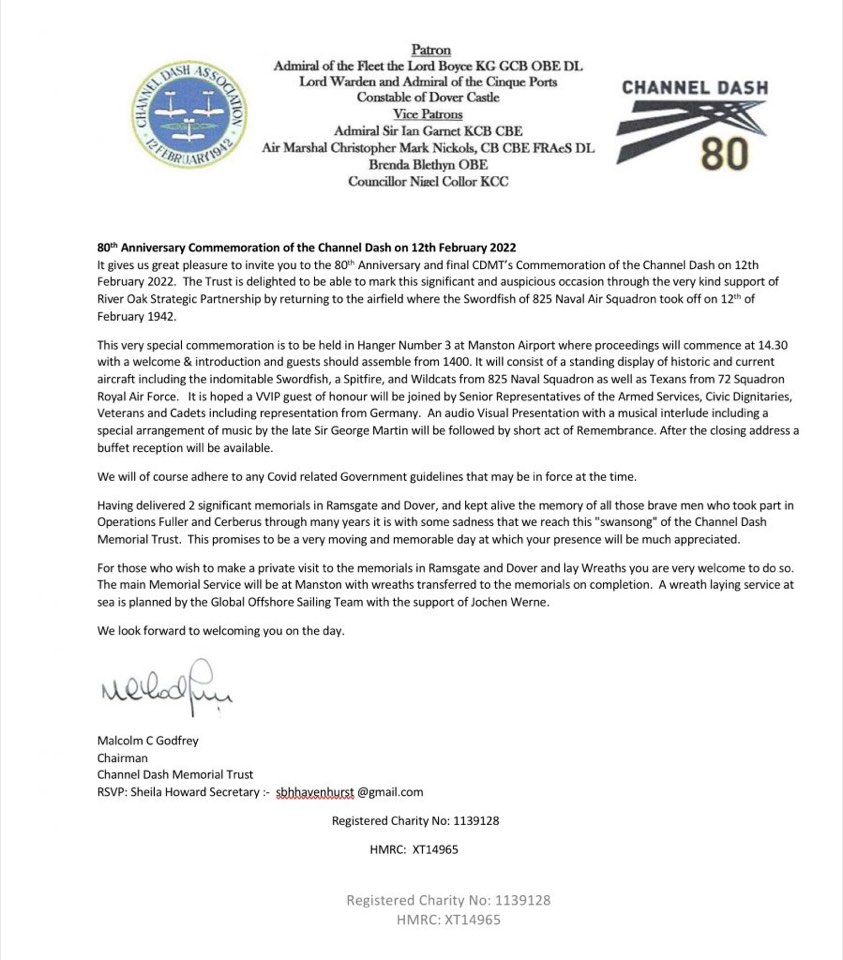
13th February 2022: On this day, the Global Offshore Sailing Team will set off from Dover in a joint mission with the Royal Cinque Ports Yacht Club Dover to the English Channel for a commemoration at sea. We are grateful for the excellent organisation by Bernard Sealy.
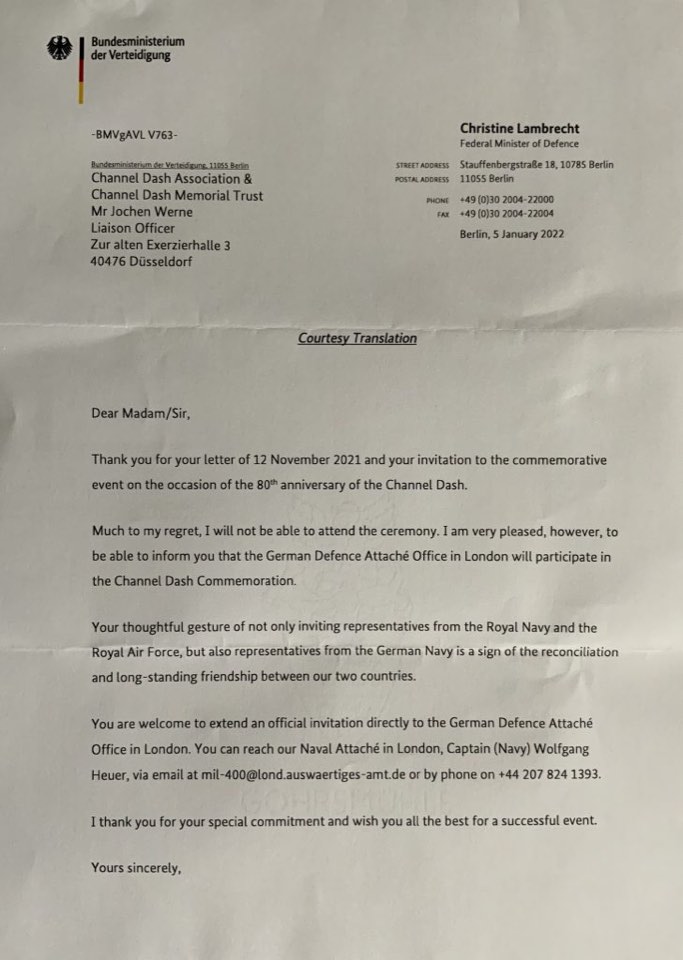
About the Global Offshore Sailing Team
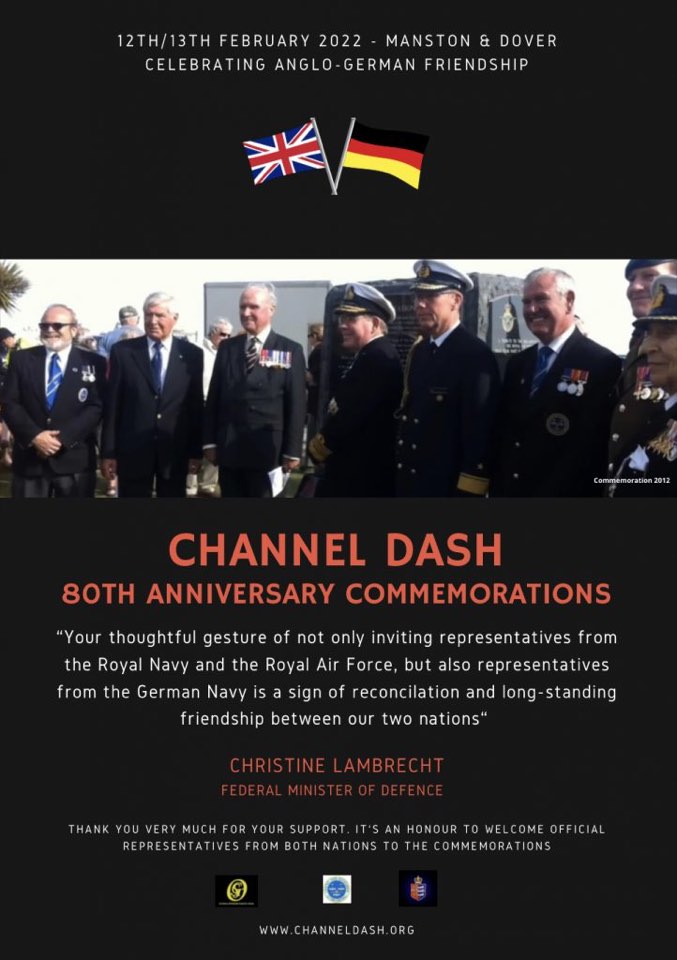
Extract from the FARO - the AIDHNC Bulletin No.2 - More here
Muchas gracias a la AIDHNC por los buenos deseos y por su destacada y sostenible labor de mantener viva la historia
Jochen Werne
Noticias
"NUESTRAS MÁS ENTRAÑABLES FELICITACIONES"
Es un grandísimo honor para la Asociación para la Investigación y Difusión de la Historia Naval de Cuba, AIDHNC, que nuestra organización hermana Global Offshore Sailing Team, a través de su co-fundador el Sr. Jochen Werne, hayan recibido la Medalla del Estado de Bavaria (Alemania), por sus más de 20 años de sostenida labor a favor de la identidad naval y protección de los mares. Es una importante noticia, para todos los seguidores de su labor. Nuestras más entrañables felicitaciones para nuestros camaradas de GOST.
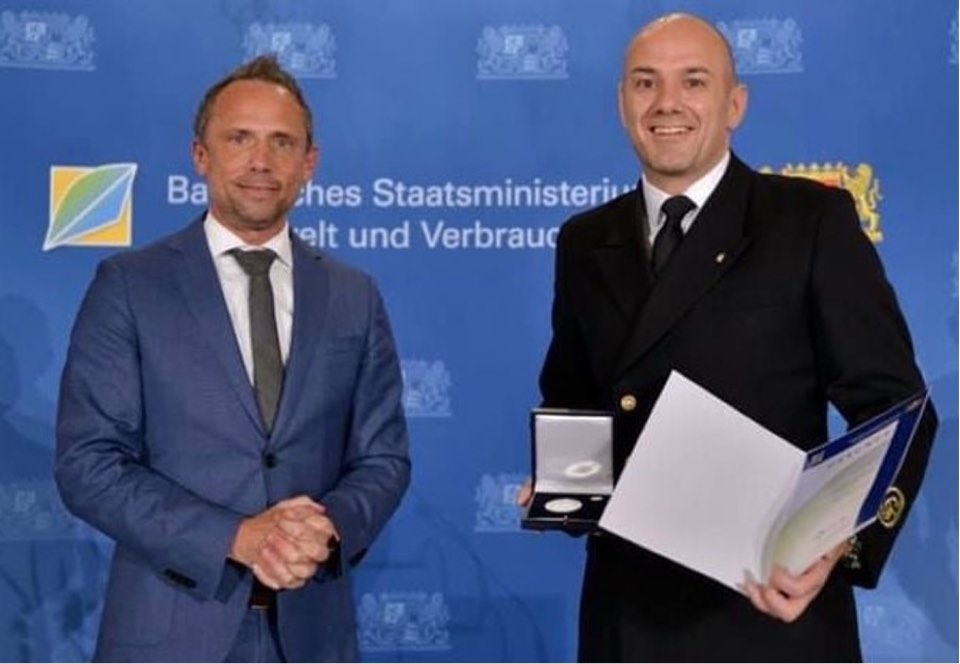
Jochen Werne es miembro de la AIDHNC, Asociación para la Investigación y Difusión de la Historia Naval de Cuba y en el año 2016 fue condecorado con el Diploma "Ancla de Oro" que otorga dicha organización, único miembro que ha alcanzado tan alta Distinción.
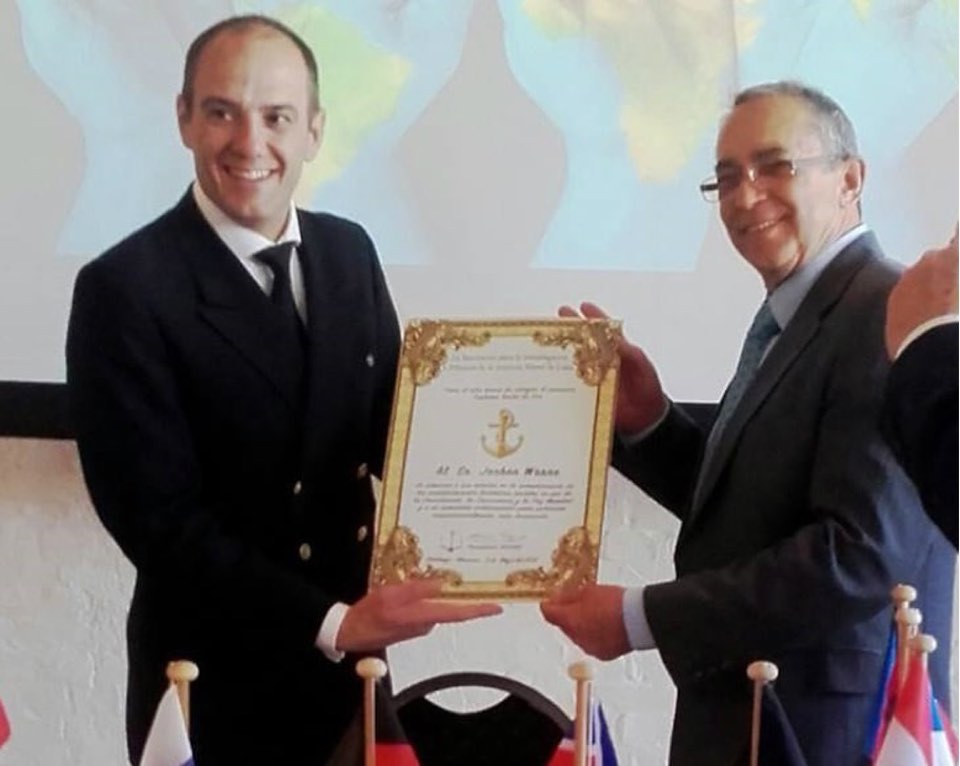
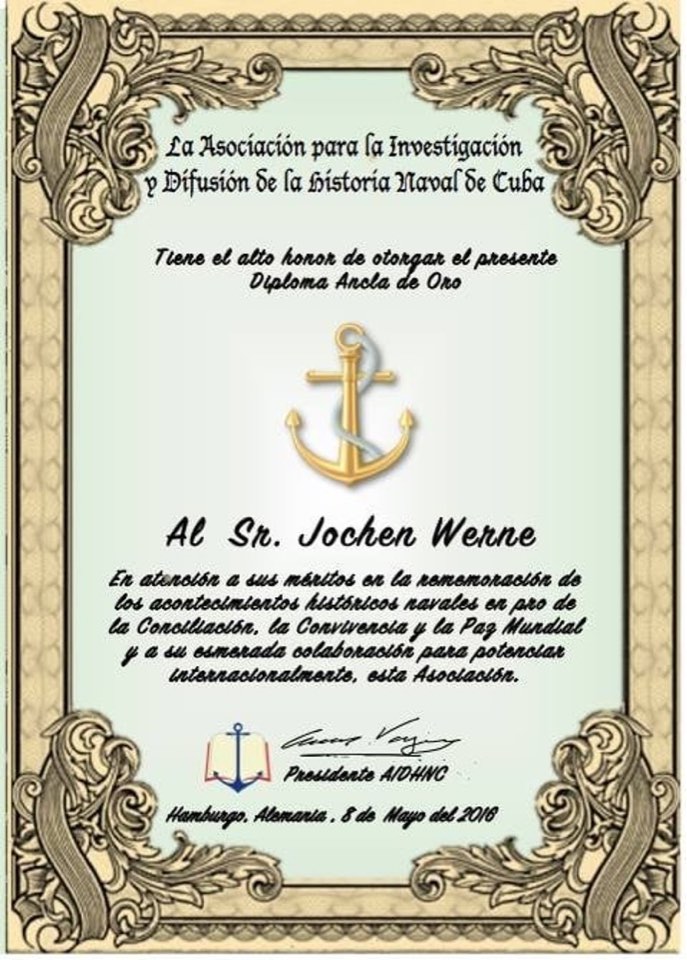
Ein Plädoyer für Vertrauen in einer Zeit des Misstrauens. Vertrauen ist die Grundlage, auf der Währungssysteme aufgebaut sind. Vertrauen bildet die Basis internationaler diplomatischer Beziehungen und ist die Grundlage für jeden Fortschritt.
Doch was passiert, wenn das Vertrauen einmal erschüttert ist?
Der aktuelle diplomatische Streit um einen milliardenschweren U-Boot-Vertrag, die Sorge um einen neuen kalten Krieg und der Zusammenbruch des Bretton-Woods-Systems vor genau 50 Jahren sind das Manuskript für diese maritim angehauchte französisch-amerikanische Geschichte über Geld und Vertrauen. Sie ist ein Lehrstück für unsere heutige Zeit, wo wir das Entstehen von Kryptofinanzmärkten miterleben und somit an der Schwelle zu einer neuen Form des Geldes stehen.
von Jochen Werne
Nach dem traditionellen langen Sommerurlaub, erwacht Frankreich im September wie jedes Jahr aus dem kurzen selbst kreierten Dornröschenschlaf. Das Leben beginnt seinen gewohnten Gang zu nehmen, auch wenn manch einer noch in Erinnerungen schwelgt und dabei vielleicht die ersten Vorboten post-Covid-sorgenfreien Lebens genießt. Nicht so Philippe Étienne. Für ihn beginnt auf der anderen Seite des Atlantik, im für diese Zeit eigentlich malerischen Washington, der Herbst mit einem diplomatischen Gewittersturm. Ein Unwetter, das selbst für den 65-jährigen grau-melierten eloquenten Botschafter Frankreichs neu gewesen sein dürfte. 6 160 Kilometer entfernt beschließt im Élysée-Palast Président de la République Emmanuel Macron seinen Spitzendiplomaten in den USA, samt seines australischen Amtskollegen Jean-Pierre Thebault, zu Konsultationen nach Paris abzuberufen. Der in der französisch-amerikanischen Geschichte einmalige Akt wird von Außenminister Jean-Yves Le Drian mit der „außergewöhnlichen Schwere“ einer australisch-britisch-amerikanischen Ankündigung gerechtfertigt und mit den Worten „Lüge“, „Doppelzüngigkeit“, „Missachtung“ und „ernste Krise“ eindrucksvoll unterstrichen.
Im Mittelpunkt dieser Krise steht die überraschende Ankündigung der genannten Länder ab sofort ein strategisches trilaterales Sicherheitsbündnis (AUKUS) einzugehen. Ein Bündnis, welches auch die Beschaffung atomgetriebener U-Boote für Australien vorsieht und somit einen bereits 2016 initiierten 56 Milliarden Euro schweren französisch-australischen U-Boot- Auftrag quasi ad acta legt. Der Abschluss des Abkommens fällt in einen Zeitraum in welchem US-Präsident Joe Biden vor der UN-Generalversammlung beteuert: „Wir streben nicht - ich wiederhole: wir streben nicht - einen neuen kalten Krieg oder eine in starre Blöcke geteilte Welt an“. Über diesen sogenannten „neuen kalten Krieg“ zwischen den USA und China sprechen Experten, wie der bekannte Historiker Niall Ferguson jedoch bereits seit 2019. Es geht hierbei nicht um atomares Wettrüsten, sondern vielmehr um die Technologievorherrschaft in Cyber Security, Künstlicher Intelligenz und Quantum Computing. Auch wenn nukleargetriebene U-Boote im Zentrum des diplomatischen Disputs stehen, so stellt man im AUKUS-Abkommen doch schnell fest, dass die Zusammenarbeit in den oben genannten Feldern einer der wichtigsten Bestandteile des Vertrags ist. Ein Ziel, welches vielleicht auch mit französischen Interessen kongruent ist. Doch geht es im Streit zwischen den alten Freunden im ersten Moment weniger um das „Was“, sondern viel mehr um das diplomatische „Wie“ – das heißt, um den Vertrauensbruch, der ausgelöst wird, wenn man enge Bündnispartner einfach vor vollendete Tatsachen stellt. Tatsachen, die sie auch finanziell und persönlich betreffen.
Denn Geld und Vertrauen sind eng verwoben. Das Vertrauen einer Bank, dass der Gläubiger seine Schulden zurückbezahlt. Das Vertrauen eines Bürgers, dass die Währung, in der er oder sie ihre Gehälter ausbezahlt bekommt, stabil ist. Das Vertrauen eines Staates in ein Währungssystem, dass die dort getroffenen Vereinbarungen von allen eingehalten werden. Georg Simmel bringt es in seiner „Philosophie des Geldes" so auf den Punkt: „Geld ist die vielleicht konzentrierteste und zugespitzteste Form und Äußerung des Vertrauens in die gesellschaftlich-staatliche Ordnung.“
Eine weiteres französisch-amerikanisches Vertrauensbruchsmelodrama mit maritimer Untermalung jährt sich in diesem Jahr zum 50. Mal. Die bewegenden Ereignisse des 6. August 1971 beschreibt Benn Steil, Senior Fellow des Council on Foreign Relations, in seinem Buch „The Battle of Bretton Woods“ wie folgt: „…ein Unterausschuss des Kongresses gab einen Bericht mit dem Titel ´Action Now to Strengthen the US-Dollar` heraus, der paradoxerweise zu dem Schluss kam, dass der Dollar geschwächt werden müsse. Das Dollar-Dumping beschleunigte sich und Frankreich schickte ein Kriegsschiff, um französisches Gold aus den Tresoren der New Yorker Fed abzuholen.“
Diese dramatisch anmutende Geste des damaligen französischen Präsidenten Georges Pompidou im finalen Akt des Zusammenbruchs des Bretton-Woods Systems wirkt auf den ersten Blick genauso befremdlich wie der Abzug der Botschafter heute. Die Basis jedoch ähnelt sich und lag damals wie heute in einem ebenfalls erschütterten Vertrauen zwischen den doch so eng verwobenen großen Nationen. Ohne tiefer auf die nach dem Zweiten Weltkrieg geschaffene neue Währungsordnung mit dem US-Dollar als Ankerwährung eingehen zu wollen, ist es wichtig den im „White Plan“ offensichtlichen Grund des französischen Aufbegehrens zu verstehen. Der Plan sah vor, dass die USA den Bretton-Woods-Teilnehmerstaaten garantierten, Gold auf unbestimmte Zeit zum festen Kurs von 35 US-Dollar pro Unze kaufen und verkaufen zu dürfen. Das Dilemma dieser Regelung wurde früh sichtbar. Denn bereits Ende der 1950er Jahren überstiegen die bei ausländischen Zentralbanken befindlichen Dollarbestände die Goldreserven der USA. Als der französische Präsident Charles de Gaulle 1966 die USA aufforderte die französischen Dollarreserven gegen Gold zu tauschen, reichten die Goldvorräte der FED, nur für etwa die Hälfte. Der immer tiefer sich verankernde Vertrauensverlust zwang den amerikanische Präsidenten Richard Nixon am 15. August 1971 die nominale Goldbindung aufzukündigen und der sogenannte „Nixon-Schock“ beendete das System wie es war.
Und dort wo etwas endet kann oder wird zwangsläufig etwas Neues beginnen.
Heute leben wir in einer Welt, in der die Stabilität unserer Währung auf unserem Vertrauen in die staatliche Finanzpolitik, der Wirtschaftskraft unseres Landes und auf der guten Arbeit einer unabhängigen Zentralbank beruht. Wir leben jedoch auch in einer Zeit in der sich am dichten Horizont bereits neue Währungssysteme abzeichnen. Die Basis dafür legte 2008 nicht überraschend eine der schwersten Vertrauenskrisen in das internationale Bankensystem, die die Neuzeit erlebete. Und umgesetzt werden die neuen Systeme mit Hilfe modernster Distributed-Ledger Blockchain Technologie. Das Neue mit seinem dezentralen Charakter fordert das Alte heraus. Während viele der neuen Währungen in der Kryptowelt, wie etwa der Bitcoin, großen Schwankungen unterworfen sind, versprechen Stablecoins eine Bindung und fixe Umtauschbarkeit an einen vorhandenen Wert, wie beispielsweise den US-Dollar oder auch Gold. Die alte Bretton-Woods-Herausforderung, dieses Versprechen auch jederzeit einhalten zu können, bleibt jedoch auch in der neuen Welt bestehen. Von der New Yorker Generalstaatsanwaltschaft verhängte Strafen in Millionenhöhe gegen den größten US-Dollar Stablecoin Tether wegen nicht lückenloser Nachweisbarkeit helfen dem Vertrauen wenig, besonders wenn weniger als 3 Prozent der Marktkapitalisierung auch wirklich in US-Dollar Cash hinterlegt ist. Es gilt wie immer bei neuem, Vertrauen aufzubauen. Sei es privatwirtschaftlich durch eventuell einen zu 100% mit Zentralbankgeld hinterlegten Stablecoin oder staatlich, mit durchdachten Central Bank Digital Currencies, wie dem von der Europäischen Zentralbank geplanten digitalen Euro.
Wir leben in einer Welt immer währenden schnellen Wandels und Vertrauen ist, wie Osterloh es beschreibt, „der Wille sich verletzlich zu zeigen“. Ohne Vertrauen gibt es keine Bündnisse, kein Miteinander, keinen Fortschritt.
Philippe Étienne war bereits nach ein paar Tagen zurück im herbstlichen Washington und arbeitet seither wieder daran wofür Diplomaten bestens ausgebildet sind – Vertrauen zu schaffen.
Quellen
Billon-Gallan, A., Kundnani, H. (2021): The UK must cooperate with France in the Indo-Pacific. A Chatham House expert comment. https://www.chathamhouse.org/2021/09/uk-must-cooperate-france-indo-pacific (Abgerufen 24.9.2021)
Brien, J. (2021): „Stablecoin ohne Stabilität“: Tether und Bitfinex zahlen 18,5 Millionen Dollar Strafe. URL: https://t3n.de/news/stablecoin-tether-bitfinex-strafe-1358197/?utm_source=rss&utm_medium=feed&utm_campaign=news (Abgerufen: 30.9.2021)
Corbet, S. (2021): France recalls ambassadors to U.S., Australia over submarine deal. URL: https://www.pressherald.com/2021/09/17/france-recalls-ambassadors-to-u-s-australia-over-submarine-deal/ (Abgerufen am 25.9.2021)
Ferguson N. (2019): The New Cold War? It’s With China. And It Has Already Begun. URL: https://www.nytimes.com/2019/12/02/opinion/china-cold-war.html (Abgerufen: 30.9.2021)
Graetz, M., Briffault, O. (2016): A “Barbarous Relic“: The French, Gold , and the Demise of Bretton Woods. URL: https://scholarship.law.columbia.edu/cgi/viewcontent.cgi?article=3545&context=faculty_scholarship S. 17 (Abgerufen 25.9.2021)
Osterloh, M., Weibel, A. (2006): Investition Vertrauen. Prozesse der Vertrauensentwicklung in Organisationen, Gabler: Wiesbaden.
Steil, B. (2020): The Battle of Bretton Woods: John Maynard Keynes, Harry Dexter White, and the new world, S. 377
Stolze, D. (1966): Besiegt de Gaulle den Dollar? In der ZEIT Nr. 36/1966. URL: (https://www.zeit.de/1966/36/besiegt-de-gaulle-den-dollar/komplettansicht (Abgerufen: 26.9.2021)
The Guardian Editorial (2021): The Guardian view on Biden’s UN speech: cooperation not competition URL: https://www.theguardian.com/commentisfree/2021/sep/22/the-guardian-view-on-bidens-un-speech-cooperation-not-competition(Abgerufen: 29.9.2021)
Unal, B., Brown, K., Lewis, P., Jie, Y. (2021): Is the AUKUS alliance meaningful or merely a provocation – A Chatham House expert comment. URL: https://www.chathamhouse.org/2021/09/aukus-alliance-meaningful-or-merely-provocation (Abgerufen: 24.9.2021)
Zeit-Online (2021): Frankreich sieht Verhältnis in der Nato belastet. URL: https://www.zeit.de/politik/ausland/2021-09/u-boot-deal-frankreich-australien-usa-streit-nato-jean-yves-le-drian?utm_referrer=https%3A%2F%2Fmeine.zeit.de%2F (Abgerufen: 25.9.2021)
SECURITY BRIEFING. The battlefields of the past as a lesson for the protection of crypto assets today.
COLD HISTORY. HOT REALITY is a contribution to The Yearbook 2022 "Treasury and Private Banking", edited by Roland Eller. The book is a well-known platform for building the bridge from the traditional to the new decentralised financial world.
COLD HISTORY. HOT REALITY by Jochen Werne is a plea for openness to new technologies, embedded in a historical-social security briefing on money, power and the indispensable need to protect assets. The battlefields of the past provide the framework for lessons on protecting crypto assets in our technology-dominated world and help us gain a basic understanding of the opportunities and threats in our new cyber reality.
COLD HISTORY - HOT REALITY was particularly inspired by conversations and articles from the following thought leaders, to whom I am deeply indebted.
Raimundo Castilla - CEO Prosegur Custodia Digitales, Ghislain D’Hoop - Ambassador of Belgium to Austria, Slovakia, Slovenia and Bosnia and Herzegovina, Permanent Representative to the United Nations, Roland Eller - Founder and CEO of Roland Eller Consulting, Niall Ferguson - Milbank Family Senior Fellow at the Hoover Institution at Stanford University, Christoph Impekoven - Co-Founder micobo GmbH, Benon Janos - CFO flatexDEGIRO Bank AG, Lior Lamesh - Founder & CEO of GK8, Bernd Lehmann - Historian, Commander of the German Navy (ret.), Rakesh Sharma - Author, Thomas Vartanian - Author and Counselor, Heath White - CEO Prosegur Germany, Johannes Winter - Managing Director of the Platform „Learning Systems“ - Germany‘s AI-platform
Preview and excerpt from Chapter I of "COLD HISTORY - HOT REALITY"
WHAT IS PAST IS PROLOGUE
Impressive and powerful, the words "What is past is prologue" are chiselled in white marble at the foot of the statue in front of the National Archives in Washington D.C.. The famous quote from William Shakespeare's "The Tempest" is a haunting reminder to everyone that history provides the context for the present.
We live in a present that is changing at breathtaking speed. This fact concerns us daily, but if we do not take the time for a little history lesson, we are doomed to painfully repeat the mistakes of the past. More than aware of this realisation is the former CEO of tech giant Alphabet, Google's parent company. He dedicated the following note to the New York Times bestseller, "The Square and the Tower: Networks and Power, from the Freemasons to Facebook": "Niall Ferguson … brilliantly illuminates the great power struggle between networks and hierarchies that rages around the world today. As a software engineer familiar with the theory and practice of networks, I was deeply impressed by the insights of this book. Silicon Valley needed a history lesson and Ferguson delivered." Not only is Eric Schmidt impressed, but many of the thoughts in this article are inspired by Niall Ferguson's illuminating papers and lectures.
The beauty of the past is that everything that has already happened, successes and failures, can always be explained in detail and serve as lessons for future challenges. Successful leaders use this knowledge to develop solutions to the problems of the future and to develop communication strategies to make their visions understood by others.
This article was written at a time when humanity is in the final stages of a global pandemic that is saddling countries with an unprecedented debt burden. At the same time, a "New Cold War" is emerging and an arms race for technological supremacy has begun. With new possibilities, the old equilibrium is shaken and a new, albeit familiar, competition for power and money begins. All this at a time when crypto-blockchain-based monetary systems are rapidly becoming a new reality.
The article, with its historical analogies, aims to give the reader a better understanding of how money, power and security are closely intertwined. This helps to put quite complex issues into perspective and gives a clear view of the dangers and opportunities of our changing reality.
The world and change are not to be feared, but understood.
Jochen Werne
The new YEARBOOK will be available in Spring 2022. Find out more HERE
From Antarctica to Artifical Intelligence, a man-made journey between brilliance and madness
by Jochen Werne
When we look carefully at our past, we come across a fascinating and sometimes schizophrenic human history of partial madness and absolute brilliance - not only when it comes to the use of new technologies. Let's take a look into some of these stories.
1961 HAVANNA, CUBA: The world is on the brink of a nuclear holocaust. A reality created by the effects of the Cold War, political doctrines, hard borders and, not least, technological progress. Only diplomacy and pure instinct for the essence of human existence on both sides prevented the worst.
A story that reflects the precarious situation of the world at that time particularly well is found in Fidel Castro's indirect offer to the Soviet Union to "solve the problem" and carry the communist revolution to victory by launching nuclear missiles from Cuban soil. His comrade-in-arms Che Guevara even went a step further, saying, "We say that we must tread the path of liberation, even if it may cost millions of nuclear war victims. In the struggle to the death between two systems, we can think of nothing but the final victory of socialism or its downfall as a result of the nuclear victory of imperialist aggression." In 1962, the former First Secretary of the Communist Party of the Soviet Union, Nikita Khrushchev, replied in a letter to Fidel Castro that he did not agree with the idea because it would inevitably lead to thermonuclear war and that there was still a need for a world into which the revolution could be carried.
1961 NEW YORK, USA: In the same year, 12 nations ratify a treaty for the joint administration of an entire continent. A continent larger than the United States. A continent that is home to 90% of the world's freshwater reserves and is of extraordinary importance for the climate of our planet: Antarctica. It is the year in which one of humanity's most encouraging treaties was signed - the Antarctic Treaty.
OPEN-SOURCE CONCEPT: The treaty - contains several chapters on the exclusively peaceful and scientific use of Antarctica. Along with this, the treaty also regulates the joint use of all research results and data. A concept that seemed revolutionary for the time and which is crucial for finding solutions to the great challenges of our time - such as climate change or effectively combating a pandemic.
2022 PLANET EARTH. Throughout history, we have often underestimated both the positive and negative impacts on society that come from revolutionary technologies. But technology itself cannot be judged in terms of good or bad. Rather, it is how society uses it that must be judged. Today, we are again on the brink of such a societal challenge.
We live in a globally connected world. Technological progress has made data one of the most important resources. The co-founder of Twitter, Evan Williams, surprisingly stated the following in a New York Times interview in 2017: "I thought that if everyone could speak freely and share information and ideas, the world would - automatically - become a better place. I was wrong".
It would be easy to get the impression that this phenomenon is new, but Niall Ferguson, professor of history and senior fellow at the Hoover Institute, is convinced that today's technological progress and its impact on society are comparable to the invention of the printing press by Johannes Gutenberg in the 15th century. The printing press had many positive effects on the progress of mankind and catapulted the Bible to the top of the book bestseller list for 200 years. Unfortunately, the same technology made "Malleus Maleficarum", also known as the "Hammer of witches", number 2 on this list for the same period. The book was the basis for the witch hunt and brought death to so many innocent people. Certainly, today the contents of the book would be called "fake news".
PRESENT & THE WORLD OF TOMORROW
We are all shaping the world of tomorrow today, and our aspirations have already led to much good. Technology and human creativity have, for example, contributed to a massive reduction in poverty rates worldwide. In the last 25 years, more than one billion people have been lifted out of extreme poverty.
If we look at the moment, we cannot avoid dedicating a few lines to the current COVID-19 pandemic. It is a global challenge and could be the next story of human brilliance and madness. We will witness tremendous advances in medical research and pandemic response measures thanks to AI-based analytics. But we will also witness a recession, which historically has always been an element for populism and nationalism. All this in an environment of fear and closed borders. In these situations, where many feel helpless, change has always come from progressive thinkers who were convinced of their ideas, from Kant to Ghandi to the thought leaders of today.
In our open society and with machine and deep learning technologies in our hands, we have the opportunity to make the world a better place. We can make a difference in our professions, and we can stand up and make our voices heard against polarising movements and injustice in every way. We can use our creativity and intellect to defend "the progress of thought", which has always had the goal of "freeing man from his fear", just as it was one of the goals of the Age of Enlightenment.
Sources:
https://www.plattform-lernende-systeme.de/home-en.html
http://www.niallferguson.com
http://antarcticblanc.com
https://www.ats.aq/index_e.html
https://www.nytimes.com/2017/05/20/technology/evan-williams-medium-twitter-internet.html
Photo source: https://pixabay.com
It was indeed a great pleasure contributing in co-authorship Dr. Johannes Winter & Jochen Werne to the Henry Stewart Publications and we are pleased to not only the present the article, but also give everyone the opportunity to download and read the full chapter here:
POINT OF NO RETURN:
TURNING DATA INTO VALUE
The Cambridge Dictionary defines the point of no return as the stage at which it is no longer possible to stop what you are doing, and when its effects cannot now be avoided or prevented. Exponential advances in technology have led to a global race for dominance in politically, militarily and economically strategic technologies such as 5G, artificial intelligence (AI) and digital platforms.
A reversal of this status quo is hardly conceivable. Based on this assumption, this paper looks to the future, adding the lessons of recent years — the years when the point of no return was passed. In addition, the paper uses practical examples from different industries to show how digital transformation can be successfully undergone and provides six key questions that every company should ask itself in the digital age.
The article includes key learnings and/or best practise examples from e.g.
acatech – Deutsche Akademie der Technikwissenschaften
Plattform Lernende Systeme – Germany’s AI Platform
Prosegur
Tesla
Waymo
Google
Amazon
relayr
Ada Health
Fiege Logistik
Westphalia DataLab
Satya Nadella
Microsoft
TikTok
Facebook
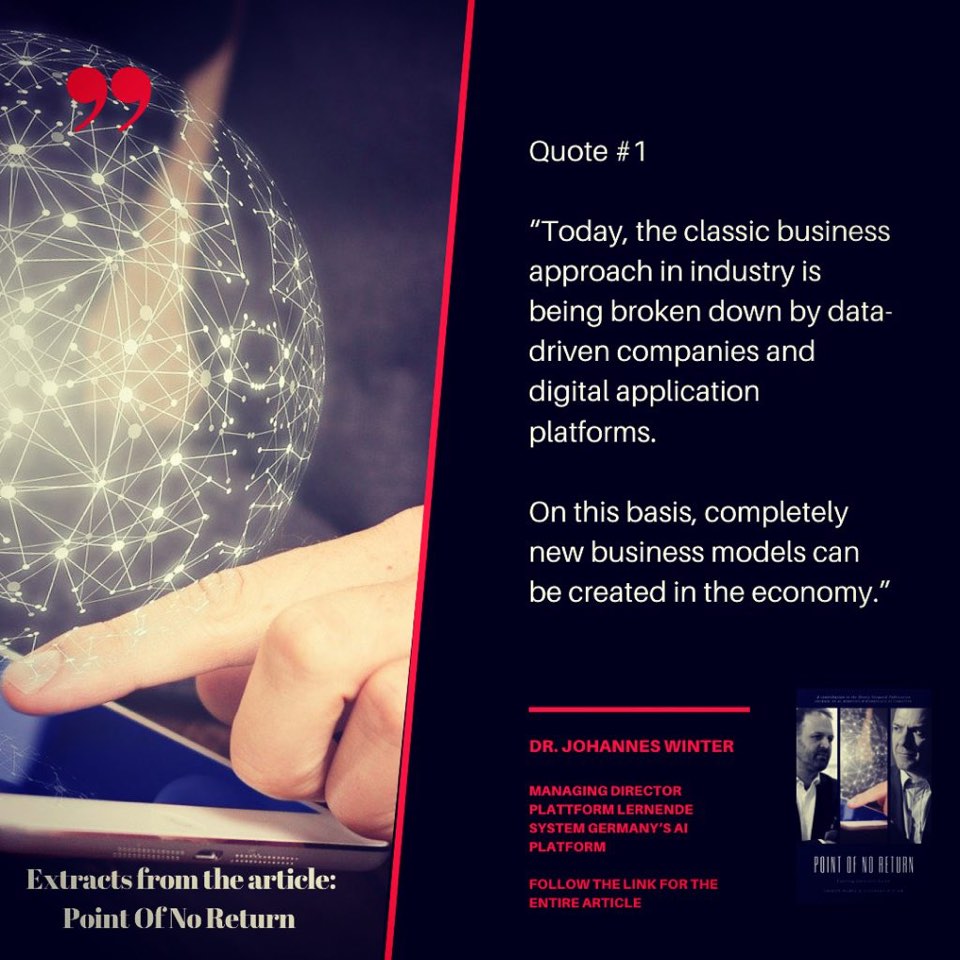
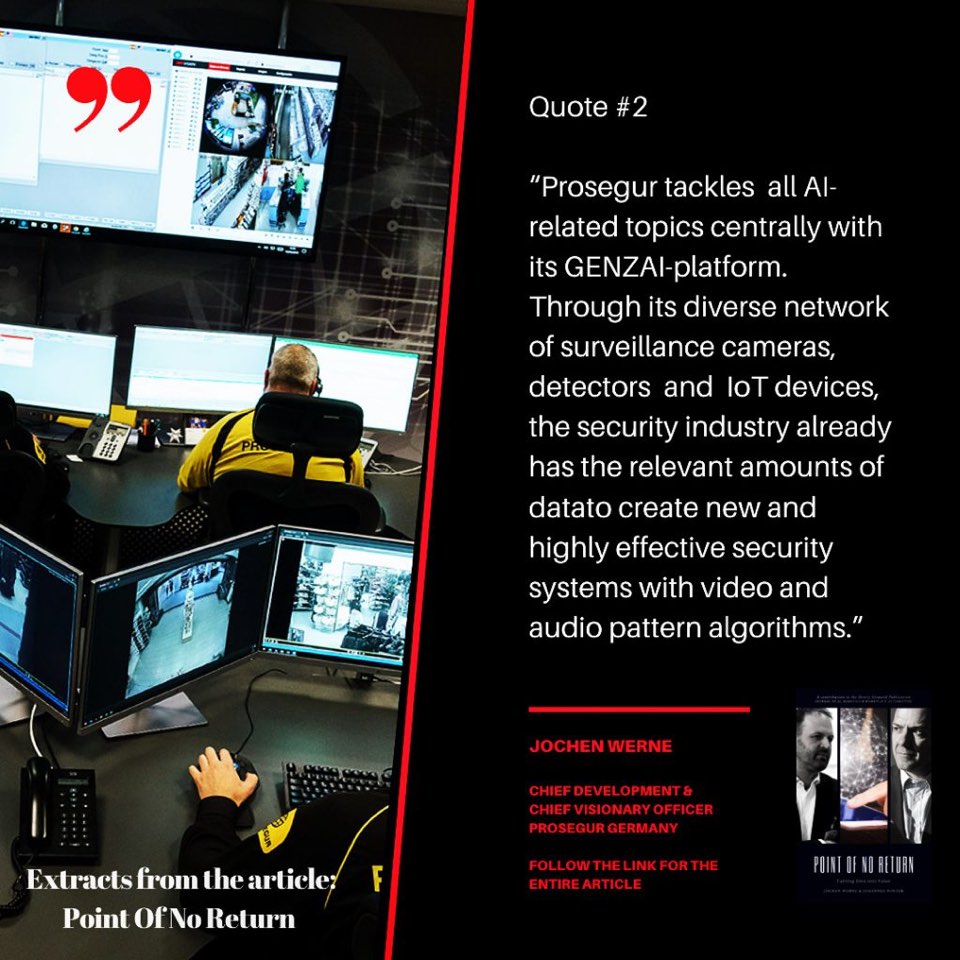

The Prosegur focus topic - current clip
Chief Development & Chief Visionary Officer Jochen Werne on the subject of sustainability
This year, the Bavarian State Medal was awarded to Jochen Werne by State Minister Thorsten Glauber for his personal commitment and services to the environment.
Prosegur congratulated him on this honourable recognition and asked him how this passion flows into his daily work at Prosegur.
You can see his statement in our latest clip
www.prosegur.com
https://www.stmuv.bayern.de/ministerium/auszeichnungen/verdienst_umwelt/detailansicht.htm?tid=21865
The crypto market has become and will remain an undeniable part of our financial system and Germany has become the frontrunner in regulating the market
Jochen Werne
The German Act Implementing the Amending Directive on the Fourth EU Anti-Money Laundering Directive (Federal Law Gazette I of 19 December 2019, p. 2602 (Gesetz zur Umsetzung der Änderungsrichtlinie zur Vierten EU-Geldwäscherichtlinie) has included crypto custody business in the German Banking Act (Kreditwesengesetz – KWG) as a new financial service. Since the Act came into force on 1 January 2020, undertakings wishing to provide this service are required to apply for an authorisation from BaFin.
One of the prerequisites receiving the authorisation is the proof the the managing directors of an institution must be qualified and reliable and devote sufficient time to the performance of their duties (section 25c (1) of the KWG). This also applies for the conduct of crypto custody business within the meaning of section 1 (1a) sentence 2 no. 6 of the KWG. A managing director’s lack of qualifications will constitute a ground for denial of authorisation (section 33 (1) no. 4 of the KWG).
Aside from the fact that lifelong learning is a MUST for leaders in our rapidly changing technology-driven environment, the crypto regulation Germany has opted for underscores an important point: "The crypto market has become and will remain an undeniable part of our financial system."
It was a pleasure participating with other executives of innovation driving companies and banks at the 1st Crypto Custody Certificate Course offered by WM Seminare.
The well balanced equilibrium between theory and practise makes the course valuable. Especially the expert speakers as Dr. Carola Rathke ( Eversheds Sutherland ), Veronika (Vicky) Ferstl (TEN31 Bank AG ), Dr. Sven Hildebrandt ( DLC Distributed Ledger Consulting GmbH ), Martin Kreitmair ( Tangany GmbH ), Dr. Tim A. Kreutzmann, LL.M. (SUN) ( BVI Bundesverband Investment und Asset Management e.V. , Jacek Trzmiel ( Coinfirm ) & Christopher Zapf ( Tangany GmbH )
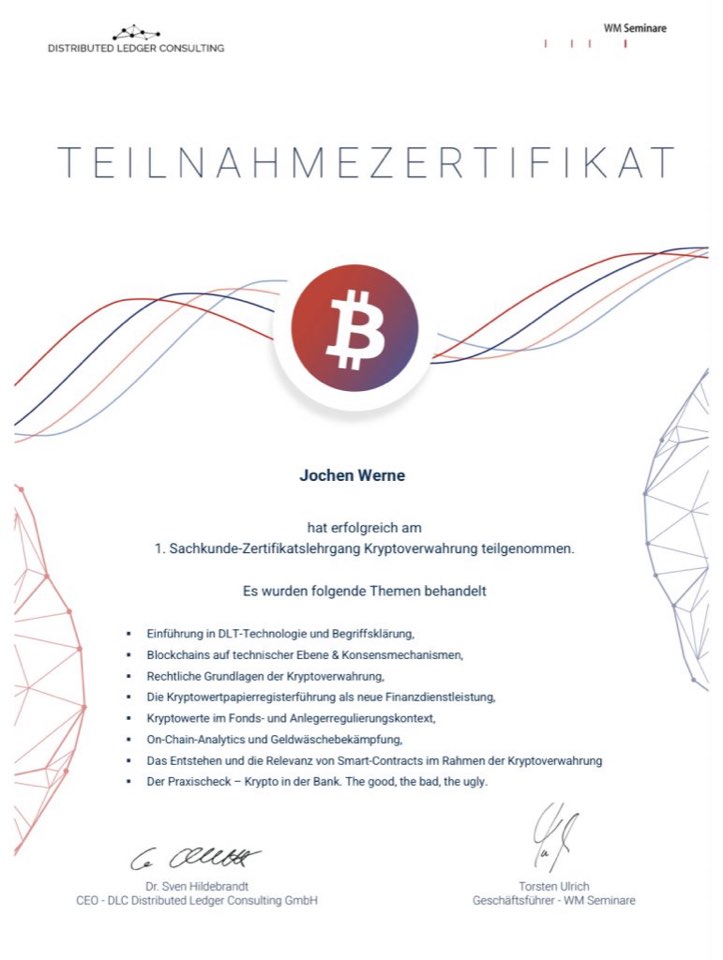
Munich, 26 October 2021
GOST co-founder JOCHEN WERNE is awarded the STATE MEDAL - the highest honor of the Free State of Bavaria - for special commitment to environmental protection and announces an extraordinary new project with the EXPEDITION BLUE OCEAN.
In the Imperial Hall of the Residence in Munich on 26 October, Minister of State Thorsten Glauber presented the Environmental Medal 2021 to selected personalities, municipalities or organisations for their special commitment to environmental or consumer protection. The honor of this highest award of the Free State of Bavaria is bestowed on a maximum of 15 people each year.
Jochen Werne, who founded the Global Offshore Sailing Team (GOST) together with Guido Zoeller in 1999, was awarded the Bavarian State Medal. For more than 20 years he has been working to raise awareness in society for ocean issues. Over 30 GOST expeditions across the world's oceans culminated in 2018 with the Expedition Antarctic Blanc in an act of state in Antarctica supported by 19 heads of state and led to extraordinary attention to the concerns of our environment and the need for close friendly international understanding.
Werne emphasizes, "This extraordinarily honorable award may bear my name, but it is for me a GOST AWARD. Without the commitment and passionate dedication of all GOST members and supporters to each mission, all that has been created would not have been possible."
GOST is already planning the next major initiative, Expedition Blue Ocean (www.ExpeditionBlueOcean.org), which is open to anyone who wants to contribute to the oceans. Expedition Blue Ocean will take the sea route from Monaco in the Mediterranean to the Arctic port of Longyearbyen. Comparable to the Olympic torch relay, the expedition flag will be passed from one ship to the next. In the process, many crews will make a small but very important contribution to achieving a major goal. This will also serve symbolically to involve important actors in the field of marine protection and international maritime shipping in a dialogue.
Expedition Blue Ocean will serve as a platform for all crews and supporters in ports to promote the beauty of our oceans through events, fundraisers, international media coverage, etc. This will be done by raising civil society awareness of the importance and fragility of our planet's marine ecosystem in light of the United Nations Sustainable Development Goals. Viewers around the world will be able to follow the prestigious yachts, their crews and the events on the internet and social media, or get involved themselves as ambassadors of the expedition with their own contribution. The expedition management can be contacted at info@expeditionblueocean.org.
Please find the Press Release in English below
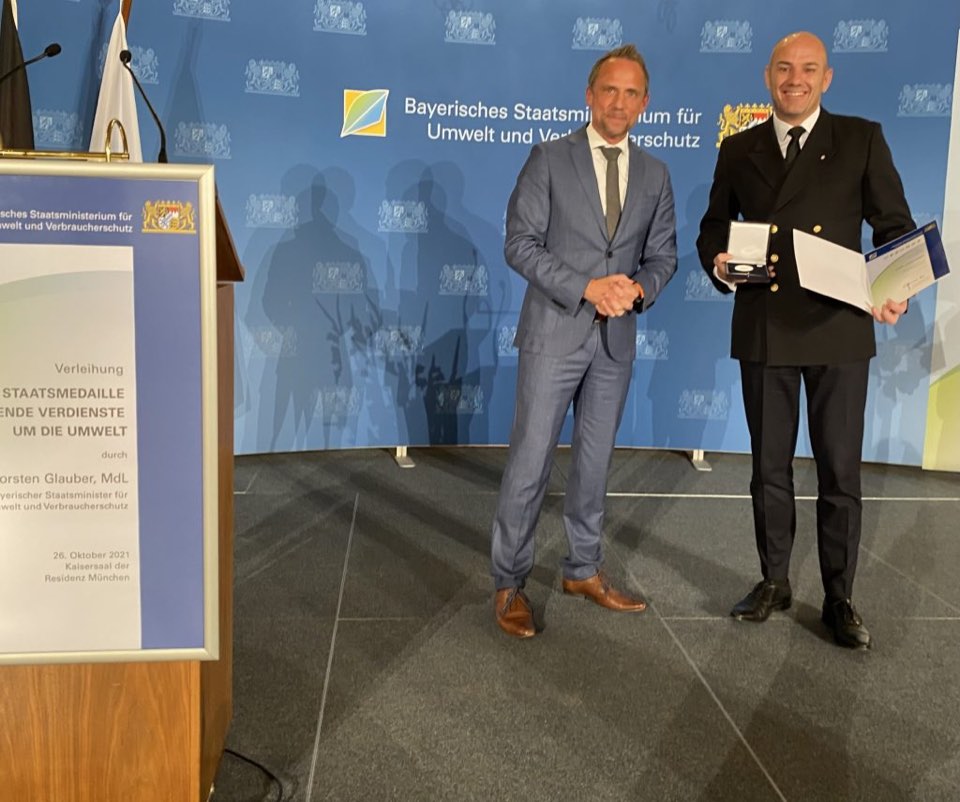
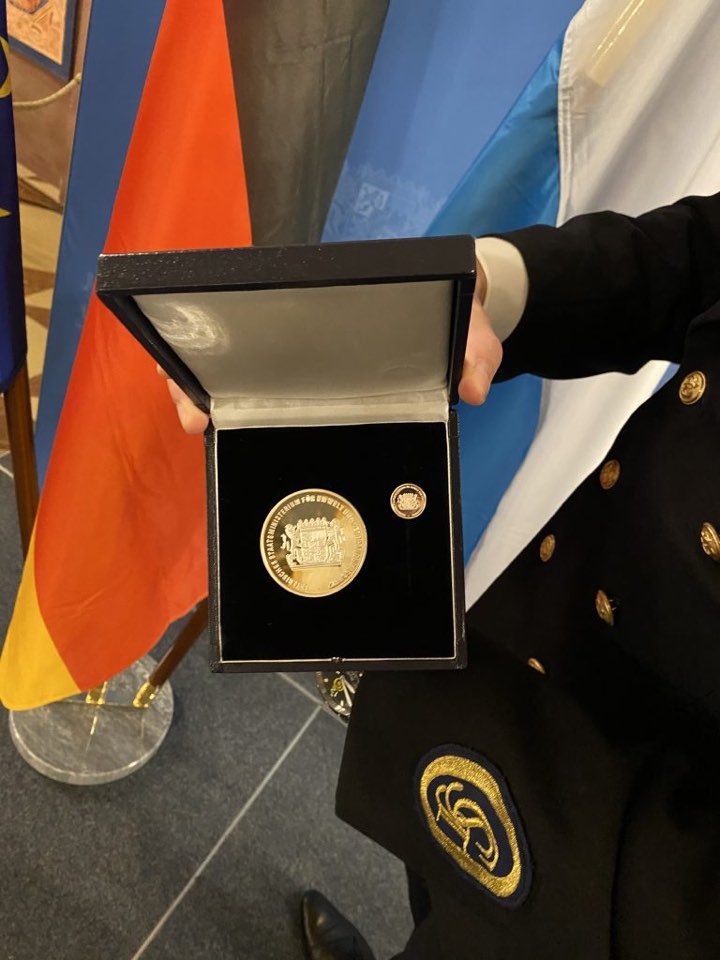
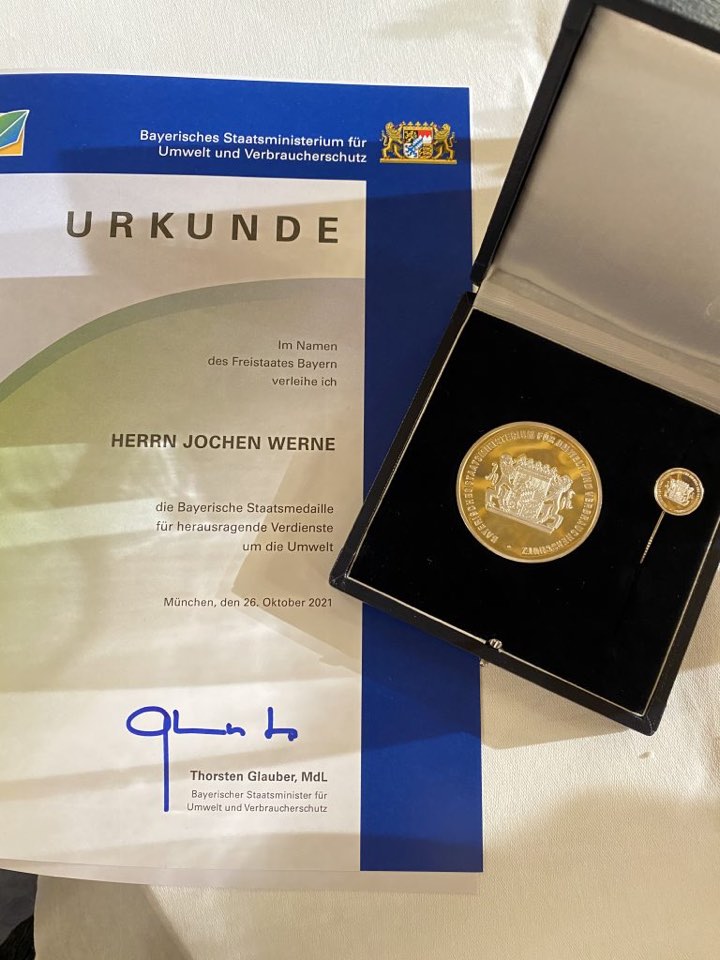
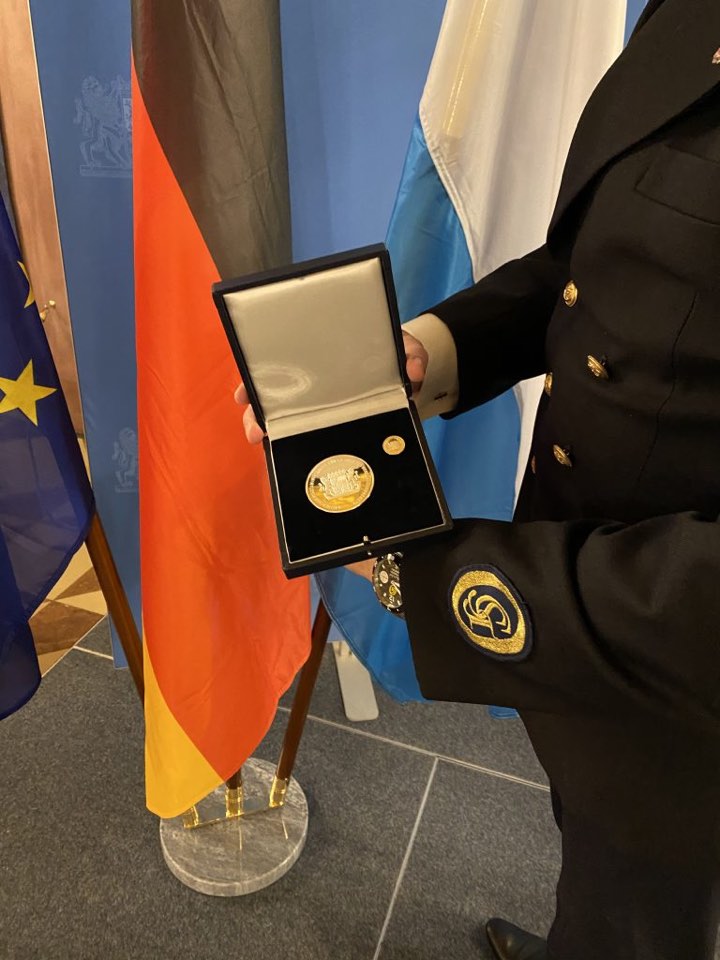
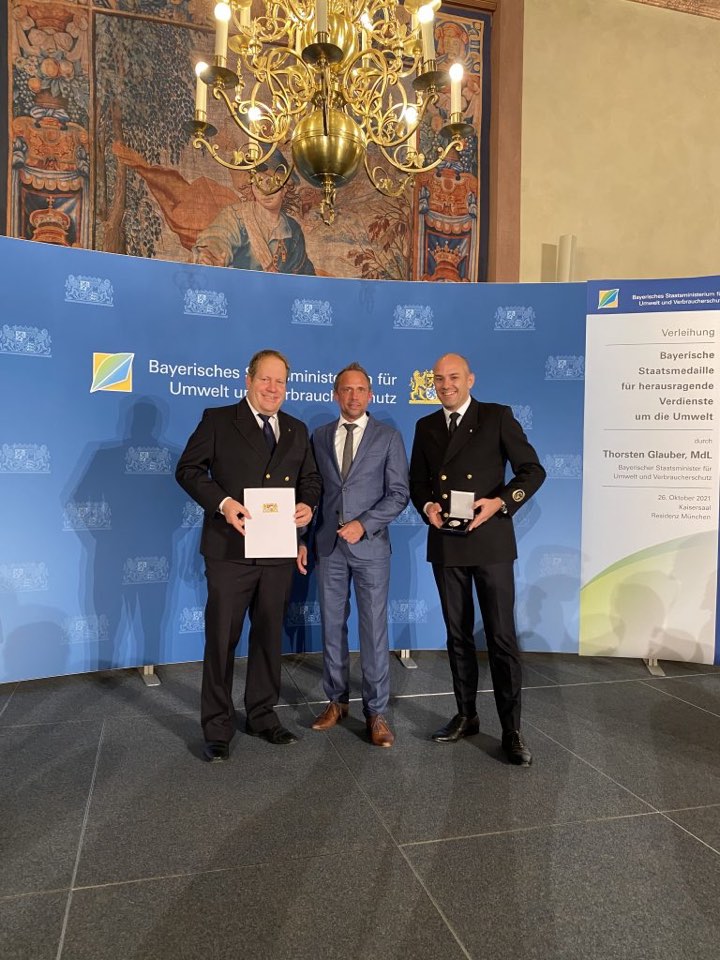
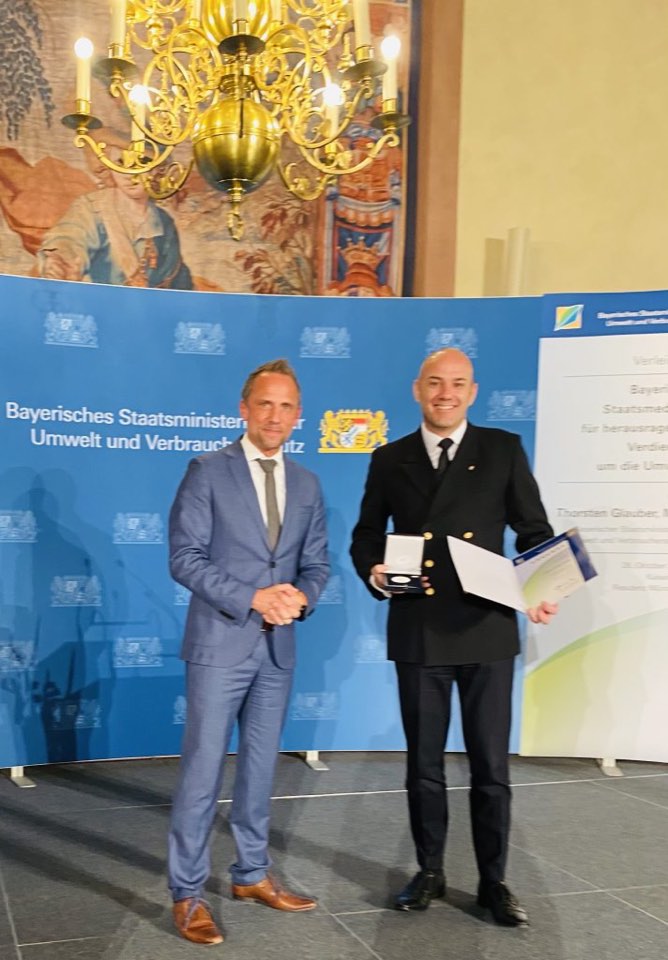
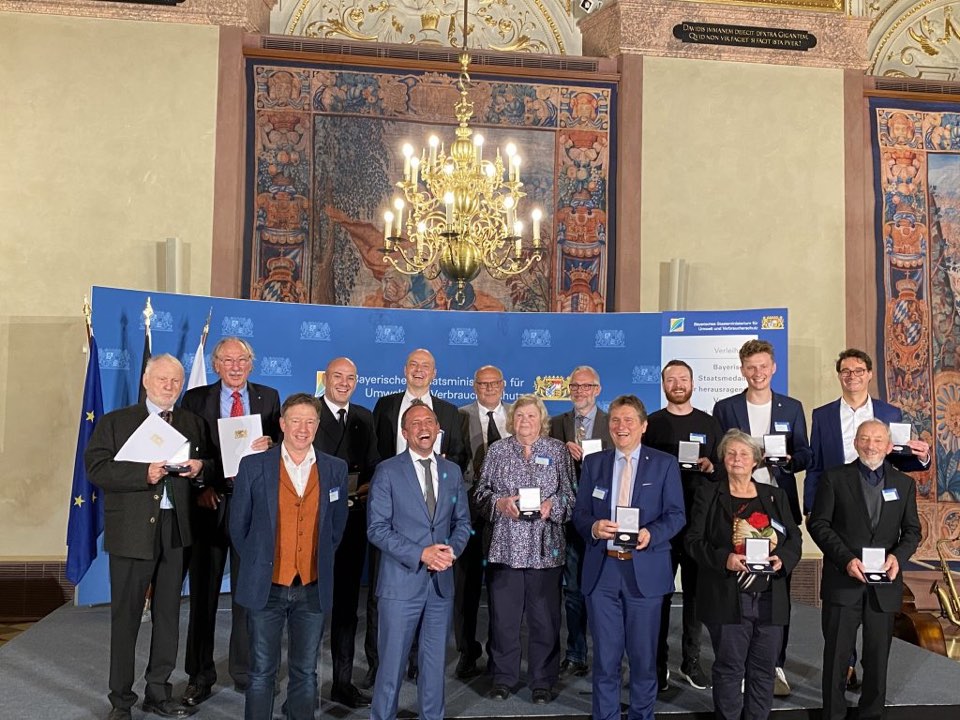
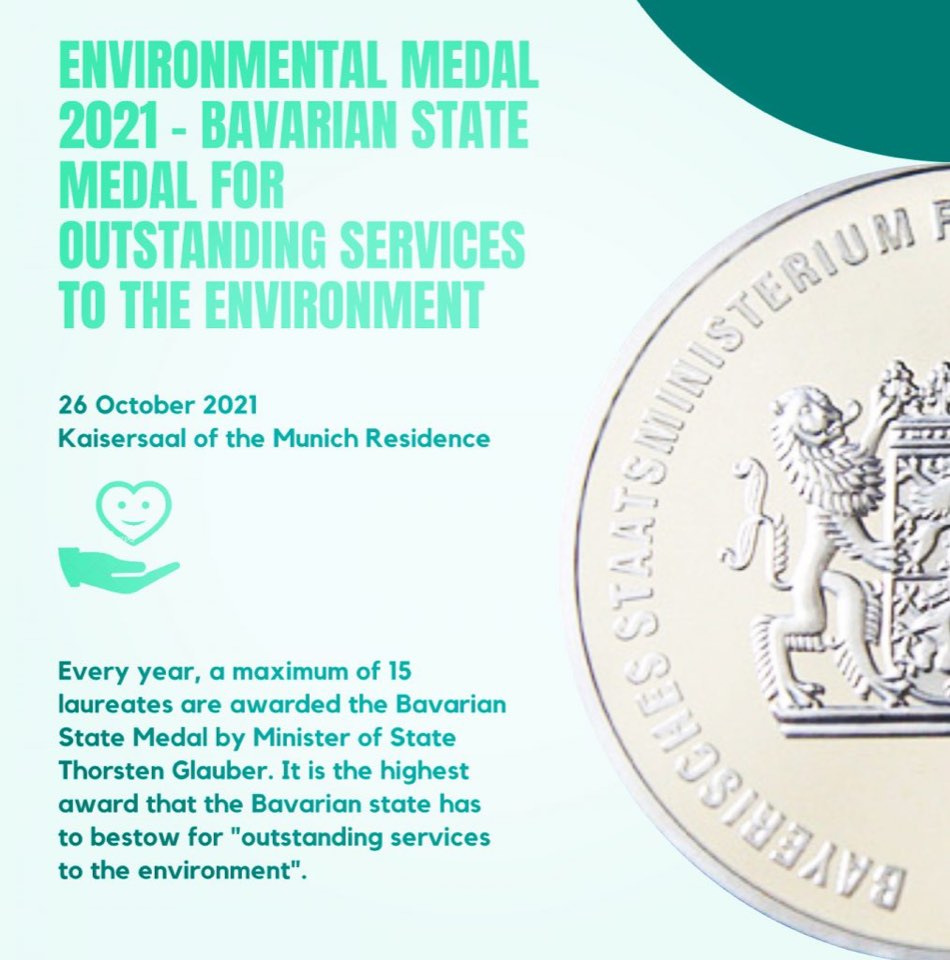
Announcement from the Bavarian State Ministry for the Environment and Consumer Protection
BAVARIAN MINISTER OF THE ENVIRONMENT THORSTEN GLAUBER PRESENTS ENVIRONMENTAL MEDAL FOR OUTSTANDING SERVICES TO NATURE, ENVIRONMENTAL AND CLIMATE PROTECTION
26 October 2021 - 6 pm
Kaisersaal of the Munich Residence
The Bavarian State Medal for Outstanding Services to the Environment is the highest award the Free State has to bestow in this field.
https://www.stmuv.bayern.de/aktuell/presse/pressemitteilung.htm?PMNr=178/21
INAUGURAL EDITION
of the
JOURNAL OF AI, ROBOTICS and WORKPLACE AUTOMATION
It was indeed a great pleasure contributing in co-authorship Dr. Johannes Winter & Jochen Werne to the Henry Stewart Publications and we are pleased to present the article:
POINT OF NO RETURN:
TURNING DATA INTO VALUE
The Cambridge Dictionary defines the point of no return as the stage at which it is no longer possible to stop what you are doing, and when its effects cannot now be avoided or prevented. Exponential advances in technology have led to a global race for dominance in politically, militarily and economically strategic technologies such as 5G, artificial intelligence (AI) and digital platforms. A reversal of this status quo is hardly conceivable. Based on this assumption, this paper looks to the future, adding the lessons of recent years — the years when the point of no return was passed. In addition, the paper uses practical examples from different industries to show how digital transformation can be successfully undergone and provides six key questions that every company should ask itself in the digital age.
The article includes key learnings and/or best practise examples from e.g.
acatech – Deutsche Akademie der Technikwissenschaften
Plattform Lernende Systeme - Germany's AI Platform
Prosegur
Tesla
Waymo
Google
Amazon
relayr
Ada Health
Fiege Logistik
Westphalia DataLab
Satya Nadella
Microsoft
TikTok
Facebook
INNOVATION DAY ON ARTIFICIAL INTELLIGENCE
It is a pleasure to give a guest lecture at today's Accenture internal Innovation Day. Accenture was an exceptional starting point for me in my career as young professional and I am very pleased to have been invited. Many thanks Wolfram Wendebourg.
The talk will include historically fascinating facts on technological change inspired by the famous historian and Senier Fellow at The Hoover Institution, Stanford University Institution, Stanford University Niall Ferguson and an outlook, specifically in the German and European context on AI business model innovations based on the analysis of the Plattform Lernende Systeme - Germany's AI Platform
Find out more at:
www.Accenture.com
www.Prosegur.com
www.plattform-lernende-systeme.de
www.JochenWerne.com
A historical-social innovation briefing for a world where military high-security standards meet digital crypto-assets
by Jochen Werne
Chief Development & Chief Visionary Officer PROSEGUR Germany
SAVE THE DATE

The aim of this contribution to the debate is to combine historical insights into the meaning of money with the latest technological developments in the digital age, to compare visions with realities and to develop options for action for shaping the digital transformation of money.
The 10 most successful bank robberies in human history, in which the equivalent of US$1.62 billion was taken at sometimes massive expense, seem like the work of amateurs compared to the US$3.78 billion taken by cybercriminals in 2020 alone. In a world where tech companies are spearheading campaigns to create a new cryptocurrency and bitcoin is surpassing the US$50,000 mark because a visionary electric car maker wants to recognise the cryptocurrency as a means of payment, some fundamental questions arise: How must money be defined in a digital world to reliably fulfil the characteristics of a universally recognised store of value and medium of exchange? And what changes will result if so-called stablecoins challenge the banks' classic deposit business and their traditional business models?
SAVE THE DATE: 29 September 2021 - 11.30 a.m. Berlin Time
It‘s a great pleasure giving a keynote at the VÖB-Service GmbH #VSK2021 Conference and to discuss with financial industry experts fundamental questions about the FUTURE OF MONEY
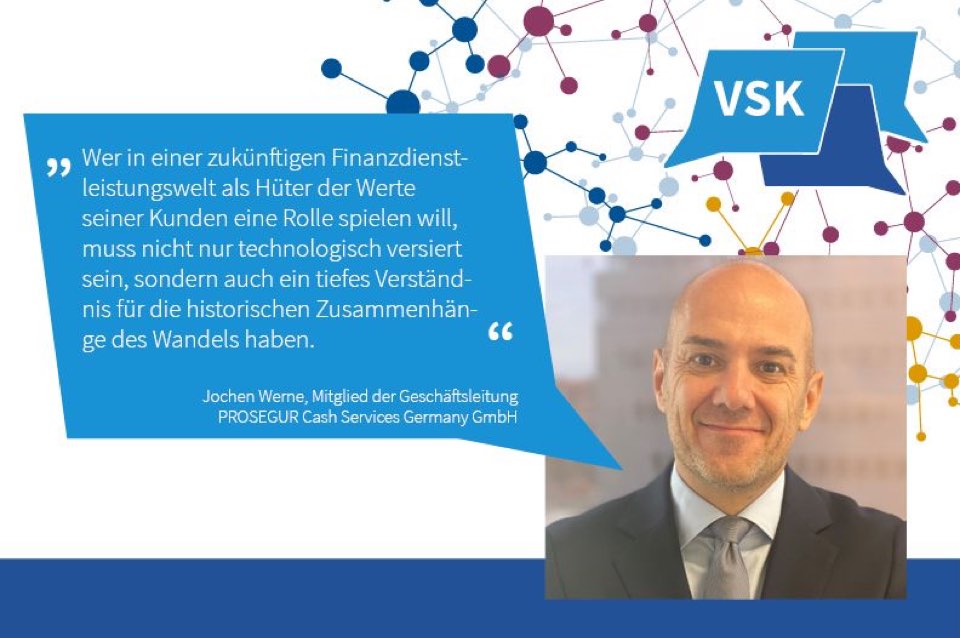
The ten most successful bank robberies in human history, in which the equivalent of US$1.62 billion was captured at great expense, seem almost like the work of amateurs compared to the US$3.78 billion captured by cybercriminals in 2020 alone.
In a world where tech companies are spearheading campaigns to create a new #cryptocurrency, where bitcoin is surpassing the US$50,000 mark because a visionary electric car maker wants to recognise cryptocurrency as a means of payment, Jochen Werne, Member of the Executive Board Prosegur Germany, asks some fundamental questions. "How must money be defined in a digital world in order to fulfil the characteristics of a generally recognised and reliable store of value and medium of exchange?" Or also: "What changes are coming to the financial industry when #Stablecoins spread and challenge the classic deposit business of banks?"
In our stream Digitalisation at #VSK2021, Jochen Werne presents possible answers to these and other questions.
Be there and register today for the #Kreditwirtschaft congress on Wednesday, 29 September! ? https://lnkd.in/gMe2g59
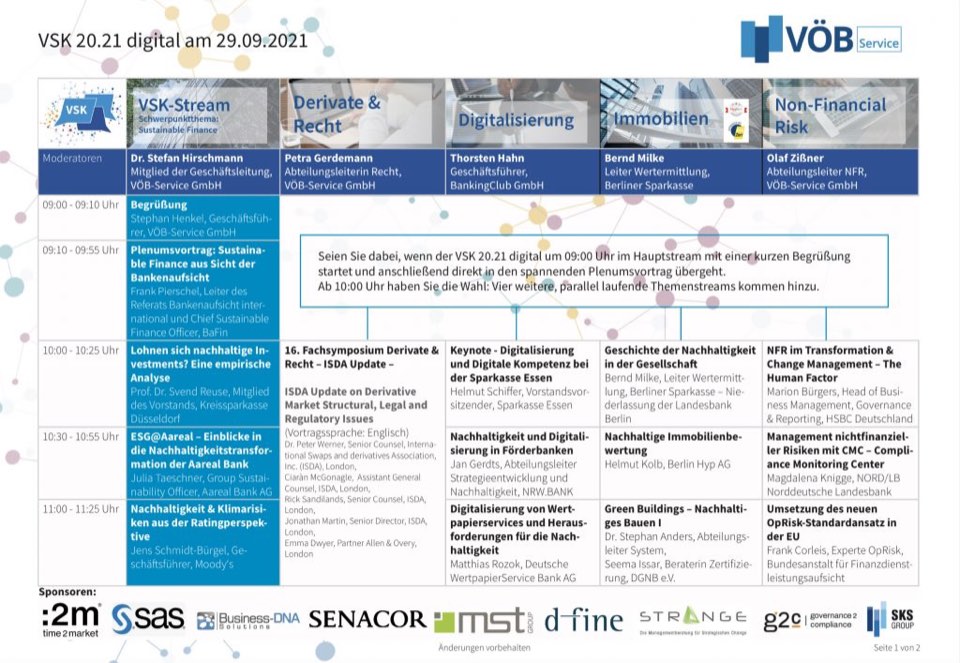
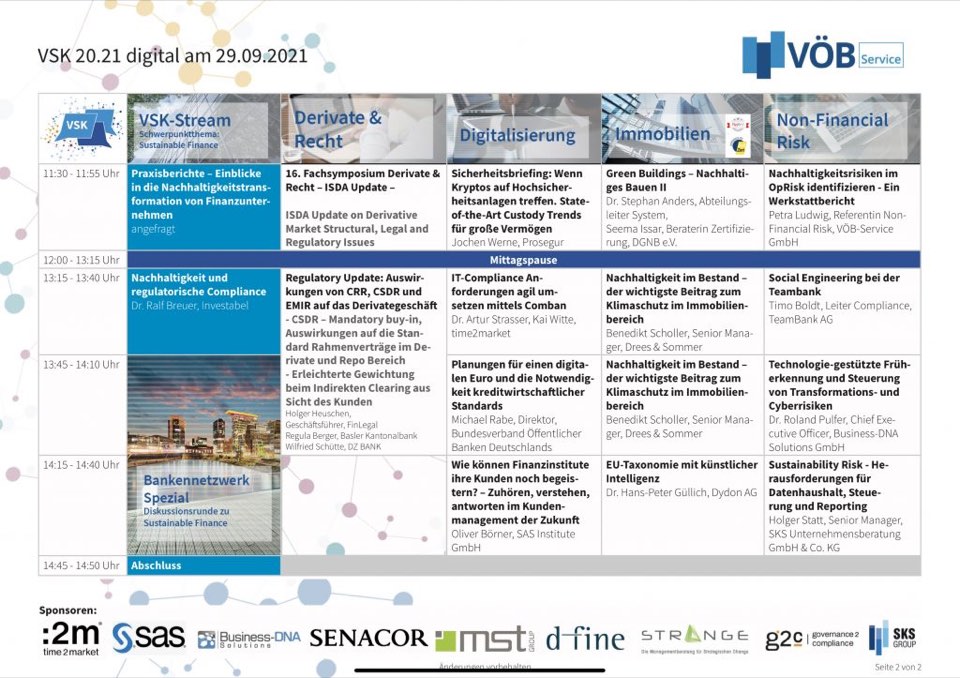
July 6,2021
Original published in German in “TRUCKERS WORLD powered by MAN“ - translation by Deepl.com
CLEAN and SAFE.
Cash transport with the MAN eTGE
The world's first armoured electric money transporter is now in use at the security service provider Prosegur. Since the armouring was realised in lightweight construction, the electrically powered MAN eTGE has enough payload and range for city traffic. On tour with the environmentally friendly cash messengers in Potsdam.
For safety reasons, Prosegur's cash messengers always travel in pairs or sometimes even in threes - a well-rehearsed team. Today Uwe E. is driving the yellow money carrier through Potsdam. His colleague Andreas H. watches the surroundings from the passenger seat. He mainly looks for hedges, backyards and other possible hiding places. Because "the others" could be lurking there in ambush. That's what H. calls criminals who are after money and valuables transported in the vehicle, doubly protected by the armoured outer skin and the armoured inner cabin. The course of each tour, each of which covers several banks, ATMs or shops, is planned in detail to minimise the risk of robbery. At Prosegur's Potsdam branch, a security guard watches on a monitor as the GPS signal of the MAN eTGE moves through the city and keeps in touch with the two cash messengers by radio. Driver and co-driver are highly concentrated while the electrically driven van glides almost silently through the streets. "This silence while driving is great," says money messenger Andreas H. with satisfaction. "Without noise, I can focus even better and am less exhausted at the end of the working day."
However, the advantage of the noiseless drive is not the main reason why Prosegur uses the world's first armoured electric money carrier. The company wants to prove to itself and the entire security industry that electric mobility is not only suitable for normal delivery traffic, but also for the special requirements of cash-in-transit. Despite the additional weight of the armour, which reduces the payload of the vehicle and the already limited range of the electric battery.
Lightweight construction for armouring
Since Prosegur has already had good experience with the conventional MAN TGE panel vans in its fleet, its battery-electric variant, a MAN TGE 3.140 E, was chosen as the test vehicle. The STOOF company provided it with armouring and dispensed with steel in order to save weight. Instead, aramid was used, a lightweight high-performance fabric that is also used by the military for armoured vehicles and protective clothing. In this way, it was possible to realise the cash transporter with a tare weight of 3,150 kilograms, including the armour. "Its battery charge allows for about 120 to 130 kilometres of range. That is absolutely sufficient for our tours in the urban area" tells Alexander Lange, who manages Prosegur's fleet. "Our electric money transporter travels 70 to 90 kilometres per day. There is still enough range left over as a safety reserve."
Prosegur has been using the MAN eTGE since September 2020. It has since been integrated into normal operations. The test phase has been successfully completed. The proof is in: environmentally friendly transport of valuables without local emissions is feasible. The electric version has proven itself very well. "As a company with a large fleet of vehicles, we want to make an important contribution to climate protection, so there is no way around electric cash-in-transit vehicles," announces Jochen Werne. The Chief Development Officer of Prosegur in Germany estimates: "A large part of our tours - especially in urban areas - can be realised with battery-electric vehicles." For supra-regional shuttle transports, according to the current state of the art, another drive solution with a higher range is still required.
At Prosegur, the changeover to electric mobility will take place in carefully coordinated steps. Jochen Werne emphasises that in addition to the purchase costs of the vehicles - the fleet comprises 900 cash-in-transit vehicles and 300 service vehicles - additional costs must be calculated for setting up the charging infrastructure. Until now, the MAN eTGE has been charged overnight at a simple 230-volt socket. After around eight hours, the battery is full again. "In order to fully exploit the advantages of electric mobility, high-performance charging stations are of course indispensable," Werne explains. Despite the necessary investments, the head of development at Prosegur also sees a great economic opportunity in electromobility: "In a long-term total cost consideration, this technology can even save money."
A sign for climate protection
In Potsdam, Prosegur is setting a clearly visible example for climate protection with the MAN eTGE.
In contrast, the money messengers Uwe E. and Andreas H. want to attract as little attention as possible to their risky job. For each customer, they park as close as possible to the entrance. Uwe E. quickly slips into the shelter of the building and soon after back into the vehicle. For the short distance, he carries the valuable cargo in a special transport security device. After completing their rounds, the money messengers drive their "e-tank" through a security gate back to Prosegur's premises. Safe and clean.
Reflections by Jochen Werne, Chief Development & Chief Visionary Officer Prosegur Germany (published in Prosegur Express 02/2021)
In all debates on analogue and digital means of payment, "trust" is always at the centre of the discussion: trust in the state-social order, which stands as a guarantor for stability and security of the fiat money issued. In this respect, some would almost like to marvel at how Bitcoin & Co. have managed to gain such trust in such a short time that a market capitalisation in the billions has been achieved. One of the points is certainly the technological confidence in the non-manipulability of the blockchain.
But is the blockchain really not manipulable, or is it rather a question of time before an attack will succeed? And what conclusions are central banks around the world drawing from this as they look at creating central bank digital currencies? Currencies designed to bridge the gap between the stability of analogue central bank money and the demands of our digital age.
Perhaps the solution for a trustworthy and generally accepted today and now lies in a hybrid model: in a cryptocurrency, in form of a stablecoin, that is 100 per cent backed by physical central bank money. This means that every digital token has a unique physical counterpart (euro). Due to the tradability of the tokens, the flexibility of book money is paired with the guarantee of physical central bank money. Last but not least, a regulated trustee function guarantees that the existing and securely stored central bank money is always paired with its digital twin. Thus. the best of both worlds is firmly united.
It has been a great pleasure being the clean-up batter for moderator Michael Dowling (University Regensburg) in the Webtalk hosted by Dr. Johannes Winter and the prestigious National Academy of Science and Engineering (acatech). The esteemed experts Olga Mordvinova, CEO of incontext.technology; Franz Gruber, founder of Forcam, Kai-Uwe Weiß, Manager at Leser and Wolfgang Faisst, founder of value.works.ai discussed about how digital transformation and artificial intelligence helps SME‘s to find a positive way out of the crisis, about GAIA-X, digital twins and best-practice experiences. It was an honour rounding-up the event together with Prof. Dowling.
Follow the Clean-up Batter comments in this summary
Details from the webtalk in German HERE . Translation below made with DeepL.com
Munich, March 9, 2021
Digital technologies have proven their worth, especially in the Corona pandemic: Thanks to them, companies were and are more adaptable during the crisis and can respond more quickly to customer requirements. But what role do digital technologies now play in finding a way out of the crisis? And what framework conditions need to be created so that SMEs in particular give up their reluctance to digitize? Experts from business and research discussed this at an acatech Webtalk on March 5.
Many globally operating, medium-sized companies in Germany had a problem during the Corona pandemic: Since business trips were not possible, customers could not take delivery of an ordered product on site at the plant. However, digital technologies provided a remedy: the safety valve manufacturer Leser GmbH, for example, as Leser manager Kai-Uwe Weiß reported in his presentation, offers customers the service of a "remote inspection", in which customers are guided through the plant via a virtual reality application and can thus carry out the acceptance.
Earlier, Wolfgang Faisst, a member of the Learning Systems Platform and founder of value.works.ai, had already recommended a "Digital Business Framework" to medium-sized companies in his introductory impulse in order to emerge better from the Corona crisis. For this, technological and organizational requirements would have to be optimally harmonized with digital ambitions (e.g. reconfiguration of business processes or digital refinement of products). Wolfgang Faisst referred to the offerings of the Learning Systems Platform, which provides target images, implementation examples and roadmaps for AI introduction and application.
The panel discussion following the presentations, moderated by acatech member Michael Dowling (University of Regensburg), emphasized that the success of Industrie 4.0 must be measured in terms of entrepreneurial results and the customer benefits generated. Olga Mordvinova, member of the Learning Systems Platform and CEO of incontext.technology GmbH, emphasized that Germany has an excellent position both on the technology provider side and in the area of domain knowledge. However, in order for the potential of digitization to be better exploited - especially in SMEs - a secure and sovereign digital infrastructure is needed in Germany and Europe, said Franz Gruber, founder and advisory board member of Forcam GmbH. Only then would companies abandon their reluctance, which is due in part to their dependence on large platform companies. Jochen Werne, member of the Learning Systems Platform and board member of Prosegur Germany, agreed: Fundamental for the near future and the time after Corona is a clear European vision and implementation strategy for digital transformation.
Find the full acatech webtalk here
It is with great pride that we hold the Gold Stevie Award 2021 in our hands. The award is representative of so many at Prosegur who work every day to make the company once again a pioneer in the industry when it comes to e-mobility and sustainability.

The organizers of the Stevie® Awards 2021 have announced their winners: In the category for special achievements in the field of product innovation, Prosegur Germany has been awarded as GOLD STEVIE® WINNER. With the world's first fully electric armored MAN eTGE cash-in-transit vehicle, the international jury of experts was convinced. This makes Prosegur Germany one of the winners - alongside other award-winning companies such as Deutsche Post DHL Group, Deutsche Telekom Services Europe SE or Vodafone GmbH.
Read more HERE
It was a great day to experience live with MAN and my Prosegur colleagues how the world's first all-electric CIT van performs. Many thanks to MAN for producing an excellent report on this great achievement, which takes our company another step closer to achieving the climate targets we set ourselves by signing the Climate Pledge.

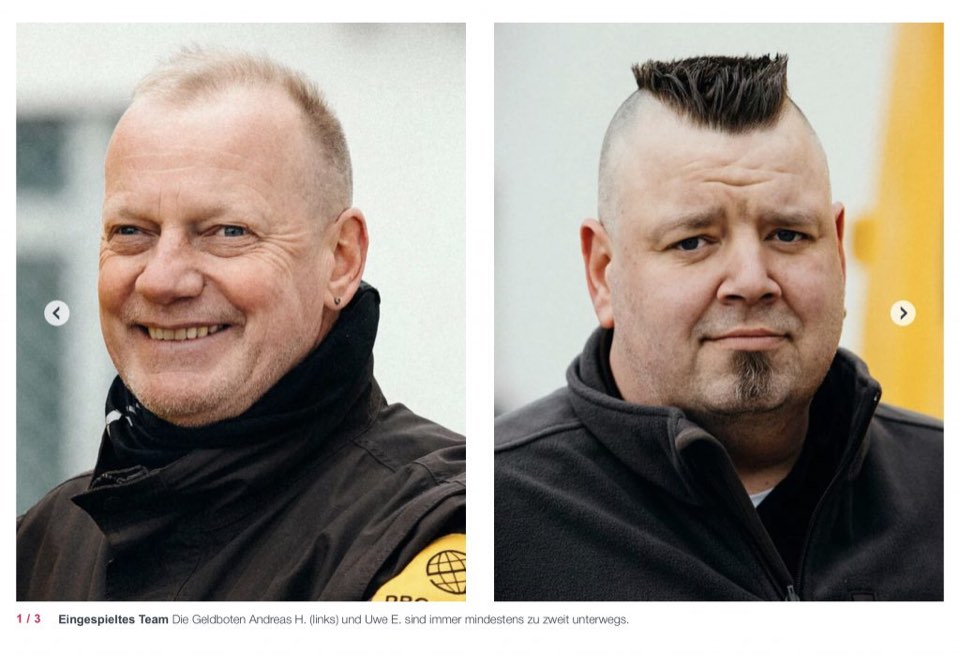
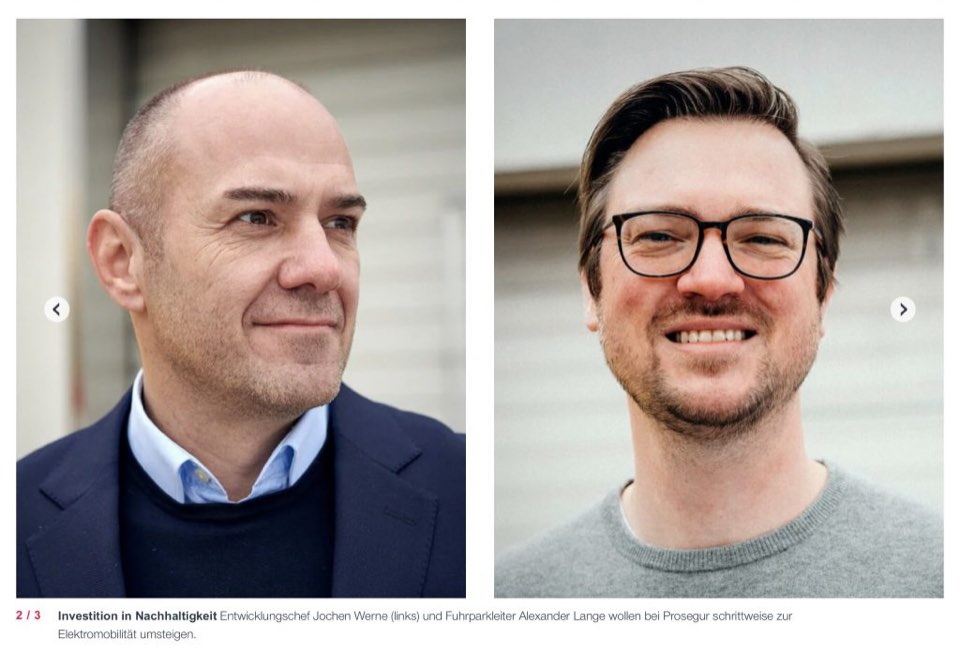
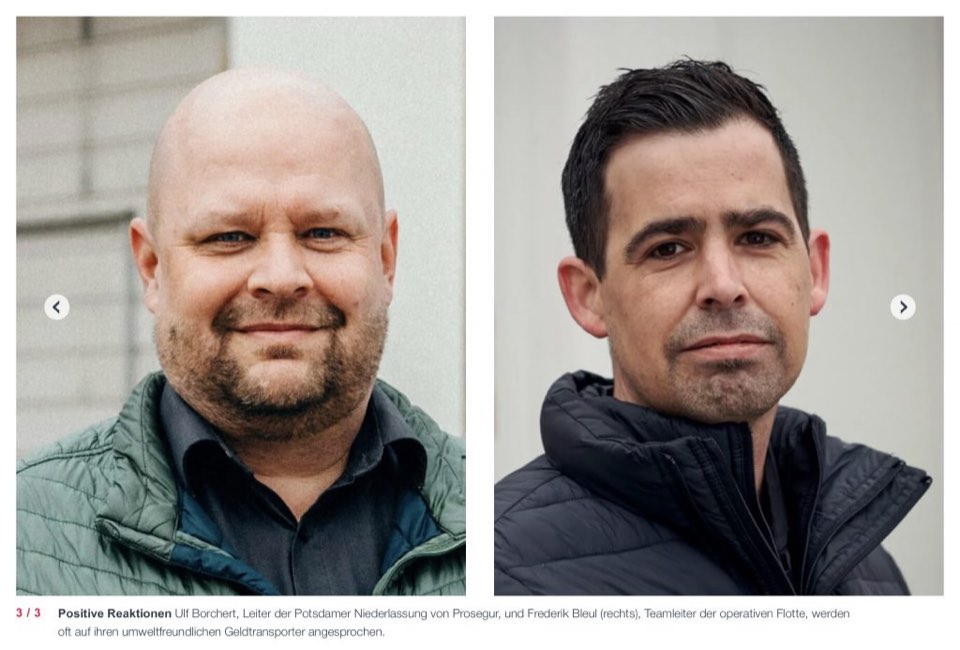
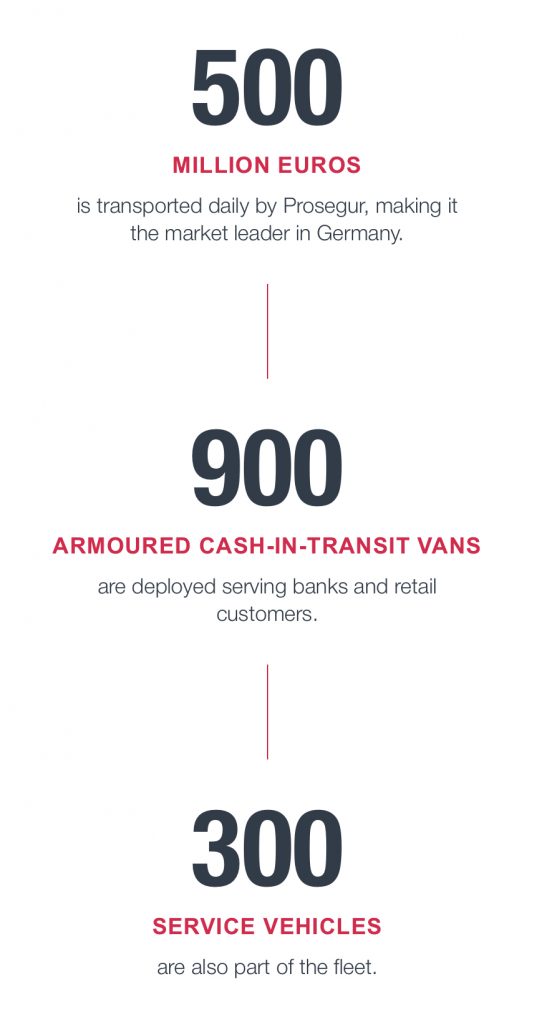
It’s a great pleasure giving beside other experts a keynote speech at this year’s Project Networks Strategy Summit 2021 Marketing & E-Commerce.
SAVE THE DATE: 18 May 2021 - 15:50 - 16:25
About the Keynote held by Jochen Werne
Platform Money: From Cash to Cryptocurrencies? Trust and security as parameters for the success of money in a digital world
It's all about the money
Cash and digitalisation - how do they fit together?
Rethinking Cash: can cash go digital?
Too big to digitize? On the way to a digital euro
"Everything that can be digitised will be digitised," said former Hewlett Packard boss Carly Fiorina in 2009. The trend towards digital transformation has received another enormous boost against the backdrop of the Corona pandemic. Does this also apply to something as physical as cash?
Jochen Werne, Chief Development Officer of Prosegur Germany, presents the current initiatives for a digital euro, explains the differences to other electronic means of payment, uses Facebook's cryptocurrency "Libra" to shed light on the cornerstones of a good and bad communication strategy and gives an outlook on what the digitalisation of cash means for the business model of Germany's market leader for cash-in-transit and cash management.
About the Strategy Summit
2020 has brought a huge surge in digitization as a result of the pandemic and has permanently changed the framework conditions for B2B marketing and digital business. This has once again accelerated the strong market dynamics, which are manifested, for example, in changed buyer behavior and in market-dominating platforms and ecosystems. At the same time, many companies in B2B have been able to benefit from strong demand even in times of Corona, eCommerce has brought revenue growth in numerous companies. Well-established processes and efficient digital sales channels are the prerequisites for this success.
What lessons can be learned from this for marketing and digital business in 2021?
28 February 2021
published in the current issue of the magazine gi Geldinstitute
For the trade magazine gi Geldinstitute, leading experts answered Stefanie Walter's questions on the topic of "Process Mining at Banks". Jochen Werne - Prosegur Germany, Gerrit von der Hardt - TARGO Dienstleistungs, Sebastian Hennerici - Aareal Bank AG, Gerrit Meier - Hanseatic Bank GmbH & Co KG, Thorsten Briest - PSD Bank Braunschweig eG, Christian Meusel - Berliner Volksbank eG, André H. Burger - Synpulse Management Consulting
Professional know-how and the right feeling for changing customer needs are essential factors in being able to innovatively develop needs-based solutions for our customers.
The entire roundtable talk in the current print edition or soon online at www.Geldinstitute.de
gi-Geldinstitute published „For the good of all - Why standards are so important“, A plea for future-oriented minimum standards in the CIT industry, underlining Prosegur‘s frontrunner role as resilient infrastructure provider in the security and cash management industry.

Find Original in German HERE. Translation generated with deepL.com
A plea for future-oriented minimum standards in the CIT industry. The neighbouring banking industry (and often the customers of CIT companies) is already protected by standards such as MaRisk and BAIT. However, cash-in-transit companies that work closely with their customers (banks) have less high standards in IT, whereby the industry is becoming increasingly digitalised. Prosegur argues for higher standards across the CIT industry.
Emeritus professor of literature Hans-Dieter Gelfert, who has spent many years researching German, British and American mentalities, expressed in an interview with Deutsche Welle that the orderly society of modern Germany has a long genesis. "Order is one of the sacred words in Germany, and that has something to do with the German emphasis on security as opposed to freedom," he said. "For the last thousand years, security has always been the supreme value and order is a mainstay of security." Part of Germany's success is built on norms. It is not without reason that the encyclopaedia "Brands of the Century" lists more than 200 German brands such as Hipp or Tempo as examples of entire product categories. The entire title is: "German Standards - Brands of the Century". Aha, standards then - a coincidence?
Without rules, norms or minimum standards, a modern society would be almost inconceivable. They structure, make things comparable and act as a control mechanism. Cultural imprints and regional differences come into play in their design. For example, many an EU citizen groans about the General Data Protection Regulation when a form has to be filled out for consent to the use of personal data. On the other side of the Atlantic, people certainly pay respect to the GDPR for the standards it sets. Standards that reflect the values of an enlightened Europe.
Beyond social norms and local legislation, there are other rules in the business world. There is hardly an industry that has not already given itself a catalogue of minimum standards. This is an advantage for many, because the complexity on the supply side is often reduced for those asking. But the question must be allowed whether minimum standards are sufficient and whether they all focus on the well-being of customers and society. Too often the focus is on the providers. Yet there are standards that need to be established today in order to prepare for future challenges.
Prosegur is committed to more than minimum standards to position the entire industry for the future and to ensure society's trust in this system-critical industry. An industry that does nothing less than ensure the unrestricted supply of central bank money to the population and the safe return of several million euros of cash income daily to the accounts of businesses to ensure their liquidity.
A look at the customer environment reveals that the related banking industry is leading the way: with MaRisk (Minimum Requirements for Risk Management) or BAIT (Bank Supervisory Requirements for IT), credit institutions have positioned themselves for the future. Since banks usually cooperate with a cash-in-transit company, it is only logical for Prosegur to apply these already existing requirements in an identical manner to its own business operations today and consequently to demand rapid implementation from all providers of cash and valuables transport.
All players operating in such an important part of our economic life must keep their eyes on the future and never cling to the status quo. Today, topics such as digitalisation and environmental protection naturally belong in the programmes of sustainably oriented companies. Every organisation needs courage, creativity and a willingness to invest in finding a digital language for analogue solutions. This fact is of particular importance in the Corona pandemic, because it acts as an accelerator for the global digital transformation.
Politicians underlined that they have recognised this on 9 December 2020 with the BMI's draft bill for a second law to increase the security of information technology systems. But even before the draft becomes law, the following applies to Prosegur: the further development of current standards, investment in sustainable technologies and personnel as well as in the certification of processes and models must absolutely be in the interest of every serious money and value service provider already today.
It is essential to arm oneself against all kinds of threat scenarios - known and new, present and future - and to become resilient against external shocks. To be resilient so that, as a critical infrastructure, citizens can access money even in crises or exceptional situations. And to offer support to other critical infrastructures to also become resilient in order to avert supply bottlenecks for the population in cooperation. Prosegur consistently pursues this maxim, among other things with the smart cash procedure, in which cash receipts, for example in the supermarket or pharmacy, are deposited in a smart safe, where they can be credited to the business account via Early Value. Independent of the physical collection of the money, the company can use it to do business. A lack of liquidity does not become a showstopper for supermarkets and pharmacies in times of crisis. They remain open and the supply of goods and medicines is maintained. In the impulse paper "Resilient pioneers from business and society" of the German Academy of Science and Engineering (acatech), Prosegur Smart Cash was presented in December 2020 as a resilient concept for success.
Standards create resilience. So what standards should the cash and cash-in-transit industry additionally orient itself to? In Prosegur's opinion, the standards of the credit institutions with which the cash and valuables transport industry cooperates on a daily basis. Not only in terms of their own resilience, but also in order to be a true partner for customers with their very own challenges in the low and negative interest rate environment, in the digital transformation and in the climate crisis. Then the players in this industry not only transport, process and store values, they also embody them and prepare to take on even greater responsibility in the "cash cycle" value chain.
HOT OFF THE TAPE: Business Transformation in the Digital Age - Insight into Practice from an Expert's Perspective
It was a great pleasure being invited as guest to the brand new podcast format POLEDIFY. With Poledify, Felix Gehm offers insights into the routines, mindsets and habits of experts and thought leaders from a wide range of disciplines.
Find the POLEDIFY podcast HERE
CONTENT & LINKS (posted by Poledify)
Jochen Werne is Chief Development Officer and Chief Visionary Officer of Prosegur Germany. Prosegur Group is one of the leading security service providers worldwide with over 175,000 employees on five continents. Jochen Werne is, among other things, a member of the Learning Systems Platform, which advises the German government on artificial intelligence, and of the Royal Institute of International Affairs Chatham House, one of the most important think tanks in the world. Jochen was listed as one of the AI experts in Germany by Focus magazine. He is also an author, keynote speaker, internationally awarded NGO founder and specialist in business development and transformation, and international diplomacy. In 2020, the Tyto Tech Power List named him one of the 50 most influential people in the tech scene in Germany.
Topics of this episode:
What does digital transformation mean for "traditional" business sectors?
How Prosegur plans to master digital transformation
How not to be deterred by big challenges
The most important characteristics of a leader in the face of such challenges
Links and other things from the episode:
The interview between Bill Gates and Warren Buffet: shorturl.at/mGPYZ
Books:
Utopias for Realists by Rutger Bregman
Mordern Monopolies by Alex Moazed and Nicholas L. Johnson
Here you can find Jochen Werne and everything about Prosegur:
Jochen Werne LinkedIn: https://www.linkedin.com/in/jochenwerne/
Jochen Werne Website: http://jochenwerne.com/
Prosegur LinkedIn: https://www.linkedin.com/company/prosegur/
Prosegur website: https://www.prosegur.com/en/jobs
Platform Learning Systems: https://www.plattform-lernende-systeme.de/home-en.html
Questions, criticism, suggestions or anything else? Write to me!
Instagram: https://www.instagram.com/poledify/
Twitter: https://twitter.com/ThisIsFelixGehm
or simply send an email to poledify@gmail.com
Where does the fine music (intro & outro) come from?
The fine music in the intro and outro is produced by pads. Behind the artist name is Patrick, who has finally decided to record all his little songs. You can find it all here:
YouTube: bit.ly/33TOFcN
Instagram: https://bit.ly/2XWFDIm
Soundcloud: https://bit.ly/3oYQA8k
An event organised by acatech – the National Academy of Science and Engineering which is the voice of the technological sciences at home and abroad. acatech provides advice on strategic engineering and technology policy issues to policymakers and the public. The National Academy of Science and Engineering fulfils the mandate to provide independent, evidence-based advice that is in the public interest under the patronage of the Federal President.
Start: 05 March 2021 - 10:00 a.m.
End: 05 March 2021 - 11:30 a.m
Location: Virtual event - Language: German
Especially in the Corona pandemic, digital technologies proved their usefulness: through them, companies were more adaptable in the crisis. What role do digital technologies now play on the way out of the crisis - especially for medium-sized companies? How do they manage the digital transformation and develop new value creation models?
A debate organized by acatech
The host is discussing these and other questions with guests from business and research on 5 March.
PROGRAM
Dr. Johannes Winter, acatech Secretariat
Prof. Dr. Michael Dowling, University of Regensburg/acatech
Dr. Wolfgang Faisst, CEO ValueWorks.ai / Platform Learning Systems
BEST PRACTICE INDUSTRY 4.0
LESER GmbH & Co. KG: Digital transformation in medium-sized companies
Kai-Uwe Weiß, Head of Global Industrial Engineering
FORCAM GmbH: Value creation through integrative IIoT platform solution
Franz Gruber, Founder and Advisory Board
Olga Mordvinova, CEO incontext.technology GmbH / Learning Systems Platform
Jochen Werne, Prosegur Cash Services Germany GmbH / Learning Systems Platform
Franz Gruber, FORCAM GmbH
Kai-Uwe Weiß, LESER GmbH & Co. KG
Registration:
Admission free; registration required. Please register under the following link, all registered will receive the access link before the event.
In his expert interview, Jochen Werne sheds light on central aspects from the perspective of gastronomy and retail for more efficient processes after the lockdown.
Read original interview by Prosegur Germany: LINK HERE. Translation by DeepL.com
Of course, every crisis first of all brings suffering and a pandemic naturally brings suffering for the individual and his or her relatives when the fate of the disease triggered by the virus befalls him or her. Everything else is like a chain reaction. Starting with the state, which has the sovereign task of protecting its citizens and, in the case of a pandemic, also enforces this by shutting down social life. This, in turn, results in drastic losses of income for closed companies while costs continue. If liquidity is insufficient, this then leads to insolvencies, job losses and, in the worst case, an economic crisis. Historically, however, every crisis - and this one is no exception - has also led to the economy becoming more efficient and technological trends experiencing an acceleration.
At the moment - in this situation that is so difficult for many - I observe an incredible and inspiring creativity. It starts with small and medium-sized enterprises, which are trying to adapt agilely to what feels like a new situation every day, to improve, to optimise costs and to position themselves optimally for the time after the crisis. This gives us hope for the time after the crisis and it is a great motivation to be able to contribute with a fantastic team.
Every crisis demands a certain resilience from companies. The National Academy of Science and Engineering (acatech) presented an impulse paper entitled "Resilient Pioneers" at the German government's digital summit in November. In it, Prosegur with its digital smart cash solution is named as a best practice example for a future-oriented and cost-optimised cash management for retail and gastronomy. How does Prosegur Smart Cash work?
With Prosegur Smart Cash, restaurateurs, retailers or wholesalers can insert cash directly into the Smart Cash device for safekeeping. The special feature - in contrast to a simple safe - is that once inserted, the device automatically takes over the daily counting and accounting of the cash. The time and thus cost savings in our customers' internal processes are sometimes considerable. The device has a communication protocol that allows the value of the collection to be transferred to the client's bank account within 24 hours. Once the money is in the device, the responsibility and management lies with Prosegur Cash's specialised team, which is responsible for transporting and holding the money to the bank branch. This also eliminates the sometimes daily and not harmless trip to the bank branch.
In summary, it saves our customers time and money and creates more transparency and security. Prosegur Smart Cash customers can store their cash quickly and securely, reducing unknown losses. Prosegur Smart Cash enables time savings by automating the counting process and in the daily settlement of cash. In addition, thanks to Prosegur Smart Cash, the customer does not have to go to the bank to deposit the cash, as Prosegur provides security in managing and handing over all the cash to the bank, which avoids dangerous situations for the customer and helps them save time so they can devote themselves fully to their business. In addition, a Smart Cash solution reduces the frequent and expensive phenomenon of the so-called "unknown loss".
This is the loss of inventory or other business resources due to a variety of factors, such as internal and external theft, administrative failure, fraud or cash flow errors. This situation is often a key problem for restaurateurs and retailers.
There is an unbelievable longing to finally be able to get in touch with their customers again, to be able to passionately offer them their own services again. Many small and medium-sized companies, not to mention the big ones, have invested massively in hygiene concepts and tried to use the time to optimise their own processes in terms of costs.
We ourselves have never had so many consultations regarding smart cash solutions as we do today. This has increased even more after clear statements and studies by the World Health Organisation (WHO) and the Bundesbank pointed out that the hygienic cleanliness of cash is at least equal to that of card payments and that the risk of infection in relation to our daily payment methods is minimal in both cases.
Interestingly enough, we have also noticed a high demand for efficiency lifting among companies with small cash volumes and have used the time to be the first company in Germany to develop a corresponding very cost-effective digital solution for this group as well. A crisis always forces everyone to become more efficient and, in my opinion, there is nothing better than doing this together. This is the only way to emerge stronger from a crisis.
It is an honour to be able to support this forward-looking Data Literacy Charter, initiated by the Stifterverband, as a first signatory together with the most competent representatives from politics, education, business and science.
Jochen Werne
Find all original information in German > HERE / please find below a translation for English speaking audience - created with DeepL.com
 The Data Literacy Charter, initiated by the Stifterverband in January 2021 and supported by numerous professional societies, formulates a common understanding of data literacy and its importance for educational processes. The charter is in line with the Federal Government's data strategy and with the Berlin Declaration on the Digital Society.
Author and authors:
Katharina Schüller, Henning Koch, Florian Rampelt
SUMMARY
Data literacy encompasses the data skills that are important for all people in a world shaped by digitalisation. It is an indispensable part of general education.
 With the Data Literacy Charter, the signatories express the common understanding of data literacy in the sense of comprehensive data literacy and its importance in educational processes. This understanding is in line with the Federal Government's data strategy and with the Berlin Declaration on the Digital Society.
Data literacy includes the skills to collect, manage, evaluate and apply data in a critical way. If data is to support decision-making processes, it needs competent answers to four fundamental questions:
What do I want to do with data? Data and data analysis are not an end in themselves, but serve a concrete application in the real world.
What can I do with data? Data sources and their quality as well as the state of technical and methodological developments open up possibilities and set limits.
What am I allowed to do with data? All legal rules of data use (e.g. data protection, copyrights and licensing issues) must always be considered.
What should I do with data? Because data is a valuable resource, a normative claim derives from it to use it for the benefit of individuals and society.
The supporters of the Charter see data literacy as a central competence of all people in the 21st century. It is the key to systematically transforming data into knowledge.
Data literacy enables people, businesses and scientific institutions, as well as governmental or civil society organisations,
to actively participate in the opportunities offered by data use;
deal confidently and responsibly with their own and other people's data;
to use new drivers and technologies such as Big Data, Artificial Intelligence or Internet of Things to meet individual needs, address societal challenges and solve global problems.
Data literacy strengthens judgement, self-determination and a sense of responsibility and promotes the social and economic participation of all of us in a world shaped by digitalisation.
GUIDING PRINCIPLES
Five principles characterise the importance and role of data literacy as a key competence of the 21st century.
Data literacy must be accessible to all.
Data literacy serves to promote maturity in a modern digitalised world and is therefore important for all people - not only for specialists. The aim of teaching data literacy is to ensure that each individual and our society as a whole deal with data in a conscious and ethically sound manner. Data literacy enables successful and sustainable action that is based on evidence and that takes appropriate account of uncertainty and change in our living environment. We are therefore committed to ensuring that data literacy is taught broadly and can be acquired by all people.
Data literacy must be taught throughout life in all areas of education.
Data literacy must be anchored in all formal and non-formal education sectors and thus established as part of general education. To do this, we must continuously teach learners how data relates to their respective lifeworlds: Data are digital images of real phenomena, objects and processes - this applies to all fields of application. How to collect or procure, evaluate, apply and interpret data appropriately for the respective application must be systematically learned and practised. The basic concept of data literacy and its sub-areas therefore applies across the board, even if the level of competence imparted varies depending on the educational sector and level.
In concrete terms, this requires the inclusion of data literacy in the curricula and educational standards of schools, in the curricula of degree programmes and in teacher training programmes. Learners should not only be addressed as passive consumers of data. Rather, we want to enable them to actively shape data-related knowledge and decision-making. In order to make lifelong learning of data literacy possible, data literacy programmes for extracurricular and vocational training are also needed. We advocate developing and promoting these, for example, together with adult education centres or public libraries.
Data literacy must be taught as a transdisciplinary competence from three perspectives.
Data literacy involves three perspectives: the application-related ("What is to be done?"), the technical-methodical ("How is it to be done?") and the social-cultural ("What is it to be done for?"). We therefore want to ensure that data literacy is taught from a trans- and interdisciplinary approach. This includes
● the application-oriented perspective (for example, applications from the natural and engineering sciences, economics, medicine, psychology, sociology, linguistics, media studies and many more),
the technical-methodological perspective (for example, from the perspective of statistics, mathematics, computer science and information science),
the socio-cultural perspective (for example, reflection on legal, ethnological, ethical, philosophical as well as inequality aspects)
● as well as the perspective of teaching (for example on the part of subject didactics and educational science).
Data literacy must systematically cover the entire process of knowledge and decision-making with data.
Data literacy ensures that answers to real problems are found with the help of data in a structured and qualitative way. Data literacy therefore includes the following areas of competence:
● Using and protecting data (ability and motivation to responsibly acquire, analyse, share and obtain appropriate data and information in the context of the task at hand).
Classify data and information derived from it (ability and motivation to contextualise and interpret data and information and to critically question learning systems, such as AI applications).
● Act in a data-supported manner (open-minded attitude towards data in the sense of a data culture including insight into the role of data for evidence-based action, ability to handle data with confidence including effective communication of data-based decisions).
Data literacy must comprise knowledge, skills and values for a conscious and ethically sound handling of data.
Data literacy comprises three competence dimensions that must be mapped in all three competence areas. Each competence area is characterised by
● specific knowledge (dimension "Knowledge"),
● the skills and abilities to apply this knowledge (dimension "Skills") and
● by the willingness to do so, i.e. the corresponding value attitude (dimension "Values").
Data ethics is a central component of a key competence and is reflected in all sub-areas of data literacy. This means that when data is collected, managed, evaluated and used in a critical way, ethical aspects play an important role throughout. Data ethics and values contribute significantly to ensuring that not only the right means are used to solve problems with the help of data, but above all that the right goals are pursued: Data should make a sustainable positive contribution to society and therefore be used responsibly, context-sensitively and with a view to possible future consequences.
The signatories of the Data Literacy Charter will take measures to disseminate this understanding of data literacy and to further strengthen the associated competences. They call on other actors to do the same in their sphere of influence.
The initial signatories
Institutions & Initiatives (in alphabetical order)
Individuals (in alphabetical order)
Regina Ammicht Quinn, Dorothee Bär, Thomas K. Bauer, Manfred Bayer, Jörg Bienert, Felicitas Birkner, Vanessa Cann, Thomas M. Deserno, Roman Dumitrescu, Johanna Ebeling, Florian Ertz, Andrea Frank, Gerd Gigerenzer, Jessica Heesen, Ulrich Hemel, Norbert Henze, Burghard Hermeier, Wolfgang Heubisch, Oliver Janoschka, Johannes Jütting, Claudia Kirch, Volker Knittel, Henning Koch, Ralf Klinkenberg, Annegret Kramp-Karrenbauer, Alexander Knoth, Beate M. Kreiner, Sebastian Kuhn, Monique Lehky Hagen, Andreas Lenz, Andreas Liebl, Anna Masser, Volker Meyer-Guckel, Antje Michel, Ralf Münnich, Dominic Orr, Ada Pellert, Martin Rabanus, Walter J. Radermacher, Philipp Ramin, Florian Rampelt, Richard K. Frhr. v. Rheinbaben, Peter Rost, Philipp Schlunder, Harald Schöning, Katharina Schüller, Rainer Schwabe, Andrea Stich, Sascha Stowasser, Renata Suter, Georges-Simon Ulrich, Daniel Vorgrimler, Jochen Werne, Johannes Winter
The hallmark of an open society is that it promotes the unleashing of people's critical faculties, and the Data Literacy Charter, in this best sense, promotes the much-needed creation of data literacy for all areas of our digital society
Jochen Werne
Publiziert von Prosegur Deutschland: LINK HIER
Herr Werne, was sind Ihre persönlichen Beobachtungen in Bezug auf Wirtschaft und Gesellschaft nach einem Jahr der Krise?
Jede Krise bringt natürlich zunächst einmal Leid mit sich und eine Pandemie selbstverständlich Leid für den Einzelnen und seine Angehörigen, wenn ihn das Schicksal, der durch das Virus ausgelösten Krankheit ereilt. Alles Weitere ist wie eine Kettenreaktion. Beginnend vom Staat, der die hoheitliche Aufgabe hat seine Bürger zu schützen und dies im Falle einer Pandemie auch mit dem Herunterfahren des gesellschaftlichen Lebens durchsetzt. Dies wiederum hat bei geschlossenen Unternehmen die Folge drastischer Einkommenseinbußen bei weiterlaufenden Kosten. Bei nicht ausreichender Liquidität führt dies dann zu Insolvenzen, Arbeitsplatzverlusten und im schlimmsten Fall zu einer Wirtschaftskrise. Geschichtlich gesehen hat jedoch auch jede Krise - und diese ist keine Ausnahme - dazu geführt, dass die Wirtschaft effizienter wird und technologische Trends eine Beschleunigung erfahren.
Im Moment - in dieser für viele so schwierigen Situation - beobachte ich eine unglaubliche und inspirierende Kreativität. Sie beginnt bei den kleinen und mittelständischen Unternehmen, die sich versuchen agil, der gefühlt täglich neuen Lage anzupassen, sich zu verbessern, Kosten zu optimieren und sich optimal für die Zeit nach der Krise aufzustellen. Das stimmt hoffnungsfroh für die Zeit nach der Krise und es ist eine große Motivation mit einem fantastischen Team den eigenen Teil dazu beitragen zu können.
Jede Krise fordert von Unternehmen eine gewisse Resilienz. Die nationale Akademie der Technikwissenschaften (acatech), hat zum Digitalgipfel der Bundesregierung im November ein Impulspapier mit dem Titel „Resiliente Vorreiter“ vorgestellt. Darin wird Prosegur mit deiner digitalen Smart Cash Lösung als Best Practice Besipiel für ein zukunftsgerichtetes und kostenoptiertes Cash Managment für den Handel und die Gastronomie genannt. Wie funktioniert Prosegur Smart Cash?
Mit Prosegur Smart Cash können Gastronomen, Einzel- oder Großhändler Bargelder zur sicheren Verwahrung direkt in das Smart Cash Gerät einführen. Das Besondere - im Gegensatz zu einem einfachen Tresor ist es, dass einmal eingeführt, das Gerät automatisch das tägliche Zählen und Abrechnen des Bargeldes übernimmt. Die Zeit- und somit Kostenersparnis in den internen Prozessen bei unseren Kunden ist teilweise beträchtlich. Das Gerät verfügt über ein Kommunikationsprotokoll, das die Überweisung des Wertes der Abholung auf das Bankkonto des Kunden innerhalb von 24 Stunden ermöglicht. Sobald sich das Geld im Gerät befindet, liegt die Verantwortung und Verwaltung bei dem spezialisierten Team von Prosegur Cash, das für den Transport und die Verwahrung des Geldes zur Bankfiliale verantwortlich ist. Somit entfällt auch der teilweise tägliche und nicht ungefährliche Gang zur Bankfiliale.
Was sind die Vorteile von Prosegur Smart Cash?
Zusammengefasst spart es unseren Kunden Zeit und Geld und schafft mehr Transparenz und Sicherheit. Die Kunden von Prosegur Smart Cash können ihr Bargeld schnell und sicher aufbewahren und so unbekannte Verluste reduzieren. Prosegur Smart Cash ermöglicht eine Zeitersparnis durch die Automatisierung des Zählens und bei der täglichen Abrechnung des Bargeldes. Darüber hinaus muss der Kunde dank Prosegur Smart Cash nicht zur Bank gehen, um das Bargeld einzuzahlen, da Prosegur für die Sicherheit bei der Verwaltung und Übergabe des gesamten Bargelds an die Bank sorgt, was gefährliche Situationen für den Kunden vermeidet und ihm hilft, Zeit zu sparen, damit er sich voll und ganz seinem Geschäft widmen kann. Außerdem reduziert eine Smart Cash Lösung das häufige und teure Phänomen des sogenannten „unbekannten Verlustes“.
Was ist „Unbekannter Verlust“?
Jochen Werne: Hierbei handelt sich um den Verlust von Inventar oder anderen Geschäftsressourcen, der auf eine Vielzahl von Faktoren zurückzuführen ist, wie z. B. interner und externer Diebstahl, Verwaltungsversagen, Betrug oder Fehler im Cashflow. Diese Situation stellt für Gastronomen und Einzelhändler oftmals ein zentrales Problem dar.
Was beobachten Sie, in Bezug auf ihre Kunden und wie sich diese auf die Zeit nach dem Lockdown vorbereiten?
Jochen Werne: Es ist eine unglaubliche Sehnsucht zu beobachten, endlich wieder mit seinen Kunden in Kontakt treten zu dürfen, um Ihnen wieder leidenschaftlich die eigenen Leistungen und Services bieten zu dürfen. Viele Kleine und mittelständische Unternehmen, von den großen ganz abgesehen, haben massiv in Hygienekonzepte investiert und versucht die Zeit zu nutzen um die eigenen Prozesse zu kostenoptimieren.
Wir selbst haben noch nie so viele Beratungsgespräche in Bezug auf smarte Bargeldlösungen geführt wie heute. Dies hat sich noch einmal erhöht, nachdem deutliche Aussagen und Studien der Weltgesundheitsorganisation (WHO) und der Bundesbank darauf hinwiesen, dass die hygienische Sauberkeit vom Bargeld mindestens gleich dem von Kartenzahlungen ist und eine Ansteckungsgefahr in Bezug auf unsere täglichen Bezahlmethoden in beiden Fällen geringst ist.
Interessanterweise haben wir auch eine hohe Nachfrage nach Effizienzhebung bei Unternehmen mit kleinem Bargeldaufkommen festgestellt und die Zeit genutzt um als erstes Unternehmen in Deutschland auch für diese Gruppe eine entsprechende sehr kostengünstige digitalte Lösungen zu entwickeln. Eine Krise zwingt immer alle effizienter zu werden und es gibt meiner Meinung nach nichts besseres, als dies gemeinsam zu tun. Nur so schafft man es gemeinsam aus einer Krise gestärkt hervor zu gehen.
Expedition „UNITED OCEANS“
“The severe pandemic brought pain and hardship to all our lives and many of our efforts to support international understanding through international diplomacy had to step back to the important goal of not putting lives in danger. Who could understand this better than seafarers.
But now there is light at the end of the tunnel…dawn on the horizon. And even if we cannot all meet on the same boat and on the same ocean yet, we want to announce a very special challenge with GOST's 2021 Expedition UNITED OCEANS - of course in compliance with all COVID-related regulations.
In June, GOST members from around the world will meet on different oceans with different yachts for Expedition UNITED OCEANS. While this time the current of the salt water will unite us, we celebrate the freedom of the seas and the friendship that knows no boundaries.”
Jochen Werne
Co-Founder
Global Offshore Sailing Team
Video cut from different Global Offshore Sailing Team expeditions. Voice: John F. Kennedy. Speech at the Admirals Cup Dinner 1962. Video prepared with Splice.
————-
“EXPEDITION UNITED OCEANS”
Del 29 de Mayo al 5 de Junio de 2021.
“Una grave pandemia nos ha traído dolor y dificultades a nuestra existencia. Muchos de nuestros esfuerzos para apoyar un acercamiento internacional a través de la diplomacia, se han visto frenados, en un esfuerzo de no poner en peligro vidas humanas. No obstante, en estos momentos en que se aprecia una luz al final del túnel, así como un nuevo amanecer en el horizonte, y aunque aún todavía no podemos reunirnos todos en el océano, queremos anunciar un nuevo y especial desafío de Global Offshore Sailing Team GOST para este año 2021; se trata de la realización de la EXPEDICIÓN UNITED OCEANS, cumpliendo, por supuesto, con todas las regulaciones y protocolos relacionadas con el COVID19. En estas mismas fechas, los miembros de GOST de todo el mundo se reunirán en diferentes océanos con diferentes yates, que navegarán apoyando la “Expedition United Oceans”. Esta vez y simbólicamente, serán las corrientes oceánicas las que nos una para celebrar la libertad de los mares y la amistad que no conoce de fronteras”.
GOST
……………………………………………
Edited by Prof. Dr. Peter Scholz; published by Palgrave Studies in Financial Services Technologies. Buy a copy here
Congratulations to Peter Scholz for publishing this excellent book on new technological investment methods. It was an honour for me to write the foreword and I wish every reader enriching insights into this new field of investing in the digital age.
Jochen Werne

This book is the first to provide comprehensive answers to these questions in a fundamental, decisive, detailed and nuanced way. It clarifies the basics, the technology and the tactics behind those clever, financial machines, gives insights into their previous track record to date and much more. Looking ahead, it provides a preview of what is and may be yet to come. As a matter of fact, so far only a relatively small percentage of the global investment community have more or less relied on robo-advisors, depending on their respective culture. It is also a fact that we are only at the beginning of development. We have all borne witness to how exponentially fast things can move forward. One such example is the evolution of smartphones—which by the way have been around for just a little longer than robo-advisors.
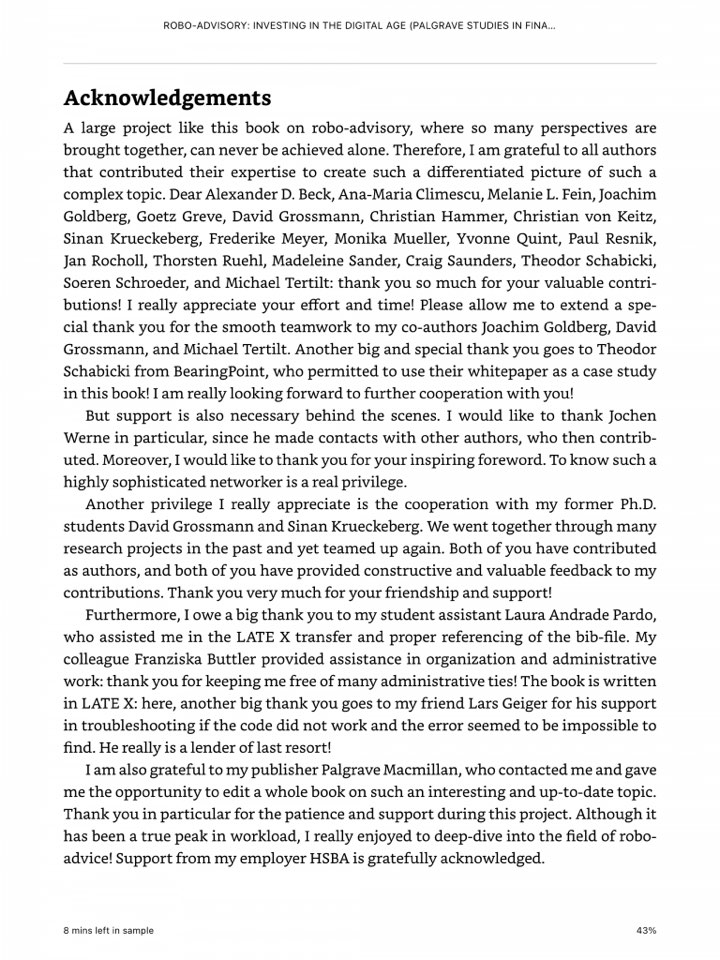

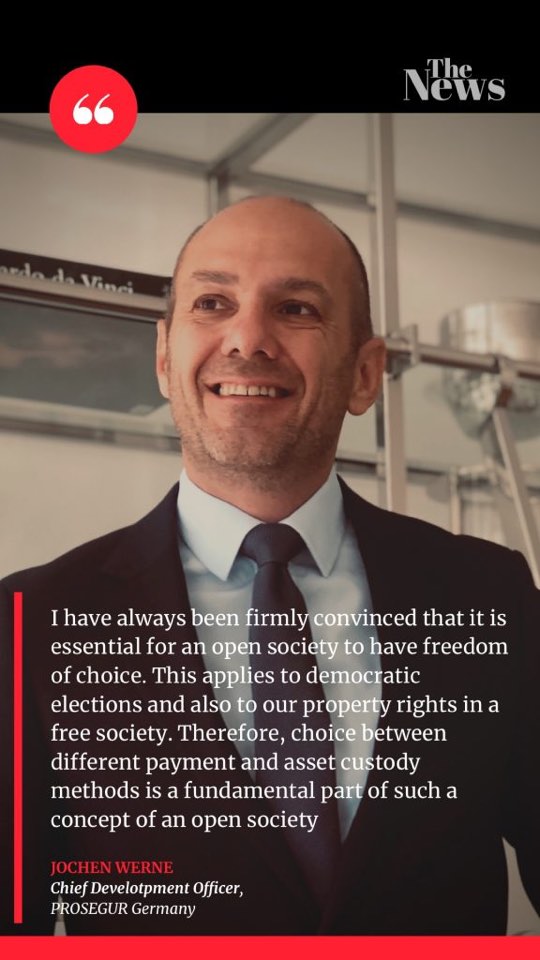
The possibility to buy Bitcoins with cash in a regulated process at a designated ATM intelligently combines the best of both worlds. As Germany's market leader in cash transport and processing, Prosegur guarantees secure cash handling for Europe's largest operator of Bitcoin ATMs.
Find details about the project in this article from t3n, translated with Deepl.com. Find original HERE
Sutor Bank has announced a number of cooperations in the fintech sector in recent years. In the future, the tradition-rich bank will set up Bitcoin ATMs in Germany.
The project will be implemented as a cooperation with the Hamburg-based Sutor-Bank, the Austrian Kurant, which claims to be Europe's largest operator of Bitcoin ATMs, as well as the startup Spot9 with the participation of IDnow, Coinfirm and Prosegur. According to the participants, this is a unique cooperation that meets all the requirements of the German banking supervisory authority Bafin - and the number of participants already suggests how high they are. Their rules include, for example, compliance with money laundering guidelines and the secure identification process of customers, which IDnow takes over. Finally, Prosegur is involved as a security service provider in the area of cash transport and processing and is supposed to guarantee secure cash handling.

Last week, the first machine was set up in Berlin - in the medium term, a nationwide network of Bitcoin machines is to be set up. "Spot9's vision is to enable everyone, even without extensive prior knowledge, to use our Bitcoin ATMs. That is why it is very important for us to understand exactly how customers behave at the vending machine before we open the additional locations," says Johannes Gorski, CEO of Spot9.
The vending machine solution is intended to be a safe and easy-to-understand alternative to buying online and carries fewer risks than buying cryptocurrencies on Bitcoin exchanges, the parties involved explain. The purchase process works via cash and is similar to the operation of a conventional ATM. Thus, the offer is aimed at customers who want to buy cryptocurrencies in their normal everyday life.
After the first vending machine has been set up in Berlin, but can be used by a selected test group for the time being, the primary goal is to get to know the user behaviour of the customers better and thus ensure an optimal user experience. The opening of further locations is to take place in the course of the first quarter of 2021, whereby the Corona Factor will of course still have an impact.
It should be possible to use the Bitcoin ATMs with any digital Bitcoin wallet. The user is thus independent of an ATM-specific wallet. However, in order to use the Bitcoin ATMs, the customer must first go through the registration process with verification on the Spot9 website.
The Tyto Tech 500 Power List is an objective, data-based survey of various technology sectors in Germany, France and the UK. The study is the first of its kind to measure who has what influence in the tech sector on the basis of various key figures from the online and offline world.

It is a special pleasure to be ranked #35 (Jochen Werne / Prosegur) in the just published Top50-List 2020 of the most influential Germans
DIE 50 EINFLUSSREICHSTEN DEUTSCHEN DER TECH-SZENE
Die Tyto Tech 500 Power List ist eine objektive, datengestützte Untersuchung verschiedener Technologie-Bereiche in Deutschland, Frankreich und dem Vereinigten Königreich. Die Studie ist die erste ihrer Art, die auf Basis verschiedenster Kennzahlen aus der Online- und Offline-Welt misst, wer welchen Einfluss im Tech-Bereich hat.
Es ist eine besondere Freude in der soeben veröffentlichten Top50-Liste 2020 der einflussreichsten Deutschen den Rang #35 (Jochen Werne / Prosegur) zu belegen und dies neben Persönlichkeiten wie (nach Ranking):
Sascha Dolling, Jens Pöppelmann, Oliver von Wersch, Sven Bornemann, Sven Stuehmeier, Carol Starr, Bastian Krüger, Norman Wagner, Miriam Thome, Maike Abel, Nico Winkelhaus, Naren Shaam, Robert Jacobi, Ramin Niroumand, Claudia Kemfert, Mallikarjun Rao, Matthias Reinwarth, Ben Shaw, Tessa Niemann, Maren Wulf, Miriam Wohlfarth, Karin Libowitzky, Afseneh Afsaei, Dr. Oliver Vesper, Tim Sievers, Milos Rusic, Felix Falk, Markus Forster, Martin Schmid, Alen Nazarian, Hartmut Giesen, Peter Altmaier, Murat Vurucu, Chris Bartz, Eduard Singer, Alexander Schott, Ritavan ~, Joachim Hensch, Tim Höttges, Dr. Jan Kemper, Andreas Schierenbeck, Hans-Dieter Kettwig, Jost Backhaus, Jens Spahn, Paul Gauselmann und Frank Puscher
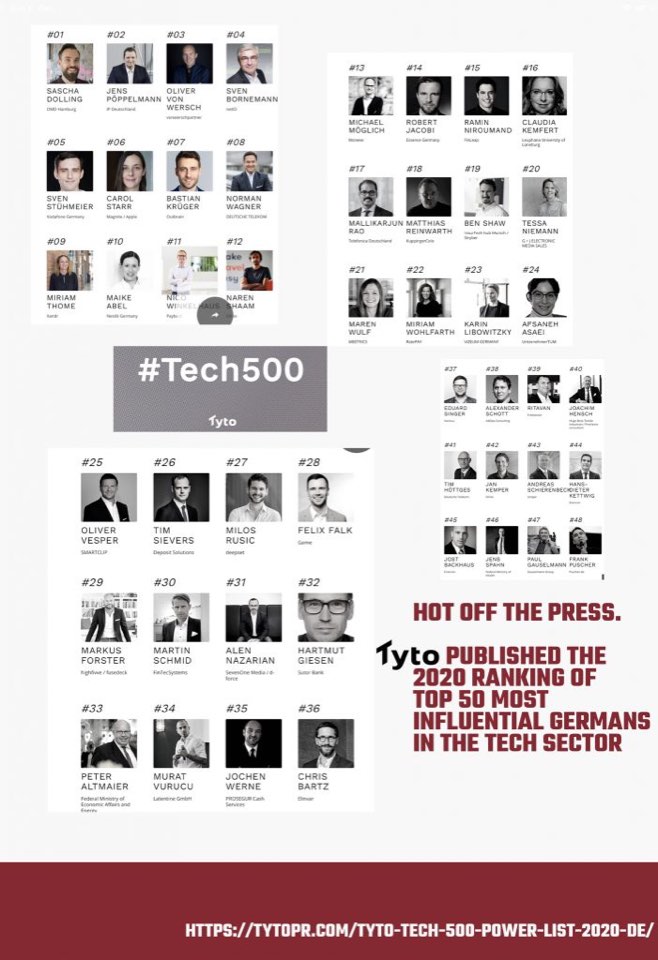
Design approaches for change management
About this whitepaper
This paper was prepared by the Work/Qualification, Human-Machine Interaction working group of the Learning Systems Platform. As one of a total of seven working groups, it examines the potentials and challenges arising from the use of artificial intelligence in the world of work and life. The focus is on questions of transformation and the development of humane working conditions. In addition, it focuses on the requirements and options for qualification and lifelong learning as well as starting points for the design of human-machine interaction and the division of labour between man and technology.
Original published in German. Translation made by Deepl.com
Authors:
Prof. Dr.-Ing. Sascha Stowasser, Institut für angewandte Arbeitswissenschaft (ifaa) (Projektleitung)
Oliver Suchy, Deutscher Gewerkschaftsbund (DGB) (Projektleitung)
Dr. Norbert Huchler, Institut für Sozialwissenschaftliche Forschung e. V. (ISF-München) Dr. Nadine Müller, Vereinte Dienstleistungsgewerkschaft (ver.di)
Dr.-Ing. Matthias Peissner, Fraunhofer-Institut für Arbeitswirtschaft und Organisation (IAO) Andrea Stich, Infineon Technologies AG
Dr. Hans-Jörg Vögel, BMW Group
Jochen Werne, Prosegur Cash Services Germany GmbH
Authors with guest status:
Timo Henkelmann, Elabo GmbH
Dr.-Ing. habil. Dipl.-Tech. Math. Thorsten Schindler, ABB AG Corporate Research Center Germany
Maike Scholz, Deutsche Telekom AG
Coordination:
Sebastian Terstegen, Institut für angewandte Arbeitswissenschaft (ifaa) / Dr. Andreas Heindl, Geschäftsstelle der Plattform Lernende Systeme / Alexander Mihatsch, Geschäftsstelle der Plattform Lernende Systeme
The introduction of artificial intelligence (AI) in companies offers opportunities and potential both for employees, for example in the form of relief through AI systems, and for companies, for example in the form of improvements in work processes or the implementation of new business models. At the same time, the challenges in the use of AI systems must - and can - be addressed and possible negative accompanying implications dealt with. The change in the companies can only be mastered together. All in all, it is a matter of shaping a new relationship between people and technology, in which people and AI systems work together productively and the respective strengths are emphasised.
Change management is a decisive factor for the successful introduction of AI systems as well as the human-centred design of AI deployment in companies. Good change management promotes the acceptance of AI systems among employees, so that the potential of new technologies can be used jointly for all those involved, further innovation steps can be facilitated and both employees and their representatives can be made the shapers of technological change.
The participation of employees and their representatives makes a significant contribution to the best possible design of AI systems and the interface between man and machine - especially in terms of efficient, productive work organisation that promotes health and learning. Early and process-oriented participation of employees and co-determination representatives is therefore an important component for the human-centred design and acceptance of AI systems in companies.
The introduction of artificial intelligence has some special features which also have an impact on change management as well as on the participation of employees including the processes of co-determination in the company. The authors of the working group Work/Qualification, Human-Machine-Interaction pursue with this white paper the goal to sensitize for the requirements of change management in Artificial Intelligence and to give orientation for the practical implementation of the introduction of AI systems in the different phases of the change process:
Phase 1 - Objectives and impact assessment: In the change processes for the introduction of AI systems, the objective and purpose of the applications should be defined from the outset with the employees and their representatives and information on the functioning of the AI system should be provided. On this basis, the potential of the AI systems and the possible consequences for the company, the organisation and the employees can then be assessed. A decisive factor for the success of a change process is the involvement of the employees and the mobilisation for the use of new technologies (chapter 2.1).
Phase 2 - Planning and design: In a second step, the design of the AI systems themselves is the main focus. This is primarily concerned with the design of the interface between man and AI system along criteria for the humane and productive implementation of man-machine interaction in the working environment. Of particular importance here are questions of transparency and explainability, of the processing and use of data and of analysis possibilities by AI systems (including employee analysis) as well as the creation of stress profiles and the consideration of employment development (Chapter 2.2).
Phase 3 - Preparation and implementation: The AI systems must also be integrated in a suitable way into existing or new work processes and possibly changed organisational structures. This means preparing employees for new tasks at an early stage and initiating the necessary qualification measures. It is also important to design new task and activity profiles for employees and to adapt the work organisation to a changed relationship between man and machine. A helpful instrument in the introduction of AI systems are pilot projects and expert phases in which experience can be gathered before a comprehensive introduction and possible need for adaptation with regard to AI systems, qualification requirements or work organisation can be identified (Chapter 2.3).
Phase 4 - Evaluation and adaptation: After the introduction of the AI systems, a continuous review and evaluation of the AI deployment should take place in order to ensure possible adaptations with regard to the design of the applications, the organisation of work or the further qualification of the employees. In addition, the regular evaluation of AI deployment can make use of the experience of the employees and initiate further innovation processes - both with regard to the further improvement of (work) processes and with regard to new products and business models - together with the employees as designers of change (Chapter 2.4).
These practice-oriented requirements are aimed at all stakeholders involved in change processes and are intended to provide orientation for the successful introduction of AI systems in companies. In addition, these requirements should also inspire the further development of existing regulations - for example in legislation, social partnership or standardisation - and thus enable an employment-oriented, flexible, self-determined and autonomous work with AI systems and promote the acceptance of AI systems.
Cash, book money and free availability
by JOCHEN WERNE published in DER BANK BLOG (30 October 2020) - For the original version in German please follow this LINK - English version translated by Deepl.com
"Disposal power" or "authority to dispose" are legal terms which are of great importance in the discussions on cash and book money. It also concerns the freedom of choice of citizens.
The German language today is much more extensive than the 100,000 words used by Goethe in his time. We hardly use many of these words, which are so characteristic of our language, despite their meaning. Perhaps some readers feel the same way about the word "Verfügungsmacht" as I did when I consciously read it for the first time in a quotation from the former president of the Federal Constitutional Court, Prof. Dr. Udo Di Fabio. And perhaps it is like with many things in life that one only realises the deeper meaning at the moment when one deals with it in more detail.
In our modern times, hardly anyone will visit the university library to quickly get to grips with a topic. Instead, people google the library to get an overview. And while less than 20 years ago we would have found our first little research happiness about the term "power of disposal" or also "authority to dispose of property" in the library of the law faculty, Internet research reveals in seconds a glance at a litany of legal forums.
Definition of power of disposal
What is striking here is that the focus is not on the definition of control, but that the topic of regaining control dominates the first page on Google. Inevitably, this reminds me of my first visit to the Munich Google office many years ago. Almost rapturously in his remarks about the power of the algorithm, a sales employee of the world's most powerful search engine asked the group if we knew where on the Internet they hid a body. With a glance into his head-shaking auditorium, he solved the riddle with a smile and said: "On the second page of Google search. Inevitably, of course, one then asks oneself - albeit only rhetorically - whether the Google business model works in particular because many have simply relinquished control over their data.
The power of disposal or also power of disposition is defined as the "legal power to dispose of an object". Which is banal, meaning that I should also have the power of disposal over what belongs to me - in other words, what is legally my property. However, the success of my own research on the first Google page suggests one thing above all else to the reader: that the power to dispose of property can be lost. For example, also of your own money? In order to answer this question, one should basically distinguish between cash and book money.
Cash, book money and the power of disposal
With cash, I have direct unlimited physical control over my money in the form of coins or notes. This power of disposal can of course be lost if I am robbed or simply lose my wallet. Without entering into the legal depths of "normal" debt and the right to dispose of money, citizens have in principle all the means guaranteed by the state at their disposal to recover their property.
The same applies to book money, if, for example, money is lost through credit card fraud when shopping online. The limits of non-physical power of disposal would, however, quickly become apparent if a bank went bankrupt and the money parked in the account in excess of the deposit guarantee was no longer available.
Cash, book money and free availability
It is utopian and not at all sensible to hoard all one's "money" as cash. But it is certainly important to make clear what it means to no longer have the freedom of choice between cash and book money and thus to completely give up one's right to physical availability of money.
In the concluding sentence of his speech at the 2018 Cash Symposium of the Deutsche Bundesbank, Udo Di Fabio underlined what is probably the most important point in the current discussion surrounding this election. He said that it should not be "disregarded" in principle that every citizen should be able to freely dispose of his money - his "exchangeable assets". He further added that this was particularly true when "financial privacy" was considered a legal requirement.
This means that a society whose entire assets would only be managed digitally in book money could also only exercise limited individual power of disposal over its money and would have to face the question "whether the state, through its central bank, would be entitled to carry out a controlled devaluation through negative interest rates, booking discounts or fees on credit balances". Prof. Di Fabio further points out that this would then not only be an encroachment on ownership but, as a result, possibly also the imposition of a special levy, which is only permitted under strict conditions in the German legal system.
Conflicts of interest and trust
It is easy to see that this issue can give rise to considerable conflicts of interest in the triangular relationship between citizens (- how can I protect and increase my money), government (- how can public debt be reduced) and central bank (- how can economic and monetary stability be ensured). This is particularly true in the light of the continuing challenges posed by the Corona pandemic.
It is thanks to the excellent work of the Deutsche Bundesbank since the Federal Republic of Germany came into existence and the confidence it has built up in our currency that the confidence of the public in both cash and book money is so high in this country.
Freedom of choice between cash and book money
Of course, another decisive aspect of this trust is the freedom of choice between cash and book money, which the Bundesbank also advocates. This freedom of choice also offers banks the opportunity to deal flexibly with the funds. For example, instead of charging 100 percent negative interest on book money to citizens or companies, banks could also physically hold it or have it held in safekeeping as cash.
Since it is not part of a bank's core competence to operate high-security systems and one certainly does not want to expose one's own employees to the risk of a robbery or the blackmailing abduction of a family member, there is of course the possibility of outsourcing such a service in a LCR-compatible and MaRisk-compliant manner. A service that supports the customer in parts of his liquidity management and does not make it difficult for him to possibly maintain his own safe in his own four walls and without a security concept and thus endanger himself and his family.
"Money is coined freedom"
In his prose work "Records from a House of the Dead", the Russian writer Fyodor Mikhailovich Dostoevsky describes his own experiences in Siberian captivity and formulates the later much quoted sentence: "Money is coined freedom", thereby describing the vital relevance of a free exchange of goods in an unfree environment - and this through coined cash money. For the young Dostoyevsky, the changeover to a pure book money system in Siberian prison would have meant the withdrawal of his individual power of disposal over money, so that in reverse he would no longer have any assets which he could have used for the exchange of goods and other things. He describes this situation in the quintessence as follows: The suffering of prisoners who do not have money is "10 times greater".
It is therefore reasonable to assume that the intellectual, serious discussions about the freedom of choice between cash and book money and the freedom of citizens in a constitutional state, which is freely consolidated in its constitution, would please Dostoevsky with his experiences in an unfree society. And it is characteristic of our open society that, especially in a crisis like the present one, we are conducting and continuing the debate on freedom of choice and power of disposal at this level, and not only with regard to our money.
Does cash have a future? An article by Dunja Koelwel, editor in chief of gi Geldinstitute | 20.10.2020 - 13:02
Please follow this LINK for the original source in German. Translation made by DeepL.com
Cashless payment is on the advance worldwide, only the Germans hang on to cash. gi Geldinstitute therefore wanted to know from Ralf-Christoph Arnoldt (Bundesverband der Deutschen Volksbanken und Raiffeisenbanken BVR), Jochen Werne (Prosegur Germany), Dr. Harald Olschok (BDSW) and Leif Wienecke (Solarisbank) Does cash still have a future?
Signs such as "Cash only" should be a thing of the past in Germany, according to the digital association Bitkom. Wherever customers can pay, at least one digital payment option that can be used throughout Europe should be offered on a mandatory basis, according to the "Bitkom theses on freedom of choice in payment".
"Cash shows itself to be an anchor of trust in uncertain times. With increasing concern about the corona virus, the amount of physical cash in circulation in the USA, for example, has risen," says Jochen Werne, member of the management of Prosegur Cash Services Germany. gi geldinstitute therefore asked: What is the current situation regarding 'war on cash'?
Since the Corona crisis, more and more people have been paying with cards or smartphones instead of with coins or notes. Is this a trend that is slowly eliminating cash? What is your perception?
Ralf-Christoph Arnoldt: Indeed, in recent months we have seen gains in card payments, especially in payments with Girocard. In the first half of 2020, transaction figures have increased by 20.7 percent compared to the same period last year. However, cash still plays an important role in everyday life in Germany, even if this love is eroding.
According to the Eurohandelsinstitut (EHI), the share of cash in turnover in 2019 was still 45.5 percent. Cash offers some advantages from the customer's point of view. Paying with cash is convenient for the customer, anonymous, immediately final. Cash is freedom for customers. Regulators and business circles involved in the cash circle should accept this as a fact and not force them to change it.
Dr. Harald Olschok: Without doubt, a new phase of "war on cash" began during the Corona crisis. 75 percent of the member companies of the BDGW expect sales next year to be up to 20 percent lower than in the past. We assume that the proportion of cash payments in the retail sector will fall from around 48 percent at the beginning of 2020 to well below 40 percent. However, the crisis has also shown that Germans continue to have great confidence in cash as a secure means of payment and store of value. According to a survey by YouGov, Germans also cannot imagine living in a cashless society.
Leif Wienecke: Since the Corona crisis, we have seen an acceleration of many trend developments, some of which were already foreseeable before. This also includes contactless payment. This customer behaviour, which is relatively new in Germany, fits in well with corona-related hygiene measures. Basically, it can be said that, in addition to hygiene considerations, end customers are primarily looking for speed when choosing a means of payment. This is where digital and contactless payment methods come into play. Over the next few years, we will see a further decline in cash payments and an increasing use of digital payment methods such as mobile wallets.

Jochen Werne: What is important to people when it comes to their money - the "fruits of their labour"? Certainly its unlimited availability. If they can have confidence that they can get their money at any time, people choose the payment option that is most convenient for each individual. Some prefer to pay by smartphone, while for others it's "only cash is true". It is fundamental that we as consumers are free to decide from which means of payment we can freely choose. Freedom of choice is the key word.
A "per cash" argument often made is that technology is vulnerable and that in a crisis the value of security is always the highest good. This is why many people have been hoarding cash at the beginning of the lockdown. Do you believe that this money will now come back into circulation? And what do you think about the technological error potential of digital payment options?
Ralf-Christoph Arnoldt: The fact that cash was hoarded at the beginning of the lockdown was more due to the fact that people thought the cash supply could be endangered because of the Corona crisis. But that quickly proved to be incorrect. In the meantime, the hoardings have been continuously disbanded. We can see this, among other things, in the fact that the payout volumes at ATMs are still about 25 percent below the pre-corona level. If you want to compare the security of cash with card payments or digital payment options, you don't get very far. If cash is stolen, for example, it is gone for good. If a payment card is stolen, the bank is usually liable.
Jochen Werne: It is undeniable that cash is seen by many as an anchor of trust in uncertain times. Electronic payment methods always risk a loss of trust due to technical failures. One of the last of these incidents was not long ago: during the pre-Christmas business on 23 December 2019, of all days, EC card payments were not accepted at many terminals. Many consumers who rely solely on digital payments have probably already had similar experiences of lesser consequence. Such situations can be observed time and again at the cash desks in department shops and supermarkets - for example, when the NFC chip on a card or simply the card reader does not work. Soon the eyes of the people standing around in the shopping queue turn to the payer, impatient and interested, trying to find out the name on the card of the supposedly insolvent unlucky person. Nevertheless, modern technologies are becoming more and more stable over time and a balance will be established between the various payment methods. Just as the "hoarded" will be returned to consumption or investment after the crisis. A cycle that, soberly, has always existed historically.
It became apparent that banks would no longer be able to offer free cash withdrawals from ATMs in the long term. This affects in particular people on low incomes, the elderly and, in general, all those who do not have access to digital forms of payment. Which solution do you think makes the most sense?
Leif Wienecke: Indeed, an accelerated dismantling of bank branches has been observed in recent months, but also before. The cost-benefit ratios seem to be out of proportion. Many end customers, especially older people, are suffering as a result. At the same time, however, one can also read about the creative solutions that savings banks, for example, are using to offer customers in rural areas the service they are used to (e.g. branch on wheels, transfer bus). I believe that other companies will fill the gap left by the banks. For some years now, supermarkets and petrol stations, for example, have been offering free "withdrawal" of cash. This trend to integrate banking services into the context of everyday life is known as contextual banking. The end customer wants to have access to cash or transactions wherever he or she is. As Solarisbank, we see the future in banking here.
Jochen Werne: Making an individual's assets available as cash causes costs, just as paying with a card costs consumers money. The latest evaluation of 294 account models of 125 credit institutions in Germany by Stiftung Warentest shows that 55 models already charge fees for payment with the Girocard. It is the task of the institutions not only to manage their customers' money, but also to meet the customer's wish to make these assets available to them again in the form of cash or book money. The current practice of offering cash or accounts without fees and cross-subsidising them in return is a German phenomenon. The former head of BaFin, Dr. Elke König, already raised the question critically more than five years ago at the "Bank of the Future" event.
Today's pressure on margins at banks now demands this adjustment. It is undisputed that, according to the German Bundesbank, ATMs are the most popular source of cash, accounting for 84 per cent of all cash withdrawals. Their number has risen by a good 18 per cent in Germany in recent years. On average, there is one ATM per 1,415 inhabitants. ATMs are therefore of enormous social and economic importance. It is not surprising that the area of "cash supply" is expressly listed as a "critical service" in Section 7 of the Critical Service Ordinance of the Federal Office for Information Security (BSI-KritisV), as a "service for the supply of the general public (…), the failure or impairment of which would lead to considerable supply bottlenecks or to threats to public security". The fact that banks have to provide cash and cards to their customers, but are generally not able to do so profitably without charging is a long-term problem and needs to be improved. However, there is room for debate as to whether charges are the right way forward for consumers.
For US economics professor Kenneth Rogoff, the abolition of large banknotes is a first step. According to Rogoff, cash is synonymous with crime and the shadow economy - and in this respect it is a threat to the general public. Is cash really more "crime-sensitive" than digital payment methods?
Dr. Harald Olschok: As a "learned" Freiburg economist, I am always appalled by the populist and simplistic theses of the former chief economist of the IMF. It is much worse than you suggest. For Rogoff, "there is no question that cash plays a vital role in criminal activities, including drug trafficking, organised crime, extortion, corruption of authorities, trafficking in human beings and money laundering. (Der Fluch des Geldes, Munich 2016, p. 11). Oh yes, and undeclared work and illegal immigration are also owed to cash. Unfortunately, it has also been heard in the euro area. The 500 euro banknote has already been abolished. At the heart of the Rogoffian theses is the abolition of cash in order to impose negative interest rates. People should not save, but spend their money. This ignores the fact that fraud with non-cash means of payment, such as crypto-currencies, is booming. I expect that these forms of fraud will continue to increase. We must therefore assume the opposite.
Ralf-Christoph Arnoldt: Passing on a USB stick with millions of dollars in crypto-currencies, for example, is as easy as passing on a banknote. Criminals and the black economy are also part of the trend towards digitalisation, unfortunately sometimes even ahead of the investigating authorities.
Leif Wienecke: There is a lot of discussion on this topic and also conflicting studies. The Federal Government's decision to tighten the reporting requirements for notaries, for example in real estate transactions, underlines Rogoff's thesis. Nevertheless, I believe that it is not possible to generalise. Certainly, the anonymity of cash brings some advantages for criminals and money laundering can be curbed by switching to more strongly regulated, digital payment procedures.
And what about security? With cash, the problem is counterfeiting, with digital payments, for example, the tapping of identities and data. What is easier to protect?
Ralf-Christoph Arnoldt: I don't see a big difference. It is always a mutual arms race. New security features for cash require more know-how and greater investment for counterfeiters. It is becoming more difficult, the number of offenders is getting smaller, but the sums that a counterfeiter puts on the market are bigger. The situation is similar for digital payments. As a financial group, we are doing everything we can to stay one step ahead of criminals through new cryptographic procedures, hardened systems and so on. It is not without reason that our experts are already working on cryptographic solutions that will be able to withstand the coming era of quantum computers. The challenge here is to maintain the convenience for the customers.
Jochen Werne: By its very nature, cash is without doubt the most robust payment method. This is regularly demonstrated in extreme scenarios such as disasters, failure of a digital infrastructure due to cyber attacks, natural disasters or technical failure. Cash is not tied to electricity, digital infrastructure, passwords or other technical features. In addition, the introduction of the second series of euro banknotes has enhanced security features and made banknotes more secure and more counterfeit-proof. As the Bundesbank reported at the beginning of the year, the number of counterfeit banknotes has fallen by a further five percent. With digital payment methods, consumers themselves have a responsibility to protect themselves. At the beginning of the Corona crisis, for example, the payment limit for contactless payments, such as in supermarkets, was increased. At first glance, this sounds harmless. But as a result, anyone can use a card - and it does not have to be their own - to pay for higher-priced goods without further security checks, such as by entering a PIN. And as far as data protection is concerned: with every cashless payment, consumers disclose personal information. Data that many companies use commercially.
Dr Harald Olschok: The risk of coming into contact with counterfeit money in Germany is still low. Most counterfeits are easy to detect. The security features of the current Euro series make it difficult for criminals. However, if digital payment methods are attacked, consumers should be aware that they lose much more than just their money.
China wants to take a step in this direction from 2021 onward at the state level as well. The aim is to link the Alipay payment solution with all private and state databases, including those in which cashless payment transactions are stored. The aim is to record and evaluate consumer behaviour. Subsequently, either rewards are offered or sanctions are threatened. Anyone who accumulates too much debt or fails to pay it back is no longer allowed to use express trains or planes in China. Although such a development is completely out of the question in European democracies in the foreseeable future, do you also expect consumer behaviour to play a much greater role in credit rating in the future?
Jochen Werne: Harvard history professor Niall Ferguson coined the term "new cold war" over a year ago. This "Cold War" is mainly about one technology leadership in artificial intelligence and takes place between the United States and China. Technologies are not good or bad, but how and for what purpose they are used by us humans, determines the outcome. Just because something is now technically possible, it does not necessarily make sense for a society. It is a great value of liberal democracies that these issues are discussed, that privacy is protected and that the state cannot act on its own authority.
On the question of creditworthiness, it can be said that the better a credit institution knows the borrower, the better a risk assessment can be made in order to quantify credit default risks. When assessing creditworthiness, the institution is required to use all relevant and available data for the decision. Today, it is technically possible to enrich the data provided by the future borrower with information about him/her from the Internet and social media and to round off the data with the help of AI algorithms and peer group comparisons. However, there is a high risk that private personal data may be processed here if inadvertently and the protection of privacy may be violated. This must be prevented. However, it remains to be seen how this will be dealt with in the future.
Leif Wienecke: First and foremost, it is a matter of making sensible use of the many possibilities of generated data to create added value. Companies such as banks primarily face the challenge of preparing their customers' data in a meaningful way and integrating it for new applications. The ecosystems of the "GAFAs" or Alipay are "data first" companies which are integrated into the everyday life of their users. In principle, they only make decisions based on data and empirical findings. The above description from China, however, does not go hand in hand with our understanding of data or consumer protection, so we do not see this coming either.
On the other hand, it is of course essential to pursue data-driven innovation. Even the credit rating system that exists today can certainly be extended via relevant, contextual data points, in the interests of consumers and credit institutions. The topic of "social scoring", i.e. the use of customer data from social networks, is controversial in Germany and is discussed above all in the context of consumer protection. This is correct, because the consumer should not only have to give his consent for such scoring, but should also be able to understand the algorithm and complain in case of discrimination.
Recently, initiatives have been heard repeatedly to make a CBDC (Central Bank Digital Currency) accessible to all citizens and not to limit an e-euro to institutional participants in the financial markets. What do you think about this?
Leif Wienecke: The CBDC issue is still in its infancy and has many facets. It is mostly about increasing the efficiency of payment transactions. End customers also benefit from this. In principle, innovation processes and initiatives to transform the financial industry are to be seen as positive. As with all topics with a European or international scope, it is important to create a uniform regulatory framework. Precisely because the introduction of a digital central bank currency for the public would not be accompanied by a change in the existing monetary system. At Solarisbank, we have been dealing with the block chain and crypto currency industry for over two years. Last year, we founded the subsidiary Solaris Digital Assets to realise our vision of the broad use of digital assets.
Ralf-Christoph Arnoldt: Unfortunately, very different things are mixed up here. Firstly, there is the technology on which most crypto currencies are based: the block chain. It is highly interesting because rights (to money, benefits from contracts, etc.) can be transferred securely and traceably. This technology has its use cases and will increase in importance. To issue a currency based on this digital solution is certainly forward-looking but not without risks. The speed with which sums of money can be transferred would in itself increase the speed at which money circulates to an extent at which we lack economic experience. Questions also remain to be answered about the security of the currency and who is responsible for the counter-value. It is therefore to be welcomed that we are dealing with this issue at an early stage so that we can learn with manageable and calculated risk.
The concept of the euro, on the other hand, suggests a digital currency as a means of payment. In my view, it is still too early for that. Not only because the overall economic effects can only be estimated to a limited extent at present, but also because this technology is geared to the security and distribution of data, not to transaction efficiency. The number of transactions is technically limited. There are concepts such as the Lightning technology to circumvent this and allow more transactions. However, the latter again functions as an intermediary according to principles similar to those of traditional payment transactions. Transactions are executed and then "booked" in the block chain - similar to a central bank transfer.
Likewise, too little attention is paid to the ecological aspect. According to estimates, Bitcoin alone consumed around 74 terawatt hours in one month at the end of 2019. By way of comparison, Germany's total electricity consumption over the same period was around 47 terawatt hours.
And now the crucial question at the end: How do you make cashless payments?
Ralf-Christoph Arnoldt: With the Girocard - as far as possible contactless of course, and with pleasure also by mobile phone.
Leif Wienecke: I use Google Pay with my debit cards from our partners Tomorrow, Vivid Money and Bitwala. Offline I use the corresponding Visa cards. And online I also use PayPal.
Jochen Werne: Of course with cash and cashless.
Dr. Harald Olschok: In food retailing and gastronomy regularly with cash. For larger expenses, including refuelling, with credit cards.
Prosegur transports cash and gold bars. Not an easy task when the gold price rises and fluctuates as it did in the Corona crisis.



The blue fence is over four meters high, with a layer of barbed wire at the top. Anyone wishing to enter the building must pass through several locks and doors. No door opens without the one behind it closing. At the reception, visitors must identify themselves. Only then does the next locked door open. Behind it stands Jochen Werne, a tight-fitting suit, his hair as short as his beard, and says: "Welcome to Fort Knox."
Ein Bericht von Jaqueline Goebel
Erstpublikation am 11. Oktober 2020 in WirtschaftsWoche Online
Es war uns ein Vergnügen Frau Goebel bei Prosegur in Hamburg zu Gast zu haben. Den gesamten Bericht ihres Besuchs können sie in der WirtschaftsWoche unter oben stehendem Link lesen. Ein Auszug findet sich hier:

„Prosegur transportiert Bargeld oder Goldbarren. Keine einfache Aufgabe, wenn der Goldpreis so steigt und schwankt wie in der Coronakrise. Doch Entwicklungsvorstand Jochen Werne hat einen ganz eigenen Blick auf den Markt.
Der blaue Zaun ist über vier Meter hoch, ganz oben eine Lage Stacheldraht. Wer in das Gebäude hineinwill, muss mehrere Schleusen und Türen passieren. Keine Tür öffnet sich, ohne dass sich die dahinter schließt. Beim Empfang müssen sich Besucher ausweisen. Erst dann öffnet sich die nächste verriegelte Tür. Dahinter steht Jochen Werne, eng anliegender Anzug, die Haare ebenso kurz wie der Bart, und sagt: „Willkommen in Fort Knox.“
....
by JOHANNES WINTER and JOCHEN WERNE
23 August 2020
Original in German published online in the Cicero - Magazine for political education. Please click here
Translation made by DeepL.com
In the first half of digitisation, the USA and China have mercilessly left Europe behind. But nothing is lost yet: a plea for sovereign data infrastructures and a transformation to service-oriented value creation.
Europe is at a crossroads - once again. This time it is about nothing less than the preservation of the continent's sovereignty, at least in technological and economic terms. It is therefore not surprising that "Digital Sovereignty" is a focus topic of the German EU Council Presidency. Europe's largest economy exemplifies the current challenges in the midst of a global trade conflict and quasi-monopolies of American and Asian platform companies: because Germany's strength as the world's equipment supplier is under scrutiny.
Since the 1970s, the first wave of digitalization has been underway, characterized by the use of electronics and IT as well as the automation and standardization of business processes. It has been driven by exponential growth in performance parameters such as communication networks, memories and processors, which is typical for the IT industry. As a manufacturer of machines, plants, vehicles or process technology, Germany has benefited considerably from this. "Made in Germany" is a worldwide promise of quality. But for how much longer? Or to put it another way: How can we transfer this promise into the digital age?
The real and virtual worlds are merging, an Internet of things, data and services is emerging in all areas of work and life. Automated systems driven by artificial intelligence learn during operation and increasingly act autonomously, as collaborative manufacturing robots, robo-advisors or intelligent harvesters.
Europe is falling behind
Consumer platforms such as Amazon, Alibaba and Facebook have dominated the first half of digitisation. With the exception of the streaming service Spotify, Europe is hardly present in the B2C platform markets. The second half includes the industrial sector, both the digitisation and networking of production (Industry 4.0) and the expansion of products and services to include personalised, digital services (digital business models).
So far the stocktaking - what is still outstanding, however, is the comprehensive implementation, without which Europe will fall further behind in the global race. What levers are there for Europe to score points in the second half and thus maintain competitiveness and self-determination? Two aspects seem particularly important:
Without a sovereign data infrastructure
Once developed, software platforms have process costs that approach zero. This makes it easy to aggregate huge amounts of data, learn from data with Artificial Intelligence and use it to develop digital business models that can be scaled exponentially across countries and industries. Google's search engine with a 95 percent EU market share is an example of both innovation leadership and quasi-monopoly. In order to gain sovereignty over data and data infrastructures, digital sovereignty is needed: from hardware and software components to communication networks, cloud infrastructures, data rooms and platforms.
European efforts such as the policy- and business-driven project "GAIA-X" deserve broad support, even if success is by no means certain. Self-determination does not mean self-sufficiency or the exclusion of dominant competitors. On the contrary: Europe's path must be determined by diversity, openness and decentralization, not by isolation. A glance at the regional distribution of medium-sized world market leaders is enough to understand that Europe's technological and entrepreneurial pound is not in the hands of a few large companies.
Germany has domain expertise
Appropriately, Europe should focus on building open digital ecosystems based on a common reference architecture and defined standards, enabling technological interoperability, providing distributed cloud and edge services and relying on European values such as trustworthiness, security, privacy and fairness. In the industrial sector, the race is still open, since production-strong and product-centric countries like Germany have domain expertise and industrial data such as machine, process, user and product data to which hyperscalers like Google and Amazon have so far had only limited access.
But to achieve sovereignty, Europe needs access to the cloud and data infrastructures, whether in the mechanical engineering or mobility sector. And it needs European regulation as well as state and companies as active consumers of European technology and business offerings. To do so, they must be secure, high-performance, cost-effective and competitive. A high standard! However, if Europe chooses the passive path, this endangers economic competitiveness, entrepreneurial freedom and, in the medium term, our prosperity.
Value creation shifts in favour of the platform operators
We know from the consumer world that investor-financed technology start-ups attack established business models in all domains, act as a platform operator between supplier and customer, define rules, standards and interfaces and benefit from network and economies of scale. As a result, value creation shifts in favour of the platform operators, traditional providers of products and services are degraded to suppliers. Operating and controlling platforms and marketing digital products and services on them is therefore a core prerequisite for Europe's survival in a digital economy.
Since no single company in the industrial environment has the know-how and data to be successful in the digital age, digital value-added networks are the solution. The "Learning Systems" platform, led by the Federal Ministry of Education and Research and acatech, recently highlighted a dozen success stories of digital ecosystems in Germany. One example shows how resilient manufacturing is created when machine builders can minimize production stops with the help of IoT and AI service providers by means of data-based prediction.
Process optimization is scalable
If the machine nevertheless comes to a standstill, a contingency insurance policy is taken out. In an Industry 4.0 logic, this creates a flexible production line that almost never stops and is therefore even more profitable. And: This process optimization including the digital business model is scalable and does not remain an isolated solution. Another example shows how agricultural APPs and IoT platforms enable cross-manufacturer data exchange with agricultural machinery, even if farmers and contractors use machines from different manufacturers.
The entire vehicle fleet can thus be optimized via one platform. This reduces complexity and enables medium-sized technology leaders for sensor systems, seeds or harvesting machines to scale in a trustworthy platform environment without having to take a greater entrepreneurial risk in building their own platforms.
Europe must speak with one voice
Many more such examples are needed - and they are also emerging in federal Europe. The realization is there, after all. But: In order to play an important role in the world, Europe should not only become faster, but should also speak with one voice, whether in enforcing a level playing field or in international standardization.
Completing the digital single market is also important to enable what China and the US have ahead of us: huge consumer markets in which domestic providers can scale. Europe is at a digital crossroads. Let us take the fork in the road to self-determination!
Hauptstadt-TV reported on August 6, 2020. Coverage here
Today, on 6 August 2020, the time had come for a world premiere, the first armoured money transport vehicle with an electric motor. This project was only made possible by a collaboration between the MAN vehicle and engineering group and the special protection vehicle manufacturer Stoof and the security service provider Prosegur. Together, they have succeeded in making the heavily armoured vehicles more environmentally friendly. As this report shows.

Without a doubt it has always been a great pleasure being an author for Dr. Hansjörg Leichsenring‘s highly recognised „Der Bank Blog“. After having published 7 articles l‘m looking forward finishing the eigth publication - this time in the new role as Chief Visionary Officer of PROSEGUR Germany - country’s CIT and Cash Management market leader and liquidity management innovation driver.
More to find here https://www.der-bank-blog.de/author/werne/
An expedition supporting the creation of international understanding and the creation of awareness for the UN sustainability goal No.14
We are living and experiencing a time where we are globally opening borders again. It’s a time of hope and a time to celebrate the great achievements mankind made throughout cooperation, diplomacy and exchange.
Like in the days – many of us do record very well – when the Cold War ended and borders opened, brave women and men worked intensively in many projects to overcome also the barriers in the minds of the people. Fear was replaced by the hope for a better future for mankind. Adversaries became friends and as a result nationalism and populism were disarmed.
With Expedition Baltic Sea Hawk we want to commemorate with a ceremony on sea all those who were engaged for international understanding because we’re convinced that in these days it’s more than ever important to create understanding for the continuation of the historically longstanding period of peace in Europe. The GOST ceremony supporting international understanding will take place at the historical site, where sailors of the navies of NATO and Warsaw Pact operated with a sober attitude in closest distance during times when political tensions were on the edge.
In addition to that we will support the UN sustainability Goal 14 by creating awareness for the BALTIC SEA AS A TIME MACHINE predicting the impact of human activities on our oceans.
Overfishing, warming, acidification, pollution, eutrophication, loss of oxygen, intensive use of coasts—all these are phenomena that we observe around the globe. Because they have been particularly drastic in the Baltic, but also because some key problems were successfully addressed, the region can, for good and for bad, tell us what to expect and how to respond to the challenges of the future.
The Baltic Sea, as a model region, can contribute to achieving the United Nation’s Sustainable Development Goal 14— THE CONSERVATION AND SUSTAINABLE USE OF THE OCEANS, SEAS AND MARINE RESOURCES

It‘s a great privilege commanding the flagship of Expedition „BALTIC SEA HAWK“ during this offshore challenge through the Baltic Sea to the North and hence crossing twice one of the planet’s most exciting waterways: the Kattegat. With a commemoration ceremony supporting international understanding we will remember and honour the sailors of the navies of NATO and Warsaw Pact who operated during the Cold War in these waters always with a sober attitude in closest distance, even when political tensions were on the edge. Their professional engagement has been instrumental for the long-standing period of peace in which we have the comfort to live in.
JOCHEN WERNE
EXPEDITION LEADER & CO-FOUNDER GLOBAL OFFSHORE SAILING TEAM
Autor Jochen Werne - Ein Blogbeitrag für die Handelsblatt Jahrestagung Restrukturierung
Bei sorgfältiger Betrachtung unserer Vergangenheit stoßen wir auf eine faszinierend und teilweise schizophren anmutende Menschheitsgeschichte von partiellem Wahnsinn und absoluter Brillanz – nicht nur, wenn es um den Einsatz neuer Technologien geht. Werfen wir einen Blick in einige dieser Geschichten.
1961 HAVANNA, KUBA: Die Welt steht am Rande eines nuklearen Holocaust. Eine Realität entstanden durch die Auswirkungen des kalten Kriegs, politischer Doktrinen, harter Grenzen und nicht zuletzt technologischen Fortschritts. Nur Diplomatie und der reine Instinkt für das Wesen der menschlichen Existenz auf beiden Seiten verhinderten das Schlimmste.
Eine Geschichte, die die prekäre Lage der Welt zu jener Zeit besonders gut widerspiegelt findet sich in dem indirekten Angebot Fidel Castro an die Sowjetunion, „das Problem“ zu lösen und die kommunistische Revolution durch den Abschuss von Atomraketen von kubanischem Boden, zum Sieg zu tragen. Sein Kampfgefährte Che Guevara ging sogar noch einen Schritt weiter, indem er sagte: „Wir sagen, dass wir den Weg der Befreiung beschreiten müssen, auch wenn er Millionen von Atomkriegsopfern kosten kann. Im Kampf auf Leben und Tod zwischen zwei Systemen können wir an nichts anderes denken als an den endgültigen Sieg des Sozialismus oder seinen Untergang als Folge des nuklearen Sieges der imperialistischen Aggression.” 1962 antwortete der ehemalige Erste Sekretär der Kommunistischen Partei der Sowjetunion, Nikita Chruschtschow, in einem Brief an Fidel Castro, dass er mit der Idee nicht einverstanden sei, weil sie unweigerlich zu einem thermonuklearen Krieg führen würde und dass es doch noch eine Welt bräuchte, in die die Revolution getragen werden könnte.
1961 NEW YORK, USA: Im selben Jahr ratifizieren 12 Nationen einen Vertrag zur gemeinsamen Verwaltung eines ganzen Kontinents. Ein Kontinent, der größer ist als die Vereinigten Staaten. Ein Kontinent, der 90% der Süßwasserreserven der Welt beheimatet und für das Klima unseres Planeten von außerordentlicher Bedeutung ist: die Antarktis. Es ist das Jahr, in dem einer der ermutigendsten Verträge der Menschheit unterzeichnet wurde – der Antarktis-Vertrag.
OPEN-SOURCE-KONZEPT: Der Vertrag – beinhaltet mehrere Kapitel zur ausschliesslich friedlichen und wissenschaftlichen Nutzung der Antarktis. Damit einhergehend regelt der Vertrag auch die gemeinschaftliche Nutzung aller Forschungsergebnisse und Daten. Ein Konzept, das für die damalige Zeit revolutionär erschien und das für die Findung von Lösungen für die großen Herausforderungen unserer Zeit – wie Klimawandel oder die effektive Bekämpfung einer Pandemie – von entscheidender Bedeutung sind.
2020 PLANET ERDE. In der Geschichte haben wir oft die positiven wie auch die negativen Auswirkungen auf die Gesellschaft unterschätzt, die von revolutionären Technologien ausgehen. Doch kann Technologie selbst nicht mit den Begriffen gut oder schlecht beurteilt werden. Vielmehr muss beurteilt werden, wie die Gesellschaft diese nutzt. Heute stehen wir wieder am Rande einer solchen gesellschaftlichen Herausforderung.
Wir leben in einer global vernetzten Welt. Technologischer Fortschritt hat Daten zu einer der wichtigsten Ressourcen gemacht. Der Mitbegründer von Twitter, Evan Williams, erklärte in einem Interview der New York Times 2017 überraschenderweise das Folgende: „Ich dachte, wenn alle Menschen frei sprechen und Informationen und Ideen austauschen können, wird die Welt – automatisch – zu einem besserer Ort. Ich habe mich geirrt“.
Man könnte leicht den Eindruck gewinnen, dass dieses Phänomen neu ist, aber Niall Ferguson, Geschichtsprofessor und Senior Fellow des Hoover Institutes ist davon überzeugt, dass der heutige technologische Fortschritt und seine Auswirkungen auf die Gesellschaft mit der Erfindung des Buchdrucks durch Johannes Gutenberg im 15. Jhdt. vergleichbar sind. Die Druckerpresse hatte viele positive Auswirkungen auf den Fortschritt der Menschheit und katapultierte die Bibel 200 Jahre lang auf den ersten Platz der Buch-Bestsellerliste. Leider machte die gleiche Technik “Malleus Maleficarum”, auch bekannt als der „Hexenhammer“, für dieselbe Zeit zur Nummer 2 auf dieser Liste. Das Buch war die Grundlage für die Hexenjagd und brachte so vielen Unschuldigen den Tod. Sicherlich würde man heute die Inhalte des Buches als „Fake News“ bezeichnen.
Wir alle gestalten heute die Welt von morgen, und unser Streben hat bereits zu viel Gutem geführt. Technologie und menschliche Kreativität haben bspw. dazu beigetragen, die Armutsquote weltweit massiv zu senken. In den letzten 25 Jahren wurden hierbei mehr als eine Milliarde Menschen extremer Armut befreit.
Betrachten wir den Moment so kommt man nicht umhin der aktuellen COVID-19-Pandemie einige Zeilen zu widmen. Es ist eine globale Herausforderung und könnte gleichzeitig die nächste Geschichte des menschlicher Brillanz und Wahnsinns sein. Wir werden dank der KI-basierten Analyseelemente enorme Fortschritte in der medizinischen Forschung und bei den Maßnahmen zur Pandemiebekämpfung erleben. Wir werden aber auch Zeugen einer Rezession werden, die historisch gesehen immer ein Element für Populismus und Nationalismus war. All dies in einem Umfeld von Angst und geschlossenen Grenzen. In diesen Situationen, in denen sich viele von hilflos fühlen, ging Wandel immer von fortschrittlichen Denkern aus, die von ihren Ideen überzeugt waren, von Kant über Ghandi bis zu den Vordenkern der heutigen Zeit.
In unserer offenen Gesellschaft und mit Machine- und Deep Learning Technologien in unseren Händen haben wir die Möglichkeit die Welt zu einem besseren Ort zu machen. Wir können in unseren Berufen viel Neues bewegen, und wir können gegen polarisierende Bewegungen und Ungerechtigkeit in jeder Hinsicht aufstehen und uns Gehör verschaffen. Wir können unsere Kreativität und unseren Intellekt einsetzen, um „den Fortschritt des Denkens” zu verteidigen, der schon immer das Ziel hatte, den Menschen von seiner Angst zu befreien“, genau wie es eines der Ziele des Zeitalters der Aufklärung war.
Quellen:
https://www.plattform-lernende-systeme.de/home-en.html
http://www.niallferguson.com
http://antarcticblanc.com
https://www.ats.aq/index_e.html
https://www.nytimes.com/2017/05/20/technology/evan-williams-medium-twitter-internet.html
Fotoquelle: https://pixabay.com
By Jochen Werne, Management Board member, Chief Development & Chief Visionary Officer (CDO/CVO) of Prosegur Cash Services Germany GmbH
In times when our life is being affected significantly by the effects of the situations like the COVID-19 pandemic, we become more aware of the basic needs in our lives. However, the COVID-19 crisis, which hits us globally so hard that we are even prepared to give up some of our civil rights and liberties guaranteed by the constitution, also reveals what certainty means and gives us and what we rely on in order to overcome a crisis and regain our freedom.
We live in a world of exponential leaps in technology – and the technological progress has traditionally always resulted in a global improvement in living standards. The international community can be rightly proud of its achievement of reducing the percentage of people who have to live in absolute poverty from 35% to 8% in the last 30 years thanks to global trade. However, it is in times of crisis that we see just how sustainable the goals that have been achieved are. Here prudent and decisive action from political and business leaders is called for. Confidence gained in people and instruments is the greatest asset in times of uncertainty.
The same applies for payments. While the independent good work over decades of many central banks such as the Deutsche Bundesbank, the European Central Bank and the US Federal Reserve is making itself noticeable in the crisis and the citizens rely on the stability of the euro and US dollar, cash is also showing itself to be an anchor of confidence in uncertain times. With growing concerns due to the coronavirus, in the USA for example the volume of physical cash in circulation has increased. In the week before 25 March this increased by 1.8% to 1.86 trillion dollars in absolute figures. This represents the biggest weekly increase since December 1999, when the fear of the so-called Millennium Bug was the reason for the rise. As we see today, the technological meltdown did not happen. However, 20 years later we are now more aware than ever of the vulnerability of technology and that in times of crisis the value of certainty is always the greatest asset. The increase in demand for cash, including in Germany, at the start of the corona crisis is probably attributable to this legitimate need of citizens for certainty and their great confidence in cash. According to the Bundesbank, the volume on Monday 16 March alone, the first day upon which schools and nurseries were closed, was 0.7 billion euros above the average.
Electronic payment methods, which are essential in so many areas such as online trading for example, repeatedly risk a loss of confidence due to technical failures. One of the most recent of these incidents occurred during of all times the Christmas shopping period on 23 December 2019, when EC card payments were no longer accepted at many terminals. It is a little like the situation described by the Roman poet Ovid: “People are slow to claim confidence in undertakings of magnitude.” Most certainly our savings – the fruit of our labour – are of this magnitude for us. It is for this reason that the availability of our money is so important. If this availability were restricted, we would start to feel that we might no longer be able to access our money, and a bank run would most likely be the result.
It is not without reason that the “supply of cash” is expressly defined as a “critical service” in Section 7 of the Regulation on the Identification of Critical Infrastructures (BSI-Kritisverordnung - BSI-KritisV) of the Federal Office for Information Security (BSI). That is to say a “service to supply the general public […], the loss or impairment of which would result in significant supply shortages or risks to public security.”
In the COVID-19 crisis, anxiety about health and the economic consequences of any crisis dominate our daily life. While fear is clearly caused by an external threat, anxiety is indeterminate. As the Greek stoic philosopher Epictetus wrote in his Enchiridion of stoic morals: “People are not disturbed by things, but by the view they take of them.”
It was therefore also absolutely consistent that the World Health Organization (WHO), the European Central Bank, the Bundesbank and the Robert Koch Institute have been stressing repeatedly in the corona crisis that there is no documented case that would suggest there would be an increased virus risk due to the use of cash as opposed to card payment. They refer here to corresponding scientific studies and underline repeatedly that no information on such a risk has been documented.
John Stuart Mill, one of the most successful liberal thinkers of the 19th century, defined freedom as the “first and strongest desire of human nature.” Accordingly, all governmental and social action must be directed towards granting the individual free development, while his freedom, as Mill formulates it in a principle known as the “principle of freedom,” may be limited under one condition: to protect himself or another person. Now, during a serious crisis, all citizens are forgoing some of their fundamental constitutional rights of freedom. This massive intervention is certainly consistent with Mills’ theory in this time of corona. In his novel The House of the Dead, Fyodor Mikhailovich Dostoevsky describes his own experiences of life in a Siberian prison camp and writes the subsequently oft-quoted sentence: “Money is coined liberty,” whereby he describes the vital relevance of a free exchange of goods in an environment where people are deprived of freedom – with cash in the form of coins.
Although not in the same way as Dostoevsky, we are also living in a time of extreme change: on a social, economic and political level. We are living in a time when, due to exponential technological developments, whole industries and business models are changing radically and countries are competing for supremacy in areas such as Artificial Intelligence (AI). It is a time in which transformation is the new norm and an agile corporate culture has to be the key to success. It is currently the case in many traditional industries that “anything that can be digitised, will be digitised.”
And inevitably this also raises the question of whether this is also the case for the first “instant payment” solution, one of the earliest and longest-lasting achievements of human civilisation – for our cash?
Our current free choice of payment method is certainly good, as long as we can choose freely as consumers the payment method appropriate for the respective situation. Discussions about the possible restriction of the freedom of choice of citizens regularly prompt intellectuals to issue warnings. For example, the poet Hans Magnus Enzensberger is of the opinion regarding the issue of “restriction”: “Those who abolish cash, abolish freedom.” This opinion is also shared by Carl-Ludwig Thiele, a former member of the Executive Board of the Deutsche Bundesbank: “Abolishing cash would hurt consumer sovereignty — the free choice of citizens about their payment instruments […] Government agencies do not have the right to tell citizens how they should pay.“
Particularly in extreme scenarios such as disasters, failures of a digital infrastructure due to cyber attacks, natural events or simply due to technical failure, it is made clear that cash, by its nature, is currently the most robust payment method. The fact that the contactless payment limit has been increased without further ado, for example in supermarkets, at first sounds harmless. However, as a result, anyone can pay for higher-priced goods using a card, and it does not have to be their own card, without any further security checks such as entering a PIN. Everyone has to examine and question critically for themselves the possible consequences of such a payment method.
Also not to be disregarded is the issue of data protection. More cashless payments also mean more personal information disclosed by everyone. Data which numerous companies use for commercial purposes. At the latest since the introduction of the EU General Data Protection Regulation (EU GDPR), the sensitivity of the population of Europe with regard to data protection and privacy has been rising gradually.
Klaus Müller, Germany’s top consumer protector and Executive Director of the Federation of German Consumer Organisations (vzbv), describes cash as “data protection in practice”. Anyone who pays with cash does not leave any traces to create a consumer profile, purchasing and payment behaviour cannot be manipulated. Cash also helps to protect financial privacy. This was emphasised by Udo Di Fabio, who was a judge of the Federal Constitutional Court for twelve years, at the Cash Symposium 2018 hosted by Deutsche Bundesbank. He explained that every citizen can dispose freely of their money. In his view this freedom would be restricted if financial management were completely digitised.
Crises such as the current corona pandemic always bring to light new approaches and act as accelerators of transformation processes that have already been set in motion. With regard to cash-related industries, the banking world has already been in a transformation process for some time. A company such as Prosegur, which, with over 4,000 employees and 31 branches, is a market leader in Germany in the transportation of cash and valuables, is increasingly becoming a full payment-platform provider. Several banks have already taken the path of fully outsourcing their cash management for synergy and cost-saving reasons. Here, cash processes are becoming not only much leaner, but also more cost-effective. This is the case not only for banks, but also for retail customers. With smart machines installed by Prosegur at its customers, cash can be disposed of directly and credited to the customer account on the same day. The smart infrastructure, including dynamic monitoring and forecasting, optimises the logistics and reduces costs in cash logistics. This is the next step towards an efficient, digital and integrated cash management.
In view of the technological progress and the associated social changes, it can be seen that key values from the human perspective are still valid. Based on an intellectual, serious discussion, the relevance to today of the theories of for example Dostoevsky with his experiences in an unfree society is clear: The discussion about the civil rights and liberties of citizens is always very closely related to their ability to use cash freely, to their freedom of choice of payment method and ultimately to the rightfulness of their actions with regards also to effiency and impact.
Our open and liberal society is characterised by the fact that we are discussing and most certainly will continue to discuss “Coined Liberty 2.0” at this level.
Prosegur Cash Services Germany GmbH, Kokkolastraße 5, 40882 Ratingen
Telephone: +49 2102 / 1248‐0, E‐mail: redaktion@prosegur.com, www.prosegur.de
Es war ein großes Privileg zum sechsten Mal als Co-Autor an einem anerkannten und angesehenen Fachbuch mitwirken zu können.
Das Buch stellt den digitalen Transformationsprozess in der Finanzbranche vor und beschreibt verschiedene digitale Dienstleistungen und Business Cases. Etablierte Anbieter erörtern ihre digitale Strategie, arrivierte Fintechs schildern ihre Geschäftsmodelle und neue Start-ups präsentieren ihre innovativen Produkte und Dienstleistungen. Das Buch gibt somit einen profunden Überblick über den Status quo sowie über den weiteren Fortschritt der Digitalisierung in der Finanzindustrie.
Die Autoren stammen aus der Finanzdienstleistungsbranche, von Fintechs, aus Beratungsunternehmen und der Wissenschaft. Sie geben dem Buch eine hohe Aktualität und Praxisrelevanz. Das Buch richtet sich an diejenigen in der Branche, die sich mit der digitalen Strategie- und Produktentwicklung befassen und die die digitale Transformation der Finanzindustrie maßgeblich vorantreiben.
BUY THE BOOK HERE https://www.weltbild.de/artikel/ebook/finanzdienstleister-der-naechsten-generation_27271168-1?rd=1
von Jochen Werne, Chief Development & Chief Visionary Officer Prosegur Germany
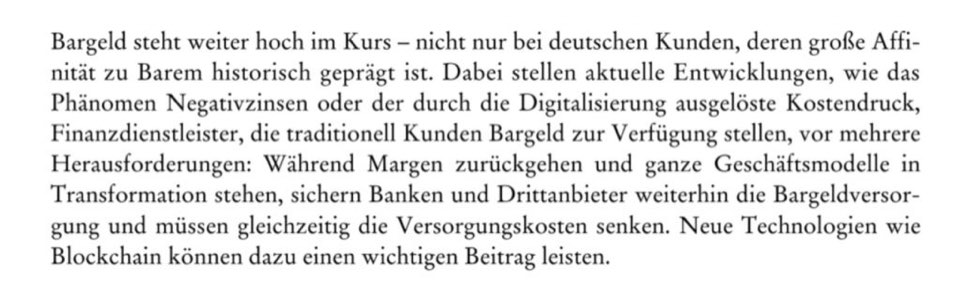
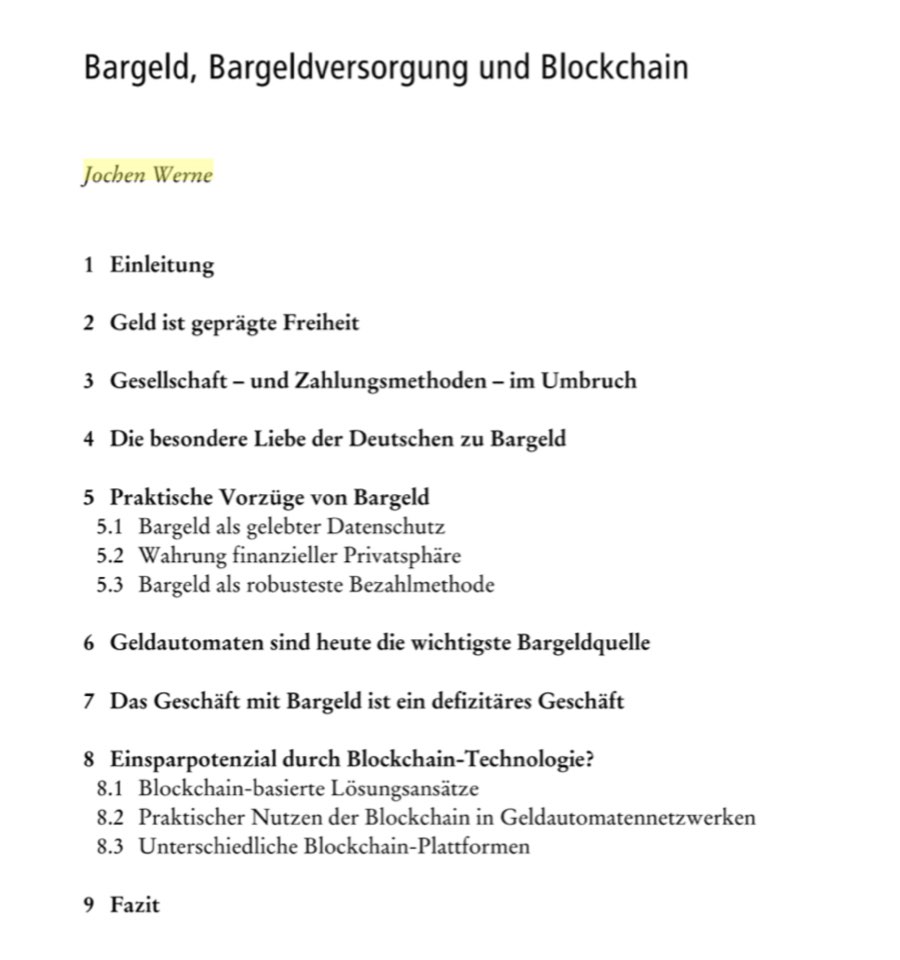

It has been a privilege contributing as co-author for the fifth time to an inspiring book project. “CRM goes digital“ has been initiated by Dr. Martin Stadelmann, Mario Pufahl and David Lauch and is part of the Springer Gabler Edition Sales Excellence book series (ESE)
Author: Jochen Werne
Werne J. (2020) Artificial Intelligence meets Homo Sapiens – Einsatzmöglichkeiten und Grenzen Künstlicher Intelligenz. In: Stadelmann M., Pufahl M., Laux D. (eds) CRM goes digital. Edition Sales Excellence. Springer Gabler, Wiesbaden
A special encounter. Algorithms developed by humans meet everything that man and nature embody - from industrial processes to our very own behaviour. A race between countries and companies has begun to decide the enormous potential of AI and its impact on our consumer behavior, as well as on our society. However, despite all the euphoria, it is important to understand the topic, its possible applications and also its limitations well, so as not to succumb to the danger of losing oneself in technology-believing magic.
Consistent customer orientation and digital transformation lead to completely new approaches in management: the focus is on omnichannel or mobile CRM concepts, big-data and social media instruments, and automation. But what does this mean in concrete terms for marketing, sales and service? What effects does digitalization have on product and service optimization or on sales management and customer loyalty? How can methodical customer orientation contribute to an improvement in sales performance? Answers to these and other questions are provided by the contributions from science and practice in this book. The authors illuminate the requirements and possible solutions of CRM systems along the concept of the customer journey using selected industry examples. They provide concrete recommendations for action and offer managers and users from customer-oriented business areas valuable orientation aids for the implementation of digital customer management.
From the content
CRM: strategies, organisation, controlling and employees
Concepts in digitisation
Best Practices in CRM: Case studies of customer-centric companies
Topics of CRM research
An examination using the example of Germany
Author: Jochen Werne
Published: Werne, Jochen (2019, December 1). The nature of society: Are certain cultures less predisposed to cyberthreats than others? An examination using the example of Germany. In the Cyber Security: A Peer-Reviewed Journal, Volume 3, Issue 2.
Successful ransomware attacks and thefts of data and passwords have unequivocally demonstrated that technical defensive measures are to be considered as merely basic moves in the protection against cyberattacks, and that security concepts, if to be effective, must take ever greater account of the human factor. Several examples prove that attack vectors which belong to the area of ‘social engineering’ are menacingly successful. Employees of enterprises, especially SMEs, frequently underestimate their importance when assessing security risks and the defence against them. As a consequence of these findings, a company-wide risk management should respect cultural and psychological peculiarities. Another promising approach are AI-based concepts, both as a technical defence against cyberthreats and in respect of processes specific to the company, as well as culture-specific characteristics of its employees. Both approaches are based on understanding human behaviour in its sociocultural context. Within the scope of this paper, this cultural aspect of cyber security is examined with regard to whether certain cultures may be less predisposed to cyberthreats than others. This is analysed using the example of Germany and also considers the question whether more or less authoritarian company cultures play a role in this context. How can phenomena such as German angst and similar cultural peculiarities be adequately taken into account? The remarks are mainly targeted at an audience which is concerned with organisational and technical countermeasures again cyberthreats. They focus on the importance of incorporating findings from psychology and social sciences when designing and realising such measures.
Jochen Werne is the Chief Development and Chief Visionary Officer (CDO/CVO) and executive committee member of PROSEGUR Cash Services Germany Ltd. Prior to that he was director and authorised officer of the Bankhaus August Lenz & Co. AG. Jochen is also member of the Federal Ministry of Education and Research Initiative ‘Learning Systems’ — a platform for artificial intelligence, member of the expert board of Management Circle, as well as a member of one of the most important think tanks worldwide: Chatham House, the Royal Institute of International Affairs. Jochen is a keynote speaker at various banking, innovation and executive conferences as well as an author and co-author of several textbooks and professional articles.

Cyber Security is the major peer-reviewed journal publishing in-depth articles and case studies written by and for cyber security professionals. It showcases the latest thinking and best practices in cyber security, cyber resilience, cyber crime and cyber warfare, drawing on practical experience in national critical infrastructure, government, corporate, finance, military and not-for-profit sectors.
Each quarterly 100-page issue analyses significant current and emerging cyber security threats and the latest strategies, techniques and technologies available to detect, manage and react to them, helping to uncover potential weaknesses in your current systems which could be open to attack. Its detailed articles and case studies – all of which are peer-reviewed by an Editorial Board of leading cyber security experts – provide in-depth, actionable advice and ‘lessons learned’ from fellow professionals, showing how cyber security programmes have been specified, designed, implemented, tested and updated in their organisations, as well as how data breaches and exercises have been managed in practice.
Cyber Security does not publish advertorial or advertising but rather in-depth articles on key topics including:
Thank you very much Stefanie Milcke for the friendly invitation to this inspiring marketing meetup in the age of Corona!
It's all about when and in what form marketing makes sense in such extraordinary times, and possibly even makes companies emerge stronger from the crisis. Certainly, as in any crisis, transparent communication to the outside world, but above all internally, is the ultimate discipline.
Message from the organizer
Hiermit lade ich euch alle ganz herzlich zu meinem (ersten) virtuellen Meetup in meiner neuen Gruppe Munich Marketing Roundtable ein. Das Thema: Macht Marketing während der Corona Krise Sinn?
Die Corona Krise trifft uns alle unvorbereitet. Gerade im Marketing herrscht derzeit viel Ahnungslosigkeit, wie mit der Situation umzugehen ist, weshalb die meisten Unternehmen unisono "wir sind da" kommunizieren und kaum einer Indiviualität zeigt.
Deshalb widme ich dieses virtuelles Meetup dem Thema "Macht Marketing in der Corona Krise überhaupt Sinn?" Dafür habe ich ein Experten Round Table organisiert und lade euch hiermit gerne als Zuhörer und "Mit-Diskutierer" ein.
Jeder meiner Experten wird zu Beginn kurz (10 Minuten) seine Erfahrungen insbesondere kommunikativer Natur mit der Krise schildern und dann für die offene Q&A mit euch zur Verfügung stehen.
Dafür habe ich mir ein paar tolle Experten eingeladen:
Ich freue mich auf euch!
Es war ein Vergnügen im SZ-Interview über das Thema Digitalisierung, New Work und die Veränderungen im Berufsbild des Finanzberaters zu diskutieren.

EinEn Monat nach Erscheinen des Artikels von SZ-Autor Marcel Grzanna und inmitten der Corona-Krise ist das Thema New Work aktueller denn je.

Der vollständige Artikel findet sich hier https://www.sueddeutsche.de/karriere/finanzen-banken-vermoegen-berater-digitalisierung-1.4830194
Handelsblatt Managing Corona Webinar
YOU CAN‘T GO AGAINST THE SEA
mit Jochen Werne
Fr. 3 April - 16.30
Register for free at https://veranstaltungen.handelsblatt.com/managing-corona/content-piece/you-cant-go-against-the-sea/
Heading to the sea –
Planung trifft Realität
What to do when the storm hit you –
Vom Lock-down zum Lock-On
Finding new routes
Die neue Realität in einer Welt beschleunigter Transformation
It is a great pleasure giving a keynote at the WIWO Digital Suite 2020 and to discuss the topic „Back to the roots. How technological progress and artificial intelligence is influencing international affairs and business today.“ with Germany‘s leading CFO‘s.
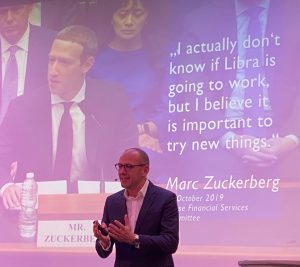
The length of stay of market-leading companies in the DAX, NASDAQ and other leading indices is decreasing rapidly. The planning cycles in companies and for CFOs are becoming shorter and shorter and the planning uncertainty with regard to the effects of international tensions on exports is increasing. The keynote will provide information on the relationship between the phenomenon of exponential technology leaps and the resulting innovations in the field of artificial intelligence and its impact on the geopolitical situation and international cooperation in general, and customer behavior and communication in particular.
A successful digitization strategy can only be implemented with and by the CFO. CFOs are drivers of change in the company and at the same time have to change themselves and the finance function.
This is a balancing act in which the prioritization of digitization projects in particular becomes a challenge in day-to-day business and again increasing cost pressure.
With the CFO Digital Suite, WirtschaftsWoche offers a creative space for your own assessment and inspiration.
Where do other CFOs stand with their digitization roadmap? The data driven company - process mining in practical test Restructuring and cost management vs. future projects - mastering the balancing act
Upskilling - wish or reality?
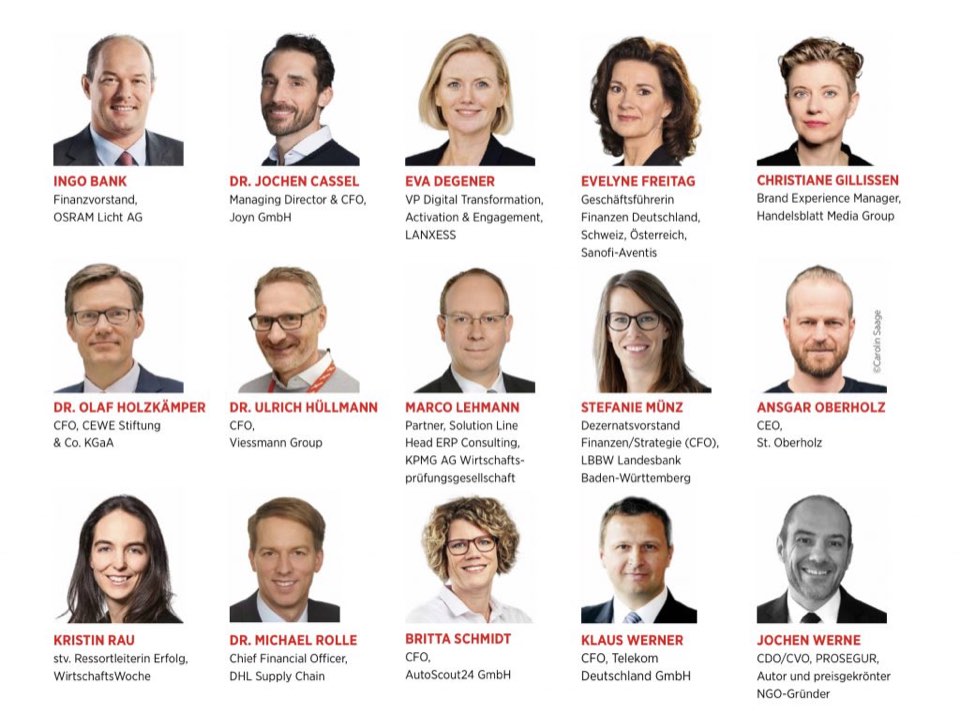
GOST‘s adventurous 2020 expedition BLACK SEA DRAGON (www.BlackSeaDragon.com) will depart on June 27 from the famous Bulgarian Black Sea harbour and home of the country’s Naval Academy, Varna.
INTERNATIONAL RELATIONS: By combining TRADITION and FUTURE in today’s hyper-connected world, the initiators of the expedition will bring together people and sailors from around the world to commemorate peacefully not only the great seafarers and explorers of all times – who were the first to unite our nations and people around the globe – but also to raise awareness and sensitise civil society to the importance of our MARITIME ECOSOCYSTEM with regard to the UNITED NATIONS SUSTAINABLE DEVELOPMENT GOALS. Together with all partners, new relations will be created between sailors, states and academic officials in support of international understanding and peaceful relations.
COMMEMORATION: In international waters the expedition yacht crews will remember the Black Sea sailors of all nations who lost their lives while being on duty with a wreath laying commemoration ceremony on sea.
CHALLENGE: In just one leg the yachts will challenge each other from their home base to the Northern entrance of the Bosphorus. There the yachts will unite to pass the strait southwards to their Marmara Sea destination, the famous Mega Yacht Marina Ataköy near Turkey‘s biggest city Istanbul.
“It‘s a great privilege commanding the flag ship of Expedition „BLACK SEA DRAGON“ during this offshore challenge through the Black Sea and the Mediterranean Sea and hence crossing twice one of the planet’s most challenging waterways: the Bosphorus. While in Greek mythology Jason and his team of Argonauts challenged clashing rocks in the strait, the dedicated international sailors of the Global Offshore Sailing Team will be challenged by today‘s busy ships traffic, the famous powerful 4 to 6kn current and strong funnelling wind effects.”
“Expedition BLACK SEA DRAGON will mark another milestone in the history of the Global Offshore Sailing Team. After missions on nearly all oceans of this planet, the Black Sea is an outstanding challenge for 2020. Fostering international relations in this historically rich region will be a great pleasure.”
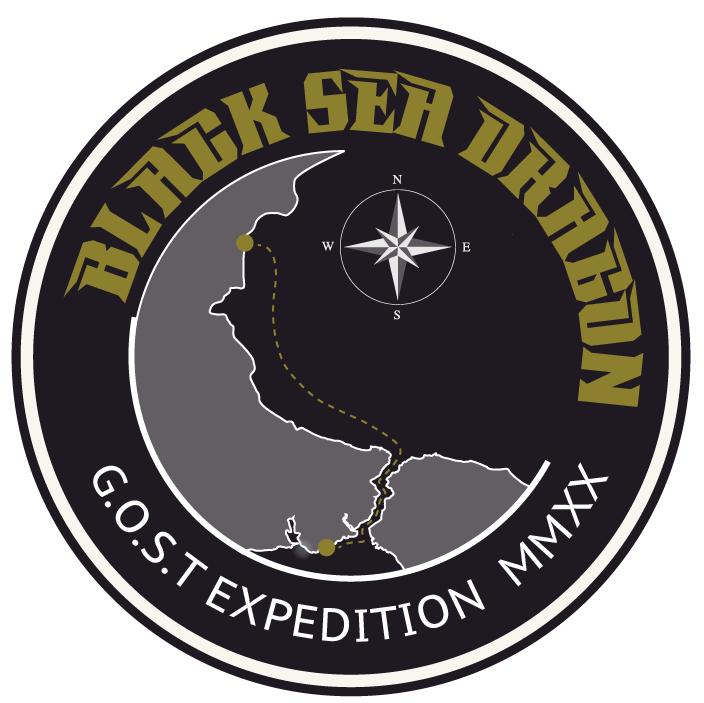
It was a great pleasure discussing with Dr. Robin Kiera about human behaviour and technological progress in the insurance industry during a perfectly organised EUROFORUM Deutschland GmbH conference in beautiful #Hamburg. Thanks Karin Hanten and the #EUROFORUM Team for the kind invitation.
...and thanks to Robin for keeping the fun alive which good interviews always bring
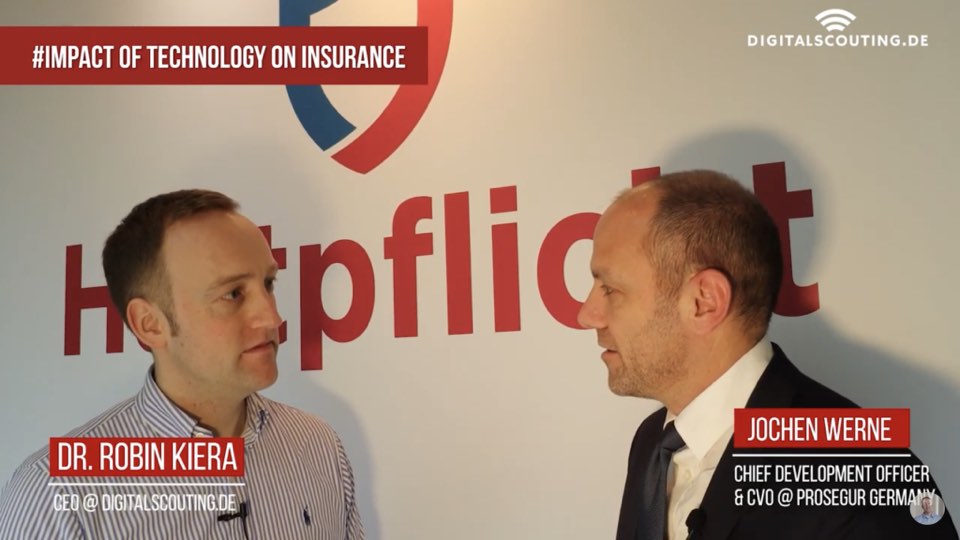
#digitalisierung #germany #künstlicheintelligenz #handelsblatt #europa #strategie #technologien #deutschland #cybersecurity #defence #cyberthreats #security #aiplatform #innovation #artificialintelligence #platformeconomy #exponential #iot
Those who put the customer at the heart of their data strategy, will be those who come out on top. With the increasing focus on customer experience, engagement and targeting, how can we continue to commercialise data and drive revenue with the customer in mind? And if we take a step back, are we truly making a positive social impact with our data?

Looking forward discussing about the question, if we can drive revenue whilst creating positive social impact at the Big Data & AI World in London
It has been a great pleasure giving the keynote at the CashCon2020 together with Mirko Siepmann, member of the board at Bankhaus August Lenz and long term business partner of Prosegur Germany.
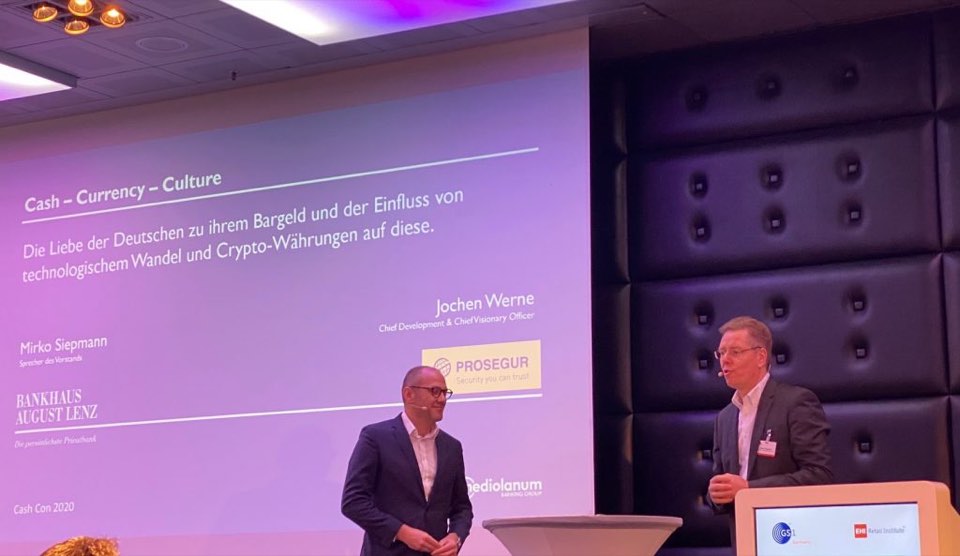
We reflected with the expert auditorium, topics as Cash versus Crypto, The rise and fall of cash through the ages; Why we Germans, of all people, stick so closely to cash and if ATMs - will soon be a thing of the past or will they withstand digital disruption?
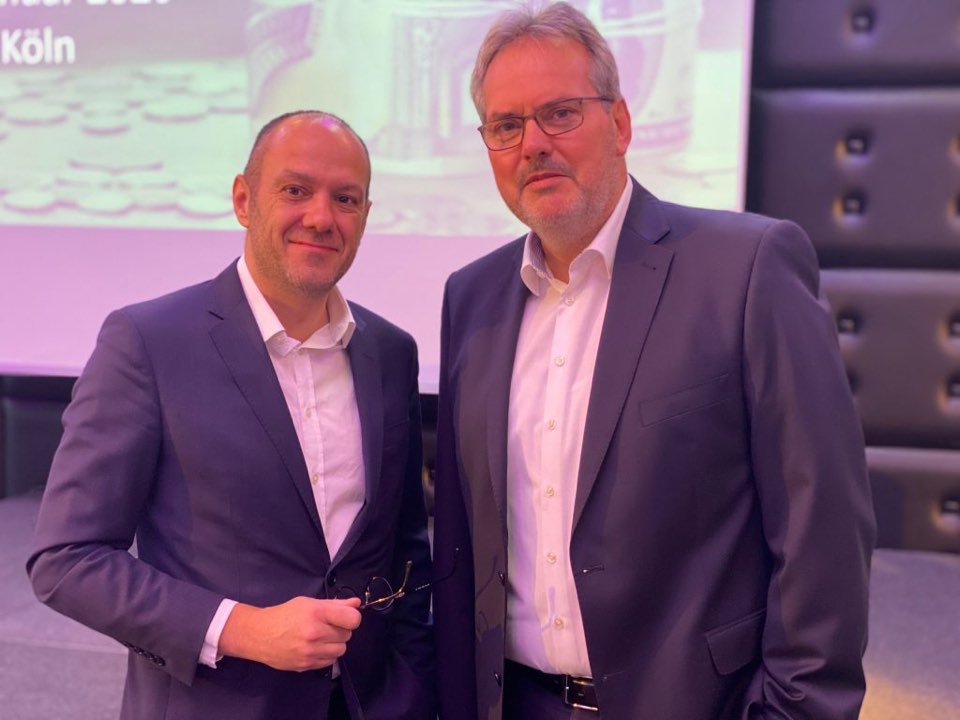
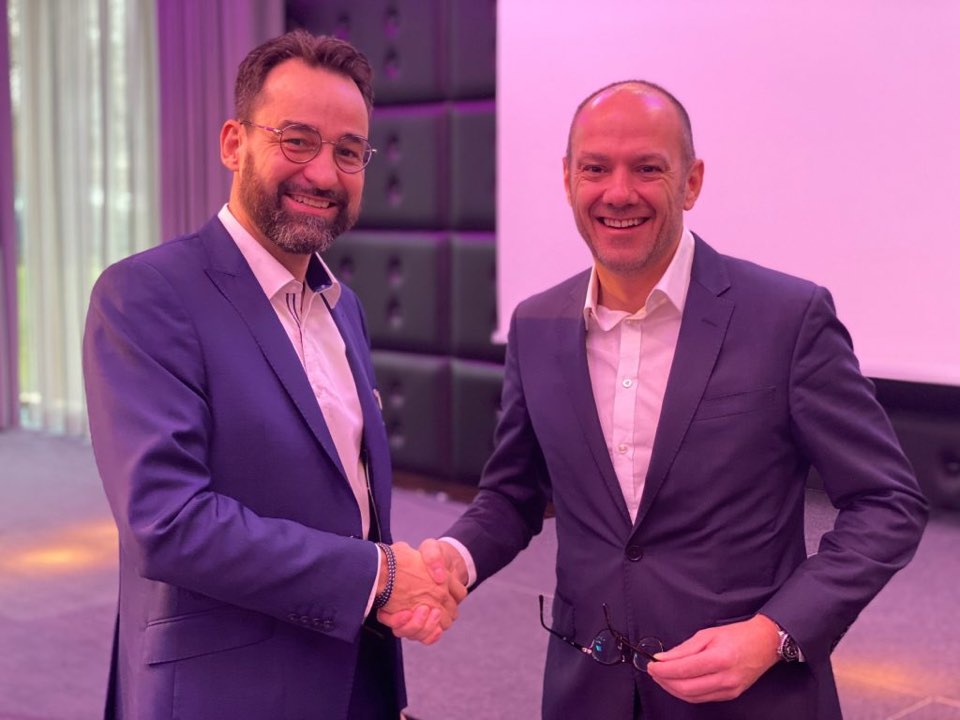
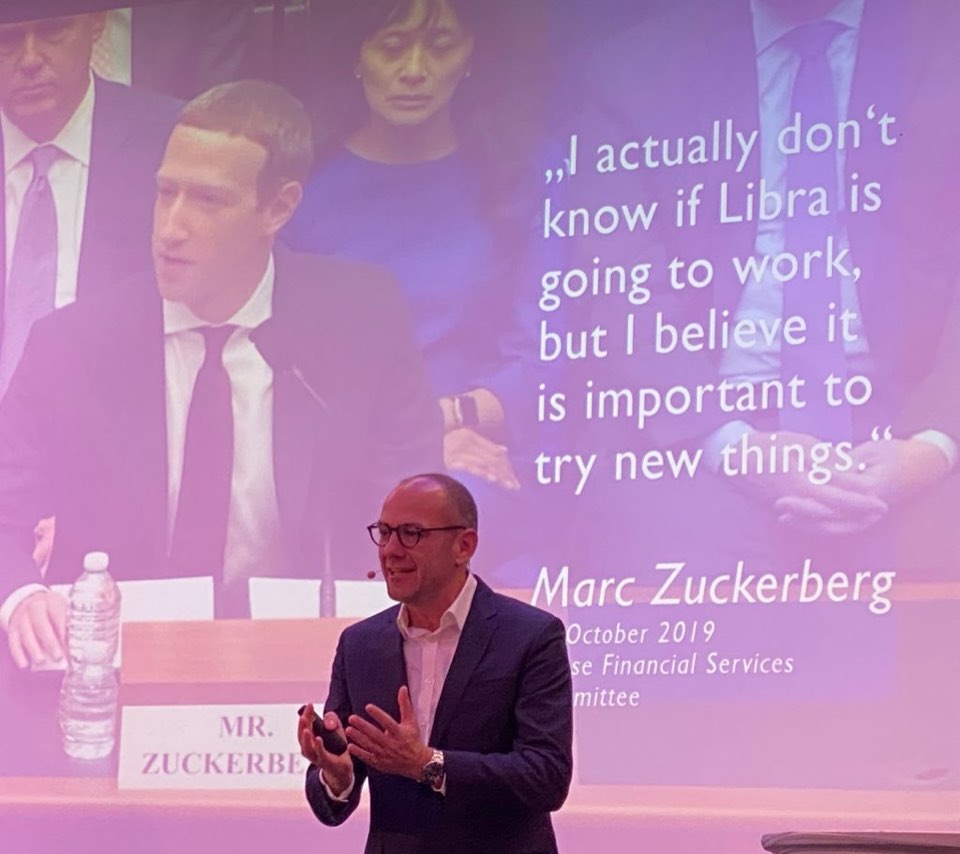
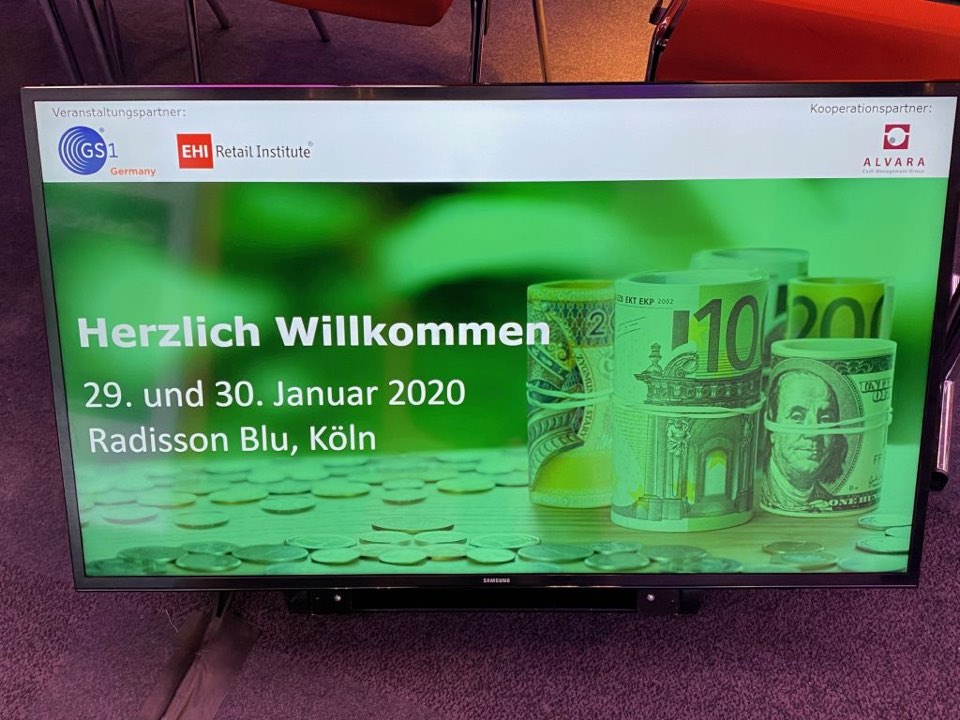
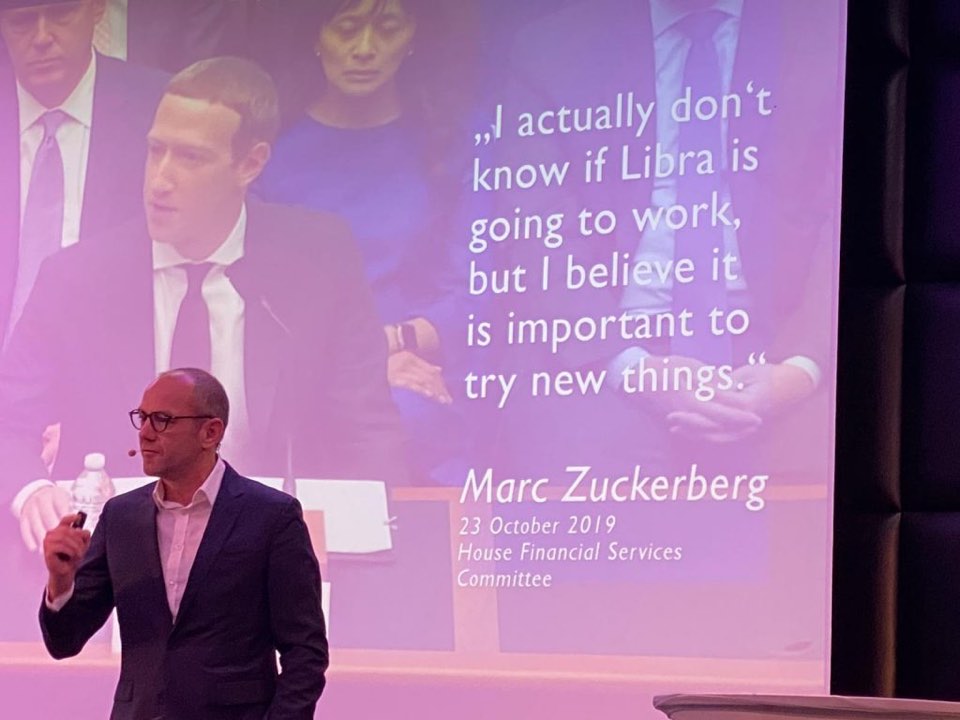
Keynote take-away at the EUROFORUM Deutschland GmbH #HAFTPFLICHT20 Conference:
“Transformation is the new normal case in times of exponential technology steps and artificial intelligence”
Jochen Werne
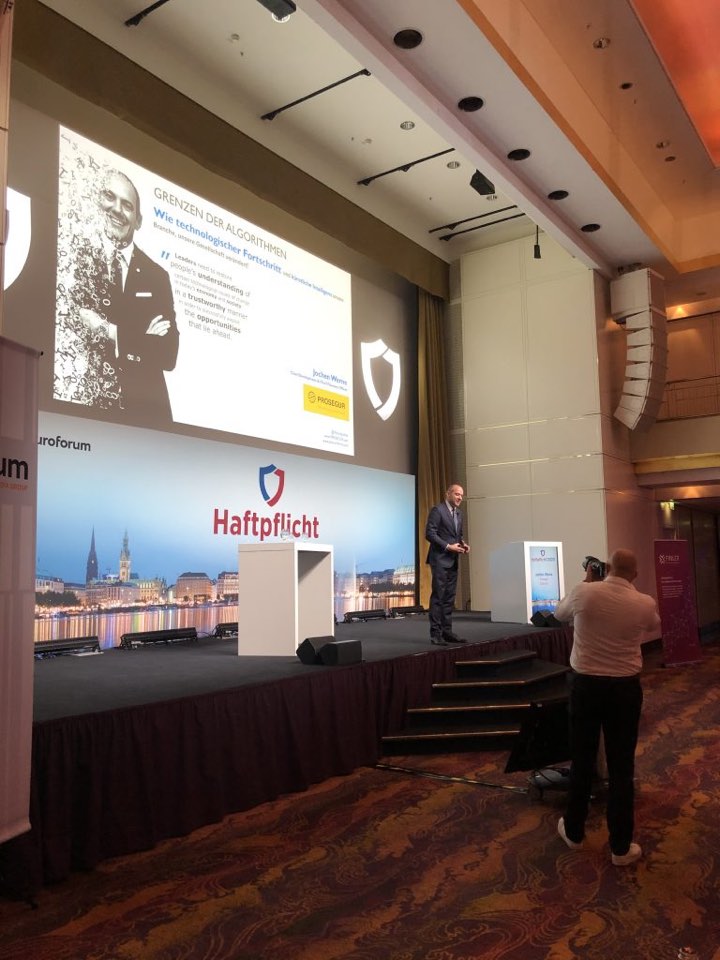
https://lnkd.in/dyGTH7W
A plea from Johannes Winter & Jochen Werne

1st published in the German newspaper Handelsblatt on January 8, 2020 - translated by DeepL.com. Photos: Pixabay
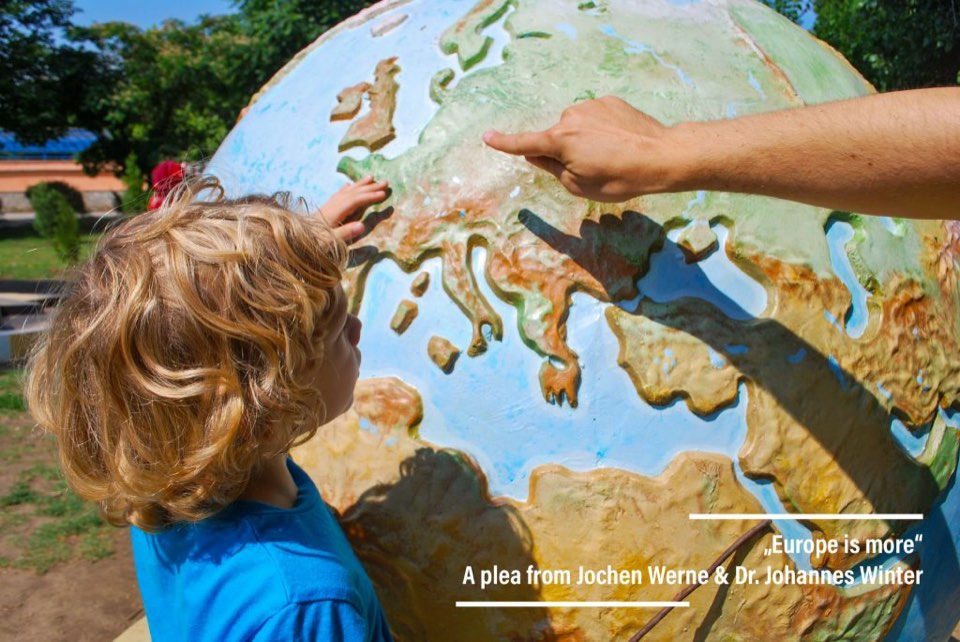
Looking at the world sometimes gives the impression that things seem to be much better outside Europe. Examples? The world's largest airport, Beijing-Daxing, goes into operation after four years of construction, while at BER, construction continues after 13 years. The coffee house chain Luckin Coffee, valued at $4.5 billion, will replace Starbucks as No. 1 in the Chinese market by the end of the year, two years after its foundation. Digital platform companies such as Apple, Amazon, Alphabet, Tencent & Co. have left the traditional commodity and industrial groups behind in terms of value.
What made these American and Asian companies so big? Absolute willingness to implement at high speed, massive state and private investments, sometimes industrial policy intervention, huge, scalable domestic markets and a just-do-it mentality favour economic and technological development alongside a number of other factors.
Is Europe, on the other hand, in a downward spiral? Is the continent now losing the much-discussed second half of digitisation, which is mainly about the digitisation of industry, now that the B2C race seems to be lost?
The recent history can also be told in a different way. The financial crisis of 2008/2009 has shown how valuable Europe's and especially Germany's strong industrial core is. A highly specialised, excellent SME sector and the leading groups from mechanical, plant and vehicle engineering to the pharmaceutical and chemical industries are anchors of stability. With Industry 4.0, the vision for the future of value creation comes from Germany, and there is a worldwide competition for its widespread introduction.
The strength lies in product innovation, especially in complex products such as machine tools, medical devices, vehicles or building services engineering. Germany also has world market leaders in engineering and in production and automation technology. Despite all the negative predictions, Germany has further expanded its strength in networked physical platforms with the integration of IoT, data and services in industrial environments and has secured a very good starting position. The German research landscape also holds an internationally good position in areas critical to success such as semantic technologies, machine learning and the digital modelling of products and users. And let's not forget that the companies in the country have produced outstanding software products for the fast, reliable and scalable processing of big data and the integration of business processes.
While Germany wants to consolidate its pioneering position as the world's supplier, the USA is relying on its expertise as a global networker and China is relying on short decision-making paths, capital intensity and a large domestic market in which it can scale quickly. In this situation, it is important that we concentrate on our strengths and resolutely tackle the digitization of industry and SMEs. However, this requires a much faster entry into the emerging B2B platform markets.
In Europe, we stand for a liberal value system, both economically and politically, which, as in the past, has proven to be the decisive differentiating factor in the medium and long term. The debate on the use of data is conducted in Europe in good tradition at an extremely high level and this in the good understanding that digitisation is not coming over us, but is made by people and is intended to serve them.
It is therefore the right moment to take a decisive step towards the future and to open up Europe's path. To do this, we need a large, homogeneous domestic market that will make us almost competitive with the USA and China. We also need substantial investment in digital infrastructure and cybersecurity, as well as training and further education. Both competitive regions currently have the power to set standards in digitization as well. The goal of the European Union to create a single digital internal market is laudable, but final implementation is still pending. This implementation, however, is the important and very concrete next step in order to be able to achieve the competition-relevant scaling effects and to be able to play a competitive role in data-based business model innovations.
The second half is running and nothing is lost.
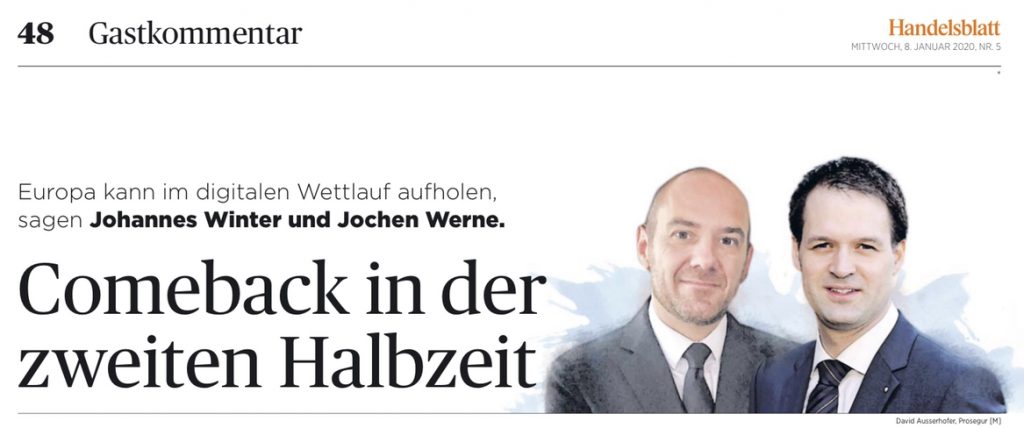
About the authors

Jochen Werne (48) is a member of the Executive Board and Chief Development Officer of Prosegur Cash Services GmbH, as well as a member of the Artificial Intelligence Learning Systems Platform and the Royal Institute of International Affairs, Chatham House.
LinkedIn: https://www.linkedin.com/in/jochen-werne-2292507a/
Twitter: @WerneJochen
E-mail: jw@JochenWerne.com
Dr. Johannes Winter (42) heads the office of the Learning Systems Platform and the technology department at the German Academy of Science and Engineering (acatech).
LinkedIn: https://www.linkedin.com/in/johannes-winter-13048629/
Twitter: @jw4null
e-mail: winter@acatech.de
GOVERNANCE TODAY: One of the best descriptions about the role of the Chief Visionary Officer can be found on Wikipedia
A chief visionary officer or chief vision officer (CVO) is an executive function in a company like CEO or COO. The title is sometimes used to formalize a high-level advisory position and other times used to define a higher ranking position than that held by the CEO. In some cases, the CVO is added to the CEO title (for CEO/CVO status), much in the same way that people with multiple university degrees list them after their names.
The CVO is expected to have a broad and comprehensive knowledge of all matters related to the business of the organization, as well as the vision required to steer its course into the future. The person in charge must have the core-competencies of every executive, and the visionary ideas to move the company forward, defining corporate strategies and working plans. The role has expanded to include formalizing the company’s strategic-planning processes, forging new working relationships and synergies across the organization, and establishing greater transparency and accountability for those people carrying out the company’s strategy.
Companies add CVOs (or consider doing so), sometimes interchangeable with CSO - Chief Strategy Officer, to their management teams for several reasons. Changes to the business landscape — complex organizational structures, rapid globalization, new regulations, the struggle to innovate — make it more difficult for CEOs to be on top of everything, even in areas as important as strategy execution and vision direction. Strategy development has become a continuous process, and successful execution depends on rapid and effective decision making. Further, as Harvard Business School professor Joseph L. Bower has noted, iron-fisted control of execution often eludes the top team’s grasp, as line executives seek to define strategy on their own terms. (See Bower and Clark G. Gilbert’s “How Managers’ Everyday Decisions Create—or Destroy—Your Company’s Strategy,” February 2007.)
Einar Stefferud, co-founder and CVO of First Virtual Holdings in 1994, is usually recognized as the first CVO. Another early CVO was Tim Roberts of Broadband Investment Group. Roberts said[citation needed] he invented the title to recognize the visionary attributes needed to integrate a complex business with many diverse aspects. Roberts chose the title to define his role in the organization, and didn't intend the designation to proliferate across the corporate world in the way that it has.
It is with pride to serve PROSEGUR Cash Services Germany as Chief Development & Chief Visionary Officer in one of the most fascinating times of techological progress and transformation
Jochen Werne

Monday, 18 November 2019
Member press release
° Digital and transformation expert to support strategic development internationally
° Heath White continues to drive forward strategy on innovations and new products

Ratingen (Germany), 18 November 2019 - Jochen Werne has been strengthening the C-Suite of Prosegur Cash Services Germany GmbH since 1 November 2019 as a member of the Management Board and Chief Development & Chief Visionary Officer (CDO/CVO).
"With Jochen Werne, we have been able to win an internationally networked and leadership-strong digital and transformation expert for Prosegur. The focus of his work at Prosegur will be the development and implementation of the strategy for Business Development, Innovation, II&S (Innovative Integrated Solutions), Business Process Outsourcing, New Products and International Sales. We expect that his industry expertise will provide our company with further impulses that will enable us to set trends in a market environment that is changing dynamically due to new technologies," explains Heath White, CEO Prosegur Cash Services Germany GmbH.
Werne's academic career has taken him to the University of Passau, the J.W. Goethe University Frankfurt a. M., the Helsinki School of Economics and Oxford University. He started his professional career in Global Investment Banking at Bankers Trust and Deutsche Bank AG. After a leading position in a start-up for electronic trading platforms and as a management consultant at Accenture, he joined Bankhaus August Lenz & Co. AG, where he headed various departments of the bank. According to Fintech Finance, during this time the bank transformed itself from an analogue private bank to a driver of innovation in digitalisation.
Werne is a member of the platform "Learning Systems" for artificial intelligence. This platform was initiated by the Federal Ministry of Education and Research. He is also a member of the Royal Institute of International Affairs, Chatham House. He is a keynote speaker, author and co-author of numerous specialist books and articles. He has received several international awards for his commitment to the development of diplomatic relations between nations.
About Prosegur
Prosegur is one of the leading security service providers worldwide with more than 175,000 employees on five continents. In Germany, Prosegur offers comprehensive services in security logistics with 31 branches and more than 4,000 employees. In the cash and valuables transport sector, Prosegur has the largest share of the industry's turnover. The service portfolio includes automated cash processes and ATM services in addition to cash and courier logistics and cash management. With the automated deposit solutions "Prosegur Smart Cash", customers optimize their cash handling. Following the acquisition of BaS Solution, Prosegur is one of the few cash and valuables logistics providers to offer technical services from a single source throughout Germany. The company bundles its social and cultural commitment in the Prosegur Foundation, which benefited over 43,200 people in 2018.
Media contact:
Agency komm.passion GmbH
Gernot Speck
Phone: 0211 / 600 46 271
e-mail: prosegur@komm-passion.de
Press Release translated with www.DeepL.com/Translator
It was greatly stimulating discussing innovation and the impacts of modern technology on our business and society with international experts from South America, Europe and Asia at the 3rd Annual International Payment Summit, organised by ICT. All in the context of Coined Liberty 2.0
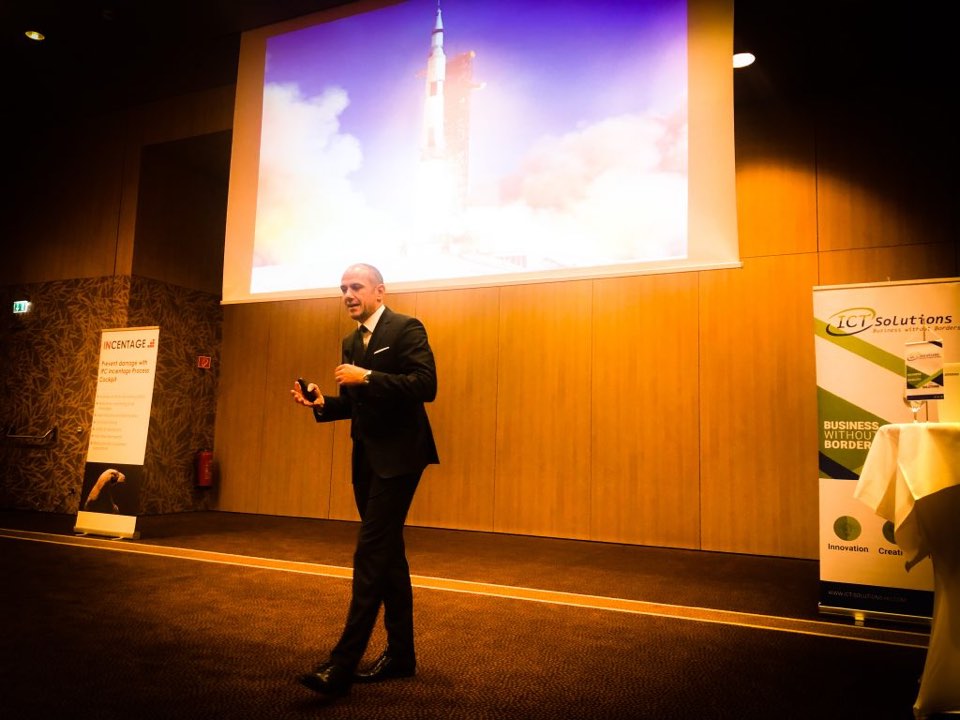
Find highlights here
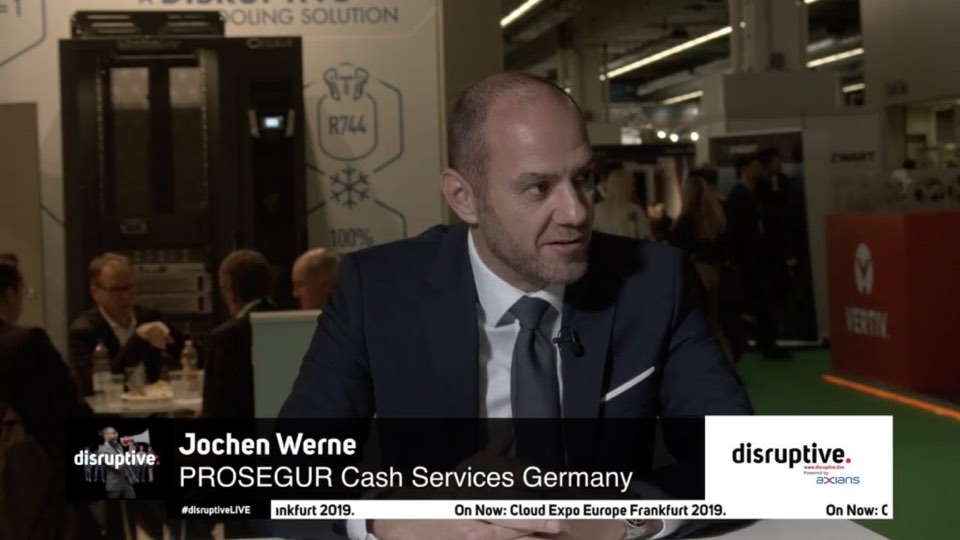
Natalie Turner, Host of disruptive LIVE and Jochen Werne, CDO/CVO of Prosegur Cash Services, Germany in a lively discussion about the different aspects of change in companies and society. The interview touches aspects of fear and consciousness by giving examples reaching from Shakespeare to the Age of Enlightenment and our modern times of exponential technologies and artificial intelligence.
Find the full interview on DisruptiveLIVE, HERE
On Tuesday, November 5, 2019, Managing Director Dr. Stefan Hirschmann and his team from VÖB-Services organised an inspiring BANKENNETZWERK networking event "Digitisation and digital competence in banks" with an auditorium of 70 banking professionals.
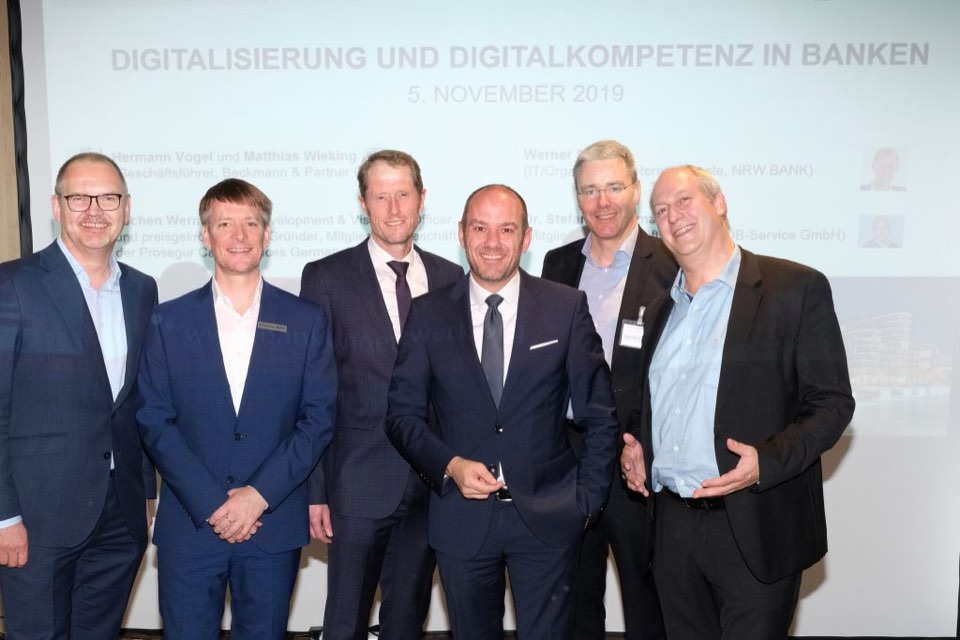
Learning from history is crucial to understand the current societal changes triggered by technological progress. It‘s the basis to be able to make smart strategic decisions in a fundamentally changing business environment.
Some examples in the keynote referring to Professor Niall Ferguson‘s inspiring book „The Square and the Tower“. Enjoy some of his insights here
See more impressions HERE
It has been a privilege discussing with an inspiring auditorium the future of real estate and how technology leads to transformation at the Handelsblatt Summit "Immobilienwirtschaft 2019" in Berlin.
Congratulations to the EUROFORUM Handelsblatt Team for the creation of this highly valuable network
IMPRESSIONS
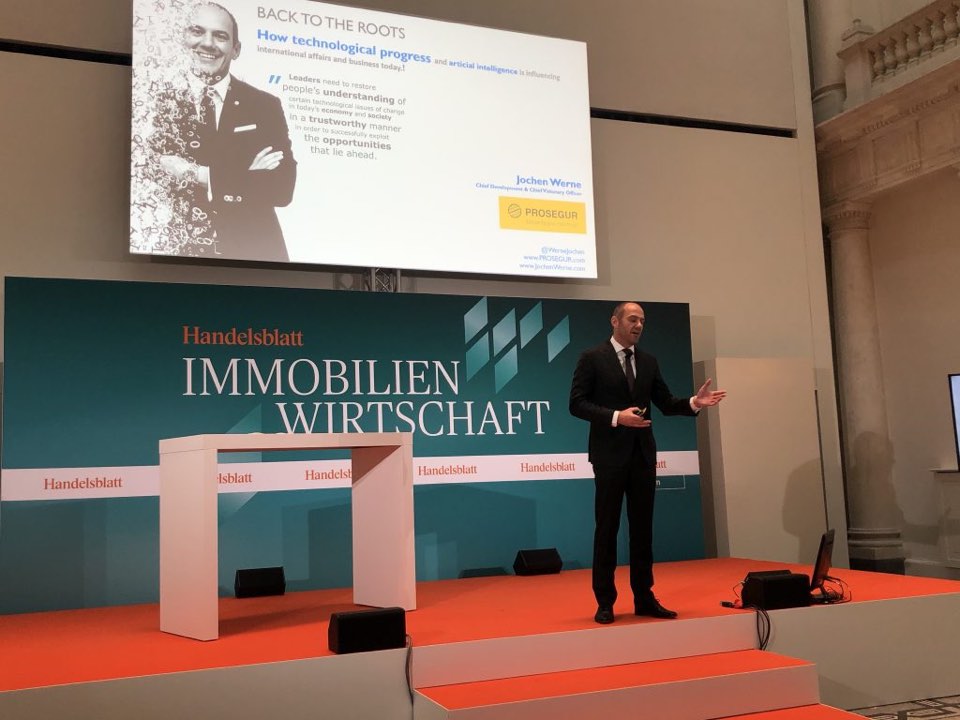
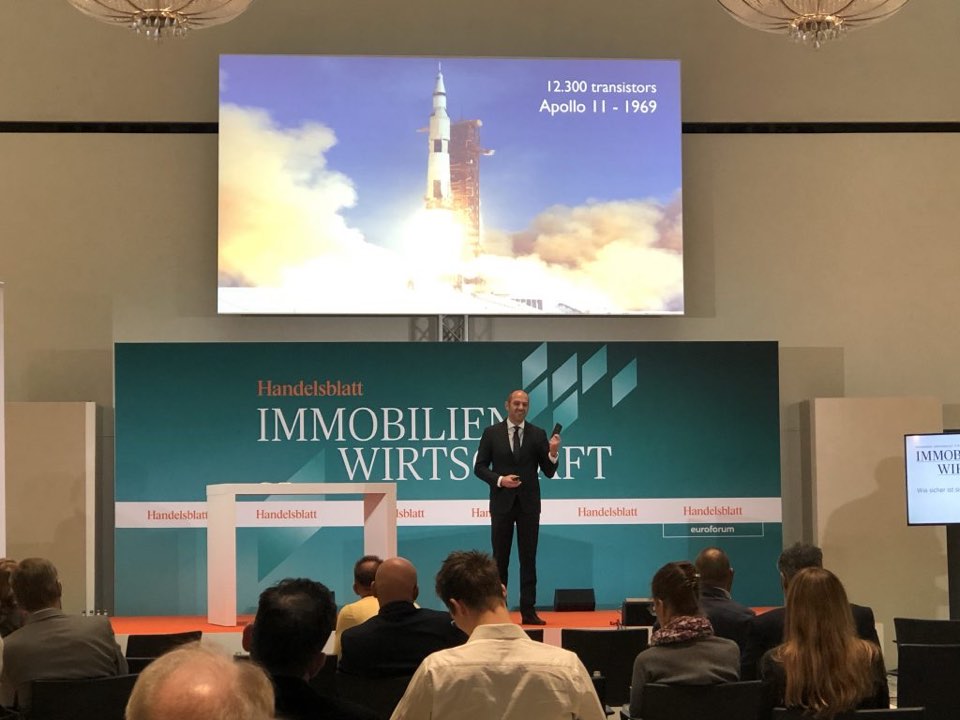
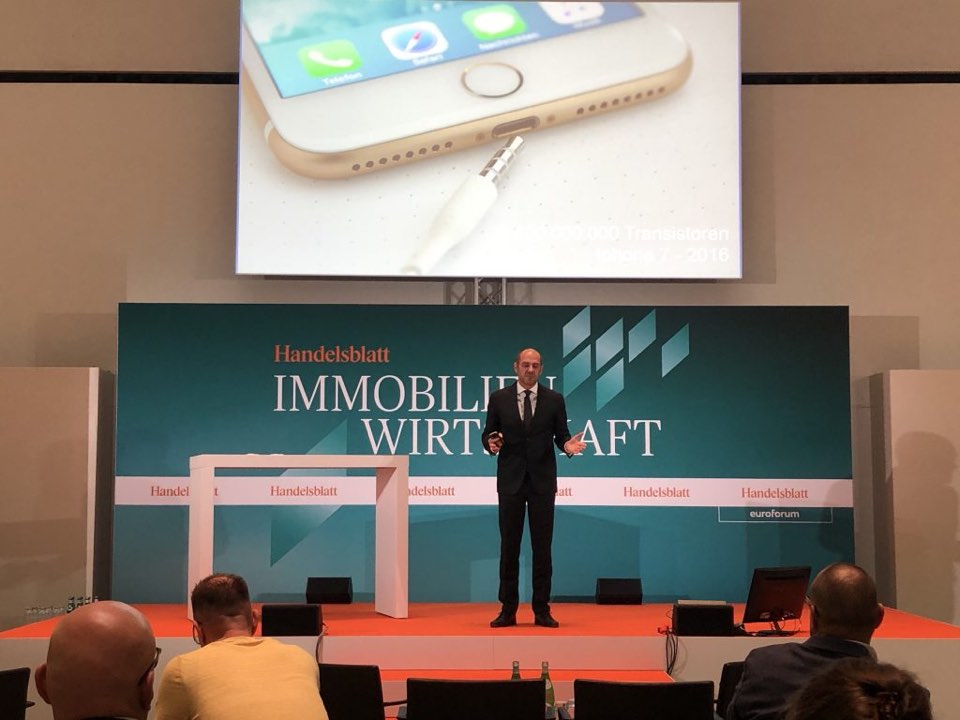
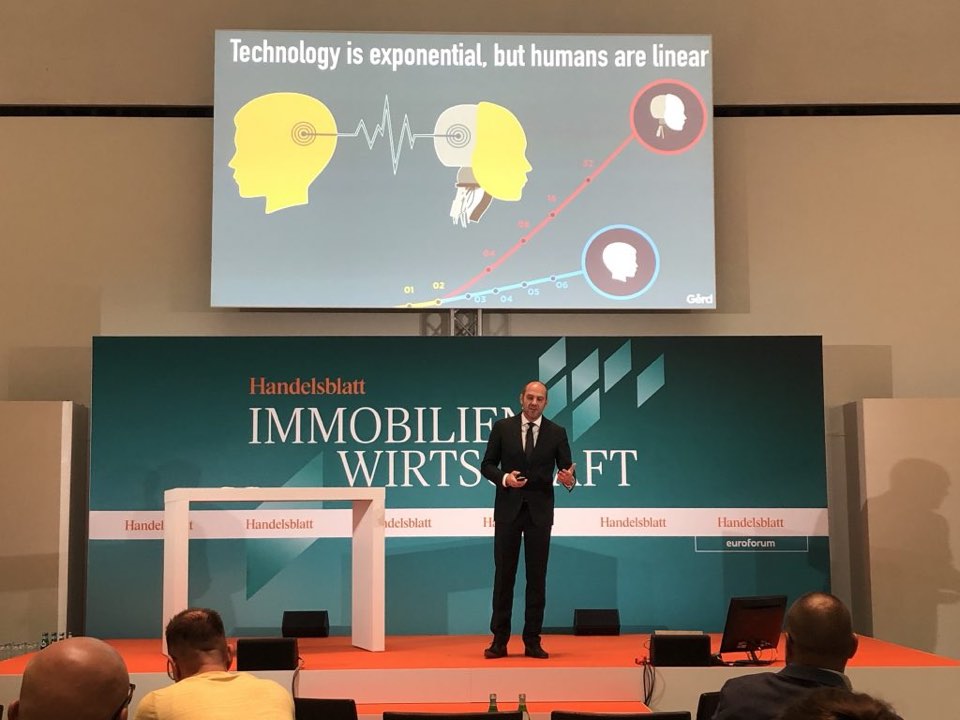
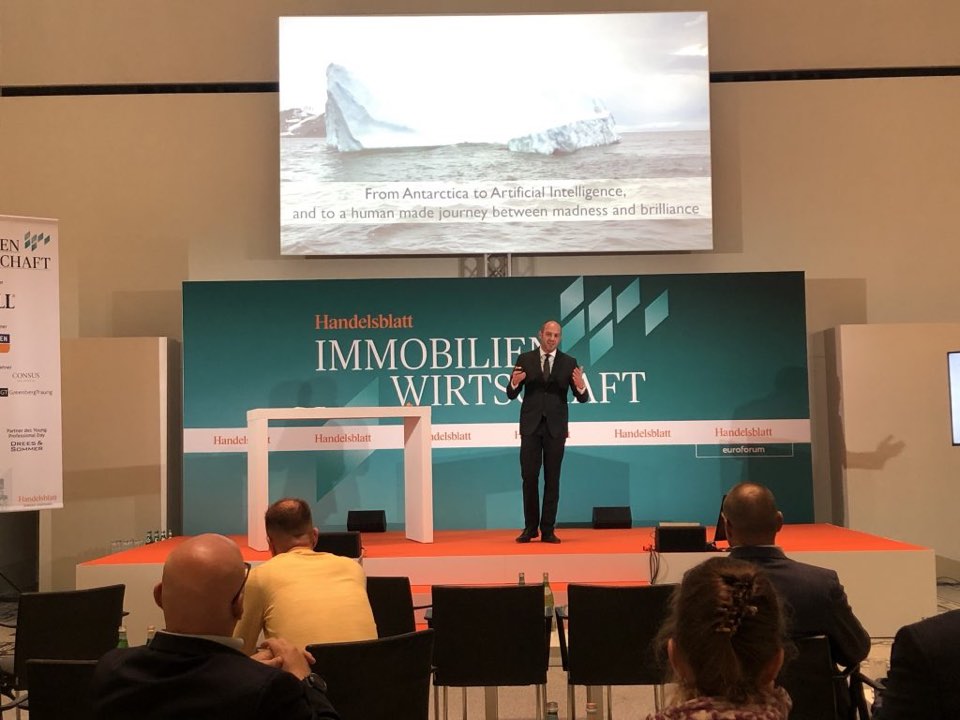
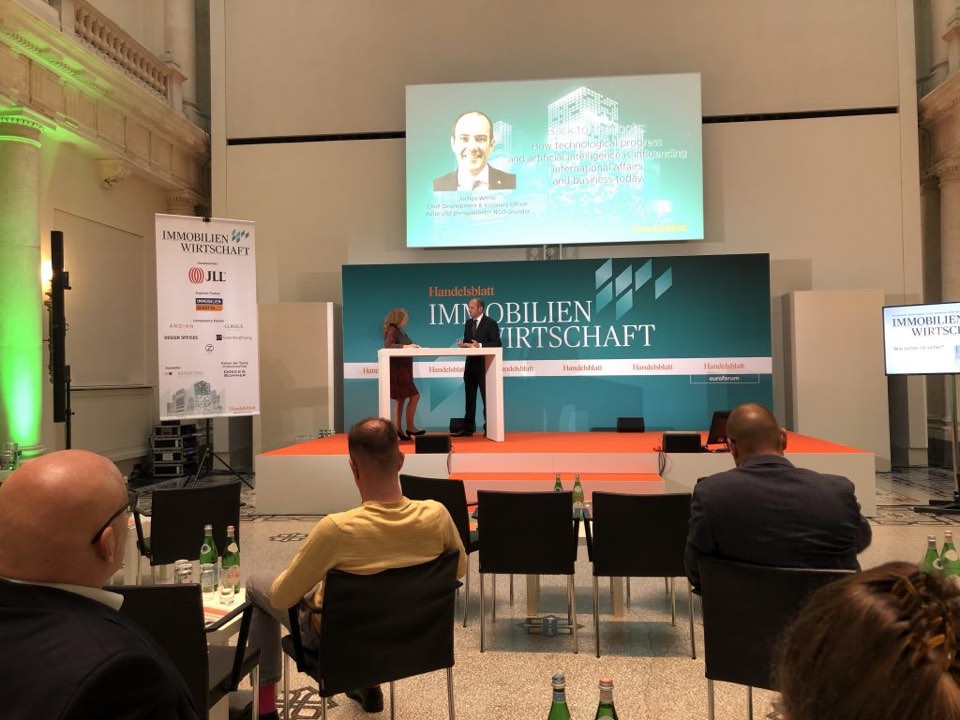
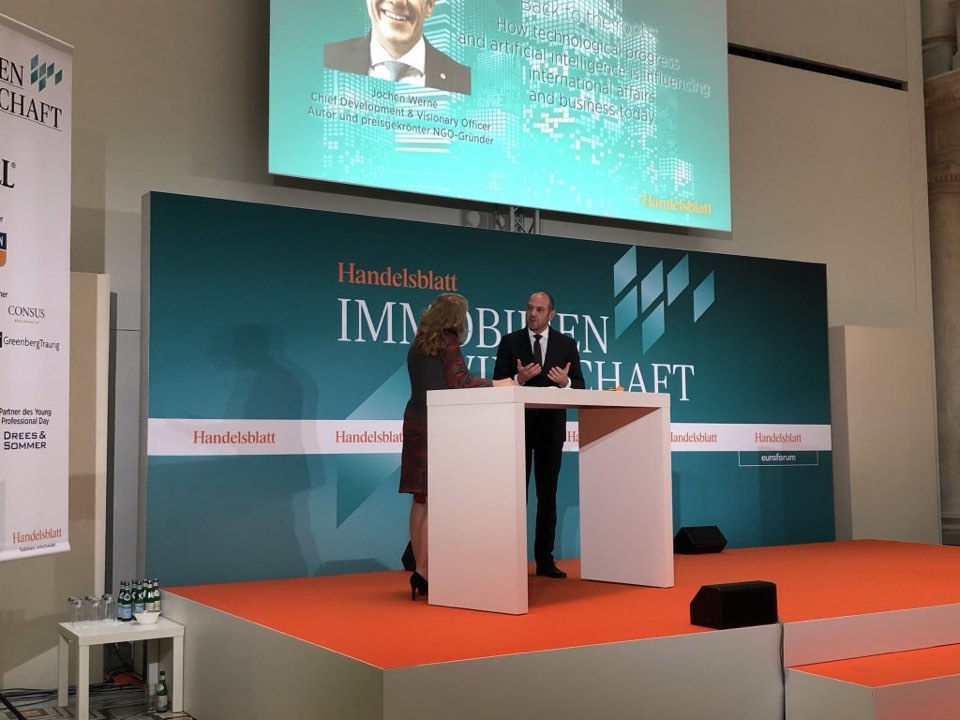
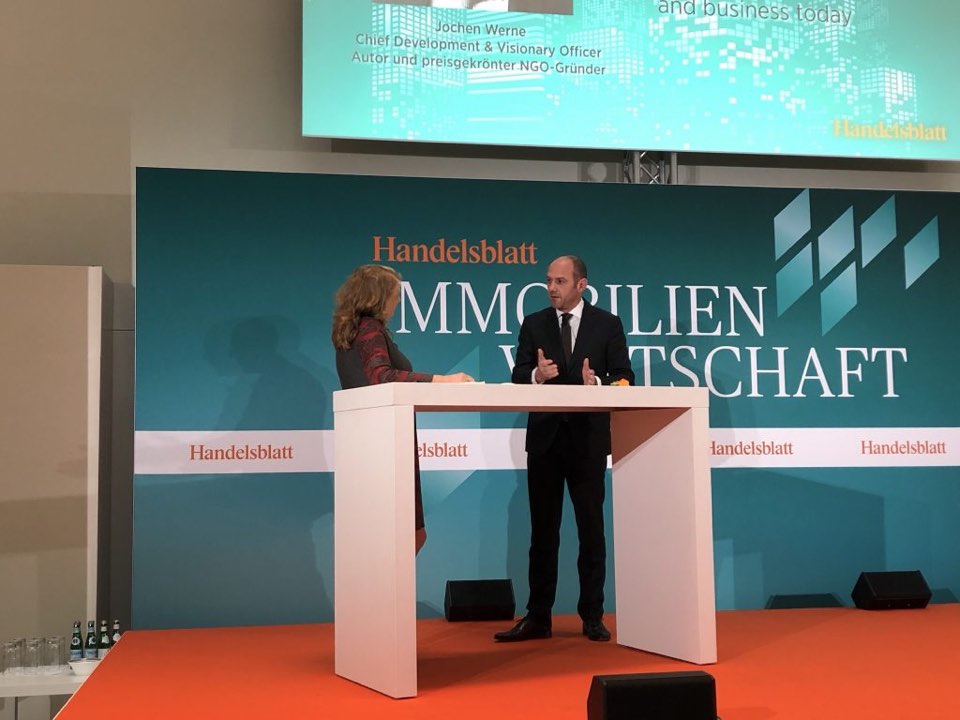
A crypto currency challenges technology, regulation and humans.
Author: Jochen Werne
"Money is perhaps the most concentrated and acute form and expression of trust in the social-state order."
Georg Simmel
In this clarity, the German philosopher and sociologist Georg Simmel, born in 1858, formulated the value of a currency in his work "Philosophy of Money". This clear and comprehensible insight also provides a simple basis for understanding why, for example, states rely on the independence of their central banks. And just as simply the question arises, which order do you trust when it comes to crypto currency?
Almost 4,000 of these currencies now exist worldwide. After Bitcoin, Ether, XRP, Litecoin and Co., Libra now wants to establish itself as a future heavyweight in the market - and with a noble goal. Libra is to become the cashless payment option "for mankind" and make international payment easier.
No crypto currency received comparable media attention, triggered only by the announcement of the project. And the emotionality and toughness with which the discussion is already being conducted shows how seriously the topic is being taken. It's about reputation, influence, control, responsibility and only in the last instance about technology. Central banks and government bodies are sceptical about the "currency of the future" on a broad basis, even though the advancing globalization could argue for a single currency in the long run. A currency that supports a consistent free exchange of goods and services. Also under discussion is whether Libra Coin could be the means of payment for the approximately 1.7 billion people who have no access to banking services and whether the familiarity and the large target group of Facebook, combined with the announced low transaction costs, could make it possible to reach billions of people worldwide.
Technically, not all hurdles have been cleared yet: In order to make a stable coin possible, it is necessary to find the right technology. It is precisely this stability that is supposed to distinguish Libra Coin from other crypto currencies and thus also make it suitable for skeptical end consumers. Members such as Mastercard, Paypal or Ebay should also provide the Libra Association with their names and brand promises additional confidence for the end consumer. But already today the alliance is not as stable as the founding members had hoped and the exits of Mastercard, Visa and Paypal weakens the consortium.
The Libra Association has repeatedly emphasized that it wants to comply with all regulatory aspects, but there are voices at the political and banking levels that are extremely sceptical about the project. The new payment system raises many questions in monetary and legal terms. Central banks and supervisors want to keep an eye on the influence of the potentially new currency and usually share the view that whoever acts like a bank must be treated like a bank. In other words, comprehensive requirements must be met and regulations observed - especially at the international level. This is difficult because current regulations are designed for the classical financial system, with which the Libra system has largely no points of contact. The aim is to keep total regulatory influence and not to allow any possible loopholes.
Despite its American origin, the Libra Coin is to be administered from Geneva by the Libra Association. The idea here is to be regulated by the Swiss Financial Market Supervisory Authority FINMA. Although Facebook has paid a lot of attention to the underlying technology, the legal issues still need to be clarified. Especially with regard to money laundering, consumer protection and possible misuse of the currency for illegal activities. Within the Association, there will be no special treatment for the founder Facebook, but equal voting rights for all members.
With regard to Germany, it can be said that its citizens are within the international average as far as their affinity for digital is concerned. However, a historical-cutlurell caution can certainly be observed with regard to the topic of money, which certainly explains the well-known love of cash. A more pronounced European awareness of data protection with the General Data Protection Regulation (GDPR) makes many people, especially in Germany, sceptical about the subject. The fact that Libra was launched by Facebook is hardly a confidence booster after the Cambridge Analytica scandal. The fear of the transparent customer meets with security concerns about one's own savings. Every German knows the quote: "Friendship ends with money" and thus new things are always put test. Culturally different in Sweden, where sometimes it's only possible to pay by card. The same in China, where WeChat Pay and Alipay are no longer just a trend.
As always, changes are taking place step by step. It remains to be seen whether Libra Coin in its current form has future prospects. In any case, any change can only work if it is accepted and used by the end consumer despite all skepticism.
And this stands and falls - also in the digital world - with what Georg Simmel already put in the centre in terms of money in the 19th century: CONFIDENCE.
A more in-depth look at money and value can be found in the article "Coined Liberty 2.0".
Following the keynote on "Libra in Retail?" at the Payment Summit 2019 in Hamburg, the article "Libra and the Dilemma of Trust" has been published to give participants further insides on the topic.
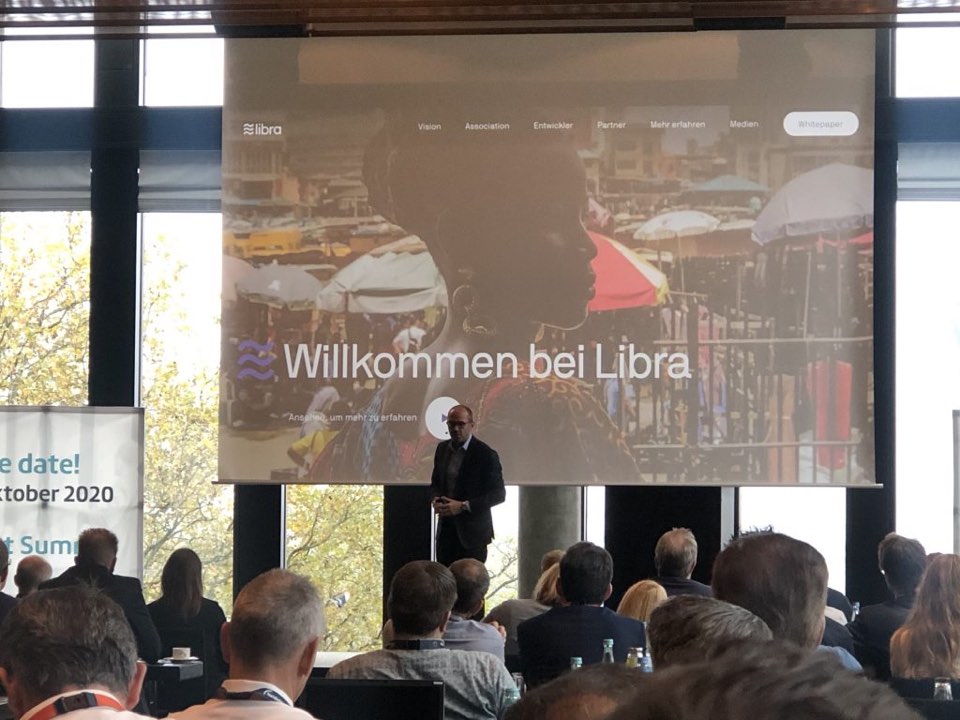
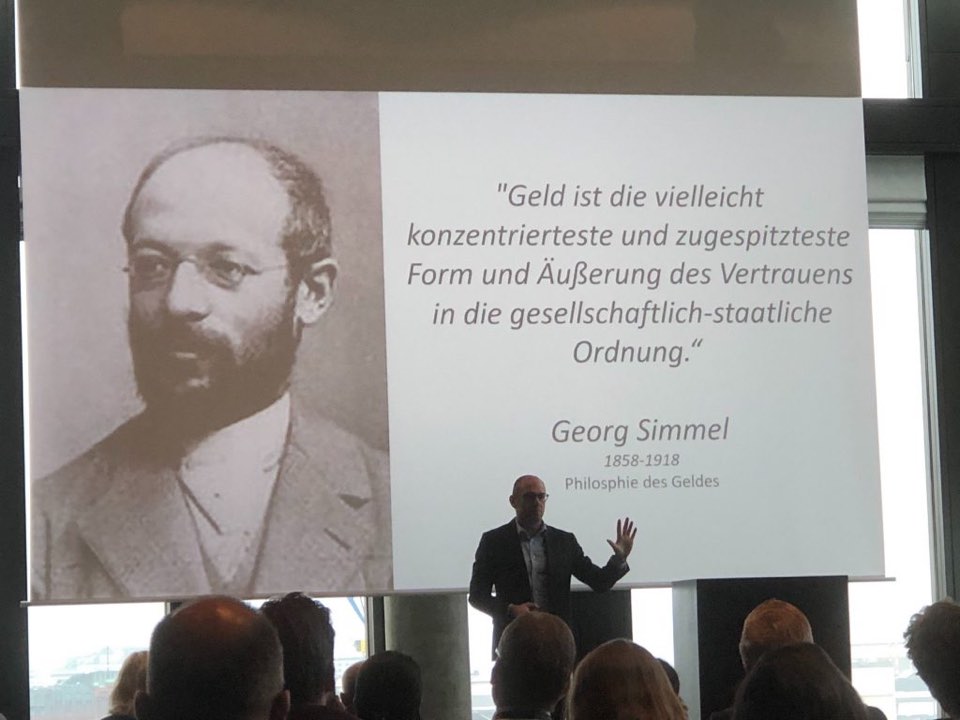
Es war eine besondere Freude beim Digitalgipfel 2019 die Panels der Plattform für Lernende Systeme gemeinsam mit Dr. Johannes Winter, Leiter der Geschäftsstelle der Plattform beim acatech moderieren zu können.
Die Diskussionen führender Persönlichkeiten im Bereich künstlicher Intelligenz der deutschen Wirtschaft führten final zu einem gemeinsamen Nenner:
„Wer es schafft Vertrauenswürdigkeit in KI-Technologien und die damit handelnden Personen zu schaffen, wird sich einen wesentlichen Erfolgs- und Wettbewerbsfaktor sichern. Dies gilt sowohl auf Unternehmensebene wie auch im nationalen Kontext.“
Digitalgipfel 2019
Panel „Forschung – KI für digitale Plattformen“ mit
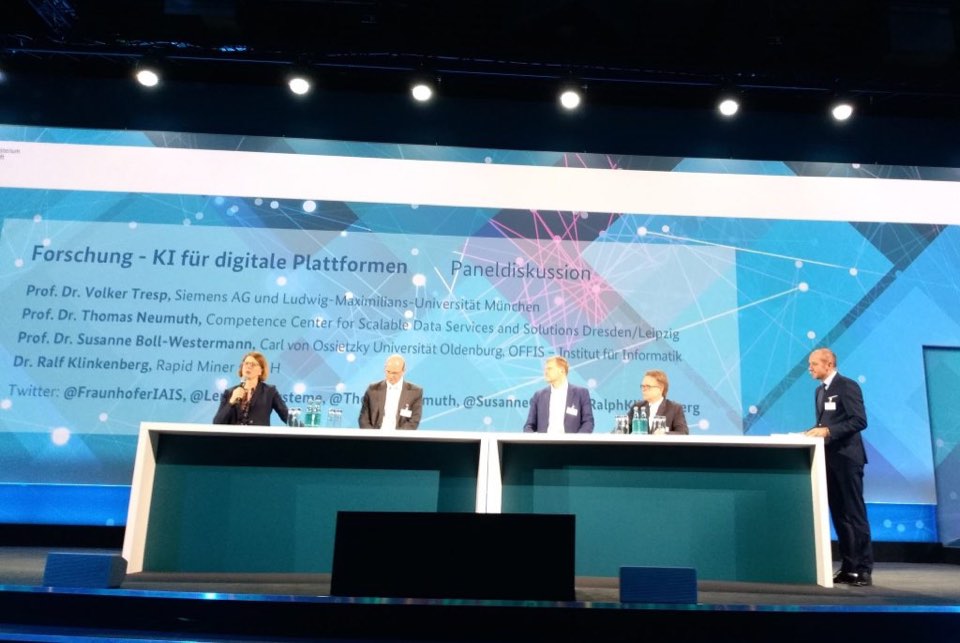
Panel „Transfer und Anwendung – Digitale Plattformen für neue KI-basierte Services“ mit
Moderiertes Gespräch „Vertrauenswürdige KI als Voraussetzung für sichere Datenplattformen“ mit
This prize to be awarded to the person, group or team that contributed the most to the goal of creating international understanding within the year, of the Lord Warden Trophy and it was unanimously agreed by a panel of judges that this should be presented to Jochen Werne (a founder member of GOST as well as a member of RCPYC) for his outstanding work in reaching across national boundaries and promoting and advancing the spirit of sailing around the world both through his work with GOST and the various other organisations he represents, not least his organising the Lord Warden Challenge race. Congratulations to you Jochen.
Geoff Dunne esq., Commodere, Royal Cinque Ports Yacht Club Dover
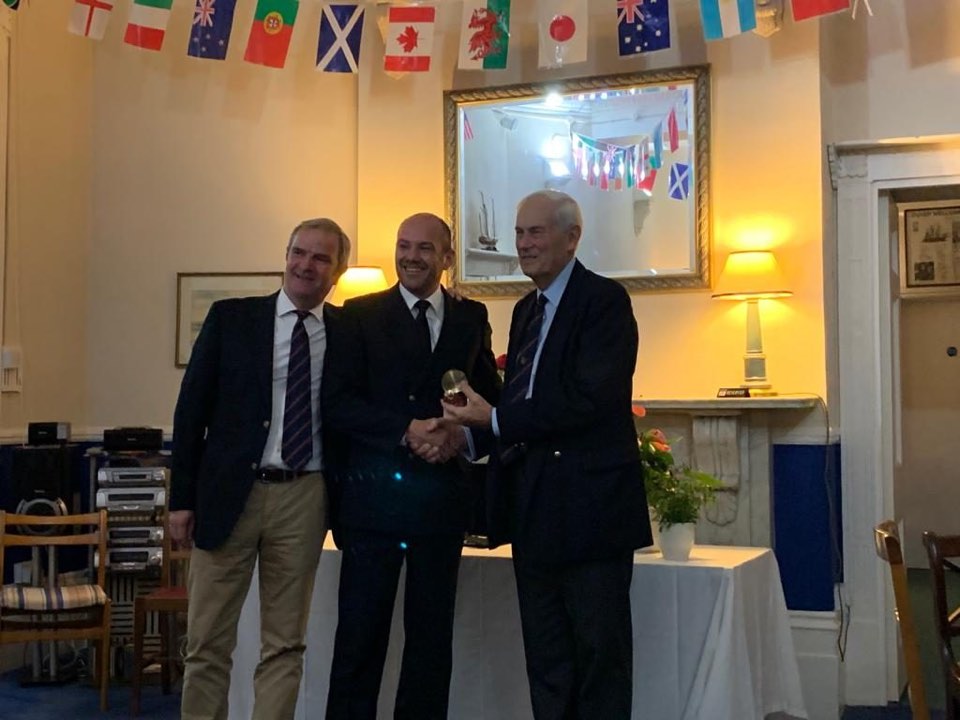
It was a great honour to receive the Admiral of the Fleet The Lord Prize, awarded for the first time for international understanding, on behalf of all those who, through their commitment, have helped to unite people from different countries of our beautiful planet.
A great privilege to receive the prize from the hands of one of the people I greatly admire for his life’s work and especially for his brilliance in bringing people together. The Lord Warden of the Cinque Ports, Admiral of the Fleet The Lord Boyce is a shining example for so many and a great inspiration.

Author: Jochen Werne | First published in German on September 6, 2019 in the BANK—BLOG
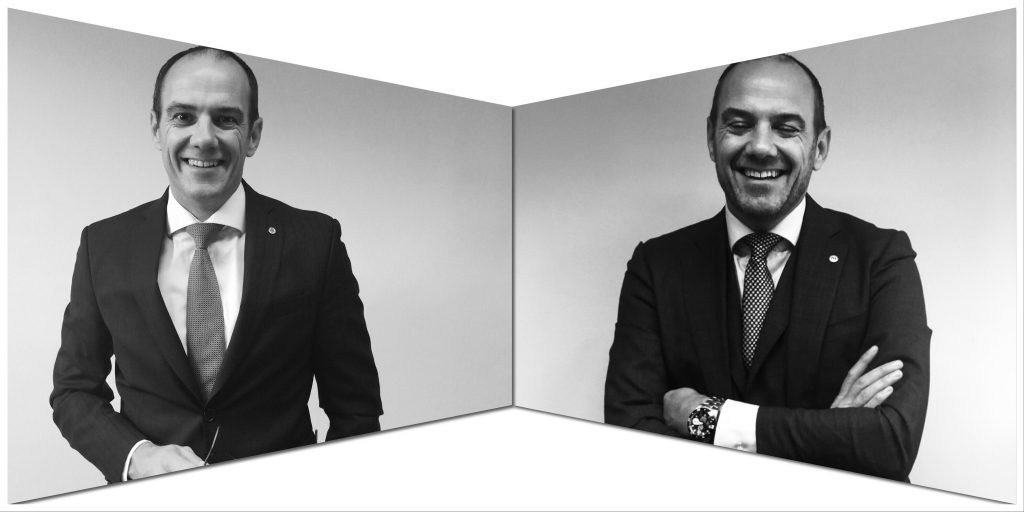
The "cobra effect" is a prime example of failed incentive structures. Good governance in banks and savings banks must serve stability and flexibility at the same time. Compliance with four principles is indispensable.
Well-intentioned is not well done yet. Science calls this the cobra effect. It goes back to an event when India was still a British colony. In order to control a cobra plague, a British governor placed a bounty on every snake that he killed. With the result that enterprising Indians began to breed cobras to collect the bounty. When the governor learned of this practice, he had the program stopped and the breeders released the snakes. Result: The problem had multiplied.
The Kobra effect is regarded as a prime example of failed incentive structures - and thus of failed governance. This word, derived from the French "governance" for government, is often used today, and with its almost inflationary mention, the blur surrounding it is also growing.
So let us recall: governance refers to the structures and forms of governance that exist in a society. This refers to the interaction between the state, the private sector and interest groups. The aim is to improve the management of an organisation or a political or social unit in order to achieve better results.
However, it has become common practice to use governance primarily when it is not a question of state structures. For example, the term plays an important role in practically all companies that deal with the public in the form of customers or stakeholders. As a result of the blurred use of the term, case studies from politics are often used today to explain economic frameworks.
Undoubtedly, there are many parallels between the governance of states and the governance of private companies, in their structure and processes and thus also in their form of governance. The decisive factor for both is first and foremost stability and thus the ability to cope with major crises. For states, the core of stability is the constitution, which enables leadership during the crisis and at the same time serves as the basis for a way out of the crisis. A current example of this is the national crisis in Austria. The government has failed; until the next elections a transitional government of experts will lead the country and thus guarantee stability. Around this core, however, a state structure must also have a certain flexibility in order to be able to react to developments.
And this is where the differences to the private sector begin. States are not in competition with the private sector and generally continue to exist even after crises, even if in extreme cases the political system and its fundamental form of governance may change. The situation is different for companies. Of course, they also need a stable core. But they must be extremely flexible and adapt to market situations in order to survive in the long term. Their stability is based on the flexibility of the process organisation. When it comes to flexibility, smaller companies often have an advantage over large, difficult-to-maneuver corporations. We see this in the financial services industry with the example of FinTechs and InsurTechs. However, these relatively small companies often lack the stability they need to survive when consolidating.
Let's take the example of the banking industry: It faces clear challenges - digitization, new competing business models, exponential technology leaps and ever shorter product cycles with lower margins and increasing regulation. Sustainable answers and the resulting strategies will only be found by those houses that are stable in themselves on the one hand, but are also capable of a degree of flexibility that has never been demanded of them in history on the other.
But how does a company obtain the necessary stability? There are four principles for good, i.e. successful, governance, which must always be present:
Accountability: There must be an organization that is controllable and controlled.
Accountability: The company as a whole and each individual employee are accountable for their actions.
Openness: Only when employees, customers and stakeholders understand what is happening is transparency actually lived out.
Fairness: Ethical conduct is one of the foundations for long-term value creation.
In order to achieve a satisfactory situation for both sides, the four principles of governance are indispensable. However, it is not enough to lay them down in statutes; they must also be lived by each individual.
In addition, the current major transformation issues, which not only the banks but also the entire economy have seized, should be seen as an opportunity for companies with a consolidated governance structure and remind us of a statement by the Roman philosopher Seneca, who said: "Only the tree that has been constantly exposed to gusts of wind is firm and strong, because in battle its roots are consolidated and strengthened".
WHAT HAS IAM & CYBERSECURITY TO DO WITH A FAMOUS CAR CRASH OF A SOVIET LEADER ?
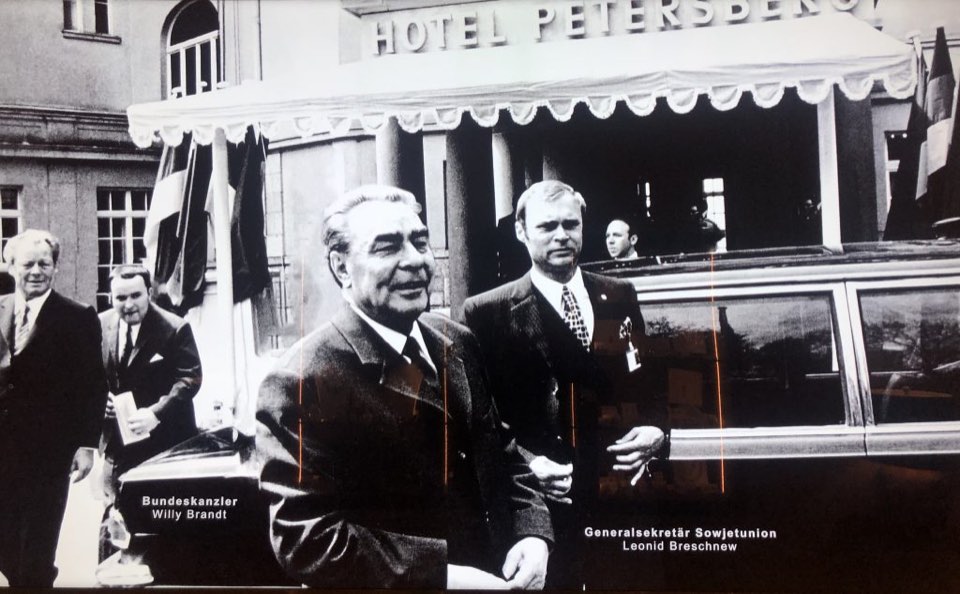
It was a perfect Friday morning over the clouds on the way to give a speech at the famous Steigenberger Hotels and Resorts Grand Hotel Petersberg. In 1973 the Soviet head of state and party stayed for a few days in the luxury hotel and the visit became legendary because Brezhnev had an accident with his guest gift, a sports car, on the curving driveway.
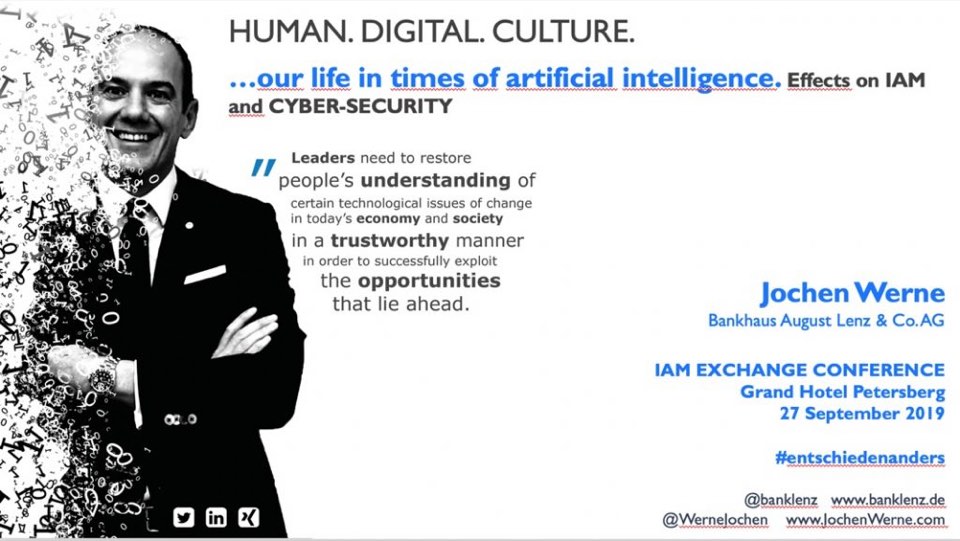
What could be a better place to discuss safety and security with thought leaders in a speech about "#AI and it’s impact on #IAM & #Cybersecurity” at the Executive-Insights IAM Exchange Conference
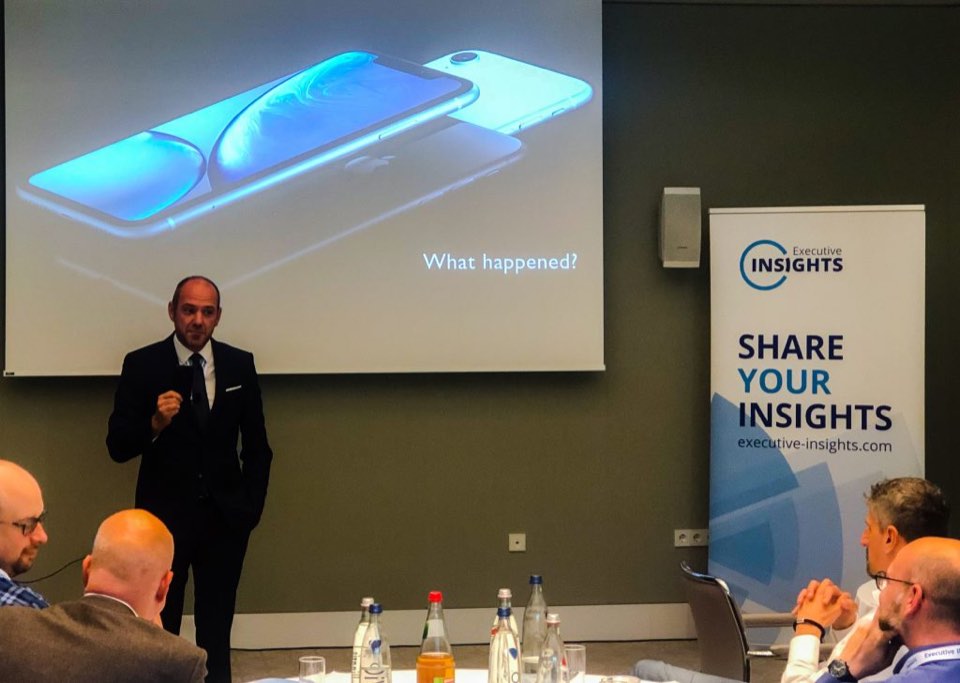
Identity Recovery Services - The smart idea in Cyber Security and Access Management: More to come on this topic soon
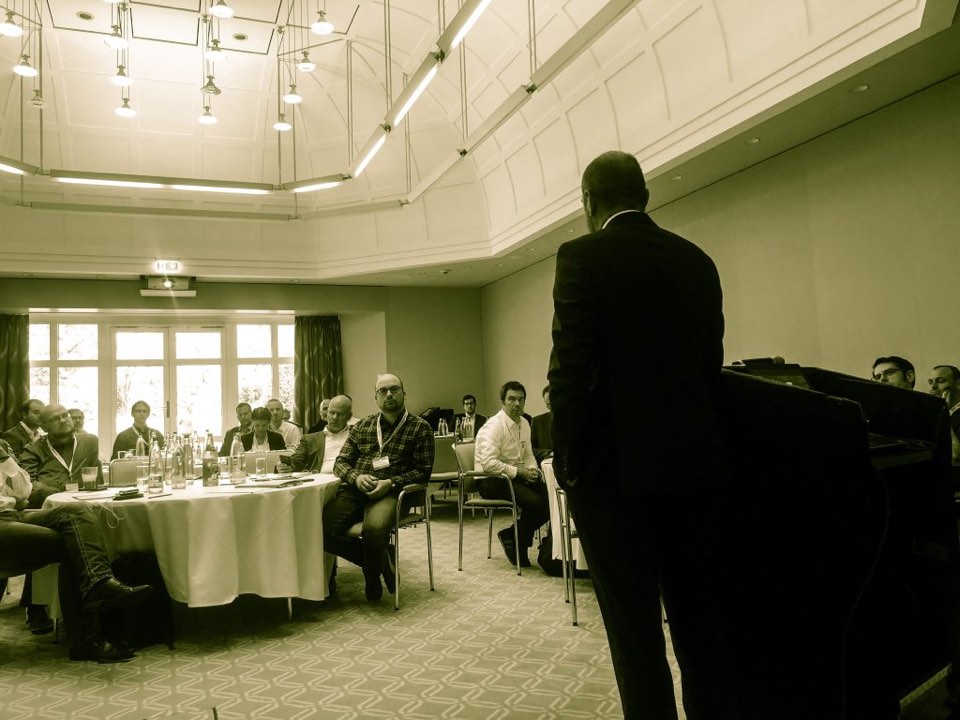
Find more details on the conference at www.iam-exchange.com
It's a great pleasure supporting on October 28, this year's DIGITAL SUMMIT together with other experts from the "Platform Learning Systems, the Platform for Artificial Intelligence" #DigitalGipfel19 #platformeconomy
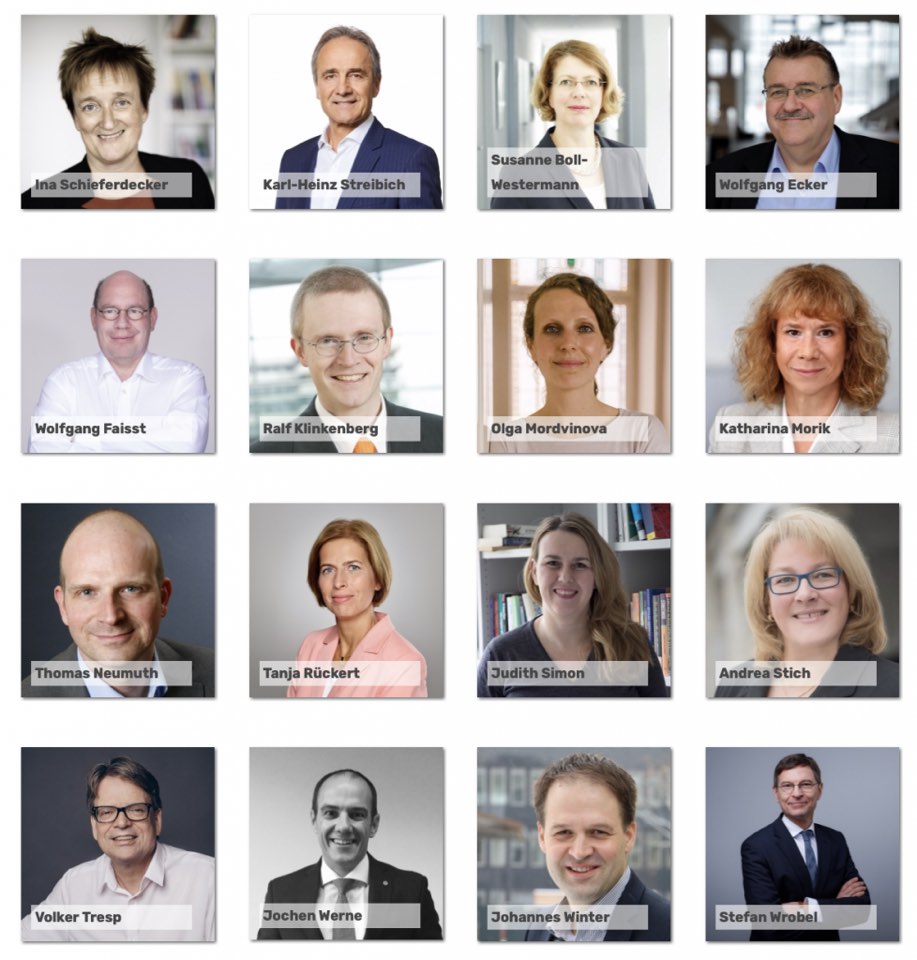
The Digital Summit (previously the National IT Summit) and the work that takes place between the summit meetings form the central platform for cooperation between government, business, academia and society as we shape the digital transformation. We can make best use of the opportunities of digitisation for business and society if all the stakeholders work together on this.
The National IT Summit was renamed the Digital Summit in 2017. This was to take account of the fact that digitalisation comprises not only telecommunications technology, but the process of digital change in its entirety – from the cultural and creative industries to Industrie 4.0.
The Digital Summit aims to help Germany to take advantage of the great opportunities offered by artificial intelligence whilst correctly assessing the risks and helping to ensure that human beings stay at the heart of a technically and legally secure and ethically responsible use of AI.
The Digital Summit looks at the key fields of action within the digital transformation across ten topic-based platforms. The platforms and their focus groups are made up of representatives from business, academia and society who, between summit meetings, work together to develop projects, events and initiatives designed to drive digitalisation in business and society forward. The Summit will serve to present the results of the work that has been done in the past, to highlight new trends and discuss digital challenges and policy approaches.
Looking forward moderating the Panel Discussion on "Digital Platforms for new AI-based Services"
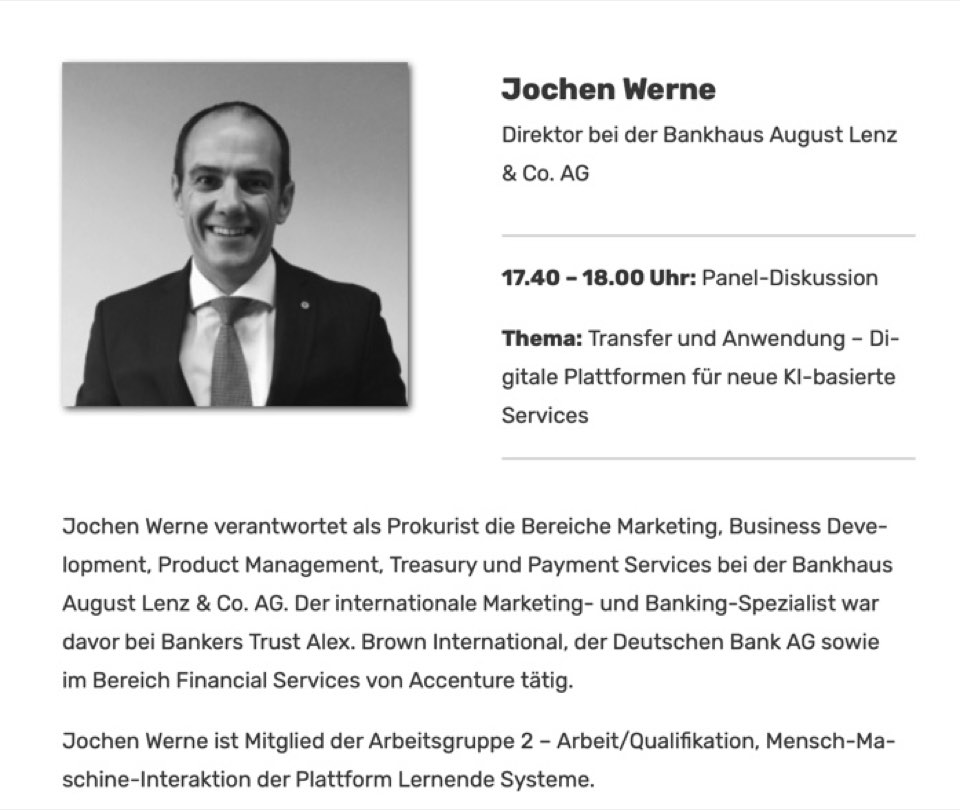
Video Stream of Jochen Werne's keynote at the launch ceremony of the Vietnam Germany Innovation Network (VGI Network).
"It was a great inspiration to meet so many committed people in just one day, ambitious and authentically personally committed, striving for strong intercultural relations between Vietnam and Germany, with the aim of bringing visible benefits to the people of both nations".
Jochen Werne
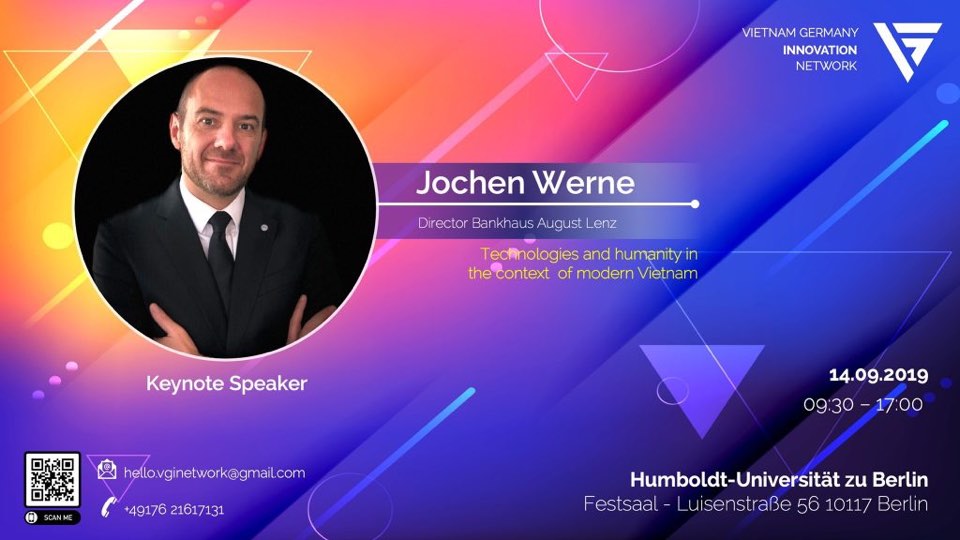
Experience more about the VGI Network at https://www.facebook.com/VGInetwork2019/
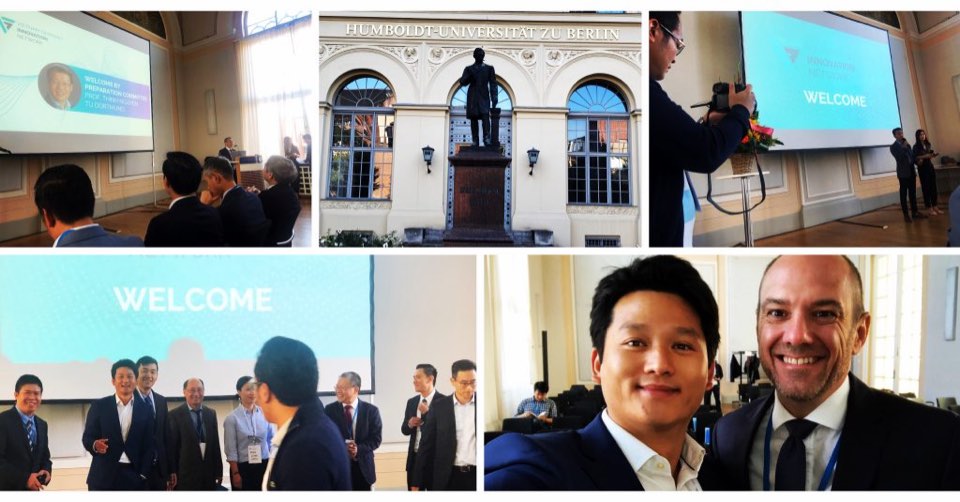
Great discussions on the suspicious nature of society with data experts at the BankenForen Conference IT- & Cybersecurity in the financial industry
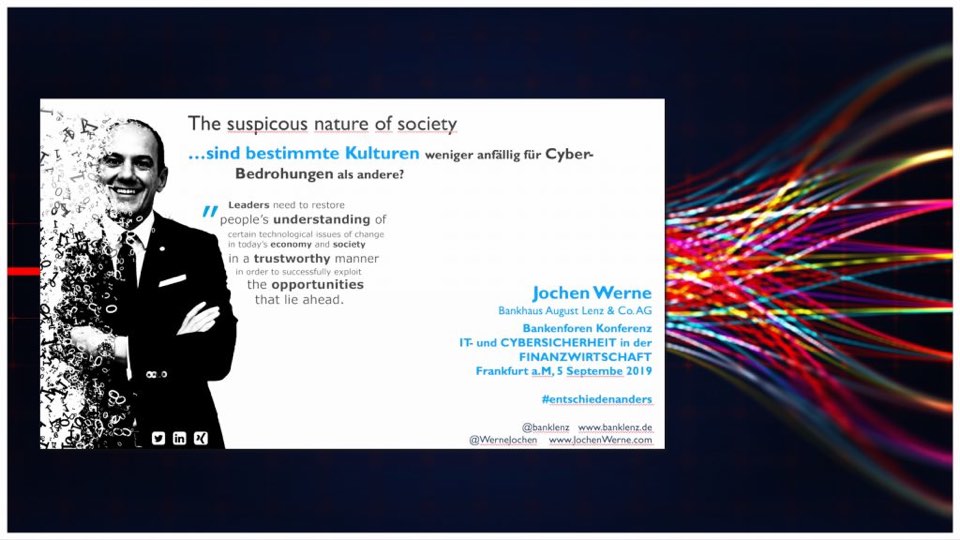
Details HERE
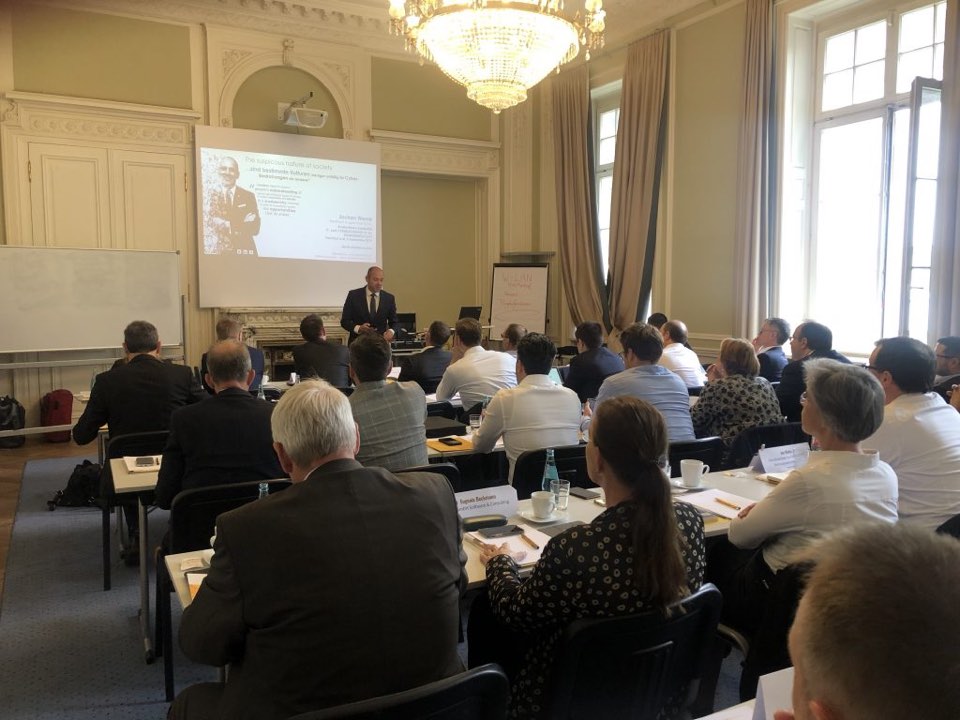
Inspiring discussions with Michael Kaiser, Head of Department for Financial Institutions at the Office for Data Protection of the German State of Hesse & Ralf Heim, Co-Founder of Fincite.
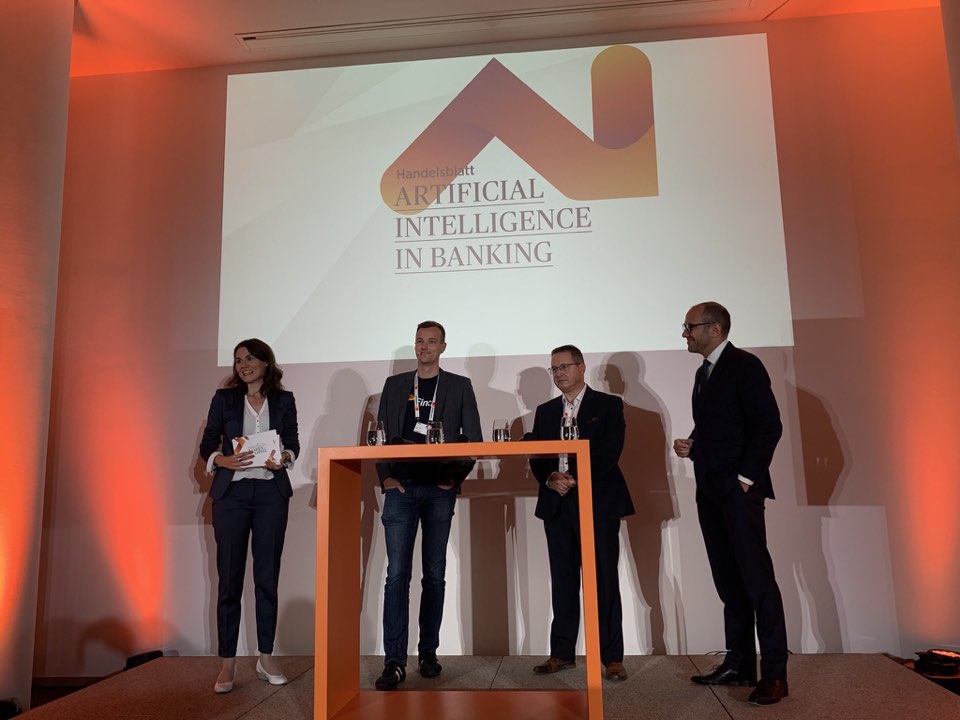
Finance Journalist at Handelsblatt Katharina Schneider greatly moderated the panel: “Chances & Risks of #Technology - Can data protection and artificial intelligence be reconciled?”
Details HERE
It's a great pleasure seeing GOST's Documentation Officer Stefano Malvestio in an in-depth Interview with Italian TV-station Asterisco about Navigator's Heritage Challenge and its effects produced in the creation of International Understanding and the creation of awareness for the UN Global Goals.
The Lord Warden Cup is a 200nm Offshore Sailing Challenge from Dover to Portsmouth and back, with the goal to install a stable international relations between sailors and people.
The Cup is conjointly organised by the Global Offshore Sailing Team (GOST) and the Royal Cinque Ports Yacht Club Dover (RCPYC)
The Cup has been inspired by the current Lord Warden, Admiral of the Fleet The Lord Boyce, who has been for the Cup’s initiators a role model for a creator of international relations.
The 1st Lord Warden Offshore Cup will take place between Thursday October 10, 2019 and Sunday, October 13, 2019.
This Cup is awarded to the Winners of the Offshore Sailing Challenge
This prize is awarded to the person, group, association or team who contributed most to the goal of creating international understanding within this years’ Lord Warden Cup

by Katharina Schneider - Handelsblatt, 21 August 2019 -
"It has been inspiring discussing with Katharina Schneider about AI and the future of the financial sector and being quoted in her article among other experts as Prof. Andreas Dengel (DFKI), Dirk Elsner (DZ Bank) and Nils Beier (Accenture) . Read the original article here"
Jochen Werne
Frankfurt The interplay between artificial intelligence and the financial sector in Great Britain will soon be very vivid: from 2021, the portrait of Alan Turing will adorn the new 50 pound notes. The scientist is known for his early research on computer technology. (translated with DeepL.com)
Read the original article here
It has been pleasure being guest author for the DIGIPRAKTIKER, Finanz Colloquium Heidelberg.
Author: Jochen Werne, Director Business Development, Product Management, Treasury and Payment Services at Bankhaus August Lenz & Co. AG
I. Introduction
The only constant in history was, is and remains change. Gutenberg's invention of the printing press in 1450 was a milestone on the timeline of human development. Today we still take note of this invention, which was considered an innovation at that time, but we have long lived surrounded by smartphones and cloud applications, in which we can store the most private information and retrieve it from anywhere in the world. Today's change is being driven by a veritable digital revolution.
Digital change already has fundamental consequences for individuals and their lifestyles, but it is developing its full potential when it comes to interacting with our social environment. In times of smart robotics and maturing systems in relation to artificial intelligence, the question arises again and again what role humans play on the stage of these technologies. Is he …
Read the full article by clicking here and being forwarded to the DigiPraktiker
We've been honoured by a message arrived from the ASOCIACIÓN PARA LA INVESTIGACIÓN Y DIFUCIÓN DE LA HISTORIA NAVAL DE CUBA. We are grateful that we were able to establish a long-term relationship with this esteemed association and its great members . Together we reached far beyond the boundaries often faced by national politics.
Jochen Werne
Co-Founder Global Offshore Sailing Team

¡EXCELENTE! 20 años de esfuerzos, destinados al matenimiento de las tradiciones e historia naval, a mantener vivas las hazañas de los pioneros exploradores, a unir a la familia naval internacional, a unir pueblos, culturas, a salvaguardar el medio ambiente y a lograr la union de los pueblos con un mensaje de paz y de concordia. Toda esa labor a hecho grande a GOST, que sin dudas hoy ocupa el liderazgo entre la organizaciones de su clase. Nos sentimos profundamente honrados y orgullosos de haber sido un pedacito de esta hazaña de gigantes. ¡Larga vida a Global Offshore Sailing Team! Sois un ejemplo a seguir, una esperanza. FELICITACIONES!!!! Reciban todos su miembros, las muestrasde del más profundo respeto y admiración de la Asociacion para la Investigacion y Difusión de la Histora Naval de Cuba. Gracias por existir.
Maximino Gomez Alvarez
Vice-President of the AIDHNC

Translation: EXCELLENT! 20 years of efforts aimed at maintaining naval traditions and history, keeping alive the exploits of pioneer explorers, uniting the international naval family, uniting peoples, cultures, safeguarding the environment and achieving the union of peoples with a message of peace and harmony. All that work has done great to GOST, which undoubtedly today occupies the leadership among the organizations of its kind. We feel deeply honored and proud to have been a bit of this feat of giants. Long live Global Offshore Sailing Team! You are an example to follow, a hope. CONGRATULATIONS! Receive all your members, the deepest respect and admiration of the Association for the Research and Dissemination of the Naval History of Cuba. Thank you for existing.
25. JULY 2019 BY JULIANE WAACK - KEYNOTE BY Jochen Werne

For the opening keynote of our ec4u virtual conference Digital Thoughts on May 23rd, Jochen Werne, Director Marketing & Authorised Officer at Bankhaus August Lenz, talked about opening up to the digital transformation. It turns out, what we associate with technology and what it actually offers are often two completely different things.
„Companies and people need to participate actively in the transformation. We need to move. It’s impossible to be a passive participant in the transformation.“
J. Werne
It has been a great pleasure being invited as studio guest to the BR-Abendschau and to speak with Christoph Deumling about the Navigators Heritage Challenge (www.NavigatorsHeritage.com), the Global Offshore Sailing Teams impact on international understanding and the creation of international awareness for the UN Global Goals and environmental issues
It has been a great pleasure giving an interview to Bernhard Bomke, about the development of the Robo-Advisor market in Germany, Innovation, Banking and the impact of Artificial Intelligence.
I'm proud having the opportunity to publish today this homage to all on- and offshore members of the Global Offshore Sailing Team (GOST). They created in the last 20 years a unique example of people's diplomacy. Founded in 1999 by Jochen Werne and Guido Zoeller, the Global Offshore Sailing Team, acts today as an international group of dedicated sailors comprised of members from all over the world. GOST which navigates on oceans worldwide and in which many teammates have naval backgrounds, have made it a priority to keep naval traditions alive and to use expeditions as instrument for the creation of international understanding and peoples’ diplomacy.
Jochen Werne
Co-Founder GLobal Offshore Sailing Team
The Working Group 2 "Future of Work and Human-Machine Interaction" of the German Platform for Artificial Intelligence "Platform Learning Systems" recently published its Whitepaper.

The working group focuses on human-centred design of the future working world and on human-machine interaction issues (HMI). At the same time the working group serves as the interface between HMI and the area of Manufacturing and Industrie 4.0.
It's an inspiring honour being member of this body of experts.
Download the Whitepaper here
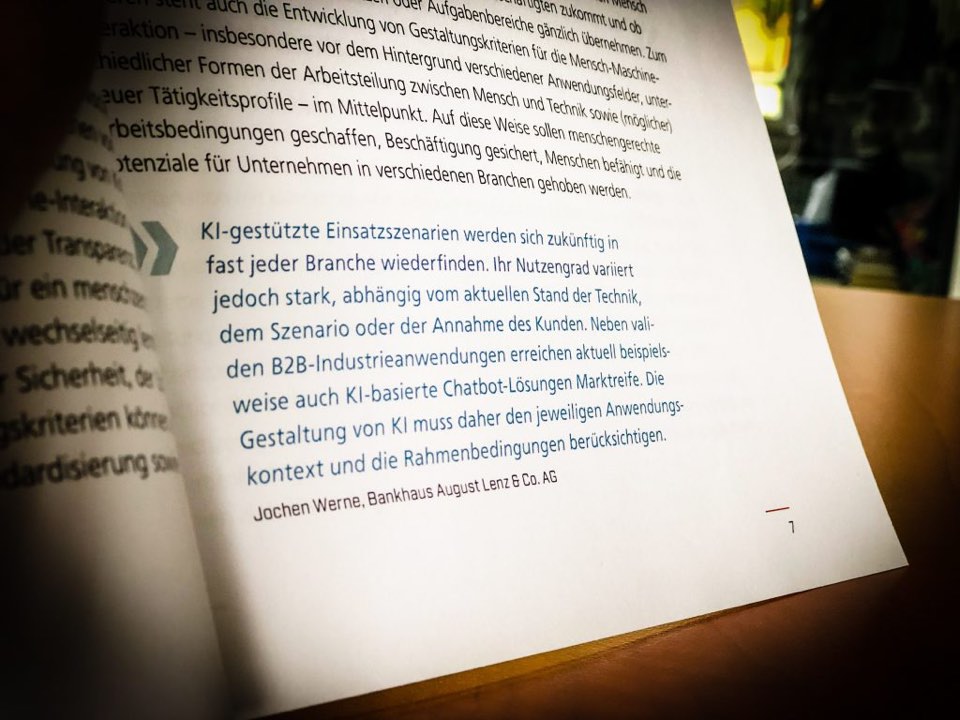
AI-supported scenarios will be found in almost every industry in future. However, their degree of benefit varies greatly depending on the current state of technology, the scenario and the customer's acceptance. In addition to valid B2B industry applications, AI-based chatbot solutions are for example currently reaching market maturity. A project using AI-technology must therefore take into account the respective use-case context and framework conditions.
Jochen Werne, Bankhaus August Lenz & Co. AG
This paper was prepared by the Working Group Work/Qualification, Human-Machine Interaction of the Learning Systems Platform. As one of a total of seven working groups, it investigates the potentials and challenges arising from the use of artificial intelligence in the world of work and life. The focus is on questions of transformation and the development of humane working conditions. It also examines the requirements and options for qualification and lifelong learning, as well as starting points for shaping human-machine interaction and the division of labour between humans and technology.
The Working Group is lead by:
Prof. Dr. Elisabeth André, Universität Augsburg
Prof. Dr.-Ing. Prof. e. h. Wilhelm Bauer, Fraunhofer-Institut für Arbeitswirtschaft und Organisation IAO und Universität Stuttgart
Members of the Working Group are:
Prof. Dr. Lars Adolph, Bundesanstalt für Arbeitsschutz und Arbeitsmedizin (BAuA)Prof. Dr.-Ing. Jan C. Aurich, TU Kaiserslautern
Vanessa Barth, IG Metall
Klaus Bauer, TRUMPF Werkzeugmaschinen GmbH + Co. KGNadine Bender, KUKA Deutschland GmbH
Prof. Dr. Angelika Bullinger-Hoffmann, TU Chemnitz
Prof. Dr.-Ing. Barbara Deml, Karlsruher Institut für Technologie (KIT)
Prof. Dr. Prof. h.c. Andreas Dengel, TU Kaiserslautern und
Deutsches Forschungszentrum für Künstliche Intelligenz (DFKI) GmbH
Dr. Jan-Henning Fabian, ABB AG
Prof. Dr.-Ing. Sami Haddadin, Munich School of Robotics and Machine Intelligence,
TU München
Prof. Dr. Michael Heister, Bundesinstitut für Berufsbildung (BIBB)
Dr. Norbert Huchler, Institut für Sozialwissenschaftliche Forschung e.V. (ISF-München)Dr. Nadine Müller, Vereinte Dienstleistungsgewerkschaft (ver.di)
Dr. Rahild Neuburger, Ludwig-Maximilians-Universität München
Prof. Dr.-Ing. Annika Raatz, Leibniz Universität Hannover
Prof. Dr.-Ing. Jürgen Roßmann, Rheinisch-Westfälische Technische Hochschule AachenProf. Dr. Christoph M. Schmidt, RWI – Leibniz-Institut für Wirtschaftsforschung und Ruhr-Universität Bochum
Prof. Dr. Jochen Steil, TU Braunschweig
Andrea Stich, Infineon Technologies AG
Oliver Suchy, Deutscher Gewerkschaftsbund (DGB)
Prof. Dr.-Ing. Sascha Stowasser, Institut für angewandte Arbeitswissenschaft (ifaa)
Dr. Hans-Jörg Vögel, BMW Group
Dr. Bernd Welz, SAP SE
Jochen Werne, Bankhaus August Lenz & Co. AG
The Working Group is supported by:
Dr. Chi-Tai Dang, Universität Augsburg
Dr. Andreas Heindl, Geschäftsstelle der Plattform Lernende Systeme
Dr.-Ing. Matthias Peissner, Fraunhofer-Institut für Arbeitswirtschaft und Organisation IAODr. Anke Soemer, Fraunhofer-Gesellschaft zur Förderung der angewandten Forschung e.V.
An interview series made by Entrepreneur Sascha Adam, wegofive
Find article here
In the penultimate part 3 of our interview with Jochen Werne from the Munich based bank, Bankhaus August Lenz & Co. AG, Mediolanum Banking Group is concerned with the question which characteristics can help us in companies to shape the real challenge of #digitization and #transformation.
Approaches that came out of the conversation, among other things: Transformation
In addition also the supposedly simple core idea of Jochen:
We need the people in the center (not the technology), because only the people "do" the transformation and only in their role as customers new #products and #business models become real through acceptance and acceptance.
"Transformation ist kein Projekt, vielmehr ein dauerhafter Prozess"
Jochen Werne
In dem vorletzten Teil 3 unseres Interviews mit Jochen Werne von dem Bankhaus August Lenz & Co. AG, Mediolanum Banking Group geht es um die Frage welche Eigenschaften uns in Unternehmen helfen können die eigentliche Herausforderung der #Digitalisierung, die #Transformation, zu gestalten.
Ansätze, die in dem Gespräch u.a. herauskamen: Transformation...
* ...ist kein Projekt, sondern ein dauerhafter Prozeß
* ...ist eine Führungsfrage
* ...erfordert Neugierde
* ...hat im Zentrum den Faktor "Mensch"
* ...muss auch die Kultur berücksichtigen
Dazu auch der vermeintlich simple Kerngedanke von Jochen: Wir brauchen den Menschen im Mittelpunkt (nicht die Technologie), weil erst der Mensch die Transformation "macht" und erst in seiner Rolle als Kunde neue #Produkte und #Geschäftsmodelle durch die Akzeptanz und Abnahme real werden lässt. #customercentricity #kulturwandel #business #leadership #wegofive
Author: Jochen Werne
First published in German at LinkedIn Pulse on July 20, 2019. Please find article and sources in this link. Publication in English language pleas find below
Fyodor Mikhailovich Dostoyevsky, one of the most important writers of the 19th century, impressively describes in his works the great existential and spiritual conflicts in which mankind was caught at the dawn of modernity. Not only his observations during the turbulent times of the upheaval of the Russian Empire in the 19th century, but also his personal experiences are an essential part of his work.

At the age of 28 and at the beginning of a promising career as a writer, Dostoevsky was sentenced to four years in a Siberian prison camp. The reason for this was his participation in meetings of the Petraschwezen, an intellectual circle that spoke out against tsarist despotism and serfdom. In his novel, "The House of the Dead", which also describes Dostoyevsky's own experiences in Siberian captivity, he formulates the sentence that was later much quoted: "Money is coined liberty". The sentence describes the vital relevance of the possibility of a free exchange of goods in an unfree environment - and this through coined cash money.
More than 150 years have passed since the first publication of the work. Europe needed to go through the age of Enlightenment, the experiences of two world wars and a long cold war to become a peaceful and very liberal place for its citizens. A place which is putting the dignity and freedom of the individual first.
The freedom in our payment options has also multiplied thanks to technological progress. It is part of our everydays life to pay the morning croissant at the bakery, the new monthly ticket for the subway or even the use of public toilets - even without cash. Technological progress, the smartphone revolution and also our user behaviour made this evolution in payments possible. "Digital payments" have become part of our progressive society. However, the aspect of not having money physically tangible sometimes entails interesting and also unwanted aspects.
Like Dostoevsky, we also live in a time of extreme social, economic and political upheaval. An age in which exponential technology developments, industries and business models are changing radically and countries competing for dominance in areas such as artificial intelligence. It is a time when transformation is the new normality and an agile corporate culture is the key to success. In these times, for many it became clear that, "Everything that can be digitized will be digitized." And thus the question inevitably arises whether this also applies to the first "Instant Payment" solution humans invented, one of the earliest and most sustainable achievements of civilization - cash.

If we look at Germany, cash is still one of the most popular payment methods and - culturally speaking - will probably remain for quite some time to come. According to a survey by the Bundesbank, 88 percent of German citizens continue to regard cash as their preferred means of payment. This cultural imprint can certainly also be traced back to modern history and the personal experiences of the Germans with their money. Beginning with the traumatic experience of hyperinflation during the Great Depression of 1923 and the resulting deep-rooted German understanding of the importance of a central bank independent from politics.
A painful experience, which states even today - like Venezuela - live through again and again and whose causes are often identical. In Reinhard and Rogoff's bestseller book "This time is different", this phenomenon is brilliantly explained using an analysis of 800 years of international economic history.
The positive image of (cash) money in Germany was impressively advanced after the end of the 2nd World War. From the currency reform of 1948 and the beginning of the economic miracle with 40 D-Mark, which every German was allowed to hold physically in his hands, to the 100 D-Mark welcome money at the reunification in 1989. These personal experiences paired with a consistently brillant independent work by the German Bundesbank - which always gave the population the feeling of having a strong, stable and secure own currency - are all German experiences, which were literally "obvious" and shaped the cultural reference of the country and its citizens.

The current freedom of our payment options is certainly good, as long as we consumers are free to decide which means of payment we pay with. Discussions about a possible restriction of citizens' freedom of choice, for example through the abolition of cash, regularly call on intellectuals to take a warning position. The poet Hans Magnus Enzensberger, for example, has the following opinion on the subject of "restriction": "Those who abolish cash abolish freedom". Also former Deutsche Bundesbank board member Carl-Ludwig Thiele said at a conference in 2015: "Abolishing cash would hurt consumer sovereignty — the free choice of citizens about their payment instruments“ and "Government agencies do not have the right to tell citizens how they should pay.”
Having "physical power of disposal" over money, i.e. holding the banknote in one's hands, immediately establishes a much stronger relationship for the value of something than a number on a display. More than ten years ago, the US scientists Raghubir and Srivastava in their essay for the "Journal if Experimental Psychology: Applied" described that the degree of abstraction often poses a problem when it comes to means of payment. They found a correlation between the indebtedness of individuals and the use of credit cards.
In Germany, the trend towards digital payment became apparent for the first time last year. In this period consumers in the stationary retail sector spent more money on checking and credit cards than in cash, as the trade research institute EHI recently announced.
However, this does not mean that customers will soon only pay by card or smartphone, the experts emphasized at the same time. Three-quarters of all retail purchases continue to be settled in cash. When it comes to the highly sensitive issue of "money", many consumers continue to find it difficult to trust the comprehensive healing promises of an omnipresent digital world.
In order to ensure that cash and book money continue to be equally available, the players involved in the cash cycle, such as CIT companies like Prosegur, ATM operators like IC-Cash, banks like Bankhaus August Lenz et al., are working concentrated to make the provision of cash at all locations even more efficient and cost-effective. Both the providers of cash solutions and those of digital solutions experiment therefore with the latest blockchain and AI technologies to reach the before mentioned goals.
Especially in extreme scenarios, such as catastrophes or other failures of a digital infrastructure due to cyberattacks, natural events or simply technical failure, it becomes clear how cash - by its very nature - proves to be actually the most robust payment method. Ultimately, it is not tied to electricity, digital infrastructures, passwords or other technical features - it is simply available. An interesting recent anecdote occurred in Sweden, which is one of the most advanced countries in cashless payment. A country where even the traditional church collection is now equipped with a card reader. At the Bråvalla music festival 2014, for example, the memory chips on the admission tickets went on strike. Thousands of thirsty fans sat on dry land and had to write out promissory notes for their drinks by hand. An experience that can be observed again and again when paying at the checkout, when the magnetic stripe of a card or simply the card reader does not work and the views of the people standing around in the queue are impatiently looking at the payer and trying to catch a glimpse of the name on the card of the supposedly non-solvent unlucky fellow.
In an interview with Rheinische Post in February 2017, Klaus Müller, head of the Federal Association of Consumer Groups (Bundesverband der Verbraucherzentralen), said "Cash is data protection in practice". He added: "Unbarred figures leave traces of data that can be used commercially to create a consumer profile. This data may be illegally "fished" by third parties." Now Müller points to nothing new here and opponents of cash, use the argumentation to underline that the supposed anonymity of cash can be used for illegal business and transactions and that the suppression of cash stands above the protection of privacy. But since the first publication of the interview, the introduction of the EU General Data Protection Regulation (GDPR), the recently imposed $5 billion fine against Facebook for the Cambridge Analytica scandal and similar events, the sensitivity of the European population with regard to data protection and privacy has grown substantially.
In the closing sentence of his speech at the Cash Symposium 2018 of the Deutsche Bundesbank, the former judge of the German Federal Constitutional Court, Prof. Dr. Udo Di Fabio, underlined the probably most important point in the current discussion about cash. He said that in principle it is "not to be underestimated" that every citizen has the souvereignity of the free disposal of his money - of his personal "exchangeable assets". He further added that this is particularly true when "financial privacy" is considered legally imperative. In other words, a society whose entire assets would be managed in digital form only, could also exercise only limited individual control over its money and would have to ask itself, "whether the state would be entitled via its central bank to carry out a controlled devaluation through negative interest rates, accounting discounts or fees on credit balances". Prof. Di Fabio further points out that this would then not only be a property encroachment, but as a result possibly also the imposition of a special levy, which is permitted in the German legal system only under narrow conditions.
For young Fjodor Mikhailovich Dostoyevsky the conversion to book money in the Siberian prison would have meant the withdrawal of his individual sovereignity over money, so that he would not have had any more the fortune of using cash for the exchange of goods and other things. He describes the quintessence of this situation as follows: The suffering of prisoners who don't have money is 10 times greater.
Thus, it is reasonable to assume that the intellectual serious discussions about cash and civil liberty rights would delight Dostoyevsky, with his experiences in an unfree society.
Our open and liberal society is characterised by the fact that we have and continue the discussion about "Coined Liberty 2.0" at this level.
Co-Author: Jochen Werne
Chapter: Information Overload
Find out more and buying options here
Content extract
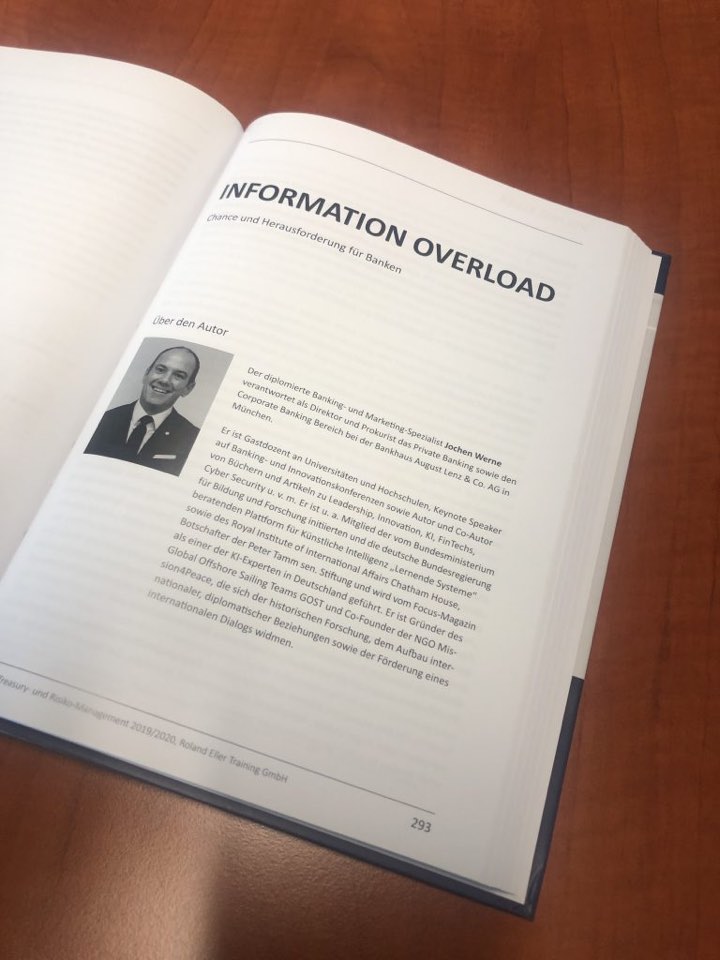
Monaco-Matin - 5 Jul 2019 T.P.
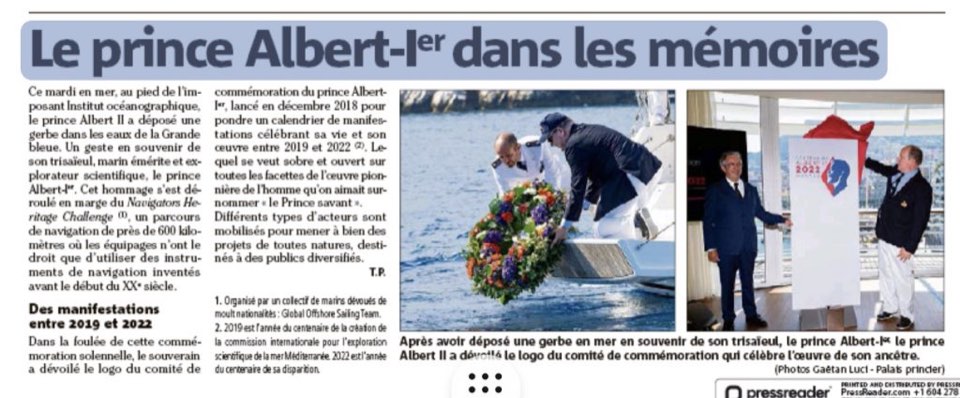
This Tuesday at sea, at the foot of the imposing Institute of Oceanography, Prince Albert II laid a wreath in the waters of the Great Blue. A gesture in memory of his great-great-grandfather, emeritus sailor and scientific explorer, Prince Albert I. This tribute took place on the fringes of the Navigators Heritage Challenge (1), a nearly 600-kilometre sailing course where crews are only allowed to use navigational instruments invented before the beginning of the 20th century; demonstrations between and following this solemn commemoration, the Sovereign unveiled the logo of the Prince Albert Ier Memorial Committee, launched in December 2018 to lay a calendar of events celebrating his life and work between 2019 and 2022 (2). It is intended to be sober and open to all aspects of the pioneering work of the man we liked to call "the learned Prince". Different types of actors are mobilized to carry out projects of all kinds, aimed at diverse audiences, organized by a collective of dedicated sailors of many nationalities: Global Offshore Sailing Team. 2. 2019 is the year of the centenary of the creation of the International Commission for the Scientific Exploration of the Mediterranean Sea. 2022 is the year of the centenary of his death.
Translated with www.DeepL.com/Translator
Monaco-Matin - 5 Jul 2019 T.P.
Ce mardi en mer, au pied de l’imposant Institut océanographique, le prince Albert II a déposé une gerbe dans les eaux de la Grande bleue. Un geste en souvenir de son trisaïeul, marin émérite et explorateur scientifique, le prince Albert-Ier. Cet hommage s’est déroulé en marge du Navigators Heritage Challenge (1), un parcours de navigation de près de 600 kilomètres où les équipages n’ont le droit que d’utiliser des instruments de navigation inventés avant le début du XXe siècle.Des manifestations entre et Dans la foulée de cette commémoration solennelle, le souverain a dévoilé le logo du comité de commémoration du prince AlbertIer, lancé en décembre 2018 pour pondre un calendrier de manifestations célébrant sa vie et son oeuvre entre 2019 et 2022 (2). Lequel se veut sobre et ouvert sur toutes les facettes de l’oeuvre pionnière de l’homme qu’on aimait surnommer « le Prince savant ». Différents types d’acteurs sont mobilisés pour mener à bien des projets de toutes natures, destinés à des publics diversifiés.Organisé par un collectif de marins dévoués de moult nationalités : Global Offshore Sailing Team. 2. 2019 est l’année du centenaire de la création de la commission internationale pour l’exploration scientifique de la mer Méditerranée. 2022 est l’année du centenaire de sa disparition.
Bitte hier klicken für DETAILS und ANMELDUNG ZUM EVENT
Source: Diplomatic Council
The speaker this morning is Jochen Werne, a graduate banking and marketing specialist. As director and authorized signatory, he is responsible for private banking and corporate banking at Bankhaus August Lenz & Co. AG in Munich. He is guest lecturer at universities and colleges, keynote speaker at banking and innovation conferences, author and co-author of books and articles on leadership, innovation, KI, FinTechs, Cyber Security and much more. He is a member of the platform for artificial intelligence "Learning Systems" initiated by the Federal Ministry of Education and Research and advising the German Federal Government as well as of the Royal Institute of International Affairs Chatham House, ambassador of the Peter Tamm sen. foundation and is listed by Focus-Magazin as one of the AI experts in Germany. He is the founder of the Global Offshore Sailing Team GOST and co-founder of the NGO Mission4Peace, which is dedicated to historical research, building international diplomatic relations and promoting international dialogue.
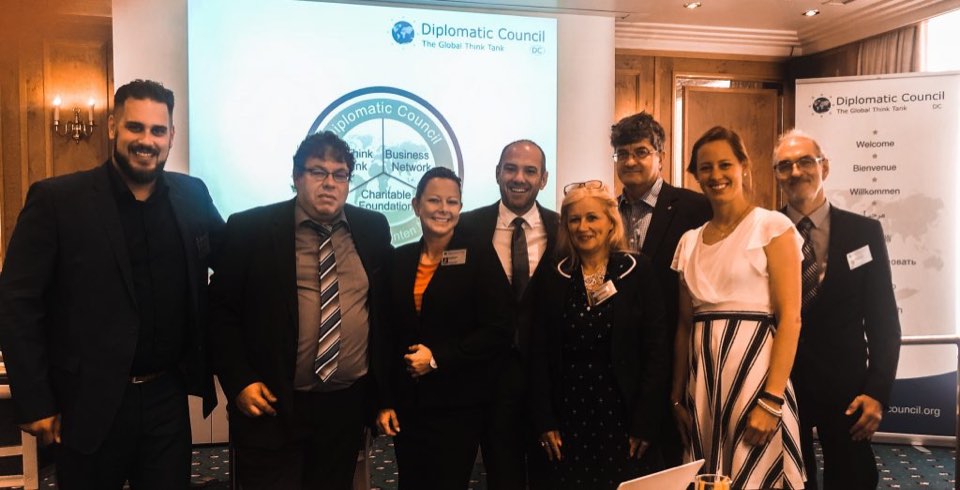
The participants will also get to know the Diplomatic Council (DC) this morning. It combines a global think tank, a business network and a charity foundation in a unique organization with consultative status at the United Nations. Stephanie Stoerk, Chapter Director DC Stuttgart, explains what distinguishes the Diplomatic Council from all other networks and what advantages it offers its members.
Breakfast is open from 8:30 am. At 9:00 a.m. we start our official program (whoever comes earlier has time to eat in peace), which lasts until 10:30 a.m. (including questions and answers). In between there is always the possibility to eat from the rich breakfast buffet.
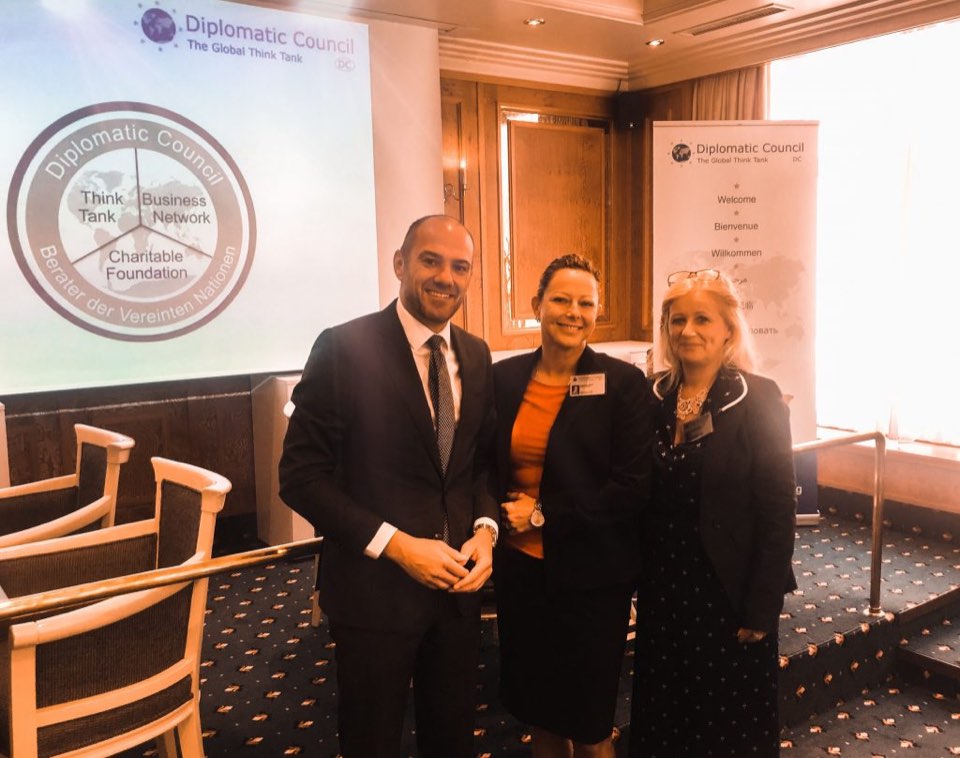
PROGRAMM
Der Redner an diesem Morgen ist der diplomierte Banking- und Marketing-Spezialist Jochen Werne. Er verantwortet als Direktor und Prokurist das Private Banking sowie den Corporate Banking Bereich bei der Bankhaus August Lenz & Co. AG in München. Er ist Gastdozent an Universitäten und Hochschulen, Keynote Speaker auf Banking- und Innovationskonferenzen, sowie Autor und Co-Autor von Büchern und Artikeln zu Leadership, Innovation, KI, FinTechs, Cyber Security u. v. m. Er ist u. a. Mitglied der vom Bundesministerium für Bildung und Forschung initiierten und die deutsche Bundesregierung beratende Plattform für Künstliche Intelligenz „Lernende Systeme“ sowie des Royal Institute of International Affairs Chatham House, Botschafter der Peter Tamm sen. Stiftung und wird vom Focus-Magazin als einer der KI-Experten in Deutschland geführt. Er ist Gründer des Global Offshore Sailing Teams GOST und Co-Founder der NGO Mission4Peace, die sich der historischen Forschung, dem Aufbau internationaler, diplomatischer Beziehungen sowie der Förderung eines internationalen Dialogs widmet.
Darüber hinaus lernen die Teilnehmer an diesem Morgen das Diplomatic Council (DC) kennen. Es verknüpft einen globalen Think Tank, ein Business Network und eine Charity Foundation in einer einzigartigen Organisation mit Beraterstatus bei den Vereinten Nationen. Stephanie Stoerk, Chapter Director DC Stuttgart, informiert, was das Diplomatic Council von allen anderen Netzwerken unterscheidet und welche Vorteile sich daraus für die Mitglieder ergeben.Das Frühstück ist ab 8:30 Uhr geöffnet. Um 9:00 Uhr starten wir unser offizielles Programm (wer früher kommt, hat also Zeit, in Ruhe zu essen), das bis 10:30 Uhr andauert (inklusive Fragen und Antworten). Es besteht zwischendurch jederzeit die Möglichkeit, sich vom reichhaltigen Frühstücksbuffet zu versorgen
As part of the cycle of commemorations in honour of Prince Albert I, H.S.H. Prince Albert II laid a wreath at sea - as part of the Global Offshore Sailing Teams Expedition Navigators Heritage Challenge - to pay tribute to His great-great-grandfather. On this occasion, the logo commemorating the centenary of Prince Albert I was unveiled at the Yacht Club de Monaco (YCM), in the presence of Thomas Fouilleron, Director of the Archives of the Princely Palace. This event is part of the 100th anniversary of the International Commission for the Scientific Exploration of the Mediterranean Sea (CIESM).
Translated with www.DeepL.com/Translator
Original Text: Dans le cadre du cycle des commémorations en l’honneur du Prince Albert 1er, S.A.S. le Prince Albert II a déposé une gerbe en mer pour rendre hommage à Son trisaïeul. À cette occasion, le logo de commémoration du centenaire du Prince Albert 1er a été dévoilé au Yacht Club de Monaco (YCM), en présence de Thomas Fouilleron, Directeur des Archives du Palais Princier. Une manifestation qui s’inscrit dans le cadre des cent ans de la Commission Internationale pour l’Exploration Scientifique de la mer Méditerranée (CIESM).
Also in the second part of our interview we do not go directly into the technical aspects of the introduction of artificial intelligence.
Based on the question "How do you get all this under one roof?" we get a look at Jochen's personal insights and points of view and at how each individual can counter the increasing autonomisation and the change of the working world and society through algorithms with a corresponding attitude.
Jochen Werne is full-time Director & Authorized Officer for Bankhaus August Lenz & Co. AG of the Mediolanum Banking Group and is responsible for Business Development, Marketing, Product Management, Treasury & B2B Payment Services. In addition, he is involved in the development of non-profit organizations and a member of the Learning Systems Platform of the Federal Ministry of Education and Research.
The initiative www.wegofive.net addresses the question of how a unit of man and machine can be created in the working world of tomorrow and how algorithms can be seamlessly integrated into the organization in order to supplement the capabilities of employees.
As an independent interim manager, profile and team coach, Sascha Adam supports people, decision-makers and companies in actively shaping digital change.
More at www.wegofive.net/mission/about or www.sascha-adam.net.
Many thanks to the coast by east Hamburg in the Hafencity Hamburg for the permission to film here. A very recommendable location with obliging service, extraordinary menu and good drinks. Apropos, the background noises also give you the feeling of sitting directly with us ;-)
Ein Banker mit einer (KI-)Mission / Teil 2: "Das neue Jetzt - Jeder kann etwas bewegen"
Auch in dem zweiten Teil unseres Interviews gehen wir nicht direkt auf die technischen Aspekte der Einführung von künstlicher Intelligenz ein. Ausgehend von der Frage "Wie bekommst Du das alles unter einen Hut?" bekommen wir einen Blick auf die persönlichen Erkenntnisse und Sichtweisen von Jochen und darauf wie jeder Einzelne mit einer entsprechenden Haltung der zunehmenden Autonomisierung und dem Wandel der Arbeitswelt und der Gesellschaft durch Algorithmen begegnen kann.
Jochen Werne ist hauptberuflich Director & Authorized Officer für das Bankhaus August Lenz & Co. AG der Mediolanum Banking Group und verantwortet dort die Bereiche Business Development, Marketing, Product Management, Treasury & B2B Payment Services. Darüberhinaus ist er am Aufbau gemeinnütziger Organisationen beteiligt und Mitglied der Plattform Lernende Systeme des Bundesministerium für Bildung und Forschung. Die Initiative www.wegofive.net geht der Frage nach wie in der Arbeitswelt von morgen eine Einheit aus Mensch & Maschine geschaffen werden kann und sich Algorithmen nahtlos in die Organisation integrieren, um die Fähigkeiten der Mitarbeiter zu ergänzen.
Sascha Adam unterstützt als selbstständiger Interimsmanager, Profile- und Team-Coach Menschen, Entscheider und Unternehmen dabei den digitalen Wandel aktiv zu gestalten.
Mehr unter www.wegofive.net/mission/about oder www.sascha-adam.net
Ganz herzlichen Dank an das coast by east Hamburg in der Hafencity Hamburg für die Genehmigung hier filmen zu dürfen. Eine sehr zu empfehlende Location mit zuvorkommender Bedienung, außergewöhnlicher Speisekarte und guten Drinks. Apropos, die Hintergrundgeräusche geben einem auch gleich das Gefühl direkt bei uns zu sitzen ;-)
Jochen Werne, Director Marketing & Business Development at Bankhaus August Lenz, explains in his keynote address how we can shape the future from the innovations and topics of the past and why digitization must be thought of not only technologically but also culturally.
Jochen Werne, Direktor Marketing & Business Development beim Bankhaus August Lenz, erläutert in seiner Keynote, wie wir aus den Innovationen und Themen der Vergangenheit in der Gegenwart die Zukunft gestalten können und warum Digitalisierung nicht nur technologisch, sondern auch kulturell gedacht werden muss.
Artificial intelligence is the new buzz word of the financial industry, says Jochen Werne. In view of the rapid pace of technological development it is becoming a source of hope for the banks - and rightly so, writes the author. After all, banks have an enormous amount of data at their disposal. Despite all the digitalisation and areas of application of AI, Werne sees the chance for a renaissance of consulting as a link between people and the technical world. Red. Bank und Markt
Read the full article in the new June 2019 edition of BANK und MARKT here
German: Künstliche Intelligenz ist das neue Buzz-Wort der Finanzbranche, sagt Jochen Werne. Angesichts der rasanten technologischen Entwicklung wird sie zum Hoffnungsträger für die Banken - zu Recht, meint der Autor. Schließlich verfügen Banken über einen enormen Datenschatz. Trotz aller Digitalisierung und Einsatzbereiche von KI sieht Werne jedoch die Chance auf eine Renaissance der Beratung als Bindeglied zwischen Mensch und technisierter Welt. Red.
On Friday the 28th of June at 7.30 p.m. the exclusive Navigators Heritage Red Carpet Event will take place at Palacio Can Marques in Palma de Mallorca.
It is dedicated to raising awareness for the Ocean Challenge, the merits of Prince Albert I of Monaco as well as the associated UN Global Goal #14 to protect the world‘s oceans.
The dress to impress event consists of three insightful talks led by Martina Hirschmeier.
In the first talk, Jochen Werne will provide some background information about the Navigators Heritage Challenge.
In the second talk, Philippe Nguyen will give some insights on how the challenge addresses the UN Global Goal #14: „Life Below Water.“
In the third talk, the architect Mathias Koester will present his innovative concept for a sustainable under water skyscraper.
Following the talks, food and drinks will be served on the Can Marques roof top terrace and there will be the possibility to further discuss the Navigators’ Heritage Challenge as well as its associated environmental goals as well as touching original navigation instruments from the 19th century provided by the International Maritime Museum Hamburg
We are grateful to event partners for their support and generosity.
Jochen Werne is full-time Director & Authorized Officer for Bankhaus August Lenz & Co. AG of the Mediolanum Banking Group and is responsible for Business Development, Marketing, Product Management, Treasury & B2B Payment Services. In addition, he is involved in the development of non-profit organizations and a member of the Learning Systems Platform of the Federal Ministry of Education and Research.
The initiative www.wegofive.net addresses the question of how a unit of man and machine can be created in the working world of tomorrow and how algorithms can be seamlessly integrated into the organization in order to supplement the capabilities of employees.
In this first, introductory part of our interview Jochen gives us an insight into what has changed for him in the last decades - and he finds out that "Hamburg is probably the most beautiful city in Germany" ;-)
As an independent interim manager, profile and team coach, Sascha Adam supports people, decision-makers and companies in actively shaping digital change.
More at www.wegofive.net/mission/about or www.sascha-adam.net.
Many thanks to the coast by east Hamburg in the Hafencity Hamburg for the permission to film here. A very recommendable location with obliging service, extraordinary menu and good drinks. Apropos, the background noises also give you the feeling of sitting directly with us ;-)
Jochen Werne ist hauptberuflich Director & Authorized Officer für das Bankhaus August Lenz & Co. AG der Mediolanum Banking Group und verantwortet dort die Bereiche Business Development, Marketing, Product Management, Treasury & B2B Payment Services. Darüberhinaus ist er am Aufbau gemeinnütziger Organisationen beteiligt und Mitglied der Plattform Lernende Systeme des Bundesministerium für Bildung und Forschung. Die Initiative www.wegofive.net geht der Frage nach wie in der Arbeitswelt von morgen eine Einheit aus Mensch & Maschine geschaffen werden kann und sich Algorithmen nahtlos in die Organisation integrieren, um die Fähigkeiten der Mitarbeiter zu ergänzen. In diesem ersten, einleitenden Teil unseres Interviews gibt uns Jochen einen Einblick was sich in den letzten Jahrzehnten für ihn verändert hat - und stellen fest, dass "Hamburg die wahrscheinlich schönste Stadt in Deutschland ist" ;-) Sascha Adam unterstützt als selbstständiger Interimsmanager, Profile- und Team-Coach Menschen, Entscheider und Unternehmen dabei den digitalen Wandel aktiv zu gestalten. Mehr unter www.wegofive.net/mission/about oder www.sascha-adam.net. Ganz herzlichen Dank an das coast by east Hamburg in der Hafencity Hamburg für die Genehmigung hier filmen zu dürfen. Eine sehr zu empfehlende Location mit zuvorkommender Bedienung, außergewöhnlicher Speisekarte und guten Drinks. Apropos, die Hintergrundgeräusche geben einem auch gleich das Gefühl direkt bei uns zu sitzen ;-)
Der Messekongress Kundenmanagement ist der IMPULSGEBER für ein erfolgreiches Zusammenspiel aller Kundenschnittstellen.Der Messekongress Kundenmanagement bietet Ihnen eine Bühne des fachlichen Austauschs rund um das "ganzheitliche Kundenmanagement von morgen".
The trade fair congress "Customer Management" is giving IMPULSES for a successful interaction of all customer interfaces. The trade fair congress "Customer Management" offers you a stage for professional exchange around the "holistic customer management of tomorrow".
Banking Professionals are faced with many new challenges as PSD2 & Instant Payments in Europe at center stage which are driving automation and Innovations. It will be a great pleasure representing Bankhaus August Lenz with a keynote on the importance of the combination of all aspects of HUMAN, DIGITAL & CULTURE to create valuable business models for future banking. Looking forward joining other Top Industry Experts to tackle these topics with them.

It was a pleasure and great fun having an interview with Anna-Maria Guth about Antarctica, its importance for our planet and its extreme weather phenomenas
Jochen Werne
SCJohnson wrote: "An expedition under extreme conditions: From 12.02. - 28.02.2018 Jochen Werne led the expedition Antarctic Blanc to Antarctica. The team passed the Drake Passage and sailed "to the end of the world". The extreme conditions at sea demand special protection: that's why the crew had skin care products from SC Johnson Professional™ with them. Jochen Werne, expedition leader of the Antarctic Blanc, reports after the expedition on his experiences and new findings. "One hand for the man, one hand for the ship" - the perfect skin care for all professions and extreme weather situations is called Stokolan®."
The NAVIGATORS HERITAGE CHALLENGE is a 360 nautical mile OFFSHORE SAILING CHALLENGE where navigators are allowed to use only instruments invented before 1900.
"It's a great accolade for the Navigators Heritage Challengers and their engagement in creating international understanding and environmental awareness, that His Serene Highness Prince Albert II of Monaco is giving us the honour and will personally lay the wreath in commemoration of Albert 1er from the expedition's flag ship on July 2, 2019"
Jochen Werne, Expedition Leader
IN REMEMBRANCE OF the unique explorer, seaman and statesman PRINCE ALBERT I of MONACO the challenge starts in Palma de Mallorca and ends Monaco with the goal to raise awareness and sensitise civil society for the importance of our MARITIME ECOSOCYSTEM in relation to the UNITED NATIONSUSTAINABLE DEVELOPMENT GOALS.
What makes this challenge special is that it is open – by invitation – to all types of sailing yachts, but for the participating crews it is only allowed to use navigation technologies invented before 1900. While the navigators on board give their best to determine their position at sea as accurately as possible, the spectators worldwide can follow the yachts and their tactics live on the Internet thanks to modern GPS tracking devices.
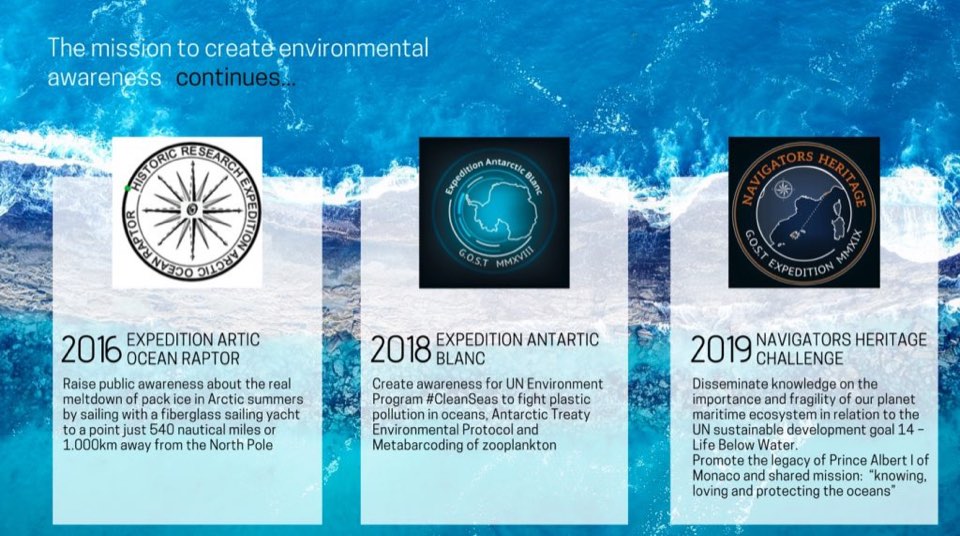
Jochen Werne, Direktor der Bankhaus August Lenz & Co. AG antwortet AudiMax auf die Frage nach dem Klischee, dass Banker keine Freizeit haben. Text: Felix Schmidt / AudiMax
"Freizeit ist wichtig! Nicht nur zur Entspannung, sondern vor allem um den Blick über den Tellerrand hinaus zu schärfen. Die Bankenbranche befindet sich in einer der größten Umbruchphasen ihrer Geschichte. In solchen Phasen ist neben unternehmerischen Denken besonders Kreativität gefragt. Und wie kann man dies besser schöpfen als abseits täglicher Routinen"
Jochen Werne
Das Original der AudiMax Sommerausgabe findet sich hier
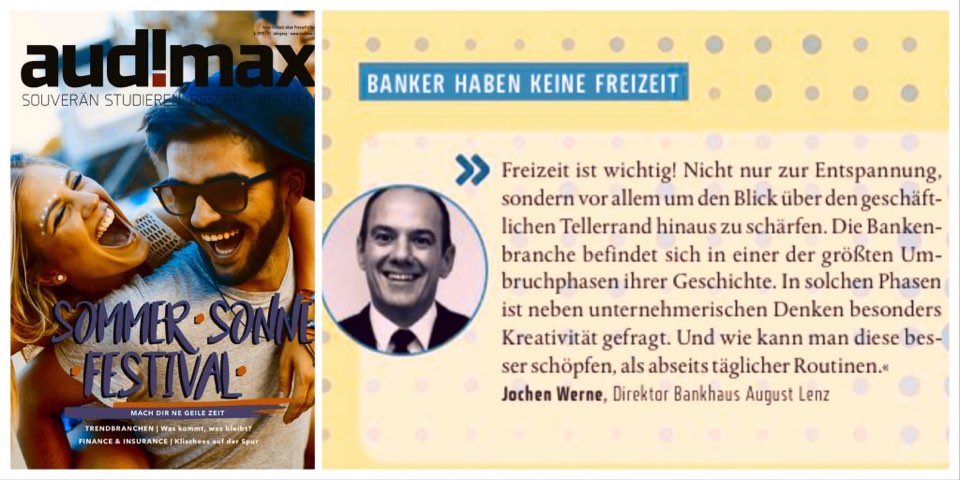
Man sollte nie so viel zu tun haben, dass man zum Nachdenken keine Zeit mehr hat.
Georg Christoph Lichtenberg
Erster deutscher Professor für Experimentalphysik im Zeitalter der Aufklärung
Author: Jochen Werne / first published May 2019 @LinkedInPulse
Siri or Alexa? Who can offer us more help in our daily life? Who provides the better answers and leads the more eloquent conversation? A legitimate question, because both Smart Devices are now so technically mature that it is difficult to make a simple distinction. Alexa was only launched in November 2014 in the USA and at the end of October 2016 in Germany.

Our world is changing from analogue to digital. While the invention of the printing press in 1450 by Gutenberg was a true milestone on the timeline of human development, we now live surrounded by smartphones and cloud applications in which we can store, share and retrieve even the most private information from anywhere in the world. Smart support is omnipresent: Siri accompanies us through everyday life in the form of Apple products and Alexa awaits us - Amazon powered - with a familiar voice when we get home. The intelligent speech assistance systems are only one of many modern applications of Machine & Deep Learning technologies and are therefore more broadly defined by artificial intelligence. With the extremely dynamic and rapid development of smart robotics and learning systems, some people are asking themselves what role humans will play on the stage of these technologies in the future.
The emerging technological possibilities, like all technological achievements in the past, have an impact on our daily personal lives, but their potential unfolds when we consider this impact in a scaled way and when it comes to our society as a whole. The Tübingen professor of media science, Bernhard Pörksen, even speaks of the fact that we have long since been able to be described as a "digital society" - this change took place in an extremely short time and without us being prepared for it. As a result, we would first have to learn competences to understand our actions in this new digital world and also to learn how to deal with the resulting effects. The learning of these skills takes place at different speeds in the case of digitisation issues, even against a demographic background. In contrast to the digital natives of the 21st century, some parts of our population with fewer points of contact with digital media find it more difficult to deal with the challenges of new technological standards and to adapt to the changed conditions in the service sector. The efficiency of the technical possibilities that permeate all areas of our lives is impressive, but it is crucial for success in the service sector not to ignore one factor: human empathy.
An example of this is the financial sector. Your own money is an issue that most people are most personally concerned about. However, plagued by fears of loss, personal biases and an extremely complex oversupply of investment alternatives, many investors seek personal support that goes beyond enumerating facts. We are talking about human support and empathic accompaniment, which machines (so far) have not been able to provide. A service that ideally covers not only the technical aspects of financial consulting, but also the behavioural finance aspects.
Undoubtedly there are already developments like Google Assist, in which attempts are made to incorporate empathic components into the developments, but the ability of the machines to simulate emotions and accordingly cause emotional reactions in humans (still) reaches its limits.
The upcoming technological developments will help us to solve many hitherto unsolvable problems in e.g. medicine, in environments hostile to humans or in a World Food Programme in a relatively short time. But as always with new technologies, it is also important to limit the abusive possibilities of use and to educate population that have little contact with modern instruments and technologies, because otherwise there is the danger of creating a feeling of inequality, which in turn can lead in extreme cases to a division of society. The desired progress would thus be reversed into its opposite: a step backwards based on a lack of communication at the micro and macro levels.
"It will certainly be our task in the future to ensure that developments in technological progress, artificial intelligence and the role of man go hand in hand. To advance optimizations through technology and digitization, as well as a parallel enlightenment of the individual with regard to his uniqueness in relation to technological development, as well as his social responsibility in this context."
Jochen Werne
The following comparison should simplify the problem between strengths and limitations of automated systems: In 2012 an autopilot would probably not have let the Costa Concordia collide with a rock - the reason was human, emotionally driven behaviour. But an autopilot could not have landed an Airbus 320 on the Hudson River in 2009 either. This required human experience and spontaneous creativity. Something that our brain can do, but that still allows the technical possibilities of AI to reach hard limits for the foreseeable future.
It remains to be said that smart devices like Alexa and Siri provide valuable support and even provide entertainment with the increasingly mature question-and-answer game. We can ask the digital companions anything. We also get - within the scope of technical possibilities - a cheeky answer. But we have to deal with the extent to which these answers provide us with what we expect, also on an emotional basis. Because our expectations often go beyond a technical answer.
More in-depth insights on this topic can be found, for example, at the Platform for Learning Systems (https://www.plattform-lernende-systeme.de/home.html ).
It has been greatly inspiring giving a keynote on the impacts of AI on business and society and to discuss with some of the 800 thought leaders, leading vendors, analysts, visionaries and executives at the highly recognised Kuppinger Cole European Identity & Cloud Conference 2019.
Jochen Werne
Find more inspiring keynotes from the #EIC19 here
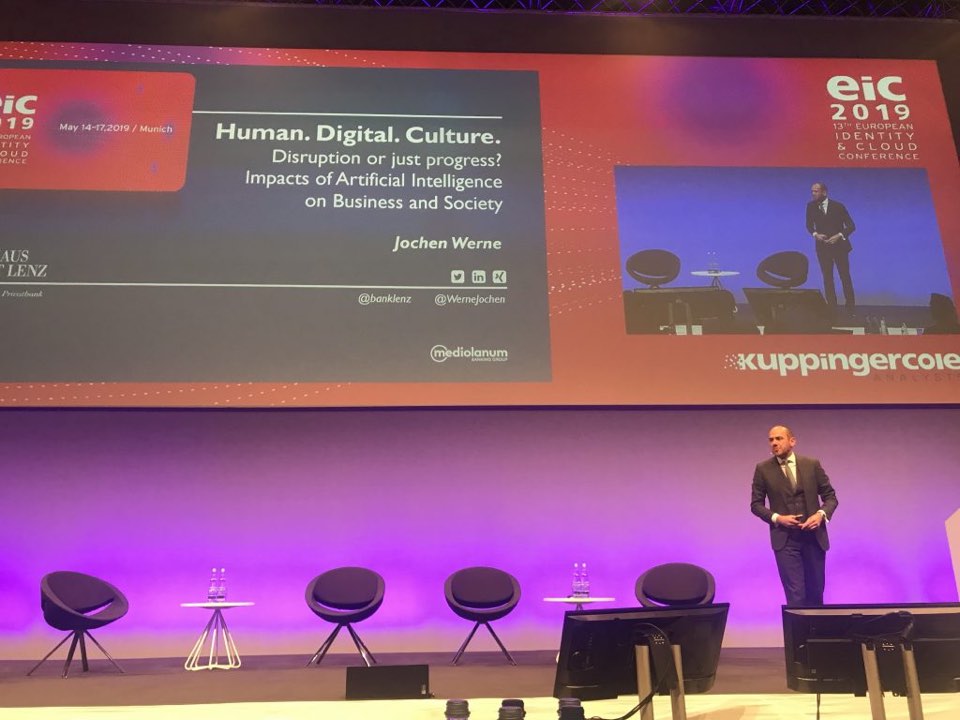
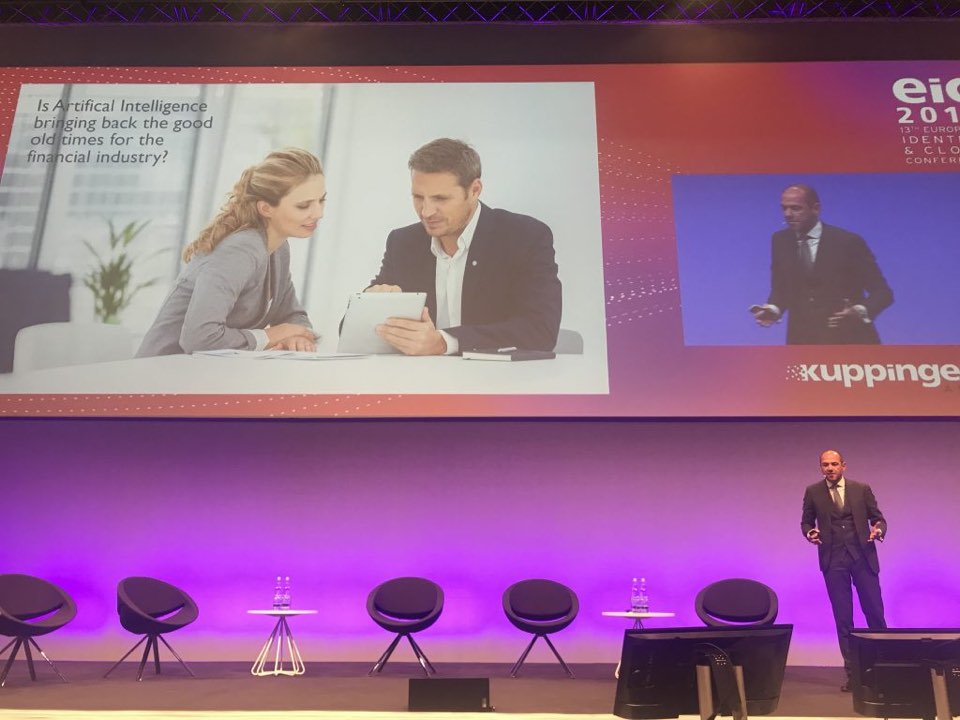
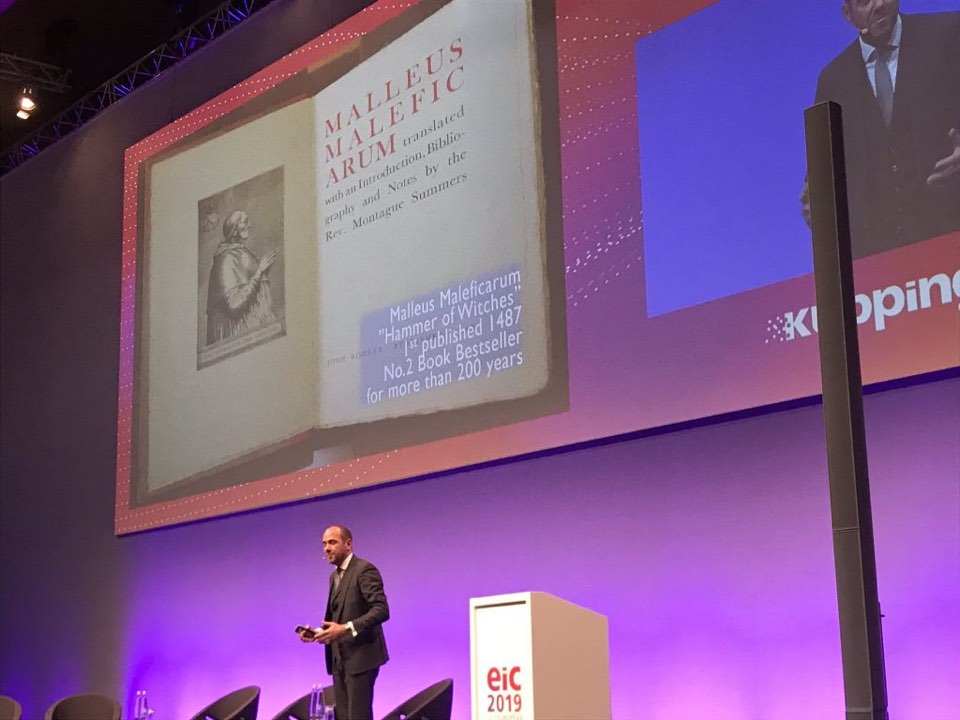
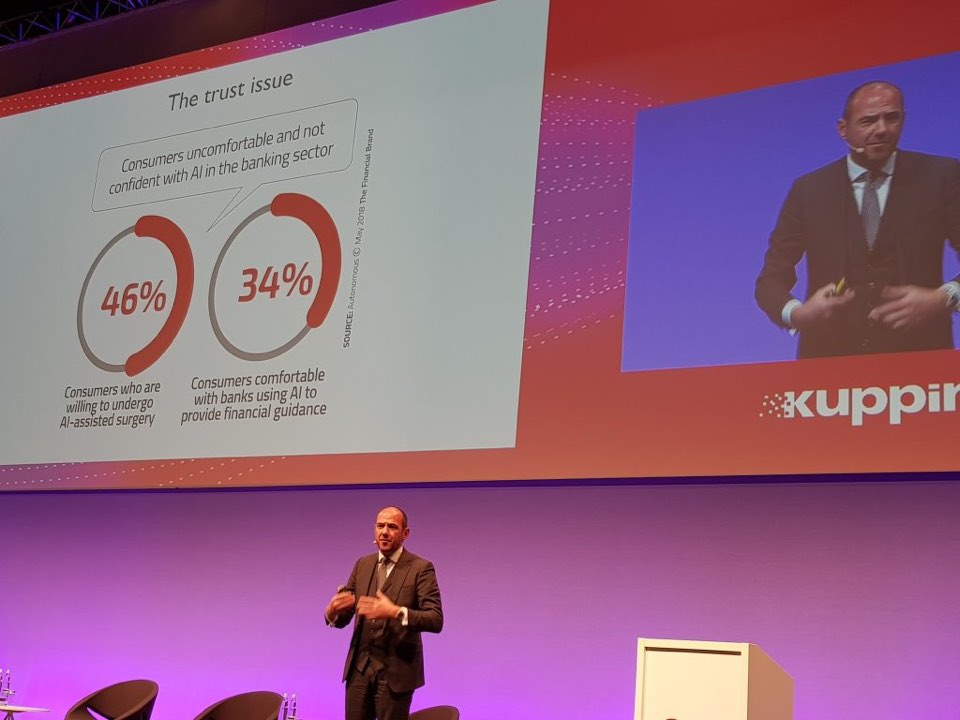
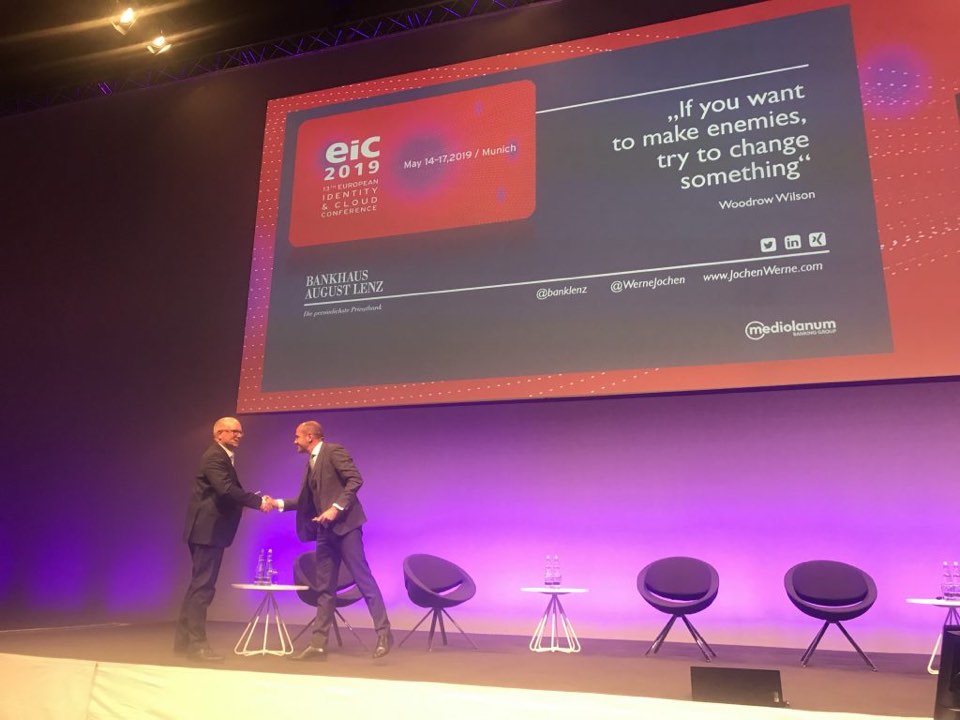
"It has been an honour to give a speech for the "Marine-Offiziers-Messe München", highlighting the importance of Antarctica for us and our planet and to report about the Global Offshore Sailing Team's Expedition Antarctic Blanc."
Jochen Werne
Antarctic Blanc Expedition Leader
Having experienced the sea by themselves the retired German Naval Officers enriched the discussion greatly with their own fascinating experiences and personal stories about life on sea and the challenges with the elements.
I'm grateful to Commander ret. Bernd Lehmann and Commander ret. Bernd Chittka for the invitation and the members and guests of the "Marine-Offiziers-Messe München for an outstanding evening and their engagement for our society.
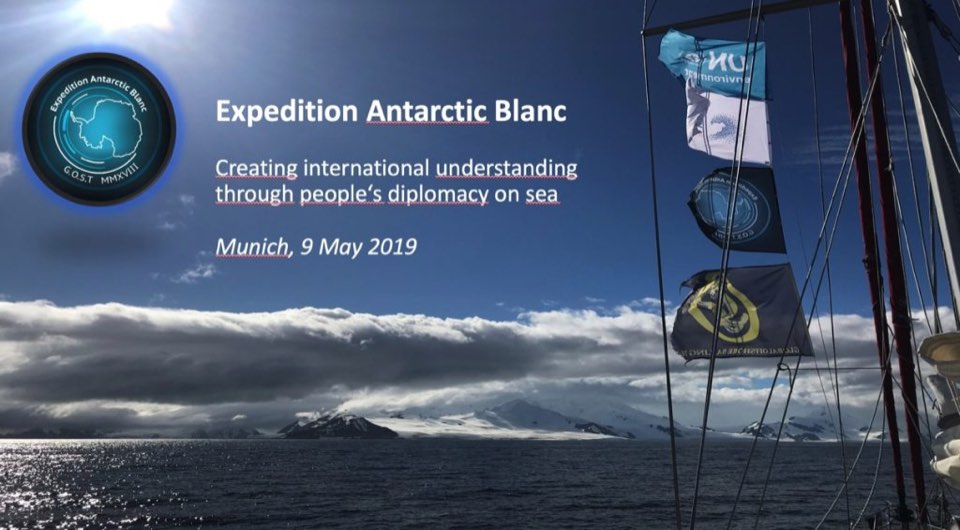
The Global Offshore Sailing Team sailed to the most Southerly partially ice-free place of this planet – the ANTARCTIC continent. The international team remembered all sailors who bravely explored this fragile and dangerous environment.
With this Expedition a platform of intercultural and interdisciplinary exchange for ANTARCTIC enthusiasts such as Historians, Environmental Scientists, Sailors, NGO’s, Navies, Associations or just out of personal interest has been created.
The German Stevie Awards are a top-class business award for the German business world. Outstanding achievements are rewarded in over 80 different categories: from Manager of the Year in over 30 industries, to Marketing Campaign of the Year, to Product of the Year, and more.
It's greatly inspiring seeing the different approaches companies are going to be innovative and a step ahead of their competition in a highly dynamic business environment
Jochen Werne
German Stevie Awards Jury Member
Management & Human Ressources

Es war eine besondere Freude als Co-Autor des Buches "Vermögensmanufaktur", der renommierten Herausgeber Roland Eller und Markus Heinrich, mitzuwirken.
Jochen Werne
Der Beitrag: "Die Bank - Der Lotse im digitalen Anlagedschungel" ist einer der 27 Artikel namhafter Mitautoren wie Prof. Dr. Karlheinz Ruckriegel (TH Nürnberg), Dr. Jürgen Michels (BayernLB), Dr. Volker Gronau (Deutsche Wertpapiertreuhand), Dr. Bernhard Breloer (Robeco), Prof. Dr. Thomas Egner (Otto-Friedrich-Universität Bamberg), Rudolf Geyer (ebase), Georg Geiger (Value Holding AG), et al.
Co-Author: Jochen Werne
Chapter: The Bank – The pilot in the digital investment jungle
Find a reading extract here
Buy at Finanzbuch Verlag / Amazon / Weltbild / GooglePlay
Content extract
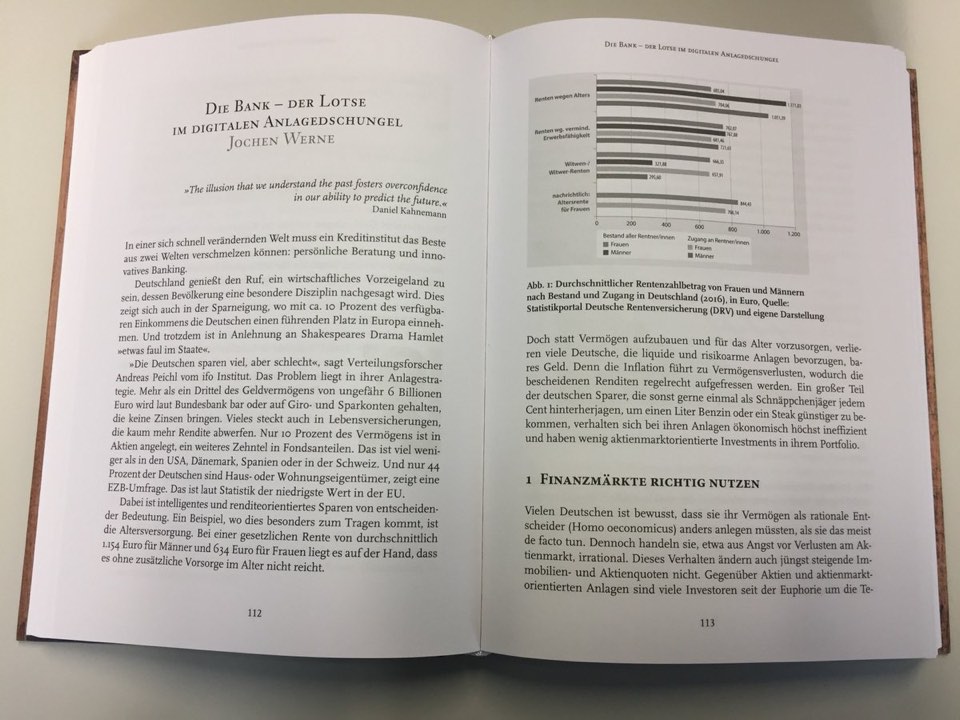
On May 23, ec4u will present innovations and trends for the customer experience and innovative applications for marketing, sales and service together with customers, experts and opinion formers and address the challenges of digital leadership in the midst of (agile) transformation:
"It's greatly inspiring giving a real keynote in an innovative virtual conference like Digital Thoughts 2019"
Jochen Werne
Looking greatly forward to give a keynote on the impacts of AI on business and society and to discuss with some of the 800 thought leaders, leading vendors, analysts, visionaries and executives at the highly recognised Kuppinger Cole European Identity & Cloud Conference 2019.
Jochen Werne
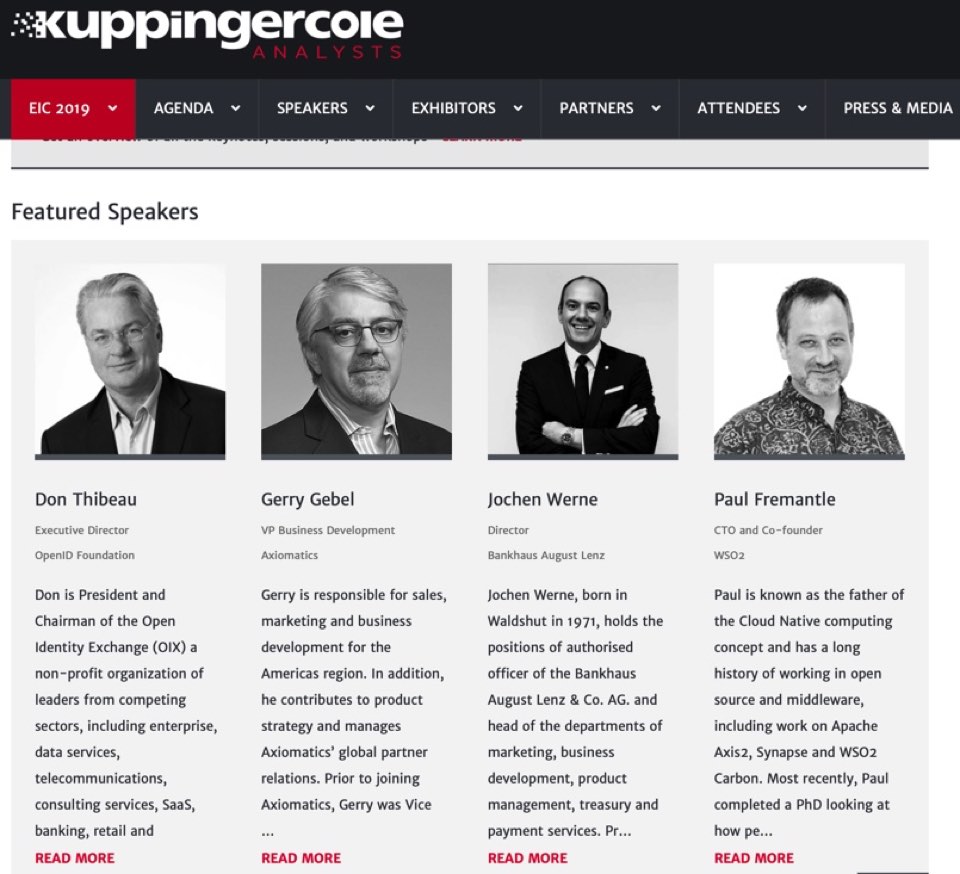
The place where the Digital Transformation is happening. The European Identity & Cloud Conference, held from May 14-17, 2019, offers a mixture of best practice discussions, visionary presentations, and networking opportunities with a future-oriented community. More than 800 thought leaders, leading vendors, analysts, visionaries, executives, and end-users get together in Munich to be inspired by a list of world-class speakers.
With five parallel tracks, more than 200 international speakers and experts, many Best Practice presentations and 120 hours of relevant content, EIC 2019 provides you with a comprehensive overview of future trends in Internet security as well as practical information about current projects.
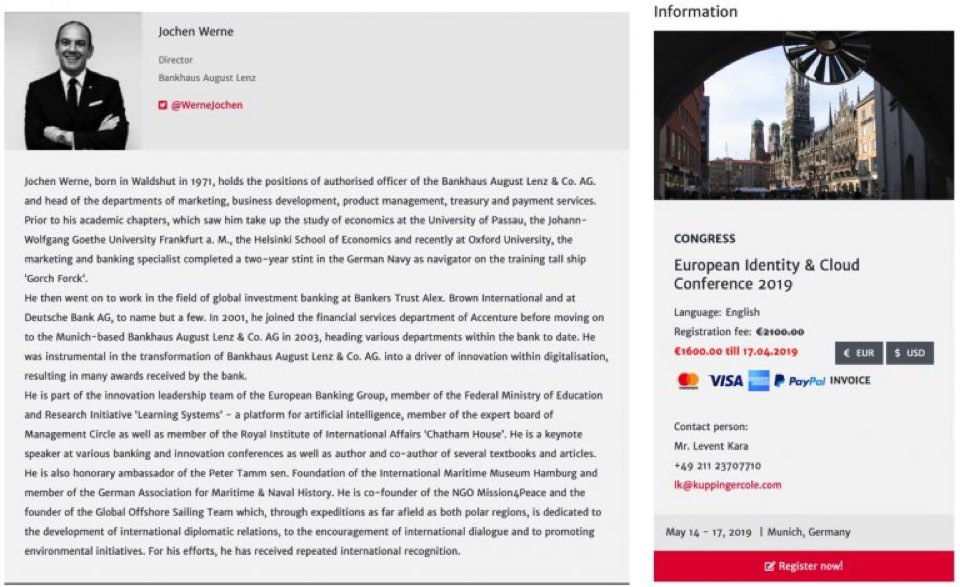
Every year the agenda focuses on the latest and most relevant Information Security and Digital Identity topics to offer you the foundation to design the right digital identity and security strategies for your business. Hear about emerging trends in order to be prepared to meet and exceed present and future business, identity and security challenges.
Monaco Info reported about the Expedition Antarctic Blanc's Press Conference at the Yacht Club de Monaco interviewing Expedition Leader Jochen Werne, Environmental Initiatives Coordinator Dr. Benon Janos and Chief Observer David Gamba. The expedition will took place between the 12th and the 27th of February 2018 and was engaged in the commemoration of Antarctic explorers and the support of the United Nations #CleanSeas initiative.
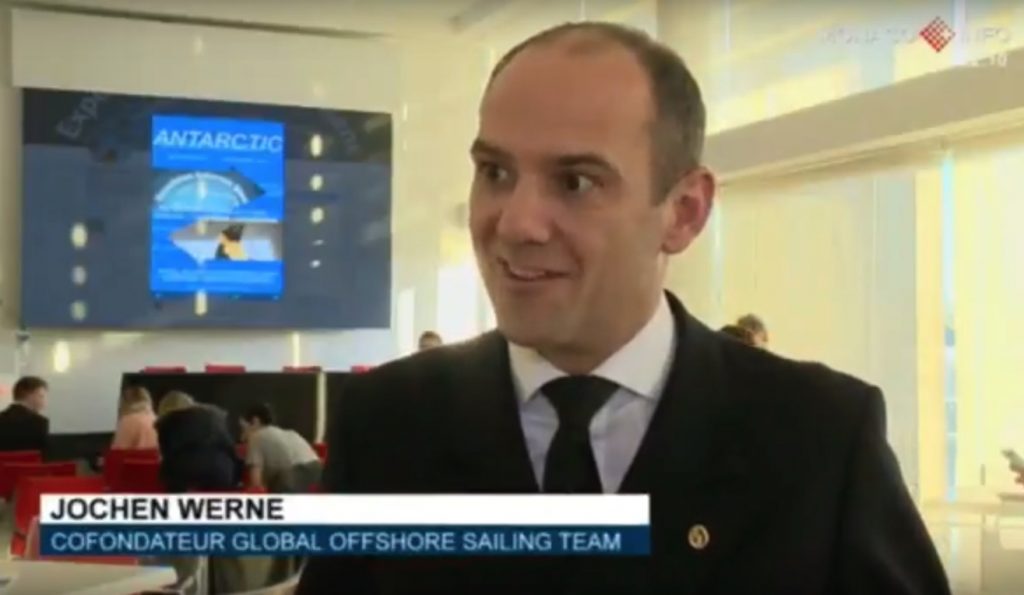

"Wille, Durchsetzungskraft und ein Ziel. Marianne Frank-Mast und ihre Unterstützer sind mit ihrem Projekt: Mädchenschule-Khadigram e.V. ein herausragendes Beispiel, wie das Engagement Einzelner, unsere Welt zu einer noch besseren macht. Marianne im Rahmen einer Abendveranstaltung des Bankhaus August Lenz kennen lernen und unterstützen zu dürfen, war ein inspirierendes und gleichzeitig sehr motivierendes Erlebnis."
Jochen Werne

Jeder der dieses engagierte Projekt unterstützen möchte - wie es an dem Abend auch Torwartlegende Toni Schumacher auf bemerkenswerte Weise machte - findet alle Information HIER
Das Motto der Organisation „Mädchenschule Khadigram“ e.V.
Bildung und Ausbildung sind die Voraussetzungen für eine eigenständige wirtschaftliche und soziale Entwicklung. Bildung ist die Grundvoraussetzung für ein selbstständiges, wirtschaftlich unabhängiges Leben. Bildung ermöglicht die Teilnahme an Demokratisierungsprozessen und politischen Entscheidungen und ist deshalb grundlegend. Daher ist es eine dringende Notwendigkeit, in erster Linie zur Alphabetisierung junger Frauen und Mädchen beizutragen. Dies gilt leider nicht nur für Indien, aber gerade für Indien! Ein Land in dem es für das eigene (neugeborenen) Überleben entscheidend ist, ob man als Mann oder Frau geboren wird. Denn Millionen von Mädchen werden entweder abgetrieben oder nach der Geburt ermordet. Für den Verlauf des weiteren Lebens entscheidet über Wohl oder Wehe, ob man zu den oberen Kasten, oder überhaupt einer Kaste zugehörig ist. Gerade in der Gesellschaftsschicht der Unberührbaren, zu denen auch die Stammesangehörigen zählen, ist die Analphabetenrate exorbitant hoch, ganz besonders bei den Frauen. Die Armut, wobei hier von Armut unterhalb der, von der UN errechneten Armutsgrenze gesprochen wird, ist dementsprechend verbreitet.
Der Verein Mädchenschule Khadigram e.V. hat als Ziel, insbesondere Mädchen zu alphabetisieren. An unseren Schulen sollen Mädchen aus Familien der "Kastenlosen" und Stammesangehörigen eine Bildungschance erhalten. Wir wollen einen fünfjährigen Schulbesuch möglich machen. Der Verein unterhält Ganztagsschulen mit derzeit 230 Kindern, davon 170 Mädchen und 60 Jungs. Seit 2016 haben auch Jungen aus der gleichen „Kaste“ eine Chance aufgenommen zu werden. Allerdings darf das Verhältnis von 25 % zu 75 % der Mädchen nicht überschritten werden. Weiterhin gilt unbedingt die Priorität den Mädchen und Frauen.
"It has been a great pleasure and honour that author Maurizio Abbati has mentioned Expedition Antarctic Blanc in his new book as a successful example how public awareness for important environmental topics can be raised."
Jochen Werne, Expedition Leader
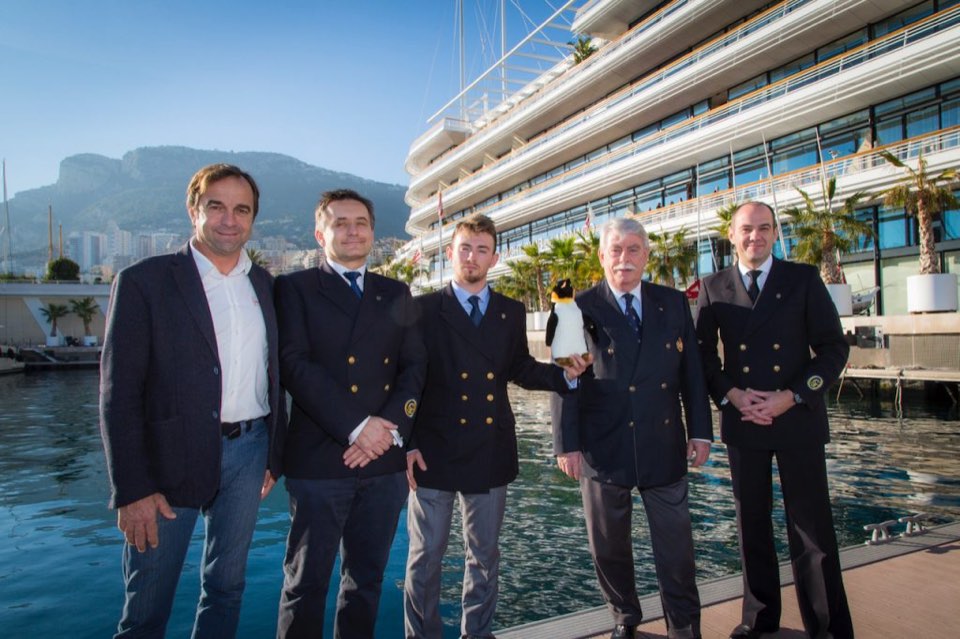
This book, based on authoritative sources and reports, links environmental communication to different fields of competence: environment, sustainability, journalism, mass media, architecture, design, art, green and circular economy, public administration, big event management and legal language. The manual offers a new, scientifically based perspective, and adopts a theoretical-practical approach, providing readers with qualified best practices, case studies and 22 exclusive interviews with professionals. A fluent style of writing leads the readers through specific details, enriching their knowledge without being boring. As such it is an excellent preparatory and interdisciplinary academic tool intended for university students, scholars, professionals, and anyone who would like to know more on the matter.
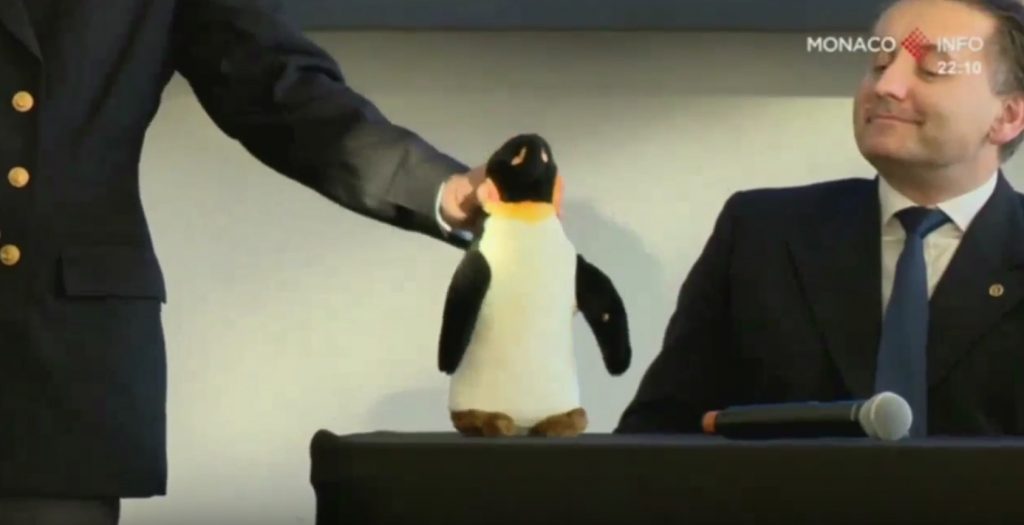
It has been a great pleasure not only to give a speech at the plenary meeting for the Wirtschaftsjunioren Hamburg, but also to discuss in-depth the impact of AI on our society with a highly engaged auditorium.
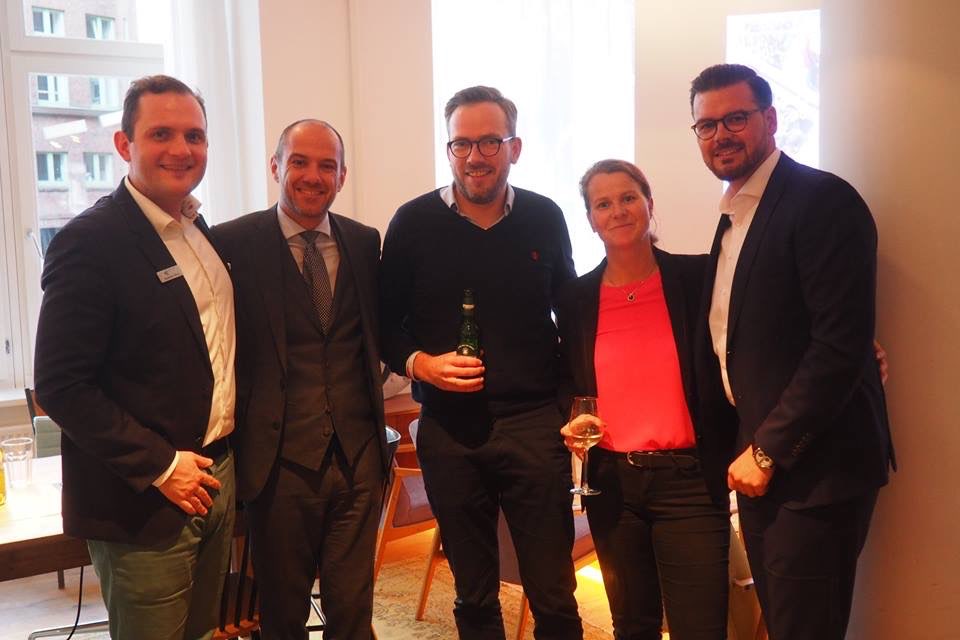
After the meeting the Wirtschaftsjunioren summarised the evening on Facebook as follows:
"At yesterday's plenary meeting of the Education Committee, we combined the exciting topic of artificial intelligence with the beautiful (junior) life. Our keynote speaker Jochen Werne, Director Business Development & Marketing at Bankhaus Lenz, lecturer and author, gave a vivid presentation on the opportunities, dangers and challenges of AI for companies and society. How does it feel to pass on your activated smartphone to the person sitting next to you? What does a folded leaf have to do with the moon and AI?
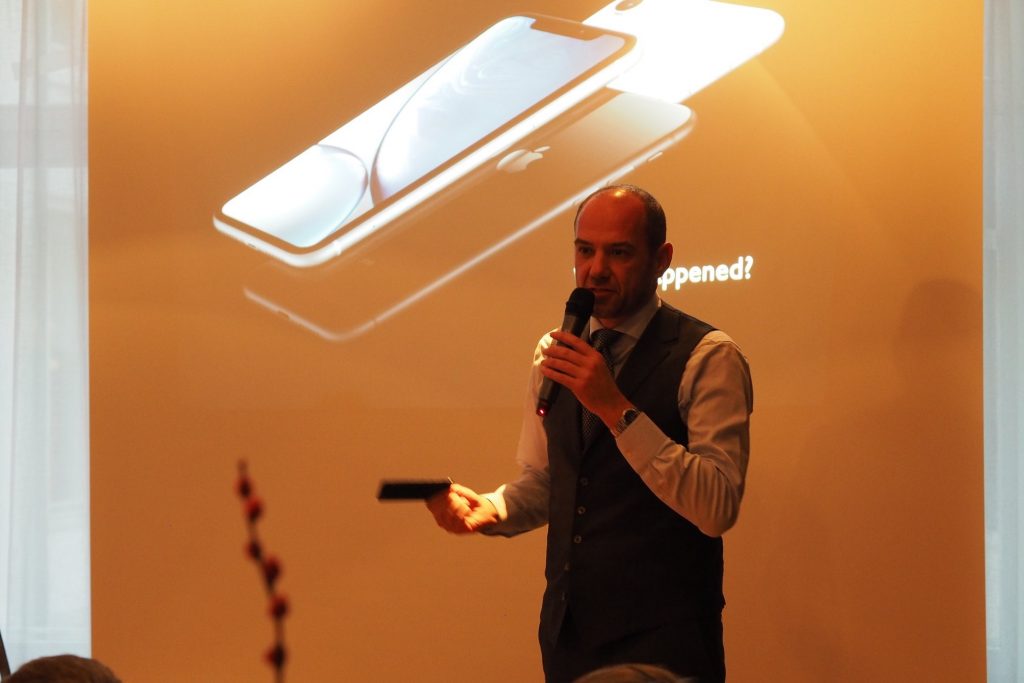
We had SALT AND PEPPER as a guest for the further practical testing of AI. In a VR environment, we were able to build future production facilities using the BoxPlan product. The innovative Startup Smunch, the online canteen for happy teams, provided us with very real, delicious food. In the lounge-like atmosphere of the Ruby Hans Workspaces we found a great setting for stimulating conversations and networking.
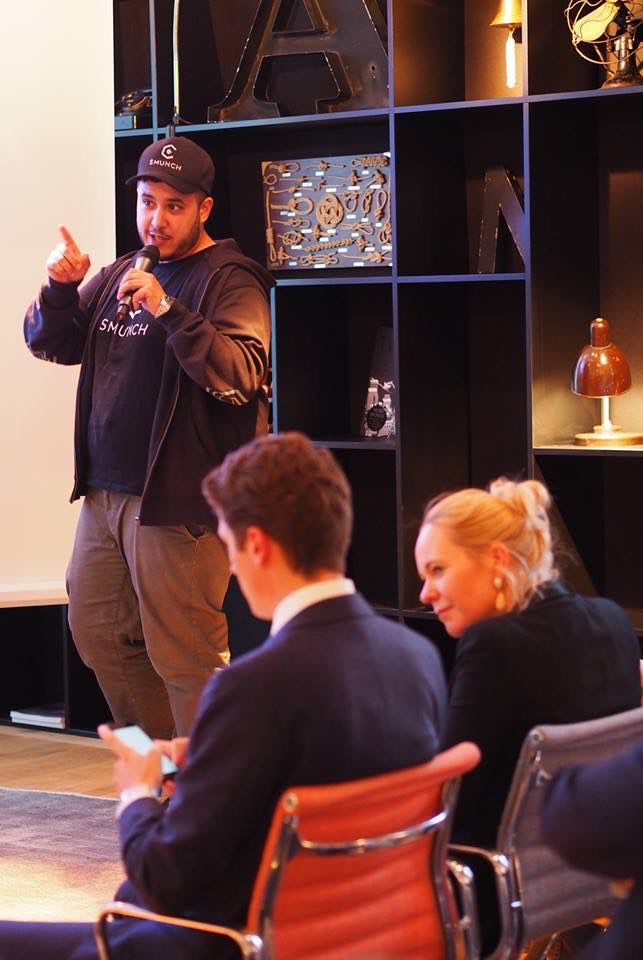

We would like to thank all guests and cooperation partners for a successful junior evening: Private Family Banker, Exclusive Agent Bankhaus August Lenz & Co. PUBLIC LIMITED COMPANY, SALT AND PEPPER technology and management consulting, software development, Smunch.co
And remember, on 26.05.2019 is the European election, Step Up For Europe (see group photo ;-) )"
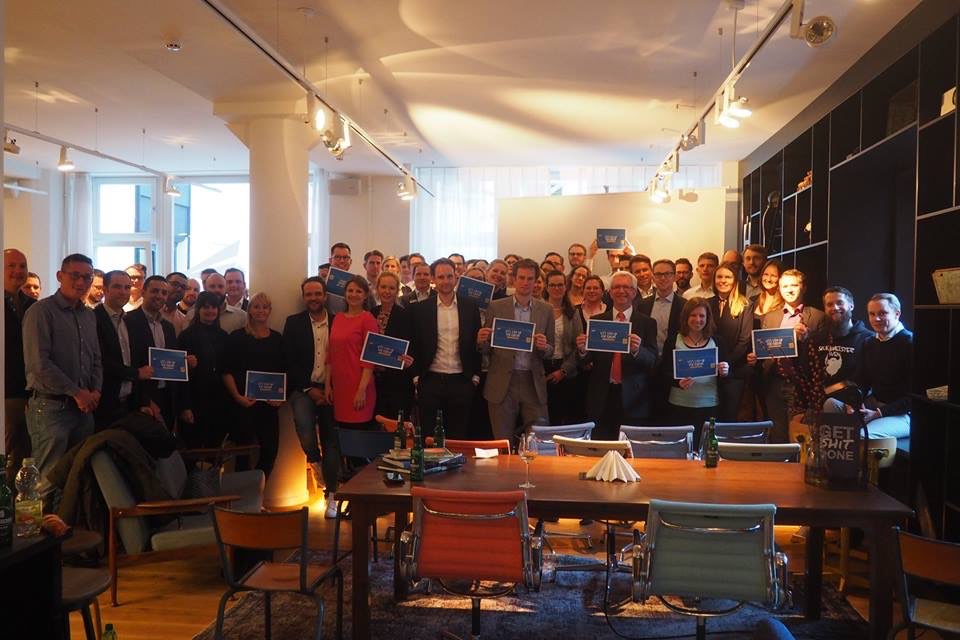

Thank you very much to the Wirtschaftsjunioren Hamburg and Alexander Köhne for the highly appreciated invitation.
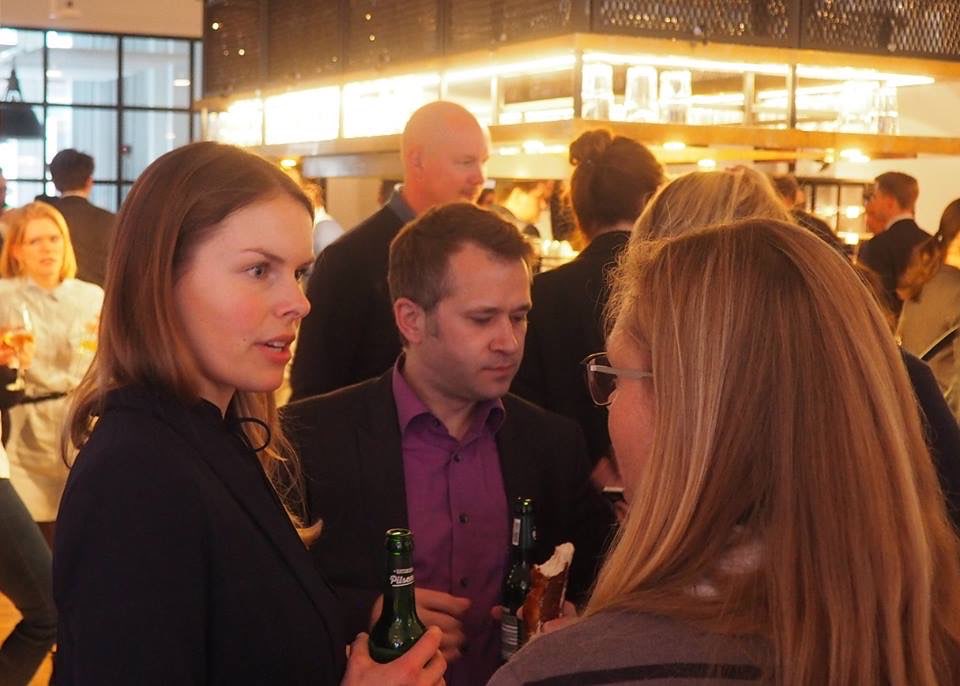
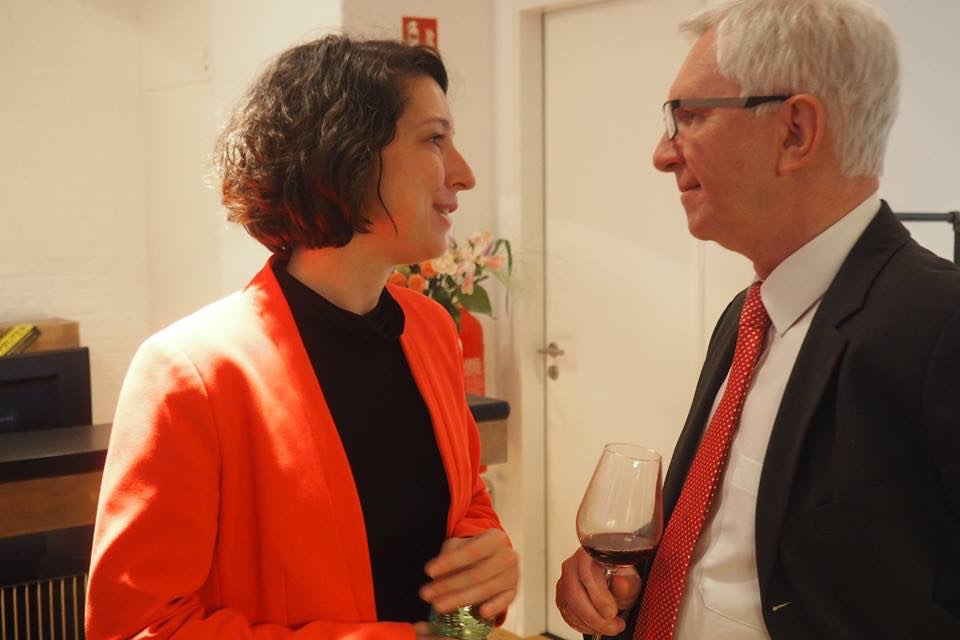

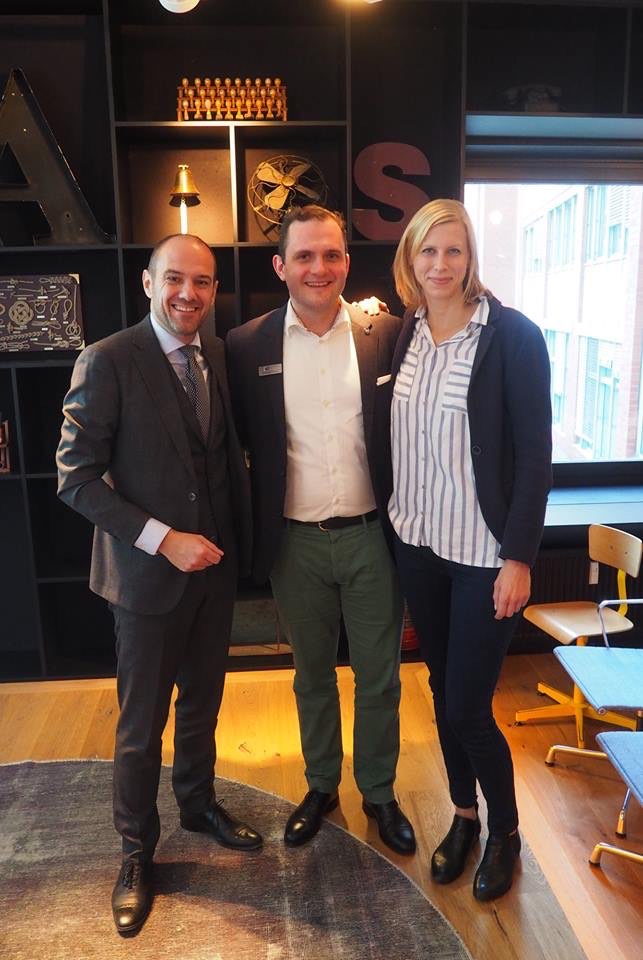
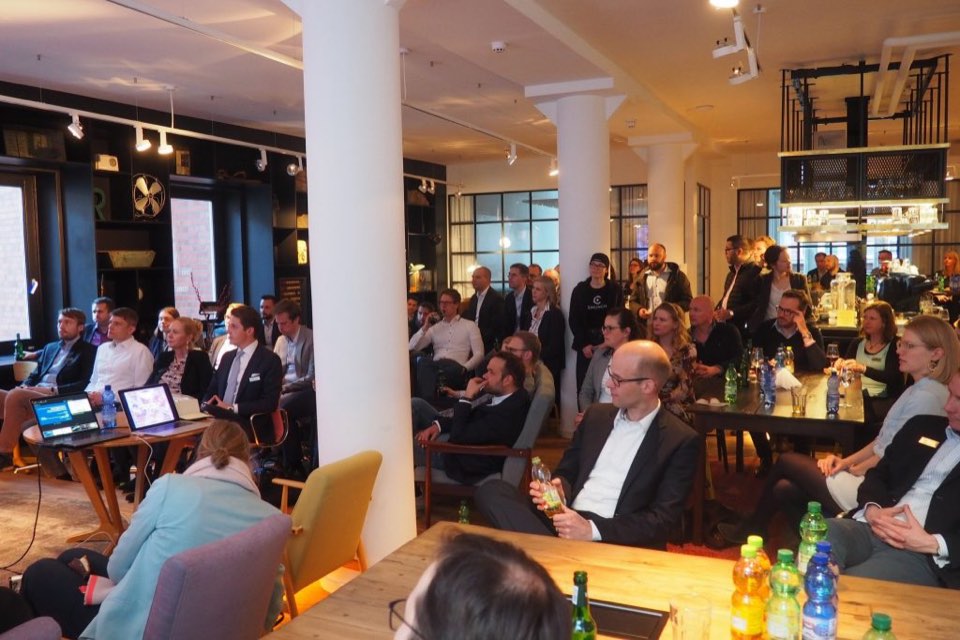
Original published in German in the Handelsblatt KI-Summit "KI-Business Guide". Translation performed by DeepL.com

AI is making its way into every industry, but banks, insurance companies and FinTechs in particular are seeing a renaissance for their data-based business models in disruptive times. Jochen Werne, director and head of the innovation team at Munich-based private bank Bankhaus August Lenz, explains the role that the human factor will play in banking and consulting in the future.
Google, Apple, Facebook and Amazon (GAFA) have long seen artificial intelligence as the technology of the future. Banks and insurance companies also see the potential in machine and deep learning approaches to be a relevant player in the future in an increasingly technology-driven market environment. After "FinTech", "Blockchain" and "Crypto-currencies", "AI" is the new buzzword of the industry. From the AI-optimized chatbot to highly complex, self-learning, investment algorithms - the omnipresence of the term suggests that the integration of Artificial Intelligence into one's own business model seems to be virtually necessary for survival. But is that really the case, where do we stand and which factors cannot be replaced by technology?
What becomes possible in times of exponential technologies is de facto nothing less than a revolution. The financial industry holds a vast amount of valuable and already processed data. Not only do they reflect our daily and extremely private life, from buying tickets for the subway via apps to the preference of our garments - but they reflect also the payment flows of entire companies and industries, and therefor our entire economy. Maturing AI systems not only make it easier to prepare and process this data, they also make it much cheaper, faster and more targeted. AI will not only enable banks to make their services more customer centric, it will also transform most areas of the financial industry - from asset management to business operations and money laundering prevention to marketing.
Every major technological leap has historically been accompanied by a positive and an abusively usable development. TIME magazine recently published an article by Apple CEO Tim Cook entitled "It's time for action on privacy. We all deserve control over our digital life". Every electronic transaction generates customer-specific data. These structured data sets, which have been collected for many years, are now becoming the most valuable raw material. It's important to create meaningful use-cases especially when it comes to the enrichment of existing structured data sets with external, possibly unstructured data. However, this is exactly where the risk lies. If sensitive data falls into the wrong hands and is deliberately misused, cyber attacks can cause considerable damage to individuals and groups. Trust is and remains therefore one of the most important assets of a credit institution or financial service provider. Consequently, the protection of customer data in a digital banking world has absolute priority today more than ever before. When using AI technology, it is therefore essential to use private and sensitive data in the interests of the customer. And this is where not only IT and cyber security departments of banks come into play, but also politics: their primary task must be to find meaningful solutions for handling the effects of the use of AI on society, the economy and thus on our lifes and the work of tomorrow. And this without endangering the competitiveness of our own country. The fact that this topic is taken seriously is evident not only in national initiatives such as the German Platform for Artificial Intelligence "Lernende Systeme", but also, for example, in the European Artificial Intelligence shoulder-to-shoulder approach, which is being pushed forward at full speed by France and Germany.
In order to advance the acceptance of AI in the financial sector, it is important that existing digital tools are even better adapted to customer needs. The successful symbiosis between people and digital technology is indispensable. With the help of online financial forums, banking apps, vlogs and digital industry comparisons, private individuals can now achieve basically the same level of knowledge as financial professionals, but what is usually lacking is the successful filtering of the "information overload" and the consideration of the behavioral finance problem.
A realistic model for the successful transformation of the financial sector is therefore quite simple: streamline business models and processes, use data efficiently and always place the needs of customers at the centre of all activities. Taking advantage from technological progress always comes with successful deployment scenarios. Consequently, the technological revolution associated with the use of AI systems can only succeed if it is accepted by society - meaning, by us humans.
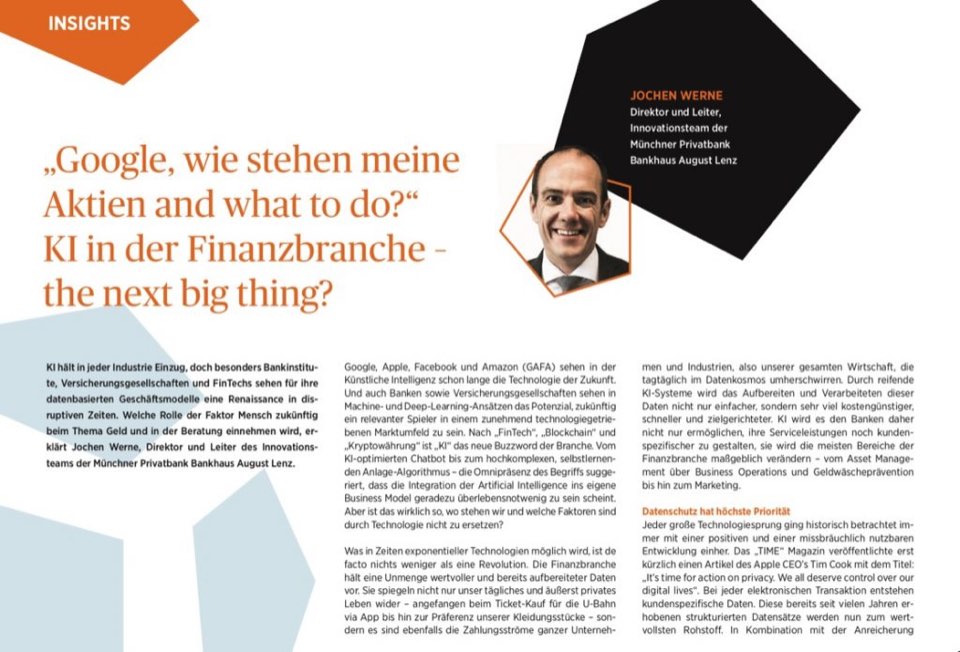
It has been an honour for the delegation of GOST's Expedition Antarctic Blanc consisting of Jochen Werne (Expedition Leader), Dr. Olivier Blanchard (Chief Liaison Officer to France) and Dr. Wolfgang Händel (Chief Logistics Officer) to be received by Mme Sophie-Dorothée Duron, Conseillère Biodiversité Eau Mer and Mme Carole Semichon, Chargée de mission - Milieu marin, Environnement polaire. The international Antarctic expedition has been successfully carried out with French assistance. The delegation presented the expedition flag, which represented France in Antarctica, as a symbol of remembrance. Mme Duron expressed her gratitude and said that she will present the flag to François de Rugy, ministre d'État, ministre de la Transition écologique et solidaire. In addition to that ideas have been exchanged how to strengthen the ties and to further involve the civil society into ecological topics also via expeditions of the Global Offshore Sailing Team.
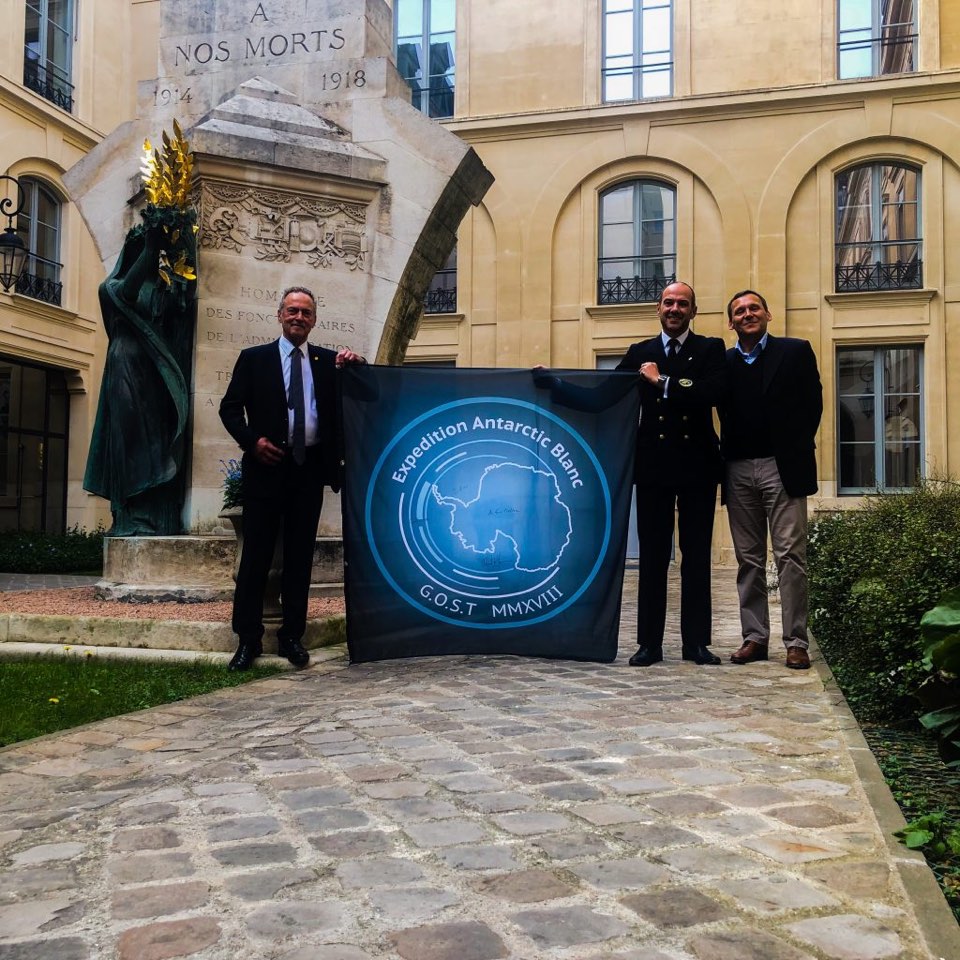
We are grateful for this fruitful get-together and we're looking forward to our next meetings in Paris.
Es war ein großes Vergnügen gemeinsam mit dem GOST Chief Historian Bernd Lehmann in einem 45-minütigen Interview geführt von Christopher Griebel im Deutschen Museum über viele Facetten der Seefahrt und der zu dem Zeitpunkt bevorstehenden Antarktisexpedition Antarctic Blanc zu diskutieren.
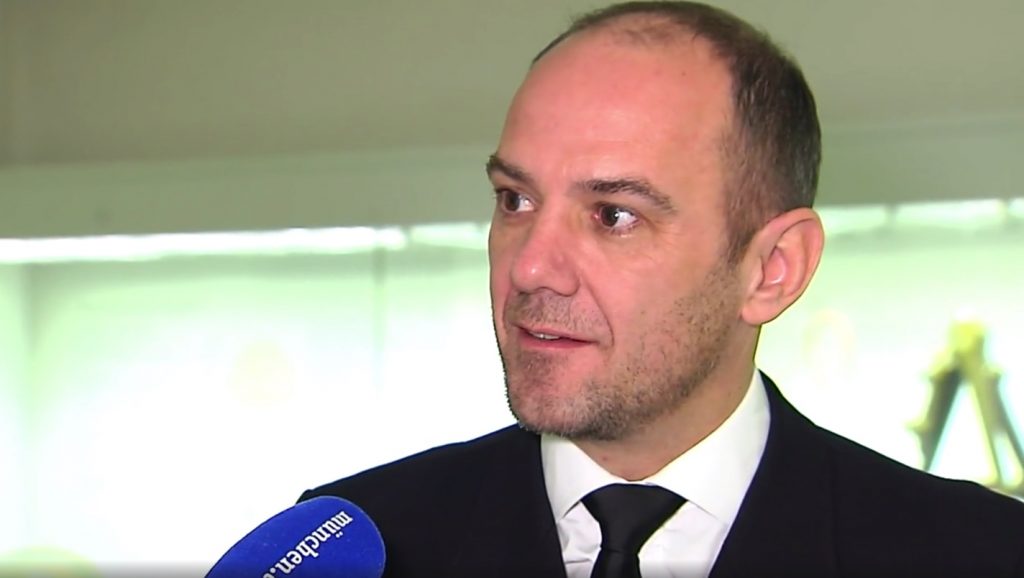
Es ist etwas besonderes auf diese Pre-Expedition Dokumentation genau heute am 1. April 2019 zurückzuschauen, an dem Tag, wo eine Delegation bestehend aus Jochen Werne (Expedition Leader), Dr. Olivier Blanchard (Chief Liaison Officer to France) und Dr. Wolfgang Händel (Chief Logistics Officer), französischen Regierungsvertretern in Paris die Expeditionsflagge übergeben werden.
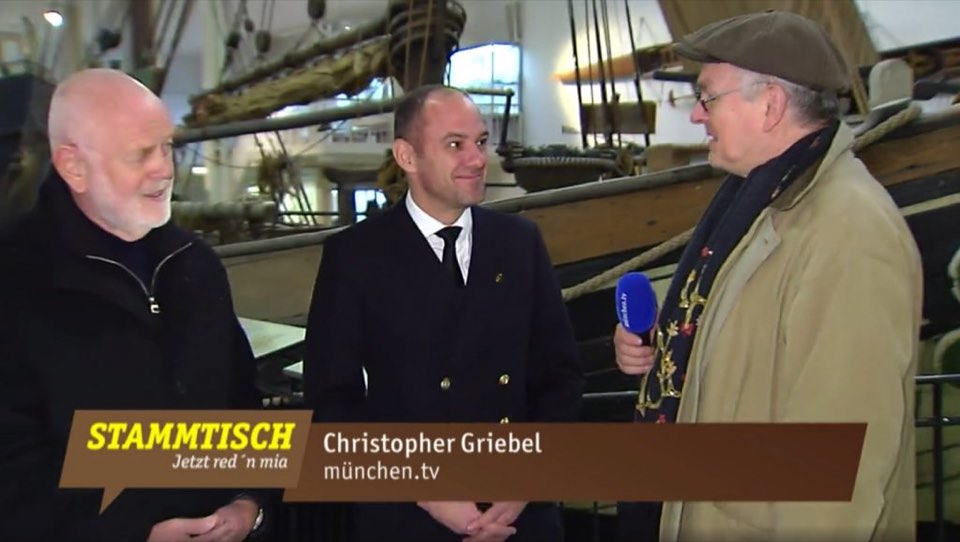
LINK ZUM INTERVIEW
https://www.muenchen.tv/mediathek/video/im-deutschen-museum-2/

It's greatly inspiring and an honour being part of this unique platform which is concentrating knowledge and illustrating perspectives in the field of artificial intelligence and self learning systems
The Plattform Lernende Systeme brings together expertise from science, industry and society for fostering Germany‘s position as an international technology leader. It understands itself as a forum for exchange and cooperation.

Designing self-learning systems for the benefit of society is the goal pursued by the Plattform Lernende Systeme which was launched by the Federal Ministry of Education and Research (BMBF) in 2017 at the suggestion of acatech. The members of the platform are organized into Working Groups and a Steering Committee which consolidate the current state of knowledge about self-learning systems and Artificial Intelligence. They point out developments in industry and society, analyse the skills which will be needed in the future and use real application scenarios to demonstrate the benefit of self-learning systems. A Managing Office at acatech coordinates the work of the platform.
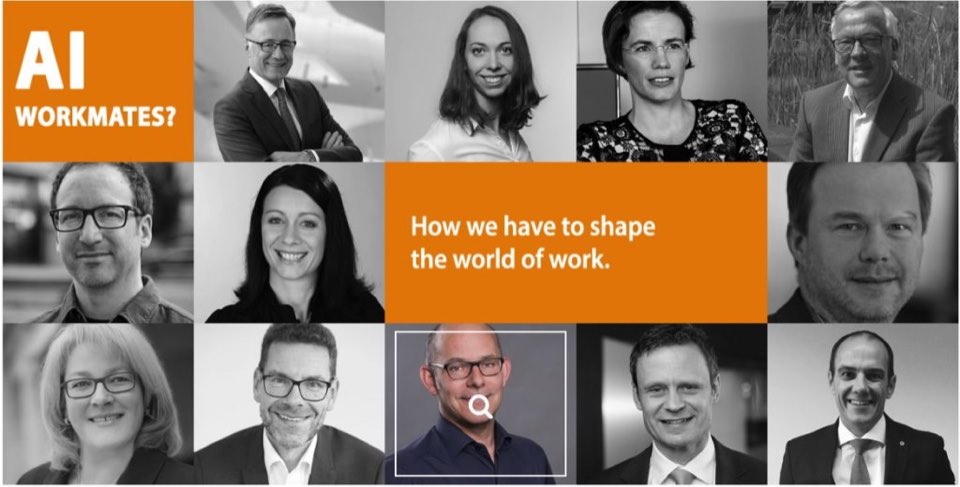
Self-learning systems are increasingly becoming a driving force behind digitalisation in business and society. They are based on Artificial Intelligence technologies and methods that are currently developing at a rapid pace in terms of performance. Self-learning systems are machines, robots and software systems that learn from data and use it to autonomously complete tasks that have been described in an abstract fashion – all without specific programming for each step.
Self-learning systems are becoming increasingly commonplace supporting people in their work and everyday lives. For example, they can be used to develop autonomous traffic systems, improve medical diagnostics and assist emergency services in disaster zones. They can help improve quality of life in many different respects, but are also fundamentally changing how humans and machines interact.
Self-learning systems have immense economic potential. As digitalisation takes hold, they are already helping companies in certain sectors to create entirely new business models based on data usage and are radically changing conventional value creation chains. This is opening up opportunities for new businesses, but can also represent a threat to established market leaders should they fail to react quickly enough.
Developing and introducing self-learning systems calls for special core skills, which need to be carefully nurtured to secure Germany’s pioneering role in this field. Using self-learning systems also raises numerous social, legal, ethical and security questions – with regard to data protection and liability, but also responsibility and transparency. To tackle these issues, we need to engage in broad-based dialogues as early as possible.

Plattform Lernende Systeme brings together leading experts in self-learning systems and Artificial Intelligence from science, industry, politics and civic organisations. In specialised focus groups, they discuss the opportunities, challenges and parameters for developing self-learning systems and using them responsibly. They derive scenarios, recommendations, design options and road maps from the results.
AI thought leaders met on the 21st and 22nd at the #HBAISummit not only to discuss the latest developments in machine and deep learning programming but especially real use-cases, trends in the start-up scene, the role of Germany and Europe in the AI race and the impact of AI on our society. Read more here
It has been a great pleasure discussing and being inspired by a highly engaged auditorium during two sessions:
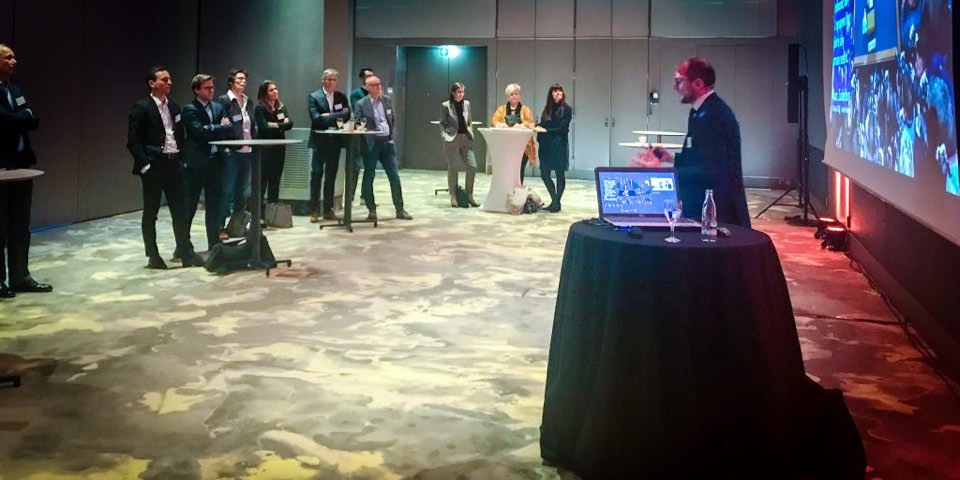
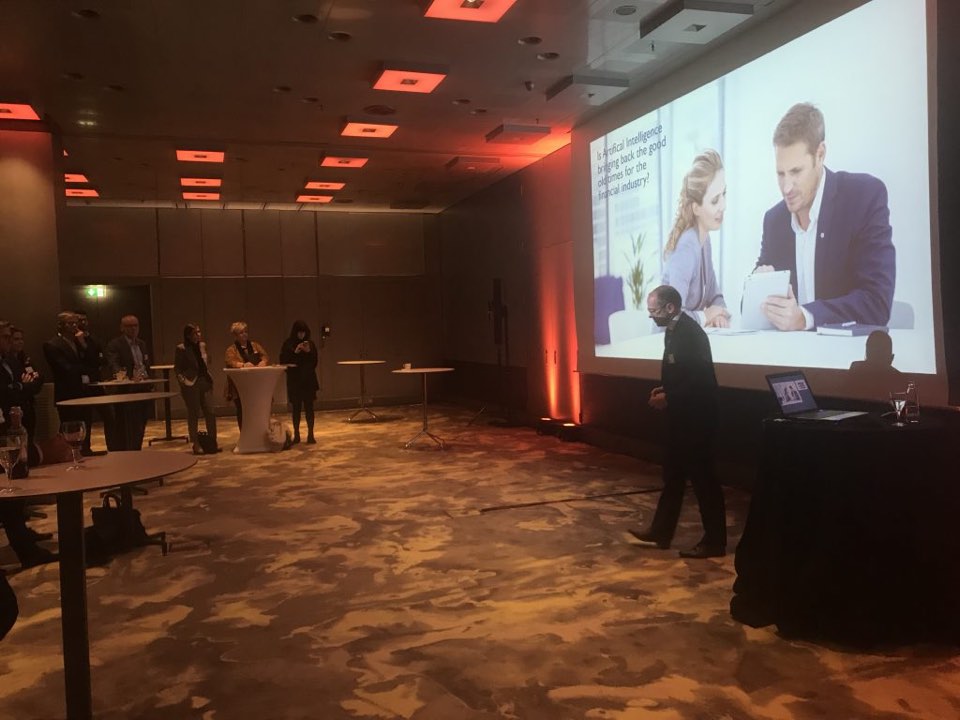
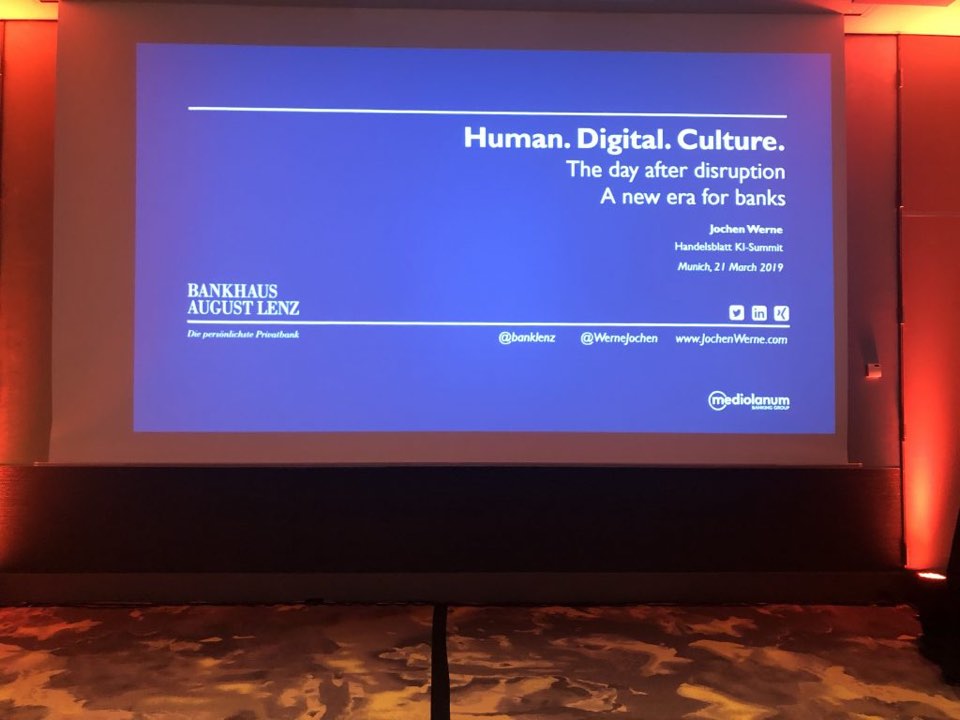
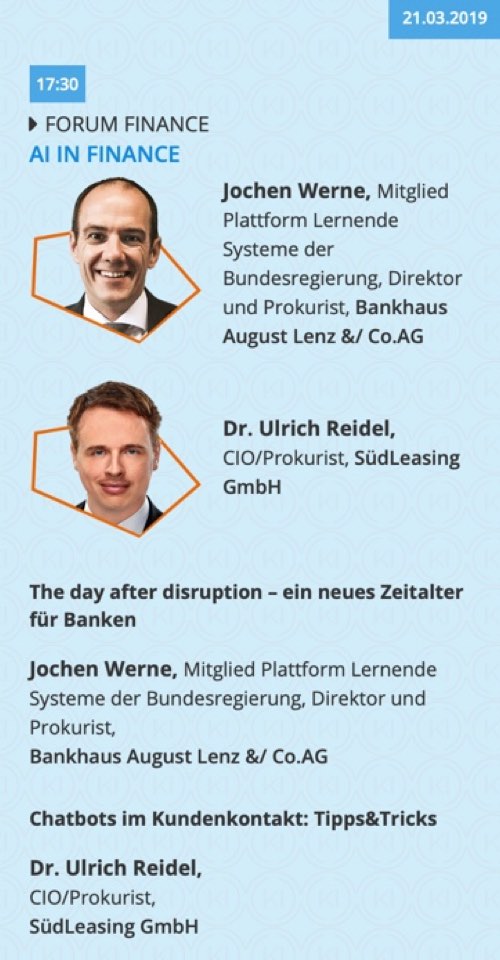
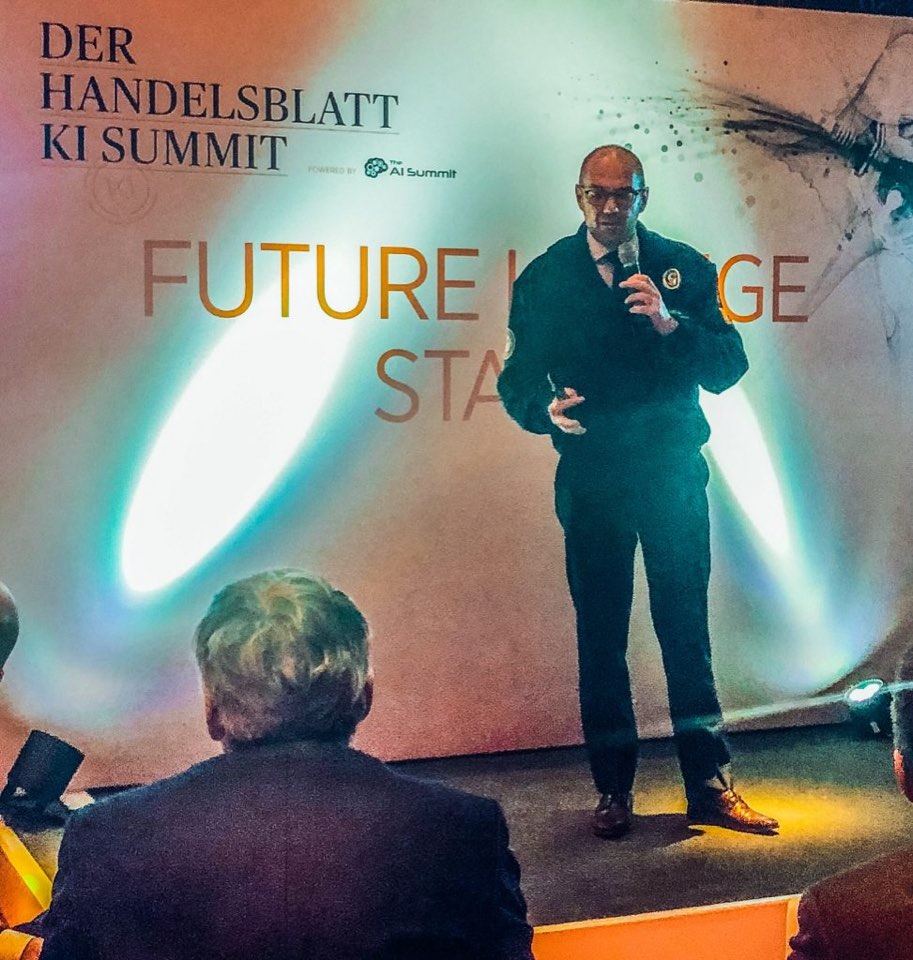
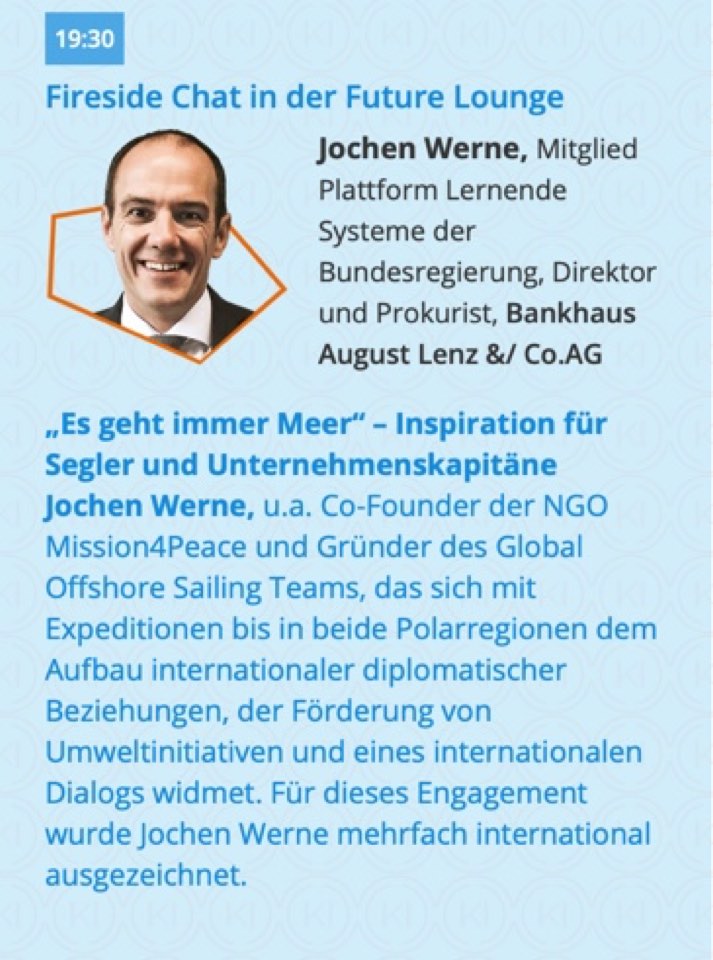
C'est un grand honneur d'avoir reçu une invitation du ministère français de la Transition écologique et solidaire à remettre le drapeau de l'expédition internationale à Mme Sophie-Dorothée Duron, Conseillère Biodiversité Eau Mer au Cabinet du Ministre sur la recommandation du Président de la République française Emmanuel Macron.
Le 1er avril 2019 à 16h00, Mme Sophie-Dorothée Duron, Conseillère Biodiversité Eau Mer, accueillera une délégation de l'expédition internationale Antarctic Blanc, menée avec succès et avec le soutien de la France. La délégation présentera le drapeau de l'expédition, qui représentait, entre autre, la France en Antarctique, comme un symbole du souvenir.
Le Président français Emmanuel MACRON a personnellement souligné dans sa lettre de soutien à l'Expédition l'importance de la préservation de l'écosystème de notre planète et la valeur d’une sensibilisation de la société par cette initiative.
Expédition Antarctique Blanc poursuivait des objectifs historiques, sociaux et environnementaux. Les 12 participants de l'initiative à l'expédition, soutenue également par les Nations Unies et 19 États, ont traversé sur un voilier de 20 mètres, deux fois en 12 jours, dans les conditions les plus difficiles, l'une des routes maritimes les plus dangereuses du monde – le détroit de Drake, couvrant 1129 milles marins (plus de 2 000 km). Le voyage a été marqué par le passage de plusieurs systèmes orageux en Antarctique et au large du Cap Horn, ce qui a retardé de plusieurs jours le retour de l’expédition. Des vents soufflant jusqu'à 50 km/h, des vagues jusqu'à 8m de haut et des températures autour du point de congélation ont exigé des performances physiques de haut niveau de la part des participants à l'expédition.
Naviguer sur des routes historiques. L'expédition a commémoré les chercheurs, explorateurs et marins dont les navires ont dû surmonter les difficultés survenues pour atteindre une région inconnue du monde. L'équipe internationale a organisé une cérémonie commémorative sur l'île volcanique proche de l’Antarctique, d'importance historique, l'île de la Déception. Au nom de tous les États ayant soutenu l’expédition et des Nations Unies, une couronne de glace locale a été symboliquement formée et déposée afin de rendre hommage aux réalisations internationales dans l'exploration de ce continent unique. Les pays ayant soutenu l’expédition comptent parmi les signataires du Traité sur l'Antarctique du 23 juin 1961, un traité politiquement unique en son genre. Les chefs d'Etat et de gouvernement des 19 nations ont exprimé leur soutien à cette expédition unique et privée par des lettres adressées au chef de l'expédition, Jochen Werne, notamment pour la réalisation de cette cérémonie de commémoration.
La France a adhéré au Traité sur l'Antarctique le 23 juin 1961 et, par sa signature, a également reconnu que "dans l'intérêt de l'humanité tout entière, l'Antarctique est utilisé exclusivement à des fins pacifiques et ne doit pas devenir le théâtre ou l'objet de discorde internationale" "qu’il est dans l’intérêt de l’humanité toute entière que l’Antarctique soit à jamais réservée aux seules activités pacifiques et ne devienne ni le théâtre ni l’enjeu de différends internationaux". La France a également souligné son engagement en faveur de la préservation de cet écosystème en tant que "réserve naturelle dédiée à la paix et à la science".
L'objectif principal de l'expédition était de sensibiliser le public international à la préservation de l'écosystème unique de l'Antarctique et de soutenir l'initiative des Nations Unies Clean Seas pour combattre les déchets plastiques dans les océans. Avec l’Expédition Antarctique Blanc, cet important projet du Programme des Nations Unies pour l'environnement est maintenant accepté sur tous les continents de notre planète.
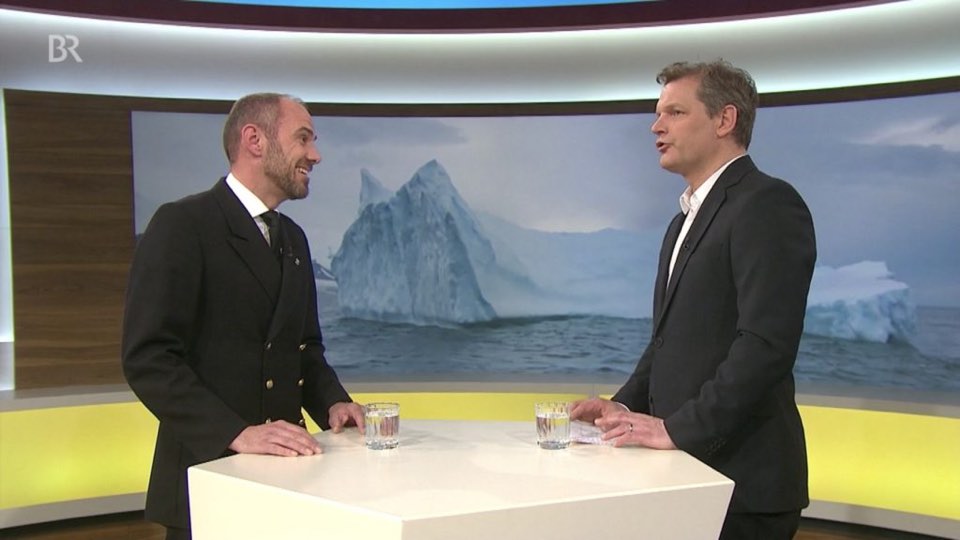
De plus, l'expédition a soutenu le projet de recherche de l'Université du Connecticut et de l'Université Northeastern sur le métabolisme du plancton en en prélevant des échantillons, ce qui pourrait apporter une contribution fondamentale à l'obtention de réponses rapides sur les réactions de l'écosystème face au changement climatique.

Avec l'observation de 18 baleines différentes et la documentation détaillée sur leur position et leur comportement, l'expédition a également contribué à l'établissement de la plateforme mondiale d'observation des baleines "Happy Wales". Cette plateforme vise à fournir à la science des connaissances approfondies sur le comportement et le développement des plus grands mammifères de notre planète.
Afin de promouvoir des projets internationaux pour les enfants et les jeunes, plusieurs retransmissions en direct en mer et sur le continent Antarctique avec les enfants de l'école de voile du Yacht Club de Monaco ont eu lieu. A son retour, l'équipe a visité l'école de voile Cedena Yacht School Puerto Williams, au Chili, qui est ouverte aux enfants de tous les milieux de la région la plus méridionale de notre planète, et qui les encourage par le sport à développer leurs propres objectifs et traits de caractère, propices à leur développement personnel. En plus d'un don de l'équipe de l'expédition, elle a posé la première pierre d’un échange international et les enfants ont suivi une présentation sur l'Antarctique et son importance.
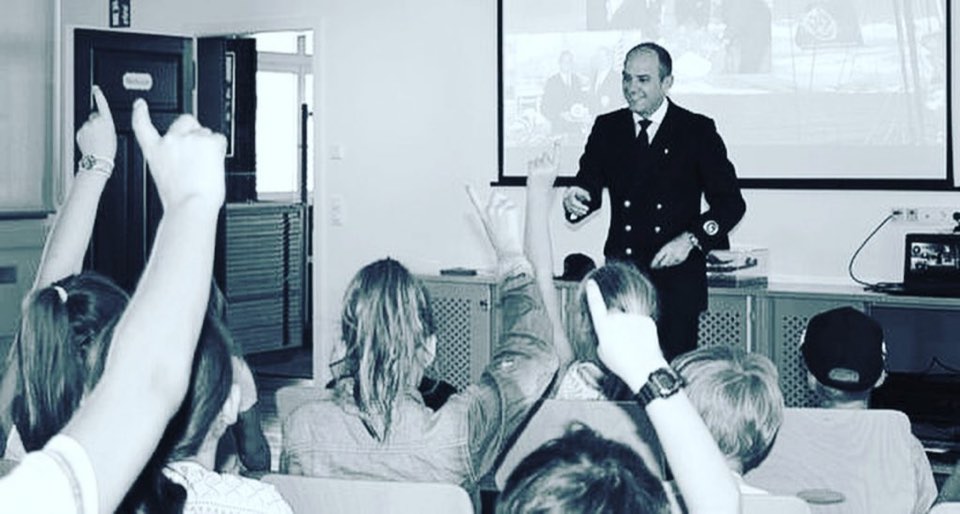
La visite à Paris marque la cinquième réception importante pour Expédition Antarctique Blanc après celle du Prince Albert II à Monaco, de l'ambassadrice des pôles des Pays-Bas, Carola van Reijnsoever, à La Haye, du Président de l'Autriche Alexander Van der Bellen à Vienne et du secrétaire particulier de Sa Majesté la Reine du Danemark Henning Fode.
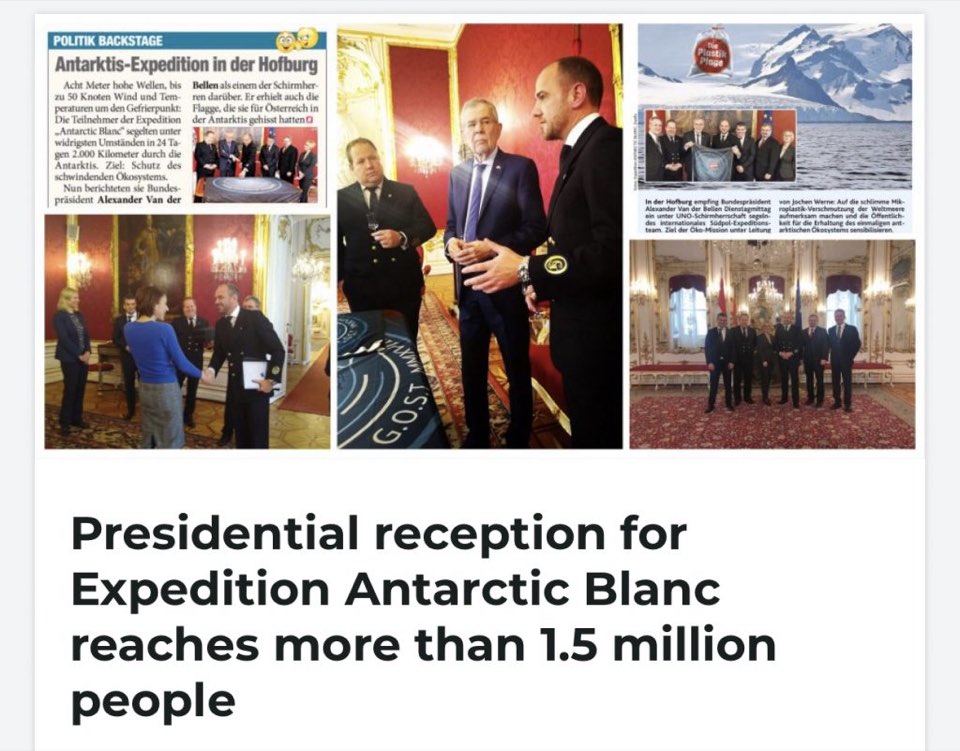
Après la remise du drapeau le 1er avril 2019 à 16h00 à Paris, le chef d'expédition Jochen Werne et le chef de liaison en France Olivier Blanchard seront à la disposition de la presse pour répondre à des questions et interviews, ou se prêter à des photos et des tournages.
Sur demande, la délégation peut également participer à des conférences de presse à Paris ce jour-là.
L'accréditation est demandée. Veuillez envoyer un e-mail à ExpeditionLeader@AntarcticBlanc.comà cet effet.
Participants à l'expédition - Équipe Offshore
Jochen Werne Chef d'expédition
Marco Schröter Directeur de la sécurité
Oliver Picht Navigateur et chef de la documentation
Linden Blue Chef des communications
Bernd Görgner Chief Medical Officer
Benon Janos Coordinateur des initiatives environnementales
Wolfgang Händel Directeur de la logistique
Hans Axtner Maître de cérémonie
Michael Melnick Coordinateur en chef des sciences
David Gamba Observateur en chef
Wolf Kloss Skipper et propriétaire d'un bateau d'expédition
Karl Papenfuss Maté
Commentaire sur l'initiateur de l'expédition - The Global Offshore Sailing Team (GOST)
L'expédition "Antarctic Blanc" est la suite de l'initiative polaire lancée en 2016 avec des objectifs comparables sous le nom de "Arctic Ocean Raptor", mais dans la zone maritime du Spitzberg et jusqu'à la limite de la banquise arctique. Un autre aspect important a été la commémoration des marins de toutes les nations, qui ont rempli leurs fonctions de marins au cours des opérations maritimes dans l'Arctique dans des conditions météorologiques généralement impitoyables et qui ont en partie perdu la vie. Au nom du roi norvégien Harald V et du gouvernement canadien, une couronne a été remise au lac ; la Belgique, l'Allemagne, la Grande-Bretagne et l'Italie ont également apporté leur soutien international à cette expédition. Fondée en 1999 par Jochen Werne et Guido Zoeller, l'équipe Global Offshore Sailing Team s’est à nouveau engagée dans l'histoire maritime et les questions environnementales avec cette expédition particulièrement exigeante et sa campagne People's Diplomacy.
Author: Jochen Werne – Original published by Bankenforen Leipzig in Bankenforen-Themendossier – 12 March 2019 - Translated by DeepL
There is no lack of buzzwording when it comes to trends in the financial sector: Disruption, FinTech, block chain, crypto. Currently, another term is climbing the zenith of a media hype - platform banking. And not without good reason. "Platform Banking" was voted "Financial Word of the Year" in 2018. Behind this lies the call for banking institutions to open up to third-party providers. Banks and savings banks should not only offer their own services on open platforms, but should also integrate third-party offers and services. Consistently thought through to the end, banks will thus become more intermediaries for all possible services and less providers of their own financial services. The legally necessary prerequisites for such an approach in the strictly regulated financial market have already been set in motion by the adoption of the Payment Services Directive PSD2. Will platform banking become a new hope for the industry, or another risk component in the attempt to lose fewer customers to new technology competitors?
The hype surrounding the topic is understandable: Eight of the ten world's most valuable companies - Amazon, Google, Microsoft, Apple and Co. - have a platform in their business model. And even more striking: Only one of these companies was already among the top 10 worldwide in 2008. This growth potential, which is the result of the platform expansion, is of course intended by many industries to benefit themselves. The world of finance is also changing rapidly. In recent years, a variety of innovative developments have taken place in the areas of payment transactions and payments. The arrival of third party providers and fintechs has changed the market sustainably and comprehensively.
According to a recent whitepaper by Deloitte Consulting, banks will also have to consider a platform strategy in the future: In the future, the customer base will also be able to access products and services from third-party providers in addition to the existing offering. The long-term goal behind this is well known - to retain existing customers, acquire new ones and increase margins.
In general, a platform can be seen as a place where supply and demand meet. Economists call such a market - not a new discovery. Due to the digitization of all areas of business and life, geographical boundaries of the marketplaces belong to the past. The result: an almost unlimited number of supply and demand meet on a digital platform - and competition is known to stimulate business. In these business models, the so-called "network effect" ensures that with each new provider on a platform, the incentive for demanders and customers also increases. And in general the more demanders there are on the platform, the more lucrative it becomes for the suppliers. Both sides save enormous search and time efforts and transaction costs are reduced. In short, reflects this the recipe for success behind industry giants such as Amazon, AirBnB, Uber and Co. Nevertheless, there are existing fundamental reservations. The desire of many bank managers to grab a straw in order to grasp a component of hope in a difficult market environment seems understandable. However, blind action is fatal in this situation. Banks must not forget what the emergence of competition in the form of FinTechs has already revealed: frightening weaknesses with regard to their own modern hardware and software solutions, organisation and innovative corporate culture. The fact is that the challenge facing change management is proving to be enormous. And this already now, without having given space to the idea of creating a single platform. The current wave of closing down banking or partnership-based Robo Advisor solutions shows how quickly these carriers of hope can become problems. The commission model behind this, which is always transparent and low priced, is hardly profitable for the banking infrastructure and marginalises the added value that an institution is able to provide for its customers.
The complexity of the changes on all levels, starting with the completely changed, technological possibilities and their effects on the transformation of long-established business models, over the resulting new economic situation of the enterprises are enormous. The difference to the past decades lies in the temporal component. If companies today do not react directly to market changes, they open the way for competitors to their own customers. And this faster than ever before. In such disruptive times, all those involved want an "efficient" change process. However, active, well-considered and vital change management is often criminally neglected. For this one opens door and gate to blind actionism.
The business model of a financial platform is complex, the regulatory framework is strict and the willingness of customers to switch is only slightly visible. For this reason, this business model has so far been too uninteresting for Internet groups. And now, of all things, the banks, often perceived as conservative and unmodern, are to be transformed into digital platforms that can compete with Amazon & Co?
Banks need a forward-looking and sustainable strategy. That is beyond question. At the latest since the massive "democratization" of the Internet at the end of the 1990s, our lives have been shaped by leaps in technology. In short, the world feels like it is turning faster than ever before. What does this mean for the banks of the 21st century? Anyone who does not understand this exponential dynamic of technical possibilities or does not take them sufficiently into account in his business model can quickly lose touch - with the customers of today and tomorrow. Open banking is both an opportunity and a technological challenge for the banking industry. The European Payment Service Directive 2 - or PSD2 for short - has inevitably made opening up to third parties the focus of the digital strategy.
At the technical level, this is primarily associated with the use of programming interfaces, so-called APIs, which enable both internal and external cost-effective and fast access to data, as well as functions of software applications. What provides the end customer with a cross-product customer experience, means for banks to strategically cooperate with external partners. For FinTechs, cooperation is also advantageous. It creates fast access to customers and their data, as well as to the necessary financial and structural prerequisites.
Anticipating these developments requires a good eye for tomorrow's customers. After all, customer data is a success driver for future business models. A few years ago, FinTechs began to "poach" their digital offerings among the customer base of traditional institutes. All of this culminated in Robo-Advisors, standardized, computer-controlled asset managers with low fees. It was therefore time for the banks to set sail anew. The plan was to enter into symbioses with FinTechs or "buy" their products directly into their own portfolios. For many large banks, it has become good form to enter into cooperation with small, independent and innovative financial service providers. This is also clearly demonstrated by the current situation of FinTechs. Mergers and co-operation are nothing else than a proof for the fact that the search for sustainable business models is not easy with a fixed idea to solve, not even with the platform strategy. Nevertheless, neither the previous business models nor the product possibilities seem to be mature.
The personal relationship, the touchpoint between customer and consultant in the real world, has been increasingly reduced by the acceptance of digital banking. Nevertheless, even if a digital experience is a good thing for a modern bank, consumers continue to appreciate human contact points - especially in economically or politically turbulent times.
The challenge lies in providing the right balance between the digital experience and the traditional, trust based, personal customer relationship.
Jochen Werne
This is precisely the added value that banks can really deliver in this environment today. And this without having to rely on the healing promises of platform banking. Be a guide in the digital jungle and protect customers from ill-considered gut decisions. In addition, it is important to include the customer's background, apart from monetary issues, in the decision-making process. This usually requires a counterpart. Not a digital one, but a human one. A person of heart and soul who generates trust and can provide a place for personal encounter. Today, it is the customer alone who determines where this is located and what it should look like. The same goes for when this meeting takes place. The modern customer expects the best possible service regardless of space and time, not only in view of the phenomenon of digital gadgets.
At a time of fast pace and constant digital transformation, it is ultimately the Bank's task to invoke traditional values, ensure humanity and meet the need to be an institution that the client trusts. Perhaps even beyond monetary concerns.
Jochen Werne
HANDELSBLATT KI-SUMMIT
DETAILS & LINK TO THE SUMMIT
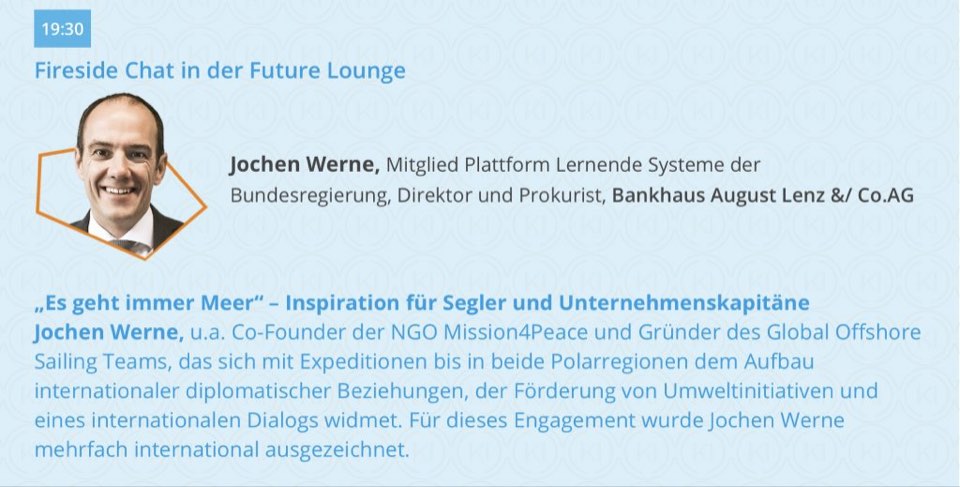
Read interviews and articles from experts in the KI-Businessguide published by the Handelsblatt for the Summit and free to download on this website

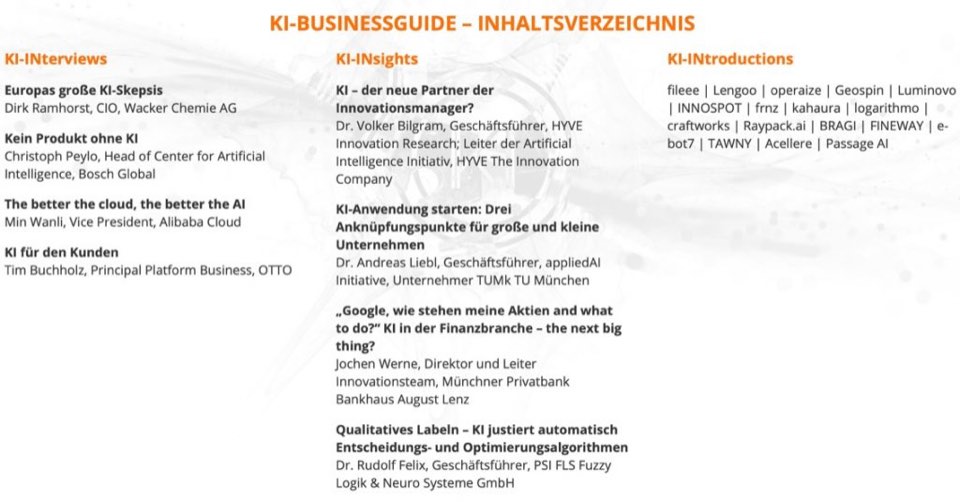
by JOCHEN WERNE, April 4, 2018 - Original published in DER BANK-BLOG - Translated by DeepL
FinTechs offer innovative digital services, at a speed that traditional banks have difficulties to compete. What phases do these new technologies go through when they are introduced and what can banks learn from it?
Until recently, there were no alternatives to traditional banking - then FinTechs came along. In many cases, they claim nothing less for themselves than to have triggered a revolution in the financial sector. And there is no doubt that FinTechs, with their special offers and concept of initially approaching the problem from the customer's point of view, free of regulatory and organisational considerations, are hitting the nerve of time. In addition, they show the pain points, i.e. the wishes of financial customers that have not yet been optimally satisfied. These are exactly the demands that have to be met in times of disruptive innovation.
The question of where this change should begin, with which project or projects is the decisive management question. It can be said in advance that this question cannot be answered in general, as too many components of the environment, orientation and corporate governance structure of the respective institution have to be taken into account.
A look at Gartner's Hype Cycle for Digital Banking Transformation can help the pre-strategy decision-making process. It looks at most future issues and arranges them along a curve that shows which phases of public attention a new technology goes through when it is introduced.
By means of a technological trigger, a specialist audience and other third parties begin to increase the level of awareness of an innovation or even just an idea for an innovation (on the rise). Expectations rise disproportionately and some time later they reach the peak of exaggerated expectations (at the peak). Since the creation of expectations progresses much faster than their fulfilment, a first disappointment is inevitable (sliding into the through). Then, in the so-called "path of enlightenment", a realistic examination of the technology begins, in which lower media interest and productive deployment scenarios emerge (climbing the slope), which then lead to a plateau of productivity (entering the plateau) - if the technical innovation turns out to be relevant.
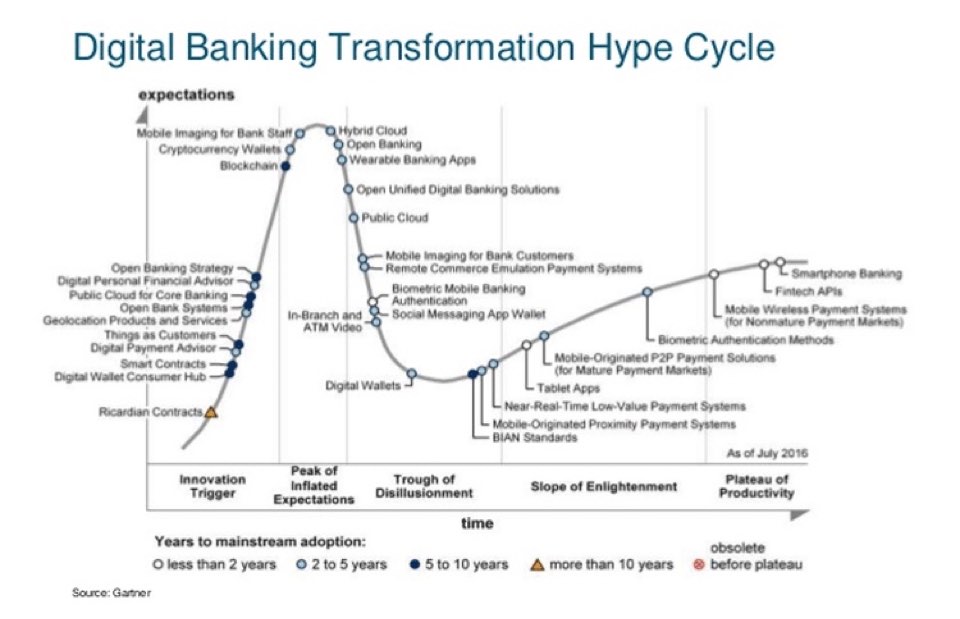
Gartner categorized in 2016 Digital Banking Transformation topics as follows:
On the Rise - Ricardian Contracts, Digital Wallet Consumer Hub, Smart Contracts, Digital Payment Advisor, Things as Customers, Geolocation Products and Services, Open Bank Systems, Public Cloud for Core Banking, Digital Personal Financial Advisor, Open Banking Strategy
At the Peak - Blockchain, Cryptocurrency Wallets, Mobile Imaging for Bank Staff, Hybrid Cloud, Open Banking Wearable Banking Apps
Sliding Into the Trough - Open Unified Digital Banking Solutions, Public Cloud, Mobile Imaging for Bank Customers, Remote Commerce Emulation Payment Systems, Biometric Mobile Banking Authentication, Social Messaging App Wallet, In-Branch and ATM Video, Digital Wallets, BIAN Standards, Mobile-Originated Proximity Payment Systems, Near-Real-Time Low-Value Payment Systems
Climbing the Slope - Tablet Apps, Mobile-Originated P2P Payment Solutions (for Mature Payment Markets), Biometric Authentication Methods
Entering the Plateau - Mobile Wireless Payment Systems (for Nonmature Payment Markets), FinTech APIs, Smartphone Banking
REMARK by the author: compare the 2018 situation in the Gartner study available HERE
The listed topics should be familiar to every member of the management and the responsible managers in the area of strategic corporate development, as they can become key value drivers for the future orientation of your institute. The entrepreneur Brett King expressed it even more radically in his 2016 book "Augmented: Life in a smart world":
"If you're a bank, this is the year you start redesigning every single product in your wheelhouse."
Brett King
Transparent fee structures and the simplest possible access to the banking system are basic requirements for customers. Whether FinTechs can offer sustainable business models in the long term remains to be seen. They, too, cannot escape the pressure on margins and changing customer demands. FinTechs make it easier for their customers to access the banking sector and can thus counteract the dissatisfaction of traditional bank customers in the service sector. They offer services where traditional banks often do not yet act flexibly enough. Established financial service providers are thus forced to rethink, adapt or further develop their business models. Those who escape this change will have to contend with major competitive disadvantages in the future.
About the author: Jochen Werne and the Munich based private bank August Lenz on-boarded five FinTechs within just one year. FinTech Finance wrote about the transformation "A bank becomes driver of innovation in digitalisation"
Co-Author: Jochen Werne
Chapter: Transformation of an analogue private bank into an innovation driver
Find a reading extract here
Buy at Amazon / Springer Shop / Thalia / Hugendubel / GooglePlay

Chapter 5: Transformation of an analogue private bank into an innovation driver
Reflection on change, technological progress and human behaviour in disruptive times
The article analyses and discusses the changes, challenges, decision paths and implementation practices of Bankhaus August Lenz in the years 2014 to 2016. In addition, the author would like to provide executives and managers entrusted with the transformation of their institution with practical arguments that may help them to cope better with daily challenges in change management practice. As a traditional private bank with a European parent, the task was not only to complete the transition away from a fully analog bank, but also to adapt the Group’s strategy for the German market with the budget adapted to the size of the institution. The most important internal customer was also integrated into the change: the Family Banker®, which is at the heart of the philosophy and is responsible for customer contact. This human contact and personal contact is the guarantee for the indispensable relationship of trust between customer and bank. The author examines issues such as coopetition, agile project management approaches and cooperation with FinTechs. In addition, topics such as value proposition, behavioral finance, the need to concentrate on core issues, the importance of personal consulting in the digital age and exchange in an international working environment as well as communication are treated as essential success factors. The paper does not claim to be perceived as a scientific work, but focuses on the practical implementation of the core problem of a market participant in a disruptive market – the question of how to restructure and realign companies in order to continue to play a role as a market player in the future.
On 1 April 2019 at 4 p.m., Mme Sophie-Dorothée Duron, Conseillère Biodiversité Eau Mer will welcome a delegation from the international expedition Antarctic Blanc, which was successfully carried out with French assistance. The delegation will present the expedition flag, which represented France in Antarctica, as a symbol of remembrance.
French President Emmanuel MACRON personally underlined in his letter of support to the Expedition how important the preservation of our planet's ecosystem is and how valuable therefore the creation of awareness in the society by the initiative.
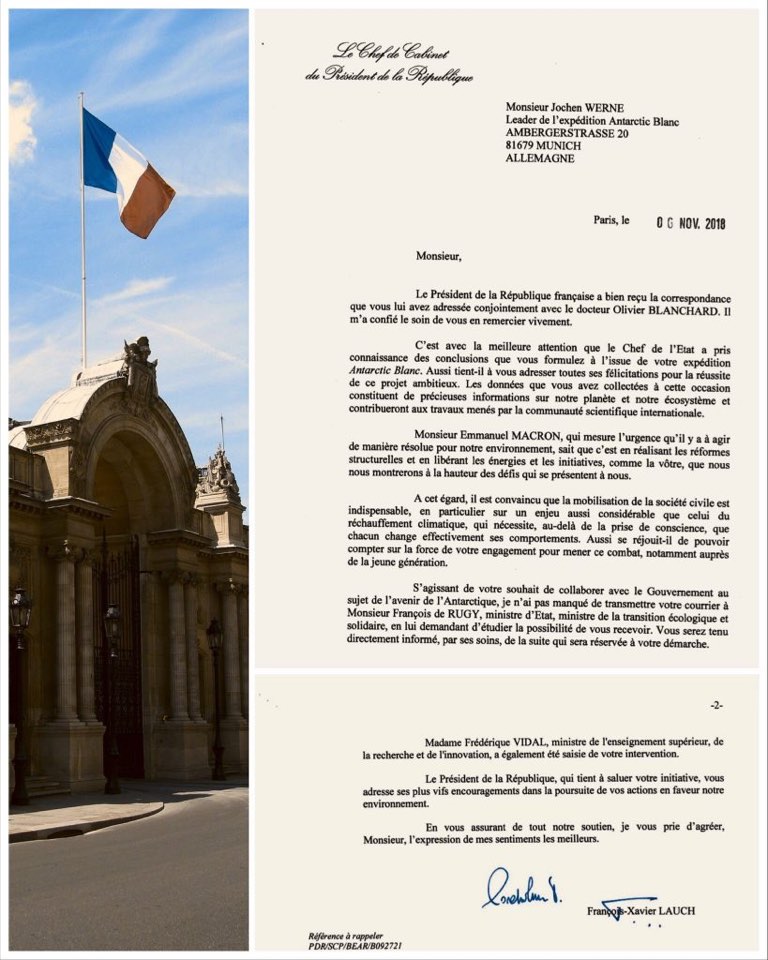
STORMS AND ICEBERGS
Expedition Antarctic Blanc pursued historical, social and environmental goals. The 12 expedition offshore participants of the initiative, supported by the United Nations and 19 states, crossed on a 20m sailing yacht twice in 12 days, under the toughest conditions, one of the most dangerous sea routes in the world – the Drake Passage, covering 1129 nautical miles (over 2,000km). The journey was marked by the passage of several storm systems in the Antarctic and off Cape Horn, which delayed the return by several days. Winds with up to 50kn, waves up to 8m high and temperatures around freezing point demanded top physical performances from the expedition participants.
INTERNATIONAL COMMEMORATION CEREMONY. Sailing on Historic Routes. The expedition commemorated the researchers, explorers and sailors whose ships had to master the challenging peculiarities of reaching an unknown part of the world. The international team held a commemoration ceremony on the historically significant Antarctic volcanic Deception Island. In the name of all supporting states and the United Nations, a wreath of local ice was symbolically formed and laid down in order to pay international tribute to the achievements in the exploration of this unique continent. The supporting nations are among the signatories of the politically unique Antarctic Treaty of 23 June 1961. Heads of state and government organizations of the 19 nations have expressed their support for this unique, privately initiated expeditions in letters to the leader of the expedition, Jochen Werne, in particular for the execution of the ceremonial act of commemoration.
FRANCE AND THE ANTARCTIC TREATY. France joined the Antarctic Treaty on 23 June 1961 and, with its signature, also acknowledged that “in the interest of all mankind, Antarctica is used exclusively for peaceful purposes and should not become the scene or object of international discord”. France also underlined its commitment to the preservation of this ecosystem as a “nature reserve dedicated to peace and science”.
UNEP CLEAN SEAS INITIATIVE. The main focus of the expedition was to sensitize the international public for the preservation of the unique Antarctic ecosystem and to support the UN initiative Clean Seas to combat plastic waste in the oceans. With Expedition Antarctic Blanc, this important United Nations Environmental Program project is now finding acceptance on all continents of our planet.
CONSEQUENCES OF CLIMATE CHANGE ON THE ECOSYSTEM. In addition, the expedition supported the University of Connecticut and Northeastern University’s research project on plankton metabarcoding by collecting plankton samples, which could provide a fundamental contribution to obtaining rapid responses to the ecosystem’s response to climate change.
WHALES IN THE ANTARCTIC. With the observation of 18 different whales and the detailed documentation of their position and behaviour, the expedition also contributed to the establishment of the global whale observation platform ‘Happy Wales’. The platform is intended to provide science with in-depth insights into the behaviour and development of the largest mammals on our planet.
CHILD AND YOUTH DEVELOPMENT. To promote international children and youth projects, several live broadcasts were held from sea and Antarctica with children of the sailing school of the Yacht Club de Monaco. On their return, the team visited the Cedena Yacht School Puerto Williams, Chile, which is open to children from all walks of life in the southernmost region of our planet, and through sport encourages them to develop their own goals and character traits that are conducive to their personal development. In addition to a donation from the expedition team, the foundation stone was laid for an international exchange and the children were introduced to Antarctica and its significance.
INTERNATIONAL RECOGNITION. The visit to Paris marks the fifth important reception for Expedition Antarctic Blanc after the reception by Prince Albert II in Monaco, the ambassador of the poles of the Netherlands, Carola van Reijnsoever, in The Hague, the President of Austria Alexander Van der Bellen in Vienna and the Private Secretary to Her Majesty The Queen of Denmark Henning Fode.
PRESS INVITATION
Expedition participants – Offshore Team
Jochen Werne Expedition Leader
Marco Schröter Chief Safety Officer
Oliver Picht Navigator & Chief Documentation Officer
Linden Blue Chief Communication Officer
Bernd Görgner Chief Medical Officer
Benon Janos Environmental Initiatives Coordinator
Wolfgang Händel Chief Logistics Officer
Hans Axtner Master of Ceremony
Michael Melnick Chief Sciences Coordinator
David Gamba Chief Observer
Wolf Kloss Skipper and Expedition Yacht Owner
Karl Papenfuss Mate
Comment on the initiator of the expedition – The Global Offshore Sailing Team (GOST)
Expedition “Antarctic Blanc” is the continuation of the polar initiative launched in 2016 with comparable objectives under the name “Arctic Ocean Raptor”, but in the Spitsbergen sea area and up to the Arctic pack ice limit. An additional and important aspect was the commemoration of the seafarers of all nations, who fulfilled their seafaring duties during the maritime operations in the Arctic under the mostly merciless weather conditions and partly also lost their lives. In the name of the Norwegian King Harald V and the Canadian government, a wreath was handed over to the lake; further international support for this expedition came from Belgium, Germany, Great Britain and Italy. Founded in 1999 by Jochen Werne and Guido Zoeller, the Global Offshore Sailing Team is once again committed to maritime history and environmental issues with this particularly challenging expedition and its People’s Diplomacy campaign.
Press contact:
Jochen Werne
Expedition Leader
Mail: ExpeditionLeader@AntarcticBlanc.com
Expedition Antarctic Blanc supported with pride the new movie of producer Martina Hirschmeier
Martina wrote on Facebook about today's premiere:

"Tomorrow, Tuesday 19.2.19, 16 o'clock on the stage of the VBE in hall 8 on the #Didacta2019 #Premiere of #Oceans in danger. It is the most international and probably most important project I have ever supervised. Many thanks to the supporters, without whom we would never have been able to manage the project: the #loveyourocean Initiative, Sarah Kinloch #seashepherd Nicolai Duda, Frank, Madeleine von Hohenthal and Benjamin Wenke from #Bracenet, Martin Aigner, Reefcalendar, #Scubazoo, Cornelia Nauen, #Mundusmaris, Line Hindsbjerg, Emily Penn, #Exxpedition, Jenn Russell, #DeutscheMeeresstiftung, Ariel Lucero, Melina, Parinoshka Kobbe, #Tasini, Underwater Worlds, Katrin Haensch, Teresa, #Maketheoceansplasticfree, Mareike Huhn, Katrin Hans, Lena Löschel, #BandaSea, Jochen Werne, #Antarcticblanc, #Guppybag, Marcella Hansch, #MermaidKat, Esther Gonstalla, Ghost Fishing, Healthy Seas, Torben Cord, #Planctonchronicles, #PalmaAquarium, #MHouse. Thanks for the emotional support go to Melanie Künzl and Christina Schröter."
After meeting Martina for the first time at the world's largest boat show, it quickly became clear that her heart beats for our oceans and for educating children and young people about the importance of preserving our planet's ecosystem. It is a great pleasure to support her new project and we are all looking forward to seeing "Oceans in danger" soon.
Jochen Werne
Expedition Leader
Expedition Antarctic Blanc
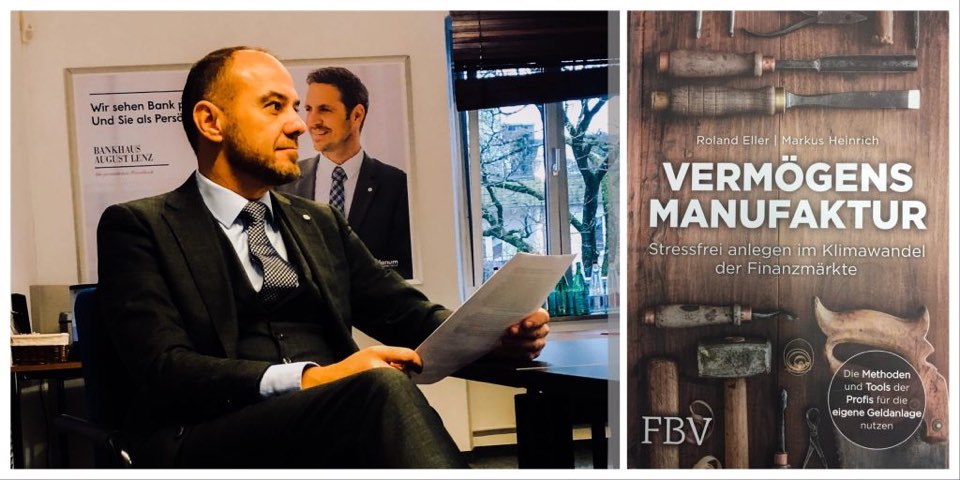
Co-Author: Jochen Werne
Chapter: The Bank - The pilot in the digital investment jungle
Find a reading extract here
Buy at Finanzbuch Verlag / Amazon / Weltbild / GooglePlay
Content extract
Author: Jochen Werne - published by Der Bank-Blog - 15 February 2019

Cyber crime has become a serious threat to business, politics and private individuals since a long time. New technologies based on the use of artificial intelligence might offer more security.
The fight against cyber threats has become significantly more complex for global government organisations, businesses, and individuals in recent years. Technical protection of IT systems and infrastructures and thus data security in the narrower sense are no longer the only issues. Companies, for example, need to address the much broader concept of information security.
Solutions based on artificial intelligence could prove helpful in the fight against cybercrime. According to a study by the IBM Institute for Business Value, the spread of intelligent, AI-based security solutions will increase significantly in the coming years.
Technical protective measures have long since been based on machine learning, for example, to identify spam or phishing e-mails or to record trends and anomalies in large amounts of data - both in data traffic within the corporate network and in its external connections.
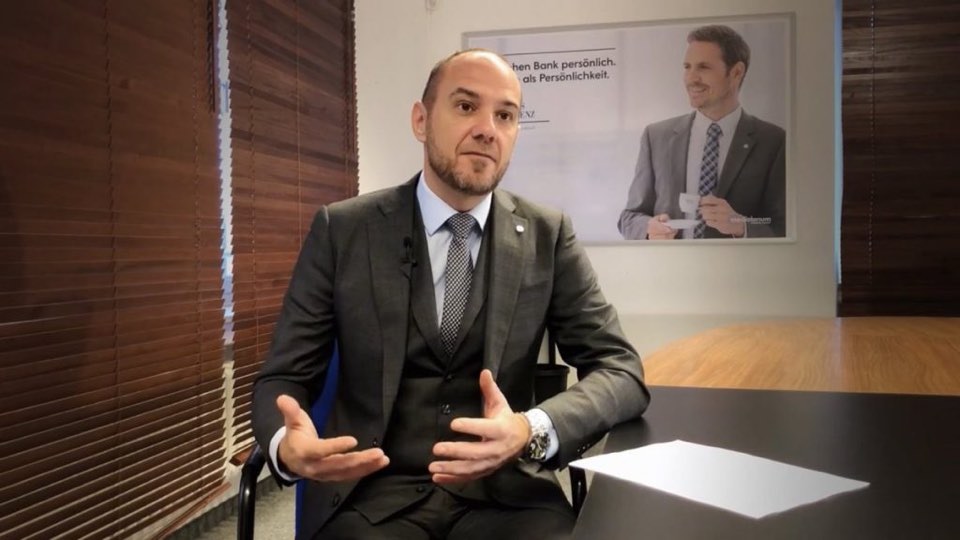
In future, for example, systems might also be able to identify hidden channels in the corporate network through which cyber criminals attempt to acquire data. AI's greatest strength, pattern recognition, enables automated detection of a wide range of anomalies and security incidents. For this purpose, however, AI-based systems must also learn to distinguish between common IT failures and cyber attacks. In addition, self-learning algorithms need to take internal corporate processes into account to come up with precise results.
In the near future, according to a forecast by Christian Nern, former Head of Security Software DACH at IBM Germany and today Partner at the Consulting firm KPMG, AI-based security analysis systems will be able to detect and fend off attacks proactively. Then, according to the former IBM security software chief, the confrontation between cyber criminals and security officers could possibly take place directly between the AI systems they use.
Germany, which considers itself a pioneer country in the fields of learning systems and artificial intelligence, has already launched a platform for artificial intelligence on this topic initiated by the Federal Ministry of Education and Research (BMBF): "Learning Systems". The platform with its 200 members brings together leading experts from science, business and society and deals with technological, economic and social issues relating to the development and introduction of learning systems on an interdisciplinary and cross-sector basis.
One of the seven working groups deals in particular with IT security, privacy, law and ethics. The composition of the topics in this group shows the interwoven culture-specific discussions that will later lead to scenarios, recommendations, guidelines and roadmaps.
As often in cyber security topics, there is no patent solution for the numerous questions and challenges. A company-wide risk management system, which establishes appropriate technical and organisational measures and also takes into account findings from psychology and cultural studies, seems to be a sensible way forward.
The right balance between security awareness and security, individual freedom paired with increased personal responsibility as well as support through technology and organisational structure is probably the most promising approach in the current state of research and technology to effectively meet the challenges for information and IT security.
Artificial intelligence is finding its way into the highly regulated world of banking. And not only GAFA Silicon Valley high-tech companies see it as the technology of the future, but also FinTechs and established banks. How it came to this, what possibilities and limits there are at the moment and why humans will remain irreplaceable not only when it comes to money - the commentary
by Jochen Werne, innovation and transformation expert
Munich private bank Bankhaus August Lenz
Original published in German in the IT-Finanzmagazin (31 July 2018). Translation by DeepL
After "FinTech", "Blockchain" and "Crypto", "AI" is the new buzzword in the banking world. Whether chatbots in the digital customer center or self-learning algorithms for highly complex investment strategies are being discussed - the omnipresence of the term suggests that the integration of artificial intelligence into one's own business model seems to be virtually vital.
Artificial intelligence and big data are currently the strongest and most vibrant innovation trends in the financial sector …
… was also one of the guiding principles of Prof. Joachim Wuermeling, board member of the Deutsche Bundesbank, in his speech on "Artificial Intelligence" at the second annual FinTech and Digital Innovation Conference in February 2018 in Brussels.
The choice of the conference venue, which like rarely any other city combines both a belief in progress and a deeply rooted European tradition, can hardly be more symbolic of the forthcoming change. In fact, the topic is by no means new: the development towards an increased use of so-called non-human intelligence is based on approaches from the 1940s - with the invention of the first computers
Artificial intelligence: revolution as a reaction to mountains of data?
But what is now possible in times of exponential technologies is in fact nothing less than a revolution. The financial industry is sitting on a valuable mountain of data, the extent of which is currently difficult to estimate. The maturing AI systems would not only make the preparation and processing of this data easier, but also much more cost-effective, faster and more targeted. Data already collected could become the most valuable raw material and a resource due to the technological leaps in the field of AI, which, in combination with the enrichment of external, non-structured data, must be "usable" in a meaningful way.
The industry is asked to use private data in a sensitive way for the benefit of the customer, - a goal that should certainly apply to all AI-based approaches.
To find meaningful regulations for the handling and the effects of the use of AI on society, economy and thus on our life and the work of tomorrow is the task of politics. The fact that this topic is taken very seriously is evident not only in national initiatives such as the German Platform for Artificial Intelligence "Learning Systems", but also in the European Artifical Intelligence shoulder-to-shoulder approach, which is being pushed forward by France and Germany.
"Digital hand holding" in the event of a financial crash is not enough
At present, it is still too early to say which operational areas of the financial world will sooner or later be supported - in part or even entirely - by the use of AI systems. However, the financial crises of the past have shown this time and again:
Trust is crucial when it comes to money. Trust in the markets, the banking system and the human contact as an intermediary in a complex issue".
However, the banking industry knows very well from its own experience how easy it is to loose customer's trust. An experience that Mark Zuckerberg and Facebook recently also had to make in connection with the Cambridge-Analytica scandal. As with every new technology and every new approach, the same applies to the topic of "intelligent" systems: a lot of trust, coupled with half-knowledge and a big dash of emotionality results in a popular trend cocktail, which, however, bears a certain risk of headaches on the following day.
Jochen Werne is the authorized signatory responsible for Marketing, Business Development, Product Management, Treasury and Payment Services at Bankhaus August Lenz & Co. After two years as navigator of the sailing training ship 'Gorch Fock', the international marketing and banking specialist completed his studies as client coverage analyst at Bankers Trust Alex. Brown International and in Global Investment Banking at Deutsche Bank AG, he has worked on numerous projects in other European and American countries. In 2001, he joined Accenture as a Customer Relationship Management Expert in the Financial Services Division before joining Bankhaus August Lenz & Co. AG in Munich, where he has since been responsible for various areas of the institute. As part of the Innovation Leadership Team of the Mediolanum Banking Group, a member of the expert council of Management Circle and the IBM Banking Innovation Council, Jochen Werne is a keynote speaker at numerous banking and innovation conferences.
On Feb 12, 1942, the Channel Dash happened. 70 years later, on Feb 12, 2012, the Global Offshore Sailing Team has been invited for the first time by the Channel Dash Association to commemorate brave air and sea man and to create and strengthen friendships between people and nations who were enemies in former times. Today at the 76th anniversary of the Channel Dash we continue the tradition to remember and to make us all aware how precious and equally vulnerable peace is. And therefore how important the engagement of our civil society is to strengthen the roots of peace every day.
12 February 2012: Jochen Werne, Skipper and Representative of the GLOBAL OFFSHORE SAILING TEAM (www.gost.org) is commenting the "Channel Dash" during the CHANNEL DASH ASSOCIATION's 70th Anniversary Remembrance Event at the Royal Airforce Base Manston. The Team thanks greatly the CDA (www.channeldash.org) for the kind invitation and hospitality. The Channel Dash, (codenamed Operation "Cerberus" by the Germans), was a major naval engagement during World War II in which a German Kriegsmarine squadron consisting of both Scharnhorst class battleships, and heavy cruiser Prinz Eugen along with escorts, ran a British blockade and successfully sailed from Brest in Brittany to their home bases in Germany via the English Channel.* The Expedition Corps of the Global Offshore Sailing Team will leave - 70 years after Operation "Cerberus"-- Brest on a 50ft sailing yacht on the historical footsteps of this spectacular operation. This historic research Expedition "CERBERUS" 2012 wants to be a platform for remembering and honoring all woman and men who fought on both sides with great bravery. The Daily Mail reported in 1942 "This is an episode of which Britons can be rightly proud. In planes which, against the German protecting aircraft, were as slow as a cart horse compared with a motorcar, 18 men of the Fleet Air Arm flew over the Channel. Crippled and ablaze before they got within range, they kept on, delivered their attacks - and died!" *www.wikipedia.de
We also want to remember the man who inspired us so much bringing our goal of creating international understanding forward: Peter Nixon
Peter Nixon, Chairman of the Channel Dash Association once reflected about history and human mankind with the following words:
„ … working so hard to bring history back to everyone`s attention and recognizing the many great acts of courage performed on our behalf by men and women of all sides during a period of conflict. … It is not about Winner`s or Loser`s. … The world is a wonderful place to live because it is made up of many different, but beautiful countries.… We should be proud of this fact. Equally, we should not be ashamed of our past, nor should we glorify it, for it was our past which created what we are today.”
Peter Nixon
The world lost in July 2018 an outstanding personality and many of us a dear friend. His ideas and inspiration will remain with us. Jochen Werne Co-Founder - GOST
Interview for Bankhaus August Lenz
Bankhaus August Lenz im Gespräch: mit Jochen Werne, Direktor, Mitglied der BMBF Blattform für Künstliche Intelligenz „Lernende Systeme“ & des Royal Institutes of International Affairs Chatham House
MANAGEMENT IN DISRUPTIVE TIMES
Author: Jochen Werne . Firstly published in the Academy for Leadership column in German. Translation supported by DeepL
"An analogy for business leaders in the financial industry that compares the challenging times of today's technological enterprise transformation with the changes during the time of the industrial revolution when steam ships ended the centuries-long era of sailing ships."
In 1971, the BBC began broadcasting a series on the history of James Onedin, who, as captain and later as shipowner, lived through the stormy times of industrialisation and the conversion of the entire industry from sailing to steam navigation. The series, which takes place in Victorian England in the second half of the 19th century, describes in a special way the subtleties of the interplay of a changing market. New technologies, new skills of market participants, increased conflict potential between entrepreneurs and managers and reorientation in an environment of shrinking margins - special challenges for those who tried to continue their business as before: with sailing ships.
The captain is responsible for bringing his ship, crew and cargo safely and within a specified time and financial framework to the port of destination. But what if the ship is no longer able to do this and the competition suddenly moves across the blue oceans with completely different ships? What if the shipowner does not have the capacity to trust the new technologies or simply does not have the financial resources to re-equip his fleet? And what about the crew? Does the crew has the necessary skills to sail on the new ships?
Many captains of banks and financial institutions seem to have this scenario all too present. E.g. due to declining customer traffic in bank branches, the high costs for a broad branch network are hardly to be paid today. Germany as a financial centre is "overbanked", interest rates in the basement - the conditions in Germany for successful banking have never been as challenging as they are now. To this end, customers are continuing to drive change in the industry with their changing demands on digital tools.
Outwaiting a problem or tackling it
The complexity of economic changes has been enormous in every epoch, the difference to current upheavals lies in the temporal component. If companies do not react immediate to market changes today, they might loose their customers faster than ever before. In such disruptive times, all those involved want an "efficient" change process. The only problem is that the term "change" is so omnipresent that it is often perceived as stress and overload. As a result, many levels of management fall into one of the following situations: either they try to sit out the situation and leave change to their successors, or they push many, often less effective measures in an attack of blind actionism. Active, thoughtful and vital change management is often neglected.
More entrepreneurial thinking
Processes of change require both superiors and employees. If the existing situation cannot be improved or adapted at any vertical level, it must be questioned. Concluding, this means for all those involved that situations must always be reflected and corrective measures initiated at an early stage.
Understanding the corporate culture is vital for a successful transformation
In many companies, however, this need for action, which has a high potential for conflict, is often insufficiently communicated. In some places there is a lack of interest for employee issues, a lack of error and conflict culture and a minimal willingness to change. If banks neglect these issues, change processes threaten to fail on a broad basis. This means that managers in a disruptive environment have a natural need for action. The implementation of new strategies, systems and structures and early adaptation to changing market situations are vital factors for survival. A well-known quote by former US President Wodrow Wilson (1913-1921) is particularly valid for today's highly competitive financial sector: "If you want to make enemies, try to change something."
Those companies that create the change will share the large financial services market with the new market players and use instruments that did not exist in the classic banking of the past.
Just like James Onedin, who for the longest time was an advocate of classic sailing ships, finally added a modern steamship to his fleet. And to facilitate the change for himself personally, he named the ship after someone he loved.
The two largest Austrian newspapers “Kronenzeitung” and “Heute” reported on the official visit of a delegation of Expedition Antarctic Blanc to the Hofburg. Together, the publications have a circulation of more than 1.5 million copies per day.
We are grateful to President Alexander Van der Bellen for the invitation, the President’s Press Corps and the press for the publications that support the goal of raising awareness of such important issues as the UNEP Clean Seas Initiative, the fight against microplastics in our oceans, the importance of Antarctica for our ecosystem and the importance of international cooperation and understanding.
Austria has a long standing tradition in Polar Research leading to the Austrian Polar Research Institute, who’s coordinating today the country’s activities in the Arctic and Antarctica
The delegation consisted of
Jochen Werne (Expedition Leader); Andris Adam (Chief Liason Officer to Austria and Hungary); Götz Credé (Chief Liaison Officer to Belgium, Denmark and The Netherlands); Dr. Wolfgang Händel (Chief Logistics Officer); Prof. Dr. Andreas Richter (Founding Director of the Austrian Polar Research Institutes); Christin Latk (Expedition Support Team – Akademie der Führungskräfte)
Country-specific aspects of cybercrime.
The number of cyber attacks on businesses, governments and individuals is increasing worldwide. The human being in his cultural environment is an important element. Different cultures seem to be associated with different susceptibilities.
by JOCHEN WERNE - Original published in German on January 18, 2019 at Der Bank-Blog - Translation with DeepL.com
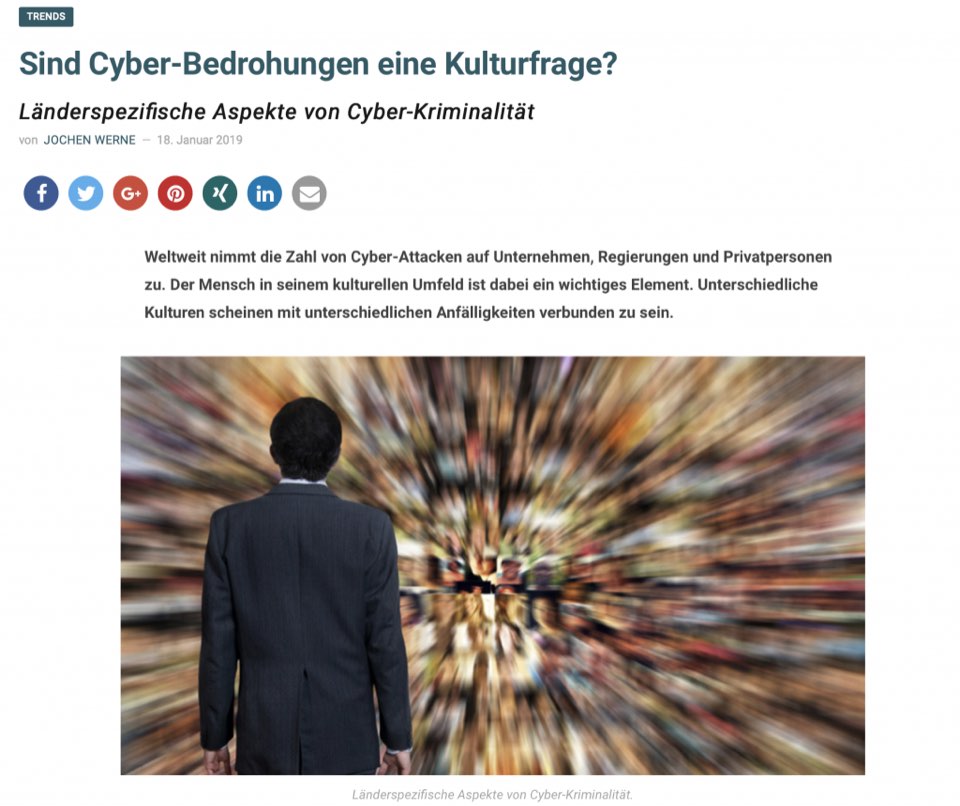
In its annual management report "The Situation of IT Security in Germany 2018", the Federal Office for Information Security records a threatening scenario: The number of cyber attacks on the federal government, German industry and private individuals is increasing at an alarming rate. Germany, in particular, is being massively targeted by criminal hackers.
One thing is certain: almost 90 percent of all cyber attacks have a criminal background. Approximately ten percent of all cyber attacks are caused by state cyber warriors. The goal of criminals is either personal data (account connections, credit card numbers, passwords, etc.) or capturing the computer for new attacks via bot network or to extort ransom money for the renewed release of the computer. The ransomware "Wannacry" is an equally prominent and frightening example of this. If state systems become the target of hackers, this usually results in sabotage, espionage and the spying out of trade secrets. The BSI discovered 800 million malicious programs for computer systems last year. In the previous year, the figure was 600 million - around 400,000 malware variants are added daily.
Cyber Security and the Human-Cultural Factor
The view must be directed to an important dimension of the human factor: The influence of different cultures on the handling of technology and in particular on the behaviour of individuals in the context of cyber security. Cultural peculiarities influence preferences, prejudices and behaviours. In his renowned book "The Culture Code", anthropologist and marketing expert Dr. Clotaire Rapaille explores how members of different nationalities have developed very different codes for the image of products, companies or countries.
These findings come from client assignments in which Dr Rapaille conducted extensive interviews with focus groups to identify cultural preferences, prejudices, idiosyncrasies and behaviors. In more in-depth analyses, a piece of generalized psycho-cultural characteristics is then derived from representatives of the countries studied.
Country-specific aspects of cybercrime
Questions arise as to what protective concepts and guidelines might look like that take this background into account appropriately? And what role do cultural and country-specific aspects play here, such as the famous "German Angst" and corporate cultural aspects, such as the comparison of a classical hierarchical system versus Holacracy models, which have become increasingly en vogue in times of digital transformation?
Some concise examples from the findings of Dr. Rapaille: Americans define themselves strongly through their work. In this culture, professional activity largely determines the image of one's own identity. The importance of money in this culture is proof of diligence and success.
The author sees completely different meanings in European countries. In France, for example, work and money are regarded more as "necessary means to an end" - those who can afford it expect at least a certain amount of entertainment and comfort from their job there. According to Dr. Rapaille, quality and technical perfection play an important and in some cases even absolute role in Germany or Japan, while US-Americans, according to his analyses, in many cases content themselves with "It just works" and are even sceptical about excessive perfection.
The author recognizes the Germans' tendency towards perfectionism, which is partly exaggerated from a foreign point of view, as decisive for the quality of "German Engineering" and the global economic success of the Germans in this field. Dr. Rapaille is convinced that US culture, on the other hand, is characterized by a widespread refusal to grow up, which in turn leads to a great competitive advantage in the field of innovation.
Conclusions for more cyber security
This raises the question what are the appropriate protection concepts in an increasingly complex threat situation. A classic approach is the definition and enforcement of policies, both on a technical and organizational level, which are intended to guarantee compliance with security measures. The more hierarchically and authoritatively a corporate culture is aligned, the more restrictive the corresponding guidelines usually become.
However, the approach of establishing security primarily through bans and restrictions on user freedoms has proven to be double-edged in practice. The more the possibilities of an individual user are restricted, the more this encourages the tendency to escape the corset of safety-related rules.
A typical consequence is the "Bring Your Own Device" (BYOD) problem with which many company IT departments have been confronted for years - if the functions and authorizations of their work equipment are too limited, users bring private end devices with them to the workplace. These are then often not integrated at all into the protection and security concepts of the company. If the BYOD escape route is also suppressed, such measures often result in a refusal attitude à la "The desired is not possible with the means available - if the IT department wants it that way, then this task cannot be solved".
Flat hierarchies and personal responsibility as a solution?
Is the better way, then, in holacracy models, in flat hierarchies, or in "loose reins" in terms of security and a strengthening of employees' personal responsibility?
For the reasons derived in the preceding sections, this approach is by no means a guarantee for higher IT and information security. A healthy middle course could lie in adequate risk management. Technical and organisational security measures take into account the hazard level of specific data and applications. Sensitive areas and particularly sensitive data are subject to more stringent security measures, business areas or processes with less sensitivity are also protected, but assign employees a higher degree of personal responsibility. All protective measures take into account the above-mentioned psychological and cultural-historical findings.
This quote by Austrian President Alexander Van der Bellen has been chosen by the Hofburg‘s prestigious press corps to introduce the article about the reception for Expedition Antarctic Blanc on the President‘s website.
The GOST delegation consisting of six members handed over with pride in Vienna’s Hofburg the Antarctic Blanc expedition flag to the President Van der Bellen on January 22, 2019.
The ceremony took 30 minutes and the President received an expedition report, watched the official video, signed the flag and had in-depth discussions with the delegates.
The president who himself is greatly engaged in environmental topics and climate discussions worldwide has listened carefully how a private initiative as the Global Offshore Sailing Team (GOST) has been able to connect nations, politicians, scientists and the civil society to enter deeper into discussions about important historical, environmental and societal topics. With its expeditions GOST hereby became an ambassador for international understanding.
President Van der Bellen also took note that Austria’s ratification of the Environmental Protocol is still missing and is now in contact with the Founding Director of the Austrian Polar Research Institute Prof. Dr. Andreas Richter to examine the topic.
The delegation consisted of Jochen Werne (Expedition Leader);Andris Adam (Chief Liason Officer to Austria and Hungary);Götz Credé (Chief Liaison Officer to Belgium, Denmark and The Netherlands);Dr. Wolfgang Händel (Chief Logistics Officer);Prof. Dr. Andreas Richter (Founding Director of the Austrian Polar Research Institutes)Christin Latk (Expedition Support Team – Akademie der Führungskräfte)
Pictures: Lechner/HBF
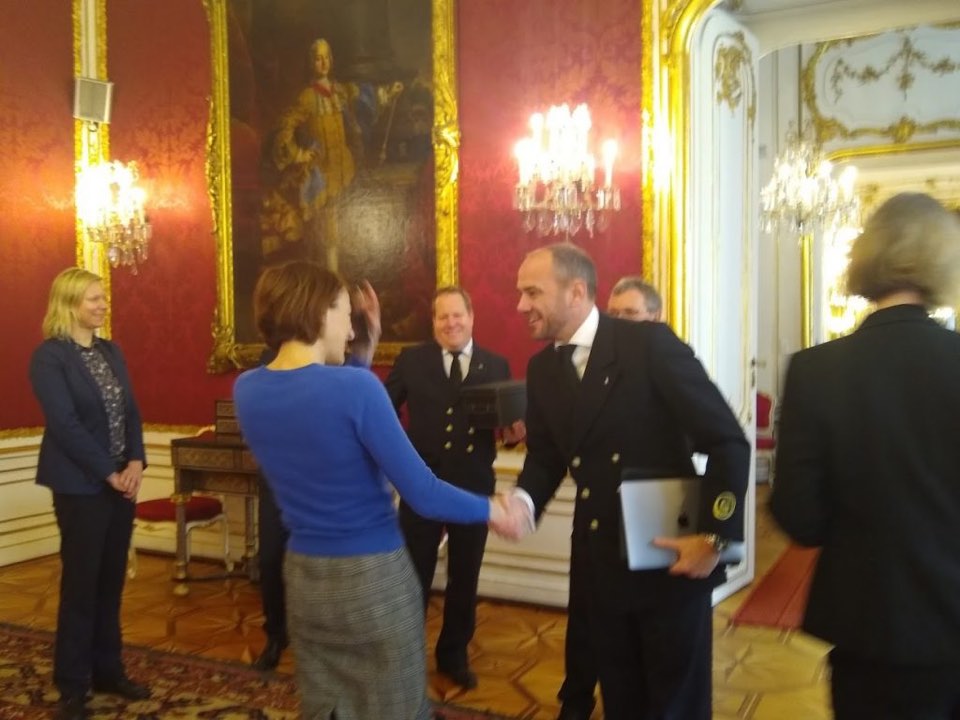
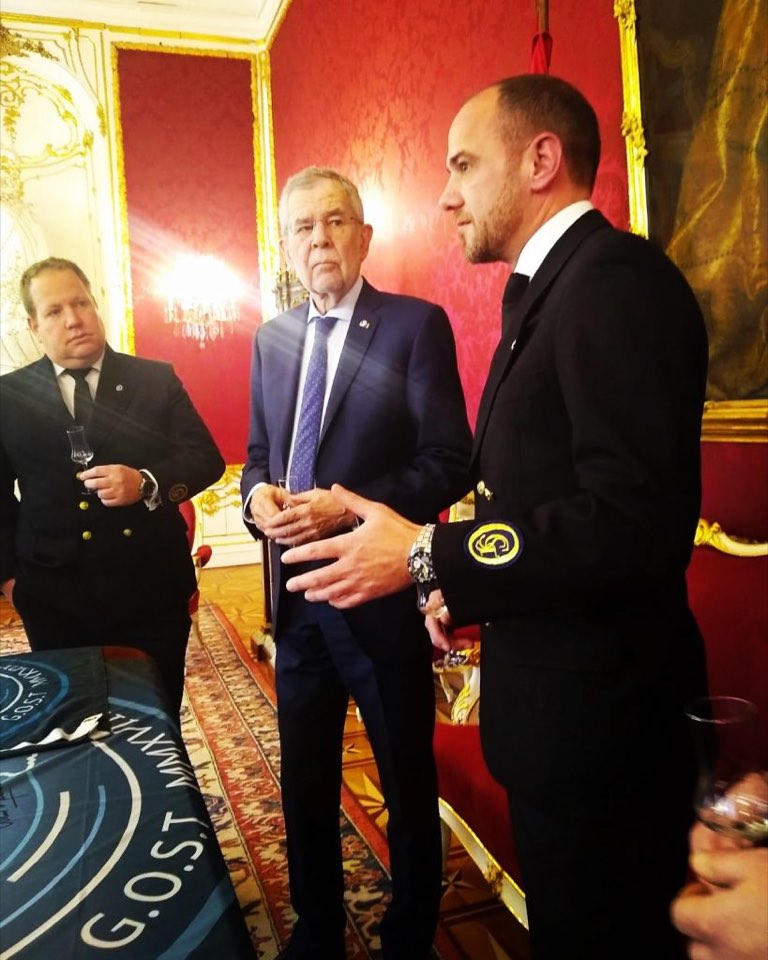
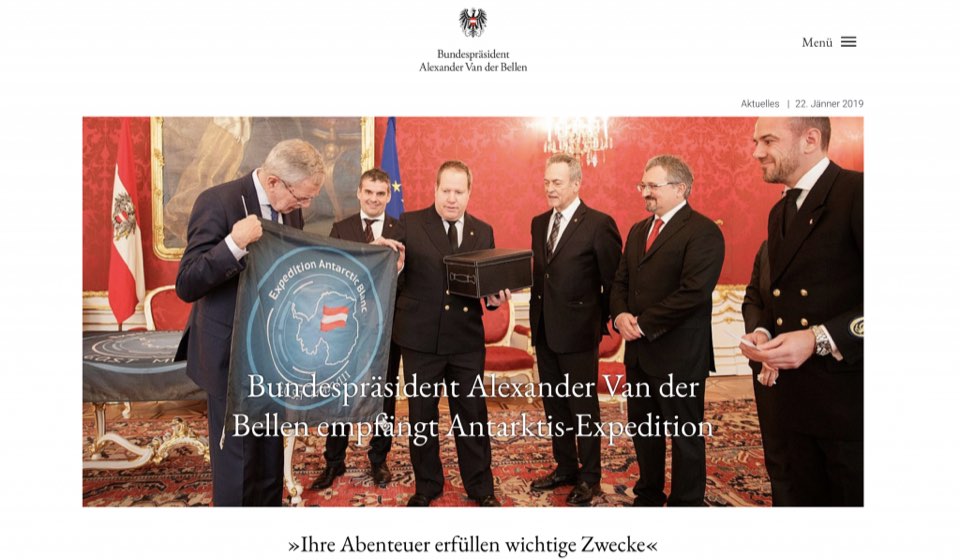
16 January 2019 - Author: Jochen Werne
Almost every day, experts in the media try to create a historical analogy for us in order to explain the dynamics and speed with which changes are taking place today at all levels of our lives - from private consumption and our working world to international politics. Often analogies are drawn to different decades of the 20th century. The prominent British historian and Harvard professor Niall Ferguson contradicts these comparisons and sees an analogy rather in the effects that the invention of the printing press in the 15th century had on our lives and on our society. Only that today the changes due to exponential technologies and the Internet take place much faster.
For us as the HUMAN Factor, these comparisons are incredibly important. In times of uncertainty, they help us to better assess the changes and thus at least maintain a certain reassuring feeling of security and explainability. However, if we do not succeed in setting the right filters in times of social media and "information overload", we run the risk that this feeling of understanding does not materialize and that we all too easily become victims of supposedly simple explanations and "fake news". Ferguson uses a striking example to illustrate that this is not a new phenomenon and that serious technological changes have also brought major and often turbulent changes to society. In times of the invention of book printing, knowledge was spread more cheaply and a broad part of the population gained access to higher education. One of the first books to be printed in large numbers was the Bible. But also other writings, like "Malleus Maleficarum" or in English the "Hammer of Witches" became famous. The "Fake News" book served to justify the persecution of witches, appeared in 29 editions and has been second place on the book bestseller list for 200 years.
At the latest since the end of the 1990s, since the mass "democratization" of the Internet, our lives have been shaped by the exponential progress of modern technologies. The associated digitalization - the DIGITAL Factor - is not only a technical and economic challenge, but also a societal one. However, the enlightened man began, not to accept everything that a "Beautiful New World", sometimes reminiscent of Aldous Huxley's novel, promises. This is shown by citizen projects such as the so-called "Charter of Digital Fundamental Rights" of the European Union.
The word "exponential" automatically hides the logical conclusion that change will take place even faster in the future. These changes affect almost every industry and what is seen today as a billion-dollar future market can quickly become a basic business with significantly lower costs and thus significantly lower profit margins tomorrow. The camera chip of our smartphones costs today only about two to three Euros, a Spotify subscription, and thus the access to an incredible amount of music, only a few Euros a month.
The conclusion for companies in the 21st century is simple: Those who do not understand these exponential dynamics of technical development or do not take them sufficiently into account in their business model can quickly lose touch - not only with customers but also with potential business partners. But why is it so difficult for us to correctly assess the development potential of the technologies? The answer: People think linearly. This is why technologies are usually overestimated at the beginning of their development, but tend to be underestimated in the long run. This was first described in 1965 by the Intel engineer Gordon Moore - later known as Moore´s Law, one of the essential theoretical foundations of the "digital revolution". In times of exponential technologies, our society risks a split between the group of people with an affinity for digital and digital natives and a group of people who have growing difficulties with the speed of change of our time. The latter have not learnt to keep pace with fast-moving digital innovations due to their low affinity, age or lack of points of contact in everyday life.
Throughout history, new technological possibilities have always come with threatening concepts that have been published and discussed on all media channels available during this period. Today it is: "total transparency", "transparent consumer", "constant availability" or even job loss due to ongoing automation and artificial intelligence. At the social and state level, attempts are being made to counteract such fears, to increase competitiveness and to involve the population in the process of change. Two of the many good examples referring to Germany are the strategy on artificial intelligence put in place by the Federal Government and the Platform for Learning Systems initiated by the Federal Ministry of Education and Research.
It is important never to forget, that every change - even if the trigger is a rapidly developing technology - requires a certain time horizon to be implemented and to create broad acceptance. Here the "CULTURE Factor" often comes into play. One example is cash. While the Scandinavian countries, above all Sweden, are about to digitalize their payment systems to a large extent, in Germany currently about 80 percent of all transactions are carried out with cash.
In every business model, global trends need to be identified, changes need to be driven, and local conditions need to be taken into account in order to be successful in this market. The same formula applies to societal change. Especially when it comes to creating an agenda for the use of new technologies for the benefit of our society.
--------------
Photo from Niall Ferguson and Peter Robinson discuss networks and hierarchies throughout history in this episode of Uncommon Knowledge. Quote from the New York Times article "‘The Internet Is Broken’: @ev Is Trying to Salvage It" by David Streitfeld
16. Januar 2019 - Autor: Jochen Werne
Fast täglich wird von Experten in den Medien versucht für uns eine geschichtliche Analogie herzustellen, um die Dynamik und Geschwindigkeit zu erklären, mit der sich heute Veränderungen auf allen Ebenen unseres Lebens - vom privaten Konsum, unserer Arbeitswelt bis hin zu internationaler Politik - vollziehen. Oftmals werden hierfür Vergleiche zu den 1930ern oder 70ern gezogen. Der bekannte britische Historiker und Harvard Professor Niall Ferguson widerspricht diesen Vergleichen und sieht eine Analogie vielmehr in den Effekten, die die Erfindung der Druckerpresse im 15. Jahrhundert auf unser Leben und auf unsere Gesellschaft hatte. Nur, dass sich heute die Veränderungen durch exponentielle Technologien und das Internet wesentlich schneller vollziehen. Für uns Menschen – also den HUMAN Factor - sind diese Vergleiche unglaublich wichtig. Sie helfen uns in Zeiten der Unsicherheit, die Veränderungen besser einschätzen zu können und somit zumindest ein gewisses beruhigendes Gefühl der Sicherheit und Erklärbarkeit zu erhalten. Wenn es uns jedoch nicht gelingt in Zeiten von Social Media und medialem „information overload“ die richtigen Filter zu setzen, laufen wir Gefahr, dass sich dieses Gefühl des Verständnisses nicht einstellt und wir allzu leicht Opfer vermeintlich einfacher Erklärungen und „Fake News“ werden. Dass dies kein neues Phänomen ist und gravierende technologische Veränderungen auch große und oftmals turbulente Veränderungen auf die Gesellschaft mit sich brachten, macht Ferguson an einem prägnanten Beispiel fest. In Zeiten der Erfindung des Buchdrucks kam es zu einer kostengünstigeren Verbreitung von Wissen und somit zur Möglichkeit, dass breite Bevölkerungsschichten Zugang zu höherer Bildung erlangten. Eines der ersten in großer Auflage gedruckten Werke war die Bibel. Doch erlangten auch andere Schriften, wie „Malleus Maleficarum“ oder zu deutsch der Hexenhammer Berühmtheit. Das eindeutige „Fake News Werk“ diente zur Rechtfertigung der Hexenverfolgung, erschien in 29 Auflagen und belegte für immerhin 200 Jahre den zweiten Platz der Bücherbestsellerliste.
Spätestens seit Ende der 90er Jahre, seit der massenhaften „Demokratisierung“ des Internets, ist unser aller Leben durch den exponentiellen Fortschritt moderner Technologien geprägt. Die damit einhergehende Digitalisierung – also der DIGITAL Factor - ist nicht nur eine technische und ökonomische Herausforderung, sondern vor allem auch eine gesellschaftliche. Dass der aufgeklärte Mensch jedoch beginnt, nicht alles einfach unreflektiert hinzunehmen, was eine an Aldous Huxley erinnernde „Schöne neue Welt“ zu versprechen scheint, zeigen Bürgerprojekte, wie die sogenannte „Charta der Digitalen Grundrechte“ der Europäischen Union.
Bereits im Wort „exponentiell“ verbirgt sich automatisch die logische Schlussfolgerung, dass sich Veränderungen in Zukunft noch schneller vollziehen werden. Diese Veränderungen betreffen nahezu jede Branche und was heute ein milliardenschwerer Zukunftsmarkt ist,kann morgen schnell zu einem Basisgeschäft mit deutlich geringeren Kosten und somit auch deutlich geringeren Gewinnmargen werden. Der Kamera-Chip unserer Smartphones kostet heute nur noch rund zwei bis drei Euro, ein Spotify-Abo, und somit der Zugriff auf eine unfassbar große Menge an Musik, nur wenige Euro im Monat.
Die Schlussfolgerung für Unternehmen im 21. Jahrhundert ist sichtlich einfach: Wer diese exponentiellen Dynamiken von technischer Entwicklung nicht versteht oder nicht ausreichend in seinem Geschäftsmodell berücksichtigt, kann schnell den Anschluss verlieren – Anschluss an Kunden aber auch an potenzielle Geschäftspartner.
Doch warum fällt es uns so schwer, das Entwicklungspotenzial der Technologien richtig einzuschätzen? Die Antwort: Menschen denken linear. Deswegen werden Technologien zu Beginn der Entwicklung meist überschätzt, langfristig aber tendenziell unterschätzt. Dies wurde 1965 durch den Intel Ingenieur Gordon Moore erstmals beschrieben – später bekannt als Moore´s Law, einer der wesentlichen Theoriegrundlagen der „digitalen Revolution“.
Unsere Gesellschaft lebt in Zeiten exponentieller Technologien natürlich auch mit der Gefahr einer Spaltung zwischen der Gruppe digital affiner Bevölkerungsschichten und Digital Natives sowie einer Gruppe von Menschen, die wachsende Schwierigkeiten mit der Veränderungsgeschwindigkeit unserer Zeit hat. Letztere haben aufgrund geringer Affinität, teilweise des Alters oder fehlender Berührungspunkte im Alltag nicht gelernt, mit den schnelllebigen digitalen Innovationen Schritt zu halten. Mit allen technischen Möglichkeiten geistern zudem Begrifflichkeiten durch die Medien, die vielen Sorgen bereiten und Ängste schüren: „Totale Transparenz“, „gläserner Konsument“, „ständige Verfügbarkeit“ oder gar Arbeitsplatzverlust aufgrund anhaltender Automatisierung und Artificial Intelligence. Auf gesellschaftlicher und staatlicher Ebene wird versucht solchen Ängsten entgegenzuwirken, Konkurrenzfähigkeit zu steigern und die eigene Bevölkerung in den Veränderungsprozess miteinzubeziehen. Zwei der vielen guten Beispiele in Deutschland hierfür sind, die von der Bundesregierung verabschiedete Strategie zu Künstlicher Intelligenz oder die vom BMBF initiierte Plattform für Lernende Systeme.
Es gilt bei jeder Veränderung - sei der Auslöser auch eine sich schnell entwickelnde Technologie – nie zu vergessen, dass es einem zeitlichen Horizont bedarf um Neues zu implementieren und eine breite Akzeptanz zu schaffen. Hier kommt der „CULTURE Factor“ oftmals ins Spiel. Ein Beispiel ist Bargeld. Während die skandinavischen Länder, allen voran Schweden, davor stehen ihre Bezahlsysteme weitgehend zu digitalisieren, werden in Deutschland aktuell noch rund 80 Prozent aller Transaktionen mit Bargeld durchgeführt. Es gilt also in jedem Geschäftsmodell globale Trends zu erkennen, Veränderungen zu treiben, jedoch auch lokale Gegebenheiten zu berücksichtigen, um in diesem Markt erfolgreich zu sein. Dieselbe Formel gilt für unsere gesellschaftlichen Veränderungen und das Ziel neue Technologien zum Guten für unsere Gesellschaft einsetzen zu können.
PRESS RELEASE
January 2019
(translated from German original by DeepL.com)
AUSTRIAN PRESIDENT WILL WELCOME ANTARCTIC EXPEDITION IN VIENNA
On 22 January 2019 at 11 a.m., Federal President Alexander Van der Bellen will welcome a delegation from the international expedition Antarctic Blanc, which was successfully carried out with Austrian assistance. The delegation will present the expedition flag, which represented Austria in Antarctica, as a symbol of remembrance.
POLAR RESEARCH IN AUSTRIA
Austria has a long tradition in polar research, which began with the Austro-Hungarian polar expedition in the 1870s. A milestone in Austrian polar research were the contributions to the International Geophysical Year 1957/58, which formed the basis for a polar focus at the University of Innsbruck. As a result, several renowned scientists carried out research in both the Arctic and Antarctic as part of the programme. After all, the International Polar Year 2007/08 was a great success for Austrian polar research. It strengthened national and international cooperation and led to the foundation of the Austrian Polar Research Institute in 2012.
STORMS AND ICEBERGS
Expedition Antarctic Blanc pursued historical, social and environmental goals. The 12 expedition offshore participants of the initiative, supported by the United Nations and 19 states, crossed on a 20m sailing yacht twice in 12 days, under the toughest conditions, one of the most dangerous sea routes in the world – the Drake Passage, covering 1129 nautical miles (over 2,000km). The journey was marked by the passage of several storm systems in the Antarctic and off Cape Horn, which delayed the return by several days. Winds with up to 50kn, waves up to 8m high and temperatures around freezing point demanded top physical performances from the expedition participants.
INTERNATIONAL COMMEMORATION CEREMONY. Sailing on Historic Routes. The expedition commemorated the researchers, explorers and sailors whose ships had to master the challenging peculiarities of reaching an unknown part of the world. The international team held a commemoration ceremony on the historically significant Antarctic volcanic Deception Island. In the name of all supporting states and the United Nations, a wreath of local ice was symbolically formed and laid down in order to pay international tribute to the achievements in the exploration of this unique continent. The supporting nations are among the signatories of the politically unique Antarctic Treaty of 23 June 1961. Heads of state and government organizations of the 19 nations have expressed their support for this unique, privately initiated expeditions in letters to the leader of the expedition, Jochen Werne, in particular for the execution of the ceremonial act of commemoration.
AUSTRIA AND THE ANTARCTIC TREATY. Austria joined the Antarctic Treaty on 25 August 1987 and, with its signature, also acknowledged that “in the interest of all mankind, Antarctica is used exclusively for peaceful purposes and should not become the scene or object of international discord”. Austria also underlined its commitment to the preservation of this ecosystem as a “nature reserve dedicated to peace and science”.
UNEP CLEAN SEAS INITIATIVE. The main focus of the expedition was to sensitize the international public for the preservation of the unique Antarctic ecosystem and to support the UN initiative Clean Seas to combat plastic waste in the oceans. With Expedition Antarctic Blanc, this important United Nations Environmental Program project is now finding acceptance on all continents of our planet.
CONSEQUENCES OF CLIMATE CHANGE ON THE ECOSYSTEM. In addition, the expedition supported the University of Connecticut and Northeastern University’s research project on plankton metabarcoding by collecting plankton samples, which could provide a fundamental contribution to obtaining rapid responses to the ecosystem’s response to climate change.
WHALES IN THE ANTARCTIC. With the observation of 18 different whales and the detailed documentation of their position and behaviour, the expedition also contributed to the establishment of the global whale observation platform ‘Happy Wales’. The platform is intended to provide science with in-depth insights into the behaviour and development of the largest mammals on our planet.
CHILD AND YOUTH DEVELOPMENT. To promote international children and youth projects, several live broadcasts were held from sea and Antarctica with children of the sailing school of the Yacht Club de Monaco. On their return, the team visited the Cedena Yacht School Puerto Williams, Chile, which is open to children from all walks of life in the southernmost region of our planet, and through sport encourages them to develop their own goals and character traits that are conducive to their personal development. In addition to a donation from the expedition team, the foundation stone was laid for an international exchange and the children were introduced to Antarctica and its significance.
INTERNATIONAL RECOGNITION. The visit to the Hofburg marks the third important reception for Expedition Antarctic Blanc after the reception by Prince Albert II in Monaco and the ambassador of the poles of the Netherlands, Carola van Reijnsoever, in The Hague. Further visits to Copenhagen, Paris and Madrid are planned shortly.
PRESS INVITATION
Expedition participants – Offshore Team
Jochen Werne Expedition Leader
Marco Schröter Chief Safety Officer
Oliver Picht Navigator & Chief Documentation Officer
Linden Blue Chief Communication Officer
Bernd Görgner Chief Medical Officer
Benon Janos Environmental Initiatives Coordinator
Wolfgang Händel Chief Logistics Officer
Hans Axtner Master of Ceremony
Michael Melnick Chief Sciences Coordinator
David Gamba Chief Observer
Wolf Kloss Skipper and Expedition Yacht Owner
Karl Papenfuss Mate
Comment on the initiator of the expedition – The Global Offshore Sailing Team (GOST)
Expedition “Antarctic Blanc” is the continuation of the polar initiative launched in 2016 with comparable objectives under the name “Arctic Ocean Raptor”, but in the Spitsbergen sea area and up to the Arctic pack ice limit. An additional and important aspect was the commemoration of the seafarers of all nations, who fulfilled their seafaring duties during the maritime operations in the Arctic under the mostly merciless weather conditions and partly also lost their lives. In the name of the Norwegian King Harald V and the Canadian government, a wreath was handed over to the lake; further international support for this expedition came from Belgium, Germany, Great Britain and Italy. Founded in 1999 by Jochen Werne and Guido Zoeller, the Global Offshore Sailing Team is once again committed to maritime history and environmental issues with this particularly challenging expedition and its People’s Diplomacy campaign.
Press contact:
Jochen Werne
Expedition Leader
Mail: ExpeditionLeader@AntarcticBlanc.com
Mobile & WhatsApp: +491752315879
Further links:
Website Expedition Antarctic Blanc: www.AntarcticBlanc.com
Government correspondence: http://antarcticblanc.com/about/honorary-supporters
Twitter: @AntarcticBlanc
Instagram: @AntarcticBlanc
Facebook: @AntarcticBlanc
VIDEO. Official expedition trailer: https://youtu.be/Lx5tM6aiqxA
Austrian Polar Research Institute: http://www.polarresearch.at
UNEP Clean Seas Initiative: http://antarcticblanc.com/environmental-research/un-environment-initiative-cleanseas
Antarctic Treaty & Environmental Protection: http://antarcticblanc.com/environmental-research/the-protocol-on-environmental-protection-to-the-antarctic-treaty
Federal Environment Agency: http://antarcticblanc.com/environmental-research/official-expedition-meeting-with-the-german-environmental-agency-umweltbundesamt
Global Offshore Sailing Team: http://antarcticblanc.com/about/global-offshore-sailing-team
International Maritime Museum Hamburg: www.IMMHH.de
German Society for Maritime and Naval History e.V.: www.marinegeschichte.de
Yacht Club de Monaco: www.YCM.mc
Royal Cinque Ports Yacht Club: www.RCPYC.org.uk
Picture credits: Picture 1 & 2 © Expedition Antarctic Blanc / Picture 3 © Dr. Oliver Picht / Picture 4 © Cedena / Picture 5 © Axel BASTELLO / Palais Princier

Original Source in German: published on Oct 5, 2018 - "Die Bank wird als Marke wahrgenommen" Translation by DeepL Pro
Author: Angelika Breinich-Schilly interviewed Jochen Werne, Director Marketing, Business Development, Treasury & Payment Services at Bankhaus August Lenz.
Banks need to do a lot to keep pace in an increasingly digital world. In an interview with Springer Professional, Jochen Werne from Bankhaus August Lenz talks about the challenges they have to face and the right strategies.

Springer Professional: Mr. Werne, what do you see as the most important driver of change in banks that is being invoked everywhere? Is it just the ongoing digitalization or do you see other reasons that require a strategic change process of the institutes?
Jochen Werne: The industry is undergoing what is probably a historic upheaval. We live in times of exponential technologies and in addition to the cost-side necessity of digitizing a large part of the processes of the institutes, the rapid change in customer expectations associated with technology, poses great challenges to an industry which is not known for being greatly agile. This disruption will eclipse many things and later perhaps be judged as revolutionary as the invention of the steam engine. In recent weeks, this has hardly made anything as clear as the rise of the online payment processor Wirecard. Wirecard was not only able to outperform Commerzbank in the DAX in September. Founded in 1999, the company has already overtaken Deutsche Bank in terms of market capitalization. In addition to the ongoing digitalization, there are also other current challenges: The low interest rate phase, which has now already lasted for a long time, is putting massive pressure on the margins of traditional houses. Political crises, trade disputes, currency problems such as in Turkey and Brexit naturally also have a direct effect on the classic business models of banks: In the future, they will have to adapt more than ever and increasingly prove their agility.
The exponential leaps in technology and ever shorter product cycles are forcing the global economy as a whole to change and adapt to changing circumstances more than ever before. Kodak is a good example. For the sake of simplification, the company has often been accused of not being far-sighted, but it has failed because of a culture that has allowed little change. Two letters are currently electrifying the economy: AI. After decades of disinterest, artificial intelligence is suddenly once again regarded as the decisive guarantor of a company's future viability. The immediate integration of AI into one's own business model seems indispensable, even vital for survival. Without smart software, you'd think you were dedicated to meaninglessness.
Similar to Facebook, the financial industry holds very valuable data. The preparation and processing of this data will not only become easier with maturing AI systems, but also much faster, cheaper and more targeted. It is nevertheless private and sensitive data. In order to make this resource usable in conjunction with external data, the industry must at the same time ensure its long-term security. Data may only be used in the sense of the customer, the human being - an objective that certainly has to apply to all AI-based approaches. Artificial intelligence offers an enormous range of opportunities for companies to be closer to their customers. But it also has its limits and here we are not only talking about technical limits, but also about limits that arise when the customer's mindset does not go hand in hand with what is technically possible. Technology will only prevail if people accept it. Too radical a step, without consideration for all three areas Human, Digital and Culture, is always counterproductive.
Springer Professional: You describe that many decision-makers in the banks are well aware of the necessary changes in the business model. At the same time, however, top management often does not seem to set a concrete course and have corresponding visions. Why do you think that is?
Jochen Werne: Digitization, technological advances and the acceleration of product cycles are forcing executives to reposition their businesses. The question is no longer whether and why companies should change and introduce a more flexible organizational form, but only: How quickly and sustainably can they do it? The need for successful Change Management is not new and digitization was not an unforeseeable event. What is new, however, is the sum of the technical innovations, the possibilities offered by the technological leaps and the resulting need for extremely high implementation speeds. This circumstance has far-reaching effects on the entire management of the company. This often leads to different change processes overlaying each other, individual change processes being interrupted, modified or restarted and the organization being in a state of continuous change. And this also applies to the manager.

Springer Professional: In order to become a driver of innovation as a bank, it is necessary to anticipate not only upcoming technological but also social changes, some of which still vary greatly from region to region. One example is the payment behaviour of customers, which looks different in Germany than in other European countries or even in Asia. Many financial service providers now have think tanks or innovation labs to take on this task. But does some good ideas go up in smoke due to poorly thought-out change management?
Jochen Werne: Every new innovative offering must be easy for the customer to understand, intuitive to use and as a bank, absolutely trustworthy in terms of data security. The customer relies on the security of the communication channels as well as the careful handling of his private data. The challenge is to ensure data protection while at the same time providing the highest possible level of customer convenience. The resources of traditional banks offer enormous advantages here. An established bank is perceived as a brand by its clients, who at best associate it with important values such as trustworthiness, competence, industry knowledge and personal service. This trust is enormously important to us and should definitely be used.
Springer Professional: Companies in other industries sometimes find it easier to cope with change processes because they are not subject to additional strict regulations, as is the case with banks. Nevertheless, financial service providers such as Wirecard have succeeded in clearly differentiating themselves from traditional banks with their business model. Recently, the share value of this Fintech has even overtaken Deutsche Bank, the industry leader, as the most valuable institution. What can the industry learn from this?
Jochen Werne: Laws and guidelines have a strong influence on the competitive situation. MIFID II and PSD II are prime examples of this. In the second case, industry experts predicted that the mere opening of the banking infrastructure to third parties would lead to a major shift in competition.
This is a big advantage for FinTechs, but also the FinTech industry, which is already in the process of market consolidation, has to make considerable investments and adjustments, even if the new regulations now also open up new market opportunities. Non-adaptable service providers without sustainable and a viable business models will be driven out of the market, as will banks whose offerings do not meet the needs of customers in a digital world.
The example shows not only the usefulness of cooperation, but also its necessity. The advantages of banks, such as routine handling of regulatory issues or cross-selling opportunities due to the existing customer base, will continue to exist even after the market consolidation of the FinTech industry and the introduction of new technological standards.
Springer Professional: In order to be a driver of innovation, a bank does not necessarily have to handle all tasks alone. Where and when do cooperations with Fintechs make sense from your point of view?
Jochen Werne: What some have, others lack. Banks have a solid customer base, greater financial resources and, most importantly, a banking licence and the necessary know-how to deal with the relevant regulatory authorities. In addition, traditional financial institutions with many years of market experience, expertise in customer business and their trust can score points. Fintechs, on the other hand, have business models that are geared precisely to bringing innovative, customer-centric digital tools to market in a short space of time. Strategic alliances make sense, because ultimately everyone benefits - especially the customers. Not only the young generation today has very high demands on innovative mobile banking, but all age groups have discovered the new mobile possibilities in a very short time. Personal access to customers, which has persisted despite all the financial crises to date, is a sign that banks have preserved their most important asset - the trust of their customers. In an increasingly transparent and open financial world, however, the extent to which the customer's loyalty to his bank will remain, is open.
by Martina Scherf
Original in German published on February 8, 2018 in Süddeutsche Zeitung. Translated with www.DeepL.com/Translator. Photo (c) Dr. Oliver Picht
Munich banker Jochen Werne and eleven friends want to sail from Cape Horn to Antarctica on a sailing ship. It is not only the myth of historical seafaring that drives them.
"Men wanted for hazardous journey. Small wages. Bitter cold. Safe return doubtful. Honour in case of success". With such words the British navigator Ernest Shackleton 1914 is said to have searched for men for a trip to the Southern Ocean. In the end he was honoured, but before that a dramatic struggle for survival took place. The ship got stuck in the pack ice for months until it finally sank, the men rescued themselves in open dinghies on the sea. An incredible story in which everyone survived in the end.
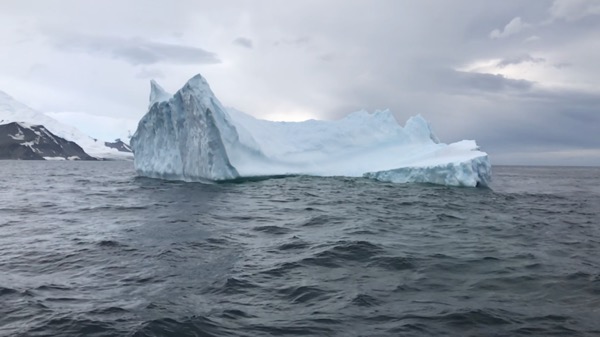
A trip to Antarctica is still dangerous today. Bitterly cold anyway. "When you approach an iceberg, it feels like putting your head in the freezer," says Jochen Werne, 46. He knows this feeling. He's been to the Arctic Sea twice before, all the way up to Spitsbergen. This time he is aiming in the other direction: from Cape Horn at the southern tip of South America to Antarctica. With a sailing ship. On the 12th of February it is supposed to start.
The Drake Strait, named after Sir Francis Drake, the British buccaneer and circumnavigator, is one of the most dangerous shipping routes in the world. In 14 days Werne and his eleven fellow sailors want to pass it there and back with the Santa Maria Australis, a 20-metre-long ship made of aluminium. It belongs to Wolf Kloss, who has his base in southern Chile and regularly sails in the Southern Ocean. Tourism has long since reached even the most remote regions of the world. Two years ago Kloss followed Shackleton's footsteps to Antarctica on the occasion of its 100th anniversary.
Werne, who has always been the skipper himself on his previous tours, relies this time on the experience of the local skipper. But the preparation and logistics were in his hands, and of course he will be at the helm himself. "The last few weeks I have hardly slept more than four hours a night," he says. They completed safety training with a life raft on Lake Starnberg. They trained themselves for medical emergencies, studied the weather conditions, drew up a plan for the procedures on board and the supporters ashore.
"We have a dentist with us who has to sew an open leg in an emergency," he says and laughs. If necessary, a doctor in Germany can advise the colleague by e-mail or satellite telephone. On board, all crew members share the tasks, they go on watch, navigate, collect weather data, take care of the on-board technology, cook and wash dishes. "The youngest is 28, the oldest 78," says Werne. They are entrepreneurs, bankers, managers, scientists from several countries. There will not only be canned ravioli, Werne emphasizes: "Napoleon already said: "The army marches on its stomachs". They are not afraid of seasickness. "I also get caught by it every now and then," he says, "but then you drink a Coke as soon as you can, eat some salt sticks and carry on. Discipline helps over everything."
Everybody has to do everything - even tricky repairs
Also about extremely tricky situations. Once, years ago, they were lying on a Legerwall with a defective machine in the English Channel. This is what sailors call one of the most unpleasant situations that can happen to them: Wind and current press against the land, but the ship is unable to manoeuvre. "You're hanging upside down in the engine compartment trying to repair the cooling water circuit, even if you've never done this before in your life."
The focus is on sailing under extreme conditions, but Werne is also concerned with the tradition of seafaring, which he wants to keep alive, and the Corps spirit. With his cruises he wants to pay tribute to the well-known and unknown heroes of the seas. "There are no monuments at sea," he says. That's why he has already launched wreaths in various places, in memory of brave men on dangerous missions.
"At sea you help each other," says Werne. He also sees himself as a peace missionary. For even after the most bitter battles, such as in the Second World War, the opponents often saved each other. He wants to remind us of this. Because they are not allowed to leave anything behind in Antarctica, no flowers, no foreign substances, they will lay down a wreath of ice. "If we make it there, we will hold a worthy ceremony in honor of the seafarers of 17 different nations." They will hoist the flags and return them to the respective government officials upon their return.
For this purpose, the Munich-based, by profession authorized signatory and marketing director of a traditional Munich bank, has collected accompanying letters from government representatives. Prince Albert of Monaco, who is very concerned about environmental issues, supports the campaign together with the Yacht Club of Monaco. The Spanish king and other dignitaries will also be present.
Environmental protection and remembrance
The environmental idea is also important for Werne. "When you are out there, in the vastness of the ocean, and you see this infinite beauty, you ask yourself: How can man destroy that?"
Werne has therefore also won the United Nations as a partner by promoting its Clean Seas programme. The uninhabited Antarctic, only discovered 200 years ago, is under special international protection. In 1959, in the middle of the Cold War, twelve nations negotiated the Antarctic Treaty. It stipulates that the area south of the 60th parallel is exclusively reserved for peaceful use. And it contains the strictest environmental regulations. Today there are not only numerous research stations, but also a growing number of visitors to the Antarctic. But the international agreement still holds. "This is a unique and wonderful agreement," says Werne.
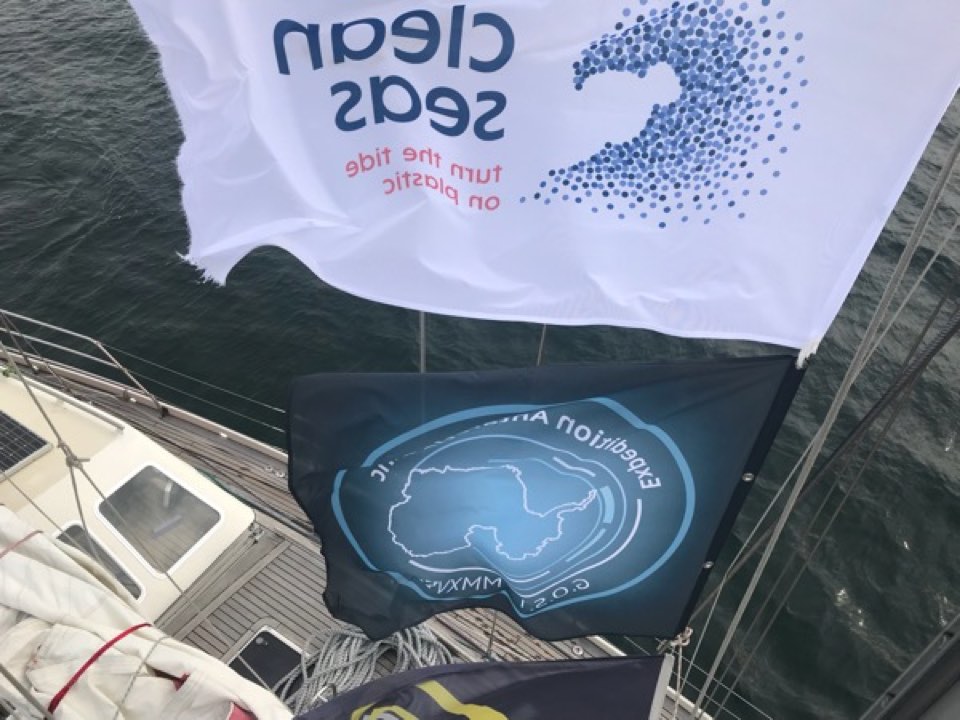
The man from Munich and his comrades-in-arms will collect plankton along the way and make it available to scientists. They will observe whales and document all their observations. They will be attending press conferences and writing to governments about the pollution of the oceans. Even plastic waste is now spreading as far as Antarctica, where birds and marine animals are suffocating.
As a child, Werne saw on television the reports of the Frenchman Jacques Cousteau, "and from then on, my mother told me, I wanted to become a 'deep-sea diver researcher'". Growing up in southwest Germany, just before the Swiss border, he went to the navy for two years after graduating from high school. The service on the Gorch Fock shaped him for life. But staying in the Navy didn't seem attractive to him. "I got to know great people there," he says, "but also some who failed because of the rigid system." He studied economics and worked for major international banks in London and Frankfurt before coming to Munich. But seafaring didn't let him go.
In 1999 he founded the Global Offshore Sailing Team with a friend. Professionally successful and internationally networked, he soon found like-minded people with the necessary small change and the equally great enthusiasm for extreme sailing. In 2011 and 2016 they sailed into the Arctic up to the pack ice limit.
The ice is unpredictable
What the violence of nature means in such regions, they experienced very closely. "After a few days of exploring the fog, we suddenly came out of nowhere towards icebergs," he says. They sought shelter in a fjord, put their ship behind a floating jetty in a small harbour. But the ice followed, pushing into the fjord with mighty force. "We kept watch around the clock and pushed the ice with poles away from the ship." It still demanded its toll. Crashing it tore the propeller of the engine from the hull, water broke in, they had to scoop for hours.
They will meet icebergs again this time. They hope for a proper distance. The Santa Maria Australis is a comfortable ship, her hull is built of several separate chambers to protect her from water ingress. She is equipped with the latest technology such as radar, satellite navigation and communication and can be followed on the Internet. It has two powerful diesel engines on board, a power generator, several battery systems, a water conditioner that turns seawater into drinking water, and heated cabins. Nevertheless, a trip to Antarctica is no walk in the park. Icebergs are unpredictable.
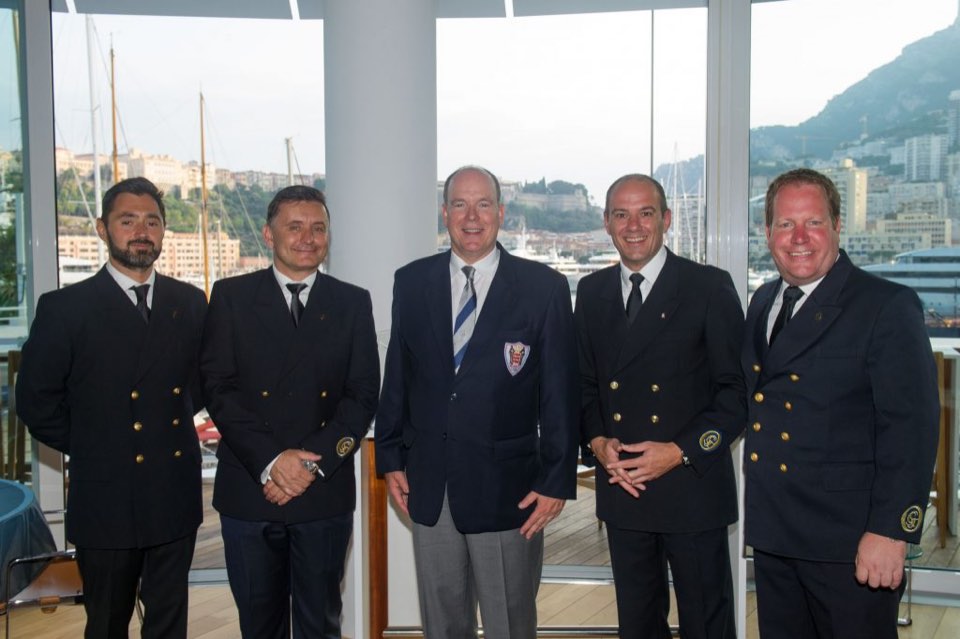
Erich von Drygalski, the Munich geographer, led the first German South Polar expedition in 1902. His ship, the Gauss, was trapped by ice on 1 March and held 50 miles off the coast for almost a year. Thanks to its rounded hull, it was not crushed but only lifted. The men had enough supplies and used the year for their research. Werne and his friends do not have that much time. But even for them, he says, "You can't go against the sea, the sea is always stronger".
The Hague, 7 December 2018 – An exciting part of The Netherlands’ 2018 Polar Symposium has been the ceremonial presentation of the Antarctic Blanc expedition flag to the Arctic Ambassador of The Netherlands, Ms. Carola Van Rijnsoever by a delegation of the Global Offshore Sailing.
This special occasion recognized the commitment of The Netherlands in preserving Antarctica as a natural reserve, devoted to peace and science. In addition, it’s has also been an opportunity to remember the explorers, scientists and sailors who set foot on the Antarctic continent to discover and made us all aware how beautiful and equally important this ecosystem and its protection for our planet is.
In his speech, Antarctic Blanc expedition leader Jochen Werne emphasised the importance of the Antarctic Treaty not only for the white continent, but also as an encouraging diplomatic achievement that underscores the human capacity to peacefully find intelligent solutions, even when it comes to jointly administer an entire continent.
He underscored, that by visiting and exploring our planet’s poles, the Netherland’s Polar Programme scientists, in collaboration with the international community of polar scientists have been a great inspiration for future generations of scientists and explorers worldwide. Due to the engagement for the Antarctic, and the establishment of the Dutch Dirck Gerritsz Laboratory at the British Rothera Research Station in 2013, The Netherlands today play an important role for the future of the white continent. By acceding the Antarctic Treaty on March 30, 1967 with the goal that “in the interest of all mankind Antarctica shall continue forever to be used exclusively for peaceful purposes and shall not become the scene or object of international discord”, The Netherlands underlined its commitment as one of the leading countries engaged in preserving this ecosystem as “a natural reserve, devoted to peace and science”. This has been made clear to everyone by The Netherland’s signature to the Antarctic Environment Protocol on January 14, 1998.
After the ceremony Dutch Arctic Ambassador Carola von Rijnsoever also signed the expedition flag underlining the strong commitment of The Netherlands to Antarctica. Prior in this year His Serene Highness Prince Albert II underlined Monaco’s commitment with his signature given in a ceremony at the Yacht Club de Monaco.
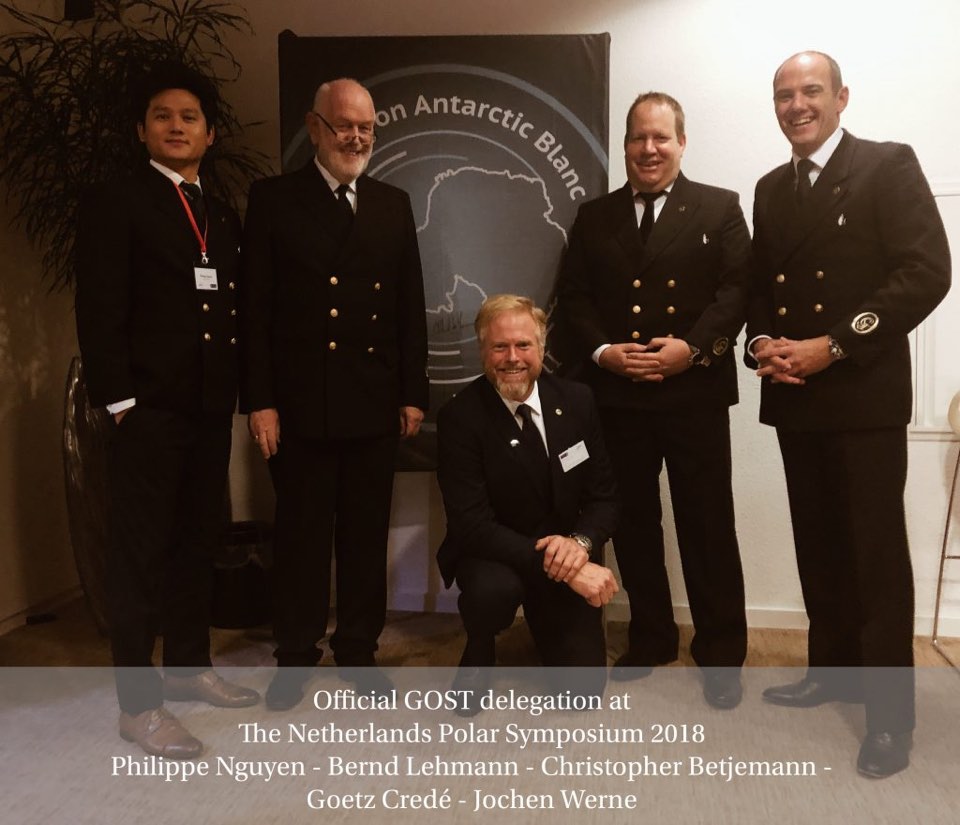
In February 2018, inspired by the era of the great explorers, the 12 members of the international Expedition ANTARTIC BLANC set sail to Antarctica through one of the most dangerous seaways on the planet, the Drake-Passage. Their aim was to raise international awareness and draw attention to the essential need to maintain and protect the unique Antarctic ecosystem. On Deception Island, the Expedition recognized the Antarctic explorers and the establishment of the Antarctic Treaty, in a solemn and dignified manner, paying tribute in the form of an international commemoration ceremony. A wreath formed out of Antarctic ice, was laid in the name of 19 nations, which gave permission to officially act on behalf of them. In addition, ANTARCTIC BLANC supported the UNEP’s “Clean Seas” initiative to combat plastic waste in and on the world’s oceans. Furthermore, the expedition gathered data for the University of Connecticut’s and the Northeastern University’s Ocean Genome Legacy Center Research Project for the meta-barcoding of plankton, which in turn could play a fundamental role in providing answers to the ecosystem’s response to climate change.
Captured in a video. IMPRESSIONS: Expedition Antarctic Blanc & The Netherlands Polar Symposium Keynote Highlights (Special Video Cut). GOST delegation hands over Expedition flag to the Ministerie van Buitenlandse Zaken Arctic Ambassador Carola van Rijnsoever. Keynotes held by Carola van Rijnsoever and Jochen Werne, Expedition Leader. GOST Delegation: Bernd Lehmann, Götz Credé, Philippe Quynh Nguyen & Christopher Betjemann III
Read more here
McKinsey Quarterly recently released an inspiring podcast entitled "Tapping into the business value of design" in which Simon London talks to McKinsey partners Benedict Sheppard and Hyo Yeon. It is very satisfying to see that the interview reflects many of the thoughts that led Bankhaus August Lenz & Co. AG, Mediolanum Banking Group to decide to launch a portrait card package to its German clients. This is the first time that a portrait cards have been launched for German private customers. The cards question the current design status of credit cards and offer not only a classic payment function, but also a 360° customer service experience combining digital, telephone and personal exchange options.
It has been a great experience challenging again the status quo, together with dedicated and highly experienced and motivated teams within the bank as well as with technology and card industry partners supporting the project.
Enjoy the McKinsey Quarterly podcast
#design #designthinking #statusquo #creditcard #maestro #mastercard #innovation #banking #bankverlag #payments #ux
Author Jochen Werne - Original in German at Bank-Blog - Translation by DeepL
Banks have to become guides for investors
Financial blogs, online communities & Co.: The ubiquitous flood of information can be both a curse and a blessing for bank customers and investors. Today more than ever, banks and savings banks must be "guides" for their customers.
Anyone who wants to invest money today gets a flood of information about the net. Dedicated private investors worldwide can be almost as well informed as professionals, in case of interest and sufficient know-how and time. Never before in the history of mankind have so many people worldwide had so much information at their disposal. Whether prices in real time, the latest assessments by analysts or experts, key figures on a security in an industry comparison, the diversity of opinion in a community - all this is available around the clock.
How intensively and purposefully this offer is used is another question. It can be assumed that only a minority is so urgently concerned with their investment or can be so concerned at all. In addition, the situation of the decision-maker is adversely affected by two factors: the excessive amount of unfiltered information and the classic behavioral finance problem.
Coping with the abundance of data and big data
Alvin Toffler, who brought the term "information overload" to prominence in his bestseller "Future Shock" in 1970, described the phenomenon and its consequences as follows:
"Information overload occurs when the input quantity of a system exceeds its processing capacity. Decision makers have a fairly limited cognitive processing capacity. Therefore, if information overload occurs, it is likely that a decrease in decision quality will occur."
Consequently, it can be concluded that the wealth of information that accumulates every day can hardly be processed by a classic investor alone, let alone placed in the right context. In addition, there is an almost unmanageable and constantly growing mass of financial products for private customers. In short, a large proportion of investment decisions are therefore not made analytically correct, but spontaneously subjectively and emotionally, as the studies by Nobel Prize winners Kahneman and Tversky show.
Banks as a guide only for wealthy clients?
Clay Shirky, writer and consultant for Social and Economic Effects of Internet technologies and well-known in New Media circles, presented an interesting reflection on the problem of information overload:
„It’s not information overload. It’s filter failure.“
This provides a great opportunity for traditional banks to position themselves as problem solvers for the investor. The alternative - at least for wealthy private clients - apart from filtering their own information mass, is dialogue with a competent expert. A person they trust - and trust to not only filter out from the wealth of data what is relevant to their needs, but also to protect them from the classic emotional mistakes of financial decisions in volatile markets.
Development of a new, adequate support concept for all bank customers
All those who do not belong to this clientele, and this is mostly the classic retail customer, have little more than to accept the zero interest rate on their accounts and short-term securities. According to Bundesbank statistics, the majority of Germans have invested their assets in these forms of investment. This makes the Federal Republic a leading nation in financial matters when it comes to missed opportunities, as can be read again and again in the Sunday editions of the major national daily newspapers.
Today more than ever, the function of bank and financial advisors must be to act as filters and guides for customers in the jungle, providing them with a flood of information. Because no algorithm, no digital advisory service can protect the investor from an ill-considered, intuitive and possibly wrong decision. For modern bank management, this means setting up a completely different support concept with cost-efficient consulting structures, a powerful and highly flexible team and the appropriate digital and mobile equipment.
Co-Author: Jochen Werne
Chapter: Information Overload
Find out more and buying options here
Content extract
"Supported by H.S.H. Prince Albert II of Monaco, author Maurizio Abbati published with his new book an inspiring masterpiece about the importance of Eco-Communication and we are delighted that he mentioned Expedition Antarctic Blanc as a successful effective example in raising awareness for important environmental topics."
Jochen Werne, Expedition Leader
This book, based on authoritative sources and reports, links environmental communication to different fields of competence: environment, sustainability, journalism, mass media, architecture, design, art, green and circular economy, public administration, big event management and legal language. The manual offers a new, scientifically based perspective, and adopts a theoretical-practical approach, providing readers with qualified best practices, case studies and 22 exclusive interviews with professionals. A fluent style of writing leads the readers through specific details, enriching their knowledge without being boring. As such it is an excellent preparatory and interdisciplinary academic tool intended for university students, scholars, professionals, and anyone who would like to know more on the matter.
On March 10 , 2019. Content in preparation.
Please find below an archive with all posts published in this Blog. Swipe over the pictures to find out more.
[post_grid id="1257"]Jochen Werne is a regular interview partner and guest in TV-broadcasts and Corporate channels
2019
2018
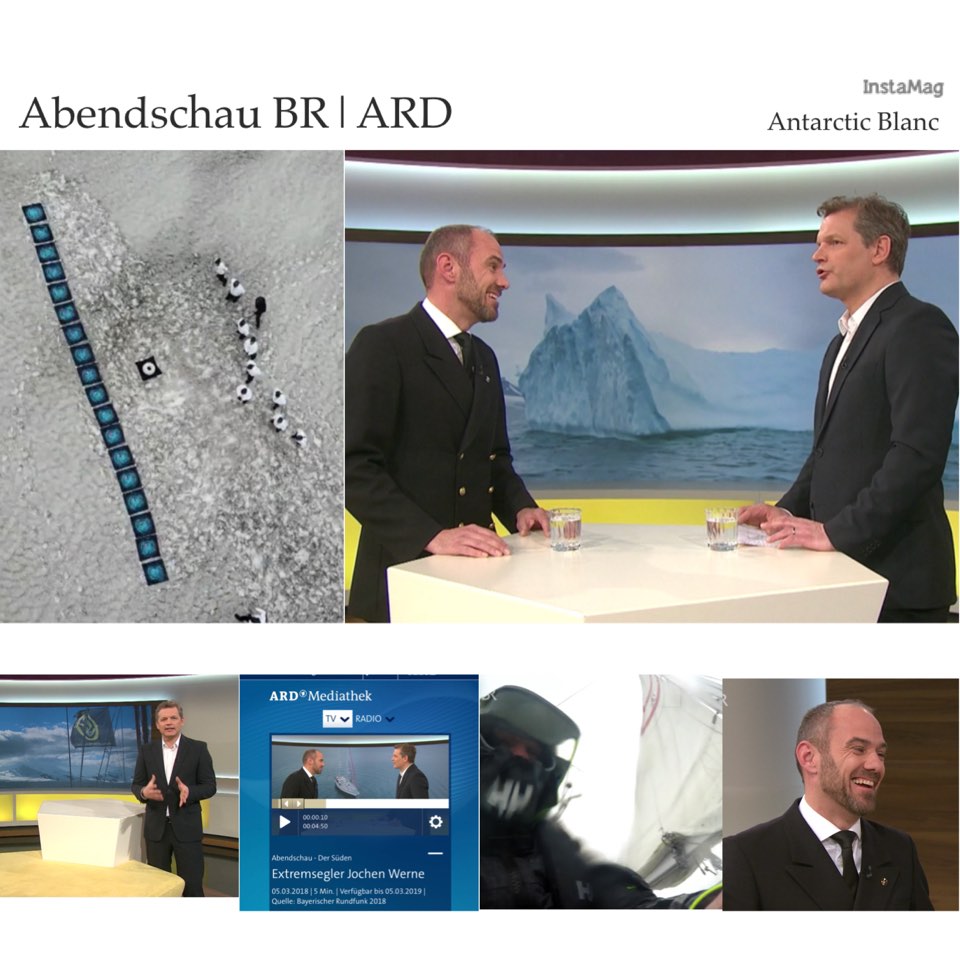
2017
2016
2015
Gut zwei Wochen auf Hoher See: Sturm, Kälte, Eisberge - die berühmte Drake Passage von Kap Hoorn - dem südlichsten Punkt Südamerikas in die Antarktis. Diese Route ist jetzt ein Münchner gesegelt. Heute ist er bei uns im Studio!
Nearly two weeks on the high seas: storm, cold, icebergs - the famous Drake Passage from Cape Horn - the southernmost point of South America to Antarctica. This route has now been sailed by a man from Munich. Today he is with us in the studio!
Interview for the BR after Expedition Antarctic Blanc
Co-Author: Jochen Werne
Chapter: Redesigning a bank
Buy at Roland Eller
Content Extract
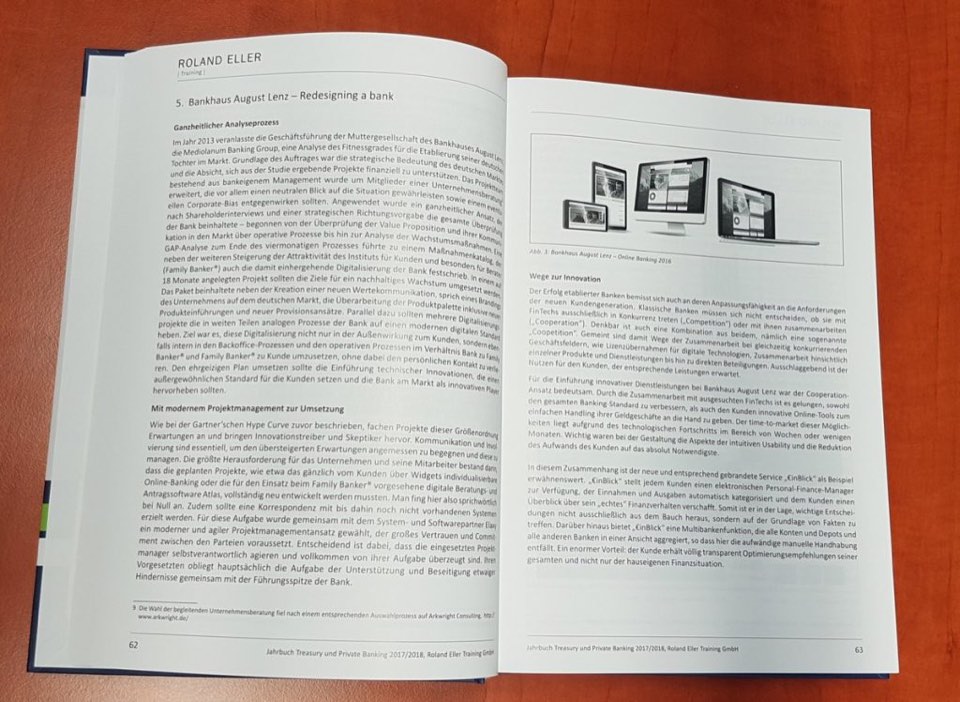
Co-Author: Jochen Werne
Chapter: The Bank - The pilot in the digital investment jungle
Find a reading extract here
Buy at Finanzbuch Verlag / Amazon / Weltbild / GooglePlay
Content extract
Co-Author: Jochen Werne
Chapter: Transformation of an analogue private bank into an innovation driver
Find a reading extract here
Buy at Amazon / Springer Shop / Thalia / Hugendubel / GooglePlay
Content extract
Chapter 5: Transformation of an analogue private bank into an innovation driver
Reflection on change, technological progress and human behaviour in disruptive times
The article analyses and discusses the changes, challenges, decision paths and implementation practices of Bankhaus August Lenz in the years 2014 to 2016. In addition, the author would like to provide executives and managers entrusted with the transformation of their institution with practical arguments that may help them to cope better with daily challenges in change management practice. As a traditional private bank with a European parent, the task was not only to complete the transition away from a fully analog bank, but also to adapt the Group's strategy for the German market with the budget adapted to the size of the institution. The most important internal customer was also integrated into the change: the Family Banker®, which is at the heart of the philosophy and is responsible for customer contact. This human contact and personal contact is the guarantee for the indispensable relationship of trust between customer and bank. The author examines issues such as coopetition, agile project management approaches and cooperation with FinTechs. In addition, topics such as value proposition, behavioral finance, the need to concentrate on core issues, the importance of personal consulting in the digital age and exchange in an international working environment as well as communication are treated as essential success factors. The paper does not claim to be perceived as a scientific work, but focuses on the practical implementation of the core problem of a market participant in a disruptive market - the question of how to restructure and realign companies in order to continue to play a role as a market player in the future.
Jochen Werne has been Co-Author of several books on management, banking and innovation and marketing.
2019
Co-Author: Jochen Werne
Chapter: Information Overload
Find out more and buying options here
2018
Co-Author: Jochen Werne
Chapter: The Bank - The pilot in the digital investment jungle
Find out more and buying options here
Co-Author: Jochen Werne
Chapter: Redesigning a bank
Find out more and buying options here
2017

Co-Author: Jochen Werne
Chapter: Transformation of an analogue private bank into an innovation driver
Find out more and buying options here
WE are living in one of the most fascinating times our planet has ever seen. A time when, thanks to enormous technological progress, we humans have the opportunity to improve the lives of so many people in our society without sacrificing our own well-being.
TOGETHER we can create a better society. We should never forget that bringing people from different cultures and backgrounds together, discussing and reflecting on each other's perspectives already creates understanding and is the basis for forward-looking solutions. It is also something that each of us can easily do. It is a way of people’s diplomacy. In times of great change, which automatically leads to uncertainty, it helps to provide historical and technological understanding and analogies to today's discussants in order to find better solutions for all possible consequences of new inventions on our society.
BALANCE. As a sailor with a great passion for our oceans, I strongly believe that man and nature must be in balance. To maintain balance, it is important to be aware of possible imbalances. To generate the right attention, it takes passionate scientists and passionate communicators to reach out to the general public with the important issues. With the support of the public and the power of technology and diplomacy, people have repeatedly found creative solutions to the most difficult situations they have faced in history.
THIS BLOG aims to give insights and to create understanding as well as to inspire further discussion in the areas INNOVATION & BUSINESS - SOCIETY & DIPLOMACY - OCEAN & PASSION
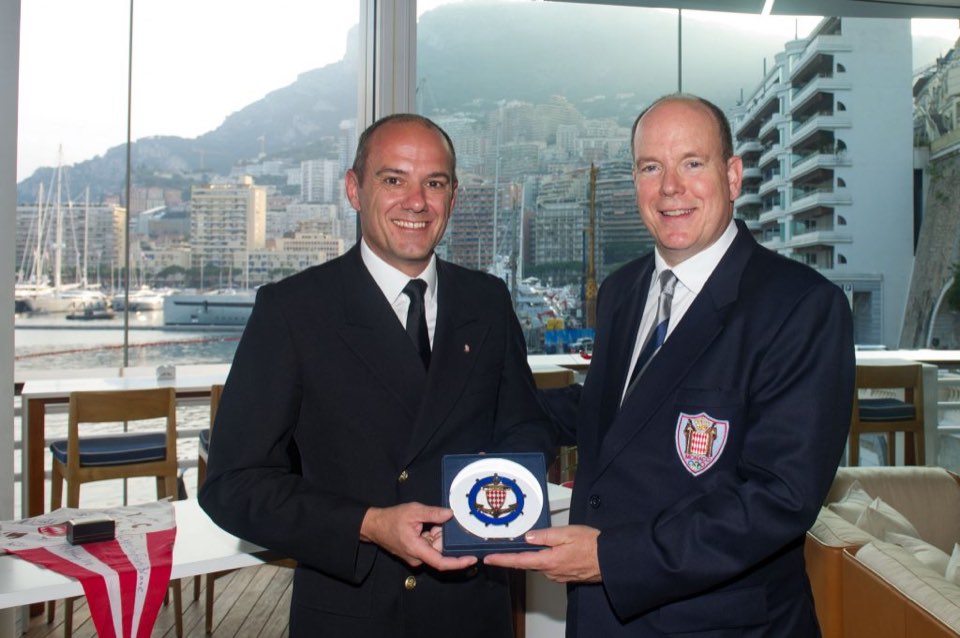
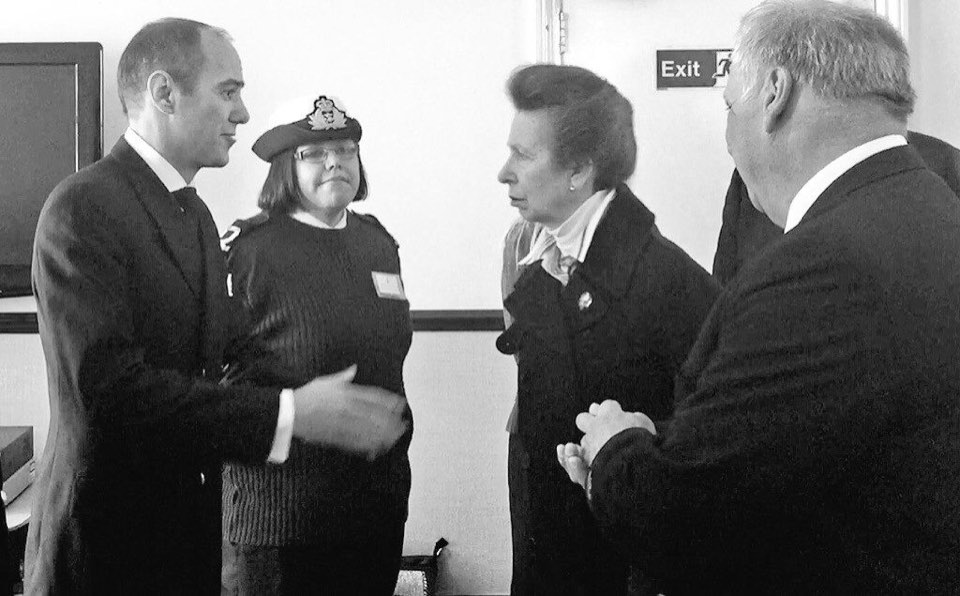
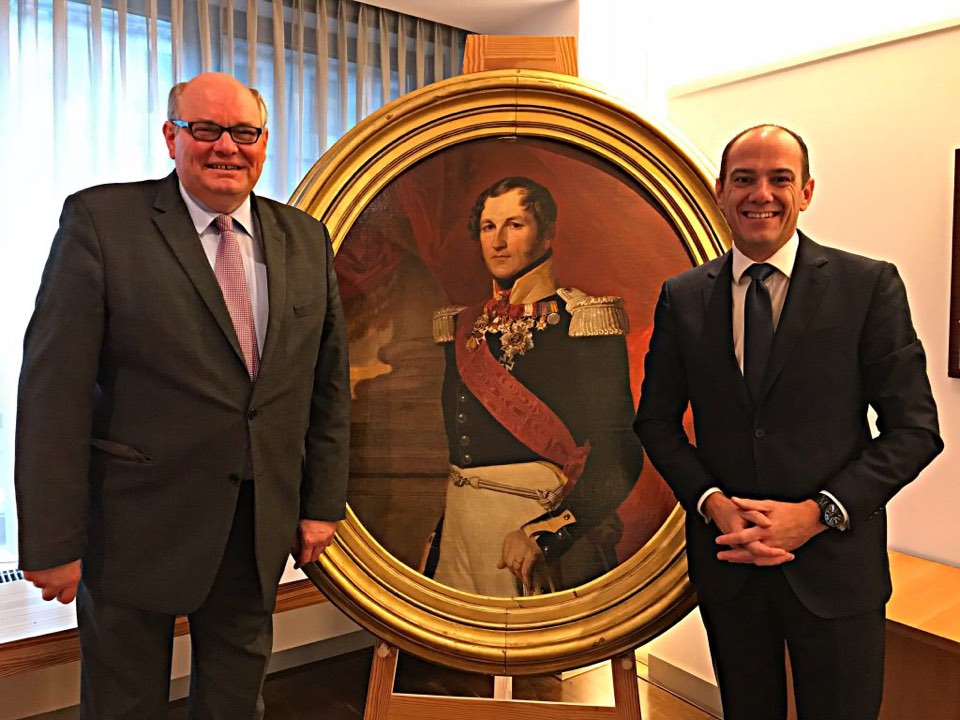
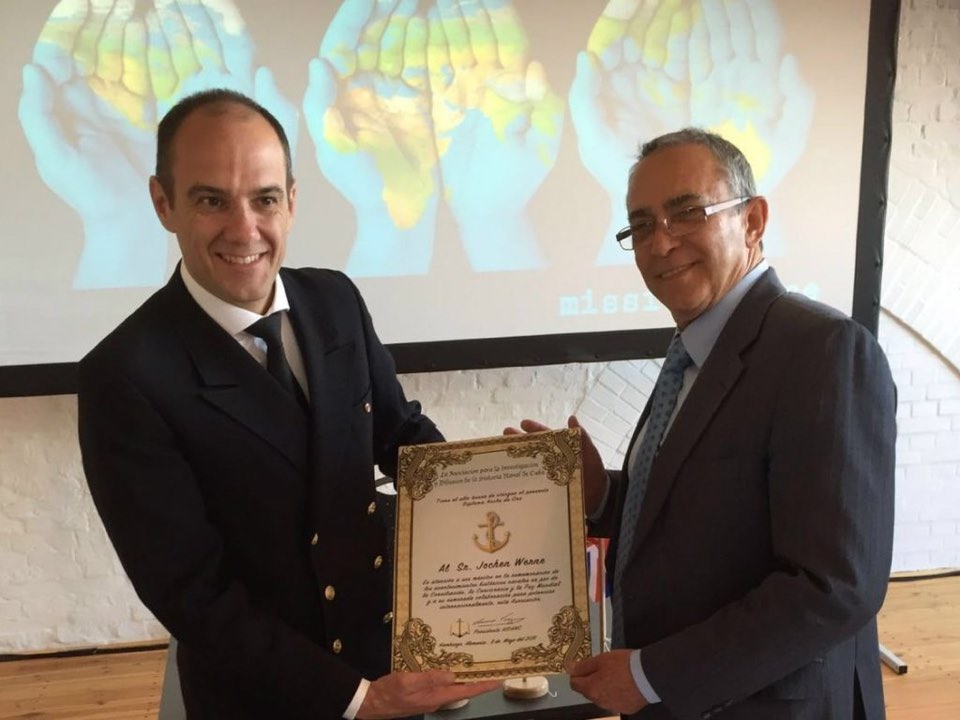
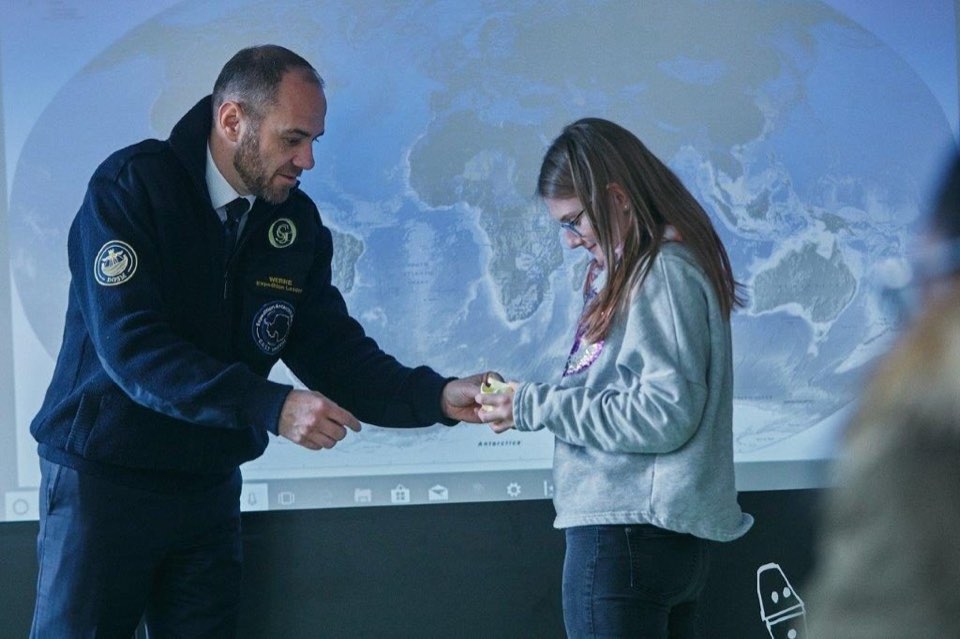
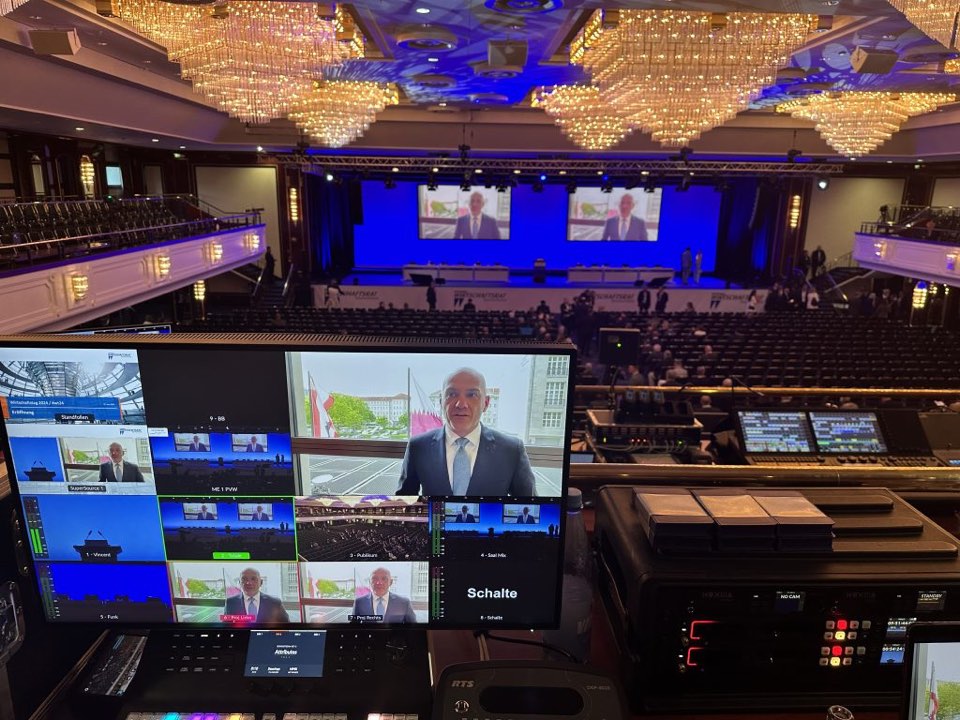
I strongly believe that in today's interconnected world, together with our different talents, we can make positive changes for a better world every day.
Jochen Werne
published and quoted


















[post_grid id="1248"]
30.12.18 - PEACEFULLY ADMINISTERING A CONTINENT TOGETHER – AN ENCOURAGING REALITY
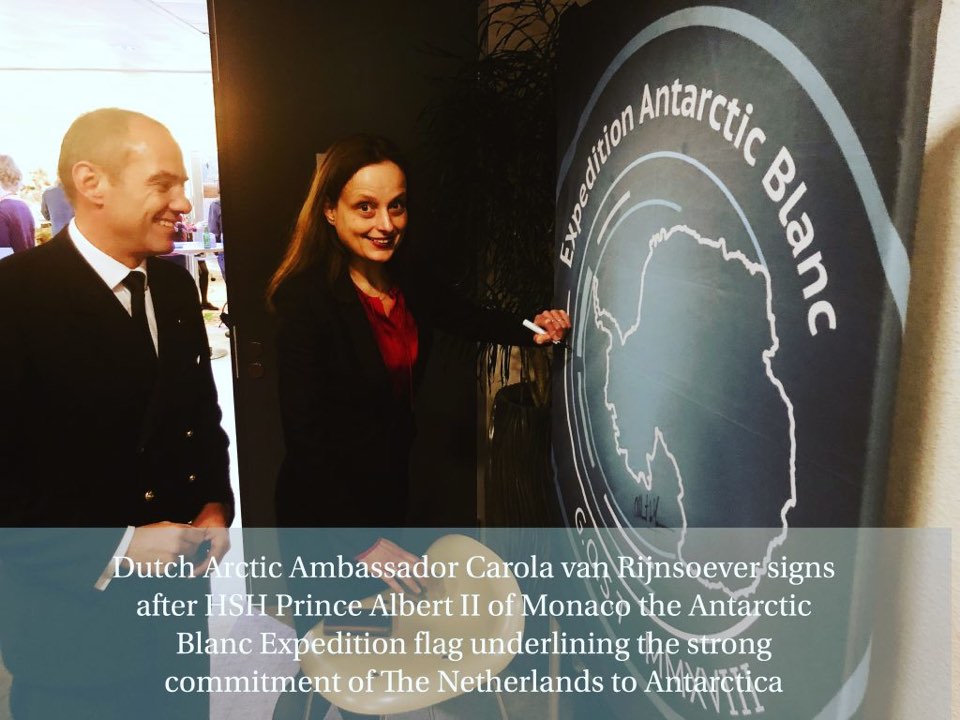
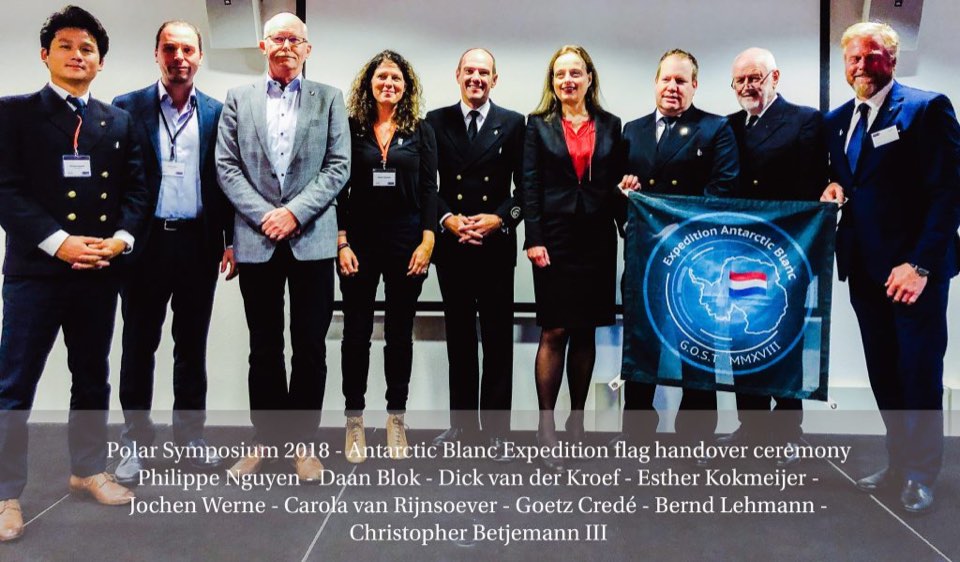
28.12.18 - Challenging the status quo: Design Thinking and the financial industry

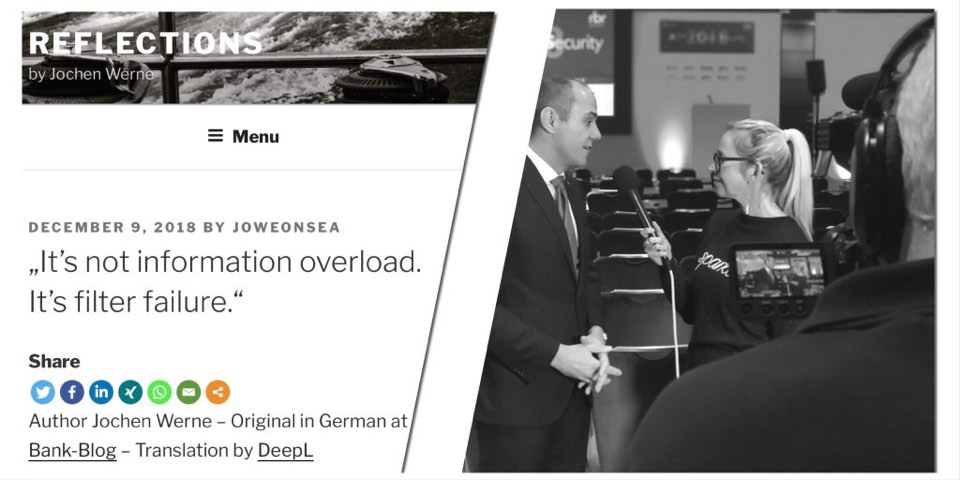
| Jahr: 2018 | ||||
| Medium | Titel | Beitragsgattung | Autor | Erscheinungsdatum |
| Bankhaus Lenz Magazin | Neue Horizonte | Blogbeitrag | Jochen Werne | 20.02.18 |
| Börsen-Zeitung | Warum digitales Händchenhalten allein nicht ausreicht | Gastbeitrag | Jochen Werne | 26.09.18 |
| Das INVESTMENT | So unterstützt künstliche Intelligenz die Arbeit der Vermögensverwalter | Gastbeitrag | Jochen Werne | 16.10.18 |
| Der Bank Blog | Banken müssen Wegweiser der Kunden werden | Gastbeitrag | Jochen Werne | 11.01.18 |
| Der Bank Blog | FinTechs: Die jungen Wilden Hype, Allheilmittel, Disruptor oder Partner? | Gastbeitrag | Jochen Werne | 04.04.18 |
| Der Bank Blog | Herausforderungen der Digitalisierung für die Management-Ebene | Gastbeitrag | Jochen Werne | 02.05.18 |
| Die Akademie für Führungskräfte | ABENTEUER MIT PLAN - wie Strukturen konsequent dem Kunden dienen | Gastbeitrag | Jochen Werne | 14.02.18 |
| DIE ZEIT | Wer braucht noch eine normale Bank | Statements | Jochen Werne | 30.09.18 |
| DigitPraktiker | Banken und FinTechs – Der Weg zu langfristig tragfähigen Geschäftsmodellen Wie Regulierung den Wettbewerb im Finanzmarkt grundlegend beeinflusst und welche Chancen sich aus PSD2 und DSGVO ergeben. | Gastbeitrag | Jochen Werne | 01.09.18 |
| Focus Online | Banken setzen auf Künstliche Intelligenz - doch der Mensch bleibt unersetzlich | Gastbeitrag | Jochen Werne | Jun 18 |
| Springer Professionell | Die Bank wird als Marke wahrgenommen | Interview | Jochen Werne | Okt 18 |
| TH Nürnberg | Künstliche Intelligenz, Behavioral Finance und Banking beim Gastvortrag von Jochen Werne vom Bankhaus August Lenz | Beitrag | Jochen Werne | Jun 18 |
| Wirtschaftswoche | Die Robos und die Angst vor dem Crash | Redationeller Beitrag | Daniel Schönwitz | Jan 18 |
| Jahr: 2017 | ||||
| Medium | Titel | Beitragsgattung | Autor | Erscheinungsdatum |
| Bank & Markt | Die Symbiose zwischen Banken und Kunden wird auf eine neue Basis gestellt | Gastbeitrag | Jochen Werne | Apr 17 |
| das Investement | „Jeder Anleger braucht einen persönlichen Experten“ | Gastbeitrag | Jochen Werne | 23.02.17 |
| das Investement | Diese 36 Finanzfirmen sind Deutschlands Kundenchampions | Redationeller Beitrag | Christian Hilmes | Mai 17 |
| das Investement | Sind Robo Advisor nur für versierte Anleger geeignet? | Gastbeitrag | Jochen Werne | 21.06.17 |
| das Investement | Persönliche Beratung muss es auch in Zeiten der Digitalisierung geben | Gastbeitrag | Jochen Werne | 08.09.17 |
| Data Center Insider | Glorifizieren wir die Algorithmen? | Gastbeitrag | Jochen Werne | 27.06.17 |
| Fundplat | Interview mit Jochen Werne | Gastbeitrag | Jochen Werne | 07.07.17 |
| Handelsblatt - Trendreport | Digital Finance | Advertorial | Jochen Werne | Jun 17 |
| Management Circle | Symbiose 2.0: Welchen Mehrwert die Digitalisierung des Alltags für Banken und ihre Kunden bereithält | Gastbeitrag | Jochen Werne | Mai 17 |
| Marketing Review St.Gallen | Simplicity and Security: Neue Online-Angebote nach Kundenbedürfnissen | Interview | Jochen Werne | Jul 17 |
| MM News | Die Digitale Privatbank: Eine Antwort auf FinTechs und co.? | Blog | 01.09.17 | |
| VVB | Die perfekte Symbiose: Persönliche Beratung in einer digitalen Finanzwelt | Gastbeitrag | Jochen Werne | Mai 17 |
| Jahr 2016: | ||||
| Bank Blog | Kontowechsel in 10 Minuten | Redaktioneller Beitrag | k.A. | Aug 16 |
| Data Center Insider | Was können FinTechs von Banken lernen? | Redaktioneller Beitrag | Jochen Werne | 01.11.16 |
| Gründerszene | Das Imperium schlägt zurück - oder auch nicht | Statement | Jochen Werne | Apr 16 |
| Hamburger Abendblatt | An Hamburg kommt eine Bank nicht vorbei | Redaktioneller Beitrag | Volker Seidel | 15.06.16 |
| Hamburger Abendblatt | Banker: "Die Hamburger sind risikobereiter" | Erwähnung | Steffen Preißler | Okt 16 |
| IT Finanzmagazin | PFM-Webtool „€inBlick“ (Bankhaus Lenz & Elaxy) erlaubt die Einbindung von Fremdbanken | Redaktioneller Beitrag | k.A. | Janurar 2016 |
| IT Finanzmagazin | FinTechs & Finanzwirtschaft: Die Disruption wird verdrängt – durch Coproduktion & Kooperation | Redaktioneller Beitrag | Jochen Werne | Mai 16 |
| Springer Professionell | Banken bereiten Kunden Schmerzen | Redaktioneller Beitrag | Jochen Werne | Nov 16 |
| Jahr 2015: | ||||
| Bank Magazin | Finanzen einfach verwalten | Redaktioneller Beitrag | k.A. | Okt 15 |
| Banken und Partner | Wo den Bankkunden der Schuh drückt | Gastbeitrag | Jochen Werne | 03.11.15 |
| Bankingnews | The day after disruption | Gastbeitrag | Jochen Werne | Nov 15 |
| Börse online | Ein neues Zeitalter für Privatanleger | Gastbeitrag | Jochen Werne | 30.09.15 |
| Life PR | 10 Jahre persönlichste Bankberatung in Baden Württemberg | Redaktioneller Beitrag | Jochen Werne | 01.11.15 |
| Life PR | Kundeninnovationspreis 2015 | Redaktioneller Beitrag | Jochen Werne | 08.09.15 |
| Nordbayern.de | Bankhaus Lenz setzt auf Empfehlungen | Redaktioneller Beitrag | Jochen Werne | 12.10.15 |
| Nürnberger Nachrichten | Bankhaus Lenz setzt auf Empfehlungen | Redaktioneller Beitrag | Jochen Werne | 12.10.15 |
Founded in 1999 by Jochen Werne and Guido Zoeller, the Global Offshore Sailing Team (GOST), acts today as an international group of dedicated sailors comprised of members from all over the world. GOST which navigates on oceans worldwide and in which many teammates have naval backgrounds, have made it a priority to keep naval traditions alive and to use expeditions as instrument for the creation of international understanding and peoples' diplomacy.
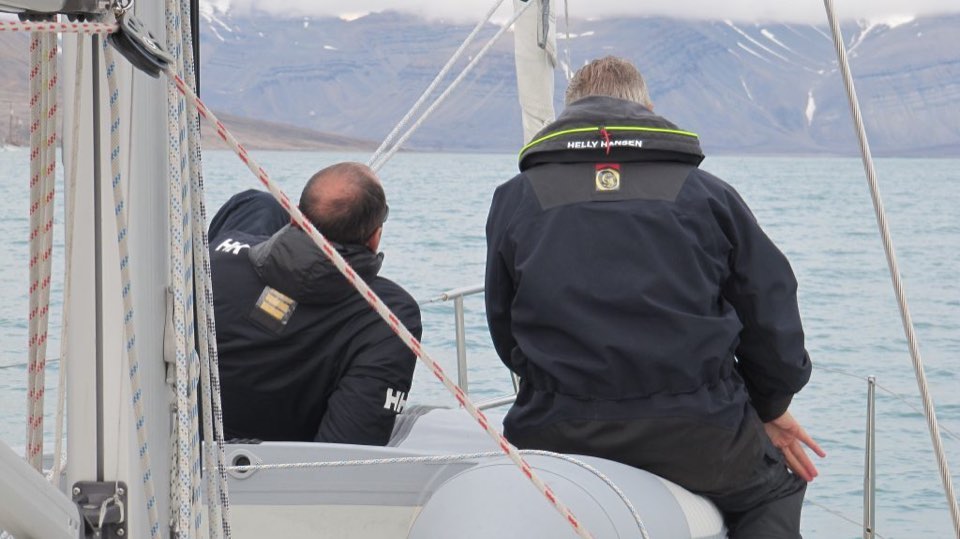
Recent expeditions beside "Antarctic Blanc" have been e.g. "Arctic Ocean Raptor" and "Arctic Ocean Predator" where the team sailed from Tromsø into the Arctic Ocean and to Svalbard in order to explore and experience the circumstances under which small weather units worked during their duty on these isolated arctic islands in World War II. The same with Expedition "Cerberus", where, in conjunction with the British Channel Dash Association, the German Association for Marine and Naval History and supported by the Royal Navy and the German Navy, we followed the route of 1942's Operation Cerberus from Brest to Kiel.
In February 2018, inspired by the era of the great explorers, the 12 GOST members of the international Expedition ANTARTIC BLANC set sail to Antarctica through one of the most dangerous seaways on the planet, the Drake-Passage. Their aim was to raise international awareness and draw attention to the essential need to maintain and protect the unique Antarctic ecosystem. On Deception Island, the Expedition recognized the Antarctic explorers and the establishment of the Antarctic Treaty, in a solemn and dignified manner, paying tribute in the form of an international commemoration ceremony. A wreath formed out of Antarctic ice, was laid in the name of 19 nations, which gave permission to officially act on behalf of them. In addition, ANTARCTIC BLANC supported the UNEP's "Clean Seas" initiative to combat plastic waste in and on the world's oceans. Furthermore, the expedition gathered data for the University of Connecticut's and the Northeastern University's Ocean Genome Legacy Center Research Project for the meta-barcoding of plankton, which in turn could play a fundamental role in providing answers to the ecosystem's response to climate change. Expedition Antarctic Blanc has been greatly supported by the Yacht Club de Monaco.
This international team believes it is important to visit the places where history happened, to not only to understand history better but to remember the events that influenced the world we live in today.
The goal of GOST's expeditions is always to try to get a sense of the background and the struggles of the events which have happened at sea. By doing this we hope to remember all the brave seamen who served their countries on all sides during times of conflict in the world. As our dear friend perfectly summarised:
„ … working so hard to bring history back to everyone's attention and recognising the many great acts of courage performed on our behalf by men and women of all sides during a period of conflict. … It is not about winners or losers. … The world is a wonderful place to live, because it is made up of many different, but beautiful countries.… We should be proud of this fact. Equally, we should not be ashamed of our past, nor should we glorify it, for it was our past which created what we are today."
Peter Nixon, Chairman of the Channel Dash Association
"I FIRMLY BELIEVE IN MANKIND AND MORE IN ITS CREATIVE POWER THAN IN ITS DESTRUCTIVE POWER."
Jochen Werne
In January 2018 the Academy for Leadership quoted this strong believe I have in its lead magazine "Advance".
A perfect example for the creative power of and what diplomacy can achieve is the Antarctic Treaty. During the high time of the Cold War in 1959, scientists and diplomats achieved to set-up a treaty, which allows to govern a whole continent by an international community of states.
With our GOST International Relations initiatives and personal relations to global network of governments, associations and diplomats we act in a way of people's diplomacy to create awareness for important topics for our society.
by Jochen Werne
Google, Apple, Facebook and Amazon (GAFA) have long seen artificial intelligence as the technology of the future. AI also holds enormous potential for banks and FinTechs. After "FinTech", "Blockchain" and "Crypto currency", "AI" is therefore the new buzzword in the banking world. From the AI-optimized chatbot to the highly complex, self-learning investment algorithm - the omnipresence of the term suggests that the integration of Artificial Intelligence into one's own business model seems to be virtually vital. To what extent is this true?
What becomes possible in times of exponential technologies is nothing less than a revolution. The financial sector holds a vast amount of valuable and already processed data. They not only reflect our daily and extremely private lives - from buying a hot cappuccino in the coffee shop in the morning, for example, to the preference of our Christmas presents - but also the payment flows of entire companies and industries and therefore our entire economy. Maturing AI systems make the preparation and processing of data not only easier, but also much more cost-effective, faster and more targeted. Every electronic transaction generates customer-specific data. These structured data records, which have already been collected for many years, become the most valuable raw material and a resource which, in combination with the enrichment of external, possibly non-structured data, must be made "usable" in a meaningful way. AI will not only enable banks to make their services even more customized, it will also make its way into most areas of the financial industry - from asset management to business operations, money laundering prevention and marketing.
Trust is and remains one of a bank's most important assets. And today, more than ever, the protection of customer data in a digital banking world has absolute priority. When using AI technology, it is crucial to use private and sensitive data in the interests of the customer. And this is where not only the IT and Cyber Security departments of the banks come into play, but also politics: It is primarily their task to find regulations for the handling of effects oon society, the economy and thus on our lives and the work of tomorrow. The fact that this topic is taken very seriously is evident not only in national initiatives such as the German Platform for Artificial Intelligence "Learning Systems", but also in the joint European Artificial Intelligence approach, which is being driven forward at full speed by France and Germany.
The use of AI technologies in consulting practice in the financial services industry shows that a purely virtual "consultant" is not sufficient for all target groups to offer comprehensive, sustainable support. The background to this can be found in the teachings of Nobel Prize winners Daniel Kahneman and Amos Tversky and their Behavioral Finance research studies, a subfield of behavioral economics. The lessons prove that emotional - i.e. human - behaviour can lead to repeated mistakes when it comes to investing money. Financial markets are volatile by nature and every perceived movement - especially downwards - triggers an emotional reaction in the investor, such as uncertainty or fear of loss. This leads to a "biased reaction", such as buying or selling a security at the wrong time - a reaction without appropriate and rational consideration of the overall situation. In such moments of strong imbalance between ratio and emotion, AI reaches its limits. In his Behavioral Finance studies, Kahneman impressively illustrates how memories of negative events are anchored more than twice as strongly in memory as positive experiences. An interim loss in value of 30 percent is a good opportunity for a long-term investor to buy back. But in order to convert this a crisis moment into an opportunity, the question arises whether rational investor considerations can be caused in times of panic better by a chatbot or a human.
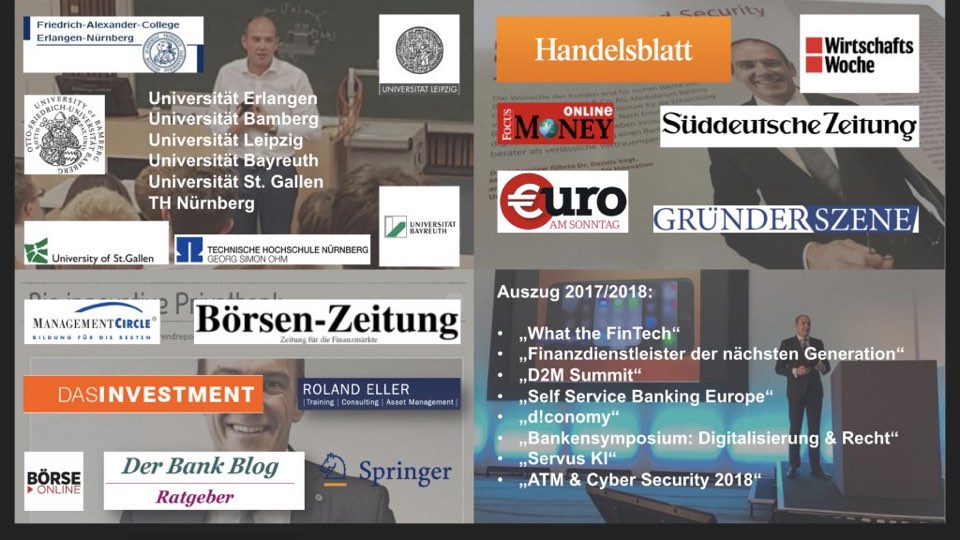
Jochen Werne is an international manager, public speaker and NGO founder with a track record in business transformation. In December 2020, he was listed in the TytoPR Top 500 ranking as one of the 50 most influential Germans in the tech scene. He is also an expert in public diplomacy and is committed to developing international diplomatic and intercultural relations. He is a relationship builder & influencer with a large network in politics, technology and business who can drive change within the leadership team of organisations.
In his current role as Chief Executive Officer of Experian DACH, he is responsible for the growth of the technology and data giant in the heart of Europe.
Previously, as Chief Development & Chief Visionary Officer and member of the Executive Board of PROSEGUR Germany and Managing Director of PROSEGUR CRYPTO GmbH, he was responsible for developing and implementing the strategy for the areas of Business Development, Innovation, II&S (Innovative Integrated Solutions), Business Process Outsourcing, New Products and International Sales.
Previously, he managed various areas of private and corporate banking such as business development, marketing, product management, treasury & payment services at Bankhaus August Lenz & Co. AG. He also held CMO / COO / CDO like positions and managed sales departments. He was a CRM expert at Accenture after working in global investment banking for Bankers Trust Alex Brown International and Deutsche Bank AG. He was also a navigator and instructor with the German Navy, studied economics at the University of Passau, Goethe University Frankfurt a. M., Helsinki School of Economics and most recently at Oxford University.
He is an honorary ambassador and founded several NGOs dedicated to the development of international diplomatic and intercultural relations. He has been quoted by DIE ZEIT, Wirtschaftswoche, Süddeutsche Zeitung and others. Germany's largest magazine Focus recently paid tribute to his achievements in its "The Influencers" section.
For his commitment to promoting international understanding, he was awarded the "Admiral of the Fleet The Lord Boyce Prize 2019" and the "Ancla d'Oro" of the Asociación para la Investigación y Difusión de la Historia Naval de Cuba. In 2021, Jochen Werne was honoured with the State Medal - the highest award of the Bavarian State - for promoting environmental awareness.
It is my strong belief that we live in one of the most fascinating times the planet ever saw. A time in which we humans have the possibility - due to the enormous technological progress - to make the life of so many in our society a better ones and this without giving up our own well-being.
It is my strong belief that together we can create a better society. We should never forget, that bringing people from different cultures and backgrounds together, letting them discuss and reflect about another’s point of view already creates understanding and is the basis for common solutions. It’s equally something everyone of us can perform easily. It’s a way of people’s diplomacy and already an act of peace.
It is my strong belief, speaking as seaman with a distinct passion for our oceans, that the human race and nature has to exist in equilibrium. To be able to keep the balance it is important to be aware about possible imbalances. For creating the right attention it needs passionate scientists and passionate communicators who are addressing the important topics to the wider public. With the support of the public and the possibilities of technology and diplomacy, humans always found creative solutions to even the most difficult situations they’ve faced in history
It is my strong belief that the chapters in this blog: innovation and business, society and diplomacy, ocean and passion are strongly connected and that we together with our different talents in today’s connected world can push with positivity change for good forward, everyday.